SUBMITTED BY: UNDER THE GUIDENCE OF :
R.VASANTHAKUMAR Ms .S .VINOTHINI AP/CSE
M.VIMALRAJ
DATE : 21.06.2022
Aim
 To validate the digital certificate through
using blockchain.
DOMAIN : BLOCK CHAIN
 A blockchain is a distributed database.
 blockchain stores information electronically
in digital format.
 Blockchains are best known for their crucial
role in cryptocurrency systems, such
as Bitcoin.
 maintaining a transaction is very secured
 decentralized record of transactions.
EXISTING SYSTEM
 According to various researches about one
million graduates passing out each year, the
certificate issuing authorities are seems to
be compromised for the security credentials
of student data.
 Due to the lack of effective anti forge
mechanism, events that cause the
graduation certificate to be forged often get
noticed.
DISADVANTAGE
 Less security
 Miss use the certificate
 There can be incidents where students may
produce the fake certificate and it is difficult
to identify them.
PROPOSED SYSTEM
 Our system is being proposed to issue, store
and retrieve university certificates through
a common portal.
 Companies can retrieve valid certificates of
students through this portal through
permission from both the student and the
institution that’s hosting the certificates.
 The hashes of the certificates are stored in
block chain.
ADVANTAGEs
 More secured.
 The certificate is hashed.
ALGORITHM
 Secured Hash Algorithm (SHA-2).
 It is used for cryptographic security.
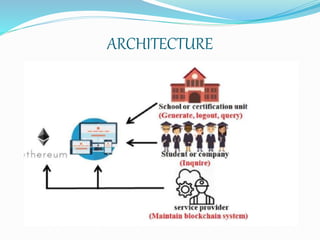
ARCHITECTURE
LITERATURE SURVEY
1.ethereum
 Ethereum is an open and decentralized
platform
 Incorruptible
 Secure
 Permanent
2.A Secure E-Qualification Certificate System
 The development of the system will adopt
the SOA of the eframework to meet the
distributed stakeholder user case.
 SOA allows developers to build applications
from sets of services.
3.AUTHORIZATION AND DELEGATION
ON BLOCKCHAIN
 This scheme is implemented in the form of smart
contracts over the Ethereum platform.
 It enables the user to audit authorization operations
and inspect how access control is actually performed.
4. Graduation Certificate Verification Model
 The university, the graduate and the verifier
are the three parties involved in the
proposed solution in order to accomplish
accurate certificate verification.
 Internal benefits
 External benefits
MODULES
 Certificate Upload
 Security and authentication module
 Verification module
CERTIFICATE UPLOAD
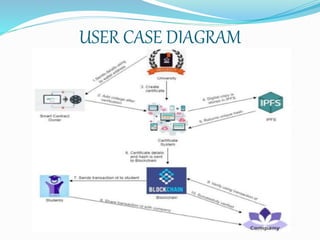
 To create the block chain based
unmodifiable certificates, initially the
university needs to get registered.
 Each university will be having its wallet
address from which it is going to send
transaction.
 University can be added only by the owner
of the smart contract
SECURITY AND AUTHENTICATION
MODULE
 Once added the university can access the
system and can create certificates with data
fields.
 Each created certificate will be stored in the
Inter planetary file system (IPFS)
 which in turn will return the unique hash
generated using SHA-256 algorithm.
 This will serve as unique identity for each
document.
VERIFICATION MODULE
 Anyone can use this transaction id to verify.
 the certificate details and can view the
original copy of certificate using IPFS hash
stored along with data.
 it is almost impossible to modify this
certificate or to create fake certificate with
same data.
 Hence with this we can solve the problem of
counterfeit certificates
USER CASE DIAGRAM
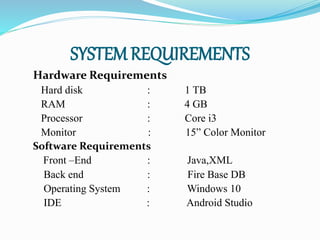
SYSTEM REQUIREMENTS
Hardware Requirements
Hard disk : 1 TB
RAM : 4 GB
Processor : Core i3
Monitor : 15” Color Monitor
Software Requirements
Front –End : Java,XML
Back end : Fire Base DB
Operating System : Windows 10
IDE : Android Studio
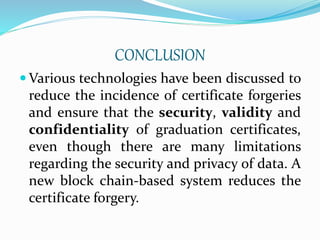
CONCLUSION
 Various technologies have been discussed to
reduce the incidence of certificate forgeries
and ensure that the security, validity and
confidentiality of graduation certificates,
even though there are many limitations
regarding the security and privacy of data. A
new block chain-based system reduces the
certificate forgery.
REFERENCE
[1] A. M. Antonopoulos, Mastering Bitcoin: Unlocking
Digital. Sebastopol, CA, USA: O’Reilly Media, 2015.
[2] C. K. Wong and S, S. Lam “Digital signatures for flows
and multicasts”, WEEE/ACM Transactions on
Networking,7(4):504-513,1999.
[3] M. Carvalho and R. Ford, “Moving-target defenses for
computer networks,”IEEE Security & Privacy, vol. 12, no.
2, pp. 73-76, Mar.- Apr.2014.
[4] M. Warasart and P. Kuacharoen,
“Paper-based Document Authentication
using Digital Signature and QR Code,” no. Iccet, 2012.
Certificate Validation using block chain

Certificate Validation using block chain

  • 1.
    SUBMITTED BY: UNDERTHE GUIDENCE OF : R.VASANTHAKUMAR Ms .S .VINOTHINI AP/CSE M.VIMALRAJ DATE : 21.06.2022
  • 2.
    Aim  To validatethe digital certificate through using blockchain.
  • 3.
    DOMAIN : BLOCKCHAIN  A blockchain is a distributed database.  blockchain stores information electronically in digital format.  Blockchains are best known for their crucial role in cryptocurrency systems, such as Bitcoin.  maintaining a transaction is very secured  decentralized record of transactions.
  • 4.
    EXISTING SYSTEM  Accordingto various researches about one million graduates passing out each year, the certificate issuing authorities are seems to be compromised for the security credentials of student data.  Due to the lack of effective anti forge mechanism, events that cause the graduation certificate to be forged often get noticed.
  • 5.
    DISADVANTAGE  Less security Miss use the certificate  There can be incidents where students may produce the fake certificate and it is difficult to identify them.
  • 6.
    PROPOSED SYSTEM  Oursystem is being proposed to issue, store and retrieve university certificates through a common portal.  Companies can retrieve valid certificates of students through this portal through permission from both the student and the institution that’s hosting the certificates.  The hashes of the certificates are stored in block chain.
  • 7.
    ADVANTAGEs  More secured. The certificate is hashed.
  • 8.
    ALGORITHM  Secured HashAlgorithm (SHA-2).  It is used for cryptographic security.
  • 9.
  • 10.
    LITERATURE SURVEY 1.ethereum  Ethereumis an open and decentralized platform  Incorruptible  Secure  Permanent
  • 11.
    2.A Secure E-QualificationCertificate System  The development of the system will adopt the SOA of the eframework to meet the distributed stakeholder user case.  SOA allows developers to build applications from sets of services.
  • 12.
    3.AUTHORIZATION AND DELEGATION ONBLOCKCHAIN  This scheme is implemented in the form of smart contracts over the Ethereum platform.  It enables the user to audit authorization operations and inspect how access control is actually performed.
  • 13.
    4. Graduation CertificateVerification Model  The university, the graduate and the verifier are the three parties involved in the proposed solution in order to accomplish accurate certificate verification.  Internal benefits  External benefits
  • 14.
    MODULES  Certificate Upload Security and authentication module  Verification module
  • 15.
    CERTIFICATE UPLOAD  Tocreate the block chain based unmodifiable certificates, initially the university needs to get registered.  Each university will be having its wallet address from which it is going to send transaction.  University can be added only by the owner of the smart contract
  • 16.
    SECURITY AND AUTHENTICATION MODULE Once added the university can access the system and can create certificates with data fields.  Each created certificate will be stored in the Inter planetary file system (IPFS)  which in turn will return the unique hash generated using SHA-256 algorithm.  This will serve as unique identity for each document.
  • 17.
    VERIFICATION MODULE  Anyonecan use this transaction id to verify.  the certificate details and can view the original copy of certificate using IPFS hash stored along with data.  it is almost impossible to modify this certificate or to create fake certificate with same data.  Hence with this we can solve the problem of counterfeit certificates
  • 18.
  • 19.
    SYSTEM REQUIREMENTS Hardware Requirements Harddisk : 1 TB RAM : 4 GB Processor : Core i3 Monitor : 15” Color Monitor Software Requirements Front –End : Java,XML Back end : Fire Base DB Operating System : Windows 10 IDE : Android Studio
  • 20.
    CONCLUSION  Various technologieshave been discussed to reduce the incidence of certificate forgeries and ensure that the security, validity and confidentiality of graduation certificates, even though there are many limitations regarding the security and privacy of data. A new block chain-based system reduces the certificate forgery.
  • 21.
    REFERENCE [1] A. M.Antonopoulos, Mastering Bitcoin: Unlocking Digital. Sebastopol, CA, USA: O’Reilly Media, 2015. [2] C. K. Wong and S, S. Lam “Digital signatures for flows and multicasts”, WEEE/ACM Transactions on Networking,7(4):504-513,1999. [3] M. Carvalho and R. Ford, “Moving-target defenses for computer networks,”IEEE Security & Privacy, vol. 12, no. 2, pp. 73-76, Mar.- Apr.2014. [4] M. Warasart and P. Kuacharoen, “Paper-based Document Authentication using Digital Signature and QR Code,” no. Iccet, 2012.