DIGITAL CERTIFICATE
VERIFICATION BASED ON
BLOCKCHAIN ETHEREUM
NAME : NUR HANIFFAH BT SUDIN
MATRIC NO : BTBL17047564
SUPERVISOR NAME : DR WAN SHUHADAH BT WAN NIK
INTRODUCTION
• A certificate is a proof of a graduates qualification and can be used to
apply for a job or other related matters.
• Whenever applicants apply for the job the organizations have to verify all
certificates manually which is very time-consuming process.
• Blockchain technology is used to ensure that the security, validity and
confidentiality of graduation certificates would be improved
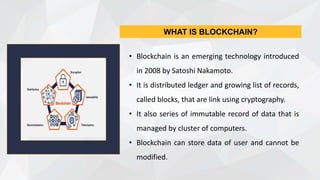
• Blockchain is an emerging technology introduced
in 2008 by Satoshi Nakamoto.
• It is distributed ledger and growing list of records,
called blocks, that are link using cryptography.
• It also series of immutable record of data that is
managed by cluster of computers.
• Blockchain can store data of user and cannot be
modified.
WHAT IS BLOCKCHAIN?
• Network based on ethereum platform was built.
• Open source computing platform based on Blockchain and
operating system featuring smart contract
• Designed to serve as a runtime environment for smart
contracts based on Ethereum.
• Instruct the EVM to execute applications by using a high-
level language called Solidity which is for developing smart
contract that run on the EVM
ETHEREUM
ETHEREUM VIRTUAL MACHINE
PROBLEM STATEMENT
1. Problem of losing certificates
• losing their certificates such as misplaced their certificates and
damaged. This situation, will make it difficult for them to apply
for work or study.
2. Waste time
• verify all certificates manually and it take a long time
exspecially for employer in employment industry.
3. Production of fake certificates
• become trends
OBJECTIVE
1.To study the applicability of decentralized application for digital
certificates verification in smart campus environment.
2.To develop and implement digital certification verification
application based on blockchain ethereum platform.
3.To test the applicabality of the developed application for graduates
in UniSZA entering employment industry .
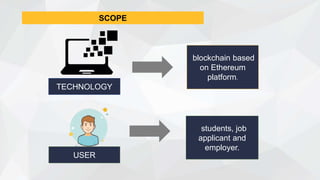
TECHNOLOGY
blockchain based
on Ethereum
platform.
USER
students, job
applicant and
employer.
SCOPE
LIMITATION
1. Network scalability of the smart contract .
• single, shared network.
• strict limitation on the number of transactions that the network can
process in any given second.
• Ethereum blockchain can only process 15 transactions per second, or
900 transactions per minute.
2. Limited knowledge about solidity language that are difficult and hard
to understand for beginner.
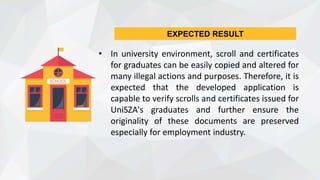
EXPECTED RESULT
• In university environment, scroll and certificates
for graduates can be easily copied and altered for
many illegal actions and purposes. Therefore, it is
expected that the developed application is
capable to verify scrolls and certificates issued for
UniSZA's graduates and further ensure the
originality of these documents are preserved
especially for employment industry.
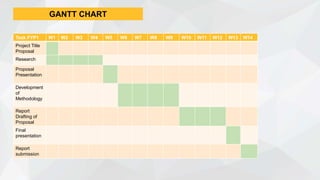
Task FYP1 W1 W2 W3 W4 W5 W6 W7 W8 W9 W10 W11 W12 W13 W14
Project Title
Proposal
Research
Proposal
Presentation
Development
of
Methodology
Report
Drafting of
Proposal
Final
presentation
Report
submission
GANTT CHART
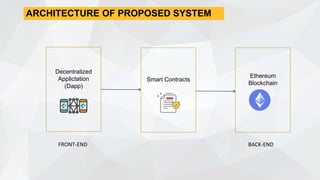
ARCHITECTURE OF PROPOSED SYSTEM
Decentralized
Applictation
(Dapp)
FRONT-END
Smart Contracts
Ethereum
Blockchain
BACK-END
Decentralized Application (Dapp)
• Dapp consists of back-end code that runs on a decentralized peer-
to-peer network. A Dapp can also have a user interface, created by
front end code that makes calls to the back end.
• Dapps are different with Apps because it run on the blockchain
network.
Smart Contracts
• Smart contract is a computer code running on top of a
blockchain containing a set of rules which the parties to the
smart contract agree to interact with each other on certain
conditions.
• Basically, developer can employ Solidity to write smart
contracts and compile the instructions into bytecode for the
EVM to execute.
Ethereum Blockchain
• Ethereum is an open source computing platform based on
Blockchain and operating system featuring smart contract
• Ethereum provides the platform for creating the
decentralized application based on smart contract.
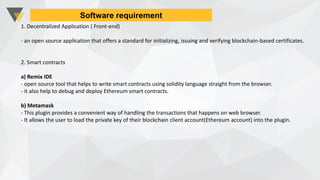
Software requirement
1. Decentralized Application ( Front-end)
- an open source application that offers a standard for initializing, issuing and verifying blockchain-based certificates.
2. Smart contracts
a) Remix IDE
- open source tool that helps to write smart contracts using solidity language straight from the browser.
- it also help to debug and deploy Ethereum smart contracts.
b) Metamask
- This plugin provides a convenient way of handling the transactions that happens on web browser.
- It allows the user to load the private key of their blockchain client account(Ethereum account) into the plugin.
3. Ethereum Blockchain
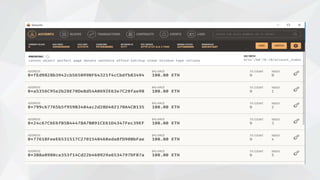
a) Ganache
-Ganache is a personal blockchain for Ethereum development that can use to deploy contracts, develop
applications, and run tests.
-allows to create a private Ethereum blockchain to run tests, execute commands, and inspect state while
controlling how the chain operates.
-It gives the ability to perform all actions would on the main chain without the cost.
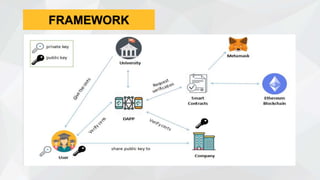
FRAMEWORK
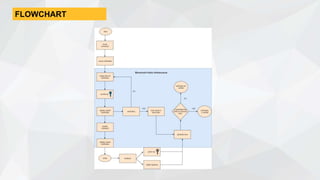
FLOWCHART
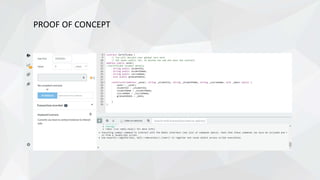
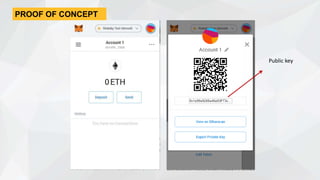
PROOF OF CONCEPT
PROOF OF CONCEPT
Public key
THANKYOU

Digital Certificate Verification based on blockchain ethereum

  • 1.
    DIGITAL CERTIFICATE VERIFICATION BASEDON BLOCKCHAIN ETHEREUM NAME : NUR HANIFFAH BT SUDIN MATRIC NO : BTBL17047564 SUPERVISOR NAME : DR WAN SHUHADAH BT WAN NIK
  • 2.
    INTRODUCTION • A certificateis a proof of a graduates qualification and can be used to apply for a job or other related matters. • Whenever applicants apply for the job the organizations have to verify all certificates manually which is very time-consuming process. • Blockchain technology is used to ensure that the security, validity and confidentiality of graduation certificates would be improved
  • 3.
    • Blockchain isan emerging technology introduced in 2008 by Satoshi Nakamoto. • It is distributed ledger and growing list of records, called blocks, that are link using cryptography. • It also series of immutable record of data that is managed by cluster of computers. • Blockchain can store data of user and cannot be modified. WHAT IS BLOCKCHAIN?
  • 4.
    • Network basedon ethereum platform was built. • Open source computing platform based on Blockchain and operating system featuring smart contract • Designed to serve as a runtime environment for smart contracts based on Ethereum. • Instruct the EVM to execute applications by using a high- level language called Solidity which is for developing smart contract that run on the EVM ETHEREUM ETHEREUM VIRTUAL MACHINE
  • 5.
    PROBLEM STATEMENT 1. Problemof losing certificates • losing their certificates such as misplaced their certificates and damaged. This situation, will make it difficult for them to apply for work or study. 2. Waste time • verify all certificates manually and it take a long time exspecially for employer in employment industry. 3. Production of fake certificates • become trends
  • 6.
    OBJECTIVE 1.To study theapplicability of decentralized application for digital certificates verification in smart campus environment. 2.To develop and implement digital certification verification application based on blockchain ethereum platform. 3.To test the applicabality of the developed application for graduates in UniSZA entering employment industry .
  • 7.
  • 8.
    LIMITATION 1. Network scalabilityof the smart contract . • single, shared network. • strict limitation on the number of transactions that the network can process in any given second. • Ethereum blockchain can only process 15 transactions per second, or 900 transactions per minute. 2. Limited knowledge about solidity language that are difficult and hard to understand for beginner.
  • 9.
    EXPECTED RESULT • Inuniversity environment, scroll and certificates for graduates can be easily copied and altered for many illegal actions and purposes. Therefore, it is expected that the developed application is capable to verify scrolls and certificates issued for UniSZA's graduates and further ensure the originality of these documents are preserved especially for employment industry.
  • 10.
    Task FYP1 W1W2 W3 W4 W5 W6 W7 W8 W9 W10 W11 W12 W13 W14 Project Title Proposal Research Proposal Presentation Development of Methodology Report Drafting of Proposal Final presentation Report submission GANTT CHART
  • 11.
    ARCHITECTURE OF PROPOSEDSYSTEM Decentralized Applictation (Dapp) FRONT-END Smart Contracts Ethereum Blockchain BACK-END
  • 12.
    Decentralized Application (Dapp) •Dapp consists of back-end code that runs on a decentralized peer- to-peer network. A Dapp can also have a user interface, created by front end code that makes calls to the back end. • Dapps are different with Apps because it run on the blockchain network.
  • 13.
    Smart Contracts • Smartcontract is a computer code running on top of a blockchain containing a set of rules which the parties to the smart contract agree to interact with each other on certain conditions. • Basically, developer can employ Solidity to write smart contracts and compile the instructions into bytecode for the EVM to execute.
  • 14.
    Ethereum Blockchain • Ethereumis an open source computing platform based on Blockchain and operating system featuring smart contract • Ethereum provides the platform for creating the decentralized application based on smart contract.
  • 15.
    Software requirement 1. DecentralizedApplication ( Front-end) - an open source application that offers a standard for initializing, issuing and verifying blockchain-based certificates. 2. Smart contracts a) Remix IDE - open source tool that helps to write smart contracts using solidity language straight from the browser. - it also help to debug and deploy Ethereum smart contracts. b) Metamask - This plugin provides a convenient way of handling the transactions that happens on web browser. - It allows the user to load the private key of their blockchain client account(Ethereum account) into the plugin.
  • 16.
    3. Ethereum Blockchain a)Ganache -Ganache is a personal blockchain for Ethereum development that can use to deploy contracts, develop applications, and run tests. -allows to create a private Ethereum blockchain to run tests, execute commands, and inspect state while controlling how the chain operates. -It gives the ability to perform all actions would on the main chain without the cost.
  • 17.
  • 18.
  • 19.
  • 20.
  • 22.