BLOCKCHAIN
WITH IOT
ADA PROJECT
A Distributed Ledger Technology
Sonali Bhoriya - 2K19/CO/382
Sourabh Ruhella - 2K19/CO/385
Suraj Kumar - 2K19/CO/396
Surya Kumar Sahani - 2K19/CO/399
Emerging Of New Era
Blockchain (there are many blockchains in fact and it’s more than the technology
powering Bitcoin), has been mentioned by virtually all research firms as a rapidly
accelerating evolution and it’s not just about financial services companies, the scope in
which we tackled blockchain outside of its cryptocurrency roots the first time (namely
FinTech or financial technology). In fact, the convergence of blockchain and the Internet of
Things is on the agenda for many companies and there are existing implementations,
solutions and initiatives in several areas, outside of IoT and financial services too.
THE DISTRIBUTED INTERNET OF
THINGS MEETS DISTRIBUTED
LEDGER TECHNOLOGY
Blockchain is also becoming important in third generation security.
Since quite some time blockchain is increasingly being looked upon in an
Internet of Things context. Blockchains have many benefits. They are not
the answer to all challenges of the digital economy as sometimes is said
but it’s certain that they will play an increasing role in the Internet of Things.
Forrester’s Dan Bieler mentioned
blockchain’s potential for IoT
solutions. In a nutshell:
As Internet of Things applications are by definition distributed,
it’s only normal that the distributed ledger technology, which
blockchain is, will play a role in how devices will communicate
directly between each other (keeping a ledger and thus trail of
not just devices but also how they interact and, potentially, in
which state they are and how they are ‘handled’ in the case of
tagged goods).
BLOCKCHAIN CAN IMPROVE IOT
Its like, blockchain is made for IoT (Surprisingly)
Blockchain is designed as a basis for applications that involve
transaction and interactions. These can include smart contracts
(smart contracts are automatically carried out when a specific
condition is met, for instance regarding the conditions of goods or
environmental conditions) or other smart applications that support
specific Internet of Things processes. This way blockchain technology
can improve not just compliance in the IoT but also IoT features and
cost-efficiency.
THE INDUSTRY IS NOT WAITING AND
TAKES INITIATIVES
IBM Blockchain
IBM Blockchain, for instance, already allows to extend (private) blockchain into cognitive Internet
of Things. In fact, ultimately it will be the combination of artificial intelligence, IoT and blockchain
that will prove most interesting across industries and in myriad possible IoT applications. With
blockchain we are pretty much adding to the changing digital infrastructure that powers so
many evolutions and impacts so many areas, from analytics to security, in an environment that
thus far was centralized.
To illustrate the benefits of blockchain and Internet of Things convergence, IBM gives the
example of complex trade lanes and logistics whereby smart contracts can follow (and via
blockchain technology register), everything that has happened to individual items and packages.
The benefits: audit trails, accountability, new forms of contracts and speed, to name a few.
THE COMPANY SUMS UP THREE KEY
BENEFITS OF USING BLOCKCHAIN FOR IOT
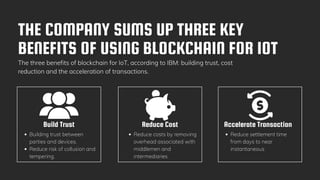
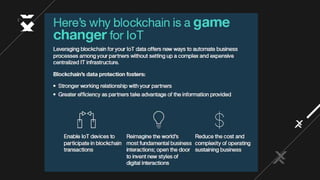
The three benefits of blockchain for IoT, according to IBM: building trust, cost
reduction and the acceleration of transactions.
Build Trust
Building trust between
parties and devices.
Reduce risk of collusion and
tempering.
Reduce Cost Accelerate Transaction
Reduce costs by removing
overhead associated with
middlemen and
intermediaries
Reduce settlement time
from days to near
instantaneous
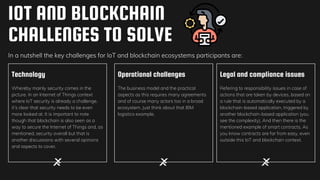
Technology
Whereby mainly security comes in the
picture. In an Internet of Things context
where IoT security is already a challenge,
it’s clear that security needs to be even
more looked at. It is important to note
though that blockchain is also seen as a
way to secure the Internet of Things and, as
mentioned, security overall but that is
another discussions with several opinions
and aspects to cover.
Operational challenges
The business model and the practical
aspects as this requires many agreements
and of course many actors too in a broad
ecosystem. Just think about that IBM
logistics example.
Legal and compliance issues
Refering to responsibility issues in case of
actions that are taken by devices, based on
a rule that is automatically executed by a
blockchain-based application, triggered by
another blockchain-based application (you
see the complexity). And then there is the
mentioned example of smart contracts. As
you know contracts are far from easy, even
outside this IoT and blockchain context.
IOT AND BLOCKCHAIN
CHALLENGES TO SOLVE
In a nutshell the key challenges for IoT and blockchain ecosystems participants are:
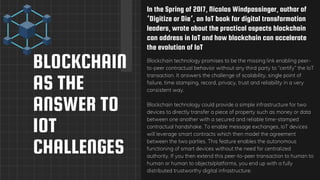
BLOCKCHAIN
AS THE
ANSWER TO
IOT
CHALLENGES
In the Spring of 2017, Nicolas Windpassinger, author of
‘Digitize or Die‘, an IoT book for digital transformation
leaders, wrote about the practical aspects blockchain
can address in IoT and how blockchain can accelerate
the evolution of IoT
Blockchain technology promises to be the missing link enabling peer-
to-peer contractual behavior without any third party to “certify” the IoT
transaction. It answers the challenge of scalability, single point of
failure, time stamping, record, privacy, trust and reliability in a very
consistent way.
Blockchain technology could provide a simple infrastructure for two
devices to directly transfer a piece of property such as money or data
between one another with a secured and reliable time-stamped
contractual handshake. To enable message exchanges, IoT devices
will leverage smart contracts which then model the agreement
between the two parties. This feature enables the autonomous
functioning of smart devices without the need for centralized
authority. If you then extend this peer-to-peer transaction to human to
human or human to objects/platforms, you end up with a fully
distributed trustworthy digital infrastructure.
BLOCKCHAIN + IOT ACROSS
INDUSTRIES: THE INSURANCE
EXAMPLE
Blockchain is being tested in several industries. And
sometimes we see that in those industries there is a link
between blockchain and IoT within the specific industry.
Point in case: blockchain and IoT in insurance.
The main use case of blockchain in insurance are smart contracts and the enhancement of
several processes such as claims management. Other applications include fraud
management, legally required applications (blockchain is thoroughly looked at in the legal
sector as well) and even the usage of technologies in an insurance context.
In the scope of blockchain and IoT it’s interesting to look at the combination of blockchain
and the Internet of Things as it’s used in insurance and will increasingly be, moving
beyond the pure telematics model to the connection of real-time IoT data in various
perspectives for various intelligent automated insurance policy applications.
Although this might seem like a very future application of blockchain in the insurance
industry it is worth noting that from an IoT investment perspective, early 2017 IDC
forecasted that insurance would be among the fastest growing industries in the period
until 2022, albeit with a major focus on telematics (where smart contracts of course make
sense too), especially as we’ll see ever more smart cars and so forth.
IOT AND BLOCKCHAIN: THE
BROADER PICTURE AND FUTURE
And it doesn’t stop with somewhat more advanced scenarios in the context of
insurance (whereby we only just mentioned the tip of the iceberg). With IoT and
blockchain we enter a space of pretty unlimited possibilities.
The reason: as mentioned, IoT obviously doesn’t stand on its own and needs to be seen in
the broader context of what it enables across various use cases and industries and the
additional technologies that are simply needed to make IoT work for whatever reason. Add
to that ongoing convergence on technological, data and business levels and the picture
becomes broader.
IOT AND BLOCKCHAIN – FROM
SMART BUILDINGS TO THE ENERGY
INDUSTRY
Smart buildings
Among the main building management and building energy management evolutions is convergence, as
is the case in so many areas where IoT comes in. One of the areas where this happens is leveraging
energy coming from local solar or wind systems and microgrids in the scope of energy efficiency and
facility optimization.
NIST: ‘the recording of autonomous, machine-to-machine transactions regarding electricity use is
another blockchain application which would take advantage of digital platform opportunities and
changing business models for tracing transactions on the smart grid‘.
As energy becomes an increasingly digital, decentralized (!) and IoT-
enabled given on various levels, including sensors as you can read in this
interview on IoT and critical power buildings, one can easily imagine a
scenario whereby excess renewable energy could be sold and bought via
blockchain. In fact, it’s one of many examples that is given in the NIST
report on blockchain technology, presented early 2018.
The report also mentions blockchain applications for the recording of
autonomous, machine-to-machine transactions regarding electricity
usage.
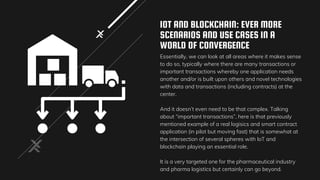
IOT AND BLOCKCHAIN: EVER MORE
SCENARIOS AND USE CASES IN A
WORLD OF CONVERGENCE
Essentially, we can look at all areas where it makes sense
to do so, typically where there are many transactions or
important transactions whereby one application needs
another and/or is built upon others and novel technologies
with data and transactions (including contracts) at the
center.
And it doesn’t even need to be that complex. Talking
about “important transactions”, here is that previously
mentioned example of a real logisics and smart contract
application (in pilot but moving fast) that is somewhat at
the intersection of several spheres with IoT and
blockchain playing an essential role.
It is a very targeted one for the pharmaceutical industry
and pharma logistics but certainly can go beyond.
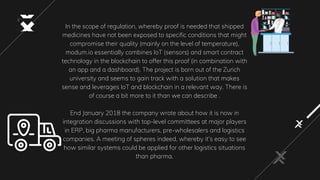
In the scope of regulation, whereby proof is needed that shipped
medicines have not been exposed to specific conditions that might
compromise their quality (mainly on the level of temperature),
modum.io essentially combines IoT (sensors) and smart contract
technology in the blockchain to offer this proof (in combination with
an app and a dashboard). The project is born out of the Zurich
university and seems to gain track with a solution that makes
sense and leverages IoT and blockchain in a relevant way. There is
of course a bit more to it than we can describe .
End January 2018 the company wrote about how it is now in
integration discussions with top-level committees at major players
in ERP, big pharma manufacturers, pre-wholesalers and logistics
companies. A meeting of spheres indeed, whereby it’s easy to see
how similar systems could be applied for other logistics situations
than pharma.
BLOCKCHAIN AND IOT USE
CASES – A CATEGORIZATION
Report emphasizes how IoT and blockchain convergence
In its report, The Internet of Trusted Things: Blockchain as the Foundation
for Autonomous Products & Ecosystem Services, released early 2018,
Kaleido Insights looked at how blockchain enables to bring trust on a
product and application level and on the level of the broader ecosystem of
‘untrusting constituents’.
IN THE CONTINUATION...
The report emphasizes how IoT and blockchain convergence obviously don’t stand on
their own. Certainly when you think about the big players such as IBM and the way they
are building their IoT platform roadmap to incorporate blockchain and AI, it’s clear that
the bigger picture is one of several technologies coming together with IoT and AI, IoT and
blockchain but also new deep learning algorithms, next-generation security, support for
digital twins, edge computing and fog computing, high performance embedded chips,
computer and machine vision, the list is pretty endless.
And so is the list of IoT and blockchain use case as the report confirms. Of course not all
use cases and additions of technologies are entering at the same speed (you won’t see
quantum computing entering the scene tomorrow, for instance) and aren’t valid for all
industries, applications, organizations and their use cases and corresponding goals.
LAST, BUT NOT THE LEAST!
However, many of the use cases in the ongoing convergence of IoT
and publication definitely are already there be served, both on a
product/application use case level as a broader ecosystem use
case category level.
The five main use case categories (with ample examples and use
cases per category) are supply chain, IoT network management,
end-user authentication, asset sharing networks and smart
contracts and compliance – with security, identity, interactions and
transactions as the core elements.
Sonali Bhoriya - 2K19/CO/382
Sourabh Ruhella - 2K19/CO/385
Suraj Kumar - 2K19/CO/396
Surya Kumar Sahani - 2K19/CO/399
SUBMITTED BY :

Blockchain with iot

  • 1.
    BLOCKCHAIN WITH IOT ADA PROJECT ADistributed Ledger Technology Sonali Bhoriya - 2K19/CO/382 Sourabh Ruhella - 2K19/CO/385 Suraj Kumar - 2K19/CO/396 Surya Kumar Sahani - 2K19/CO/399
  • 2.
    Emerging Of NewEra Blockchain (there are many blockchains in fact and it’s more than the technology powering Bitcoin), has been mentioned by virtually all research firms as a rapidly accelerating evolution and it’s not just about financial services companies, the scope in which we tackled blockchain outside of its cryptocurrency roots the first time (namely FinTech or financial technology). In fact, the convergence of blockchain and the Internet of Things is on the agenda for many companies and there are existing implementations, solutions and initiatives in several areas, outside of IoT and financial services too.
  • 3.
    THE DISTRIBUTED INTERNETOF THINGS MEETS DISTRIBUTED LEDGER TECHNOLOGY Blockchain is also becoming important in third generation security. Since quite some time blockchain is increasingly being looked upon in an Internet of Things context. Blockchains have many benefits. They are not the answer to all challenges of the digital economy as sometimes is said but it’s certain that they will play an increasing role in the Internet of Things.
  • 4.
    Forrester’s Dan Bielermentioned blockchain’s potential for IoT solutions. In a nutshell: As Internet of Things applications are by definition distributed, it’s only normal that the distributed ledger technology, which blockchain is, will play a role in how devices will communicate directly between each other (keeping a ledger and thus trail of not just devices but also how they interact and, potentially, in which state they are and how they are ‘handled’ in the case of tagged goods).
  • 5.
    BLOCKCHAIN CAN IMPROVEIOT Its like, blockchain is made for IoT (Surprisingly) Blockchain is designed as a basis for applications that involve transaction and interactions. These can include smart contracts (smart contracts are automatically carried out when a specific condition is met, for instance regarding the conditions of goods or environmental conditions) or other smart applications that support specific Internet of Things processes. This way blockchain technology can improve not just compliance in the IoT but also IoT features and cost-efficiency.
  • 6.
    THE INDUSTRY ISNOT WAITING AND TAKES INITIATIVES IBM Blockchain IBM Blockchain, for instance, already allows to extend (private) blockchain into cognitive Internet of Things. In fact, ultimately it will be the combination of artificial intelligence, IoT and blockchain that will prove most interesting across industries and in myriad possible IoT applications. With blockchain we are pretty much adding to the changing digital infrastructure that powers so many evolutions and impacts so many areas, from analytics to security, in an environment that thus far was centralized. To illustrate the benefits of blockchain and Internet of Things convergence, IBM gives the example of complex trade lanes and logistics whereby smart contracts can follow (and via blockchain technology register), everything that has happened to individual items and packages. The benefits: audit trails, accountability, new forms of contracts and speed, to name a few.
  • 7.
    THE COMPANY SUMSUP THREE KEY BENEFITS OF USING BLOCKCHAIN FOR IOT The three benefits of blockchain for IoT, according to IBM: building trust, cost reduction and the acceleration of transactions. Build Trust Building trust between parties and devices. Reduce risk of collusion and tempering. Reduce Cost Accelerate Transaction Reduce costs by removing overhead associated with middlemen and intermediaries Reduce settlement time from days to near instantaneous
  • 8.
    Technology Whereby mainly securitycomes in the picture. In an Internet of Things context where IoT security is already a challenge, it’s clear that security needs to be even more looked at. It is important to note though that blockchain is also seen as a way to secure the Internet of Things and, as mentioned, security overall but that is another discussions with several opinions and aspects to cover. Operational challenges The business model and the practical aspects as this requires many agreements and of course many actors too in a broad ecosystem. Just think about that IBM logistics example. Legal and compliance issues Refering to responsibility issues in case of actions that are taken by devices, based on a rule that is automatically executed by a blockchain-based application, triggered by another blockchain-based application (you see the complexity). And then there is the mentioned example of smart contracts. As you know contracts are far from easy, even outside this IoT and blockchain context. IOT AND BLOCKCHAIN CHALLENGES TO SOLVE In a nutshell the key challenges for IoT and blockchain ecosystems participants are:
  • 10.
    BLOCKCHAIN AS THE ANSWER TO IOT CHALLENGES Inthe Spring of 2017, Nicolas Windpassinger, author of ‘Digitize or Die‘, an IoT book for digital transformation leaders, wrote about the practical aspects blockchain can address in IoT and how blockchain can accelerate the evolution of IoT Blockchain technology promises to be the missing link enabling peer- to-peer contractual behavior without any third party to “certify” the IoT transaction. It answers the challenge of scalability, single point of failure, time stamping, record, privacy, trust and reliability in a very consistent way. Blockchain technology could provide a simple infrastructure for two devices to directly transfer a piece of property such as money or data between one another with a secured and reliable time-stamped contractual handshake. To enable message exchanges, IoT devices will leverage smart contracts which then model the agreement between the two parties. This feature enables the autonomous functioning of smart devices without the need for centralized authority. If you then extend this peer-to-peer transaction to human to human or human to objects/platforms, you end up with a fully distributed trustworthy digital infrastructure.
  • 11.
    BLOCKCHAIN + IOTACROSS INDUSTRIES: THE INSURANCE EXAMPLE Blockchain is being tested in several industries. And sometimes we see that in those industries there is a link between blockchain and IoT within the specific industry. Point in case: blockchain and IoT in insurance.
  • 12.
    The main usecase of blockchain in insurance are smart contracts and the enhancement of several processes such as claims management. Other applications include fraud management, legally required applications (blockchain is thoroughly looked at in the legal sector as well) and even the usage of technologies in an insurance context. In the scope of blockchain and IoT it’s interesting to look at the combination of blockchain and the Internet of Things as it’s used in insurance and will increasingly be, moving beyond the pure telematics model to the connection of real-time IoT data in various perspectives for various intelligent automated insurance policy applications. Although this might seem like a very future application of blockchain in the insurance industry it is worth noting that from an IoT investment perspective, early 2017 IDC forecasted that insurance would be among the fastest growing industries in the period until 2022, albeit with a major focus on telematics (where smart contracts of course make sense too), especially as we’ll see ever more smart cars and so forth.
  • 13.
    IOT AND BLOCKCHAIN:THE BROADER PICTURE AND FUTURE And it doesn’t stop with somewhat more advanced scenarios in the context of insurance (whereby we only just mentioned the tip of the iceberg). With IoT and blockchain we enter a space of pretty unlimited possibilities. The reason: as mentioned, IoT obviously doesn’t stand on its own and needs to be seen in the broader context of what it enables across various use cases and industries and the additional technologies that are simply needed to make IoT work for whatever reason. Add to that ongoing convergence on technological, data and business levels and the picture becomes broader.
  • 14.
    IOT AND BLOCKCHAIN– FROM SMART BUILDINGS TO THE ENERGY INDUSTRY Smart buildings Among the main building management and building energy management evolutions is convergence, as is the case in so many areas where IoT comes in. One of the areas where this happens is leveraging energy coming from local solar or wind systems and microgrids in the scope of energy efficiency and facility optimization. NIST: ‘the recording of autonomous, machine-to-machine transactions regarding electricity use is another blockchain application which would take advantage of digital platform opportunities and changing business models for tracing transactions on the smart grid‘.
  • 15.
    As energy becomesan increasingly digital, decentralized (!) and IoT- enabled given on various levels, including sensors as you can read in this interview on IoT and critical power buildings, one can easily imagine a scenario whereby excess renewable energy could be sold and bought via blockchain. In fact, it’s one of many examples that is given in the NIST report on blockchain technology, presented early 2018. The report also mentions blockchain applications for the recording of autonomous, machine-to-machine transactions regarding electricity usage.
  • 16.
    IOT AND BLOCKCHAIN:EVER MORE SCENARIOS AND USE CASES IN A WORLD OF CONVERGENCE Essentially, we can look at all areas where it makes sense to do so, typically where there are many transactions or important transactions whereby one application needs another and/or is built upon others and novel technologies with data and transactions (including contracts) at the center. And it doesn’t even need to be that complex. Talking about “important transactions”, here is that previously mentioned example of a real logisics and smart contract application (in pilot but moving fast) that is somewhat at the intersection of several spheres with IoT and blockchain playing an essential role. It is a very targeted one for the pharmaceutical industry and pharma logistics but certainly can go beyond.
  • 17.
    In the scopeof regulation, whereby proof is needed that shipped medicines have not been exposed to specific conditions that might compromise their quality (mainly on the level of temperature), modum.io essentially combines IoT (sensors) and smart contract technology in the blockchain to offer this proof (in combination with an app and a dashboard). The project is born out of the Zurich university and seems to gain track with a solution that makes sense and leverages IoT and blockchain in a relevant way. There is of course a bit more to it than we can describe . End January 2018 the company wrote about how it is now in integration discussions with top-level committees at major players in ERP, big pharma manufacturers, pre-wholesalers and logistics companies. A meeting of spheres indeed, whereby it’s easy to see how similar systems could be applied for other logistics situations than pharma.
  • 18.
    BLOCKCHAIN AND IOTUSE CASES – A CATEGORIZATION Report emphasizes how IoT and blockchain convergence In its report, The Internet of Trusted Things: Blockchain as the Foundation for Autonomous Products & Ecosystem Services, released early 2018, Kaleido Insights looked at how blockchain enables to bring trust on a product and application level and on the level of the broader ecosystem of ‘untrusting constituents’.
  • 19.
    IN THE CONTINUATION... Thereport emphasizes how IoT and blockchain convergence obviously don’t stand on their own. Certainly when you think about the big players such as IBM and the way they are building their IoT platform roadmap to incorporate blockchain and AI, it’s clear that the bigger picture is one of several technologies coming together with IoT and AI, IoT and blockchain but also new deep learning algorithms, next-generation security, support for digital twins, edge computing and fog computing, high performance embedded chips, computer and machine vision, the list is pretty endless. And so is the list of IoT and blockchain use case as the report confirms. Of course not all use cases and additions of technologies are entering at the same speed (you won’t see quantum computing entering the scene tomorrow, for instance) and aren’t valid for all industries, applications, organizations and their use cases and corresponding goals.
  • 20.
    LAST, BUT NOTTHE LEAST! However, many of the use cases in the ongoing convergence of IoT and publication definitely are already there be served, both on a product/application use case level as a broader ecosystem use case category level. The five main use case categories (with ample examples and use cases per category) are supply chain, IoT network management, end-user authentication, asset sharing networks and smart contracts and compliance – with security, identity, interactions and transactions as the core elements.
  • 21.
    Sonali Bhoriya -2K19/CO/382 Sourabh Ruhella - 2K19/CO/385 Suraj Kumar - 2K19/CO/396 Surya Kumar Sahani - 2K19/CO/399 SUBMITTED BY :