Certificate in Assessing Vocational Achievement (CAVA) – Unit One – Page 1
CERTIFICATE IN ASSESSING
VOCATIONAL ACHIEVEMENT (CAVA)
Assignment One
UNDERSTANDING THE PRINCIPLES AND PRACTICES OF ASSESSMENT
TUTOR TALK: Learning Outcomes
By the end of this module, learners will:
• Understand the principles and requirements of assessment
• Understand different types of assessment method
• Understand how to plan assessment
• Understand how to involve learners and others in assessment
• Understand how to make assessment decisions
• Understand quality assurance of the assessment process
• Understand how to manage information relating to assessment
• Understand the legal and good practice requirements in relation to assessment
Introduction
This Level 3 Certificate in Assessing Vocational Achievement (QCF) is a practical-based
qualification. It is intended for those who want to assess occupational competence in the workplace,
e.g. in a hairdressing salon, motor service department, retail or hospitality environment, etc. and
vocational skills, knowledge and understanding outside of the workplace, in training centres,
colleges, workshops or classrooms.
The Certificate is compiled of 3 units:
1. Understanding the principles and practices of assessment
2. Assess occupational competence in the work environment
3. Assess vocational skills, knowledge and understanding
Certificate in Assessing Vocational Achievement (CAVA) – Unit One – Page 2
This qualification provides progression opportunities directly into employment as an assessor of
occupational competence in the workplace and vocationally-related achievement in non-work
environments.
The VTCT Level 3 Certificate in Assessing Vocational Achievement (QCF) also provides
progression opportunities towards Level 4 studies for assessors looking to pursue a career in internal
verification, including:
1. Level 4 Award in Understanding the Internal Quality Assurance of Assessment Processes and
Practice (QCF)
2. Level 4 Award in the Internal Quality Assurance of Assessment Processes and Practice
(QCF)
3. Level 4 Certificate in Leading the Internal Quality Assurance of Assessment Processes and
Practice (QCF)
The aim of this unit is to develop your knowledge and understanding of the principles and practices
of assessment.
To ensure that each learning outcome is fully covered, they are broken down into assessment criteria
to provide the detail and underpinning knowledge required.
Learning Outcome 1: Understand the principles and requirements of assessment
Assessment Criteria 1.1: Explain the functions of assessment in learning and development
To complete this criteria you will need to demonstrate that you understand:
• The initial assessment to identify learner needs
• The formative assessment to track progress
• The summative assessment in assessing learner achievement
The functions of assessment in learning and development are to determine the level of performance
or competency, and previous knowledge and understanding of a learner against the outcomes and
criteria set to meet required standards.
Certificate in Assessing Vocational Achievement (CAVA) – Unit One – Page 3
Assessments are used for a number of different purposes throughout the learner journey, and are
applicable regardless of subject, environment, workplace or classroom, or age of the learner.
Assessments can:
• Determine the learner’s current level of knowledge or prior learning in the chosen vocational
area.
• Discover what support the learner might require whilst completing their course and any
reasonable adjustments they might need throughout their course.
• Help find out what methods of teaching and learning would be most appropriate for the
learner to achieve.
• Provide the teacher with information about what the learner is learning at different stages of
the course.
• Provide the learner with information about how he/she is progressing.
• To provide the teacher and learner with evidence throughout the course of what the learner
has achieved through both informal and formal methods.
• Assess whether or not the learner has met the required standards and criteria set by the
awarding organisation en route to a qualification.
• Assess the occupational competence of a learner.
Certificate in Assessing Vocational Achievement (CAVA) – Unit One – Page 4
As an assessor you will also need to provide information for Quality Assurance purposes and to also
assist in improving the procedure – you will also need to measure learner’s achievements against
national standards and measure the overall achievement of groups of learners, or cohorts, against
national benchmarks or targets.
There are many skills that are required for you to become a competent assessor, as the purpose is to
monitor the learner’s development from various types of evidence gained and then use it to provide
feedback on performance which can be delivered through tutorials, reviews or meetings to encourage
improvement to meet those standards.
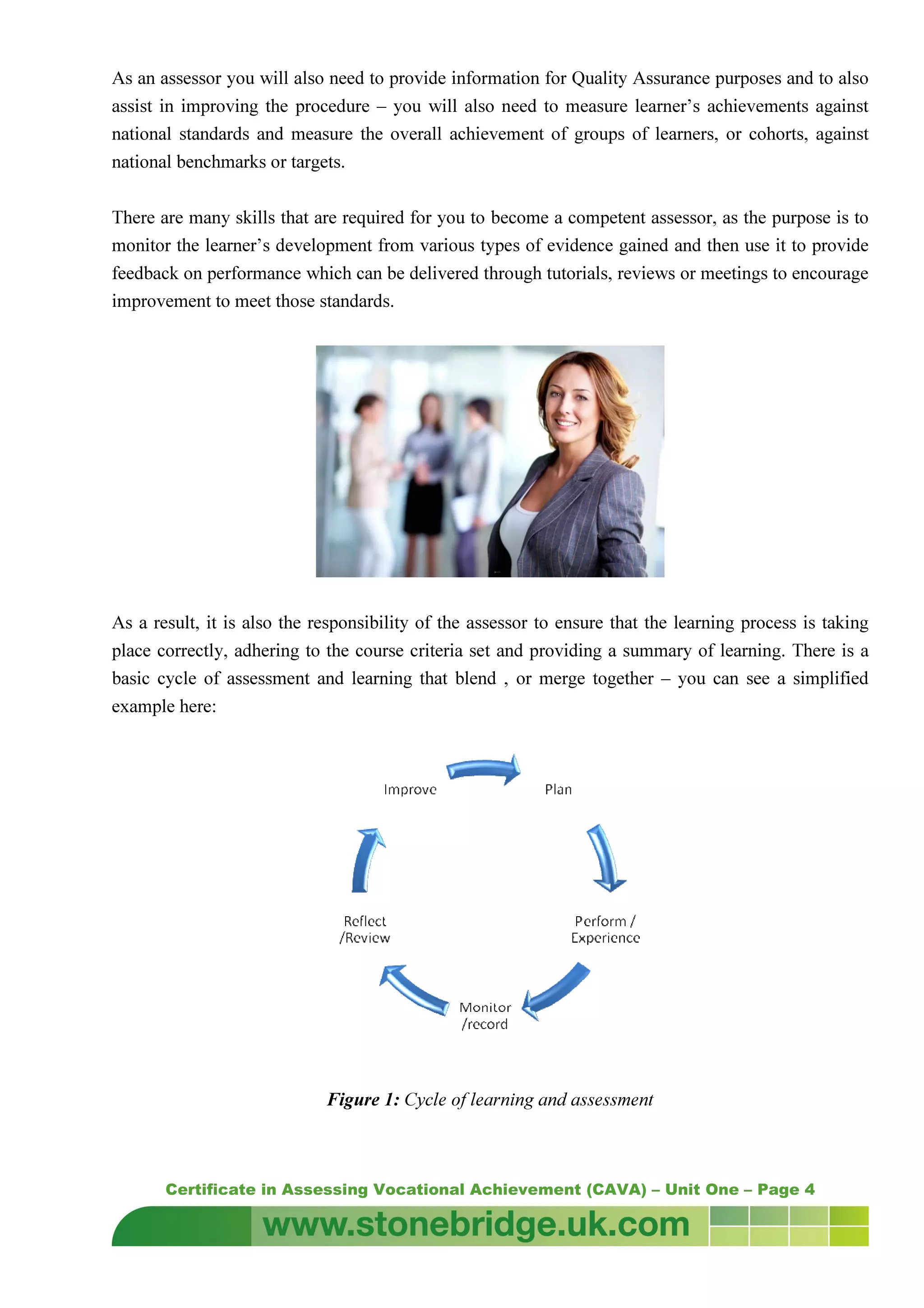
As a result, it is also the responsibility of the assessor to ensure that the learning process is taking
place correctly, adhering to the course criteria set and providing a summary of learning. There is a
basic cycle of assessment and learning that blend , or merge together – you can see a simplified
example here:
Figure 1: Cycle of learning and assessment
Certificate in Assessing Vocational Achievement (CAVA) – Unit One – Page 5
Remember – an assessment provides clear measurement of achievement during the course that
provides evidence and records the individual’s achievements and identifies what support they need to
improve and achieve.
The learner’s development is generally measured by three types of assessment and each have
different purposes and are carried out at different stages of the course.
• Initial
• Formative
• Summative
Initial assessment is carried out at the beginning of a course and it is this which helps determine the
learner’s pre-knowledge, skills and interests. It will also help to indicate if the learner will need any
additional assistance to help them achieve their maximum or if special considerations will need to be
considered throughout the assessment process.
Diagnostic assessment often runs side by side with the initial assessment which is often carried out
by testing Maths, English & IT knowledge which will determine what level the learner is currently
at, their strengths and any needs they may have to support them to achieve their goals.
Formative assessments will be carried out throughout the learner’s training course and will give the
learner continuous feedback on work they have produced during the course. This will also supply the
assessor with judgement on how the learner is achieving the set criteria through their performance.
Formative assessments are carried out both formally and informally which gradually builds
confidence in learners if feedback is delivered well and constructively, providing information to the
learner about areas for improvement and allowing them to self-assess their own needs. This is
particularly important for those who are unaware of their own abilities or lacking in confidence, as it
will help motivate them in achieving more than what they already have or think they can.
Formative assessments are also useful for the assessors themselves as this will help them to work out
their own teaching/assessing abilities and what improvements they may feel they will have to make
or any adjustments to their approach. All informal and formal assessments of work must be recorded
throughout the course as this will then give the assessor an indication of when the learner is ready to
sit their final assessment.
Certificate in Assessing Vocational Achievement (CAVA) – Unit One – Page 6
Summative assessments are carried out to assess what has been achieved at the end of units or
during the final stages of a course. Ultimately, the summative assessment will measure performance
and competency against national standards to allow qualification and certification and the
certification will usually come from an external body – or awarding organisation e.g. VTCT, City &
Guilds etc. and it is because of this external influence that all recording must be accurate to ensure
transparency and standardisation between centres.
While summative assessment provides evidence required for learner certification, it can also be used
by the learner to start applying for jobs or further education as proof of prior learning.
TUTOR TALK: Did you know?
Formative assessment, as a process, has been used since time began and is an integral part
of learning. It is based on the concept of trial and error – learning from mistakes and
improving.
Case study-scenario
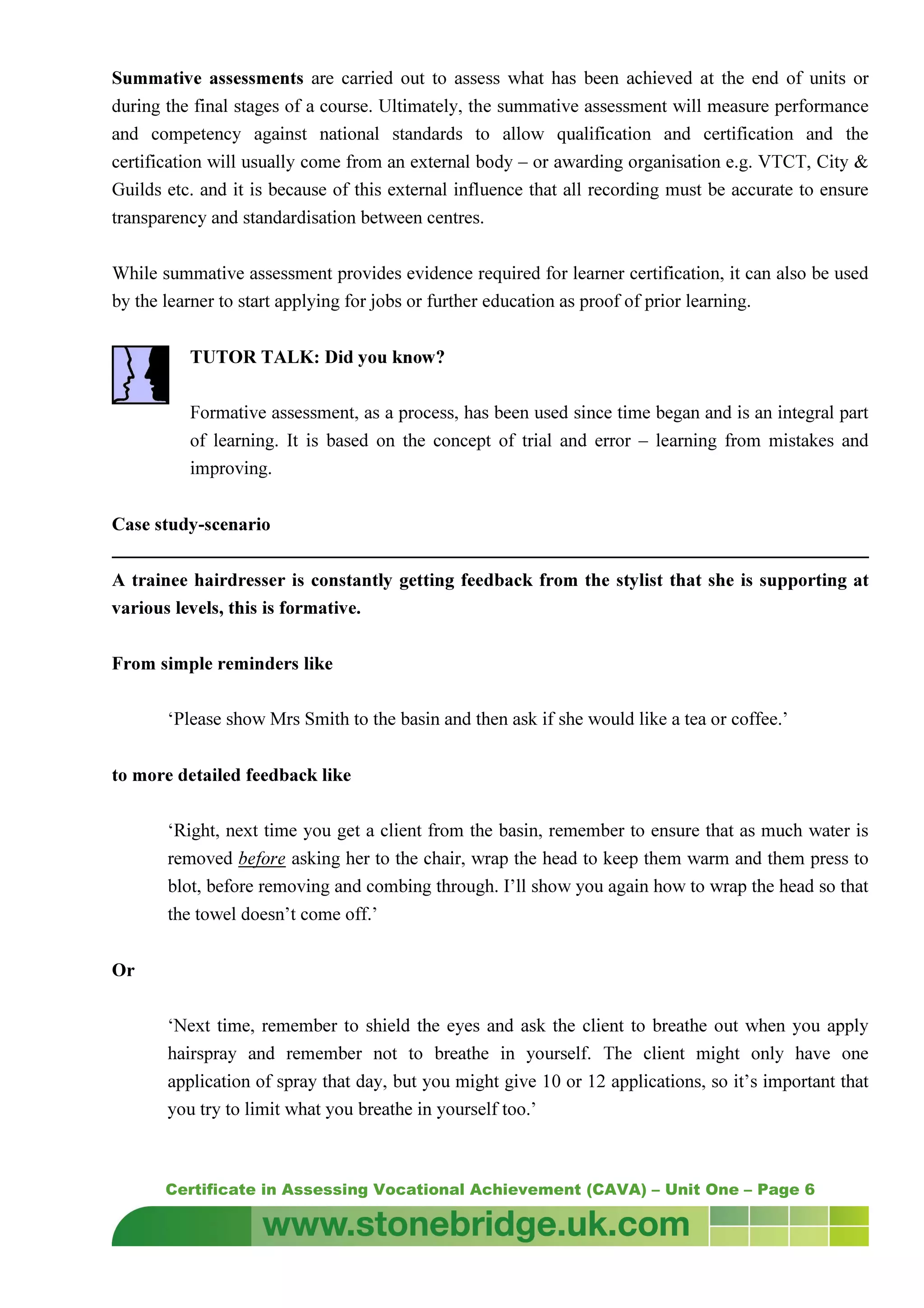
A trainee hairdresser is constantly getting feedback from the stylist that she is supporting at
various levels, this is formative.
From simple reminders like
‘Please show Mrs Smith to the basin and then ask if she would like a tea or coffee.’
to more detailed feedback like
‘Right, next time you get a client from the basin, remember to ensure that as much water is
removed before asking her to the chair, wrap the head to keep them warm and them press to
blot, before removing and combing through. I’ll show you again how to wrap the head so that
the towel doesn’t come off.’
Or
‘Next time, remember to shield the eyes and ask the client to breathe out when you apply
hairspray and remember not to breathe in yourself. The client might only have one
application of spray that day, but you might give 10 or 12 applications, so it’s important that
you try to limit what you breathe in yourself too.’
Certificate in Assessing Vocational Achievement (CAVA) – Unit One – Page 7
All feedback will shape the trainee’s performance and encourage improvements which will
ultimately help them to meet the required standards.
ACTIVITY
Check out the following video on formative assessment-evaluation:
http://www.youtube.com/watch?v=cvXS2x3UhQU
Assessment Criteria 1.2: Define the key concepts and principles of assessment
Assessment is a process of making judgements of learner’s knowledge, skills and competence
against set criteria.
It is the responsibility of the assessor to ensure that judgements are made against the specific criteria
relating to knowledge, understanding and performance, regardless of whether it is formative or
summative. Sometimes this judgement can be based on a learner’s performance alone, however, this
is usually underpinned with other knowledge that cannot be demonstrated – in all cases, all evidence
has to be valid, authentic, reliable, sufficient and current, which we will look at in more detail in a
moment.
Good Practice
Good practice in an assessment is based on the idea that the process will actively include the learner
as much as possible in their assessment and to take into consideration anything that they might have
to ask/say. The assessment should be carried out in the work place or a realistic environment that is
appropriate to the criteria and vocational area.
Both the assessor and learner have to be aware of where they are currently at, what has/is being
achieved, and of any improvements that they feel should be made, or whether any reasonable
adjustments need to be applied.
Certificate in Assessing Vocational Achievement (CAVA) – Unit One – Page 8
It is important that all assessors are fair and unbiased so that every learner has the chance to perform
well and achieve the desired outcome. This will be delivered throughout the different stages of
learning which are the initial assessment, planning for learning/assessment, implementation,
assessment, evaluation and quality assurance, and the formative formal and informal feedback which
will have directed the learner towards achievement.
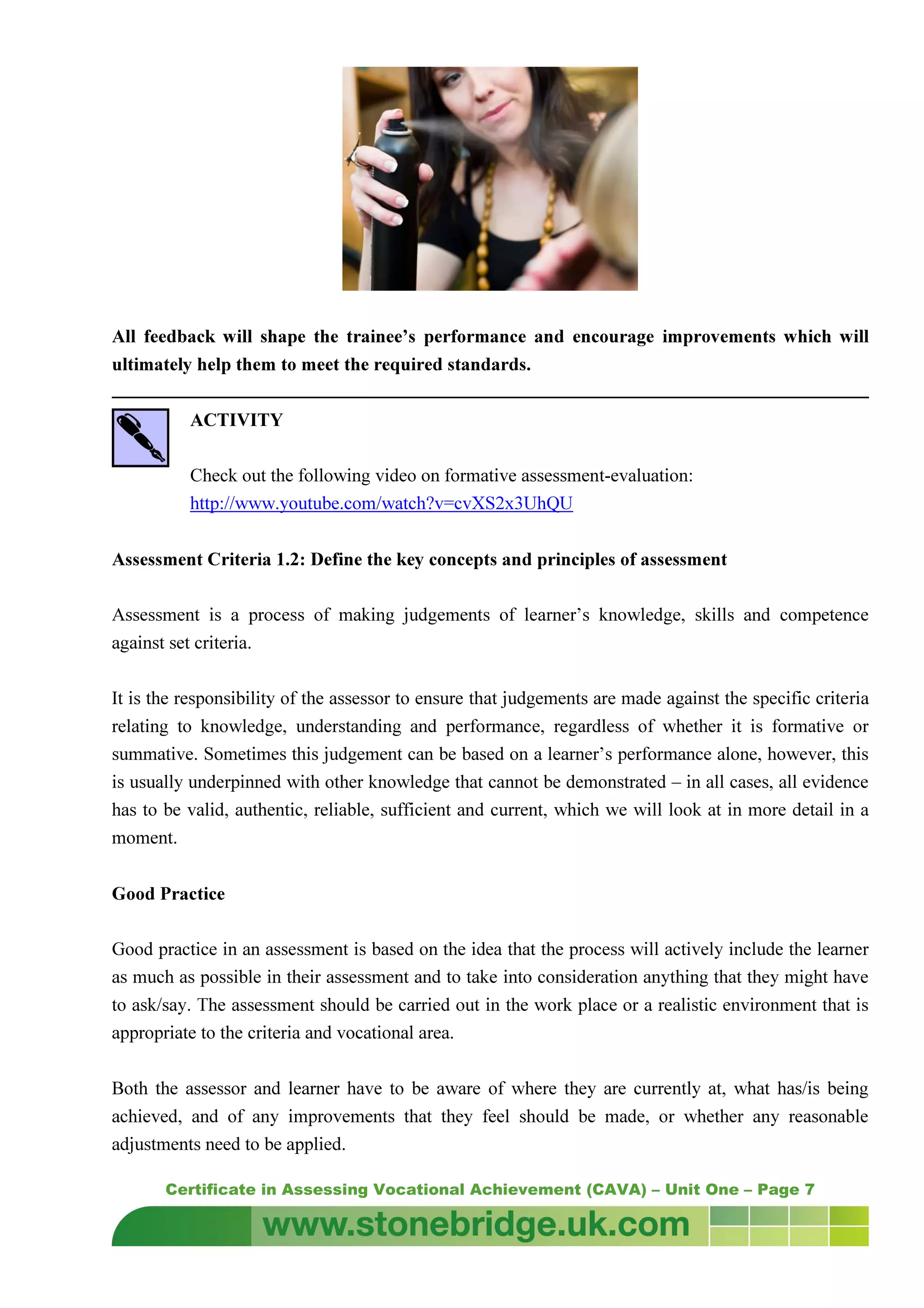
Assessment plans will contain the agreement between the learners, assessor and any other third party
on how assessment will take place, what methods and resources will be required and ensuring the
assessment is at a suitable level for the needs of the learner. Dates, times and venues should be made
clear, taking into account health and safety, equality and diversity.
Key concepts
Validity
The evidence of an assessment has to be an appropriate way of demonstrating the knowledge or skill
of the candidate or learner. For example, it would not be valid to assess a florist’s ability to produce a
bouquet by asking them to provide a picture or photograph.
You will need to be aware of the different types of assessment that will meet competency
demonstrations. These can be supported by a number of awarding organisations who strive for a
quality level of standardised assessments, and who design assessment tasks to ensure that all points
are covered. Good examples are Cache (Council for Awards in Care, Health and Education) and
HABIA (Hair and Beauty Industry Association).
Certificate in Assessing Vocational Achievement (CAVA) – Unit One – Page 9
EXAMPLE
A trainee plumber submits a photograph of a joint that has been soldered.
Is this valid evidence?
Not on its own. However, if it is supported by a narrative of the steps and signed by a
witness who authenticates that the work is that of the trainee, it becomes valid.
It’s an interesting point to remember that in the example above, if the witness statement came from
another learner – the evidence would not be validated, therefore, it is important, that all witnesses’
qualifications are checked or authenticated.
One of the most common phrases that you will hear in this field is ‘fit for purpose’ and in
assessment, your planning needs to ensure that the methods that you use are indeed that.
Authenticity
When assessing the work produced by a learner, you should be absolutely sure that the work
supplied is that of their own. There are some assessment methods that are more robust in ascertaining
authenticity, e.g. exams.
Exams are usually carried out under strict invigilated conditions and will ensure that the work
produced is that of the candidates and will prevent cheating due to an invigilator actually watching
them. Other forms of assessment might require the learner to produce work in their own time. It is
often this type of work which produces the highest incidence of plagiarism.
Plagiarism is where the learner has deliberately used either a present/past learner’s work as their own
or they have copied it from a source such as the internet. When you, as an assessor, are marking a
learner or candidate’s work, you will become aware of the style, vocabulary and sentence structure
abilities of that learner so will be able to detect when something appears a little different.
As plagiarism is so widespread, there are a number of software devices that can help you as an
assessor to identify extracts that might be plagiarised. Some of these programmes are free like The
Plagiarism CheckerIn, and there are tools that you can use online like those at
http://www.plagscan.com.
Certificate in Assessing Vocational Achievement (CAVA) – Unit One – Page 10
Here you paste in the text and a report will inform you of any matches along with their sources. For
example:
Certificate in Assessing Vocational Achievement (CAVA) – Unit One – Page 11
Many universities and larger training providers will invest in commercial plagiarism protection, one
of the most trusted being The TurnitinUK Plagiarism Detection Service. However, while this is good
for electronically submitted work, it will not be appropriate for other forms of evidence, like hand
written records, or reports, so here you need to ensure that you check handwriting, signatures and
question the learner on the content of the evidence.
Sufficiency
The term ‘sufficiency’ in assessing means that the work produced by the learner is sufficient enough
for the assessor to make a judgement on the learner’s knowledge/skills against the set criteria.
Learners will need to carry out and complete assignments/written tasks to meet certain learning
outcomes as well as often carrying out a practical task. In this instance, you, as the assessor will need
to ensure that you plan with the learner/candidate a sufficient amount of time for them to
comfortably demonstrate their skills and abilities.
If the learner is completing a portfolio of evidence, insufficient evidence can mean that the learner
has not supplied enough evidence or that the evidence supplied is not relevant. Without having a
clear outline of what is expected from the learner, they will have a vague approach in completing
their assignments and hope that the information that they provided is sufficient. Examples of
evidence that will not be sufficient for the learner to supply are letters from an employer,
documentation without explaining its relevance and why they have used this, or an assignment with
no record of discussion or questioning afterwards to ascertain their knowledge and understanding.
Reliability and Fairness
There are three mains areas of reliability and fairness in relation to assessment which are based
around consistency.
• Consistency of performance by the learner / candidate over a number of different ranges or
contexts.
• Consistency of assessors making the same standard of assessment over time of the same
evidence.
• Consistency of numerous assessors making the same decisions and judgements about the
candidates.
Certificate in Assessing Vocational Achievement (CAVA) – Unit One – Page 12
All of the above contribute to an overall fairness which means that all learners/candidates are treated
equally. Judgements set against the criteria lead to objective decisions, taking into account solid
evidence over a period of time, in different conditions and by different assessors.
Consistency leads to reliability, which in turn, leads to transparency. All parties will have an accurate
picture and will know what the standards are, and at what level they have to achieve them This
consistency is maintained through the sharing of good practice and standardisation by assessors as it
is vital for the quality of the qualification and to reassure future employers.
Currency
All evidence and work that is produced should prove that a learner / candidate’s skills and abilities
are current, that means that they are up to date on the knowledge and skills in their vocational area.
What this means is that even if someone has achieved skills or qualifications previously, they will
need to prove that they have current knowledge.
For example, someone who had previously qualified in the healthcare sector, and who has not been
working in the sector for a few years, might need to update skills with regard to ICT, as so many
communications are electronic, with patient records, etc. being protected under the Data Protection
Act, not to mention additional technologies that now support life skills for those who need to use the
sector.
Awarding organisations will have their own guidelines and policies on currency, and how this will
link with anyone applying for the recognition of prior learning and achievement, as this can be a
confusing area.
Theory of assessment
The theory behind assessments is normally explored through different types and purposes of an
assessment and then judgement is made by the assessor as to what the best option to take would be.
There are two main types of assessments that you will come across that we have already touched on.
• Assessment for learning – this is formative and provides feedback to the learner so that they
might improve.
• Assessment of learning – this is summative and an assessment to test learning and/or
performance.
Certificate in Assessing Vocational Achievement (CAVA) – Unit One – Page 13
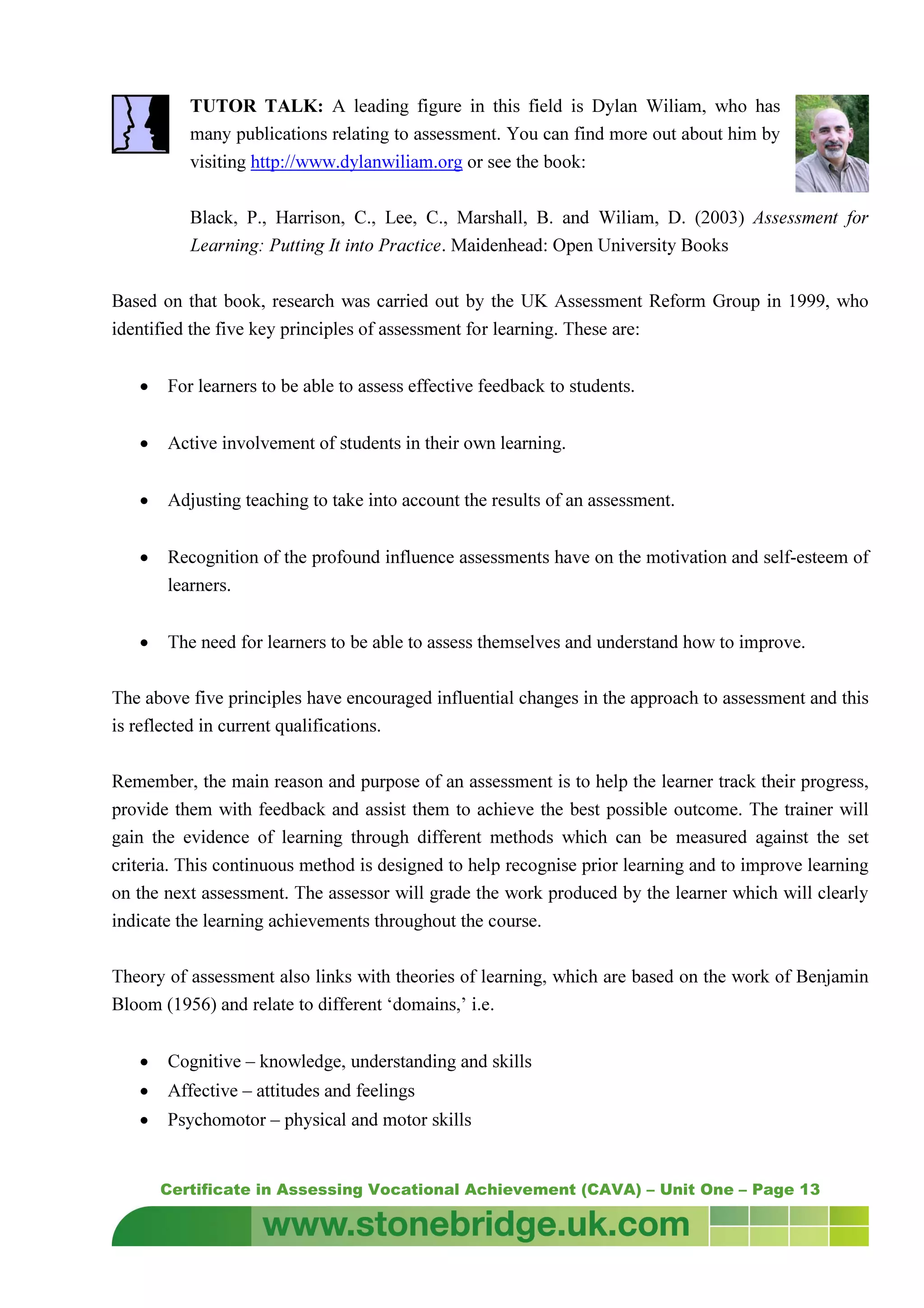
TUTOR TALK: A leading figure in this field is Dylan Wiliam, who has
many publications relating to assessment. You can find more out about him by
visiting http://www.dylanwiliam.org or see the book:
Black, P., Harrison, C., Lee, C., Marshall, B. and Wiliam, D. (2003) Assessment for
Learning: Putting It into Practice. Maidenhead: Open University Books
Based on that book, research was carried out by the UK Assessment Reform Group in 1999, who
identified the five key principles of assessment for learning. These are:
• For learners to be able to assess effective feedback to students.
• Active involvement of students in their own learning.
• Adjusting teaching to take into account the results of an assessment.
• Recognition of the profound influence assessments have on the motivation and self-esteem of
learners.
• The need for learners to be able to assess themselves and understand how to improve.
The above five principles have encouraged influential changes in the approach to assessment and this
is reflected in current qualifications.
Remember, the main reason and purpose of an assessment is to help the learner track their progress,
provide them with feedback and assist them to achieve the best possible outcome. The trainer will
gain the evidence of learning through different methods which can be measured against the set
criteria. This continuous method is designed to help recognise prior learning and to improve learning
on the next assessment. The assessor will grade the work produced by the learner which will clearly
indicate the learning achievements throughout the course.
Theory of assessment also links with theories of learning, which are based on the work of Benjamin
Bloom (1956) and relate to different ‘domains,’ i.e.
• Cognitive – knowledge, understanding and skills
• Affective – attitudes and feelings
• Psychomotor – physical and motor skills
Certificate in Assessing Vocational Achievement (CAVA) – Unit One – Page 14
However, while they have a strong bearing on assessment, they are not the main topic of this course.
Assessment Criteria: 1.3 Explain the responsibilities of the assessor
As an assessor, your main responsibility is to fully support the learner wherever possible to support
them to achieve what they have set out to achieve, in a clear and organised manner, as well as meet
organisational and awarding organisation requirements – so the key responsibilities of an assessor, in
addition to providing a professional example to which they can aspire, are:
• Plan assessments to meet learner needs – this will occur at both the formative and summative
levels, so it is important to ensure that you communicate assessment requirements to learners
and agree the plan.
• Carry out assessments, and make accurate assessment decisions fairly, objectively, and
precisely, after comparing evidence to set standards and ensuring that the evidence is
sufficient to meet awarding organisation requirements and criteria.
• Ensure that appropriate health and safety procedures are followed – for example, the use of
personal protective equipment or products (PPE).
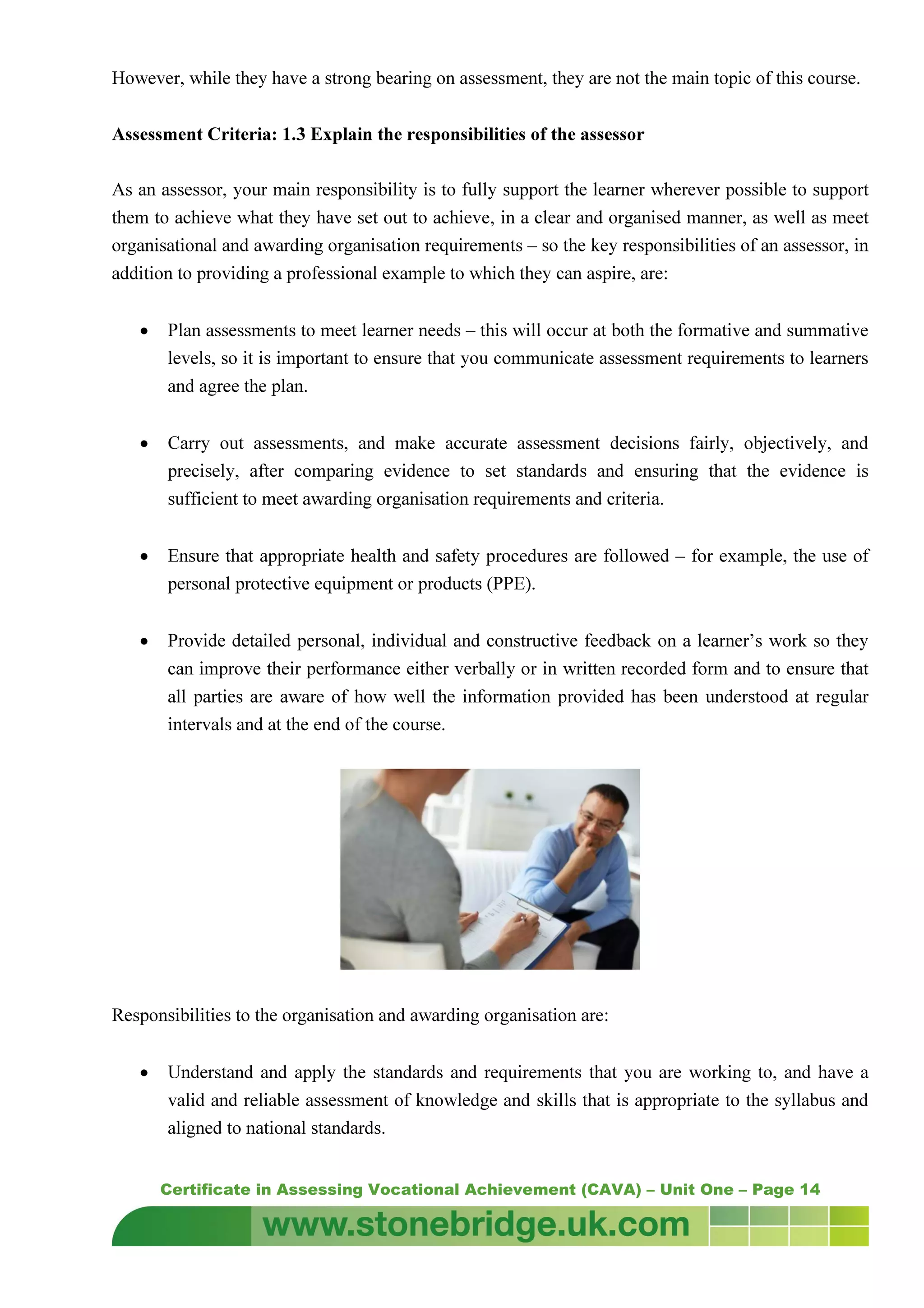
• Provide detailed personal, individual and constructive feedback on a learner’s work so they
can improve their performance either verbally or in written recorded form and to ensure that
all parties are aware of how well the information provided has been understood at regular
intervals and at the end of the course.
Responsibilities to the organisation and awarding organisation are:
• Understand and apply the standards and requirements that you are working to, and have a
valid and reliable assessment of knowledge and skills that is appropriate to the syllabus and
aligned to national standards.
Certificate in Assessing Vocational Achievement (CAVA) – Unit One – Page 15
• Record the assessment process and decisions in a clear and accurate format, completing all
relevant assessment forms and making them available for the internal quality assurer,
understanding and following quality assurance/verifier procedures.
• Provide feedback to the internal quality assurer of processes and decisions.
• To follow the organisation’s policy and practice procedures in relation to fair assessment
provision for any individual assessment needs of learners.
• Declare any conflict of interest – that is where an assessor has a personal interest in the
outcome or result of an assessment and so may behave in a biased way.
• Take part in standardisation activities and participate in continual professional development
(CPD) to maintain your own occupational knowledge, and identify opportunities for your
own personal development.
Assessment Criteria 1.4: Identify the regulations and requirements relevant to assessment in
own area of practice
As an assessor it is both your and your organisation’s responsibility to monitor standards with the
regulations and requirements that are set out in your own area of practice or vocational area. You
must make sure that, as an assessor, you conform to the awarding body’s/organisation’s requirements
and meet workplace requirements in assessing competence. For example, the requirements for
assessing plumbing will vary and require a different approach to those for hairdressing.
Each awarding organisation will have their own set of regulations and requirements that you will
have to follow which will have been devised by the regulatory bodies and their directives, including
Ofqual,(Office of Qualification and Examination Regulation) SQA,(Scottish Qualification Authority)
DfE,(Department for Education) CCEA,(Council for the Curriculum, Examination and Assessment)
as well as sector skills councils.
The actual criteria to follow will be guidelines distributed by the awarding organisation, and as an
example, you can gain access on the VTCT website (www.vtct.org.co.uk) to all the assessment
books which clearly illustrate the criteria that the assessor must follow, including what evidence
types are acceptable and when external assessment is required.
Certificate in Assessing Vocational Achievement (CAVA) – Unit One – Page 16
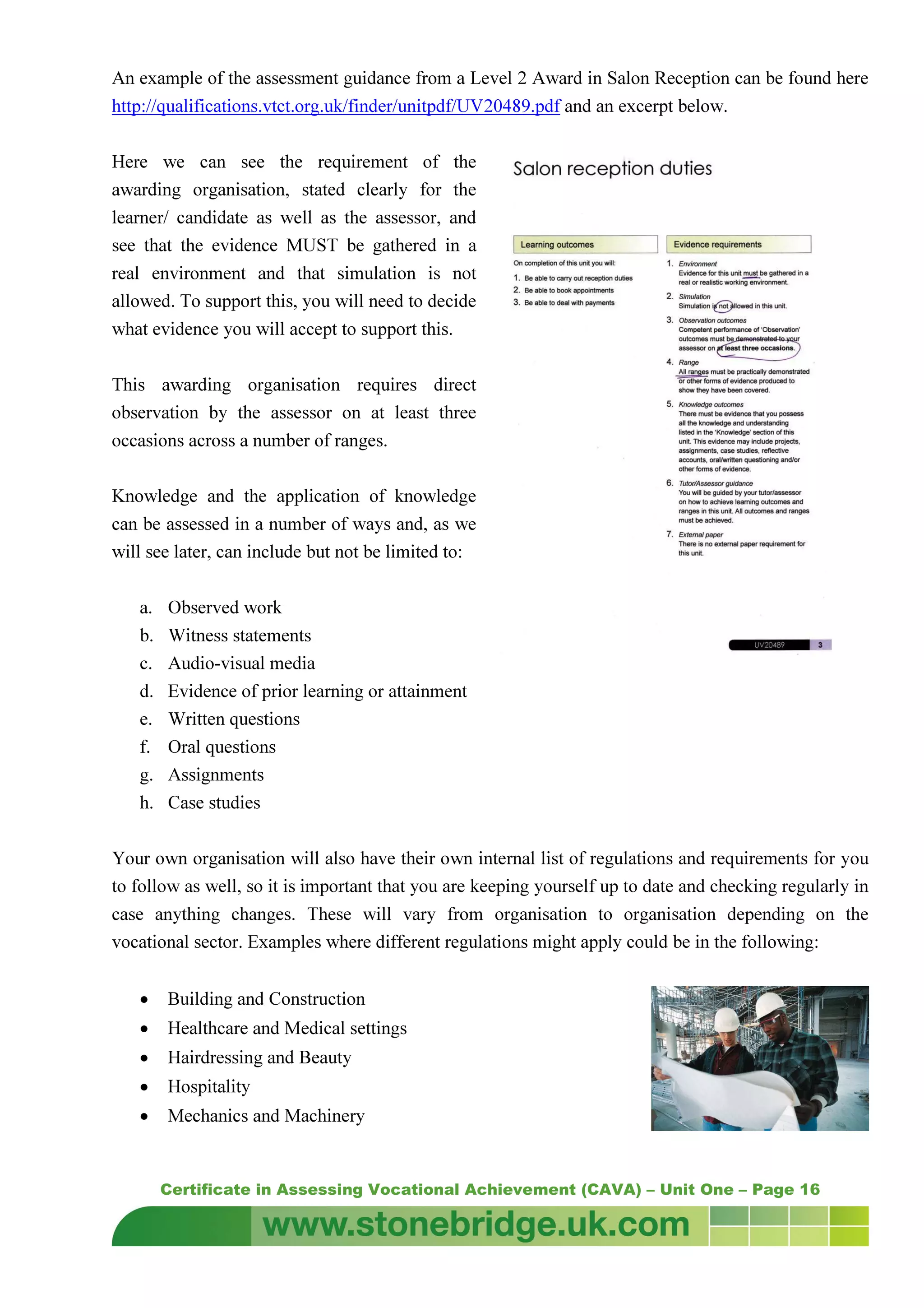
An example of the assessment guidance from a Level 2 Award in Salon Reception can be found here
http://qualifications.vtct.org.uk/finder/unitpdf/UV20489.pdf and an excerpt below.
Here we can see the requirement of the
awarding organisation, stated clearly for the
learner/ candidate as well as the assessor, and
see that the evidence MUST be gathered in a
real environment and that simulation is not
allowed. To support this, you will need to decide
what evidence you will accept to support this.
This awarding organisation requires direct
observation by the assessor on at least three
occasions across a number of ranges.
Knowledge and the application of knowledge
can be assessed in a number of ways and, as we
will see later, can include but not be limited to:
a. Observed work
b. Witness statements
c. Audio-visual media
d. Evidence of prior learning or attainment
e. Written questions
f. Oral questions
g. Assignments
h. Case studies
Your own organisation will also have their own internal list of regulations and requirements for you
to follow as well, so it is important that you are keeping yourself up to date and checking regularly in
case anything changes. These will vary from organisation to organisation depending on the
vocational sector. Examples where different regulations might apply could be in the following:
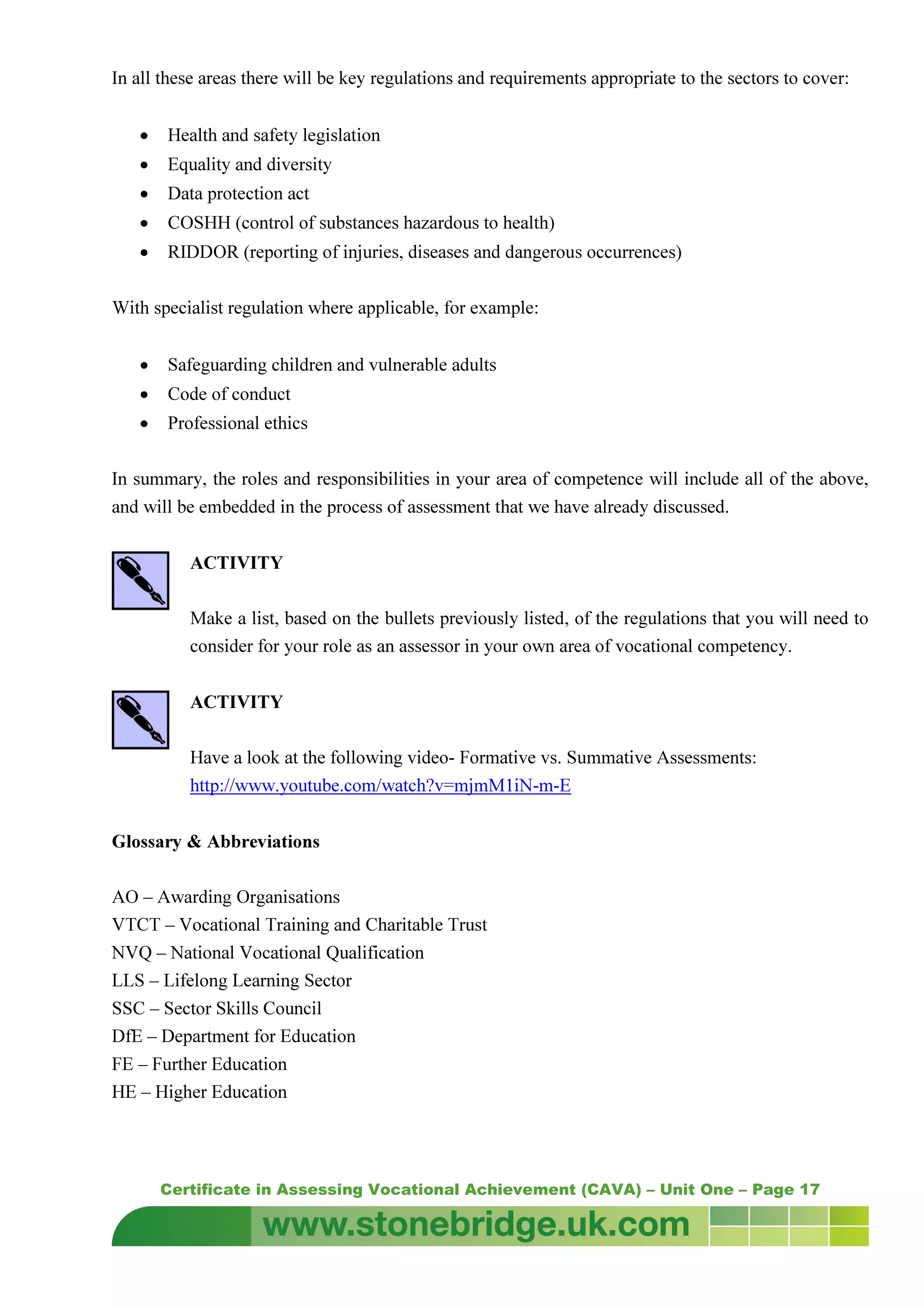
• Building and Construction
• Healthcare and Medical settings
• Hairdressing and Beauty
• Hospitality
• Mechanics and Machinery
Certificate in Assessing Vocational Achievement (CAVA) – Unit One – Page 17
In all these areas there will be key regulations and requirements appropriate to the sectors to cover:
• Health and safety legislation
• Equality and diversity
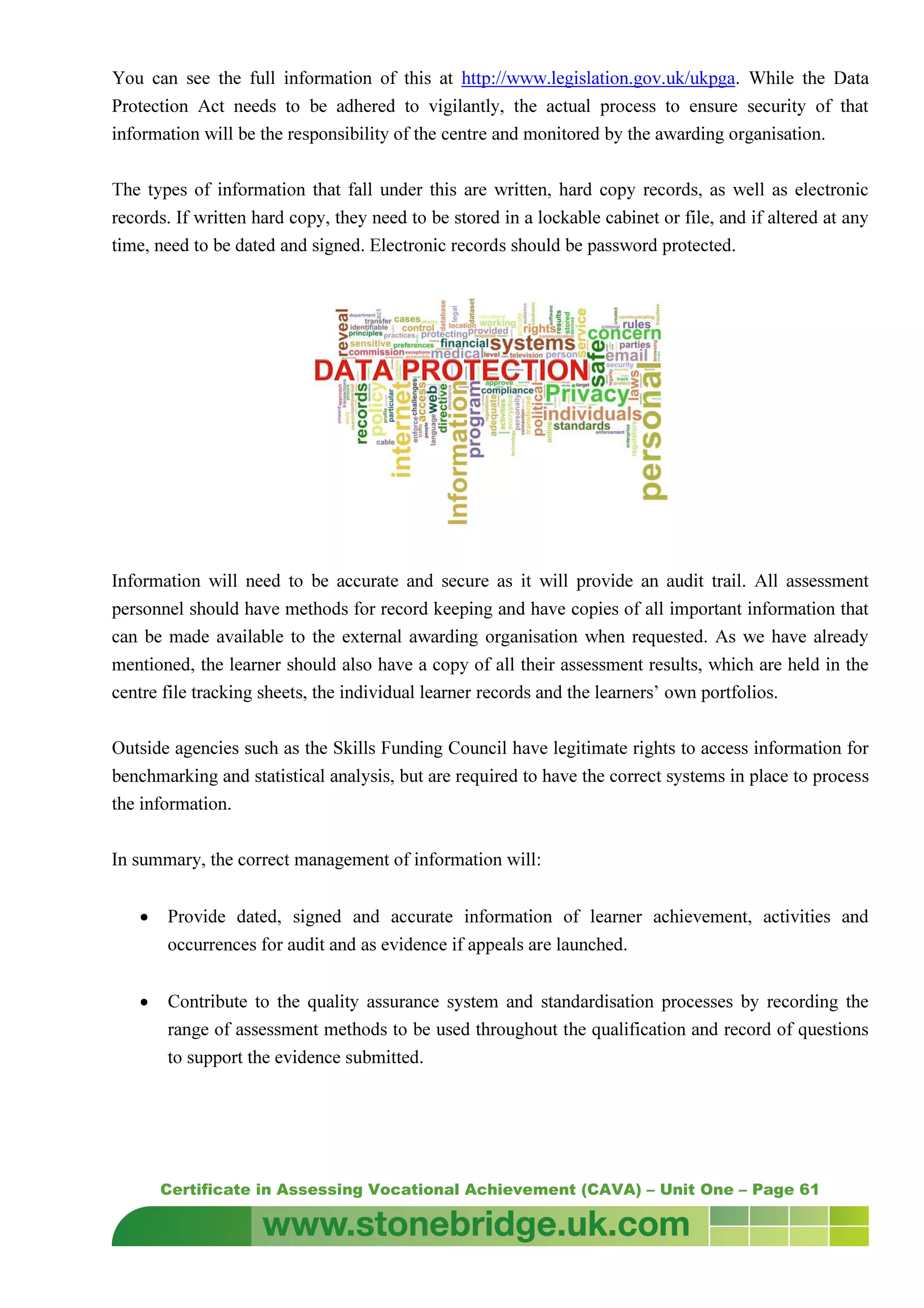
• Data protection act
• COSHH (control of substances hazardous to health)
• RIDDOR (reporting of injuries, diseases and dangerous occurrences)
With specialist regulation where applicable, for example:
• Safeguarding children and vulnerable adults
• Code of conduct
• Professional ethics
In summary, the roles and responsibilities in your area of competence will include all of the above,
and will be embedded in the process of assessment that we have already discussed.
ACTIVITY
Make a list, based on the bullets previously listed, of the regulations that you will need to
consider for your role as an assessor in your own area of vocational competency.
ACTIVITY
Have a look at the following video- Formative vs. Summative Assessments:
http://www.youtube.com/watch?v=mjmM1iN-m-E
Glossary & Abbreviations
AO – Awarding Organisations
VTCT – Vocational Training and Charitable Trust
NVQ – National Vocational Qualification
LLS – Lifelong Learning Sector
SSC – Sector Skills Council
DfE – Department for Education
FE – Further Education
HE – Higher Education
Certificate in Assessing Vocational Achievement (CAVA) – Unit One – Page 18
Additional reading and external links
• The Vocational Assessor Handbook: Including a Guide to the QCF Units for Assessment and
Internal Quality Assurance (IQA) Ros Ollin & Jenny Tucker (2014)
• The City & Guilds Practical Guide to Quality Assurance (Vocational)
• http://www.vtct.org.uk – Become a centre, Centre Handbook
• Dylan Wiliams, http://www.dylanwiliam.org
Learning Outcome 2: Understand different types of assessment method
While there is only one assessment criteria in this unit, it is probably the largest, most significant and
detailed learning outcome on the course. This is where we will look at the different methods you can
use to assess your learner/candidates and when and where to use them. The importance of this from
your point of view as an assessor, is that you can identify and suggest the best methods to allow the
learner/candidate to showcase their skills and competencies. Without a full understanding of the
value, strengths and weaknesses of the various methods you will disadvantage your candidate and
limit their chances for success.
When assessing QCF or NVQ qualifications in a work-based context, direct observation will usually
be the main method to ensure that the knowledge is applied competently, e.g. cutting someone’s hair,
providing a massage or preparing a meal. However, if we look at the type of evidence required where
demonstration of more knowledge and understanding is required, e.g. customer services, business or
financial services, then there will be many other types of evidence that can and will be more
appropriate.
Certificate in Assessing Vocational Achievement (CAVA) – Unit One – Page 19
Assessment Criteria: 2.1 Compare the strengths and limitations of a range of assessment
methods with reference to needs of the individual learners
Here, we are going to evaluate and analyse a range of methods that you will be able to draw from.
While we will discuss their strengths and limitations, we also have to often consider how to test for
the functional skills (FS) in the subjects. In 2011, functional skills replaced key skills, which is the
mandatory requirement to embed the core subjects of Maths, English and Information
Communication Technology (ITC) into training programmes like apprenticeships and study
programmes. While usually tested at the diagnostic assessment, we might also need to monitor
improvement, so some of the following methods might be a stronger method to encompass these
requirements in addition to the actual skill or subject that they are learning.
Monitoring the progression of functional skills will be ongoing, but we will also need to consider the
learner’s needs so will first look at the purpose of the assessment.
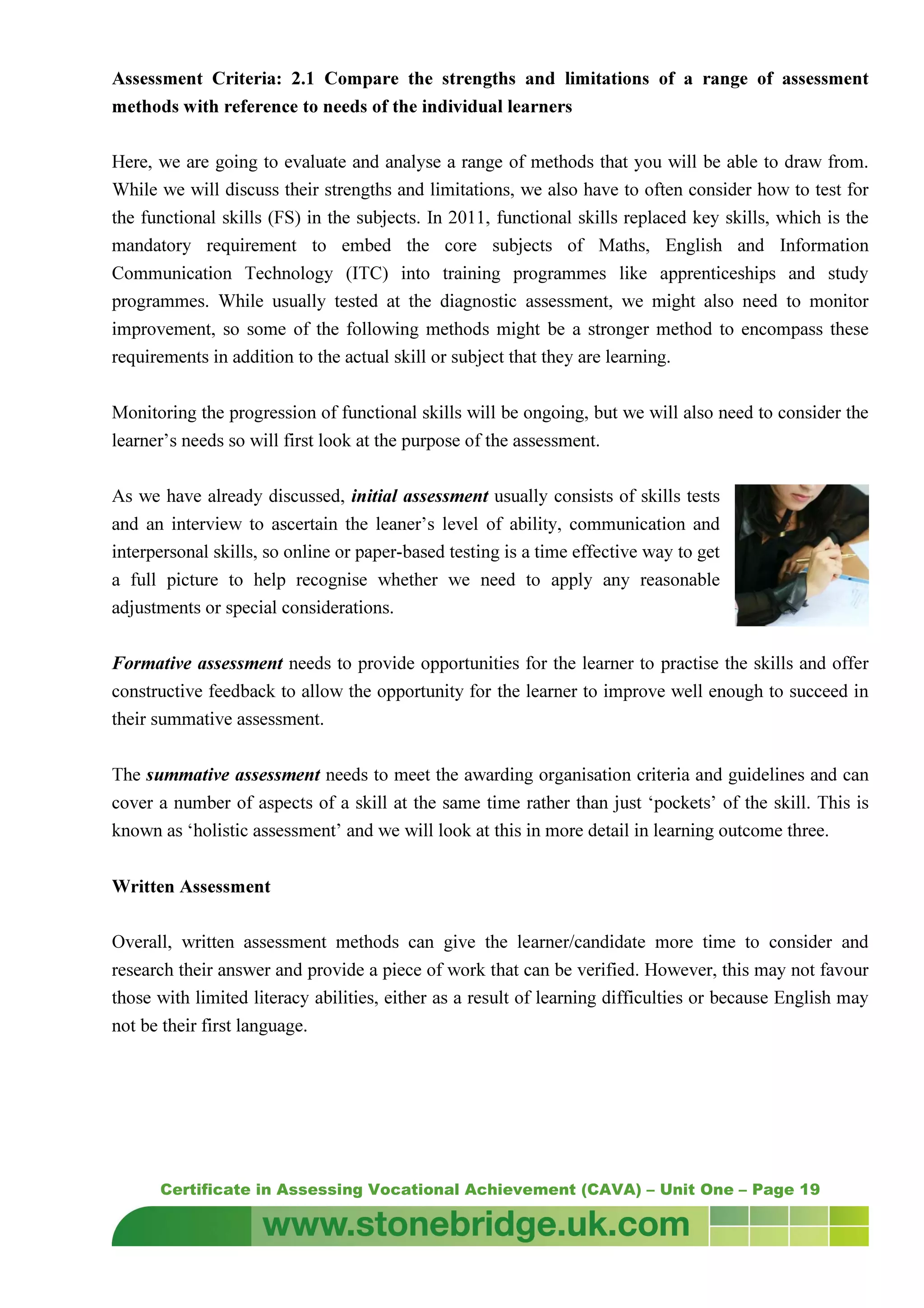
As we have already discussed, initial assessment usually consists of skills tests
and an interview to ascertain the leaner’s level of ability, communication and
interpersonal skills, so online or paper-based testing is a time effective way to get
a full picture to help recognise whether we need to apply any reasonable
adjustments or special considerations.
Formative assessment needs to provide opportunities for the learner to practise the skills and offer
constructive feedback to allow the opportunity for the learner to improve well enough to succeed in
their summative assessment.
The summative assessment needs to meet the awarding organisation criteria and guidelines and can
cover a number of aspects of a skill at the same time rather than just ‘pockets’ of the skill. This is
known as ‘holistic assessment’ and we will look at this in more detail in learning outcome three.
Written Assessment
Overall, written assessment methods can give the learner/candidate more time to consider and
research their answer and provide a piece of work that can be verified. However, this may not favour
those with limited literacy abilities, either as a result of learning difficulties or because English may
not be their first language.
Certificate in Assessing Vocational Achievement (CAVA) – Unit One – Page 20
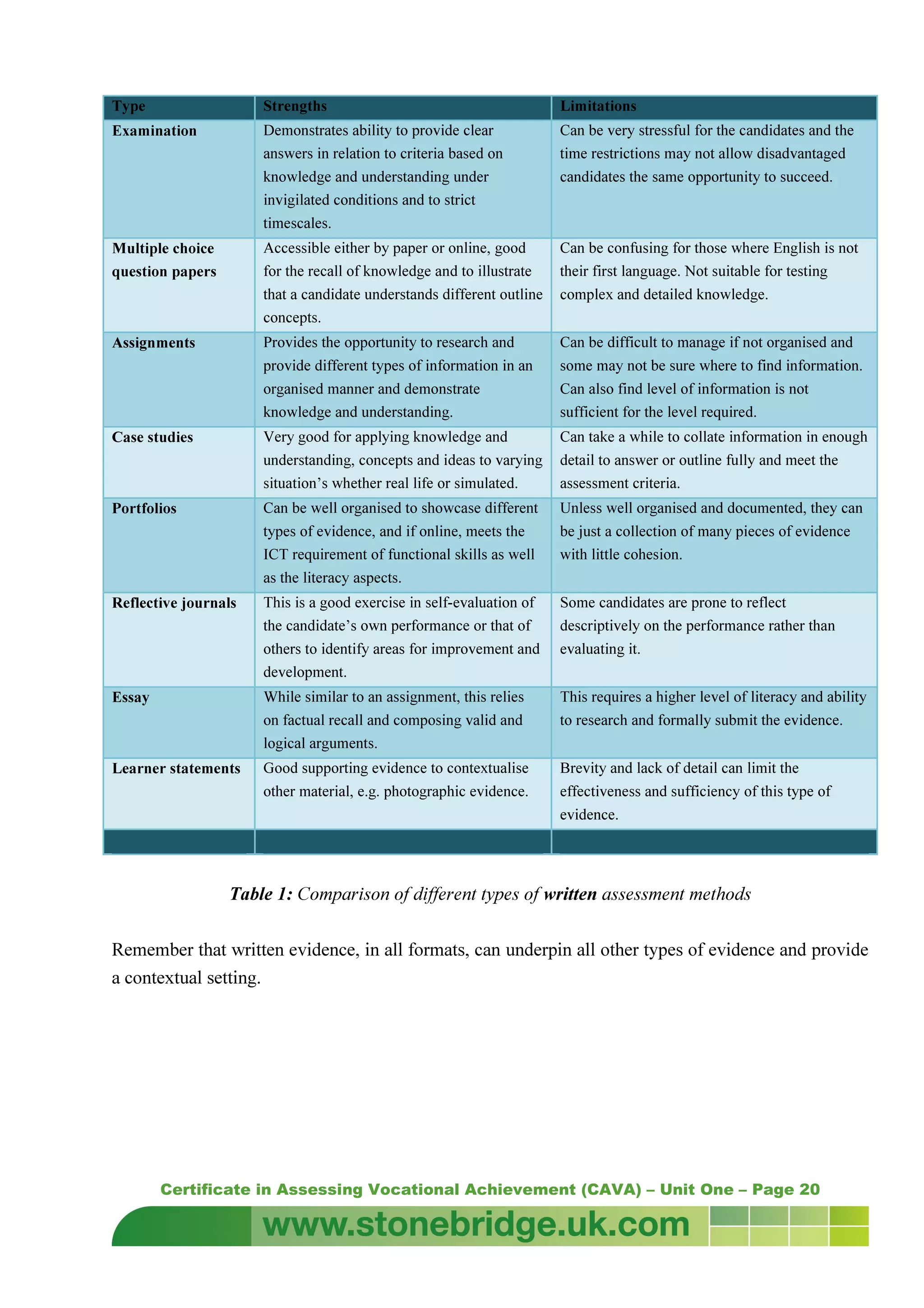
Type Strengths Limitations
Examination Demonstrates ability to provide clear
answers in relation to criteria based on
knowledge and understanding under
invigilated conditions and to strict
timescales.
Can be very stressful for the candidates and the
time restrictions may not allow disadvantaged
candidates the same opportunity to succeed.
Multiple choice
question papers
Accessible either by paper or online, good
for the recall of knowledge and to illustrate
that a candidate understands different outline
concepts.
Can be confusing for those where English is not
their first language. Not suitable for testing
complex and detailed knowledge.
Assignments Provides the opportunity to research and
provide different types of information in an
organised manner and demonstrate
knowledge and understanding.
Can be difficult to manage if not organised and
some may not be sure where to find information.
Can also find level of information is not
sufficient for the level required.
Case studies Very good for applying knowledge and
understanding, concepts and ideas to varying
situation’s whether real life or simulated.
Can take a while to collate information in enough
detail to answer or outline fully and meet the
assessment criteria.
Portfolios Can be well organised to showcase different
types of evidence, and if online, meets the
ICT requirement of functional skills as well
as the literacy aspects.
Unless well organised and documented, they can
be just a collection of many pieces of evidence
with little cohesion.
Reflective journals This is a good exercise in self-evaluation of
the candidate’s own performance or that of
others to identify areas for improvement and
development.
Some candidates are prone to reflect
descriptively on the performance rather than
evaluating it.
Essay While similar to an assignment, this relies
on factual recall and composing valid and
logical arguments.
This requires a higher level of literacy and ability
to research and formally submit the evidence.
Learner statements Good supporting evidence to contextualise
other material, e.g. photographic evidence.
Brevity and lack of detail can limit the
effectiveness and sufficiency of this type of
evidence.
Table 1: Comparison of different types of written assessment methods
Remember that written evidence, in all formats, can underpin all other types of evidence and provide
a contextual setting.
Certificate in Assessing Vocational Achievement (CAVA) – Unit One – Page 21
Oral Assessment
This provides an overall test of the learner’s ability to communicate, listen, and respond, as well as
test the development of their interpersonal skills. It gives the learner the opportunity to demonstrate
their actual understanding and knowledge and is very suitable for those who may be compromised in
their literacy ability. This can be less favourable for those who are not confident, as there is little
time to think about the answers. It is by its nature, more difficult to record for verification.
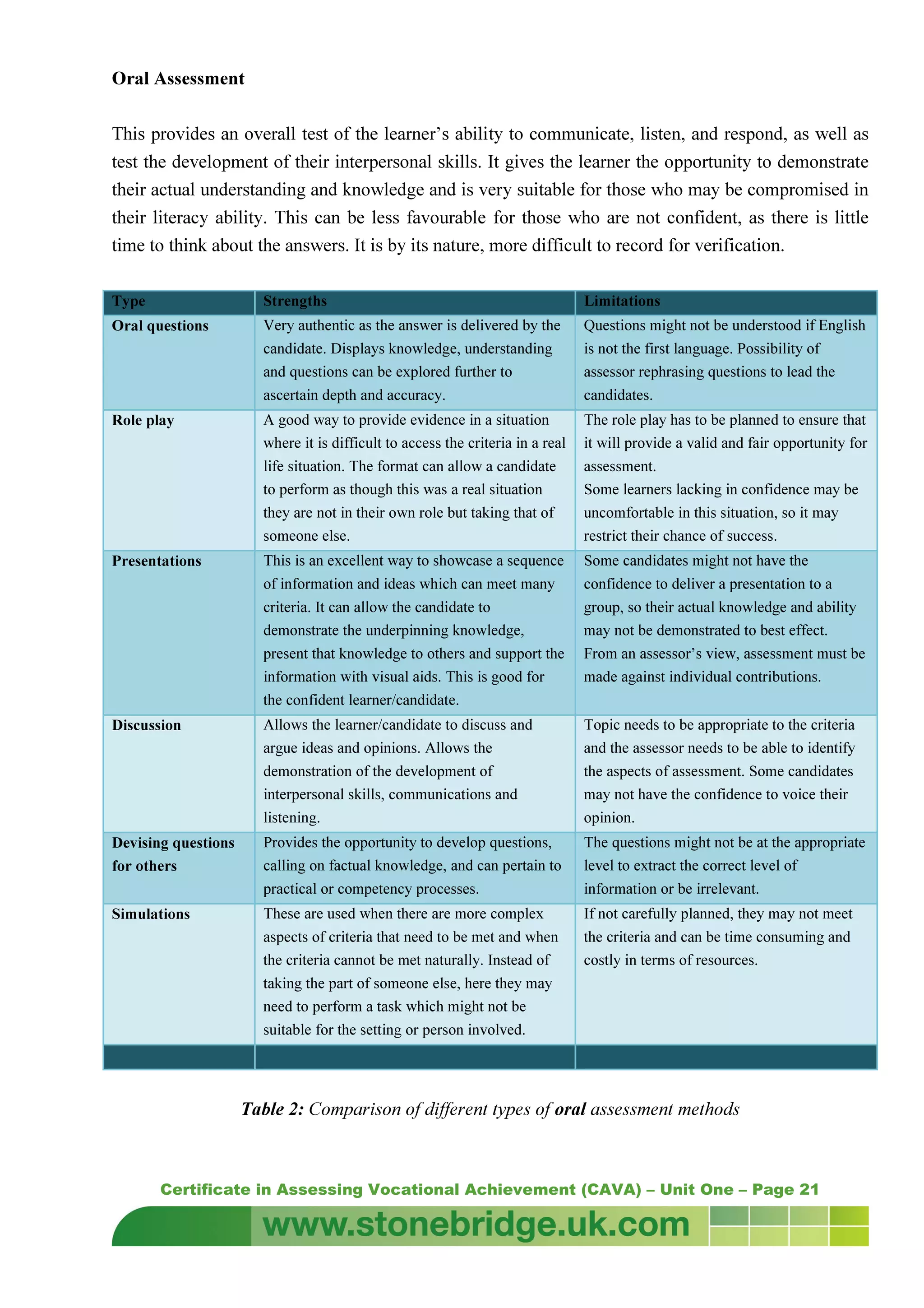
Type Strengths Limitations
Oral questions Very authentic as the answer is delivered by the
candidate. Displays knowledge, understanding
and questions can be explored further to
ascertain depth and accuracy.
Questions might not be understood if English
is not the first language. Possibility of
assessor rephrasing questions to lead the
candidates.
Role play A good way to provide evidence in a situation
where it is difficult to access the criteria in a real
life situation. The format can allow a candidate
to perform as though this was a real situation
they are not in their own role but taking that of
someone else.
The role play has to be planned to ensure that
it will provide a valid and fair opportunity for
assessment.
Some learners lacking in confidence may be
uncomfortable in this situation, so it may
restrict their chance of success.
Presentations This is an excellent way to showcase a sequence
of information and ideas which can meet many
criteria. It can allow the candidate to
demonstrate the underpinning knowledge,
present that knowledge to others and support the
information with visual aids. This is good for
the confident learner/candidate.
Some candidates might not have the
confidence to deliver a presentation to a
group, so their actual knowledge and ability
may not be demonstrated to best effect.
From an assessor’s view, assessment must be
made against individual contributions.
Discussion Allows the learner/candidate to discuss and
argue ideas and opinions. Allows the
demonstration of the development of
interpersonal skills, communications and
listening.
Topic needs to be appropriate to the criteria
and the assessor needs to be able to identify
the aspects of assessment. Some candidates
may not have the confidence to voice their
opinion.
Devising questions
for others
Provides the opportunity to develop questions,
calling on factual knowledge, and can pertain to
practical or competency processes.
The questions might not be at the appropriate
level to extract the correct level of
information or be irrelevant.
Simulations These are used when there are more complex
aspects of criteria that need to be met and when
the criteria cannot be met naturally. Instead of
taking the part of someone else, here they may
need to perform a task which might not be
suitable for the setting or person involved.
If not carefully planned, they may not meet
the criteria and can be time consuming and
costly in terms of resources.
Table 2: Comparison of different types of oral assessment methods
Certificate in Assessing Vocational Achievement (CAVA) – Unit One – Page 22
Audio-visual Assessment
Here we can see evidence of a learner /candidate demonstrate their ability to perform a skill or task
to a level of competence, supported with different evidence types to those discussed so far. The
assessor can make a judgement on the skill illustrated or performed as well as linking it to functional
skills depending on the task. Drawbacks for the candidate might be restrictions in the workplace, like
disruptions or lack of resources, and the process could be quite time consuming to set up particularly
for those lacking in confidence resulting in evidence, which is not a true representation of their
ability.
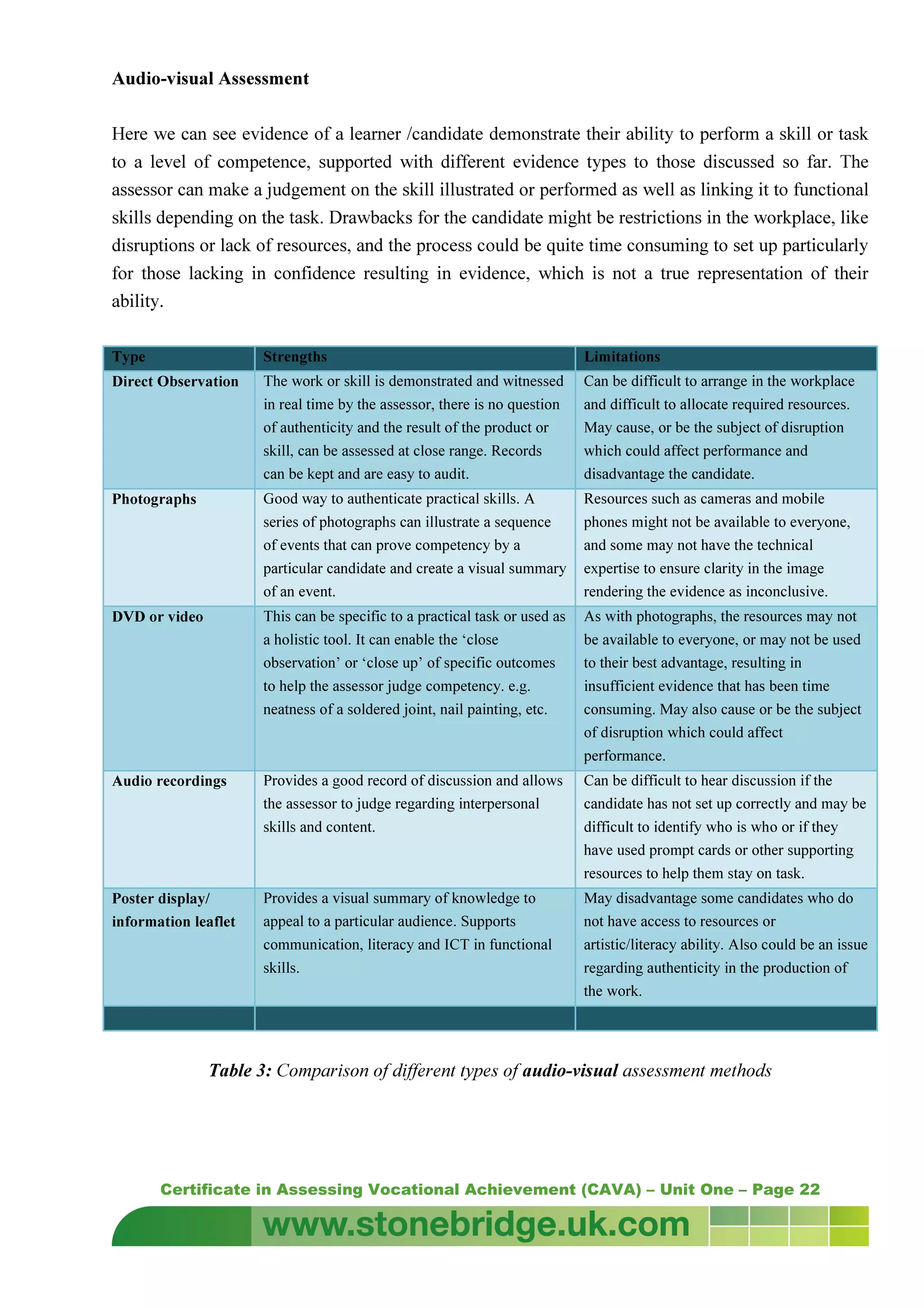
Type Strengths Limitations
Direct Observation The work or skill is demonstrated and witnessed
in real time by the assessor, there is no question
of authenticity and the result of the product or
skill, can be assessed at close range. Records
can be kept and are easy to audit.
Can be difficult to arrange in the workplace
and difficult to allocate required resources.
May cause, or be the subject of disruption
which could affect performance and
disadvantage the candidate.
Photographs Good way to authenticate practical skills. A
series of photographs can illustrate a sequence
of events that can prove competency by a
particular candidate and create a visual summary
of an event.
Resources such as cameras and mobile
phones might not be available to everyone,
and some may not have the technical
expertise to ensure clarity in the image
rendering the evidence as inconclusive.
DVD or video This can be specific to a practical task or used as
a holistic tool. It can enable the ‘close
observation’ or ‘close up’ of specific outcomes
to help the assessor judge competency. e.g.
neatness of a soldered joint, nail painting, etc.
As with photographs, the resources may not
be available to everyone, or may not be used
to their best advantage, resulting in
insufficient evidence that has been time
consuming. May also cause or be the subject
of disruption which could affect
performance.
Audio recordings Provides a good record of discussion and allows
the assessor to judge regarding interpersonal
skills and content.
Can be difficult to hear discussion if the
candidate has not set up correctly and may be
difficult to identify who is who or if they
have used prompt cards or other supporting
resources to help them stay on task.
Poster display/
information leaflet
Provides a visual summary of knowledge to
appeal to a particular audience. Supports
communication, literacy and ICT in functional
skills.
May disadvantage some candidates who do
not have access to resources or
artistic/literacy ability. Also could be an issue
regarding authenticity in the production of
the work.
Table 3: Comparison of different types of audio-visual assessment methods
Certificate in Assessing Vocational Achievement (CAVA) – Unit One – Page 23
Remember that most audio-visual material will also need a statement to
underpin it and ensure that it is valid with a contextual statement. You
may also need to request that a witness authenticates that the actual event
in real time or in that situation.
Effective questioning
Questions can be used at all levels of the assessment process, from initial to summative, however, the
structure and type of question can vary considerably from conversational oral questions to formal
written questions like those found in exam conditions. Communication is the key to a successful
relationship between the candidate and the assessor, which we will look at in more detail in learning
outcome three. Here we will look at the basic types of questions and how to use them.
Verbal questions
As an assessor, you will more than likely need to question a learner/candidate
to ensure that they have an understanding of the underpinning knowledge or to
clarify aspects of competency that cannot be demonstrated. In order to get the
most out this you will need to understand the difference between open and
closed questions as each has its strengths and place in the assessment model.
• Closed questions
A closed question is one that can be answered with either a single word or a short phrase.
That means that they are usually answered with a yes, or no, but sometimes can be a one
word answer. They give you facts and are quick and easy to answer. They are also direct so
there is little room for misinterpretation.
• Open questions
An open question is likely to promote a detailed or long answer.
This means that they can seek opinions or details and are the opposite of closed questions.
They give you opinions and feelings, and time to think, reflect and respond. Open questions
can be difficult to interpret if not formed correctly as the question may not be specific enough
to promote a correct answer.
Certificate in Assessing Vocational Achievement (CAVA) – Unit One – Page 24
ACTIVITY
Think about the following questions – which are open and which are closed?
• How much is that?
• How did you do that?
• Are you feeling okay?
• What time is it?
• How do you feel?
• Why did that happen?
• What kind of questions?
You will need to be aware of what type of questions to ask and what they are for, as well as ensure
that they are appropriate to the level of the qualification. This requires a certain amount of skill and
you need to distinguish what will be suitable for oral and written, taking into account the confidence,
ability and needs of the learner.
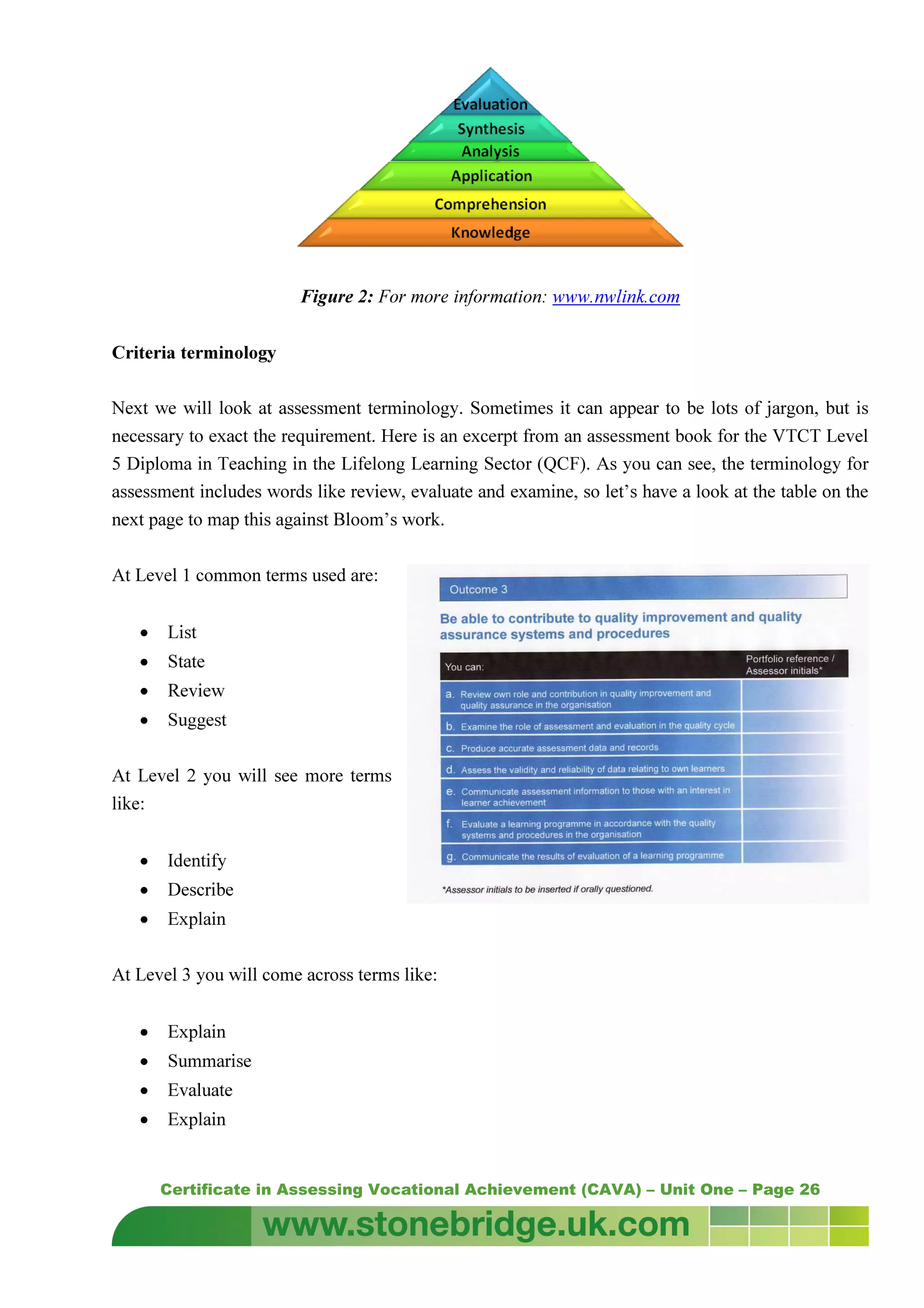
Questions can be used for number of reasons – and not just to test knowledge, but promote
conversation, establish relationships, put people at ease, as well as be specific to information.
Information gathered through effective oral questioning can be general, specific, advanced and
detailed, or to seek justification and opinion in relation to procedures or activities related to
competency. The most accomplished assessor will develop a rapport that is trusting and where the
questions are phrased in a way that promotes a relaxed response from the candidate.
Points to remember:
• Put the candidate at ease – a relaxed and comfortable candidate is more likely to be able to
provide an accurate account of their ability at the level of this assessment.
Certificate in Assessing Vocational Achievement (CAVA) – Unit One – Page 25
• Ensure that the language is appropriate to the level, e.g. at Level 2 to ask for a list of, or to
identify relevant health measures will be appropriate. It would not be appropriate to ask them
to discuss and evaluate the quantitative data of the last two years which has resulted in the
sector skills council decision to enforce that personal protective equipment be worn for a
particular exercise,(unless, of course that is an assessment criteria!).
• Avoid excessive use of jargon.
• Do not ask leading questions. It’s not just words that can be leading here – like for example
stating something like, ‘Would you say that was the tibialis anterior muscle or the
gastrocnemius, bearing in mind that one is at the front of the leg and the other is at the
back….’, but also the tone of your voice, for example stressing the correct answer when
asking for a choice of options ‘So Michelle, would you usually or always use conditioner’.
• Keep the questions specific, remember we need the answers to questions to help us evaluate
and make judgements regarding the candidate’s ability and competency, so a question like,
‘Don’t you think you should have removed your jewellery first?’ is not going to contribute to
the assessment process.
As we saw earlier, Bloom’s taxonomy, was responsible for identifying the three different domains of
learning. We will now look at the six levels of what is known as the cognitive domain of learning as
this is will impact on the type of questions you will need to formulate and use depending on the level
you are assessing.
Cognitive Domain
This is a clear representation of the levels of cognitive ability, according to Benjamin Bloom (1956).
It categorizes the levels of difficulty, with knowledge being the lowest. For the purposes of
assessment, many of the findings published at this time are still used in the development, testing and
assessment of cognitive materials and ability. It is worth noting that within each domain, there are
still different levels, so knowledge can be simplistic or detailed and your questions, whether oral or
written, need to be phrased or worded to give the candidate the maximum opportunity to give the
correct answer.
Certificate in Assessing Vocational Achievement (CAVA) – Unit One – Page 26
Figure 2: For more information: www.nwlink.com
Criteria terminology
Next we will look at assessment terminology. Sometimes it can appear to be lots of jargon, but is
necessary to exact the requirement. Here is an excerpt from an assessment book for the VTCT Level
5 Diploma in Teaching in the Lifelong Learning Sector (QCF). As you can see, the terminology for
assessment includes words like review, evaluate and examine, so let’s have a look at the table on the
next page to map this against Bloom’s work.
At Level 1 common terms used are:
• List
• State
• Review
• Suggest
At Level 2 you will see more terms
like:
• Identify
• Describe
• Explain
At Level 3 you will come across terms like:
• Explain
• Summarise
• Evaluate
• Explain
Certificate in Assessing Vocational Achievement (CAVA) – Unit One – Page 27
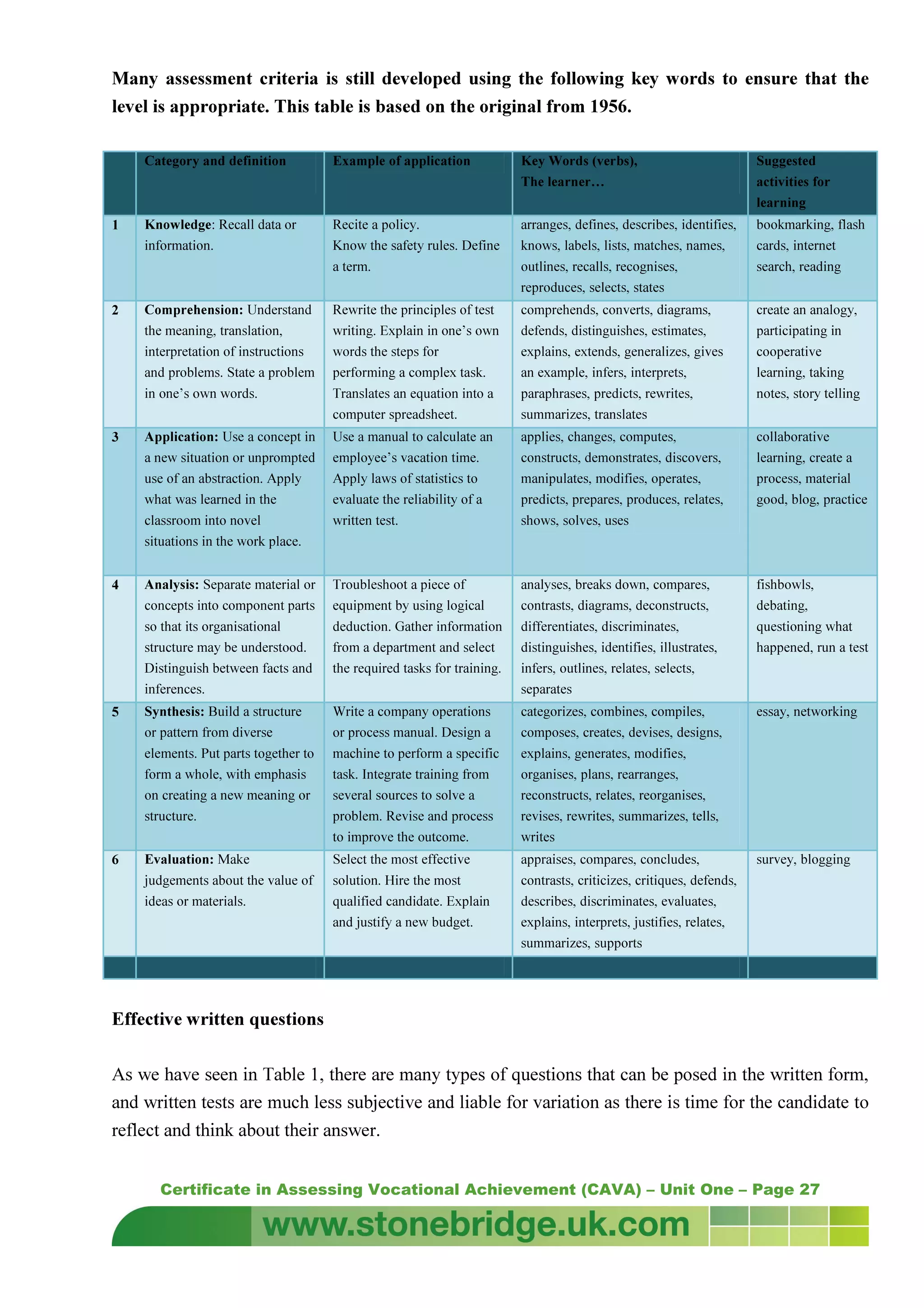
Many assessment criteria is still developed using the following key words to ensure that the
level is appropriate. This table is based on the original from 1956.
Category and definition Example of application Key Words (verbs),
The learner…
Suggested
activities for
learning
1 Knowledge: Recall data or
information.
Recite a policy.
Know the safety rules. Define
a term.
arranges, defines, describes, identifies,
knows, labels, lists, matches, names,
outlines, recalls, recognises,
reproduces, selects, states
bookmarking, flash
cards, internet
search, reading
2 Comprehension: Understand
the meaning, translation,
interpretation of instructions
and problems. State a problem
in one’s own words.
Rewrite the principles of test
writing. Explain in one’s own
words the steps for
performing a complex task.
Translates an equation into a
computer spreadsheet.
comprehends, converts, diagrams,
defends, distinguishes, estimates,
explains, extends, generalizes, gives
an example, infers, interprets,
paraphrases, predicts, rewrites,
summarizes, translates
create an analogy,
participating in
cooperative
learning, taking
notes, story telling
3 Application: Use a concept in
a new situation or unprompted
use of an abstraction. Apply
what was learned in the
classroom into novel
situations in the work place.
Use a manual to calculate an
employee’s vacation time.
Apply laws of statistics to
evaluate the reliability of a
written test.
applies, changes, computes,
constructs, demonstrates, discovers,
manipulates, modifies, operates,
predicts, prepares, produces, relates,
shows, solves, uses
collaborative
learning, create a
process, material
good, blog, practice
4 Analysis: Separate material or
concepts into component parts
so that its organisational
structure may be understood.
Distinguish between facts and
inferences.
Troubleshoot a piece of
equipment by using logical
deduction. Gather information
from a department and select
the required tasks for training.
analyses, breaks down, compares,
contrasts, diagrams, deconstructs,
differentiates, discriminates,
distinguishes, identifies, illustrates,
infers, outlines, relates, selects,
separates
fishbowls,
debating,
questioning what
happened, run a test
5 Synthesis: Build a structure
or pattern from diverse
elements. Put parts together to
form a whole, with emphasis
on creating a new meaning or
structure.
Write a company operations
or process manual. Design a
machine to perform a specific
task. Integrate training from
several sources to solve a
problem. Revise and process
to improve the outcome.
categorizes, combines, compiles,
composes, creates, devises, designs,
explains, generates, modifies,
organises, plans, rearranges,
reconstructs, relates, reorganises,
revises, rewrites, summarizes, tells,
writes
essay, networking
6 Evaluation: Make
judgements about the value of
ideas or materials.
Select the most effective
solution. Hire the most
qualified candidate. Explain
and justify a new budget.
appraises, compares, concludes,
contrasts, criticizes, critiques, defends,
describes, discriminates, evaluates,
explains, interprets, justifies, relates,
summarizes, supports
survey, blogging
Effective written questions
As we have seen in Table 1, there are many types of questions that can be posed in the written form,
and written tests are much less subjective and liable for variation as there is time for the candidate to
reflect and think about their answer.
Certificate in Assessing Vocational Achievement (CAVA) – Unit One – Page 28
If you are designing written questions then there are a few simple points to consider:
• Ensure that the answer you are looking for has value and is valid to the criteria.
• Phrase the question so that it is easily understood at the intended level.
• Develop effective marking criteria so that there is no confusion regarding what is to be
attained, either by the candidate or other assessors who might need to mark the work.
Other written evidence
Portfolio Compilation
Many NVQ’s rely heavily on the production of portfolios. These are a compilation of evidence from
numerous sources that will satisfy the requirements for the awarding organisation and provide
assessors, internal quality assurers and external quality assurers that all criteria and standards have
been met. Historically, all materials would be paper-based and bound in files, however, these days
we are seeing a swing to e-portfolio, which is electronic, or online. The evidence that is required is
still very similar in content and depth, and as we have seen, still needs to be selected to meet the
criteria.
Written Assignments
Assignments are used widely and can cover a whole range of criteria and benefit from being
appropriate to many vocational areas. They differ from essays, in that they are based on practical
ability and application of knowledge or skills whereas the essay is more theoretical.
They are also more appropriate than projects as a project will assess a vast range of practical skills
rather than the knowledge underpinning it and are also exceptionally time consuming. Within the
course of study, whether work-based or training and education setting based, there is still a good use
for assignments as they can include other resources to support them, like the production of
information leaflets, photographs or charts and promotional materials.
Certificate in Assessing Vocational Achievement (CAVA) – Unit One – Page 29
Some awarding organisations will set assignment tasks, but regardless of whether supplied, or
designed by you, they should have a structure to enable the submission to meet the standards.
• Initially, you will need to agree a title – and the particular assessment criteria that the
assignment will map to.
• You will need information about the learner, their name, learner or registration number, the
name of the tutor or assessor, date of start, when it is due.
• We can design a front sheet to include a declaration of authenticity (a statement to say the
work is the candidate’s own) as well as a signing off section – an area that records when the
assignment is completed and a space for the Internal Quality Assurer (IQA) to sign to show
that they have assured this piece of work.
• The assignment brief will include the details of the actual assignment, what it includes, what
they have to do, what types of evidence they need to supply, and give suggested resources.
Here is an example of an assignment task from Cache (Council for Awards in Care, Health &
Education) for a unit in their Supporting Teaching and Learning in Schools.
Task links to learning outcome 2, assessment criteria 2.1, 2.2, 2.3, 2.4 and 2.5.
Equality, diversity and inclusion are integral to all work that is undertaken in the educational
environment. You have a meeting scheduled with your mentor to enhance your understanding of this
important area. Prior to this meeting you need to prepare the following:
• an explanation of ways in which children and young people can experience prejudice and
discrimination
• an analysis of the impact of prejudice and discrimination on children and young people
• an evaluation of how your own attitudes, values and behaviour could impact on work with
children and young people
• an explanation how to promote anti-discriminatory practice in work with children and young
people
• an explanation of how to challenge discrimination
Certificate in Assessing Vocational Achievement (CAVA) – Unit One – Page 30
Feedback for the assignment should be clearly understood and available for the candidate as well as
for the IQA to see.
Case Studies
These are where the learners write about scenarios and possible outcomes for dilemmas and
problems. They can be based on fact or fiction. The content will usually require the candidate to
perform or reflect on a situation and then offer possible solutions and take courses of action. This is a
good way to see if a learner/candidate can apply knowledge, problem solving and thinking skills.
This method can be used at both formative and summative levels.
Reflective Journals
Reflection is a method of assessment which links in well with all personal development units and
skills. It is seen particularly in sectors which involve working with people, and provides an insight
into how the learner grows both personally and professionally through the course of study or
programme. In teaching, training and assessing, it is used as a fundamental part of self-analysis and
improvement with evaluation and reflection being built in.
Basic reflection consists of recording responses to the following questions, or similar:
• How did that go overall?
• What went well?
• What didn’t go so well?
• How did others react?
• How did I feel?
• What would I change next time?
Roth (1989) concluded that reflection at an advanced level would involve far more detailed
processes. You can see a simplified model at www.brainboxx.co.uk or for more information you can
read:
Roth, R. A. “Preparing the Reflective Practitioner: Transforming the Apprentice through the
Dialectic.” Journal of Teacher Education 40, No. 2 (March-April 1989): 31-35.
All in all, the assessment methods need to be appropriate to the level of the course/programme, and
take into account the learner’s needs. They need to be fit for purpose and ultimately give the
learner/candidate the opportunity to provide the correct information to meet the criteria.
Certificate in Assessing Vocational Achievement (CAVA) – Unit One – Page 31
As you become more experienced you will find that your skills will combine and the ‘holistic
assessment’ will be one that you will manage well as a ‘holistic assessor’!
TUTOR TALK: Did you know?
It was in 1981 that the ‘New Training Initiative’ identified the necessity to increase skills
in the UK workforce to maintain its competitiveness with overseas economies and
technological developments.
It was also recognised that ‘standards of a new kind’ would also need to be identified and
developed and this is where the beginning of the assessment model was born.
Learning Outcome 3: Understand how to plan assessments
Now we are going to look in detail at the planning process, taking into account the different
assessment methods, the level of assessment, i.e. whether initial, formative or summative, and the
needs of the learner.
Success is never guaranteed, even with good planning, however, preparation is everything.
Learning outcomes for this unit are:
• Summarise key factors to consider when planning assessment.
• Evaluate the benefits of using a holistic approach to assessment.
• Explain how to plan a holistic approach to assessment.
• Summarise the types of risks that may be involved in assessment in own area of
responsibility.
• Explain how to minimise risks through the planning process.
Assessment Criteria 3.1: Summarise key factors to consider when planning assessment
Planning for the assessment will start depending on where in the learner journey, the assessment will
take place.
Certificate in Assessing Vocational Achievement (CAVA) – Unit One – Page 32
Standards and criteria to be used
If it is an initial assessment, then it will be used to establish the current learner’s abilities in certain
areas and to what level they are currently performing. Prior learning will need to be taken into
account and also the initial assessment will show any areas that the individual might require
additional support with. There will be standards that will need to be followed to allow an accurate
diagnosis. One of the main tools used is the BSKB – http://www.bksb.co.uk. Here, the bksb Initial
Assessment (English and maths), “tracks the Functional Skills Standards and satisfies the updated
core curriculum for English and maths from Pre-Entry Level to Level 2.”
Formative and summative assessments are carried throughout a course and assessments judged
against the performance or assessment criteria set by the awarding organisation. These will be where
the assessor and learner will work together to agree a timeline or schedule for the tests, examinations
and assessments which will suit both parties. This will also include quality assurance processes such
as verification, usually at the initial interim and summative, or final phases of the programme.
Reasonable adjustments
When planning your assessment it is vital that you take into consideration any special requirements
of the learner as this can alter your assessment plan dramatically. The awarding organisation will
have a policy in place for ‘special reasonable adjustment and special considerations’ and will require
that the awarding organisation is notified of changes and adjustments made and when this applies to
a candidate. Evidence such as medical notes might be requested by the awarding organisation as
evidence before any changes can be signed off and made.
Awarding organisation requirements for assessors and internal quality assurers
The expertise and occupational competence of the assessor will need to be checked and validated by
the awarding organisation to ensure that the assessors themselves are competent to make the
appropriate decisions. There are published guidelines.
Time constraints
If you are assessing in the workplace, then you will need to factor in preparation and travel costs, as
well as ensure that there is enough time for the candidate to demonstrate the skills or provide the
evidence to meet a number of criteria or outcomes.
Certificate in Assessing Vocational Achievement (CAVA) – Unit One – Page 33
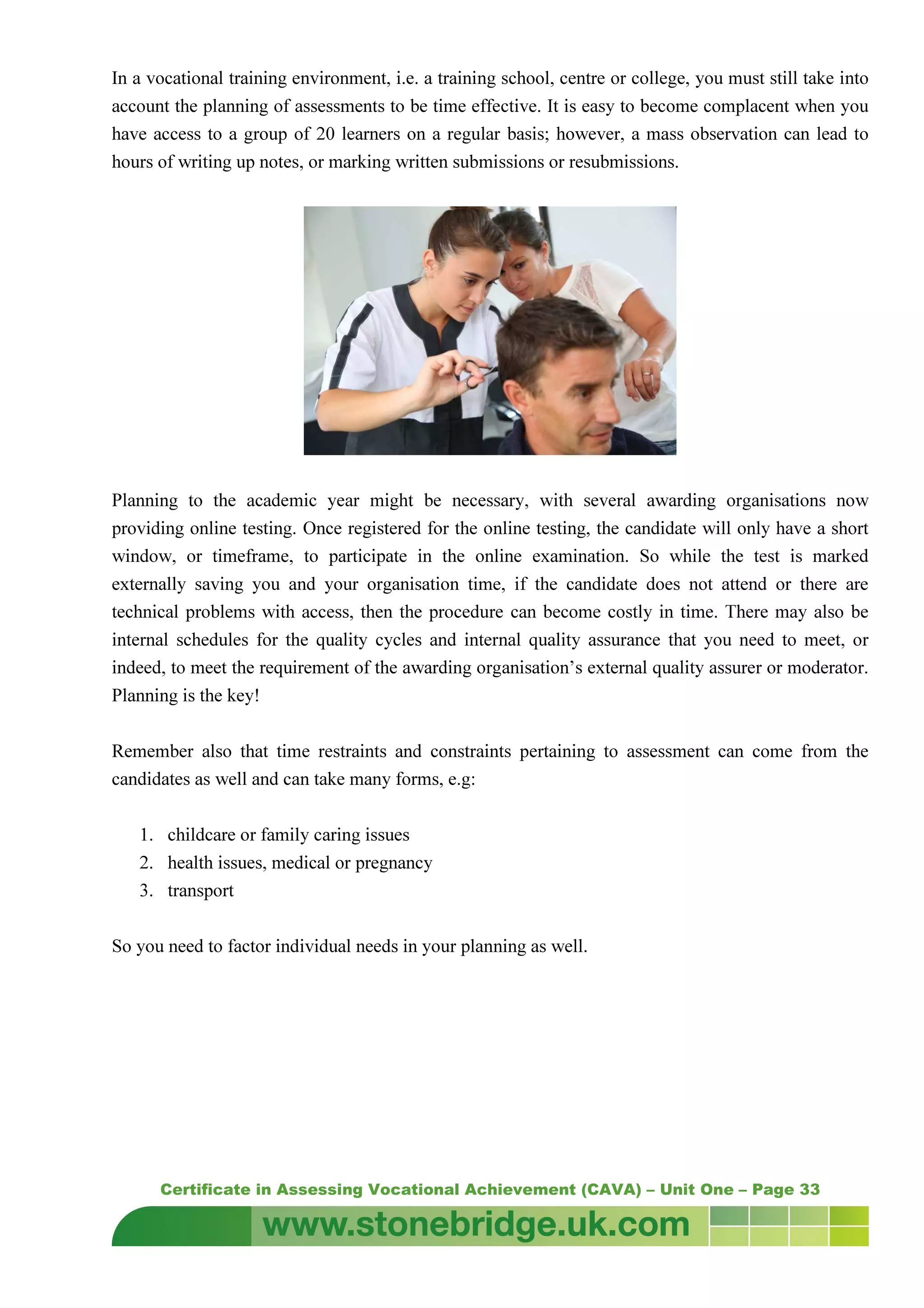
In a vocational training environment, i.e. a training school, centre or college, you must still take into
account the planning of assessments to be time effective. It is easy to become complacent when you
have access to a group of 20 learners on a regular basis; however, a mass observation can lead to
hours of writing up notes, or marking written submissions or resubmissions.
Planning to the academic year might be necessary, with several awarding organisations now
providing online testing. Once registered for the online testing, the candidate will only have a short
window, or timeframe, to participate in the online examination. So while the test is marked
externally saving you and your organisation time, if the candidate does not attend or there are
technical problems with access, then the procedure can become costly in time. There may also be
internal schedules for the quality cycles and internal quality assurance that you need to meet, or
indeed, to meet the requirement of the awarding organisation’s external quality assurer or moderator.
Planning is the key!
Remember also that time restraints and constraints pertaining to assessment can come from the
candidates as well and can take many forms, e.g:
1. childcare or family caring issues
2. health issues, medical or pregnancy
3. transport
So you need to factor individual needs in your planning as well.
Certificate in Assessing Vocational Achievement (CAVA) – Unit One – Page 34
Effectiveness of different methods
Having looked at the strengths and limitations of different assessment methods we will now look at
how to apply them in a practical sense. All of the assessment methods should be shared with and
explained to the learner/candidate at the beginning of the programme, so that they can identify
suitable sources that will contribute to their submissions. As already touched on, the purpose of the
assessment is important with regard to learner needs, but we also need to consider the following:
• Is it an individual or group setting?
• Is it ‘fit for purpose,’ i.e. will it meet the needs of the individuals, the context, be set at the
correct level?
• Have you taken into account any practical or resource limitations?
So, bearing these in mind, let’s look at the main methods we have reviewed in tables 1-3 and discuss
what we will encourage, where and why.
Observation of performance
This will vary slightly depending on whether this takes place in the workplace or training
environment.
In the workplace, other people involved in the assessment process might be colleagues who are
already experienced and qualified, along with paying customers or clients. This is often delivered via
the apprenticeship model, where the learner might attend training days at a college, but the practical
aspects are taught and assessed in the workplace. There is a significant amount of funding available
for the apprenticeship model and all can be assessed in the work place. To illustrate the subjects
available and which are the most popular, the top five apprenticeship vacancies, according to
apprenticeships.org.uk and published in Feb 2014, were:
• Business and Administration (31,558 vacancies posted online)
• Customer Service (12,091)
• Hospitality and Catering (8,372)
• Children and Young People’s Workforce (Childcare) (7,043)
• IT, Software, Web and Telecoms Professional (6,486)
Certificate in Assessing Vocational Achievement (CAVA) – Unit One – Page 35
While the most popular applications were for:
• Business and Administration (384,840 online applications made).
• Children and Young People’s Workforce (Childcare) (102,450)
• Customer Service (98,210)
• IT, Software, Web and Telecoms Professional (83,760)
• Vehicle Maintenance and Repair (67,750)
Remember that assessment in these environments can put undue pressure on the candidate as they
strive to meet the expectation of the clients/customers as well as meeting the requirements of
assessment, so it is important to establish a good relationship with the candidate and involve them in
the plan.
This is the very best environment to assess at summative level for occupational competency, i.e. the
ability to do the job to the national occupational standards, (NOS) for that vocational sector. This
presents opportunities to assess a number of criteria at the same time, however, the opportunity to
meet all criteria may be compromised if the session does not go to plan, e.g. a trainee hairdresser’s
client cancelling at the last minute.
A simulated, or training environment, is usually based in a further education establishment like a
college. With the benefit of full supervised delivery and training, on occasion, these will perform like
a business to prepare learners for the real life environment with workshops or days when the centre is
run like a business. It is not unusual for the same subjects to be available via an apprenticeship as
well as delivered by this method.
Examples of vocational education and training that are delivered in colleges, and which use ‘realistic
working environments’ for training and assessment, without the pressure of the ‘real’ work place are:
• Beauty therapy
• Hairdressing
• Catering
• Building and construction
• Motor repair and engineering
• Floristry
• Vehicle repair
• Engineering
Certificate in Assessing Vocational Achievement (CAVA) – Unit One – Page 36
Here, in this environment, as a teacher and/or assessor, you have the opportunity to work under
controlled situations and will support the learner in much more detail throughout the assessment
process.
Question: Can you remember what the main type of assessment is to help learners improve?
Within the college or simulated environment, the assessment process will still follow that of the
workplace, because ultimately it is to assess competency to occupational standards and to meet the
criteria.
TUTOR TALK: Did you know?
The National Council for Vocational Qualifications (NCVQ) was established in 1986 as
an independent body with funding from the government to develop a new set of standards
and qualification frameworks for England, Wales and Northern Ireland, while the Scottish
Council for Vocational Educational Training (SCOTVEC) did the same for Scotland. Both
liaised with awarding bodies to develop the structure of the NVQ and agree the required
quality assurance processes.
Effective Observation – Figure 1
Planning is the key to successful and effective
observation. Your organisation or awarding
organisation will supply exemplar recording
paperwork, or suggest a checklist type form. So long as
the decision is recorded for audit purposes and the
candidate understands what the outcome of the
assessment is and anything they need to do to improve
is clear, then the method should suffice; however, you
must try to ensure that it does not become too
complicated. An example is included here in Figure 1.
Points to remember:
Before the assessment
• Plan the assessment with the candidate.
• Ensure that the candidate understands what is required.
Certificate in Assessing Vocational Achievement (CAVA) – Unit One – Page 37
• Ensure that the workplace is aware that you are visiting.
• Ensure that you are aware of and follow any requirements, signing in, safety procedures or
protective clothing (like hard hats if visiting a construction site).
• Ensure that all other parties such as other employees, line managers, clients and customers
are aware of your presence.
• Discuss with the candidate where you should sit or settle to avoid disruption in the
workplace/ setting.
During the assessment
• Keep the observation ‘unobtrusive’. This means out of the eye of the candidate, so that they
do not feel any more nervous!
• Avoid the eye line of any clients and customers too, so that they react and respond naturally.
• Record your judgements and comments as you go along (this will save time and be more
accurate).
• Maintain your professionalism and remember to ensure that your body language is positive!
After the assessment
• Always find time to discuss the outcome and give feedback while it is all fresh.
ACTIVITY
Locate your organisation or awarding organisation’s suggested exemplar assessment plan.
Is there anything you think you would like to add?
Certificate in Assessing Vocational Achievement (CAVA) – Unit One – Page 38
Feedback
Feedback needs to be timely, constructive, specific and should be a positive process, and experience!
Remember the purpose for giving feedback is to improve the learner’s performance and you will
alienate and discourage them if you are just critical or offensive, so it is important to give the
feedback while the events are fresh. The exception to this would be if the learner became highly
emotional, perhaps because they felt that they were not performing well. In this situation, be
supportive, and advise them that you will wait until they have calmed down before you give them
feedback.
You should always ensure that the feedback is specific and clear otherwise the learner may not
understand what is actually required.
Regardless of whether the feedback is positive or negative you
should always start with a positive comment, ask how they
thought it went and then address the bulk of the assessment,
ending on a constructive and positive note, so that while the
specific points are addressed, the learner will know exactly what
they need to do to improve.
When engaging in giving, what might be regarded as negative feedback, you should still try to find
some positive points and avoid ‘pointing the finger’ by giving feedback from your own perspective,
like saying, ‘I think this could work better next time if……’ rather than ‘ you did it wrong and
messy’.
Many new assessors can overdo this and end up sandwiching the constructive feedback between too
many positives as they don’t want to ‘offend’ the learner. When this happens the learner can go away
with the impression that everything is good, when really, there are areas that they need to work on.
Case Study
Trainee chef, Jonathan, has plated up food in a sloppy, untidy and disorganised manner.
Assessor feedback: Well, Jonathan, I think you look very professional, and from an appearance point
of view, you have done very well. However, the plating up, seemed a little rushed resulting in the
food cooling as you spent so much time trying to tidy the plates, and clean up the servings. Do you
think there is a way you could have tried to serve more tidily?
Certificate in Assessing Vocational Achievement (CAVA) – Unit One – Page 39
I would suggest that you practise a little more. I would try to perform the whole task a little slower
next time, as the longer the food is on the plate, the more it will cool. So remember which order to
plate up in, and take your time, and I’m sure that your plates will look as good as you do next time!
Do you think this is a good example of feedback?
Examples of good practice:
• Assessment planning – http://www.youtube.com/watch?v=Rp9P3_tJ-b4
• Assessment feedback – http://www.youtube.com/watch?v=4_JxCnRPaaU
Assessment Criteria 3.2: Evaluate the benefits of using a holistic approach to assessment
A holistic approach to assessment will cover a wider range of performance where possible, and try to
make the process of assessment a more natural activity rather than performing specific individual or
isolated ‘pockets’ of the skill or knowledge. Particularly appropriate to skill-based competencies
where you may wish to observe a task which encompasses several criteria, for example,
communication and service or treatment. These assessments can also be enhanced and supported
with oral questions which could cover additional criteria.
Case Study
A trainee electrician, Steve, needs to be assessed to demonstrate competency against the following
criteria:
Be able to apply essential electrical installation techniques.
3.1 Perform the following techniques using industry standards and accurate measurement.
a. common cutting techniques using appropriate tools
b. mechanical and non-mechanical jointing techniques
c. bending techniques – spring and machine
d. fixing techniques to brick, plasterboard, wood and metal surfaces
But the assessor has noticed that the written submission for the criteria ‘Know about the key
legislation and Codes of Practice and their impact on electrical installation’ is lacking in some detail.
The assessor has decided to question Steve orally, in order to try and clarify that he does have and
understands that knowledge and can work to that legislation. This has become a holistic assessment
saving time on the resubmission of written work.
Certificate in Assessing Vocational Achievement (CAVA) – Unit One – Page 40
The value of the holistic assessment method is that it is efficient and effective if planned correctly.
As most qualifications are constructed of units, each with their own assessment criteria within the
learning outcomes, this gives the candidate the opportunity to cover different ranges at a time within
that unit.
In summary, this model can:
• Link knowledge and performance-based criteria in one assessment meaning less work for the
learner and assessor.
• Enable the learner to achieve units more quickly, through identifying a variety of assessment
methods and evidence that can be used for more than one unit.
• Maintain motivation, as several aspects can be validated at the same time.
• Provides a natural progression from one outcome to another.
Assessment Criteria 3.3: Explain how to plan a holistic approach to assessment
When planning a holistic assessment you need to ensure that you plan to take into account and
advantage of naturally occurring opportunities over a variety of activities.
A discussion should take place between the assessor and learner to identify the specific tasks that can
provide evidence to meet the assessment criteria. This can be within the training environment or the
learner’s real life work environment. Here you need to identify what types of naturally occurring
evidence may be available so that they can be included in the assessment plan.
Certificate in Assessing Vocational Achievement (CAVA) – Unit One – Page 41
In the YouTube video that we recommended earlier, http://www.youtube.com/watch?v=Rp9P3_tJ-
b4, you can see how this planning is discussion-based, with both parties working together to
construct the format of the session in great detail, which is then recorded in an assessment plan to
ensure that nothing is omitted.
Eventually, that plan should include the following:
• Units, learning outcomes and assessment criteria to be assessed
• Types of evidence that will be acceptable, e.g. observations, witness statements, questioning,
etc.
• When and where the assessment will take place
• Duration (timing) of the assessment
• Review date
• Record of outcome and action plan which should be signed by both the candidate and
assessor for internal quality and audit trails
Assessment Criteria 3.4: Summarise the types of risks that may be involved in assessment in
own area of responsibility
There are a number of risks that you will need to be aware of. Some will appear quite straight
forward, however, others will require more experience to identify. They fall into two main areas:
• Organisational or legislative, i.e. Health and safety relating to the environment, e.g. of
assessing in an engineering environment, construction or pool. Safeguarding, e.g. the
disclosing and barring service check (DBS) has taken over from the criminal records bureau
(CRB) and is applicable to working with young people who are classed as vulnerable adults.
Equality & diversity, ensuring that learners are not disadvantaged in any way and are aware
of any special considerations or issues that may arise. Risk to confidentiality or data
protection.
• Assessment related, i.e. candidate is unaware of assessment requirements through poor
planning, assessor not competent, occupational standards unavailable and documentation
unavailable, employer is unwilling to allow appropriate time or resources for assessment.
Inconsistency between assessors.
Certificate in Assessing Vocational Achievement (CAVA) – Unit One – Page 42
In addition to those above, other risks include:
a. Over-assessment
b. Unnecessary or unrealistic stress on the learner
c. Variation to the plan owing to unforeseen circumstances, cancellation or illness
d. Disruption in the workplace
e. Unfairness to the learner, bias or discrimination
f. Conflict of interest – where perhaps the work-based assessment is set in a family business or
the assessor and candidate are friends
ACTIVITY
Apart from the generic risks to assessment that we have just covered – give five risks
specific to your own occupational field. For example, if you were assessing in a gym, the
malfunctioning of equipment may be a risk.
For an example of how NOT to plan an assessment – look at
http://www.youtube.com/watch?v=n_gc6UQBYDg and see how many errors you can see in that.
Assessment Criteria 3.5: Explain how to minimise risks through the planning process
While planning will help to identify possible risks, it will not be able to eradicate all. It is your
responsibility to plan effectively and efficiently in order to provide the best opportunity for your
candidates. We have looked at the main risks associated with assessment, so now need we to look at
how to identify any actions required to help the process.
Assessment strategies – ensure that the awarding organisation directives are clearly followed, that
all appropriate assessment criteria and information is available and that assessors, or you, are
competent to assess the particular performance or skill. Assessment plans should be agreed with the
learner beforehand and appropriate methods of assessment identified to ensure that it is all valid and
reliable, and there is no wastage of evidence or time. Discuss and agree if any adaptations are
required or special dispensations and explain the appeals procedure, so that the candidate is clear of
the process should they not agree with your decision. Finally, ensure that all agreements are recorded
and signed by both the candidate and assessor; this will provide an audit trail for the internal and
external quality assurance processes.
Certificate in Assessing Vocational Achievement (CAVA) – Unit One – Page 43
Health, safety and safeguarding– check that access is available and that any procedures for guests
are followed to meet the particular business or organisational standards, e.g. visiting a day care home
might require your identity as the guest, to be checked and an identification badge to be worn while
visiting, or the production of a DBS check when assessing in the workplace where there are
vulnerable adults. Visiting or assessing in a healthcare setting might require that you wear a uniform
or protective gloves if in contact with your learner or candidate and service users on a regular basis.
A visit to a construction site might involve having to wear protective headwear and fluorescent
jackets, so always plan for your own requirements as well as those of the learner/candidate.
Variation to the plan – during the initial discussion with the candidate, there should be time given
to the discussion of contingency, i.e. back up plan in case things do not go to plan on the day.
ACTIVITY
Think of what could go wrong if you were to arrange to assess someone on a hospitality
course performing duties on reception, the aim to holistically assess someone greet a
client, confirm their reservation and take payment.
1. List the things that could, or might not, happen.
2. Construct a scenario, over which you have more control to meet the criteria.
Planning is the key way to limit the stress of assessment, and where you may find that the process
becomes complicated or you are unsure of the limit of your own authority within the assessment
situation. You must request guidance from your internal quality assurer who will have overall
responsibility for the assessment process within your organisation.
Learning Outcome 4: Understand how to involve learners and others in assessment
We have already discussed the involvement of others in the planning aspect. Here we will look in
more detail at the involvement of others in the actual assessment and the value in that.
In this learning outcome there are four assessment criteria:
a. Explain the importance of involving the learner and others in the assessment process.
b. Summarise types of information that should be made available to learners and others
involved in the assessment process.
Certificate in Assessing Vocational Achievement (CAVA) – Unit One – Page 44
c. Explain how peer and self-assessment can be used effectively to promote learner involvement
and personal responsibility in the assessment of learning.
d. Explain how assessment arrangements can be adapted to meet the needs of individual
learners.
Assessment Criteria: 4.1 Explain the importance of involving the learner and others in the
assessment process
Everyone involved in an assessment needs to understand the process and what will be involved. As
discussed in the planning stage, this will include:
• the learner/candidate
• people at the workplace who might provide witness testimony
• employers
• supervisors
• trainers
• colleagues
• peers
Benefits of involving the learner will help them contribute to their independence and identify
assessment evidence. This provides ‘transparency’, which means that the learner will understand the
actual criteria, or standard, and how the assessment decisions are made. In many assessments, like
exams, these are usually judged by someone else who decides how well the learner has performed.
However in QCF qualifications, the learner must be involved in many different ways. Once the
learner is able to understand the assessment requirements, they can suggest and identify opportunities
and contribute to planning their own role and participation in the assessment. All learners should be
supported by the assessor in pacing themselves so that they can produce the evidence for assessment
on an agreed timescale.
This will also encourage ‘efficiency,’ where the learner can identify where the evidence can come
from, for example, a witness testimony or attendance at a work review that may contribute to aspects
of personal development.
We have looked at the initial and formative assessment, and have evaluated the importance of the
learner understanding these. Throughout the training and assessment process it is important that the
learner is engaged in reviews to ensure that they are comfortable with processes and expected
outcomes in terms of performance and timescales, and are aware of what they are doing.
Certificate in Assessing Vocational Achievement (CAVA) – Unit One – Page 45
Reviews
Learner reviews are usually best done at the end of a feedback meeting for each assessment and can
be informal or formal, and conducted face to face by Skype, via email or by telephone. All reviews
should be recorded and the assessment plan should be updated with any changes of new
targets/actions once this has been agreed by the assessor and learner. If a learner cannot be present
immediately after the assessment for the review, perhaps owing to work commitments, then it is
important that the assessor sends the updated assessment plan as soon as possible and they need to be
signed, dated and used as evidence of an agreement.
These days, we will see that this often runs alongside, if not blended with the individual learner plan
(ILP), which feeds the individual learner record(ILR), which is required for funded programmes.
Other assessments
Self-assessment
Many people can learn how to self-assess, and this will often fall to the teacher, trainer, mentor or
assessor on their programme to help guide them. This will enable the learner to become independent
and take charge of the work they are producing, and become responsible in achieving new skills and
knowledge to become work ready. It can start with a statement as simple as, ‘How do you think that
went?’ as this will encourage assessment or reflection.
Self-assessment must be realistic and accurate. The learner needs to be able to recognise strengths,
weaknesses and then ways for improvement for next time round. Listen to their suggestions and
comments – are they striving for a level of performance that is not appropriate for the level of the
programme?
Peer Assessment
Here we can construct a situation where there is an opportunity for practice under supportive and
controlled conditions, where learners can discuss and assess each other’s work.
Certificate in Assessing Vocational Achievement (CAVA) – Unit One – Page 46
You must ensure that you have given clear instructions on peer assessing and have set ground. A
helpful way to make sure that all learners will give constructive feedback could be to create a
structure for them to follow which will note strengths as well as any areas that they might need
improvement on for them to use when giving peer assessments. The main rules are to give feedback
on the work or performance and not the individual.
Everyone involved in the assessment process should have their name, role and contribution recorded.
This is often used as a tracking form with specimens of signatures for authentication and is held at
the beginning of the portfolio of evidence or included in the ILP as previously mentioned.
Assessment criteria 4.2: Summarise types of information that should be made available to
learners and others involved in the assessment process
In order to make the assessment process understood by all, there will be a system, an internal quality
assurance system, which will deliver all of the information to all parties.
For the learner, there should be a clear induction at the beginning of the programme. Inductions are a
requirement for most funding contracts and a point of inspection for Ofsted, the purpose being to
ensure that the learner understands what will be required, the language used and the paperwork
necessary to complete the evidence and assessment audit trails. Apart from registration information
and personal information collected for the individual learner record, there will also be information
pertaining to the results of the initial and diagnostic assessment and any special requirements or
dispensations required. Copies of certificates to prove prior learning and experience will also need to
be kept for any additional assessors, internal quality assurers or external persons to inspect. Also, as
a point of best practice, it is here that the learning agreements or individual learning plans are agreed
and learner, assessor and employer responsibilities are identified, along with appropriate policies and
applicable procedures, for example, health and safety.
It is usual for the induction to be evidenced and signed by the learner and assessor.
Certificate in Assessing Vocational Achievement (CAVA) – Unit One – Page 47
Other information:
• tracking forms
• authenticity declarations
• witness status statements
All these will contribute to the learner information.
An assessor will also need to keep records regarding the actual assessment planning, and results of
work marked and test scores, as well as document feedback to the candidate. The assessor will often
liaise with the centre and others regarding timing, date and location of the assessments, as well as
any policies specific to the centre or organisation.
Keeping records organised is the key, not only for your own
convenience, but for audit purposes. At all points, the learner should
have the standards and criteria against which the assessments will take
place available to them, so all should be furnished with copies of the
units and learning outcomes, followed by assessment plans with dates
and evaluations being updated throughout the programme.
Assessment criteria 4.3: Explain how peer and self-assessment can be used effectively to
promote learner involvement and personal responsibility in the assessment of learning
Learners need to be involved in self and/or peer assessment in order to develop the ability to make
judgements about themselves and their work. It can also encourage them to take ownership of the
work and standards they need to achieve in order to work independently while developing their skills
and knowledge, resulting in commitment to the outcomes.
In a peer assessment, reports such as observation reports, or meeting notes which catalogue a
learner’s involvement, can be very useful and will help meet the requirement of the assessment being
realistic and accurate, while also being able to identify areas of strengths and where there are
limitations.
Certificate in Assessing Vocational Achievement (CAVA) – Unit One – Page 48
Peer assessment can be used successfully in allowing more skilled and knowledgeable peers to
advise and help other learners. This reinforces and clarifies the information one learner may already
know, while helping to instruct and advise other learners, giving opportunities for constructive
feedback and support focusing on the work’s strengths, but including areas for improvement and not
focusing on the learner, as outlined in assessment criterion 4.1. This also contributes to the
development of a range of transferable life skills, which will be valuable to learners, while on
programme and later when in employment.
Self-assessment can be performed through performance reviews and then monitored through the
setting and achievement of specific goals and targets which can be either personal or professional.
This can also be achieved through an analysis of strengths and weaknesses, like SWOT (strengths,
weaknesses, opportunities and threats), which is another way to identify opportunities for
improvement. Reflective practice is also a valuable tool and can also be formal or informal, but
needs to focus on improvement using the main questions covered in learning outcome 2.
How did that go overall?
• What went well?
• What didn’t go so well?
• How did others react?
• How did I feel?
• What would I change next time?
Both methods will help learners to become more autonomous and able to recognise the strengths and
weaknesses of their own work, and is particularly effective when learners are in the workplace.
Usually, learners in the workplace are more likely to be reliant on their own judgement of themselves
and their peers, as they can measure their own performance over a range of situations and contexts.
Remember that all assessment should become part of the learning process and encourage a stronger
commitment to understanding and applying information, as the learner will not have the benefit of
the assessor’s feedback once the programme is completed.
Certificate in Assessing Vocational Achievement (CAVA) – Unit One – Page 49
Assessment criteria 4.4: Explain how assessment arrangements can be adapted to meet the
needs of individual learners
The initial, or diagnostic, assessment of learners at the beginning of a programme is designed to
identify areas where additional support may be needed, for example with literacy or numeracy, and is
aligned with regulations from awarding organisations.
Negotiation of the plan and agreement with the learner, to ensure that the learner is in full agreement
and understands what is required is vital, and should be comprehensive and signed by the
learner/candidate. Any changes to the plan should also be recorded, dated and signed.
Reasonable adjustments and special considerations, for example, extra support may need to be given
to learners with dyslexia, or who find it difficult to organise and present written work. Extra time can
be given if needed in order to complete assignments. Maybe an agreement to rely mainly on
observation and discussion, after notification to, and agreement from the awarding organisation
should there be severe issues regarding the literacy of a learner. Remember that literacy may not be
as vital for some practical-based occupations like floristry, as it would be for administrative
qualifications.
The assessor may help a learner to utilise all opportunities for work-based and holistic assessment
observing unobtrusively to see naturally occurring evidence regardless of whether it is office, retail,
hospitality or based in another work setting like a floristry or garden centre environment.
Certificate in Assessing Vocational Achievement (CAVA) – Unit One – Page 50
Also included, and arrangements that might need to be adapted, are any specific conditions in
relation to:
• time
• resources
• technology
• work environment
• recognition of prior learning
TUTOR TALK: Did you know?
The use of red pens is discouraged in recording and marking papers as it is believed that
the colour can be construed as aggressive.
Now, many assessors and internal quality advisors use different coloured pens, often assessors will
use one colour and an IQA will use another colour so that work can be easily identified as assessed
or quality assured-most popular are turquoise, pink and green.
Case Study
A learner has a disability and is in a wheelchair and studying for a Beauty Therapy qualification.
Your responsibility is to adapt the assessment to ensure that the learner is not disadvantaged in any
way, so you will need to include the learner in the planning process.
Adaptations that may need to be made, but which will be discussed and agreed with the candidate,
may require that the observation checklist is adapted (don’t forget that this will need to be agreed
with the AO using their reasonable adjustment policy).
Certificate in Assessing Vocational Achievement (CAVA) – Unit One – Page 51
Example for a manicure assessment:
a. Location – will need to be wider to accommodate the wheelchair, so maybe not the usual
designated area.
b. Workstation – will need to set up differently so that the candidate can access equipment and
products safely.
c. Power – electrical socket will need to be accessible to the candidate and within appropriate
distance so that risks are minimised by trailing wires.
d. Appearance – uniform may need to be adapted.
e. Record keeping – may need to involve a colleague to retrieve client information if records
are not accessible owing to storage.
f. Timing – should not be affected, as this is a commercial treatment and will need to be
completed within the commercially accepted time to meet the assessment criteria.
Learning Outcome 5: Understand how to make assessment decisions
This outcome focuses on exactly how we make our decisions and looks at the evidence that the
learner will produce for us to base our judgements and decisions on. While this appears to be quite a
short learning outcome, it is based on all the information we have uncovered so far, and what will be
reinforced later. Regardless of the type of evidence, there are still some rules that apply.
Learning outcomes for this are:
• Explain how to judge whether evidence is sufficient, authentic and current.
• Explain how to ensure that assessment decisions are made against specified criteria, valid,
reliable and fair.
Assessment criteria 5.1: Explain how to judge whether evidence is:
• sufficient
• authentic
• current
Certificate in Assessing Vocational Achievement (CAVA) – Unit One – Page 52
Judging evidence needs to be in line with the awarding organisation and
centre requirements and needs to follow the rationale from the awarding
organisation and the types of evidence that are acceptable along with the
experience, competency and qualification of the assessors and internal
quality assurers. If you are ever unsure or doubt your own judgement, you
must always ask for guidance from someone within your organisation who
is more experienced.
Attendance at standardisation meetings will help develop your judgement
process, and also reading notes from any missed meeting or historical
information will help you be sure of what is expected.
ACTIVITY
Locate your organisation’s centre file and make a note of any centre requirements that
differ from the awarding organisation requirements, for example, sample ratios.
When making judgements we need to look at the evidence and need to ensure that it is:
Sufficient: Evidence needs to be collated to meet the requirements of the learning outcomes and
assessment criteria at the correct level. Evidence from more than one occasion, usually over a period
of time will also show sufficiency.
Most awarding organisations will insist that understanding or competencies are demonstrated across
a range of scenarios or conditions. An example of this is within this qualification, where you will
need to assess learners/candidates that are new to the assessment process, as well as those who are
experienced in the assessment process. You will also need to assess the same criteria at least twice at
different times to ensure consistency in your assessment decisions. All these will need to be
performed within a specific timeframe, and your awarding organisation or centre will have
guidelines on the timings between observations and assessments, which can vary from between one
to three months.
Authentic: You need to be able to confirm that the evidence is genuine and has been produced by
the learner. Usually a declaration of authenticity will have been signed to state that the work is their
own, however, you will still need to check that there is no plagiarism, and that any additional witness
testimony or statements are credible. In the event that you are unsure if the work is their own, you
will need to investigate further, usually by questioning and asking them to explain processes or give
a scenario, and asking how they would respond. If you are still unsure, then ask for advice from your
internal quality assurer.
Certificate in Assessing Vocational Achievement (CAVA) – Unit One – Page 53
Current: The evidence needs to meet the awarding organisation’s policy on currency and have been
produced recently, and in accordance to the timescale agreed on the assessment plan. Not only will
the candidate need to show that the evidence is current, but also demonstrate an awareness of current
legislative information in certain areas of their occupation, or the awareness and use of the most
recent equipment and products if applicable in their area. Finally, if the learner is claiming
recognition of prior learning and experience, this too must demonstrate that knowledge and skills
meets current levels. For example, someone who trained in administrative or customer service ten
years ago, may not have awareness of current data protection requirements or knowledge of how to
use word and excel at the level required for the qualification today.
Assessment criteria 5.2: Explain how to ensure that assessment decisions are:
• made against specified criteria
• valid
• reliable
• fair
Having already explained what to take into account when making the judgements, we now have to
look at accuracy and consistency in our decisions and to do this, we will look at the four main areas
that need to be considered when making those decisions.
Decisions must be:
Made against specified criteria: Familiarity with the assessment outcomes and criteria is essential
for both you and the learner, so you should have identified the specific criteria during the planning
process and the methods to best meet the requirements set by the awarding organisation.
Valid: You need to follow the plan and only measure against standards and not your own personal
views. An example might be when observing someone in a coffee shop studying customer service,
who has changed their uniform slightly, but if the wearing of a uniform is not mentioned in the
standard, then you cannot use it as a criterion for the assessment. However, you can record as
developmental feedback, just as you can record positive feedback that demonstrates that the
candidate has excelled in any areas not related to the criteria.
Certificate in Assessing Vocational Achievement (CAVA) – Unit One – Page 54
You also need to check that this is the normal standard for this candidate and that they perform
consistently at this level. This can be supported by multiple observations, similar to the sufficiency
aspects, and can be evidenced with other methods such as witness statements, discussions and
questioning.
Reliable: This means that the standard of your decision making is in line with awarding organisation
guidelines and your centre. This is usually checked at standardisation meetings, with the internal
quality assurance system and through moderation.
Fair: This means that you must not discriminate against any learner, and that all requirements that
may need to be applied to vary the process to give the learner the best opportunity for an unbiased
assessment are applied. Again, you need to only judge against the criteria, and base the decision on
actual evidence and not supposition.
ACTIVITY
Within your own area of occupational competency, outline what assessment methods you
would use and what you would look for in terms of evidence, for a candidate who is
bringing with them a previous qualification from 2006 as proof of prior learning towards a
newer or higher qualification. Choose a qualification. Perhaps even your own, and go
through the checks that you will need to make.
Remember, this is an activity and does not need to be submitted to your assessor for
marking.
TUTOR TALK: Did you know?
Assessments decisions are classed as ‘pass’ or ‘refer’, which replaced the term ‘fail’
because the term ‘fail’ implied that the outcome was unsuccessful and there was no
opportunity to learn from the experience or try again.
Certificate in Assessing Vocational Achievement (CAVA) – Unit One – Page 55
Learning Outcome 6: Understand quality assurance of the assessment process
Quality assurance is vital to ensure that everyone involved in the assessment process is working to
the same standards at the same level, and offer all learners and candidates the opportunity for fair
assessments. In this learning outcome we are going to cover the following:
• Evaluate the importance of quality assurance in the assessment process.
• Summarise quality assurance and standardisation procedures in own area of practice.
• Summarise the procedures to follow when there are disputes concerning assessment in own
area of practice.
Assessment criteria 6.1: Evaluate the importance of quality assurance in the assessment
process
For any qualification to be offered by an awarding organisation, they must meet the requirements set
by Ofqual, which are systems that are rigorously monitored to ensure consistency across all the
awarding organisations and centres offering the same qualifications. Centre recognition and approval
will only be granted to centres who can illustrate a good robust system.
A robust system will include all of the aspects that we have discussed before in a transparent and
fully auditable format with good record keeping and evidence of sharing of good practice and
standardisation.
The internal quality assurer will take responsibility and provide support so that all assessors assess
learners consistently and that regardless which assessor would assess a candidate, the outcome would
be the same, with opportunities for improvement delivered via constructive and supportive feedback.
They will then sample the assessor’s work to ensure that it is consistent and meets the standard,
checking portfolios, marked work, observations, record keeping, assessment planning and feedback,
as well as any final summative assessments, like exam papers. Once all is checked, it can be
presented for the External Quality Assurer – or (EVA), formally the external verifier, to sign off and
authorise the claim, once they are assured that all process have been followed, that the evidence is
appropriate and the assessment decisions are correct. If, at any of the visits, there is a breach of
protocol or evidence of bad practice, then the report produced will contain actions, which will have a
time limit for action, and if the actions are not addressed then the direct claim status will be
withdrawn until the processes improve and there are no actions.
Certificate in Assessing Vocational Achievement (CAVA) – Unit One – Page 56
This is applied to all vocational areas which can range from
customer service and administrative qualifications to
performance and skill-based qualifications like hairdressing,
veterinary assistants or car mechanics to name a few.
Ultimately, the goal of the assessment process is that the
registered learner achieves the qualification and their
certification of competency, based on the evidence supplied
by the learner, assessed by the assessor and checked by the
internal and external quality assurers.
Assessment criteria 6.2: Summarise quality assurance and standardisation procedures in own
area of practice
The policies and procedures that govern the quality assurance process will be defined at awarding
organisation level to meet the occupational standards and then implemented at centre level. Your
centre will have its own specific processes, for example, sample rations and schedules for
standardisation and observation of assessors.
The EVA will need to see evidence of the standardisation meeting minutes and agreement of
assessment methods, along with sharing of good practice, shadowing and evaluations from the IQA
and EQA, with appropriate paperwork to support planning, learner feedback and records of continual
professional development (CPD).
Not only will you have to maintain a commitment to development within your vocational area, like
maintaining your current occupational competence or upskilling to keep up to date with changes
within you area, but you will also need to commit to lifelong learning – and that can mean
maintaining memberships to professional organisations or bodies.
As occupational standards change and are updated, the awarding organisation will, in turn, change
their regulations and it is your responsibility to check for updates by responding to the alerts
published by the organisation via their websites, newsletters or bulletins.
The IQA may be contracted to your organisation on a part-time basis while also supporting other
centres. Even if this is the case, the IQA is still responsible for the standardisation of the assessment
process and you should still follow their lead and report to them.
Certificate in Assessing Vocational Achievement (CAVA) – Unit One – Page 57
ACTIVITY
Provide a chart to illustrate the quality assessment process in your organisation,
completing with names or initials and their responsibilities.
For example:
Standardisation example: standardisation is not just about meeting, but activities as well. The
following as an actual event, that took place in 2013, when I was acting as Lead Internal Quality
Assurer. I had noticed during sampling that a particular assessor was accepting photographic
evidence that I did not agree should be accepted, so I asked the assessor to explain what she could
see in the photograph. She explained several aspects correctly, and when I asked her to look more
closely, she could still not ‘see’ what I could. I asked her to explain and describe exactly what she
could see in a specific place – and then she noticed the flaw.
Once this was identified, we cascaded the same photograph to other assessors to see if they also
could ‘see’ what I had. Results were that all were able to break down the holistic image and examine
the components of the evidence. This is an example of sharing good practice and standardisation
which was recorded and signed by all who participated.
ACTIVITY
Think about a time when you have participated in a standardisation meeting. Outline what
you did, or what activity you participated in, and how it affected your practice.
Certificate in Assessing Vocational Achievement (CAVA) – Unit One – Page 58
Assessment criteria 6.3: Summarise the procedures to follow when there are disputes
concerning assessment in own area of practice
The awarding organisation will have an appeals procedure that the centres must follow and all within
the assessment process must be advised of this. There will a documented process that will cover the
actual process, personnel involved and the criteria for their roles, i.e. number of years of vocational
experience, minimum qualifications, criteria for confidentiality, discrimination and audit, so that any
learner/candidate who does appeal is not disadvantaged in further assessments. All these need to be
fully documented and recorded.
Initially, this will be communicated to the learners when they first embark on their programme,
induction will include the assessment process and appeals procedure and there will be a signed
declaration to say that this has been delivered and understood.
New assessors appointed to the centre will also engage in an induction with the IQA, as well as
assessors taking on new caseloads, so that they are aware of any outstanding issues or disputes.
There should also be a chart or organisational structure to illustrate the personnel involved:
There are areas that can give rise to disputes, whether justified or not. There are certain actions that
you can take to help minimise the instances of disputes and maintain a good standard of practice in
the process and good relationships with candidates. Although it is good to remember that if a
candidate does dispute a decision or part of the process, it is better to keep any discussion and
negotiations on a formal footing rather than as an informal chat that could lead to further
misunderstanding or the possibility of accusation.
Where there is a disagreement between yourself and a learner/candidate
over a decision, ensure that the outcome, and the reasons for that
decision are clearly explained in relation to the criteria. It should be
legible and detailed – always record your information as though a third
party, who is not present, was going to make a decision – that way you
should include and be able to justify your decision. Explain to the learner
that in the first instance the appeal should be informal and explain the
reason for your decision in a constructive way, in the event that they still
do not accept your decision, then explain how it can be referred to an
alternative assessor, and what will be involved in that process – reiterate
that it will not affect further assessments.
Certificate in Assessing Vocational Achievement (CAVA) – Unit One – Page 59
Always return a candidate’s work on time, and at the same standard. One of the most important parts
of the assessment process is to encourage the learner to commit to the process and take ownership,
however, if you do not show the same commitment, then it might indicate a lack of respect on your
part to the process and the learner.
If you suspect that the work is not that of the candidate, then you will need to investigate. This can be
identified in a number of ways but the most common is plagiarism, which we discussed earlier.
Remember that there may be limits to the vocabulary of a learner whose first language is not English
but you will still need to ascertain levels of understanding. The way in which this is handled does not
need to be accusatory, but can be exploratory, accepting that they have provided the answers, but that
you need to check the understanding with further questioning. This can also be applied to ‘study
buddies’ who are friends, work together, research together and then submit almost identical work.
Here, the aim is to explain the benefits of working together, the peer support and review that we have
also looked at, but to be really sure that both ‘buddies’ understand the outcome. Separate questioning
and asking them to differentiate their work, will help later. If they understand the issue, then you can
encourage them to work slightly differently.
Always ensure that you behave in a non-discriminatory and fair way. This will be best evidenced at
the planning stage, so you should seek agreement for assessment methods and ensure that the learner
agrees to any special changes required for the assessment, and reiterate the transparency and fairness
of the process. Once the learner has accepted this and signed – as long as you do not deviate from the
plan (other than to intervene should there be a health or safety issue), then there should be no
grounds for dispute.
Keep meticulous records when it comes to receiving and marking a learner’s work. Not only should
you supply individual feedback in detail, but also complete tracking sheets and get the learners to
initial when you and they have received the work. Some colleges will keep copies of all feedback in
the student file as a backup and for ease of reference for tracking purposes. This will help to limit the
number of disputes regarding ‘lost’ or ‘misplaced’ work, when the candidate might suggest that they
have handed something in but not received it back.
ACTIVITY
Design a simple tracking sheet to monitor a candidate’s submissions of written, theory
only, or knowledge-based evidence. What do you think you would need to include?
Certificate in Assessing Vocational Achievement (CAVA) – Unit One – Page 60
All procedures are there to protect both the learner and the assessor, but as the experienced person
leading and supporting the candidate, it will be your responsibility to monitor recording paperwork
and systems, whether health and safety, for delivery of the programme and the actual decision
making at formative or summative levels.
TUTOR TALK: Did you know?
In 1996, a report on a review of 100 NVQ and SVQ’s supported the NVQ/SVQ concept,
and 80% of employers agreed that competence-based standards were right for vocational
qualifications.
Learning Outcome 7: Understand how to manage information relating to assessment
In this outcome, we will look at information and how it is protected and used. Criteria for this
outcome are:
• Explain the importance of following procedures for the management of information relating
to assessment.
• Explain how feedback and questioning contribute to the assessment process.
Assessment criteria 7.1: Explain the importance of following procedures for the management
of information relating to assessment
The main regulation governing the management of information and confidentiality falls under the
domain of the Data Protection Act of 1998 and has eight principles which state that data must be:
• fairly and lawfully processed
• processed for limited purposes
• adequate, relevant and not excessive
• accurate
• not kept for longer than is necessary
• processed in line with your rights
• secure
• not transferred to countries without adequate protection
Certificate in Assessing Vocational Achievement (CAVA) – Unit One – Page 61
You can see the full information of this at http://www.legislation.gov.uk/ukpga. While the Data
Protection Act needs to be adhered to vigilantly, the actual process to ensure security of that
information will be the responsibility of the centre and monitored by the awarding organisation.
The types of information that fall under this are written, hard copy records, as well as electronic
records. If written hard copy, they need to be stored in a lockable cabinet or file, and if altered at any
time, need to be dated and signed. Electronic records should be password protected.
Information will need to be accurate and secure as it will provide an audit trail. All assessment
personnel should have methods for record keeping and have copies of all important information that
can be made available to the external awarding organisation when requested. As we have already
mentioned, the learner should also have a copy of all their assessment results, which are held in the
centre file tracking sheets, the individual learner records and the learners’ own portfolios.
Outside agencies such as the Skills Funding Council have legitimate rights to access information for
benchmarking and statistical analysis, but are required to have the correct systems in place to process
the information.
In summary, the correct management of information will:
• Provide dated, signed and accurate information of learner achievement, activities and
occurrences for audit and as evidence if appeals are launched.
• Contribute to the quality assurance system and standardisation processes by recording the
range of assessment methods to be used throughout the qualification and record of questions
to support the evidence submitted.
Certificate in Assessing Vocational Achievement (CAVA) – Unit One – Page 62
• Provide feedback for the learner and contribute to the review process, personal development
plans, goal and target setting to ensure an even path of progression from registration to
certification.
• Follow sharing of information guidelines as set out by Ofqual, protecting the interests of
learners safe guarding information.
You will also need to know what your responsibilities are as an assessor, particularly if you work in
a self-employed role, or remotely, as many do. Regardless of where you are based, whether within
the organisation, or contracted to it, you must still follow their guidelines.
It is not unusual to perform tutorials or support sessions
via Skype, or by internal networking methods with
various intranet or portfolio platforms. In this way there
is an option to record the session: however, it is still
good practice to record the points, as you would, if it
were a live meeting, to meet the requirements for
managing the information.
The information that you carry, is your responsibility, so you need to ensure that your laptop or PC is
password protected and that individual records are also protected.
• Check if the organisation requires that you register with the Information Commissioner’s
Office (ICO). More information can be found at https://ico.org.uk, registration is annual and
costs around £35.00 (as of 2014).
• Always upload your work to any remote server at the end of each day. If this is not possible,
perhaps through connection issues, make a separate back-up, again protecting the memory
stick or pen drive to meet the Data Protection Act.
• Ensure that sensitive information is not left where it can be discovered easily by others.
Certificate in Assessing Vocational Achievement (CAVA) – Unit One – Page 63
Assessment criteria 7.2: Explain how feedback and questioning contribute to the assessment
process
We have already seen, in the first learning outcome, how effective feedback can guide the learner
through improvement as a formative tool. The purpose of this is to give the learner constructive
advice and guidance on what has been achieved and areas which require further development in a
clear manner so that the learner understands exactly what is required. It is also used to agree
assessment decisions. Before we look at other areas where feedback might occur, remember that
badly delivered feedback can destroy a candidate’s confidence. Here, we will focus on the positive
aspects of oral feedback.
What to do Why
Ask the candidate how
they think it went.
It is important for you to ascertain the candidate’s understanding, or perception, of where
they think they are in the assessment process. If they think they have performed
competently, when they have not, your feedback will need to be tailored so that they
understand the criteria and what is required to meet that.
Open with a positive
comment.
This will build confidence and put the candidate in a positive frame of mind, so that any
constructive feedback will be well received and the candidate can see that they are already
on the path to achievement.
Feedback according to
the plan and the criteria.
Having planned the session, you must ensure that while you may acknowledge outstanding
performance outside of the plan and that your feedback must not be too broad, it must be
focused to meet the plan. This will give the learner specific points to improve that they
understand clearly. Always follow the outcomes and criteria and feedback on holistic
assessment where you can when the candidate presents evidence that will meet the criteria,
but perhaps not in the traditional sense.
Be specific and focus on
factors that can be
controlled by the
candidate.
When giving feedback, ensure that you explain exactly why something did not meet the
requirement, e.g. painting nails in a manicure, it is quite vague to say, ‘Your painting was
not very good’, but more constructive and specific to say, ‘I notice that on these three
fingers the enamel has flooded the cuticle and has gone onto the skin’. Remember that you
can only feedback on factors that are within the control of the candidate, so do not
comment on external factors, perhaps room temperature, lighting, etc. unless they are
something that can be changed or controlled by the candidate.
Response time. Ensure that there is enough time for the candidate to absorb the information and feedback.
Avoid telling the candidate what they need to do to improve, instead work with them
conversationally to discuss what needs to improve. This is almost like learning by
discovery, as they uncover and work out, with your guidance, what needs to be changed to
achieve learning outcomes.
Check understanding
and agreement.
Check understanding by asking the candidate to repeat or reiterate your feedback, and
what they need to do to improve, or maintain that level of achievement. Keep checking
that their body language remains positive and look for signs of confusion, e.g. frowning, as
this will indicate if they really understand what you are telling them. Confirm your
decision clearly and ask for their agreement.
Finish on a positive note. The feedback session should end on a positive note even if there are actions, and be
encouraging and achievable, so that the candidate does not feel disadvantaged, but that
they can succeed.
Certificate in Assessing Vocational Achievement (CAVA) – Unit One – Page 64
All feedback should be recorded in writing and then signed and dated by both the assessor and
candidate. As we have seen, this will provide the audit trail of the verbal feedback.
Feedback does not only pertain to the learner/candidate, but also has value when delivered from
other personnel engaged in the assessment process at all levels. Again, the rules apply in all
circumstances.
Other personnel involved in the feedback process:
• Lead quality assurers to other internal quality assurers regarding assessor support,
development, mentoring and processes, e.g. achievement of assessor qualifications, sample
ratios, standardisation activities, meetings, CPD records.
• Feedback to assessors, from internal quality assurers regarding observations of assessment,
reports and plans, written evidence, all collected via sampling.
• External quality assurers regarding processes, registration and certificate claims.
• Feedback to lead and internal quality assurers regarding changes or interpretations of
standards and assessor and IQA requirements.
• Feedback from employers or work placement staff to the centre regarding processes, to the
assessors regarding the performance of the candidate or to the internal quality assurer in the
case of complaints and appeals.
Certificate in Assessing Vocational Achievement (CAVA) – Unit One – Page 65
Questions
We have looked in detail at different types of questions, oral or written, formal or informal, in
learning outcome 2. We ascertained that this is the main method for establishing whether the learner
has the knowledge and understanding required to apply a particular skill across a number of ranges
within that qualification. As this questioning is usually direct, it also provides evidence that is valid
and current.
Questioning can also help to explore scenarios that are not naturally occurring, with the use of
questions starting with:
• What would you do if…?
• How would you change this if…?
• Give me an example of when you would…?
As with all evidence, questions, should be recorded, signed and dated by both parties to authenticate
and validate the evidence in line with your awarding organisation’s requirements.
In summary, feedback and questioning are vital to the assessment process as, not only is it an integral
part of improvement and development, but it also checks for current knowledge and understanding at
the point of qualification.
TUTOR TALK: Did you know?
The current legislation around data protection and the use of passwords and numbers to
protect information is regularly reviewed and updates. However, codes and ciphers have
been used, to hide the true meaning of messages or information since ancient times from
those who not intended to see it.
The word cryptography, comes from the Greek words kryptos (secret) and graphos (writing) and
means the science of codes. Codes have been used in various forms from Spartan, Roman and
Elizabethan times up to present day.
Certificate in Assessing Vocational Achievement (CAVA) – Unit One – Page 66
Learning Outcome 8: Understand the legal and good practice requirements in relation to
assessment
Having looked at the principles of assessment over the previous learning outcomes, here we are
focusing on the practice of assessment which meets the legal aspects, as well as ways to demonstrate
good practice, to meet the requirement for continual improvement and personal development.
There are four assessment criteria in this outcome:
• Explain legal issues, policies and procedures relevant to assessment, including those for
confidentiality, health, safety and welfare.
• Explain the contribution that technology can make to the assessment process.
• Evaluate requirements for equality and diversity and, where appropriate, bilingualism in
relation to assessment.
• Explain the value of reflective practice and continuing professional development in the
assessment process.
Assessment criteria 8.1: Explain legal issues, policies and procedures relevant to assessment,
including those for confidentiality, health, safety and welfare
Policies and procedures will be used as part of the internal quality assurance process and will have
been referenced by regulatory bodies, i.e., Ofqual, SQA etc. and monitored by awarding
organisations, although there will be other legal requirements that assessors and all personnel
involved in the assessment process must honour when assessing.
The main areas to focus on are:
• confidentiality
• health & Safety
• welfare of the learner
Certificate in Assessing Vocational Achievement (CAVA) – Unit One – Page 67
Confidentiality: We have already discussed in learning outcome 7, the Data Protection Act which
governs confidentiality at all levels for all personnel involved in the assessment process, and how
they have a responsibility to ensure the security and confidentiality of assessment materials. This will
include all records, submitted evidence like case studies or workbooks, summative examination
questions papers, records of marking, tracking, and portfolios of evidence. Any breach in security
must be reported to the IQA immediately who will need to inform the awarding organisation.
Health & Safety: This pertains to both the learner and assessor, and the Health and Safety at Work
Act (1974). It aims to ensure a safe environment for all learners, staff and visitors who visit an
organisation or venue and is achieved through the identification of all health and safety issues
through rigorous risk assessment. There are clear guidelines to follow and roles and responsibilities
are assigned to senior management, workers and, where applicable, learners and visitors, to ensure
the implementation of all aspects within their limit of, e.g. the wearing of personal protective
equipment, like hard hats if visiting a construction site.
This frame work allows for reducing the potential for accidents, helping to achieve compliance with
health and safety legislation and continually improving performance. Definitions are:
Health – the state in which an individual does not suffer from
any disease or injuries as a result of work or work activities or
environment.
Safety – the state in which the risk of harm (to persons),
damage to property or the environment is limited to an
acceptable level.
All procedures involved in the management of health and safety needs to ensure compliance with the
reporting of injuries, diseases and dangerous occurrences (RIDDOR) and the control of substances
hazardous to health (COSHH) requirements.
Welfare of the learner: This should be considered at all times, as the assessor, it is your
responsibility to ensure that the learner is not disadvantaged at any time and feels safe. This means
both mentally safe, e.g. from harassment, and physically safe, e.g. from bullying - this will also
pertain to anti discriminatory policies. If you should suspect that the welfare of the learner may be
compromised, you should report this to the relevant person within the training organisation,
remembering to maintain the confidentiality of the victim.
Certificate in Assessing Vocational Achievement (CAVA) – Unit One – Page 68
Relevant acts that impact on learner welfare are:
The Equality Act 2010 which was brought into force encompassing other legislation under one
umbrella to stop discrimination on the grounds of the following:
• age
• disability
• gender
• marriage and civil partnership
• pregnancy and maternity
• race and ethnicity
• religion and beliefs
• sexual orientation
This act requires that all are treated fairly and not discriminated against any of the above. This was
designed to help eliminate discrimination, harassment and victimisation, ensuring equality and
opportunity for all.
Safeguarding children, young adults and vulnerable adults.
Safeguarding has become paramount in the education system relating to vocational education and
training, with the implementation of Disclosing and Barring Service (formally the Criminal Records
Bureau (CRB)) A potential employer can check against records relating to any spent and unspent
convictions, cautions or reprimands for anyone wanting to work in this area.
Schools and FE colleges have a statuary and moral duty to create a safe learning environment to
promote wellbeing and security, minimise abuse and raise awareness of abuse, as set out in the
Education Act 2002 working in partnership with and including local authorities, health organisations,
the police and others to also safeguard vulnerable adults from significant harm, including financial
harm.
Safeguarding policies will usually cover the following:
• How to provide a safe environment for children and young adults to learn in.
• Identify children and young adults who are at risk or suffering, or likely to suffer significant
harm.
• How to take appropriate action to ensure children and young adults are kept safe.
Certificate in Assessing Vocational Achievement (CAVA) – Unit One – Page 69
• Raise awareness of issues relating to the welfare of children and young adults.
• Provide procedures for reporting and dealing with concerns.
• Provide guidance on the safe recruitment of staff and on-going training.
The following Acts all contain information and guidance relevant to safeguarding:
• The Protection of Freedoms Act 2012
• The Education Act (2002) Section 175
• The Children Act (1989 and amendments)
• The Children Act 2004
• Working Together to safeguard children 2006
• Safeguarding of the Vulnerable Adult guidance 2006
• Safeguarding of Vulnerable Adult Schemes
• Aimsafer: A Framework for Safeguarding Children & Young People in Higher Education
Institutions
The combination of the legislation and policies will provide a legal platform for assessment practice.
Encompassed within the policies will be information relating to emergency procedures, first aid
requirements of the organisation, i.e. named first aiders, accident and reporting procedures, which
fall under RIDDOR, as well as safety of information.
Finally, it is worth remembering that all aspects of the assessment must be safe, so this includes not
only the obvious health and safety when visiting workplaces like workshops or catering facilities, but
also the safety of assessment which we have covered in detail. This includes standardisation through
meetings and events, observation of assessors and sharing of good practice, moderation of assessors
and the continuation of professional development which we will look at shortly.
Assessment criteria 8.2: Explain the contribution that technology can make to the assessment
process
Technology can be used in all areas of the assessment process, benefiting not only the learner by
enhancing their experience and maintaining interest, but also the assessor by enabling them to use
different types of evidence. There needs to be policies and procedures in place to supply guidelines
for use, and these need to be monitored to ensure that learners and assessors are safeguarded and
secure when using these systems.
Certificate in Assessing Vocational Achievement (CAVA) – Unit One – Page 70
The main drawback is that some learners may be disadvantaged if they have poor ICT skills or a lack
of IT equipment or access to the internet at home, but most establishments try to provide
opportunities for all learners to have access to this equipment and give support in its use. Unless the
technology is used in a supervised way, there will also need to be guidelines in place to help
authenticate a learner’s submission and check that it is reliable.
Technology can be used in:
• formative assessment
• summative assessment
• self-assessment, evaluation and learning
• feedback
• quality assurance
• meeting the diverse needs of learners
Types of technology available for use by the learner are:
Technology Use
Mobile Phone As a camera, taking photographs, or short films to support portfolio case study
work in practical applications. Can also work with e-learning applications such as
Socrates, where learners respond by text to questions set by the assessor.
www.socrates-training.co.uk
Email & internet To submit work and communicate with tutors and assessors, as well as researching
and finding information for extended study tasks set by tutors for those who need
stretching in their ability, or for those who need additional underpinning support.
E-Learning platforms Where learners can join student communities and chat with other learners for peer
support and review.
E-portfolio systems Platforms where work can be read, interacted with, questions asked and answered,
and work submitted.
On-line access to
assessments
Many awarding organisations now offer facilities for candidates to log into the
system for access to multiple choice questions. Benefits are that this saves time for
the assessors on site as the marking is done electronically by the AO.
Diagnostic assessment The initial or diagnostic assessment is available in many versions with BSKB being
very well known. Learners log in and follow the tests and the score will indicate
the level of ability.
Blogs Learners can create a reflective blog on an individual basis for areas covered away
from the assessment centre or training centre, for example, in the workplace or
while performing case studies.
Certificate in Assessing Vocational Achievement (CAVA) – Unit One – Page 71
Internal quality assurance can be maintained by recording and transferring documents and
information to the awarding bodies and e-portfolios can be used for sampling. Email is an effective
and fast way of transferring data and arranging meetings. Skype can also be used to hold meetings if
staff are over a wide area or work remotely.
Online documentation such as sample reports and online feedback mechanisms all support the IQA
system, while online candidate registration and certification are used to a greater extent each year.
Not only does this allow for speedy registration and claims, but can also supply benchmarking, data
and the statistical information required.
Assessment criteria 8.3: Evaluate requirements for equality and diversity and, where
appropriate, bilingualism in relation to assessment
All training providers and workplaces will have a policy regarding equality and diversity which will
give clear guidelines to assessors and all personnel working within the organisation. The policy will
cover all employees and positions within the organisation, including the recruitment of staff, either
related to or unrelated, to the delivery and assessment of the training programme.
Equality is the importance of treating people equally and offering them the same opportunities,
treating no one learner less, or more favourably than another learner because of, but not limited to:
• race
• colour
• ethnic background
• social economic background
• nationality
• religion or belief
• gender
• sexual orientation
• disability (physical or mental)
• marriage or civil partnership
• gender reassignment
• pregnancy and maternity leave
• age
Certificate in Assessing Vocational Achievement (CAVA) – Unit One – Page 72
Diversity is the importance of recognising the differences between individuals and assessing
accordingly:
• offering equal opportunities
• offering individual input and support to achieve the same goals
• implementing assessment planning to include learner’s needs
• ensuring support for dyslexia, bilingualism or translators
• internal quality assurance to religious and cultural backgrounds, avoiding religious holidays
and festivals
• supporting visual, auditory impairment, physical disability
Bilingualism assumes that a learner is proficient in two different languages; however, the levels of
competency will vary enormously with each individual and the assessment process will need to take
into account:
• assessment tasks to be produced in another language
• the need of a bilingual assessor
• assignments may need to be marked in a particular language
• provide additional resources to meet individual needs
Assessors need to ensure learners are not denied access to qualifications on the grounds of language
barriers. Initial assessments carried out should identify any requirements and implementation of
language support.
Learners may be advised to improve on their written and spoken English prior to assessment or
commencement on a programme, by setting a minimum ESOL (English for Speakers of another
Language) level. For more information on the grading and levels see
http://www.educationscotland.gov.uk.
Some awarding organisations have set strict limitations on allowances when English is not the first
language, so do check to see if the one that you are working with has this in place.
Certificate in Assessing Vocational Achievement (CAVA) – Unit One – Page 73
Assessment criteria 8.4: Explain the value of reflective practice and continuing professional
development in the assessment process.
Reflective practice is an invaluable tool for assessors to identify areas of assessment that went well,
went badly or could be improved upon, as we have already discussed.
This exercise will help you to improve the assessment experience for both yourself as an assessor
and the learner and will help you to identify your own strengths and weakness, by evaluating the
experience as a whole using feedback from:
• learners
• internal quality assurers
• peers
• line manager
• external quality assurers
• perspectives and ideas
All these channels of feedback will give you an accurate picture of what you have already achieved
and help you to identify areas for development.
In order to maintain and progress your skills, maximise career opportunities and meet various
professional body, e.g. Institute for Learning (IfL), and awarding organisation requirements it is
important that you are able to continually up-date and develop in your vocational area as well as in
the delivery and assessment of the qualifications with which you are involved. This is known as
continual professional development (CPD) and be formal or informal.
Regardless of the type of CPD undertaken, it is not enough to have a list of activities, as the value is
in the reflection of the activity and by asking yourself what you have learned from the activity and
how you might use or apply the new knowledge or skill.
Certificate in Assessing Vocational Achievement (CAVA) – Unit One – Page 74
This, in turn will lead to self-assessment and give you the opportunity to set your own goals and plan
for further development.
Most awarding organisations and training providers will require that a full time tutor/assessor/IQA
should undertake 30 hours of CPD per year, and reducing pro-rata of this for part-time employees.
Information regarding what types of activities count towards CPD can be found in more detail on the
IfL website at http://www.ifl.ac.uk, however; this is a sample of activities that are identified as
valuable:
• attending training courses to extend or deepen knowledge in a specific area of your
competency.
• updating qualifications to ensure currency.
• studying knowledge based courses.
• reviewing books, journals, papers.
• moderating and reviewing exam papers within awarding organisations.
• peer review or shadowing.
• reviewing performance outside of the assessment process, for example, videos or programs.
• attending seminars and talks.
All in all, the CPD should have the full commitment from you as an assessor, as this is a
commitment to good practice, self-improvement and will help you to have control over the
achievement of your career aspirations.
CPD will help develop your skills and knowledge and provides a record to any perspective
employers of your commitment to development and your understanding of why you are doing it.
Certificate in Assessing Vocational Achievement (CAVA) – Unit One – Page 75
TUTOR TALK: Did you know?
In March 2014, the Feltag report was published and discussed the necessity of the
supported development of digital skills to enable people to be able to participate in the
new digital society. As a result, the management of information, accessibility and use of
assistive technologies, has become a priority for many training providers.
TUTOR TALK: You have now come to the end of this assignment. Answer the questions
relating to the work that you have just covered and return them to the College for marking.
© Copyright Reserved
“The person who gets the farthest is generally the one who is willing to do and dare. The sure-thing
boat never gets far from shore.”
Dale Carnegie

Certificate in assessing vocational acheivement textbook print

  • 1.
    Certificate in AssessingVocational Achievement (CAVA) – Unit One – Page 1 CERTIFICATE IN ASSESSING VOCATIONAL ACHIEVEMENT (CAVA) Assignment One UNDERSTANDING THE PRINCIPLES AND PRACTICES OF ASSESSMENT TUTOR TALK: Learning Outcomes By the end of this module, learners will: • Understand the principles and requirements of assessment • Understand different types of assessment method • Understand how to plan assessment • Understand how to involve learners and others in assessment • Understand how to make assessment decisions • Understand quality assurance of the assessment process • Understand how to manage information relating to assessment • Understand the legal and good practice requirements in relation to assessment Introduction This Level 3 Certificate in Assessing Vocational Achievement (QCF) is a practical-based qualification. It is intended for those who want to assess occupational competence in the workplace, e.g. in a hairdressing salon, motor service department, retail or hospitality environment, etc. and vocational skills, knowledge and understanding outside of the workplace, in training centres, colleges, workshops or classrooms. The Certificate is compiled of 3 units: 1. Understanding the principles and practices of assessment 2. Assess occupational competence in the work environment 3. Assess vocational skills, knowledge and understanding
  • 2.
    Certificate in AssessingVocational Achievement (CAVA) – Unit One – Page 2 This qualification provides progression opportunities directly into employment as an assessor of occupational competence in the workplace and vocationally-related achievement in non-work environments. The VTCT Level 3 Certificate in Assessing Vocational Achievement (QCF) also provides progression opportunities towards Level 4 studies for assessors looking to pursue a career in internal verification, including: 1. Level 4 Award in Understanding the Internal Quality Assurance of Assessment Processes and Practice (QCF) 2. Level 4 Award in the Internal Quality Assurance of Assessment Processes and Practice (QCF) 3. Level 4 Certificate in Leading the Internal Quality Assurance of Assessment Processes and Practice (QCF) The aim of this unit is to develop your knowledge and understanding of the principles and practices of assessment. To ensure that each learning outcome is fully covered, they are broken down into assessment criteria to provide the detail and underpinning knowledge required. Learning Outcome 1: Understand the principles and requirements of assessment Assessment Criteria 1.1: Explain the functions of assessment in learning and development To complete this criteria you will need to demonstrate that you understand: • The initial assessment to identify learner needs • The formative assessment to track progress • The summative assessment in assessing learner achievement The functions of assessment in learning and development are to determine the level of performance or competency, and previous knowledge and understanding of a learner against the outcomes and criteria set to meet required standards.
  • 3.
    Certificate in AssessingVocational Achievement (CAVA) – Unit One – Page 3 Assessments are used for a number of different purposes throughout the learner journey, and are applicable regardless of subject, environment, workplace or classroom, or age of the learner. Assessments can: • Determine the learner’s current level of knowledge or prior learning in the chosen vocational area. • Discover what support the learner might require whilst completing their course and any reasonable adjustments they might need throughout their course. • Help find out what methods of teaching and learning would be most appropriate for the learner to achieve. • Provide the teacher with information about what the learner is learning at different stages of the course. • Provide the learner with information about how he/she is progressing. • To provide the teacher and learner with evidence throughout the course of what the learner has achieved through both informal and formal methods. • Assess whether or not the learner has met the required standards and criteria set by the awarding organisation en route to a qualification. • Assess the occupational competence of a learner.
  • 4.
    Certificate in AssessingVocational Achievement (CAVA) – Unit One – Page 4 As an assessor you will also need to provide information for Quality Assurance purposes and to also assist in improving the procedure – you will also need to measure learner’s achievements against national standards and measure the overall achievement of groups of learners, or cohorts, against national benchmarks or targets. There are many skills that are required for you to become a competent assessor, as the purpose is to monitor the learner’s development from various types of evidence gained and then use it to provide feedback on performance which can be delivered through tutorials, reviews or meetings to encourage improvement to meet those standards. As a result, it is also the responsibility of the assessor to ensure that the learning process is taking place correctly, adhering to the course criteria set and providing a summary of learning. There is a basic cycle of assessment and learning that blend , or merge together – you can see a simplified example here: Figure 1: Cycle of learning and assessment
  • 5.
    Certificate in AssessingVocational Achievement (CAVA) – Unit One – Page 5 Remember – an assessment provides clear measurement of achievement during the course that provides evidence and records the individual’s achievements and identifies what support they need to improve and achieve. The learner’s development is generally measured by three types of assessment and each have different purposes and are carried out at different stages of the course. • Initial • Formative • Summative Initial assessment is carried out at the beginning of a course and it is this which helps determine the learner’s pre-knowledge, skills and interests. It will also help to indicate if the learner will need any additional assistance to help them achieve their maximum or if special considerations will need to be considered throughout the assessment process. Diagnostic assessment often runs side by side with the initial assessment which is often carried out by testing Maths, English & IT knowledge which will determine what level the learner is currently at, their strengths and any needs they may have to support them to achieve their goals. Formative assessments will be carried out throughout the learner’s training course and will give the learner continuous feedback on work they have produced during the course. This will also supply the assessor with judgement on how the learner is achieving the set criteria through their performance. Formative assessments are carried out both formally and informally which gradually builds confidence in learners if feedback is delivered well and constructively, providing information to the learner about areas for improvement and allowing them to self-assess their own needs. This is particularly important for those who are unaware of their own abilities or lacking in confidence, as it will help motivate them in achieving more than what they already have or think they can. Formative assessments are also useful for the assessors themselves as this will help them to work out their own teaching/assessing abilities and what improvements they may feel they will have to make or any adjustments to their approach. All informal and formal assessments of work must be recorded throughout the course as this will then give the assessor an indication of when the learner is ready to sit their final assessment.
  • 6.
    Certificate in AssessingVocational Achievement (CAVA) – Unit One – Page 6 Summative assessments are carried out to assess what has been achieved at the end of units or during the final stages of a course. Ultimately, the summative assessment will measure performance and competency against national standards to allow qualification and certification and the certification will usually come from an external body – or awarding organisation e.g. VTCT, City & Guilds etc. and it is because of this external influence that all recording must be accurate to ensure transparency and standardisation between centres. While summative assessment provides evidence required for learner certification, it can also be used by the learner to start applying for jobs or further education as proof of prior learning. TUTOR TALK: Did you know? Formative assessment, as a process, has been used since time began and is an integral part of learning. It is based on the concept of trial and error – learning from mistakes and improving. Case study-scenario A trainee hairdresser is constantly getting feedback from the stylist that she is supporting at various levels, this is formative. From simple reminders like ‘Please show Mrs Smith to the basin and then ask if she would like a tea or coffee.’ to more detailed feedback like ‘Right, next time you get a client from the basin, remember to ensure that as much water is removed before asking her to the chair, wrap the head to keep them warm and them press to blot, before removing and combing through. I’ll show you again how to wrap the head so that the towel doesn’t come off.’ Or ‘Next time, remember to shield the eyes and ask the client to breathe out when you apply hairspray and remember not to breathe in yourself. The client might only have one application of spray that day, but you might give 10 or 12 applications, so it’s important that you try to limit what you breathe in yourself too.’
  • 7.
    Certificate in AssessingVocational Achievement (CAVA) – Unit One – Page 7 All feedback will shape the trainee’s performance and encourage improvements which will ultimately help them to meet the required standards. ACTIVITY Check out the following video on formative assessment-evaluation: http://www.youtube.com/watch?v=cvXS2x3UhQU Assessment Criteria 1.2: Define the key concepts and principles of assessment Assessment is a process of making judgements of learner’s knowledge, skills and competence against set criteria. It is the responsibility of the assessor to ensure that judgements are made against the specific criteria relating to knowledge, understanding and performance, regardless of whether it is formative or summative. Sometimes this judgement can be based on a learner’s performance alone, however, this is usually underpinned with other knowledge that cannot be demonstrated – in all cases, all evidence has to be valid, authentic, reliable, sufficient and current, which we will look at in more detail in a moment. Good Practice Good practice in an assessment is based on the idea that the process will actively include the learner as much as possible in their assessment and to take into consideration anything that they might have to ask/say. The assessment should be carried out in the work place or a realistic environment that is appropriate to the criteria and vocational area. Both the assessor and learner have to be aware of where they are currently at, what has/is being achieved, and of any improvements that they feel should be made, or whether any reasonable adjustments need to be applied.
  • 8.
    Certificate in AssessingVocational Achievement (CAVA) – Unit One – Page 8 It is important that all assessors are fair and unbiased so that every learner has the chance to perform well and achieve the desired outcome. This will be delivered throughout the different stages of learning which are the initial assessment, planning for learning/assessment, implementation, assessment, evaluation and quality assurance, and the formative formal and informal feedback which will have directed the learner towards achievement. Assessment plans will contain the agreement between the learners, assessor and any other third party on how assessment will take place, what methods and resources will be required and ensuring the assessment is at a suitable level for the needs of the learner. Dates, times and venues should be made clear, taking into account health and safety, equality and diversity. Key concepts Validity The evidence of an assessment has to be an appropriate way of demonstrating the knowledge or skill of the candidate or learner. For example, it would not be valid to assess a florist’s ability to produce a bouquet by asking them to provide a picture or photograph. You will need to be aware of the different types of assessment that will meet competency demonstrations. These can be supported by a number of awarding organisations who strive for a quality level of standardised assessments, and who design assessment tasks to ensure that all points are covered. Good examples are Cache (Council for Awards in Care, Health and Education) and HABIA (Hair and Beauty Industry Association).
  • 9.
    Certificate in AssessingVocational Achievement (CAVA) – Unit One – Page 9 EXAMPLE A trainee plumber submits a photograph of a joint that has been soldered. Is this valid evidence? Not on its own. However, if it is supported by a narrative of the steps and signed by a witness who authenticates that the work is that of the trainee, it becomes valid. It’s an interesting point to remember that in the example above, if the witness statement came from another learner – the evidence would not be validated, therefore, it is important, that all witnesses’ qualifications are checked or authenticated. One of the most common phrases that you will hear in this field is ‘fit for purpose’ and in assessment, your planning needs to ensure that the methods that you use are indeed that. Authenticity When assessing the work produced by a learner, you should be absolutely sure that the work supplied is that of their own. There are some assessment methods that are more robust in ascertaining authenticity, e.g. exams. Exams are usually carried out under strict invigilated conditions and will ensure that the work produced is that of the candidates and will prevent cheating due to an invigilator actually watching them. Other forms of assessment might require the learner to produce work in their own time. It is often this type of work which produces the highest incidence of plagiarism. Plagiarism is where the learner has deliberately used either a present/past learner’s work as their own or they have copied it from a source such as the internet. When you, as an assessor, are marking a learner or candidate’s work, you will become aware of the style, vocabulary and sentence structure abilities of that learner so will be able to detect when something appears a little different. As plagiarism is so widespread, there are a number of software devices that can help you as an assessor to identify extracts that might be plagiarised. Some of these programmes are free like The Plagiarism CheckerIn, and there are tools that you can use online like those at http://www.plagscan.com.
  • 10.
    Certificate in AssessingVocational Achievement (CAVA) – Unit One – Page 10 Here you paste in the text and a report will inform you of any matches along with their sources. For example:
  • 11.
    Certificate in AssessingVocational Achievement (CAVA) – Unit One – Page 11 Many universities and larger training providers will invest in commercial plagiarism protection, one of the most trusted being The TurnitinUK Plagiarism Detection Service. However, while this is good for electronically submitted work, it will not be appropriate for other forms of evidence, like hand written records, or reports, so here you need to ensure that you check handwriting, signatures and question the learner on the content of the evidence. Sufficiency The term ‘sufficiency’ in assessing means that the work produced by the learner is sufficient enough for the assessor to make a judgement on the learner’s knowledge/skills against the set criteria. Learners will need to carry out and complete assignments/written tasks to meet certain learning outcomes as well as often carrying out a practical task. In this instance, you, as the assessor will need to ensure that you plan with the learner/candidate a sufficient amount of time for them to comfortably demonstrate their skills and abilities. If the learner is completing a portfolio of evidence, insufficient evidence can mean that the learner has not supplied enough evidence or that the evidence supplied is not relevant. Without having a clear outline of what is expected from the learner, they will have a vague approach in completing their assignments and hope that the information that they provided is sufficient. Examples of evidence that will not be sufficient for the learner to supply are letters from an employer, documentation without explaining its relevance and why they have used this, or an assignment with no record of discussion or questioning afterwards to ascertain their knowledge and understanding. Reliability and Fairness There are three mains areas of reliability and fairness in relation to assessment which are based around consistency. • Consistency of performance by the learner / candidate over a number of different ranges or contexts. • Consistency of assessors making the same standard of assessment over time of the same evidence. • Consistency of numerous assessors making the same decisions and judgements about the candidates.
  • 12.
    Certificate in AssessingVocational Achievement (CAVA) – Unit One – Page 12 All of the above contribute to an overall fairness which means that all learners/candidates are treated equally. Judgements set against the criteria lead to objective decisions, taking into account solid evidence over a period of time, in different conditions and by different assessors. Consistency leads to reliability, which in turn, leads to transparency. All parties will have an accurate picture and will know what the standards are, and at what level they have to achieve them This consistency is maintained through the sharing of good practice and standardisation by assessors as it is vital for the quality of the qualification and to reassure future employers. Currency All evidence and work that is produced should prove that a learner / candidate’s skills and abilities are current, that means that they are up to date on the knowledge and skills in their vocational area. What this means is that even if someone has achieved skills or qualifications previously, they will need to prove that they have current knowledge. For example, someone who had previously qualified in the healthcare sector, and who has not been working in the sector for a few years, might need to update skills with regard to ICT, as so many communications are electronic, with patient records, etc. being protected under the Data Protection Act, not to mention additional technologies that now support life skills for those who need to use the sector. Awarding organisations will have their own guidelines and policies on currency, and how this will link with anyone applying for the recognition of prior learning and achievement, as this can be a confusing area. Theory of assessment The theory behind assessments is normally explored through different types and purposes of an assessment and then judgement is made by the assessor as to what the best option to take would be. There are two main types of assessments that you will come across that we have already touched on. • Assessment for learning – this is formative and provides feedback to the learner so that they might improve. • Assessment of learning – this is summative and an assessment to test learning and/or performance.
  • 13.
    Certificate in AssessingVocational Achievement (CAVA) – Unit One – Page 13 TUTOR TALK: A leading figure in this field is Dylan Wiliam, who has many publications relating to assessment. You can find more out about him by visiting http://www.dylanwiliam.org or see the book: Black, P., Harrison, C., Lee, C., Marshall, B. and Wiliam, D. (2003) Assessment for Learning: Putting It into Practice. Maidenhead: Open University Books Based on that book, research was carried out by the UK Assessment Reform Group in 1999, who identified the five key principles of assessment for learning. These are: • For learners to be able to assess effective feedback to students. • Active involvement of students in their own learning. • Adjusting teaching to take into account the results of an assessment. • Recognition of the profound influence assessments have on the motivation and self-esteem of learners. • The need for learners to be able to assess themselves and understand how to improve. The above five principles have encouraged influential changes in the approach to assessment and this is reflected in current qualifications. Remember, the main reason and purpose of an assessment is to help the learner track their progress, provide them with feedback and assist them to achieve the best possible outcome. The trainer will gain the evidence of learning through different methods which can be measured against the set criteria. This continuous method is designed to help recognise prior learning and to improve learning on the next assessment. The assessor will grade the work produced by the learner which will clearly indicate the learning achievements throughout the course. Theory of assessment also links with theories of learning, which are based on the work of Benjamin Bloom (1956) and relate to different ‘domains,’ i.e. • Cognitive – knowledge, understanding and skills • Affective – attitudes and feelings • Psychomotor – physical and motor skills
  • 14.
    Certificate in AssessingVocational Achievement (CAVA) – Unit One – Page 14 However, while they have a strong bearing on assessment, they are not the main topic of this course. Assessment Criteria: 1.3 Explain the responsibilities of the assessor As an assessor, your main responsibility is to fully support the learner wherever possible to support them to achieve what they have set out to achieve, in a clear and organised manner, as well as meet organisational and awarding organisation requirements – so the key responsibilities of an assessor, in addition to providing a professional example to which they can aspire, are: • Plan assessments to meet learner needs – this will occur at both the formative and summative levels, so it is important to ensure that you communicate assessment requirements to learners and agree the plan. • Carry out assessments, and make accurate assessment decisions fairly, objectively, and precisely, after comparing evidence to set standards and ensuring that the evidence is sufficient to meet awarding organisation requirements and criteria. • Ensure that appropriate health and safety procedures are followed – for example, the use of personal protective equipment or products (PPE). • Provide detailed personal, individual and constructive feedback on a learner’s work so they can improve their performance either verbally or in written recorded form and to ensure that all parties are aware of how well the information provided has been understood at regular intervals and at the end of the course. Responsibilities to the organisation and awarding organisation are: • Understand and apply the standards and requirements that you are working to, and have a valid and reliable assessment of knowledge and skills that is appropriate to the syllabus and aligned to national standards.
  • 15.
    Certificate in AssessingVocational Achievement (CAVA) – Unit One – Page 15 • Record the assessment process and decisions in a clear and accurate format, completing all relevant assessment forms and making them available for the internal quality assurer, understanding and following quality assurance/verifier procedures. • Provide feedback to the internal quality assurer of processes and decisions. • To follow the organisation’s policy and practice procedures in relation to fair assessment provision for any individual assessment needs of learners. • Declare any conflict of interest – that is where an assessor has a personal interest in the outcome or result of an assessment and so may behave in a biased way. • Take part in standardisation activities and participate in continual professional development (CPD) to maintain your own occupational knowledge, and identify opportunities for your own personal development. Assessment Criteria 1.4: Identify the regulations and requirements relevant to assessment in own area of practice As an assessor it is both your and your organisation’s responsibility to monitor standards with the regulations and requirements that are set out in your own area of practice or vocational area. You must make sure that, as an assessor, you conform to the awarding body’s/organisation’s requirements and meet workplace requirements in assessing competence. For example, the requirements for assessing plumbing will vary and require a different approach to those for hairdressing. Each awarding organisation will have their own set of regulations and requirements that you will have to follow which will have been devised by the regulatory bodies and their directives, including Ofqual,(Office of Qualification and Examination Regulation) SQA,(Scottish Qualification Authority) DfE,(Department for Education) CCEA,(Council for the Curriculum, Examination and Assessment) as well as sector skills councils. The actual criteria to follow will be guidelines distributed by the awarding organisation, and as an example, you can gain access on the VTCT website (www.vtct.org.co.uk) to all the assessment books which clearly illustrate the criteria that the assessor must follow, including what evidence types are acceptable and when external assessment is required.
  • 16.
    Certificate in AssessingVocational Achievement (CAVA) – Unit One – Page 16 An example of the assessment guidance from a Level 2 Award in Salon Reception can be found here http://qualifications.vtct.org.uk/finder/unitpdf/UV20489.pdf and an excerpt below. Here we can see the requirement of the awarding organisation, stated clearly for the learner/ candidate as well as the assessor, and see that the evidence MUST be gathered in a real environment and that simulation is not allowed. To support this, you will need to decide what evidence you will accept to support this. This awarding organisation requires direct observation by the assessor on at least three occasions across a number of ranges. Knowledge and the application of knowledge can be assessed in a number of ways and, as we will see later, can include but not be limited to: a. Observed work b. Witness statements c. Audio-visual media d. Evidence of prior learning or attainment e. Written questions f. Oral questions g. Assignments h. Case studies Your own organisation will also have their own internal list of regulations and requirements for you to follow as well, so it is important that you are keeping yourself up to date and checking regularly in case anything changes. These will vary from organisation to organisation depending on the vocational sector. Examples where different regulations might apply could be in the following: • Building and Construction • Healthcare and Medical settings • Hairdressing and Beauty • Hospitality • Mechanics and Machinery
  • 17.
    Certificate in AssessingVocational Achievement (CAVA) – Unit One – Page 17 In all these areas there will be key regulations and requirements appropriate to the sectors to cover: • Health and safety legislation • Equality and diversity • Data protection act • COSHH (control of substances hazardous to health) • RIDDOR (reporting of injuries, diseases and dangerous occurrences) With specialist regulation where applicable, for example: • Safeguarding children and vulnerable adults • Code of conduct • Professional ethics In summary, the roles and responsibilities in your area of competence will include all of the above, and will be embedded in the process of assessment that we have already discussed. ACTIVITY Make a list, based on the bullets previously listed, of the regulations that you will need to consider for your role as an assessor in your own area of vocational competency. ACTIVITY Have a look at the following video- Formative vs. Summative Assessments: http://www.youtube.com/watch?v=mjmM1iN-m-E Glossary & Abbreviations AO – Awarding Organisations VTCT – Vocational Training and Charitable Trust NVQ – National Vocational Qualification LLS – Lifelong Learning Sector SSC – Sector Skills Council DfE – Department for Education FE – Further Education HE – Higher Education
  • 18.
    Certificate in AssessingVocational Achievement (CAVA) – Unit One – Page 18 Additional reading and external links • The Vocational Assessor Handbook: Including a Guide to the QCF Units for Assessment and Internal Quality Assurance (IQA) Ros Ollin & Jenny Tucker (2014) • The City & Guilds Practical Guide to Quality Assurance (Vocational) • http://www.vtct.org.uk – Become a centre, Centre Handbook • Dylan Wiliams, http://www.dylanwiliam.org Learning Outcome 2: Understand different types of assessment method While there is only one assessment criteria in this unit, it is probably the largest, most significant and detailed learning outcome on the course. This is where we will look at the different methods you can use to assess your learner/candidates and when and where to use them. The importance of this from your point of view as an assessor, is that you can identify and suggest the best methods to allow the learner/candidate to showcase their skills and competencies. Without a full understanding of the value, strengths and weaknesses of the various methods you will disadvantage your candidate and limit their chances for success. When assessing QCF or NVQ qualifications in a work-based context, direct observation will usually be the main method to ensure that the knowledge is applied competently, e.g. cutting someone’s hair, providing a massage or preparing a meal. However, if we look at the type of evidence required where demonstration of more knowledge and understanding is required, e.g. customer services, business or financial services, then there will be many other types of evidence that can and will be more appropriate.
  • 19.
    Certificate in AssessingVocational Achievement (CAVA) – Unit One – Page 19 Assessment Criteria: 2.1 Compare the strengths and limitations of a range of assessment methods with reference to needs of the individual learners Here, we are going to evaluate and analyse a range of methods that you will be able to draw from. While we will discuss their strengths and limitations, we also have to often consider how to test for the functional skills (FS) in the subjects. In 2011, functional skills replaced key skills, which is the mandatory requirement to embed the core subjects of Maths, English and Information Communication Technology (ITC) into training programmes like apprenticeships and study programmes. While usually tested at the diagnostic assessment, we might also need to monitor improvement, so some of the following methods might be a stronger method to encompass these requirements in addition to the actual skill or subject that they are learning. Monitoring the progression of functional skills will be ongoing, but we will also need to consider the learner’s needs so will first look at the purpose of the assessment. As we have already discussed, initial assessment usually consists of skills tests and an interview to ascertain the leaner’s level of ability, communication and interpersonal skills, so online or paper-based testing is a time effective way to get a full picture to help recognise whether we need to apply any reasonable adjustments or special considerations. Formative assessment needs to provide opportunities for the learner to practise the skills and offer constructive feedback to allow the opportunity for the learner to improve well enough to succeed in their summative assessment. The summative assessment needs to meet the awarding organisation criteria and guidelines and can cover a number of aspects of a skill at the same time rather than just ‘pockets’ of the skill. This is known as ‘holistic assessment’ and we will look at this in more detail in learning outcome three. Written Assessment Overall, written assessment methods can give the learner/candidate more time to consider and research their answer and provide a piece of work that can be verified. However, this may not favour those with limited literacy abilities, either as a result of learning difficulties or because English may not be their first language.
  • 20.
    Certificate in AssessingVocational Achievement (CAVA) – Unit One – Page 20 Type Strengths Limitations Examination Demonstrates ability to provide clear answers in relation to criteria based on knowledge and understanding under invigilated conditions and to strict timescales. Can be very stressful for the candidates and the time restrictions may not allow disadvantaged candidates the same opportunity to succeed. Multiple choice question papers Accessible either by paper or online, good for the recall of knowledge and to illustrate that a candidate understands different outline concepts. Can be confusing for those where English is not their first language. Not suitable for testing complex and detailed knowledge. Assignments Provides the opportunity to research and provide different types of information in an organised manner and demonstrate knowledge and understanding. Can be difficult to manage if not organised and some may not be sure where to find information. Can also find level of information is not sufficient for the level required. Case studies Very good for applying knowledge and understanding, concepts and ideas to varying situation’s whether real life or simulated. Can take a while to collate information in enough detail to answer or outline fully and meet the assessment criteria. Portfolios Can be well organised to showcase different types of evidence, and if online, meets the ICT requirement of functional skills as well as the literacy aspects. Unless well organised and documented, they can be just a collection of many pieces of evidence with little cohesion. Reflective journals This is a good exercise in self-evaluation of the candidate’s own performance or that of others to identify areas for improvement and development. Some candidates are prone to reflect descriptively on the performance rather than evaluating it. Essay While similar to an assignment, this relies on factual recall and composing valid and logical arguments. This requires a higher level of literacy and ability to research and formally submit the evidence. Learner statements Good supporting evidence to contextualise other material, e.g. photographic evidence. Brevity and lack of detail can limit the effectiveness and sufficiency of this type of evidence. Table 1: Comparison of different types of written assessment methods Remember that written evidence, in all formats, can underpin all other types of evidence and provide a contextual setting.
  • 21.
    Certificate in AssessingVocational Achievement (CAVA) – Unit One – Page 21 Oral Assessment This provides an overall test of the learner’s ability to communicate, listen, and respond, as well as test the development of their interpersonal skills. It gives the learner the opportunity to demonstrate their actual understanding and knowledge and is very suitable for those who may be compromised in their literacy ability. This can be less favourable for those who are not confident, as there is little time to think about the answers. It is by its nature, more difficult to record for verification. Type Strengths Limitations Oral questions Very authentic as the answer is delivered by the candidate. Displays knowledge, understanding and questions can be explored further to ascertain depth and accuracy. Questions might not be understood if English is not the first language. Possibility of assessor rephrasing questions to lead the candidates. Role play A good way to provide evidence in a situation where it is difficult to access the criteria in a real life situation. The format can allow a candidate to perform as though this was a real situation they are not in their own role but taking that of someone else. The role play has to be planned to ensure that it will provide a valid and fair opportunity for assessment. Some learners lacking in confidence may be uncomfortable in this situation, so it may restrict their chance of success. Presentations This is an excellent way to showcase a sequence of information and ideas which can meet many criteria. It can allow the candidate to demonstrate the underpinning knowledge, present that knowledge to others and support the information with visual aids. This is good for the confident learner/candidate. Some candidates might not have the confidence to deliver a presentation to a group, so their actual knowledge and ability may not be demonstrated to best effect. From an assessor’s view, assessment must be made against individual contributions. Discussion Allows the learner/candidate to discuss and argue ideas and opinions. Allows the demonstration of the development of interpersonal skills, communications and listening. Topic needs to be appropriate to the criteria and the assessor needs to be able to identify the aspects of assessment. Some candidates may not have the confidence to voice their opinion. Devising questions for others Provides the opportunity to develop questions, calling on factual knowledge, and can pertain to practical or competency processes. The questions might not be at the appropriate level to extract the correct level of information or be irrelevant. Simulations These are used when there are more complex aspects of criteria that need to be met and when the criteria cannot be met naturally. Instead of taking the part of someone else, here they may need to perform a task which might not be suitable for the setting or person involved. If not carefully planned, they may not meet the criteria and can be time consuming and costly in terms of resources. Table 2: Comparison of different types of oral assessment methods
  • 22.
    Certificate in AssessingVocational Achievement (CAVA) – Unit One – Page 22 Audio-visual Assessment Here we can see evidence of a learner /candidate demonstrate their ability to perform a skill or task to a level of competence, supported with different evidence types to those discussed so far. The assessor can make a judgement on the skill illustrated or performed as well as linking it to functional skills depending on the task. Drawbacks for the candidate might be restrictions in the workplace, like disruptions or lack of resources, and the process could be quite time consuming to set up particularly for those lacking in confidence resulting in evidence, which is not a true representation of their ability. Type Strengths Limitations Direct Observation The work or skill is demonstrated and witnessed in real time by the assessor, there is no question of authenticity and the result of the product or skill, can be assessed at close range. Records can be kept and are easy to audit. Can be difficult to arrange in the workplace and difficult to allocate required resources. May cause, or be the subject of disruption which could affect performance and disadvantage the candidate. Photographs Good way to authenticate practical skills. A series of photographs can illustrate a sequence of events that can prove competency by a particular candidate and create a visual summary of an event. Resources such as cameras and mobile phones might not be available to everyone, and some may not have the technical expertise to ensure clarity in the image rendering the evidence as inconclusive. DVD or video This can be specific to a practical task or used as a holistic tool. It can enable the ‘close observation’ or ‘close up’ of specific outcomes to help the assessor judge competency. e.g. neatness of a soldered joint, nail painting, etc. As with photographs, the resources may not be available to everyone, or may not be used to their best advantage, resulting in insufficient evidence that has been time consuming. May also cause or be the subject of disruption which could affect performance. Audio recordings Provides a good record of discussion and allows the assessor to judge regarding interpersonal skills and content. Can be difficult to hear discussion if the candidate has not set up correctly and may be difficult to identify who is who or if they have used prompt cards or other supporting resources to help them stay on task. Poster display/ information leaflet Provides a visual summary of knowledge to appeal to a particular audience. Supports communication, literacy and ICT in functional skills. May disadvantage some candidates who do not have access to resources or artistic/literacy ability. Also could be an issue regarding authenticity in the production of the work. Table 3: Comparison of different types of audio-visual assessment methods
  • 23.
    Certificate in AssessingVocational Achievement (CAVA) – Unit One – Page 23 Remember that most audio-visual material will also need a statement to underpin it and ensure that it is valid with a contextual statement. You may also need to request that a witness authenticates that the actual event in real time or in that situation. Effective questioning Questions can be used at all levels of the assessment process, from initial to summative, however, the structure and type of question can vary considerably from conversational oral questions to formal written questions like those found in exam conditions. Communication is the key to a successful relationship between the candidate and the assessor, which we will look at in more detail in learning outcome three. Here we will look at the basic types of questions and how to use them. Verbal questions As an assessor, you will more than likely need to question a learner/candidate to ensure that they have an understanding of the underpinning knowledge or to clarify aspects of competency that cannot be demonstrated. In order to get the most out this you will need to understand the difference between open and closed questions as each has its strengths and place in the assessment model. • Closed questions A closed question is one that can be answered with either a single word or a short phrase. That means that they are usually answered with a yes, or no, but sometimes can be a one word answer. They give you facts and are quick and easy to answer. They are also direct so there is little room for misinterpretation. • Open questions An open question is likely to promote a detailed or long answer. This means that they can seek opinions or details and are the opposite of closed questions. They give you opinions and feelings, and time to think, reflect and respond. Open questions can be difficult to interpret if not formed correctly as the question may not be specific enough to promote a correct answer.
  • 24.
    Certificate in AssessingVocational Achievement (CAVA) – Unit One – Page 24 ACTIVITY Think about the following questions – which are open and which are closed? • How much is that? • How did you do that? • Are you feeling okay? • What time is it? • How do you feel? • Why did that happen? • What kind of questions? You will need to be aware of what type of questions to ask and what they are for, as well as ensure that they are appropriate to the level of the qualification. This requires a certain amount of skill and you need to distinguish what will be suitable for oral and written, taking into account the confidence, ability and needs of the learner. Questions can be used for number of reasons – and not just to test knowledge, but promote conversation, establish relationships, put people at ease, as well as be specific to information. Information gathered through effective oral questioning can be general, specific, advanced and detailed, or to seek justification and opinion in relation to procedures or activities related to competency. The most accomplished assessor will develop a rapport that is trusting and where the questions are phrased in a way that promotes a relaxed response from the candidate. Points to remember: • Put the candidate at ease – a relaxed and comfortable candidate is more likely to be able to provide an accurate account of their ability at the level of this assessment.
  • 25.
    Certificate in AssessingVocational Achievement (CAVA) – Unit One – Page 25 • Ensure that the language is appropriate to the level, e.g. at Level 2 to ask for a list of, or to identify relevant health measures will be appropriate. It would not be appropriate to ask them to discuss and evaluate the quantitative data of the last two years which has resulted in the sector skills council decision to enforce that personal protective equipment be worn for a particular exercise,(unless, of course that is an assessment criteria!). • Avoid excessive use of jargon. • Do not ask leading questions. It’s not just words that can be leading here – like for example stating something like, ‘Would you say that was the tibialis anterior muscle or the gastrocnemius, bearing in mind that one is at the front of the leg and the other is at the back….’, but also the tone of your voice, for example stressing the correct answer when asking for a choice of options ‘So Michelle, would you usually or always use conditioner’. • Keep the questions specific, remember we need the answers to questions to help us evaluate and make judgements regarding the candidate’s ability and competency, so a question like, ‘Don’t you think you should have removed your jewellery first?’ is not going to contribute to the assessment process. As we saw earlier, Bloom’s taxonomy, was responsible for identifying the three different domains of learning. We will now look at the six levels of what is known as the cognitive domain of learning as this is will impact on the type of questions you will need to formulate and use depending on the level you are assessing. Cognitive Domain This is a clear representation of the levels of cognitive ability, according to Benjamin Bloom (1956). It categorizes the levels of difficulty, with knowledge being the lowest. For the purposes of assessment, many of the findings published at this time are still used in the development, testing and assessment of cognitive materials and ability. It is worth noting that within each domain, there are still different levels, so knowledge can be simplistic or detailed and your questions, whether oral or written, need to be phrased or worded to give the candidate the maximum opportunity to give the correct answer.
  • 26.
    Certificate in AssessingVocational Achievement (CAVA) – Unit One – Page 26 Figure 2: For more information: www.nwlink.com Criteria terminology Next we will look at assessment terminology. Sometimes it can appear to be lots of jargon, but is necessary to exact the requirement. Here is an excerpt from an assessment book for the VTCT Level 5 Diploma in Teaching in the Lifelong Learning Sector (QCF). As you can see, the terminology for assessment includes words like review, evaluate and examine, so let’s have a look at the table on the next page to map this against Bloom’s work. At Level 1 common terms used are: • List • State • Review • Suggest At Level 2 you will see more terms like: • Identify • Describe • Explain At Level 3 you will come across terms like: • Explain • Summarise • Evaluate • Explain
  • 27.
    Certificate in AssessingVocational Achievement (CAVA) – Unit One – Page 27 Many assessment criteria is still developed using the following key words to ensure that the level is appropriate. This table is based on the original from 1956. Category and definition Example of application Key Words (verbs), The learner… Suggested activities for learning 1 Knowledge: Recall data or information. Recite a policy. Know the safety rules. Define a term. arranges, defines, describes, identifies, knows, labels, lists, matches, names, outlines, recalls, recognises, reproduces, selects, states bookmarking, flash cards, internet search, reading 2 Comprehension: Understand the meaning, translation, interpretation of instructions and problems. State a problem in one’s own words. Rewrite the principles of test writing. Explain in one’s own words the steps for performing a complex task. Translates an equation into a computer spreadsheet. comprehends, converts, diagrams, defends, distinguishes, estimates, explains, extends, generalizes, gives an example, infers, interprets, paraphrases, predicts, rewrites, summarizes, translates create an analogy, participating in cooperative learning, taking notes, story telling 3 Application: Use a concept in a new situation or unprompted use of an abstraction. Apply what was learned in the classroom into novel situations in the work place. Use a manual to calculate an employee’s vacation time. Apply laws of statistics to evaluate the reliability of a written test. applies, changes, computes, constructs, demonstrates, discovers, manipulates, modifies, operates, predicts, prepares, produces, relates, shows, solves, uses collaborative learning, create a process, material good, blog, practice 4 Analysis: Separate material or concepts into component parts so that its organisational structure may be understood. Distinguish between facts and inferences. Troubleshoot a piece of equipment by using logical deduction. Gather information from a department and select the required tasks for training. analyses, breaks down, compares, contrasts, diagrams, deconstructs, differentiates, discriminates, distinguishes, identifies, illustrates, infers, outlines, relates, selects, separates fishbowls, debating, questioning what happened, run a test 5 Synthesis: Build a structure or pattern from diverse elements. Put parts together to form a whole, with emphasis on creating a new meaning or structure. Write a company operations or process manual. Design a machine to perform a specific task. Integrate training from several sources to solve a problem. Revise and process to improve the outcome. categorizes, combines, compiles, composes, creates, devises, designs, explains, generates, modifies, organises, plans, rearranges, reconstructs, relates, reorganises, revises, rewrites, summarizes, tells, writes essay, networking 6 Evaluation: Make judgements about the value of ideas or materials. Select the most effective solution. Hire the most qualified candidate. Explain and justify a new budget. appraises, compares, concludes, contrasts, criticizes, critiques, defends, describes, discriminates, evaluates, explains, interprets, justifies, relates, summarizes, supports survey, blogging Effective written questions As we have seen in Table 1, there are many types of questions that can be posed in the written form, and written tests are much less subjective and liable for variation as there is time for the candidate to reflect and think about their answer.
  • 28.
    Certificate in AssessingVocational Achievement (CAVA) – Unit One – Page 28 If you are designing written questions then there are a few simple points to consider: • Ensure that the answer you are looking for has value and is valid to the criteria. • Phrase the question so that it is easily understood at the intended level. • Develop effective marking criteria so that there is no confusion regarding what is to be attained, either by the candidate or other assessors who might need to mark the work. Other written evidence Portfolio Compilation Many NVQ’s rely heavily on the production of portfolios. These are a compilation of evidence from numerous sources that will satisfy the requirements for the awarding organisation and provide assessors, internal quality assurers and external quality assurers that all criteria and standards have been met. Historically, all materials would be paper-based and bound in files, however, these days we are seeing a swing to e-portfolio, which is electronic, or online. The evidence that is required is still very similar in content and depth, and as we have seen, still needs to be selected to meet the criteria. Written Assignments Assignments are used widely and can cover a whole range of criteria and benefit from being appropriate to many vocational areas. They differ from essays, in that they are based on practical ability and application of knowledge or skills whereas the essay is more theoretical. They are also more appropriate than projects as a project will assess a vast range of practical skills rather than the knowledge underpinning it and are also exceptionally time consuming. Within the course of study, whether work-based or training and education setting based, there is still a good use for assignments as they can include other resources to support them, like the production of information leaflets, photographs or charts and promotional materials.
  • 29.
    Certificate in AssessingVocational Achievement (CAVA) – Unit One – Page 29 Some awarding organisations will set assignment tasks, but regardless of whether supplied, or designed by you, they should have a structure to enable the submission to meet the standards. • Initially, you will need to agree a title – and the particular assessment criteria that the assignment will map to. • You will need information about the learner, their name, learner or registration number, the name of the tutor or assessor, date of start, when it is due. • We can design a front sheet to include a declaration of authenticity (a statement to say the work is the candidate’s own) as well as a signing off section – an area that records when the assignment is completed and a space for the Internal Quality Assurer (IQA) to sign to show that they have assured this piece of work. • The assignment brief will include the details of the actual assignment, what it includes, what they have to do, what types of evidence they need to supply, and give suggested resources. Here is an example of an assignment task from Cache (Council for Awards in Care, Health & Education) for a unit in their Supporting Teaching and Learning in Schools. Task links to learning outcome 2, assessment criteria 2.1, 2.2, 2.3, 2.4 and 2.5. Equality, diversity and inclusion are integral to all work that is undertaken in the educational environment. You have a meeting scheduled with your mentor to enhance your understanding of this important area. Prior to this meeting you need to prepare the following: • an explanation of ways in which children and young people can experience prejudice and discrimination • an analysis of the impact of prejudice and discrimination on children and young people • an evaluation of how your own attitudes, values and behaviour could impact on work with children and young people • an explanation how to promote anti-discriminatory practice in work with children and young people • an explanation of how to challenge discrimination
  • 30.
    Certificate in AssessingVocational Achievement (CAVA) – Unit One – Page 30 Feedback for the assignment should be clearly understood and available for the candidate as well as for the IQA to see. Case Studies These are where the learners write about scenarios and possible outcomes for dilemmas and problems. They can be based on fact or fiction. The content will usually require the candidate to perform or reflect on a situation and then offer possible solutions and take courses of action. This is a good way to see if a learner/candidate can apply knowledge, problem solving and thinking skills. This method can be used at both formative and summative levels. Reflective Journals Reflection is a method of assessment which links in well with all personal development units and skills. It is seen particularly in sectors which involve working with people, and provides an insight into how the learner grows both personally and professionally through the course of study or programme. In teaching, training and assessing, it is used as a fundamental part of self-analysis and improvement with evaluation and reflection being built in. Basic reflection consists of recording responses to the following questions, or similar: • How did that go overall? • What went well? • What didn’t go so well? • How did others react? • How did I feel? • What would I change next time? Roth (1989) concluded that reflection at an advanced level would involve far more detailed processes. You can see a simplified model at www.brainboxx.co.uk or for more information you can read: Roth, R. A. “Preparing the Reflective Practitioner: Transforming the Apprentice through the Dialectic.” Journal of Teacher Education 40, No. 2 (March-April 1989): 31-35. All in all, the assessment methods need to be appropriate to the level of the course/programme, and take into account the learner’s needs. They need to be fit for purpose and ultimately give the learner/candidate the opportunity to provide the correct information to meet the criteria.
  • 31.
    Certificate in AssessingVocational Achievement (CAVA) – Unit One – Page 31 As you become more experienced you will find that your skills will combine and the ‘holistic assessment’ will be one that you will manage well as a ‘holistic assessor’! TUTOR TALK: Did you know? It was in 1981 that the ‘New Training Initiative’ identified the necessity to increase skills in the UK workforce to maintain its competitiveness with overseas economies and technological developments. It was also recognised that ‘standards of a new kind’ would also need to be identified and developed and this is where the beginning of the assessment model was born. Learning Outcome 3: Understand how to plan assessments Now we are going to look in detail at the planning process, taking into account the different assessment methods, the level of assessment, i.e. whether initial, formative or summative, and the needs of the learner. Success is never guaranteed, even with good planning, however, preparation is everything. Learning outcomes for this unit are: • Summarise key factors to consider when planning assessment. • Evaluate the benefits of using a holistic approach to assessment. • Explain how to plan a holistic approach to assessment. • Summarise the types of risks that may be involved in assessment in own area of responsibility. • Explain how to minimise risks through the planning process. Assessment Criteria 3.1: Summarise key factors to consider when planning assessment Planning for the assessment will start depending on where in the learner journey, the assessment will take place.
  • 32.
    Certificate in AssessingVocational Achievement (CAVA) – Unit One – Page 32 Standards and criteria to be used If it is an initial assessment, then it will be used to establish the current learner’s abilities in certain areas and to what level they are currently performing. Prior learning will need to be taken into account and also the initial assessment will show any areas that the individual might require additional support with. There will be standards that will need to be followed to allow an accurate diagnosis. One of the main tools used is the BSKB – http://www.bksb.co.uk. Here, the bksb Initial Assessment (English and maths), “tracks the Functional Skills Standards and satisfies the updated core curriculum for English and maths from Pre-Entry Level to Level 2.” Formative and summative assessments are carried throughout a course and assessments judged against the performance or assessment criteria set by the awarding organisation. These will be where the assessor and learner will work together to agree a timeline or schedule for the tests, examinations and assessments which will suit both parties. This will also include quality assurance processes such as verification, usually at the initial interim and summative, or final phases of the programme. Reasonable adjustments When planning your assessment it is vital that you take into consideration any special requirements of the learner as this can alter your assessment plan dramatically. The awarding organisation will have a policy in place for ‘special reasonable adjustment and special considerations’ and will require that the awarding organisation is notified of changes and adjustments made and when this applies to a candidate. Evidence such as medical notes might be requested by the awarding organisation as evidence before any changes can be signed off and made. Awarding organisation requirements for assessors and internal quality assurers The expertise and occupational competence of the assessor will need to be checked and validated by the awarding organisation to ensure that the assessors themselves are competent to make the appropriate decisions. There are published guidelines. Time constraints If you are assessing in the workplace, then you will need to factor in preparation and travel costs, as well as ensure that there is enough time for the candidate to demonstrate the skills or provide the evidence to meet a number of criteria or outcomes.
  • 33.
    Certificate in AssessingVocational Achievement (CAVA) – Unit One – Page 33 In a vocational training environment, i.e. a training school, centre or college, you must still take into account the planning of assessments to be time effective. It is easy to become complacent when you have access to a group of 20 learners on a regular basis; however, a mass observation can lead to hours of writing up notes, or marking written submissions or resubmissions. Planning to the academic year might be necessary, with several awarding organisations now providing online testing. Once registered for the online testing, the candidate will only have a short window, or timeframe, to participate in the online examination. So while the test is marked externally saving you and your organisation time, if the candidate does not attend or there are technical problems with access, then the procedure can become costly in time. There may also be internal schedules for the quality cycles and internal quality assurance that you need to meet, or indeed, to meet the requirement of the awarding organisation’s external quality assurer or moderator. Planning is the key! Remember also that time restraints and constraints pertaining to assessment can come from the candidates as well and can take many forms, e.g: 1. childcare or family caring issues 2. health issues, medical or pregnancy 3. transport So you need to factor individual needs in your planning as well.
  • 34.
    Certificate in AssessingVocational Achievement (CAVA) – Unit One – Page 34 Effectiveness of different methods Having looked at the strengths and limitations of different assessment methods we will now look at how to apply them in a practical sense. All of the assessment methods should be shared with and explained to the learner/candidate at the beginning of the programme, so that they can identify suitable sources that will contribute to their submissions. As already touched on, the purpose of the assessment is important with regard to learner needs, but we also need to consider the following: • Is it an individual or group setting? • Is it ‘fit for purpose,’ i.e. will it meet the needs of the individuals, the context, be set at the correct level? • Have you taken into account any practical or resource limitations? So, bearing these in mind, let’s look at the main methods we have reviewed in tables 1-3 and discuss what we will encourage, where and why. Observation of performance This will vary slightly depending on whether this takes place in the workplace or training environment. In the workplace, other people involved in the assessment process might be colleagues who are already experienced and qualified, along with paying customers or clients. This is often delivered via the apprenticeship model, where the learner might attend training days at a college, but the practical aspects are taught and assessed in the workplace. There is a significant amount of funding available for the apprenticeship model and all can be assessed in the work place. To illustrate the subjects available and which are the most popular, the top five apprenticeship vacancies, according to apprenticeships.org.uk and published in Feb 2014, were: • Business and Administration (31,558 vacancies posted online) • Customer Service (12,091) • Hospitality and Catering (8,372) • Children and Young People’s Workforce (Childcare) (7,043) • IT, Software, Web and Telecoms Professional (6,486)
  • 35.
    Certificate in AssessingVocational Achievement (CAVA) – Unit One – Page 35 While the most popular applications were for: • Business and Administration (384,840 online applications made). • Children and Young People’s Workforce (Childcare) (102,450) • Customer Service (98,210) • IT, Software, Web and Telecoms Professional (83,760) • Vehicle Maintenance and Repair (67,750) Remember that assessment in these environments can put undue pressure on the candidate as they strive to meet the expectation of the clients/customers as well as meeting the requirements of assessment, so it is important to establish a good relationship with the candidate and involve them in the plan. This is the very best environment to assess at summative level for occupational competency, i.e. the ability to do the job to the national occupational standards, (NOS) for that vocational sector. This presents opportunities to assess a number of criteria at the same time, however, the opportunity to meet all criteria may be compromised if the session does not go to plan, e.g. a trainee hairdresser’s client cancelling at the last minute. A simulated, or training environment, is usually based in a further education establishment like a college. With the benefit of full supervised delivery and training, on occasion, these will perform like a business to prepare learners for the real life environment with workshops or days when the centre is run like a business. It is not unusual for the same subjects to be available via an apprenticeship as well as delivered by this method. Examples of vocational education and training that are delivered in colleges, and which use ‘realistic working environments’ for training and assessment, without the pressure of the ‘real’ work place are: • Beauty therapy • Hairdressing • Catering • Building and construction • Motor repair and engineering • Floristry • Vehicle repair • Engineering
  • 36.
    Certificate in AssessingVocational Achievement (CAVA) – Unit One – Page 36 Here, in this environment, as a teacher and/or assessor, you have the opportunity to work under controlled situations and will support the learner in much more detail throughout the assessment process. Question: Can you remember what the main type of assessment is to help learners improve? Within the college or simulated environment, the assessment process will still follow that of the workplace, because ultimately it is to assess competency to occupational standards and to meet the criteria. TUTOR TALK: Did you know? The National Council for Vocational Qualifications (NCVQ) was established in 1986 as an independent body with funding from the government to develop a new set of standards and qualification frameworks for England, Wales and Northern Ireland, while the Scottish Council for Vocational Educational Training (SCOTVEC) did the same for Scotland. Both liaised with awarding bodies to develop the structure of the NVQ and agree the required quality assurance processes. Effective Observation – Figure 1 Planning is the key to successful and effective observation. Your organisation or awarding organisation will supply exemplar recording paperwork, or suggest a checklist type form. So long as the decision is recorded for audit purposes and the candidate understands what the outcome of the assessment is and anything they need to do to improve is clear, then the method should suffice; however, you must try to ensure that it does not become too complicated. An example is included here in Figure 1. Points to remember: Before the assessment • Plan the assessment with the candidate. • Ensure that the candidate understands what is required.
  • 37.
    Certificate in AssessingVocational Achievement (CAVA) – Unit One – Page 37 • Ensure that the workplace is aware that you are visiting. • Ensure that you are aware of and follow any requirements, signing in, safety procedures or protective clothing (like hard hats if visiting a construction site). • Ensure that all other parties such as other employees, line managers, clients and customers are aware of your presence. • Discuss with the candidate where you should sit or settle to avoid disruption in the workplace/ setting. During the assessment • Keep the observation ‘unobtrusive’. This means out of the eye of the candidate, so that they do not feel any more nervous! • Avoid the eye line of any clients and customers too, so that they react and respond naturally. • Record your judgements and comments as you go along (this will save time and be more accurate). • Maintain your professionalism and remember to ensure that your body language is positive! After the assessment • Always find time to discuss the outcome and give feedback while it is all fresh. ACTIVITY Locate your organisation or awarding organisation’s suggested exemplar assessment plan. Is there anything you think you would like to add?
  • 38.
    Certificate in AssessingVocational Achievement (CAVA) – Unit One – Page 38 Feedback Feedback needs to be timely, constructive, specific and should be a positive process, and experience! Remember the purpose for giving feedback is to improve the learner’s performance and you will alienate and discourage them if you are just critical or offensive, so it is important to give the feedback while the events are fresh. The exception to this would be if the learner became highly emotional, perhaps because they felt that they were not performing well. In this situation, be supportive, and advise them that you will wait until they have calmed down before you give them feedback. You should always ensure that the feedback is specific and clear otherwise the learner may not understand what is actually required. Regardless of whether the feedback is positive or negative you should always start with a positive comment, ask how they thought it went and then address the bulk of the assessment, ending on a constructive and positive note, so that while the specific points are addressed, the learner will know exactly what they need to do to improve. When engaging in giving, what might be regarded as negative feedback, you should still try to find some positive points and avoid ‘pointing the finger’ by giving feedback from your own perspective, like saying, ‘I think this could work better next time if……’ rather than ‘ you did it wrong and messy’. Many new assessors can overdo this and end up sandwiching the constructive feedback between too many positives as they don’t want to ‘offend’ the learner. When this happens the learner can go away with the impression that everything is good, when really, there are areas that they need to work on. Case Study Trainee chef, Jonathan, has plated up food in a sloppy, untidy and disorganised manner. Assessor feedback: Well, Jonathan, I think you look very professional, and from an appearance point of view, you have done very well. However, the plating up, seemed a little rushed resulting in the food cooling as you spent so much time trying to tidy the plates, and clean up the servings. Do you think there is a way you could have tried to serve more tidily?
  • 39.
    Certificate in AssessingVocational Achievement (CAVA) – Unit One – Page 39 I would suggest that you practise a little more. I would try to perform the whole task a little slower next time, as the longer the food is on the plate, the more it will cool. So remember which order to plate up in, and take your time, and I’m sure that your plates will look as good as you do next time! Do you think this is a good example of feedback? Examples of good practice: • Assessment planning – http://www.youtube.com/watch?v=Rp9P3_tJ-b4 • Assessment feedback – http://www.youtube.com/watch?v=4_JxCnRPaaU Assessment Criteria 3.2: Evaluate the benefits of using a holistic approach to assessment A holistic approach to assessment will cover a wider range of performance where possible, and try to make the process of assessment a more natural activity rather than performing specific individual or isolated ‘pockets’ of the skill or knowledge. Particularly appropriate to skill-based competencies where you may wish to observe a task which encompasses several criteria, for example, communication and service or treatment. These assessments can also be enhanced and supported with oral questions which could cover additional criteria. Case Study A trainee electrician, Steve, needs to be assessed to demonstrate competency against the following criteria: Be able to apply essential electrical installation techniques. 3.1 Perform the following techniques using industry standards and accurate measurement. a. common cutting techniques using appropriate tools b. mechanical and non-mechanical jointing techniques c. bending techniques – spring and machine d. fixing techniques to brick, plasterboard, wood and metal surfaces But the assessor has noticed that the written submission for the criteria ‘Know about the key legislation and Codes of Practice and their impact on electrical installation’ is lacking in some detail. The assessor has decided to question Steve orally, in order to try and clarify that he does have and understands that knowledge and can work to that legislation. This has become a holistic assessment saving time on the resubmission of written work.
  • 40.
    Certificate in AssessingVocational Achievement (CAVA) – Unit One – Page 40 The value of the holistic assessment method is that it is efficient and effective if planned correctly. As most qualifications are constructed of units, each with their own assessment criteria within the learning outcomes, this gives the candidate the opportunity to cover different ranges at a time within that unit. In summary, this model can: • Link knowledge and performance-based criteria in one assessment meaning less work for the learner and assessor. • Enable the learner to achieve units more quickly, through identifying a variety of assessment methods and evidence that can be used for more than one unit. • Maintain motivation, as several aspects can be validated at the same time. • Provides a natural progression from one outcome to another. Assessment Criteria 3.3: Explain how to plan a holistic approach to assessment When planning a holistic assessment you need to ensure that you plan to take into account and advantage of naturally occurring opportunities over a variety of activities. A discussion should take place between the assessor and learner to identify the specific tasks that can provide evidence to meet the assessment criteria. This can be within the training environment or the learner’s real life work environment. Here you need to identify what types of naturally occurring evidence may be available so that they can be included in the assessment plan.
  • 41.
    Certificate in AssessingVocational Achievement (CAVA) – Unit One – Page 41 In the YouTube video that we recommended earlier, http://www.youtube.com/watch?v=Rp9P3_tJ- b4, you can see how this planning is discussion-based, with both parties working together to construct the format of the session in great detail, which is then recorded in an assessment plan to ensure that nothing is omitted. Eventually, that plan should include the following: • Units, learning outcomes and assessment criteria to be assessed • Types of evidence that will be acceptable, e.g. observations, witness statements, questioning, etc. • When and where the assessment will take place • Duration (timing) of the assessment • Review date • Record of outcome and action plan which should be signed by both the candidate and assessor for internal quality and audit trails Assessment Criteria 3.4: Summarise the types of risks that may be involved in assessment in own area of responsibility There are a number of risks that you will need to be aware of. Some will appear quite straight forward, however, others will require more experience to identify. They fall into two main areas: • Organisational or legislative, i.e. Health and safety relating to the environment, e.g. of assessing in an engineering environment, construction or pool. Safeguarding, e.g. the disclosing and barring service check (DBS) has taken over from the criminal records bureau (CRB) and is applicable to working with young people who are classed as vulnerable adults. Equality & diversity, ensuring that learners are not disadvantaged in any way and are aware of any special considerations or issues that may arise. Risk to confidentiality or data protection. • Assessment related, i.e. candidate is unaware of assessment requirements through poor planning, assessor not competent, occupational standards unavailable and documentation unavailable, employer is unwilling to allow appropriate time or resources for assessment. Inconsistency between assessors.
  • 42.
    Certificate in AssessingVocational Achievement (CAVA) – Unit One – Page 42 In addition to those above, other risks include: a. Over-assessment b. Unnecessary or unrealistic stress on the learner c. Variation to the plan owing to unforeseen circumstances, cancellation or illness d. Disruption in the workplace e. Unfairness to the learner, bias or discrimination f. Conflict of interest – where perhaps the work-based assessment is set in a family business or the assessor and candidate are friends ACTIVITY Apart from the generic risks to assessment that we have just covered – give five risks specific to your own occupational field. For example, if you were assessing in a gym, the malfunctioning of equipment may be a risk. For an example of how NOT to plan an assessment – look at http://www.youtube.com/watch?v=n_gc6UQBYDg and see how many errors you can see in that. Assessment Criteria 3.5: Explain how to minimise risks through the planning process While planning will help to identify possible risks, it will not be able to eradicate all. It is your responsibility to plan effectively and efficiently in order to provide the best opportunity for your candidates. We have looked at the main risks associated with assessment, so now need we to look at how to identify any actions required to help the process. Assessment strategies – ensure that the awarding organisation directives are clearly followed, that all appropriate assessment criteria and information is available and that assessors, or you, are competent to assess the particular performance or skill. Assessment plans should be agreed with the learner beforehand and appropriate methods of assessment identified to ensure that it is all valid and reliable, and there is no wastage of evidence or time. Discuss and agree if any adaptations are required or special dispensations and explain the appeals procedure, so that the candidate is clear of the process should they not agree with your decision. Finally, ensure that all agreements are recorded and signed by both the candidate and assessor; this will provide an audit trail for the internal and external quality assurance processes.
  • 43.
    Certificate in AssessingVocational Achievement (CAVA) – Unit One – Page 43 Health, safety and safeguarding– check that access is available and that any procedures for guests are followed to meet the particular business or organisational standards, e.g. visiting a day care home might require your identity as the guest, to be checked and an identification badge to be worn while visiting, or the production of a DBS check when assessing in the workplace where there are vulnerable adults. Visiting or assessing in a healthcare setting might require that you wear a uniform or protective gloves if in contact with your learner or candidate and service users on a regular basis. A visit to a construction site might involve having to wear protective headwear and fluorescent jackets, so always plan for your own requirements as well as those of the learner/candidate. Variation to the plan – during the initial discussion with the candidate, there should be time given to the discussion of contingency, i.e. back up plan in case things do not go to plan on the day. ACTIVITY Think of what could go wrong if you were to arrange to assess someone on a hospitality course performing duties on reception, the aim to holistically assess someone greet a client, confirm their reservation and take payment. 1. List the things that could, or might not, happen. 2. Construct a scenario, over which you have more control to meet the criteria. Planning is the key way to limit the stress of assessment, and where you may find that the process becomes complicated or you are unsure of the limit of your own authority within the assessment situation. You must request guidance from your internal quality assurer who will have overall responsibility for the assessment process within your organisation. Learning Outcome 4: Understand how to involve learners and others in assessment We have already discussed the involvement of others in the planning aspect. Here we will look in more detail at the involvement of others in the actual assessment and the value in that. In this learning outcome there are four assessment criteria: a. Explain the importance of involving the learner and others in the assessment process. b. Summarise types of information that should be made available to learners and others involved in the assessment process.
  • 44.
    Certificate in AssessingVocational Achievement (CAVA) – Unit One – Page 44 c. Explain how peer and self-assessment can be used effectively to promote learner involvement and personal responsibility in the assessment of learning. d. Explain how assessment arrangements can be adapted to meet the needs of individual learners. Assessment Criteria: 4.1 Explain the importance of involving the learner and others in the assessment process Everyone involved in an assessment needs to understand the process and what will be involved. As discussed in the planning stage, this will include: • the learner/candidate • people at the workplace who might provide witness testimony • employers • supervisors • trainers • colleagues • peers Benefits of involving the learner will help them contribute to their independence and identify assessment evidence. This provides ‘transparency’, which means that the learner will understand the actual criteria, or standard, and how the assessment decisions are made. In many assessments, like exams, these are usually judged by someone else who decides how well the learner has performed. However in QCF qualifications, the learner must be involved in many different ways. Once the learner is able to understand the assessment requirements, they can suggest and identify opportunities and contribute to planning their own role and participation in the assessment. All learners should be supported by the assessor in pacing themselves so that they can produce the evidence for assessment on an agreed timescale. This will also encourage ‘efficiency,’ where the learner can identify where the evidence can come from, for example, a witness testimony or attendance at a work review that may contribute to aspects of personal development. We have looked at the initial and formative assessment, and have evaluated the importance of the learner understanding these. Throughout the training and assessment process it is important that the learner is engaged in reviews to ensure that they are comfortable with processes and expected outcomes in terms of performance and timescales, and are aware of what they are doing.
  • 45.
    Certificate in AssessingVocational Achievement (CAVA) – Unit One – Page 45 Reviews Learner reviews are usually best done at the end of a feedback meeting for each assessment and can be informal or formal, and conducted face to face by Skype, via email or by telephone. All reviews should be recorded and the assessment plan should be updated with any changes of new targets/actions once this has been agreed by the assessor and learner. If a learner cannot be present immediately after the assessment for the review, perhaps owing to work commitments, then it is important that the assessor sends the updated assessment plan as soon as possible and they need to be signed, dated and used as evidence of an agreement. These days, we will see that this often runs alongside, if not blended with the individual learner plan (ILP), which feeds the individual learner record(ILR), which is required for funded programmes. Other assessments Self-assessment Many people can learn how to self-assess, and this will often fall to the teacher, trainer, mentor or assessor on their programme to help guide them. This will enable the learner to become independent and take charge of the work they are producing, and become responsible in achieving new skills and knowledge to become work ready. It can start with a statement as simple as, ‘How do you think that went?’ as this will encourage assessment or reflection. Self-assessment must be realistic and accurate. The learner needs to be able to recognise strengths, weaknesses and then ways for improvement for next time round. Listen to their suggestions and comments – are they striving for a level of performance that is not appropriate for the level of the programme? Peer Assessment Here we can construct a situation where there is an opportunity for practice under supportive and controlled conditions, where learners can discuss and assess each other’s work.
  • 46.
    Certificate in AssessingVocational Achievement (CAVA) – Unit One – Page 46 You must ensure that you have given clear instructions on peer assessing and have set ground. A helpful way to make sure that all learners will give constructive feedback could be to create a structure for them to follow which will note strengths as well as any areas that they might need improvement on for them to use when giving peer assessments. The main rules are to give feedback on the work or performance and not the individual. Everyone involved in the assessment process should have their name, role and contribution recorded. This is often used as a tracking form with specimens of signatures for authentication and is held at the beginning of the portfolio of evidence or included in the ILP as previously mentioned. Assessment criteria 4.2: Summarise types of information that should be made available to learners and others involved in the assessment process In order to make the assessment process understood by all, there will be a system, an internal quality assurance system, which will deliver all of the information to all parties. For the learner, there should be a clear induction at the beginning of the programme. Inductions are a requirement for most funding contracts and a point of inspection for Ofsted, the purpose being to ensure that the learner understands what will be required, the language used and the paperwork necessary to complete the evidence and assessment audit trails. Apart from registration information and personal information collected for the individual learner record, there will also be information pertaining to the results of the initial and diagnostic assessment and any special requirements or dispensations required. Copies of certificates to prove prior learning and experience will also need to be kept for any additional assessors, internal quality assurers or external persons to inspect. Also, as a point of best practice, it is here that the learning agreements or individual learning plans are agreed and learner, assessor and employer responsibilities are identified, along with appropriate policies and applicable procedures, for example, health and safety. It is usual for the induction to be evidenced and signed by the learner and assessor.
  • 47.
    Certificate in AssessingVocational Achievement (CAVA) – Unit One – Page 47 Other information: • tracking forms • authenticity declarations • witness status statements All these will contribute to the learner information. An assessor will also need to keep records regarding the actual assessment planning, and results of work marked and test scores, as well as document feedback to the candidate. The assessor will often liaise with the centre and others regarding timing, date and location of the assessments, as well as any policies specific to the centre or organisation. Keeping records organised is the key, not only for your own convenience, but for audit purposes. At all points, the learner should have the standards and criteria against which the assessments will take place available to them, so all should be furnished with copies of the units and learning outcomes, followed by assessment plans with dates and evaluations being updated throughout the programme. Assessment criteria 4.3: Explain how peer and self-assessment can be used effectively to promote learner involvement and personal responsibility in the assessment of learning Learners need to be involved in self and/or peer assessment in order to develop the ability to make judgements about themselves and their work. It can also encourage them to take ownership of the work and standards they need to achieve in order to work independently while developing their skills and knowledge, resulting in commitment to the outcomes. In a peer assessment, reports such as observation reports, or meeting notes which catalogue a learner’s involvement, can be very useful and will help meet the requirement of the assessment being realistic and accurate, while also being able to identify areas of strengths and where there are limitations.
  • 48.
    Certificate in AssessingVocational Achievement (CAVA) – Unit One – Page 48 Peer assessment can be used successfully in allowing more skilled and knowledgeable peers to advise and help other learners. This reinforces and clarifies the information one learner may already know, while helping to instruct and advise other learners, giving opportunities for constructive feedback and support focusing on the work’s strengths, but including areas for improvement and not focusing on the learner, as outlined in assessment criterion 4.1. This also contributes to the development of a range of transferable life skills, which will be valuable to learners, while on programme and later when in employment. Self-assessment can be performed through performance reviews and then monitored through the setting and achievement of specific goals and targets which can be either personal or professional. This can also be achieved through an analysis of strengths and weaknesses, like SWOT (strengths, weaknesses, opportunities and threats), which is another way to identify opportunities for improvement. Reflective practice is also a valuable tool and can also be formal or informal, but needs to focus on improvement using the main questions covered in learning outcome 2. How did that go overall? • What went well? • What didn’t go so well? • How did others react? • How did I feel? • What would I change next time? Both methods will help learners to become more autonomous and able to recognise the strengths and weaknesses of their own work, and is particularly effective when learners are in the workplace. Usually, learners in the workplace are more likely to be reliant on their own judgement of themselves and their peers, as they can measure their own performance over a range of situations and contexts. Remember that all assessment should become part of the learning process and encourage a stronger commitment to understanding and applying information, as the learner will not have the benefit of the assessor’s feedback once the programme is completed.
  • 49.
    Certificate in AssessingVocational Achievement (CAVA) – Unit One – Page 49 Assessment criteria 4.4: Explain how assessment arrangements can be adapted to meet the needs of individual learners The initial, or diagnostic, assessment of learners at the beginning of a programme is designed to identify areas where additional support may be needed, for example with literacy or numeracy, and is aligned with regulations from awarding organisations. Negotiation of the plan and agreement with the learner, to ensure that the learner is in full agreement and understands what is required is vital, and should be comprehensive and signed by the learner/candidate. Any changes to the plan should also be recorded, dated and signed. Reasonable adjustments and special considerations, for example, extra support may need to be given to learners with dyslexia, or who find it difficult to organise and present written work. Extra time can be given if needed in order to complete assignments. Maybe an agreement to rely mainly on observation and discussion, after notification to, and agreement from the awarding organisation should there be severe issues regarding the literacy of a learner. Remember that literacy may not be as vital for some practical-based occupations like floristry, as it would be for administrative qualifications. The assessor may help a learner to utilise all opportunities for work-based and holistic assessment observing unobtrusively to see naturally occurring evidence regardless of whether it is office, retail, hospitality or based in another work setting like a floristry or garden centre environment.
  • 50.
    Certificate in AssessingVocational Achievement (CAVA) – Unit One – Page 50 Also included, and arrangements that might need to be adapted, are any specific conditions in relation to: • time • resources • technology • work environment • recognition of prior learning TUTOR TALK: Did you know? The use of red pens is discouraged in recording and marking papers as it is believed that the colour can be construed as aggressive. Now, many assessors and internal quality advisors use different coloured pens, often assessors will use one colour and an IQA will use another colour so that work can be easily identified as assessed or quality assured-most popular are turquoise, pink and green. Case Study A learner has a disability and is in a wheelchair and studying for a Beauty Therapy qualification. Your responsibility is to adapt the assessment to ensure that the learner is not disadvantaged in any way, so you will need to include the learner in the planning process. Adaptations that may need to be made, but which will be discussed and agreed with the candidate, may require that the observation checklist is adapted (don’t forget that this will need to be agreed with the AO using their reasonable adjustment policy).
  • 51.
    Certificate in AssessingVocational Achievement (CAVA) – Unit One – Page 51 Example for a manicure assessment: a. Location – will need to be wider to accommodate the wheelchair, so maybe not the usual designated area. b. Workstation – will need to set up differently so that the candidate can access equipment and products safely. c. Power – electrical socket will need to be accessible to the candidate and within appropriate distance so that risks are minimised by trailing wires. d. Appearance – uniform may need to be adapted. e. Record keeping – may need to involve a colleague to retrieve client information if records are not accessible owing to storage. f. Timing – should not be affected, as this is a commercial treatment and will need to be completed within the commercially accepted time to meet the assessment criteria. Learning Outcome 5: Understand how to make assessment decisions This outcome focuses on exactly how we make our decisions and looks at the evidence that the learner will produce for us to base our judgements and decisions on. While this appears to be quite a short learning outcome, it is based on all the information we have uncovered so far, and what will be reinforced later. Regardless of the type of evidence, there are still some rules that apply. Learning outcomes for this are: • Explain how to judge whether evidence is sufficient, authentic and current. • Explain how to ensure that assessment decisions are made against specified criteria, valid, reliable and fair. Assessment criteria 5.1: Explain how to judge whether evidence is: • sufficient • authentic • current
  • 52.
    Certificate in AssessingVocational Achievement (CAVA) – Unit One – Page 52 Judging evidence needs to be in line with the awarding organisation and centre requirements and needs to follow the rationale from the awarding organisation and the types of evidence that are acceptable along with the experience, competency and qualification of the assessors and internal quality assurers. If you are ever unsure or doubt your own judgement, you must always ask for guidance from someone within your organisation who is more experienced. Attendance at standardisation meetings will help develop your judgement process, and also reading notes from any missed meeting or historical information will help you be sure of what is expected. ACTIVITY Locate your organisation’s centre file and make a note of any centre requirements that differ from the awarding organisation requirements, for example, sample ratios. When making judgements we need to look at the evidence and need to ensure that it is: Sufficient: Evidence needs to be collated to meet the requirements of the learning outcomes and assessment criteria at the correct level. Evidence from more than one occasion, usually over a period of time will also show sufficiency. Most awarding organisations will insist that understanding or competencies are demonstrated across a range of scenarios or conditions. An example of this is within this qualification, where you will need to assess learners/candidates that are new to the assessment process, as well as those who are experienced in the assessment process. You will also need to assess the same criteria at least twice at different times to ensure consistency in your assessment decisions. All these will need to be performed within a specific timeframe, and your awarding organisation or centre will have guidelines on the timings between observations and assessments, which can vary from between one to three months. Authentic: You need to be able to confirm that the evidence is genuine and has been produced by the learner. Usually a declaration of authenticity will have been signed to state that the work is their own, however, you will still need to check that there is no plagiarism, and that any additional witness testimony or statements are credible. In the event that you are unsure if the work is their own, you will need to investigate further, usually by questioning and asking them to explain processes or give a scenario, and asking how they would respond. If you are still unsure, then ask for advice from your internal quality assurer.
  • 53.
    Certificate in AssessingVocational Achievement (CAVA) – Unit One – Page 53 Current: The evidence needs to meet the awarding organisation’s policy on currency and have been produced recently, and in accordance to the timescale agreed on the assessment plan. Not only will the candidate need to show that the evidence is current, but also demonstrate an awareness of current legislative information in certain areas of their occupation, or the awareness and use of the most recent equipment and products if applicable in their area. Finally, if the learner is claiming recognition of prior learning and experience, this too must demonstrate that knowledge and skills meets current levels. For example, someone who trained in administrative or customer service ten years ago, may not have awareness of current data protection requirements or knowledge of how to use word and excel at the level required for the qualification today. Assessment criteria 5.2: Explain how to ensure that assessment decisions are: • made against specified criteria • valid • reliable • fair Having already explained what to take into account when making the judgements, we now have to look at accuracy and consistency in our decisions and to do this, we will look at the four main areas that need to be considered when making those decisions. Decisions must be: Made against specified criteria: Familiarity with the assessment outcomes and criteria is essential for both you and the learner, so you should have identified the specific criteria during the planning process and the methods to best meet the requirements set by the awarding organisation. Valid: You need to follow the plan and only measure against standards and not your own personal views. An example might be when observing someone in a coffee shop studying customer service, who has changed their uniform slightly, but if the wearing of a uniform is not mentioned in the standard, then you cannot use it as a criterion for the assessment. However, you can record as developmental feedback, just as you can record positive feedback that demonstrates that the candidate has excelled in any areas not related to the criteria.
  • 54.
    Certificate in AssessingVocational Achievement (CAVA) – Unit One – Page 54 You also need to check that this is the normal standard for this candidate and that they perform consistently at this level. This can be supported by multiple observations, similar to the sufficiency aspects, and can be evidenced with other methods such as witness statements, discussions and questioning. Reliable: This means that the standard of your decision making is in line with awarding organisation guidelines and your centre. This is usually checked at standardisation meetings, with the internal quality assurance system and through moderation. Fair: This means that you must not discriminate against any learner, and that all requirements that may need to be applied to vary the process to give the learner the best opportunity for an unbiased assessment are applied. Again, you need to only judge against the criteria, and base the decision on actual evidence and not supposition. ACTIVITY Within your own area of occupational competency, outline what assessment methods you would use and what you would look for in terms of evidence, for a candidate who is bringing with them a previous qualification from 2006 as proof of prior learning towards a newer or higher qualification. Choose a qualification. Perhaps even your own, and go through the checks that you will need to make. Remember, this is an activity and does not need to be submitted to your assessor for marking. TUTOR TALK: Did you know? Assessments decisions are classed as ‘pass’ or ‘refer’, which replaced the term ‘fail’ because the term ‘fail’ implied that the outcome was unsuccessful and there was no opportunity to learn from the experience or try again.
  • 55.
    Certificate in AssessingVocational Achievement (CAVA) – Unit One – Page 55 Learning Outcome 6: Understand quality assurance of the assessment process Quality assurance is vital to ensure that everyone involved in the assessment process is working to the same standards at the same level, and offer all learners and candidates the opportunity for fair assessments. In this learning outcome we are going to cover the following: • Evaluate the importance of quality assurance in the assessment process. • Summarise quality assurance and standardisation procedures in own area of practice. • Summarise the procedures to follow when there are disputes concerning assessment in own area of practice. Assessment criteria 6.1: Evaluate the importance of quality assurance in the assessment process For any qualification to be offered by an awarding organisation, they must meet the requirements set by Ofqual, which are systems that are rigorously monitored to ensure consistency across all the awarding organisations and centres offering the same qualifications. Centre recognition and approval will only be granted to centres who can illustrate a good robust system. A robust system will include all of the aspects that we have discussed before in a transparent and fully auditable format with good record keeping and evidence of sharing of good practice and standardisation. The internal quality assurer will take responsibility and provide support so that all assessors assess learners consistently and that regardless which assessor would assess a candidate, the outcome would be the same, with opportunities for improvement delivered via constructive and supportive feedback. They will then sample the assessor’s work to ensure that it is consistent and meets the standard, checking portfolios, marked work, observations, record keeping, assessment planning and feedback, as well as any final summative assessments, like exam papers. Once all is checked, it can be presented for the External Quality Assurer – or (EVA), formally the external verifier, to sign off and authorise the claim, once they are assured that all process have been followed, that the evidence is appropriate and the assessment decisions are correct. If, at any of the visits, there is a breach of protocol or evidence of bad practice, then the report produced will contain actions, which will have a time limit for action, and if the actions are not addressed then the direct claim status will be withdrawn until the processes improve and there are no actions.
  • 56.
    Certificate in AssessingVocational Achievement (CAVA) – Unit One – Page 56 This is applied to all vocational areas which can range from customer service and administrative qualifications to performance and skill-based qualifications like hairdressing, veterinary assistants or car mechanics to name a few. Ultimately, the goal of the assessment process is that the registered learner achieves the qualification and their certification of competency, based on the evidence supplied by the learner, assessed by the assessor and checked by the internal and external quality assurers. Assessment criteria 6.2: Summarise quality assurance and standardisation procedures in own area of practice The policies and procedures that govern the quality assurance process will be defined at awarding organisation level to meet the occupational standards and then implemented at centre level. Your centre will have its own specific processes, for example, sample rations and schedules for standardisation and observation of assessors. The EVA will need to see evidence of the standardisation meeting minutes and agreement of assessment methods, along with sharing of good practice, shadowing and evaluations from the IQA and EQA, with appropriate paperwork to support planning, learner feedback and records of continual professional development (CPD). Not only will you have to maintain a commitment to development within your vocational area, like maintaining your current occupational competence or upskilling to keep up to date with changes within you area, but you will also need to commit to lifelong learning – and that can mean maintaining memberships to professional organisations or bodies. As occupational standards change and are updated, the awarding organisation will, in turn, change their regulations and it is your responsibility to check for updates by responding to the alerts published by the organisation via their websites, newsletters or bulletins. The IQA may be contracted to your organisation on a part-time basis while also supporting other centres. Even if this is the case, the IQA is still responsible for the standardisation of the assessment process and you should still follow their lead and report to them.
  • 57.
    Certificate in AssessingVocational Achievement (CAVA) – Unit One – Page 57 ACTIVITY Provide a chart to illustrate the quality assessment process in your organisation, completing with names or initials and their responsibilities. For example: Standardisation example: standardisation is not just about meeting, but activities as well. The following as an actual event, that took place in 2013, when I was acting as Lead Internal Quality Assurer. I had noticed during sampling that a particular assessor was accepting photographic evidence that I did not agree should be accepted, so I asked the assessor to explain what she could see in the photograph. She explained several aspects correctly, and when I asked her to look more closely, she could still not ‘see’ what I could. I asked her to explain and describe exactly what she could see in a specific place – and then she noticed the flaw. Once this was identified, we cascaded the same photograph to other assessors to see if they also could ‘see’ what I had. Results were that all were able to break down the holistic image and examine the components of the evidence. This is an example of sharing good practice and standardisation which was recorded and signed by all who participated. ACTIVITY Think about a time when you have participated in a standardisation meeting. Outline what you did, or what activity you participated in, and how it affected your practice.
  • 58.
    Certificate in AssessingVocational Achievement (CAVA) – Unit One – Page 58 Assessment criteria 6.3: Summarise the procedures to follow when there are disputes concerning assessment in own area of practice The awarding organisation will have an appeals procedure that the centres must follow and all within the assessment process must be advised of this. There will a documented process that will cover the actual process, personnel involved and the criteria for their roles, i.e. number of years of vocational experience, minimum qualifications, criteria for confidentiality, discrimination and audit, so that any learner/candidate who does appeal is not disadvantaged in further assessments. All these need to be fully documented and recorded. Initially, this will be communicated to the learners when they first embark on their programme, induction will include the assessment process and appeals procedure and there will be a signed declaration to say that this has been delivered and understood. New assessors appointed to the centre will also engage in an induction with the IQA, as well as assessors taking on new caseloads, so that they are aware of any outstanding issues or disputes. There should also be a chart or organisational structure to illustrate the personnel involved: There are areas that can give rise to disputes, whether justified or not. There are certain actions that you can take to help minimise the instances of disputes and maintain a good standard of practice in the process and good relationships with candidates. Although it is good to remember that if a candidate does dispute a decision or part of the process, it is better to keep any discussion and negotiations on a formal footing rather than as an informal chat that could lead to further misunderstanding or the possibility of accusation. Where there is a disagreement between yourself and a learner/candidate over a decision, ensure that the outcome, and the reasons for that decision are clearly explained in relation to the criteria. It should be legible and detailed – always record your information as though a third party, who is not present, was going to make a decision – that way you should include and be able to justify your decision. Explain to the learner that in the first instance the appeal should be informal and explain the reason for your decision in a constructive way, in the event that they still do not accept your decision, then explain how it can be referred to an alternative assessor, and what will be involved in that process – reiterate that it will not affect further assessments.
  • 59.
    Certificate in AssessingVocational Achievement (CAVA) – Unit One – Page 59 Always return a candidate’s work on time, and at the same standard. One of the most important parts of the assessment process is to encourage the learner to commit to the process and take ownership, however, if you do not show the same commitment, then it might indicate a lack of respect on your part to the process and the learner. If you suspect that the work is not that of the candidate, then you will need to investigate. This can be identified in a number of ways but the most common is plagiarism, which we discussed earlier. Remember that there may be limits to the vocabulary of a learner whose first language is not English but you will still need to ascertain levels of understanding. The way in which this is handled does not need to be accusatory, but can be exploratory, accepting that they have provided the answers, but that you need to check the understanding with further questioning. This can also be applied to ‘study buddies’ who are friends, work together, research together and then submit almost identical work. Here, the aim is to explain the benefits of working together, the peer support and review that we have also looked at, but to be really sure that both ‘buddies’ understand the outcome. Separate questioning and asking them to differentiate their work, will help later. If they understand the issue, then you can encourage them to work slightly differently. Always ensure that you behave in a non-discriminatory and fair way. This will be best evidenced at the planning stage, so you should seek agreement for assessment methods and ensure that the learner agrees to any special changes required for the assessment, and reiterate the transparency and fairness of the process. Once the learner has accepted this and signed – as long as you do not deviate from the plan (other than to intervene should there be a health or safety issue), then there should be no grounds for dispute. Keep meticulous records when it comes to receiving and marking a learner’s work. Not only should you supply individual feedback in detail, but also complete tracking sheets and get the learners to initial when you and they have received the work. Some colleges will keep copies of all feedback in the student file as a backup and for ease of reference for tracking purposes. This will help to limit the number of disputes regarding ‘lost’ or ‘misplaced’ work, when the candidate might suggest that they have handed something in but not received it back. ACTIVITY Design a simple tracking sheet to monitor a candidate’s submissions of written, theory only, or knowledge-based evidence. What do you think you would need to include?
  • 60.
    Certificate in AssessingVocational Achievement (CAVA) – Unit One – Page 60 All procedures are there to protect both the learner and the assessor, but as the experienced person leading and supporting the candidate, it will be your responsibility to monitor recording paperwork and systems, whether health and safety, for delivery of the programme and the actual decision making at formative or summative levels. TUTOR TALK: Did you know? In 1996, a report on a review of 100 NVQ and SVQ’s supported the NVQ/SVQ concept, and 80% of employers agreed that competence-based standards were right for vocational qualifications. Learning Outcome 7: Understand how to manage information relating to assessment In this outcome, we will look at information and how it is protected and used. Criteria for this outcome are: • Explain the importance of following procedures for the management of information relating to assessment. • Explain how feedback and questioning contribute to the assessment process. Assessment criteria 7.1: Explain the importance of following procedures for the management of information relating to assessment The main regulation governing the management of information and confidentiality falls under the domain of the Data Protection Act of 1998 and has eight principles which state that data must be: • fairly and lawfully processed • processed for limited purposes • adequate, relevant and not excessive • accurate • not kept for longer than is necessary • processed in line with your rights • secure • not transferred to countries without adequate protection
  • 61.
    Certificate in AssessingVocational Achievement (CAVA) – Unit One – Page 61 You can see the full information of this at http://www.legislation.gov.uk/ukpga. While the Data Protection Act needs to be adhered to vigilantly, the actual process to ensure security of that information will be the responsibility of the centre and monitored by the awarding organisation. The types of information that fall under this are written, hard copy records, as well as electronic records. If written hard copy, they need to be stored in a lockable cabinet or file, and if altered at any time, need to be dated and signed. Electronic records should be password protected. Information will need to be accurate and secure as it will provide an audit trail. All assessment personnel should have methods for record keeping and have copies of all important information that can be made available to the external awarding organisation when requested. As we have already mentioned, the learner should also have a copy of all their assessment results, which are held in the centre file tracking sheets, the individual learner records and the learners’ own portfolios. Outside agencies such as the Skills Funding Council have legitimate rights to access information for benchmarking and statistical analysis, but are required to have the correct systems in place to process the information. In summary, the correct management of information will: • Provide dated, signed and accurate information of learner achievement, activities and occurrences for audit and as evidence if appeals are launched. • Contribute to the quality assurance system and standardisation processes by recording the range of assessment methods to be used throughout the qualification and record of questions to support the evidence submitted.
  • 62.
    Certificate in AssessingVocational Achievement (CAVA) – Unit One – Page 62 • Provide feedback for the learner and contribute to the review process, personal development plans, goal and target setting to ensure an even path of progression from registration to certification. • Follow sharing of information guidelines as set out by Ofqual, protecting the interests of learners safe guarding information. You will also need to know what your responsibilities are as an assessor, particularly if you work in a self-employed role, or remotely, as many do. Regardless of where you are based, whether within the organisation, or contracted to it, you must still follow their guidelines. It is not unusual to perform tutorials or support sessions via Skype, or by internal networking methods with various intranet or portfolio platforms. In this way there is an option to record the session: however, it is still good practice to record the points, as you would, if it were a live meeting, to meet the requirements for managing the information. The information that you carry, is your responsibility, so you need to ensure that your laptop or PC is password protected and that individual records are also protected. • Check if the organisation requires that you register with the Information Commissioner’s Office (ICO). More information can be found at https://ico.org.uk, registration is annual and costs around £35.00 (as of 2014). • Always upload your work to any remote server at the end of each day. If this is not possible, perhaps through connection issues, make a separate back-up, again protecting the memory stick or pen drive to meet the Data Protection Act. • Ensure that sensitive information is not left where it can be discovered easily by others.
  • 63.
    Certificate in AssessingVocational Achievement (CAVA) – Unit One – Page 63 Assessment criteria 7.2: Explain how feedback and questioning contribute to the assessment process We have already seen, in the first learning outcome, how effective feedback can guide the learner through improvement as a formative tool. The purpose of this is to give the learner constructive advice and guidance on what has been achieved and areas which require further development in a clear manner so that the learner understands exactly what is required. It is also used to agree assessment decisions. Before we look at other areas where feedback might occur, remember that badly delivered feedback can destroy a candidate’s confidence. Here, we will focus on the positive aspects of oral feedback. What to do Why Ask the candidate how they think it went. It is important for you to ascertain the candidate’s understanding, or perception, of where they think they are in the assessment process. If they think they have performed competently, when they have not, your feedback will need to be tailored so that they understand the criteria and what is required to meet that. Open with a positive comment. This will build confidence and put the candidate in a positive frame of mind, so that any constructive feedback will be well received and the candidate can see that they are already on the path to achievement. Feedback according to the plan and the criteria. Having planned the session, you must ensure that while you may acknowledge outstanding performance outside of the plan and that your feedback must not be too broad, it must be focused to meet the plan. This will give the learner specific points to improve that they understand clearly. Always follow the outcomes and criteria and feedback on holistic assessment where you can when the candidate presents evidence that will meet the criteria, but perhaps not in the traditional sense. Be specific and focus on factors that can be controlled by the candidate. When giving feedback, ensure that you explain exactly why something did not meet the requirement, e.g. painting nails in a manicure, it is quite vague to say, ‘Your painting was not very good’, but more constructive and specific to say, ‘I notice that on these three fingers the enamel has flooded the cuticle and has gone onto the skin’. Remember that you can only feedback on factors that are within the control of the candidate, so do not comment on external factors, perhaps room temperature, lighting, etc. unless they are something that can be changed or controlled by the candidate. Response time. Ensure that there is enough time for the candidate to absorb the information and feedback. Avoid telling the candidate what they need to do to improve, instead work with them conversationally to discuss what needs to improve. This is almost like learning by discovery, as they uncover and work out, with your guidance, what needs to be changed to achieve learning outcomes. Check understanding and agreement. Check understanding by asking the candidate to repeat or reiterate your feedback, and what they need to do to improve, or maintain that level of achievement. Keep checking that their body language remains positive and look for signs of confusion, e.g. frowning, as this will indicate if they really understand what you are telling them. Confirm your decision clearly and ask for their agreement. Finish on a positive note. The feedback session should end on a positive note even if there are actions, and be encouraging and achievable, so that the candidate does not feel disadvantaged, but that they can succeed.
  • 64.
    Certificate in AssessingVocational Achievement (CAVA) – Unit One – Page 64 All feedback should be recorded in writing and then signed and dated by both the assessor and candidate. As we have seen, this will provide the audit trail of the verbal feedback. Feedback does not only pertain to the learner/candidate, but also has value when delivered from other personnel engaged in the assessment process at all levels. Again, the rules apply in all circumstances. Other personnel involved in the feedback process: • Lead quality assurers to other internal quality assurers regarding assessor support, development, mentoring and processes, e.g. achievement of assessor qualifications, sample ratios, standardisation activities, meetings, CPD records. • Feedback to assessors, from internal quality assurers regarding observations of assessment, reports and plans, written evidence, all collected via sampling. • External quality assurers regarding processes, registration and certificate claims. • Feedback to lead and internal quality assurers regarding changes or interpretations of standards and assessor and IQA requirements. • Feedback from employers or work placement staff to the centre regarding processes, to the assessors regarding the performance of the candidate or to the internal quality assurer in the case of complaints and appeals.
  • 65.
    Certificate in AssessingVocational Achievement (CAVA) – Unit One – Page 65 Questions We have looked in detail at different types of questions, oral or written, formal or informal, in learning outcome 2. We ascertained that this is the main method for establishing whether the learner has the knowledge and understanding required to apply a particular skill across a number of ranges within that qualification. As this questioning is usually direct, it also provides evidence that is valid and current. Questioning can also help to explore scenarios that are not naturally occurring, with the use of questions starting with: • What would you do if…? • How would you change this if…? • Give me an example of when you would…? As with all evidence, questions, should be recorded, signed and dated by both parties to authenticate and validate the evidence in line with your awarding organisation’s requirements. In summary, feedback and questioning are vital to the assessment process as, not only is it an integral part of improvement and development, but it also checks for current knowledge and understanding at the point of qualification. TUTOR TALK: Did you know? The current legislation around data protection and the use of passwords and numbers to protect information is regularly reviewed and updates. However, codes and ciphers have been used, to hide the true meaning of messages or information since ancient times from those who not intended to see it. The word cryptography, comes from the Greek words kryptos (secret) and graphos (writing) and means the science of codes. Codes have been used in various forms from Spartan, Roman and Elizabethan times up to present day.
  • 66.
    Certificate in AssessingVocational Achievement (CAVA) – Unit One – Page 66 Learning Outcome 8: Understand the legal and good practice requirements in relation to assessment Having looked at the principles of assessment over the previous learning outcomes, here we are focusing on the practice of assessment which meets the legal aspects, as well as ways to demonstrate good practice, to meet the requirement for continual improvement and personal development. There are four assessment criteria in this outcome: • Explain legal issues, policies and procedures relevant to assessment, including those for confidentiality, health, safety and welfare. • Explain the contribution that technology can make to the assessment process. • Evaluate requirements for equality and diversity and, where appropriate, bilingualism in relation to assessment. • Explain the value of reflective practice and continuing professional development in the assessment process. Assessment criteria 8.1: Explain legal issues, policies and procedures relevant to assessment, including those for confidentiality, health, safety and welfare Policies and procedures will be used as part of the internal quality assurance process and will have been referenced by regulatory bodies, i.e., Ofqual, SQA etc. and monitored by awarding organisations, although there will be other legal requirements that assessors and all personnel involved in the assessment process must honour when assessing. The main areas to focus on are: • confidentiality • health & Safety • welfare of the learner
  • 67.
    Certificate in AssessingVocational Achievement (CAVA) – Unit One – Page 67 Confidentiality: We have already discussed in learning outcome 7, the Data Protection Act which governs confidentiality at all levels for all personnel involved in the assessment process, and how they have a responsibility to ensure the security and confidentiality of assessment materials. This will include all records, submitted evidence like case studies or workbooks, summative examination questions papers, records of marking, tracking, and portfolios of evidence. Any breach in security must be reported to the IQA immediately who will need to inform the awarding organisation. Health & Safety: This pertains to both the learner and assessor, and the Health and Safety at Work Act (1974). It aims to ensure a safe environment for all learners, staff and visitors who visit an organisation or venue and is achieved through the identification of all health and safety issues through rigorous risk assessment. There are clear guidelines to follow and roles and responsibilities are assigned to senior management, workers and, where applicable, learners and visitors, to ensure the implementation of all aspects within their limit of, e.g. the wearing of personal protective equipment, like hard hats if visiting a construction site. This frame work allows for reducing the potential for accidents, helping to achieve compliance with health and safety legislation and continually improving performance. Definitions are: Health – the state in which an individual does not suffer from any disease or injuries as a result of work or work activities or environment. Safety – the state in which the risk of harm (to persons), damage to property or the environment is limited to an acceptable level. All procedures involved in the management of health and safety needs to ensure compliance with the reporting of injuries, diseases and dangerous occurrences (RIDDOR) and the control of substances hazardous to health (COSHH) requirements. Welfare of the learner: This should be considered at all times, as the assessor, it is your responsibility to ensure that the learner is not disadvantaged at any time and feels safe. This means both mentally safe, e.g. from harassment, and physically safe, e.g. from bullying - this will also pertain to anti discriminatory policies. If you should suspect that the welfare of the learner may be compromised, you should report this to the relevant person within the training organisation, remembering to maintain the confidentiality of the victim.
  • 68.
    Certificate in AssessingVocational Achievement (CAVA) – Unit One – Page 68 Relevant acts that impact on learner welfare are: The Equality Act 2010 which was brought into force encompassing other legislation under one umbrella to stop discrimination on the grounds of the following: • age • disability • gender • marriage and civil partnership • pregnancy and maternity • race and ethnicity • religion and beliefs • sexual orientation This act requires that all are treated fairly and not discriminated against any of the above. This was designed to help eliminate discrimination, harassment and victimisation, ensuring equality and opportunity for all. Safeguarding children, young adults and vulnerable adults. Safeguarding has become paramount in the education system relating to vocational education and training, with the implementation of Disclosing and Barring Service (formally the Criminal Records Bureau (CRB)) A potential employer can check against records relating to any spent and unspent convictions, cautions or reprimands for anyone wanting to work in this area. Schools and FE colleges have a statuary and moral duty to create a safe learning environment to promote wellbeing and security, minimise abuse and raise awareness of abuse, as set out in the Education Act 2002 working in partnership with and including local authorities, health organisations, the police and others to also safeguard vulnerable adults from significant harm, including financial harm. Safeguarding policies will usually cover the following: • How to provide a safe environment for children and young adults to learn in. • Identify children and young adults who are at risk or suffering, or likely to suffer significant harm. • How to take appropriate action to ensure children and young adults are kept safe.
  • 69.
    Certificate in AssessingVocational Achievement (CAVA) – Unit One – Page 69 • Raise awareness of issues relating to the welfare of children and young adults. • Provide procedures for reporting and dealing with concerns. • Provide guidance on the safe recruitment of staff and on-going training. The following Acts all contain information and guidance relevant to safeguarding: • The Protection of Freedoms Act 2012 • The Education Act (2002) Section 175 • The Children Act (1989 and amendments) • The Children Act 2004 • Working Together to safeguard children 2006 • Safeguarding of the Vulnerable Adult guidance 2006 • Safeguarding of Vulnerable Adult Schemes • Aimsafer: A Framework for Safeguarding Children & Young People in Higher Education Institutions The combination of the legislation and policies will provide a legal platform for assessment practice. Encompassed within the policies will be information relating to emergency procedures, first aid requirements of the organisation, i.e. named first aiders, accident and reporting procedures, which fall under RIDDOR, as well as safety of information. Finally, it is worth remembering that all aspects of the assessment must be safe, so this includes not only the obvious health and safety when visiting workplaces like workshops or catering facilities, but also the safety of assessment which we have covered in detail. This includes standardisation through meetings and events, observation of assessors and sharing of good practice, moderation of assessors and the continuation of professional development which we will look at shortly. Assessment criteria 8.2: Explain the contribution that technology can make to the assessment process Technology can be used in all areas of the assessment process, benefiting not only the learner by enhancing their experience and maintaining interest, but also the assessor by enabling them to use different types of evidence. There needs to be policies and procedures in place to supply guidelines for use, and these need to be monitored to ensure that learners and assessors are safeguarded and secure when using these systems.
  • 70.
    Certificate in AssessingVocational Achievement (CAVA) – Unit One – Page 70 The main drawback is that some learners may be disadvantaged if they have poor ICT skills or a lack of IT equipment or access to the internet at home, but most establishments try to provide opportunities for all learners to have access to this equipment and give support in its use. Unless the technology is used in a supervised way, there will also need to be guidelines in place to help authenticate a learner’s submission and check that it is reliable. Technology can be used in: • formative assessment • summative assessment • self-assessment, evaluation and learning • feedback • quality assurance • meeting the diverse needs of learners Types of technology available for use by the learner are: Technology Use Mobile Phone As a camera, taking photographs, or short films to support portfolio case study work in practical applications. Can also work with e-learning applications such as Socrates, where learners respond by text to questions set by the assessor. www.socrates-training.co.uk Email & internet To submit work and communicate with tutors and assessors, as well as researching and finding information for extended study tasks set by tutors for those who need stretching in their ability, or for those who need additional underpinning support. E-Learning platforms Where learners can join student communities and chat with other learners for peer support and review. E-portfolio systems Platforms where work can be read, interacted with, questions asked and answered, and work submitted. On-line access to assessments Many awarding organisations now offer facilities for candidates to log into the system for access to multiple choice questions. Benefits are that this saves time for the assessors on site as the marking is done electronically by the AO. Diagnostic assessment The initial or diagnostic assessment is available in many versions with BSKB being very well known. Learners log in and follow the tests and the score will indicate the level of ability. Blogs Learners can create a reflective blog on an individual basis for areas covered away from the assessment centre or training centre, for example, in the workplace or while performing case studies.
  • 71.
    Certificate in AssessingVocational Achievement (CAVA) – Unit One – Page 71 Internal quality assurance can be maintained by recording and transferring documents and information to the awarding bodies and e-portfolios can be used for sampling. Email is an effective and fast way of transferring data and arranging meetings. Skype can also be used to hold meetings if staff are over a wide area or work remotely. Online documentation such as sample reports and online feedback mechanisms all support the IQA system, while online candidate registration and certification are used to a greater extent each year. Not only does this allow for speedy registration and claims, but can also supply benchmarking, data and the statistical information required. Assessment criteria 8.3: Evaluate requirements for equality and diversity and, where appropriate, bilingualism in relation to assessment All training providers and workplaces will have a policy regarding equality and diversity which will give clear guidelines to assessors and all personnel working within the organisation. The policy will cover all employees and positions within the organisation, including the recruitment of staff, either related to or unrelated, to the delivery and assessment of the training programme. Equality is the importance of treating people equally and offering them the same opportunities, treating no one learner less, or more favourably than another learner because of, but not limited to: • race • colour • ethnic background • social economic background • nationality • religion or belief • gender • sexual orientation • disability (physical or mental) • marriage or civil partnership • gender reassignment • pregnancy and maternity leave • age
  • 72.
    Certificate in AssessingVocational Achievement (CAVA) – Unit One – Page 72 Diversity is the importance of recognising the differences between individuals and assessing accordingly: • offering equal opportunities • offering individual input and support to achieve the same goals • implementing assessment planning to include learner’s needs • ensuring support for dyslexia, bilingualism or translators • internal quality assurance to religious and cultural backgrounds, avoiding religious holidays and festivals • supporting visual, auditory impairment, physical disability Bilingualism assumes that a learner is proficient in two different languages; however, the levels of competency will vary enormously with each individual and the assessment process will need to take into account: • assessment tasks to be produced in another language • the need of a bilingual assessor • assignments may need to be marked in a particular language • provide additional resources to meet individual needs Assessors need to ensure learners are not denied access to qualifications on the grounds of language barriers. Initial assessments carried out should identify any requirements and implementation of language support. Learners may be advised to improve on their written and spoken English prior to assessment or commencement on a programme, by setting a minimum ESOL (English for Speakers of another Language) level. For more information on the grading and levels see http://www.educationscotland.gov.uk. Some awarding organisations have set strict limitations on allowances when English is not the first language, so do check to see if the one that you are working with has this in place.
  • 73.
    Certificate in AssessingVocational Achievement (CAVA) – Unit One – Page 73 Assessment criteria 8.4: Explain the value of reflective practice and continuing professional development in the assessment process. Reflective practice is an invaluable tool for assessors to identify areas of assessment that went well, went badly or could be improved upon, as we have already discussed. This exercise will help you to improve the assessment experience for both yourself as an assessor and the learner and will help you to identify your own strengths and weakness, by evaluating the experience as a whole using feedback from: • learners • internal quality assurers • peers • line manager • external quality assurers • perspectives and ideas All these channels of feedback will give you an accurate picture of what you have already achieved and help you to identify areas for development. In order to maintain and progress your skills, maximise career opportunities and meet various professional body, e.g. Institute for Learning (IfL), and awarding organisation requirements it is important that you are able to continually up-date and develop in your vocational area as well as in the delivery and assessment of the qualifications with which you are involved. This is known as continual professional development (CPD) and be formal or informal. Regardless of the type of CPD undertaken, it is not enough to have a list of activities, as the value is in the reflection of the activity and by asking yourself what you have learned from the activity and how you might use or apply the new knowledge or skill.
  • 74.
    Certificate in AssessingVocational Achievement (CAVA) – Unit One – Page 74 This, in turn will lead to self-assessment and give you the opportunity to set your own goals and plan for further development. Most awarding organisations and training providers will require that a full time tutor/assessor/IQA should undertake 30 hours of CPD per year, and reducing pro-rata of this for part-time employees. Information regarding what types of activities count towards CPD can be found in more detail on the IfL website at http://www.ifl.ac.uk, however; this is a sample of activities that are identified as valuable: • attending training courses to extend or deepen knowledge in a specific area of your competency. • updating qualifications to ensure currency. • studying knowledge based courses. • reviewing books, journals, papers. • moderating and reviewing exam papers within awarding organisations. • peer review or shadowing. • reviewing performance outside of the assessment process, for example, videos or programs. • attending seminars and talks. All in all, the CPD should have the full commitment from you as an assessor, as this is a commitment to good practice, self-improvement and will help you to have control over the achievement of your career aspirations. CPD will help develop your skills and knowledge and provides a record to any perspective employers of your commitment to development and your understanding of why you are doing it.
  • 75.
    Certificate in AssessingVocational Achievement (CAVA) – Unit One – Page 75 TUTOR TALK: Did you know? In March 2014, the Feltag report was published and discussed the necessity of the supported development of digital skills to enable people to be able to participate in the new digital society. As a result, the management of information, accessibility and use of assistive technologies, has become a priority for many training providers. TUTOR TALK: You have now come to the end of this assignment. Answer the questions relating to the work that you have just covered and return them to the College for marking. © Copyright Reserved “The person who gets the farthest is generally the one who is willing to do and dare. The sure-thing boat never gets far from shore.” Dale Carnegie