Presenter: Dr. Sabir Ahmed Chairperson: Dr. S.D. Kshirsagar
A wide variety of tumors affect the brain and spine. Primary benign and malignant tumors arise from the various elements of the CNS, including neurons, glia, and meninges. Tumors metastasize to the CNS from many primary sources. Presentation varies widely depending on relevant neuroanatomy. Prognosis depends on histology and anatomy Modern brain tumor centers use team approaches to CNS tumors, as patients may require a combination of surgery, radiation therapy, chemotherapy and research protocol enrollment.
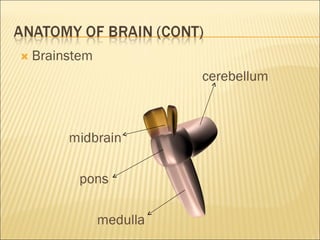
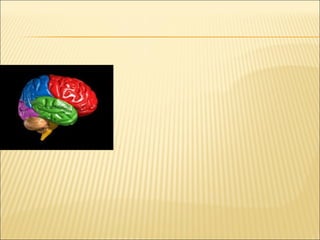
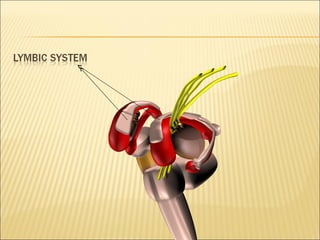
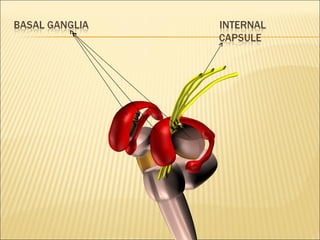
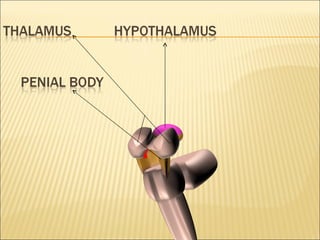
Nervous system may be divided into  Central nervous system - brain  - spinal cord peripheral nervous system - peripheral nerves - ganglia The brain consists of  (i) the cerebrum comprising 2 large cerebral hemisphere (ii) the cerebellum (iii) brainstem  - midbrain - pons - medulla
 
 
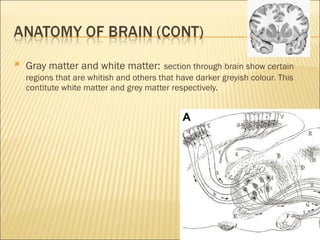
Gray matter and white matter:   section through brain show certain regions that are whitish and others that have darker greyish colour. This contitute white matter and grey matter respectively.
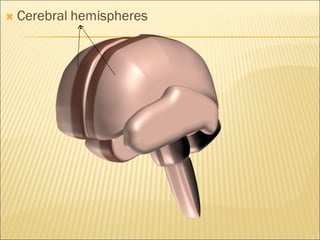
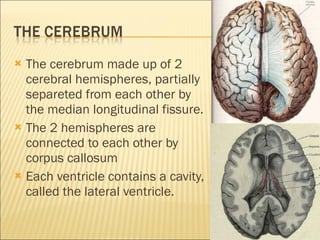
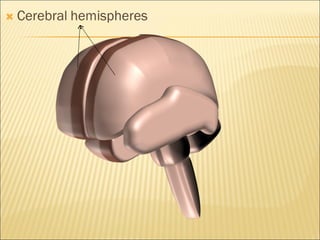
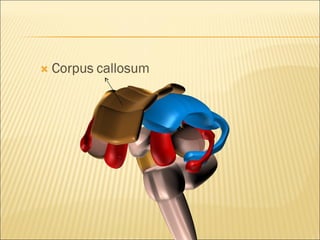
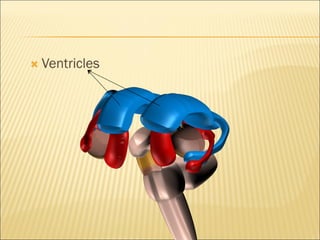
The cerebrum made up of 2 cerebral hemispheres, partially separeted from each other by the median longitudinal fissure.  The 2 hemispheres are connected to each other by corpus callosum Each ventricle contains a cavity, called the lateral ventricle.
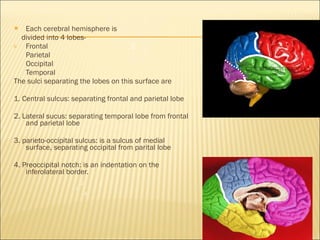
Each cerebral hemisphere is  divided into 4 lobes- Frontal  3  Parietal Occipital Temporal The sulci separating the lobes on this surface are  1. Central sulcus: separating frontal and parietal lobe 2. Lateral sucus: separating temporal lobe from frontal and parietal lobe 3. parieto-occipital sulcus: is a sulcus of medial surface, separating occipital from parital lobe 4. Preoccipital notch: is an indentation on the inferolateral border.  2  1 3 4


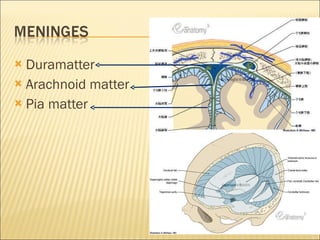
Duramatter Arachnoid matter Pia matter
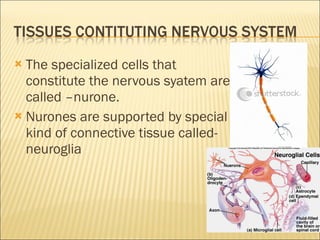
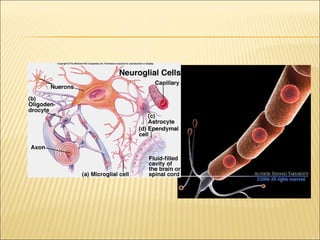
The specialized cells that constitute the nervous syatem are called –nurone. Nurones are supported by special kind of connective tissue called- neuroglia
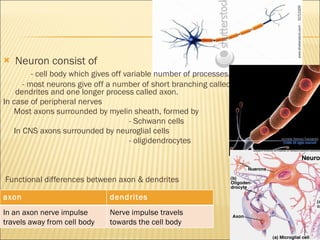
Neuron consist of  - cell body  which gives off variable number of processes. - most neurons give off a number of short branching called dendrites and one longer process called axon.  In case of peripheral nerves Most axons surrounded by myelin sheath, formed by  - Schwann cells In CNS axons surrounded by neuroglial cells  - oligidendrocytes Functional differences between axon & dendrites  axon dendrites In an axon nerve impulse travels away from cell body Nerve impulse travels towards the cell body
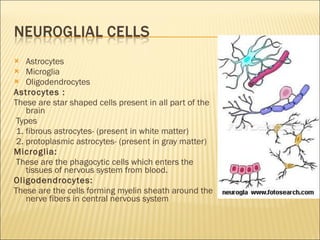
Astrocytes  Microglia Oligodendrocytes Astrocytes :  These are star shaped cells present in all part of the brain Types 1. fibrous astrocytes- (present in white matter) 2. protoplasmic astrocytes- (present in gray matter) Microglia:  These are the phagocytic cells which enters the tissues of nervous system from blood. Oligodendrocytes: These are the cells forming myelin sheath around the nerve fibers in central nervous system
 
Although either benign or malignant, almost all brain tumours are malignant in the sense that they may lead eventually to death if not treated. In general, the incidence of primary brain tumors is higher in whites than in blacks, and mortality is higher in males than in females. Brain tumours are responsible for 2 per cent of all cancer deaths. The incidence varies with age. In children tumours of the CNS comprise 20 per cent of all childhood malignancies. There is a peak at 2 years followed by a decline for the rest of the first decade. The incidence then slowly increases, peaking at 20 per 100 000 in late adulthood.
Intracranial tumour can be classified in different ways: primary versus secondary, paediatric versus adult, by cell of origin, or by location in the nervous system. Classification of brain tumour (according  to cell of origin) Neuroepithelial  metastatic  meningioma  pituitary  Tomour  tumour  tumour  tumour 50%  15%  15%  8%
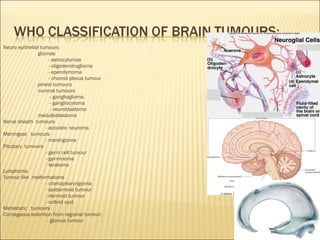
Neuro epithelial tumours  gliomas - astrocytomas - oligodendroglioma - ependymoma - choroid plexus tumour  pineal tumours nuronal tumours - ganglioglioma - gangliocytoma - neuroblastoma medulloblastoma Nerve sheath  tumours  - acoustic neuroma Meningeal  tumours  - meningioma Pituitary  tumours - germ cell tumour  - germinoma - teratoma  Lymphoma  Tumour like  malformations - craniopharyngioma - epidermoid tumour - dermoid tumour - colloid cyst Metastatic  tumours  Contageous extention from regional tumour: - glomus tumour
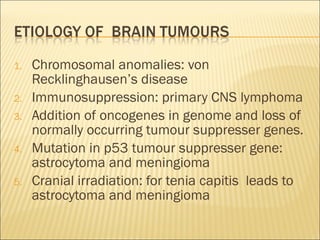
Chromosomal anomalies: von Recklinghausen’s disease Immunosuppression: primary CNS lymphoma Addition of oncogenes in genome and loss of normally occurring tumour suppresser genes. Mutation in p53 tumour suppresser gene: astrocytoma and meningioma Cranial irradiation: for tenia capitis  leads to astrocytoma and meningioma
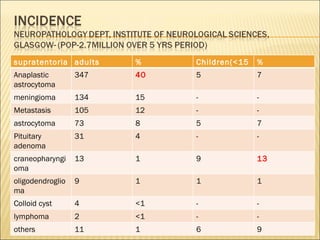
supratentorial adults % Children(<15yrs % Anaplastic astrocytoma 347 40 5 7 meningioma 134 15 - - Metastasis 105 12 - - astrocytoma 73 8 5 7 Pituitary adenoma 31 4 - - craneopharyngioma 13 1 9 13 oligodendroglioma 9 1 1 1 Colloid cyst 4 <1 - - lymphoma 2 <1 - - others 11 1 6 9
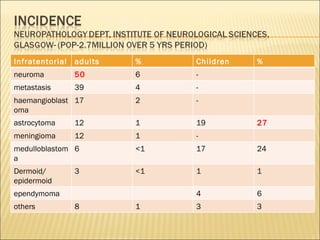
Infratentorial  adults % Children % neuroma 50 6 - metastasis 39 4 - haemangioblastoma 17 2 - astrocytoma 12 1 19 27 meningioma 12 1 - medulloblastoma 6 <1 17 24 Dermoid/ epidermoid  3 <1 1 1 ependymoma 4 6 others 8 1 3 3
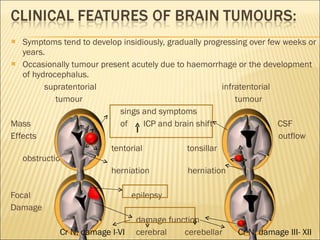
Symptoms tend to develop insidiously, gradually progressing over few weeks or years. Occasionally tumour present acutely due to haemorrhage or the development of hydrocephalus. supratentorial  infratentorial tumour  tumour sings and symptoms  Mass  of  ICP and brain shift  CSF  Effects  outflow tentorial  tonsillar  obstruction herniation  herniation Focal  epilepsy  Damage  damage function Cr N. damage I-VI  cerebral  cerebellar  Cr N. damage III- XII
Raised intracraneal pressure- headache(morning & progressive), papilloedema(disturbance of vision) Brain shift – vomiting, deteration of conscious level, pupillary dilatation
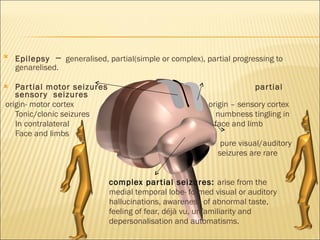
Epilepsy   –  generalised, partial(simple or complex), partial progressing to genarelised. Partial motor seizures  partial sensory  seizures origin- motor cortex  origin – sensory cortex Tonic/clonic seizures  numbness tingling in  In contralateral  face and limb Face and limbs pure visual/auditory seizures are rare complex partial seizures:  arise from the  medial temporal lobe- formed visual or auditory hallucinations, awareness of abnormal taste, feeling of fear, déjà vu, unfamiliarity and  depersonalisation and automatisms.
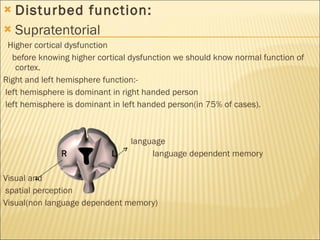
Disturbed function: Supratentorial  Higher cortical dysfunction before knowing higher cortical dysfunction we should know normal function of cortex. Right and left hemisphere function:- left hemisphere is dominant in right handed person left hemisphere is dominant in left handed person(in 75% of cases). language R  L  language dependent memory Visual and spatial perception Visual(non language dependent memory)
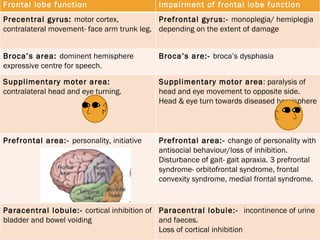
Frontal lobe function  Impairment of frontal lobe function Precentral gyrus:  motor cortex, contralateral movement- face arm trunk leg. Prefrontal gyrus:-  monoplegia/ hemiplegia depending on the extent of damage Broca’s area:  dominent hemisphere expressive centre for speech. Broca’s are:-  broca’s dysphasia Supplimentary moter area:  contralateral head and eye turning. Supplimentary motor area : paralysis of head and eye movement to opposite side. Head & eye turn towards diseased hemisphere  Prefrontal area:-  personality, initiative Prefrontal area:-  change of personality with antisocial behaviour/loss of inhibition. Disturbance of gait- gait apraxia. 3 prefrontal syndrome- orbitofrontal syndrome, frontal convexity syndrome, medial frontal syndrome. Paracentral lobule:-  cortical inhibition of bladder and bowel voiding  Paracentral lobule:-  incontinence of urine and faeces. Loss of cortical inhibition
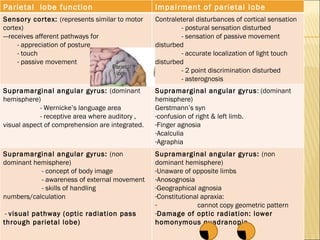
Parietal  lobe function Impairment of parietal lobe function Sensory cortex:  (represents similar to motor cortex) ---receives afferent pathways for - appreciation of posture - touch - passive movement Contraleteral disturbances of cortical sensation - postural sensation disturbed - sensation of passive movement disturbed - accurate localization of light touch disturbed - 2 point discrimination disturbed - asterognosis  Supramarginal angular gyrus:  (dominant hemisphere) - Wernicke’s language area - receptive area where auditory , visual aspect of comprehension are integrated. Supramarginal angular gyrus : (dominant hemisphere) Gerstmann’s syn confusion of right & left limb. Finger agnosia  Acalculia Agraphia Supramarginal angular gyrus:  (non dominant hemisphere) - concept of body image - awareness of external movement - skills of handling numbers/calculation -  visual pathway (optic radiation pass through parietal lobe)  Supramarginal angular gyrus:  (non dominant hemisphere) Unaware of opposite limbs Anosognosia Geographical agnosia Constitutional apraxia:  cannot copy geometric pattern Damage of optic radiation: lower homonymous quadranopia
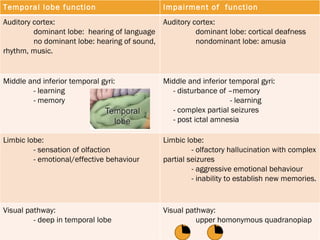
Temporal lobe function  Impairment of  function  Auditory cortex:  dominant lobe:  hearing of language no dominant lobe: hearing of sound, rhythm, music.  Auditory cortex:  dominant lobe: cortical deafness nondominant lobe: amusia  Middle and inferior temporal gyri:  - learning  - memory  Middle and inferior temporal gyri:  - disturbance of –memory - learning - complex partial seizures - post ictal amnesia Limbic lobe:  - sensation of olfaction - emotional/effective behaviour Limbic lobe:  - olfactory hallucination with complex partial seizures - aggressive emotional behaviour - inability to establish new memories. Visual pathway: - deep in temporal lobe Visual pathway: upper homonymous quadranopiap
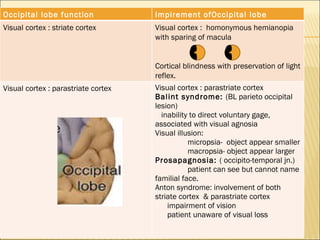
Occipital lobe function Impirement ofOccipital lobe function Visual cortex : striate cortex Visual cortex :  homonymous hemianopia with sparing of macula  Cortical blindness with preservation of light reflex. Visual cortex : parastriate cortex Visual cortex : parastriate cortex Balint syndrome:  (BL parieto occipital lesion) inability to direct voluntary gage, associated with visual agnosia Visual illusion:  micropsia-  object appear smaller macropsia- object appear larger Prosapagnosia:  ( occipito-temporal jn.) patient can see but cannot name familial face. Anton syndrome: involvement of both striate cortex  & parastriate cortex impairment of vision patient unaware of visual loss
 
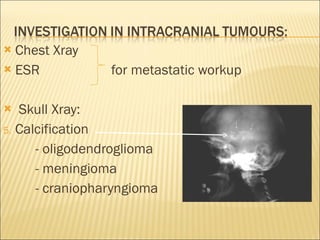
Chest Xray ESR  for metastatic workup Skull Xray:  Calcification - oligodendroglioma - meningioma - craniopharyngioma
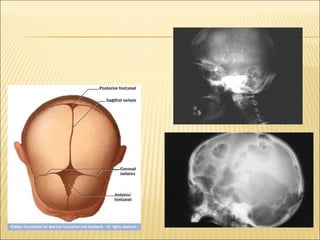
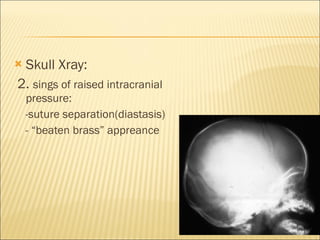
Skull Xray:  2.  sings of raised intracranial pressure: -suture separation(diastasis) - “beaten brass” appreance
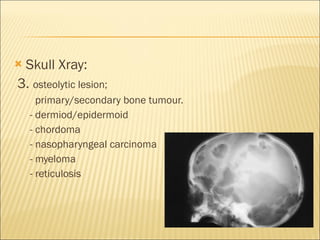
Skull Xray: 3.  osteolytic lesion; primary/secondary bone tumour. - dermiod/epidermoid - chordoma - nasopharyngeal carcinoma - myeloma - reticulosis
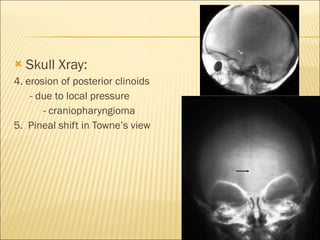
Skull Xray: 4. erosion of posterior clinoids - due to local pressure - craniopharyngioma 5.  Pineal shift in Towne’s view
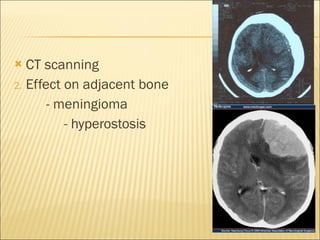
CT scanning Effect on adjacent bone - meningioma - hyperostosis
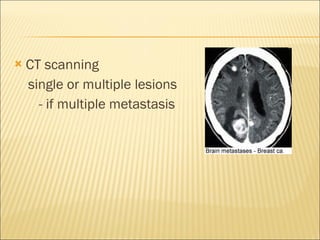
CT scanning single or multiple lesions - if multiple metastasis
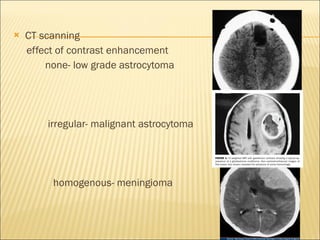
CT scanning effect of contrast enhancement none- low grade astrocytoma irregular- malignant astrocytoma homogenous- meningioma
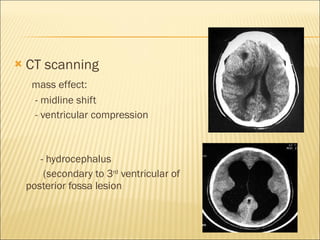
CT scanning mass effect: - midline shift - ventricular compression - hydrocephalus (secondary to 3 rd  ventricular of posterior fossa lesion
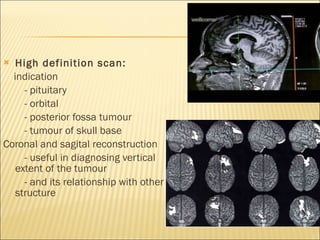
High definition scan: indication  - pituitary - orbital - posterior fossa tumour - tumour of skull base Coronal and sagital reconstruction - useful in diagnosing vertical extent of the tumour - and its relationship with other structure
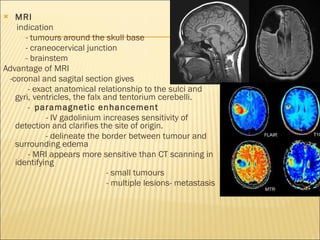
MRI indication - tumours around the skull base - craneocervical junction  - brainstem Advantage of MRI -coronal and sagital section gives - exact anatomical relationship to the sulci and gyri, ventricles, the falx and tentorium cerebelli.  -  paramagnetic enhancement  - IV gadolinium increases sensitivity  of detection and clarifies the site of origin. - delineate the border between tumour and surrounding edema - MRI appears more sensitive than CT scanning in identifying - small tumours - multiple lesions- metastasis
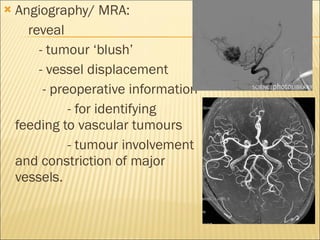
Angiography/ MRA: reveal - tumour ‘blush’ - vessel displacement - preoperative information - for identifying feeding to vascular tumours - tumour involvement and constriction of major vessels.
CSF examination: lumber puncture is contraindicated in cerebral tumours.  if CSF is obtained by another sources  - ventricular drainage  - or shunt insertion then cytological examination may reveal tumour cells
Tumour markers: Glial Fibrillary Acidic Protein(GFAP) - for glial tumours Cytokeratin Epithelial Membrane Antigen(EMA)  for metastatic carcinoma Epidermal Growth Factor- differentiate between  - high grade & low grade tumour -
Steroid therapy: - to reduce edema surrounding the intracranial tumour. - sellar/paraseller tumour occasionally present with steroid insufficiency. In these cases steroid cover is an essential prerequisite of any anesthetic and operative procedure. Dose:  -  A loading dose of 12mg IV dexamethasone -  followed by 4mg qid.  -  after several days of treatment, gradual dose reduction  minimizes the risk of unwanted side effects.
 
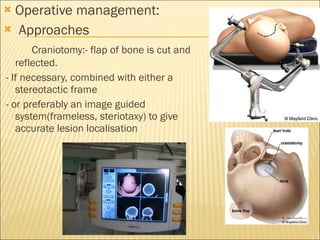
Operative management: Approaches  Craniotomy:- flap of bone is cut and reflected. - If necessary, combined with either a stereotactic frame  - or preferably an image guided system(frameless, steriotaxy) to give accurate lesion localisation
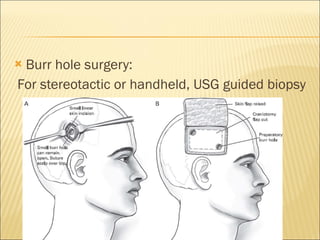
Burr hole surgery: For stereotactic or handheld, USG guided biopsy
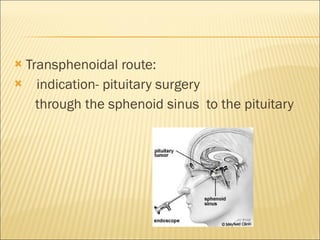
Transphenoidal route: indication- pituitary surgery through the sphenoid sinus  to the pituitary
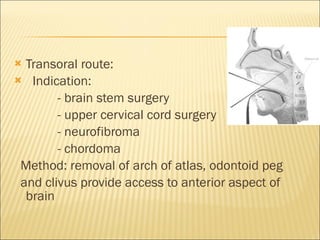
Transoral route:  Indication:  - brain stem surgery - upper cervical cord surgery - neurofibroma - chordoma Method: removal of arch of atlas, odontoid peg and clivus provide access to anterior aspect of brain
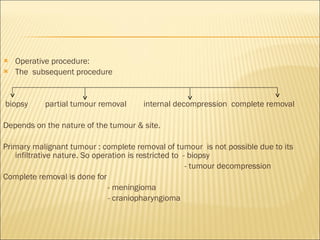
Operative procedure: The  subsequent procedure biopsy  partial tumour removal  internal decompression  complete removal Depends on the nature of the tumour & site. Primary malignant tumour : complete removal of tumour  is not possible due to its infiltrative nature. So operation is restricted to  - biopsy  - tumour decompression Complete removal is done for  - meningioma - craniopharyngioma
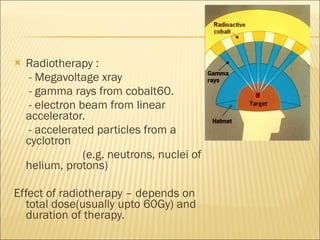
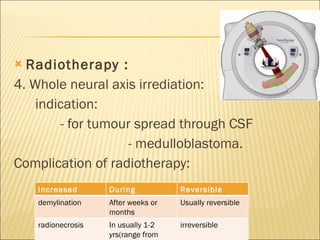
Radiotherapy :  - Megavoltage xray - gamma rays from cobalt60. - electron beam from linear accelerator. - accelerated particles from a cyclotron (e.g. neutrons, nuclei of helium, protons) Effect of radiotherapy – depends on total dose(usually upto 60Gy) and duration of therapy.
Radiotherapy :  Aim : to provide highest possible dose to the specific region, while minimal irradiation to adjacent normal brain. Indication:  In malignant tumour: - malignant astrocytoma - metastasis - medulloblastoma - germinoma In benign tumours - pituitary adenoma - craniopharyngioma
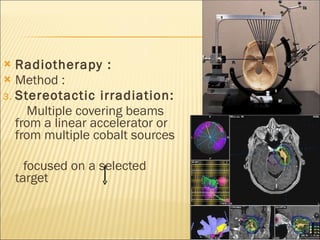
Radiotherapy :  Method :  Stereotactic irradiation: Multiple covering beams from a linear accelerator or from multiple cobalt sources focused on a selected target
Radiotherapy :  2.  Interstitial techniques: Tumour is treated from within(brachytherapy) - by implantation of multiple radioactive seeds. e.g. iodine125. 3.  Conformal therapy:  - standard radiotherapy is administered  - beam are shaped by use of variable collimeters/blocks.
Radiotherapy :  4. Whole neural axis irrediation: indication:  - for tumour spread through CSF - medulloblastoma. Complication of radiotherapy: Increased edema  During treatment  Reversible demylination After weeks or months Usually reversible radionecrosis In usually 1-2 yrs(range from 6m-10yrs) irreversible
Drugs commonly used:  - nitrosoureas - Procarbazine - Vincristine - methotrexate
Malignant astrocytoma: -nitrosoureas are most effective drug - commonly used treatment for relapse patient Low grade tumour or benign tumour: - chemotherapy has limited value Medulloblastoma: - respond to treatment but value of treatment of patient survival – is unclear. Primary germ cell tumour & primary cerebral lymphoma:  - chemotherapy has a role.
New approaches: Cell targeting:  monoclonal antibody is used to carry - cytotoxic drug - toxins - radionuleotide to the tumour cells Improving access:  modifying BBB with mannitol or preliminary binding with liposomes may improve the passage of cytotoxic drug and monoclonal antibodies to tumour tissue. Intracarotid injection:  of slow releasing biodegredable polymers of nitrosoureas in patient with - malignant glioma Invitro chemosentitivity testing:  utilizes cultured tumour cells from biopsy meterial.
 

Cerebral tumors 1

  • 1.
    Presenter: Dr. SabirAhmed Chairperson: Dr. S.D. Kshirsagar
  • 2.
    A wide varietyof tumors affect the brain and spine. Primary benign and malignant tumors arise from the various elements of the CNS, including neurons, glia, and meninges. Tumors metastasize to the CNS from many primary sources. Presentation varies widely depending on relevant neuroanatomy. Prognosis depends on histology and anatomy Modern brain tumor centers use team approaches to CNS tumors, as patients may require a combination of surgery, radiation therapy, chemotherapy and research protocol enrollment.
  • 3.
    Nervous system maybe divided into Central nervous system - brain - spinal cord peripheral nervous system - peripheral nerves - ganglia The brain consists of (i) the cerebrum comprising 2 large cerebral hemisphere (ii) the cerebellum (iii) brainstem - midbrain - pons - medulla
  • 4.
  • 5.
  • 6.
    Gray matter andwhite matter: section through brain show certain regions that are whitish and others that have darker greyish colour. This contitute white matter and grey matter respectively.
  • 7.
    The cerebrum madeup of 2 cerebral hemispheres, partially separeted from each other by the median longitudinal fissure. The 2 hemispheres are connected to each other by corpus callosum Each ventricle contains a cavity, called the lateral ventricle.
  • 8.
    Each cerebral hemisphereis divided into 4 lobes- Frontal 3 Parietal Occipital Temporal The sulci separating the lobes on this surface are 1. Central sulcus: separating frontal and parietal lobe 2. Lateral sucus: separating temporal lobe from frontal and parietal lobe 3. parieto-occipital sulcus: is a sulcus of medial surface, separating occipital from parital lobe 4. Preoccipital notch: is an indentation on the inferolateral border. 2 1 3 4
  • 9.
  • 10.
  • 11.
  • 12.
  • 13.
  • 14.
  • 15.
  • 16.
  • 17.
  • 18.
    The specialized cellsthat constitute the nervous syatem are called –nurone. Nurones are supported by special kind of connective tissue called- neuroglia
  • 19.
    Neuron consist of - cell body which gives off variable number of processes. - most neurons give off a number of short branching called dendrites and one longer process called axon. In case of peripheral nerves Most axons surrounded by myelin sheath, formed by - Schwann cells In CNS axons surrounded by neuroglial cells - oligidendrocytes Functional differences between axon & dendrites axon dendrites In an axon nerve impulse travels away from cell body Nerve impulse travels towards the cell body
  • 20.
    Astrocytes MicrogliaOligodendrocytes Astrocytes : These are star shaped cells present in all part of the brain Types 1. fibrous astrocytes- (present in white matter) 2. protoplasmic astrocytes- (present in gray matter) Microglia: These are the phagocytic cells which enters the tissues of nervous system from blood. Oligodendrocytes: These are the cells forming myelin sheath around the nerve fibers in central nervous system
  • 21.
  • 22.
    Although either benignor malignant, almost all brain tumours are malignant in the sense that they may lead eventually to death if not treated. In general, the incidence of primary brain tumors is higher in whites than in blacks, and mortality is higher in males than in females. Brain tumours are responsible for 2 per cent of all cancer deaths. The incidence varies with age. In children tumours of the CNS comprise 20 per cent of all childhood malignancies. There is a peak at 2 years followed by a decline for the rest of the first decade. The incidence then slowly increases, peaking at 20 per 100 000 in late adulthood.
  • 23.
    Intracranial tumour canbe classified in different ways: primary versus secondary, paediatric versus adult, by cell of origin, or by location in the nervous system. Classification of brain tumour (according to cell of origin) Neuroepithelial metastatic meningioma pituitary Tomour tumour tumour tumour 50% 15% 15% 8%
  • 24.
    Neuro epithelial tumours gliomas - astrocytomas - oligodendroglioma - ependymoma - choroid plexus tumour pineal tumours nuronal tumours - ganglioglioma - gangliocytoma - neuroblastoma medulloblastoma Nerve sheath tumours - acoustic neuroma Meningeal tumours - meningioma Pituitary tumours - germ cell tumour - germinoma - teratoma Lymphoma Tumour like malformations - craniopharyngioma - epidermoid tumour - dermoid tumour - colloid cyst Metastatic tumours Contageous extention from regional tumour: - glomus tumour
  • 25.
    Chromosomal anomalies: vonRecklinghausen’s disease Immunosuppression: primary CNS lymphoma Addition of oncogenes in genome and loss of normally occurring tumour suppresser genes. Mutation in p53 tumour suppresser gene: astrocytoma and meningioma Cranial irradiation: for tenia capitis leads to astrocytoma and meningioma
  • 26.
    supratentorial adults %Children(<15yrs % Anaplastic astrocytoma 347 40 5 7 meningioma 134 15 - - Metastasis 105 12 - - astrocytoma 73 8 5 7 Pituitary adenoma 31 4 - - craneopharyngioma 13 1 9 13 oligodendroglioma 9 1 1 1 Colloid cyst 4 <1 - - lymphoma 2 <1 - - others 11 1 6 9
  • 27.
    Infratentorial adults% Children % neuroma 50 6 - metastasis 39 4 - haemangioblastoma 17 2 - astrocytoma 12 1 19 27 meningioma 12 1 - medulloblastoma 6 <1 17 24 Dermoid/ epidermoid 3 <1 1 1 ependymoma 4 6 others 8 1 3 3
  • 28.
    Symptoms tend todevelop insidiously, gradually progressing over few weeks or years. Occasionally tumour present acutely due to haemorrhage or the development of hydrocephalus. supratentorial infratentorial tumour tumour sings and symptoms Mass of ICP and brain shift CSF Effects outflow tentorial tonsillar obstruction herniation herniation Focal epilepsy Damage damage function Cr N. damage I-VI cerebral cerebellar Cr N. damage III- XII
  • 29.
    Raised intracraneal pressure-headache(morning & progressive), papilloedema(disturbance of vision) Brain shift – vomiting, deteration of conscious level, pupillary dilatation
  • 30.
    Epilepsy – generalised, partial(simple or complex), partial progressing to genarelised. Partial motor seizures partial sensory seizures origin- motor cortex origin – sensory cortex Tonic/clonic seizures numbness tingling in In contralateral face and limb Face and limbs pure visual/auditory seizures are rare complex partial seizures: arise from the medial temporal lobe- formed visual or auditory hallucinations, awareness of abnormal taste, feeling of fear, déjà vu, unfamiliarity and depersonalisation and automatisms.
  • 31.
    Disturbed function: Supratentorial Higher cortical dysfunction before knowing higher cortical dysfunction we should know normal function of cortex. Right and left hemisphere function:- left hemisphere is dominant in right handed person left hemisphere is dominant in left handed person(in 75% of cases). language R L language dependent memory Visual and spatial perception Visual(non language dependent memory)
  • 32.
    Frontal lobe function Impairment of frontal lobe function Precentral gyrus: motor cortex, contralateral movement- face arm trunk leg. Prefrontal gyrus:- monoplegia/ hemiplegia depending on the extent of damage Broca’s area: dominent hemisphere expressive centre for speech. Broca’s are:- broca’s dysphasia Supplimentary moter area: contralateral head and eye turning. Supplimentary motor area : paralysis of head and eye movement to opposite side. Head & eye turn towards diseased hemisphere Prefrontal area:- personality, initiative Prefrontal area:- change of personality with antisocial behaviour/loss of inhibition. Disturbance of gait- gait apraxia. 3 prefrontal syndrome- orbitofrontal syndrome, frontal convexity syndrome, medial frontal syndrome. Paracentral lobule:- cortical inhibition of bladder and bowel voiding Paracentral lobule:- incontinence of urine and faeces. Loss of cortical inhibition
  • 33.
    Parietal lobefunction Impairment of parietal lobe function Sensory cortex: (represents similar to motor cortex) ---receives afferent pathways for - appreciation of posture - touch - passive movement Contraleteral disturbances of cortical sensation - postural sensation disturbed - sensation of passive movement disturbed - accurate localization of light touch disturbed - 2 point discrimination disturbed - asterognosis Supramarginal angular gyrus: (dominant hemisphere) - Wernicke’s language area - receptive area where auditory , visual aspect of comprehension are integrated. Supramarginal angular gyrus : (dominant hemisphere) Gerstmann’s syn confusion of right & left limb. Finger agnosia Acalculia Agraphia Supramarginal angular gyrus: (non dominant hemisphere) - concept of body image - awareness of external movement - skills of handling numbers/calculation - visual pathway (optic radiation pass through parietal lobe) Supramarginal angular gyrus: (non dominant hemisphere) Unaware of opposite limbs Anosognosia Geographical agnosia Constitutional apraxia: cannot copy geometric pattern Damage of optic radiation: lower homonymous quadranopia
  • 34.
    Temporal lobe function Impairment of function Auditory cortex: dominant lobe: hearing of language no dominant lobe: hearing of sound, rhythm, music. Auditory cortex: dominant lobe: cortical deafness nondominant lobe: amusia Middle and inferior temporal gyri: - learning - memory Middle and inferior temporal gyri: - disturbance of –memory - learning - complex partial seizures - post ictal amnesia Limbic lobe: - sensation of olfaction - emotional/effective behaviour Limbic lobe: - olfactory hallucination with complex partial seizures - aggressive emotional behaviour - inability to establish new memories. Visual pathway: - deep in temporal lobe Visual pathway: upper homonymous quadranopiap
  • 35.
    Occipital lobe functionImpirement ofOccipital lobe function Visual cortex : striate cortex Visual cortex : homonymous hemianopia with sparing of macula Cortical blindness with preservation of light reflex. Visual cortex : parastriate cortex Visual cortex : parastriate cortex Balint syndrome: (BL parieto occipital lesion) inability to direct voluntary gage, associated with visual agnosia Visual illusion: micropsia- object appear smaller macropsia- object appear larger Prosapagnosia: ( occipito-temporal jn.) patient can see but cannot name familial face. Anton syndrome: involvement of both striate cortex & parastriate cortex impairment of vision patient unaware of visual loss
  • 36.
  • 37.
    Chest Xray ESR for metastatic workup Skull Xray: Calcification - oligodendroglioma - meningioma - craniopharyngioma
  • 38.
    Skull Xray: 2. sings of raised intracranial pressure: -suture separation(diastasis) - “beaten brass” appreance
  • 39.
    Skull Xray: 3. osteolytic lesion; primary/secondary bone tumour. - dermiod/epidermoid - chordoma - nasopharyngeal carcinoma - myeloma - reticulosis
  • 40.
    Skull Xray: 4.erosion of posterior clinoids - due to local pressure - craniopharyngioma 5. Pineal shift in Towne’s view
  • 41.
    CT scanning Effecton adjacent bone - meningioma - hyperostosis
  • 42.
    CT scanning singleor multiple lesions - if multiple metastasis
  • 43.
    CT scanning effectof contrast enhancement none- low grade astrocytoma irregular- malignant astrocytoma homogenous- meningioma
  • 44.
    CT scanning masseffect: - midline shift - ventricular compression - hydrocephalus (secondary to 3 rd ventricular of posterior fossa lesion
  • 45.
    High definition scan:indication - pituitary - orbital - posterior fossa tumour - tumour of skull base Coronal and sagital reconstruction - useful in diagnosing vertical extent of the tumour - and its relationship with other structure
  • 46.
    MRI indication -tumours around the skull base - craneocervical junction - brainstem Advantage of MRI -coronal and sagital section gives - exact anatomical relationship to the sulci and gyri, ventricles, the falx and tentorium cerebelli. - paramagnetic enhancement - IV gadolinium increases sensitivity of detection and clarifies the site of origin. - delineate the border between tumour and surrounding edema - MRI appears more sensitive than CT scanning in identifying - small tumours - multiple lesions- metastasis
  • 47.
    Angiography/ MRA: reveal- tumour ‘blush’ - vessel displacement - preoperative information - for identifying feeding to vascular tumours - tumour involvement and constriction of major vessels.
  • 48.
    CSF examination: lumberpuncture is contraindicated in cerebral tumours. if CSF is obtained by another sources - ventricular drainage - or shunt insertion then cytological examination may reveal tumour cells
  • 49.
    Tumour markers: GlialFibrillary Acidic Protein(GFAP) - for glial tumours Cytokeratin Epithelial Membrane Antigen(EMA) for metastatic carcinoma Epidermal Growth Factor- differentiate between - high grade & low grade tumour -
  • 50.
    Steroid therapy: -to reduce edema surrounding the intracranial tumour. - sellar/paraseller tumour occasionally present with steroid insufficiency. In these cases steroid cover is an essential prerequisite of any anesthetic and operative procedure. Dose: - A loading dose of 12mg IV dexamethasone - followed by 4mg qid. - after several days of treatment, gradual dose reduction minimizes the risk of unwanted side effects.
  • 51.
  • 52.
    Operative management: Approaches Craniotomy:- flap of bone is cut and reflected. - If necessary, combined with either a stereotactic frame - or preferably an image guided system(frameless, steriotaxy) to give accurate lesion localisation
  • 53.
    Burr hole surgery:For stereotactic or handheld, USG guided biopsy
  • 54.
    Transphenoidal route: indication-pituitary surgery through the sphenoid sinus to the pituitary
  • 55.
    Transoral route: Indication: - brain stem surgery - upper cervical cord surgery - neurofibroma - chordoma Method: removal of arch of atlas, odontoid peg and clivus provide access to anterior aspect of brain
  • 56.
    Operative procedure: The subsequent procedure biopsy partial tumour removal internal decompression complete removal Depends on the nature of the tumour & site. Primary malignant tumour : complete removal of tumour is not possible due to its infiltrative nature. So operation is restricted to - biopsy - tumour decompression Complete removal is done for - meningioma - craniopharyngioma
  • 57.
    Radiotherapy : - Megavoltage xray - gamma rays from cobalt60. - electron beam from linear accelerator. - accelerated particles from a cyclotron (e.g. neutrons, nuclei of helium, protons) Effect of radiotherapy – depends on total dose(usually upto 60Gy) and duration of therapy.
  • 58.
    Radiotherapy : Aim : to provide highest possible dose to the specific region, while minimal irradiation to adjacent normal brain. Indication: In malignant tumour: - malignant astrocytoma - metastasis - medulloblastoma - germinoma In benign tumours - pituitary adenoma - craniopharyngioma
  • 59.
    Radiotherapy : Method : Stereotactic irradiation: Multiple covering beams from a linear accelerator or from multiple cobalt sources focused on a selected target
  • 60.
    Radiotherapy : 2. Interstitial techniques: Tumour is treated from within(brachytherapy) - by implantation of multiple radioactive seeds. e.g. iodine125. 3. Conformal therapy: - standard radiotherapy is administered - beam are shaped by use of variable collimeters/blocks.
  • 61.
    Radiotherapy : 4. Whole neural axis irrediation: indication: - for tumour spread through CSF - medulloblastoma. Complication of radiotherapy: Increased edema During treatment Reversible demylination After weeks or months Usually reversible radionecrosis In usually 1-2 yrs(range from 6m-10yrs) irreversible
  • 62.
    Drugs commonly used: - nitrosoureas - Procarbazine - Vincristine - methotrexate
  • 63.
    Malignant astrocytoma: -nitrosoureasare most effective drug - commonly used treatment for relapse patient Low grade tumour or benign tumour: - chemotherapy has limited value Medulloblastoma: - respond to treatment but value of treatment of patient survival – is unclear. Primary germ cell tumour & primary cerebral lymphoma: - chemotherapy has a role.
  • 64.
    New approaches: Celltargeting: monoclonal antibody is used to carry - cytotoxic drug - toxins - radionuleotide to the tumour cells Improving access: modifying BBB with mannitol or preliminary binding with liposomes may improve the passage of cytotoxic drug and monoclonal antibodies to tumour tissue. Intracarotid injection: of slow releasing biodegredable polymers of nitrosoureas in patient with - malignant glioma Invitro chemosentitivity testing: utilizes cultured tumour cells from biopsy meterial.
  • 65.