Download to read offline

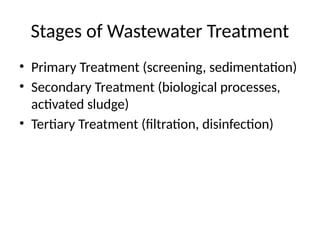
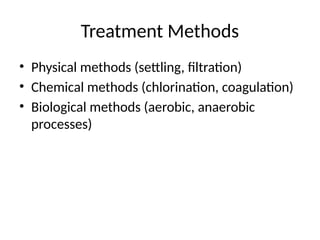
Definition Wastewater treatment is the process of removing contaminants from water used in homes, industries, and agriculture to make it safe for discharge or reuse. Sources of Wastewater Domestic: Household water from toilets, sinks, showers Industrial: Waste from factories and manufacturing plants Agricultural: Runoff containing fertilizers, pesticides, and animal waste Types of Wastewater Blackwater: Contains human waste and sewage Greywater: From sinks, showers, and laundry Industrial wastewater: Chemical and toxic waste Stages of Wastewater Treatment Primary Treatment: Screening and sedimentation to remove solids Secondary Treatment: Biological processes (e.g., activated sludge) to degrade organic matter Tertiary Treatment: Advanced methods like filtration, chemical treatment, and disinfection Treatment Methods Physical: Sedimentation, filtration Chemical: Chlorination, coagulation Biological: Aerobic and anaerobic microbial processes Importance Protects public health by removing pathogens Prevents environmental pollution of rivers, lakes, and oceans Allows water recycling and reuse Advanced Technologies Membrane filtration (RO, UF) UV and ozone treatment Constructed wetlands Benefits Reduces waterborne diseases Conserves water resources Supports sustainable development Challenges High operational costs Sludge disposal issues Limited access to advanced technology in developing regionsDefinition Wastewater treatment is the process of removing contaminants from water used in homes, industries, and agriculture to make it safe for discharge or reuse. Sources of Wastewater Domestic: Household water from toilets, sinks, showers Industrial: Waste from factories and manufacturing plants Agricultural: Runoff containing fertilizers, pesticides, and animal waste Types of Wastewater Blackwater: Contains human waste and sewage Greywater: From sinks, showers, and laundry Industrial wastewater: Chemical and toxic waste Stages of Wastewater Treatment Primary Treatment: Screening and sedimentation to remove solids Secondary Treatment: Biological processes (e.g., activated sludge) to degrade organic matter Tertiary Treatment: Advanced methods like filtration, chemical treatment, and disinfection Treatment Methods Physical: Sedimentation, filtration Chemical: Chlorination, coagulation Biological: Aerobic and anaerobic microbial processes Importance Protects public health by removing pathogens Prevents environmental pollution of rivers, lakes, and oceans Allows water recycling and reuse Advanced Technologies Membrane filtration (RO, UF) UV and ozone treatment Constructed wetlands Benefits Reduces waterborne diseases Conserves water resources Supports sustainable development Challenges High operational costs Sludge disposal issues Limited access to advanced technology in developing regionsDefinition Wastewater treatment is the process of removing contaminants from water used in homes, industries,


