CERAMIC MATRIX
COMPOSITES-
By:- Huchhe Vaishnavi Sidhaling
Roll No:- 12
Guided By:- Mantri Sir .
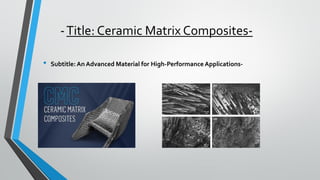
-Title: Ceramic Matrix Composites-
• Subtitle: An Advanced Material for High-Performance Applications-
Introduction
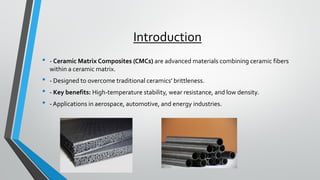
• - Ceramic Matrix Composites (CMCs) are advanced materials combining ceramic fibers
within a ceramic matrix.
• - Designed to overcome traditional ceramics' brittleness.
• - Key benefits: High-temperature stability, wear resistance, and low density.
• - Applications in aerospace, automotive, and energy industries.
Composition and Structure
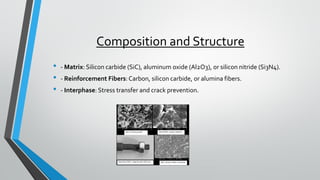
• - Matrix: Silicon carbide (SiC), aluminum oxide (Al2O3), or silicon nitride (Si3N4).
• - Reinforcement Fibers:Carbon, silicon carbide, or alumina fibers.
• - Interphase: Stress transfer and crack prevention.
Manufacturing Processes
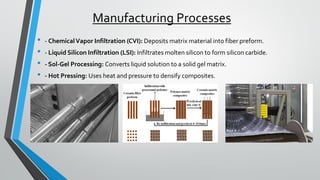
• - ChemicalVapor Infiltration (CVI): Deposits matrix material into fiber preform.
• - Liquid Silicon Infiltration (LSI): Infiltrates molten silicon to form silicon carbide.
• - Sol-Gel Processing: Converts liquid solution to a solid gel matrix.
• - Hot Pressing: Uses heat and pressure to densify composites.
Properties
• - High-Temperature Stability (>1000°C).
• -Wear and Corrosion Resistance.
• - Low Density for lightweight applications.
• - ImprovedToughness due to fiber reinforcement.
Applications
• - Aerospace: Jet engine components, heat shields.
• - Automotive: Brake discs, turbocharger components.
• - Energy:Gas turbines, nuclear reactor components.
• - Defense:Armor systems, missile nose cones.
Advantages and Challenges
• Advantages :
- Superior mechanical properties.
- High performance under extreme conditions.
• Challenges :
-High production costs.
- Limited scalability.
- Fabrication flaws sensitivity.
Limitations
• - High manufacturing costs due to complex processes.
• - Limited scalability for mass production.
• - Sensitivity to fabrication defects which can compromise performance.
• - Fragility under impact or dynamic loading conditions.
• - Environmental degradation under extreme conditions like oxidation.
Future Perspectives
• - Focus on reducing manufacturing costs and improving scalability.
• - Advances in nanotechnology and additive manufacturing.
• - Expanding applications in high-performance industries.
Conclusion
• - CMCs revolutionize material science with their toughness and durability.
• - Essential for safer, more efficient, and longer-lasting components.
• - Continued research to unlock their full potential.
THANKS

ceramic matrix composite ppt .short type

  • 1.
    CERAMIC MATRIX COMPOSITES- By:- HuchheVaishnavi Sidhaling Roll No:- 12 Guided By:- Mantri Sir .
  • 2.
    -Title: Ceramic MatrixComposites- • Subtitle: An Advanced Material for High-Performance Applications-
  • 3.
    Introduction • - CeramicMatrix Composites (CMCs) are advanced materials combining ceramic fibers within a ceramic matrix. • - Designed to overcome traditional ceramics' brittleness. • - Key benefits: High-temperature stability, wear resistance, and low density. • - Applications in aerospace, automotive, and energy industries.
  • 4.
    Composition and Structure •- Matrix: Silicon carbide (SiC), aluminum oxide (Al2O3), or silicon nitride (Si3N4). • - Reinforcement Fibers:Carbon, silicon carbide, or alumina fibers. • - Interphase: Stress transfer and crack prevention.
  • 5.
    Manufacturing Processes • -ChemicalVapor Infiltration (CVI): Deposits matrix material into fiber preform. • - Liquid Silicon Infiltration (LSI): Infiltrates molten silicon to form silicon carbide. • - Sol-Gel Processing: Converts liquid solution to a solid gel matrix. • - Hot Pressing: Uses heat and pressure to densify composites.
  • 6.
    Properties • - High-TemperatureStability (>1000°C). • -Wear and Corrosion Resistance. • - Low Density for lightweight applications. • - ImprovedToughness due to fiber reinforcement.
  • 7.
    Applications • - Aerospace:Jet engine components, heat shields. • - Automotive: Brake discs, turbocharger components. • - Energy:Gas turbines, nuclear reactor components. • - Defense:Armor systems, missile nose cones.
  • 8.
    Advantages and Challenges •Advantages : - Superior mechanical properties. - High performance under extreme conditions. • Challenges : -High production costs. - Limited scalability. - Fabrication flaws sensitivity.
  • 9.
    Limitations • - Highmanufacturing costs due to complex processes. • - Limited scalability for mass production. • - Sensitivity to fabrication defects which can compromise performance. • - Fragility under impact or dynamic loading conditions. • - Environmental degradation under extreme conditions like oxidation.
  • 10.
    Future Perspectives • -Focus on reducing manufacturing costs and improving scalability. • - Advances in nanotechnology and additive manufacturing. • - Expanding applications in high-performance industries.
  • 11.
    Conclusion • - CMCsrevolutionize material science with their toughness and durability. • - Essential for safer, more efficient, and longer-lasting components. • - Continued research to unlock their full potential.
  • 12.