SHARAD INSTITUTE OF TECHNOLOGY,
COLLEGE OF ENGINEERING,
YADRAV- ICHALKARANJI (Kolhapur)
An ‘A’ Grade Institute Accredited by NAAC
NBA Accredited Programmes
Prepared by
Mr. Ashish A. Desai
Assistant Professor
Composite Material
Introduction to Composite Materials
• Definition:
• Composite materials are engineered materials
made from two or more distinct constituent
materials with significantly different physical
or chemical properties. When combined, they
create a material with enhanced properties
that are superior to the individual
components.:
Importance of Composite Materials:
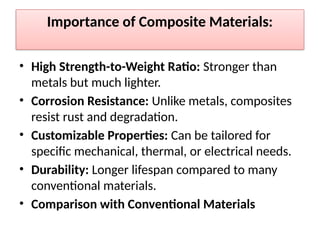
• High Strength-to-Weight Ratio: Stronger than
metals but much lighter.
• Corrosion Resistance: Unlike metals, composites
resist rust and degradation.
• Customizable Properties: Can be tailored for
specific mechanical, thermal, or electrical needs.
• Durability: Longer lifespan compared to many
conventional materials.
• Comparison with Conventional Materials
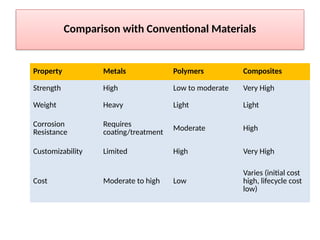
Comparison with Conventional Materials
Property Metals Polymers Composites
Strength High Low to moderate Very High
Weight Heavy Light Light
Corrosion
Resistance
Requires
coating/treatment
Moderate High
Customizability Limited High Very High
Cost Moderate to high Low
Varies (initial cost
high, lifecycle cost
low)
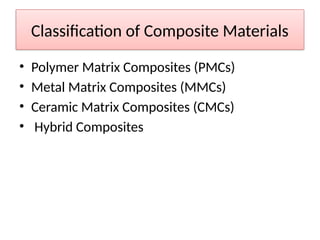
Classification of Composite Materials
• Polymer Matrix Composites (PMCs)
• Metal Matrix Composites (MMCs)
• Ceramic Matrix Composites (CMCs)
• Hybrid Composites
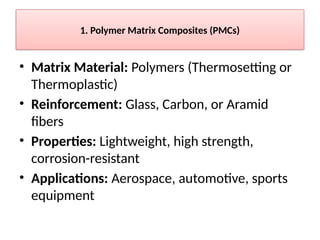
1. Polymer Matrix Composites (PMCs)
• Matrix Material: Polymers (Thermosetting or
Thermoplastic)
• Reinforcement: Glass, Carbon, or Aramid
fibers
• Properties: Lightweight, high strength,
corrosion-resistant
• Applications: Aerospace, automotive, sports
equipment
2. Metal Matrix Composites (MMCs)
• Matrix Material: Metals (Aluminum, Titanium,
Magnesium)
• Reinforcement: Silicon carbide, Boron fibers
• Properties: High-temperature resistance,
superior strength
• Applications: Aircraft structures, engine
components, defense
3. Ceramic Matrix Composites (CMCs)
• Matrix Material: Ceramics (Silicon Carbide,
Aluminum Oxide)
• Reinforcement: Ceramic fibers, Carbon fibers
• Properties: Extreme heat resistance, wear
resistance, brittle nature
• Applications: Aerospace, automotive braking
systems, nuclear reactors
4. Hybrid Composites
• Combination of two or more different types of
reinforcements or matrices
• Examples: Carbon-Glass fiber reinforced
polymers
• Properties: Tailored mechanical properties,
improved damage resistance
• Applications: High-performance structural
components in aerospace, automotive, and
biomedical sectors
Properties of Composite Materials
• Composite materials offer superior performance compared to conventional materials.
Some key properties include:
1. High Strength-to-Weight Ratio
• Stronger than metals while significantly lighter
• Used in aerospace, automotive, and sports applications to reduce weight without
compromising strength
2. Corrosion Resistance
• Unlike metals, composites do not rust or degrade in harsh environments
• Ideal for marine structures, pipelines, and chemical storage tanks
3. Fatigue Resistance
• Composites can withstand repeated loading cycles without significant deterioration
• Improves durability in aircraft, bridges, and wind turbine blades
4. Thermal and Electrical Properties
• Thermal: Some composites have high-temperature resistance (e.g., Ceramic Matrix
Composites for aerospace applications)
• Electrical: Can be tailored to be insulating (fiber-reinforced polymers) or conductive
(carbon-based composites)
Manufacturing Techniques
• Hand Lay-up
• Spray Lay-up
• Resin Transfer Molding (RTM)
• Compression Molding
• Additive Manufacturing (3D Printing)
Applications of Composite Materials
• Aerospace
• Automotive
• Marine
• Sports Equipment
• Biomedical
THANK YOU

Composite Material,its types and application .pptx

  • 1.
    SHARAD INSTITUTE OFTECHNOLOGY, COLLEGE OF ENGINEERING, YADRAV- ICHALKARANJI (Kolhapur) An ‘A’ Grade Institute Accredited by NAAC NBA Accredited Programmes Prepared by Mr. Ashish A. Desai Assistant Professor Composite Material
  • 2.
    Introduction to CompositeMaterials • Definition: • Composite materials are engineered materials made from two or more distinct constituent materials with significantly different physical or chemical properties. When combined, they create a material with enhanced properties that are superior to the individual components.:
  • 3.
    Importance of CompositeMaterials: • High Strength-to-Weight Ratio: Stronger than metals but much lighter. • Corrosion Resistance: Unlike metals, composites resist rust and degradation. • Customizable Properties: Can be tailored for specific mechanical, thermal, or electrical needs. • Durability: Longer lifespan compared to many conventional materials. • Comparison with Conventional Materials
  • 4.
    Comparison with ConventionalMaterials Property Metals Polymers Composites Strength High Low to moderate Very High Weight Heavy Light Light Corrosion Resistance Requires coating/treatment Moderate High Customizability Limited High Very High Cost Moderate to high Low Varies (initial cost high, lifecycle cost low)
  • 5.
    Classification of CompositeMaterials • Polymer Matrix Composites (PMCs) • Metal Matrix Composites (MMCs) • Ceramic Matrix Composites (CMCs) • Hybrid Composites
  • 6.
    1. Polymer MatrixComposites (PMCs) • Matrix Material: Polymers (Thermosetting or Thermoplastic) • Reinforcement: Glass, Carbon, or Aramid fibers • Properties: Lightweight, high strength, corrosion-resistant • Applications: Aerospace, automotive, sports equipment
  • 7.
    2. Metal MatrixComposites (MMCs) • Matrix Material: Metals (Aluminum, Titanium, Magnesium) • Reinforcement: Silicon carbide, Boron fibers • Properties: High-temperature resistance, superior strength • Applications: Aircraft structures, engine components, defense
  • 8.
    3. Ceramic MatrixComposites (CMCs) • Matrix Material: Ceramics (Silicon Carbide, Aluminum Oxide) • Reinforcement: Ceramic fibers, Carbon fibers • Properties: Extreme heat resistance, wear resistance, brittle nature • Applications: Aerospace, automotive braking systems, nuclear reactors
  • 9.
    4. Hybrid Composites •Combination of two or more different types of reinforcements or matrices • Examples: Carbon-Glass fiber reinforced polymers • Properties: Tailored mechanical properties, improved damage resistance • Applications: High-performance structural components in aerospace, automotive, and biomedical sectors
  • 10.
    Properties of CompositeMaterials • Composite materials offer superior performance compared to conventional materials. Some key properties include: 1. High Strength-to-Weight Ratio • Stronger than metals while significantly lighter • Used in aerospace, automotive, and sports applications to reduce weight without compromising strength 2. Corrosion Resistance • Unlike metals, composites do not rust or degrade in harsh environments • Ideal for marine structures, pipelines, and chemical storage tanks 3. Fatigue Resistance • Composites can withstand repeated loading cycles without significant deterioration • Improves durability in aircraft, bridges, and wind turbine blades 4. Thermal and Electrical Properties • Thermal: Some composites have high-temperature resistance (e.g., Ceramic Matrix Composites for aerospace applications) • Electrical: Can be tailored to be insulating (fiber-reinforced polymers) or conductive (carbon-based composites)
  • 11.
    Manufacturing Techniques • HandLay-up • Spray Lay-up • Resin Transfer Molding (RTM) • Compression Molding • Additive Manufacturing (3D Printing)
  • 12.
    Applications of CompositeMaterials • Aerospace • Automotive • Marine • Sports Equipment • Biomedical
  • 15.

Editor's Notes