Composite
materials
Composites are materials made from
two or more distinct substances that,
when combined, create a material with
properties superior to the individual
components having high strength to
weight ratio.
WHAT Are composites?
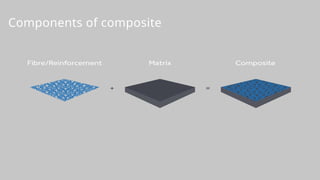
Components of composite
Parts of Composite Materials
•Matrix: Binds the reinforcement, provides shape
and protects fibers.
•Reinforcement: Provides strength, stiffness, and
other mechanical properties.
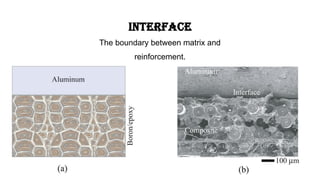
•Interface: The boundary between matrix and
reinforcement, ensuring load transfer.
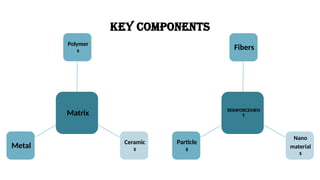
KEY Components
Earth Orbit’s
Solar Constant
and Solar Spectra
Solar Angles Collector Angles
Solar Irradiance
Comparison
to Measured
Data
Photovoltaic
Energy
Conversion
Matrix
Polymer
s
Ceramic
s
Metal
REINFORCEMEN
T
Fibers
Nano
material
s
Particle
s
Interface
The boundary between matrix and
reinforcement.
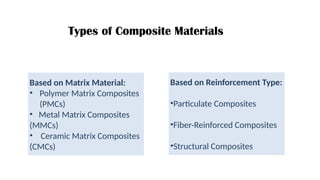
Types of Composite Materials
Based on Matrix Material:
• Polymer Matrix Composites
(PMCs)
• Metal Matrix Composites
(MMCs)
• Ceramic Matrix Composites
(CMCs)
Based on Reinforcement Type:
•Particulate Composites
•Fiber-Reinforced Composites
•Structural Composites
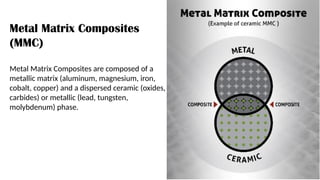
Metal Matrix Composites
(MMC)
Metal Matrix Composites are composed of a
metallic matrix (aluminum, magnesium, iron,
cobalt, copper) and a dispersed ceramic (oxides,
carbides) or metallic (lead, tungsten,
molybdenum) phase.
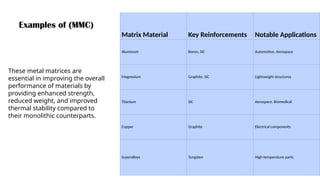
Matrix Material Key Reinforcements Notable Applications
Aluminum Boron, SiC Automotive, Aerospace
Magnesium Graphite, SiC Lightweight structures
Titanium SiC Aerospace, Biomedical
Copper Graphite Electrical components
Superalloys Tungsten High-temperature parts
Examples of (MMC)
These metal matrices are
essential in improving the overall
performance of materials by
providing enhanced strength,
reduced weight, and improved
thermal stability compared to
their monolithic counterparts.
Ceramic Matrix Composites
(CMC)
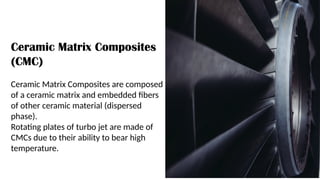
Ceramic Matrix Composites are composed
of a ceramic matrix and embedded fibers
of other ceramic material (dispersed
phase).
Rotating plates of turbo jet are made of
CMCs due to their ability to bear high
temperature.
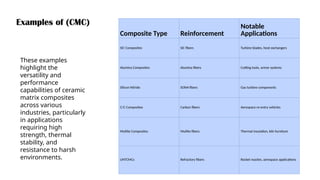
Composite Type Reinforcement
Notable
Applications
SiC Composites SiC fibers Turbine blades, heat exchangers
Alumina Composites Alumina fibers Cutting tools, armor systems
Silicon Nitride Si3N4 fibers Gas turbine components
C/C Composites Carbon fibers Aerospace re-entry vehicles
Mullite Composites Mullite fibers Thermal insulation, kiln furniture
UHTCMCs Refractory fibers Rocket nozzles, aerospace applications
Examples of (CMC)
These examples
highlight the
versatility and
performance
capabilities of ceramic
matrix composites
across various
industries, particularly
in applications
requiring high
strength, thermal
stability, and
resistance to harsh
environments.
Polymer Matrix Composites
(PMC)
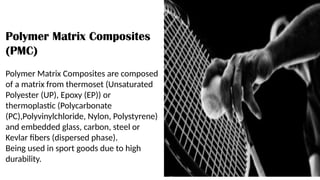
Polymer Matrix Composites are composed
of a matrix from thermoset (Unsaturated
Polyester (UP), Epoxy (EP)) or
thermoplastic (Polycarbonate
(PC),Polyvinylchloride, Nylon, Polystyrene)
and embedded glass, carbon, steel or
Kevlar fibers (dispersed phase).
Being used in sport goods due to high
durability.
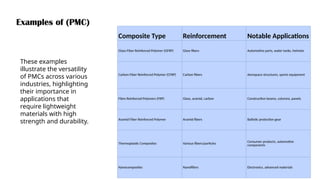
Composite Type Reinforcement Notable Applications
Glass Fiber Reinforced Polymer (GFRP) Glass fibers Automotive parts, water tanks, helmets
Carbon Fiber Reinforced Polymer (CFRP) Carbon fibers Aerospace structures, sports equipment
Fibre Reinforced Polymers (FRP) Glass, aramid, carbon Construction beams, columns, panels
Aramid Fiber Reinforced Polymer Aramid fibers Ballistic protection gear
Thermoplastic Composites Various fibers/particles
Consumer products, automotive
components
Nanocomposites Nanofillers Electronics, advanced materials
These examples
illustrate the versatility
of PMCs across various
industries, highlighting
their importance in
applications that
require lightweight
materials with high
strength and durability.
Examples of (PMC)
Particulate Composites
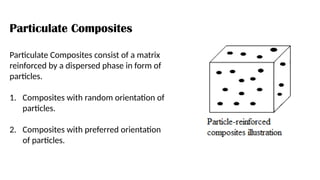
Particulate Composites consist of a matrix
reinforced by a dispersed phase in form of
particles.
1. Composites with random orientation of
particles.
2. Composites with preferred orientation
of particles.
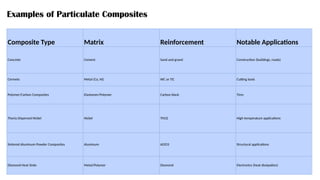
Composite Type Matrix Reinforcement Notable Applications
Concrete Cement Sand and gravel Construction (buildings, roads)
Cermets Metal (Co, Ni) WC or TiC Cutting tools
Polymer/Carbon Composites Elastomer/Polymer Carbon black Tires
Thoria Dispersed Nickel Nickel ThO2 High-temperature applications
Sintered Aluminum Powder Composites Aluminum Al2O3 Structural applications
Diamond Heat Sinks Metal/Polymer Diamond Electronics (heat dissipation)
Examples of Particulate Composites
Fibrous Composites
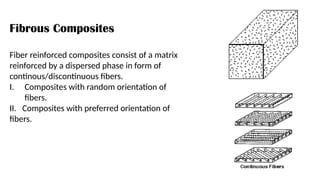
Fiber reinforced composites consist of a matrix
reinforced by a dispersed phase in form of
continous/discontinuous fibers.
I. Composites with random orientation of
fibers.
II. Composites with preferred orientation of
fibers.
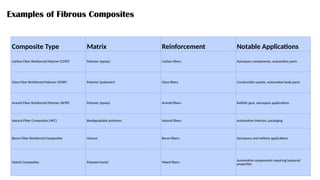
Composite Type Matrix Reinforcement Notable Applications
Carbon Fiber Reinforced Polymer (CFRP) Polymer (epoxy) Carbon fibers Aerospace components, automotive parts
Glass Fiber Reinforced Polymer (GFRP) Polymer (polyester) Glass fibers Construction panels, automotive body parts
Aramid Fiber Reinforced Polymer (AFRP) Polymer (epoxy) Aramid fibers Ballistic gear, aerospace applications
Natural Fiber Composites (NFC) Biodegradable polymers Natural fibers Automotive interiors, packaging
Boron Fiber Reinforced Composites Various Boron fibers Aerospace and military applications
Hybrid Composites Polymer/metal Mixed fibers
Automotive components requiring balanced
properties
Examples of Fibrous Composites
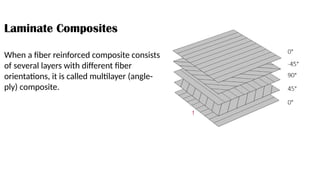
Laminate Composites
When a fiber reinforced composite consists
of several layers with different fiber
orientations, it is called multilayer (angle-
ply) composite.
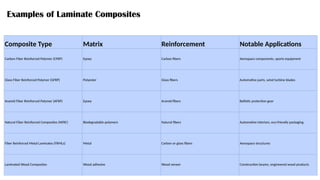
Composite Type Matrix Reinforcement Notable Applications
Carbon Fiber Reinforced Polymer (CFRP) Epoxy Carbon fibers Aerospace components, sports equipment
Glass Fiber Reinforced Polymer (GFRP) Polyester Glass fibers Automotive parts, wind turbine blades
Aramid Fiber Reinforced Polymer (AFRP) Epoxy Aramid fibers Ballistic protection gear
Natural Fiber Reinforced Composites (NFRC) Biodegradable polymers Natural fibers Automotive interiors, eco-friendly packaging
Fiber Reinforced Metal Laminates (FRMLs) Metal Carbon or glass fibers Aerospace structures
Laminated Wood Composites Wood adhesive Wood veneer Construction beams, engineered wood products
Examples of Laminate Composites
Hybrid composites consist of two or more
types of fibers or matrix materials to
improve mechanical properties and
performance.
Examples: Carbon fiber reinforced
polymer (CFRP) with glass fibers, metal
matrix composites with ceramics.
Hybrid Composite Materials
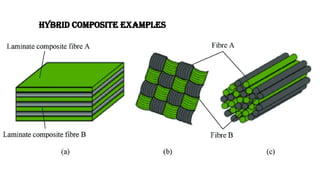
Hybrid Composite examples
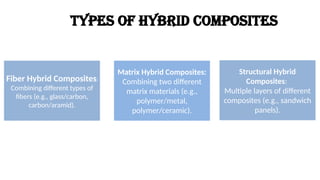
Types of Hybrid Composites
Fiber Hybrid Composites:
Combining different types of
fibers (e.g., glass/carbon,
carbon/aramid).
Matrix Hybrid Composites:
Combining two different
matrix materials (e.g.,
polymer/metal,
polymer/ceramic).
Structural Hybrid
Composites:
Multiple layers of different
composites (e.g., sandwich
panels).
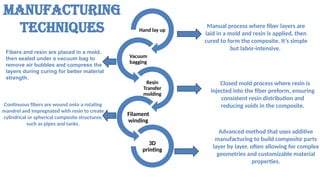
Hand lay up
Vacuum
bagging
Resin
Transfer
molding
Filament
winding
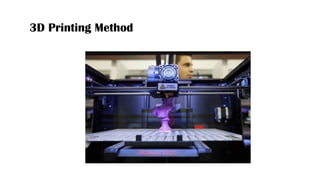
3D
printing
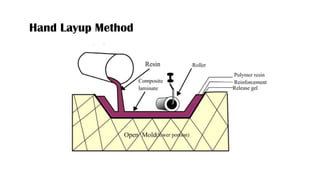
Manual process where fiber layers are
laid in a mold and resin is applied, then
cured to form the composite. It’s simple
but labor-intensive.
A Closed mold process where resin is
injected into the fiber preform, ensuring
consistent resin distribution and
reducing voids in the composite.
Advanced method that uses additive
manufacturing to build composite parts
layer by layer, often allowing for complex
geometries and customizable material
properties.
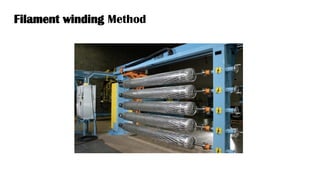
Continuous fibers are wound onto a rotating
mandrel and impregnated with resin to create
cylindrical or spherical composite structures,
such as pipes and tanks.
Fibers and resin are placed in a mold,
then sealed under a vacuum bag to
remove air bubbles and compress the
layers during curing for better material
strength.
Manufacturing
Techniques
Hand Layup Method
Filament winding Method
3D Printing Method
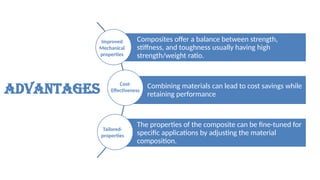
Composites offer a balance between strength,
stiffness, and toughness usually having high
strength/weight ratio.
Combining materials can lead to cost savings while
retaining performance
The properties of the composite can be fine-tuned for
specific applications by adjusting the material
composition.
Improved
Mechanical
properties
Cost-
Effectiveness
Tailored-
properties
Advantages
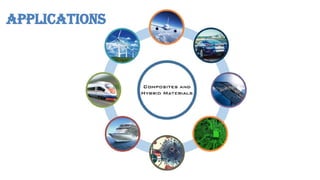
Applications
Recent advancement in hybrid/composite
•Use of nanomaterials (e.g., graphene)
in hybrid/composites to enhance performance.
•Sustainable composites: Development of
eco-friendly hybrid composites with natural
fibers and biodegradable matrices.
•Smart composites: Incorporating sensors
and electronics for health monitoring.
Thank
you!

hybrid composites and composite materials.pptx

  • 1.
  • 2.
    Composites are materialsmade from two or more distinct substances that, when combined, create a material with properties superior to the individual components having high strength to weight ratio. WHAT Are composites?
  • 3.
  • 4.
    Parts of CompositeMaterials •Matrix: Binds the reinforcement, provides shape and protects fibers. •Reinforcement: Provides strength, stiffness, and other mechanical properties. •Interface: The boundary between matrix and reinforcement, ensuring load transfer.
  • 5.
    KEY Components Earth Orbit’s SolarConstant and Solar Spectra Solar Angles Collector Angles Solar Irradiance Comparison to Measured Data Photovoltaic Energy Conversion Matrix Polymer s Ceramic s Metal REINFORCEMEN T Fibers Nano material s Particle s
  • 6.
    Interface The boundary betweenmatrix and reinforcement.
  • 7.
    Types of CompositeMaterials Based on Matrix Material: • Polymer Matrix Composites (PMCs) • Metal Matrix Composites (MMCs) • Ceramic Matrix Composites (CMCs) Based on Reinforcement Type: •Particulate Composites •Fiber-Reinforced Composites •Structural Composites
  • 8.
    Metal Matrix Composites (MMC) MetalMatrix Composites are composed of a metallic matrix (aluminum, magnesium, iron, cobalt, copper) and a dispersed ceramic (oxides, carbides) or metallic (lead, tungsten, molybdenum) phase.
  • 9.
    Matrix Material KeyReinforcements Notable Applications Aluminum Boron, SiC Automotive, Aerospace Magnesium Graphite, SiC Lightweight structures Titanium SiC Aerospace, Biomedical Copper Graphite Electrical components Superalloys Tungsten High-temperature parts Examples of (MMC) These metal matrices are essential in improving the overall performance of materials by providing enhanced strength, reduced weight, and improved thermal stability compared to their monolithic counterparts.
  • 10.
    Ceramic Matrix Composites (CMC) CeramicMatrix Composites are composed of a ceramic matrix and embedded fibers of other ceramic material (dispersed phase). Rotating plates of turbo jet are made of CMCs due to their ability to bear high temperature.
  • 11.
    Composite Type Reinforcement Notable Applications SiCComposites SiC fibers Turbine blades, heat exchangers Alumina Composites Alumina fibers Cutting tools, armor systems Silicon Nitride Si3N4 fibers Gas turbine components C/C Composites Carbon fibers Aerospace re-entry vehicles Mullite Composites Mullite fibers Thermal insulation, kiln furniture UHTCMCs Refractory fibers Rocket nozzles, aerospace applications Examples of (CMC) These examples highlight the versatility and performance capabilities of ceramic matrix composites across various industries, particularly in applications requiring high strength, thermal stability, and resistance to harsh environments.
  • 12.
    Polymer Matrix Composites (PMC) PolymerMatrix Composites are composed of a matrix from thermoset (Unsaturated Polyester (UP), Epoxy (EP)) or thermoplastic (Polycarbonate (PC),Polyvinylchloride, Nylon, Polystyrene) and embedded glass, carbon, steel or Kevlar fibers (dispersed phase). Being used in sport goods due to high durability.
  • 13.
    Composite Type ReinforcementNotable Applications Glass Fiber Reinforced Polymer (GFRP) Glass fibers Automotive parts, water tanks, helmets Carbon Fiber Reinforced Polymer (CFRP) Carbon fibers Aerospace structures, sports equipment Fibre Reinforced Polymers (FRP) Glass, aramid, carbon Construction beams, columns, panels Aramid Fiber Reinforced Polymer Aramid fibers Ballistic protection gear Thermoplastic Composites Various fibers/particles Consumer products, automotive components Nanocomposites Nanofillers Electronics, advanced materials These examples illustrate the versatility of PMCs across various industries, highlighting their importance in applications that require lightweight materials with high strength and durability. Examples of (PMC)
  • 14.
    Particulate Composites Particulate Compositesconsist of a matrix reinforced by a dispersed phase in form of particles. 1. Composites with random orientation of particles. 2. Composites with preferred orientation of particles.
  • 15.
    Composite Type MatrixReinforcement Notable Applications Concrete Cement Sand and gravel Construction (buildings, roads) Cermets Metal (Co, Ni) WC or TiC Cutting tools Polymer/Carbon Composites Elastomer/Polymer Carbon black Tires Thoria Dispersed Nickel Nickel ThO2 High-temperature applications Sintered Aluminum Powder Composites Aluminum Al2O3 Structural applications Diamond Heat Sinks Metal/Polymer Diamond Electronics (heat dissipation) Examples of Particulate Composites
  • 16.
    Fibrous Composites Fiber reinforcedcomposites consist of a matrix reinforced by a dispersed phase in form of continous/discontinuous fibers. I. Composites with random orientation of fibers. II. Composites with preferred orientation of fibers.
  • 17.
    Composite Type MatrixReinforcement Notable Applications Carbon Fiber Reinforced Polymer (CFRP) Polymer (epoxy) Carbon fibers Aerospace components, automotive parts Glass Fiber Reinforced Polymer (GFRP) Polymer (polyester) Glass fibers Construction panels, automotive body parts Aramid Fiber Reinforced Polymer (AFRP) Polymer (epoxy) Aramid fibers Ballistic gear, aerospace applications Natural Fiber Composites (NFC) Biodegradable polymers Natural fibers Automotive interiors, packaging Boron Fiber Reinforced Composites Various Boron fibers Aerospace and military applications Hybrid Composites Polymer/metal Mixed fibers Automotive components requiring balanced properties Examples of Fibrous Composites
  • 18.
    Laminate Composites When afiber reinforced composite consists of several layers with different fiber orientations, it is called multilayer (angle- ply) composite.
  • 19.
    Composite Type MatrixReinforcement Notable Applications Carbon Fiber Reinforced Polymer (CFRP) Epoxy Carbon fibers Aerospace components, sports equipment Glass Fiber Reinforced Polymer (GFRP) Polyester Glass fibers Automotive parts, wind turbine blades Aramid Fiber Reinforced Polymer (AFRP) Epoxy Aramid fibers Ballistic protection gear Natural Fiber Reinforced Composites (NFRC) Biodegradable polymers Natural fibers Automotive interiors, eco-friendly packaging Fiber Reinforced Metal Laminates (FRMLs) Metal Carbon or glass fibers Aerospace structures Laminated Wood Composites Wood adhesive Wood veneer Construction beams, engineered wood products Examples of Laminate Composites
  • 20.
    Hybrid composites consistof two or more types of fibers or matrix materials to improve mechanical properties and performance. Examples: Carbon fiber reinforced polymer (CFRP) with glass fibers, metal matrix composites with ceramics. Hybrid Composite Materials
  • 21.
  • 22.
    Types of HybridComposites Fiber Hybrid Composites: Combining different types of fibers (e.g., glass/carbon, carbon/aramid). Matrix Hybrid Composites: Combining two different matrix materials (e.g., polymer/metal, polymer/ceramic). Structural Hybrid Composites: Multiple layers of different composites (e.g., sandwich panels).
  • 23.
    Hand lay up Vacuum bagging Resin Transfer molding Filament winding 3D printing Manualprocess where fiber layers are laid in a mold and resin is applied, then cured to form the composite. It’s simple but labor-intensive. A Closed mold process where resin is injected into the fiber preform, ensuring consistent resin distribution and reducing voids in the composite. Advanced method that uses additive manufacturing to build composite parts layer by layer, often allowing for complex geometries and customizable material properties. Continuous fibers are wound onto a rotating mandrel and impregnated with resin to create cylindrical or spherical composite structures, such as pipes and tanks. Fibers and resin are placed in a mold, then sealed under a vacuum bag to remove air bubbles and compress the layers during curing for better material strength. Manufacturing Techniques
  • 24.
  • 25.
  • 26.
  • 27.
    Composites offer abalance between strength, stiffness, and toughness usually having high strength/weight ratio. Combining materials can lead to cost savings while retaining performance The properties of the composite can be fine-tuned for specific applications by adjusting the material composition. Improved Mechanical properties Cost- Effectiveness Tailored- properties Advantages
  • 28.
  • 29.
    Recent advancement inhybrid/composite •Use of nanomaterials (e.g., graphene) in hybrid/composites to enhance performance. •Sustainable composites: Development of eco-friendly hybrid composites with natural fibers and biodegradable matrices. •Smart composites: Incorporating sensors and electronics for health monitoring.
  • 30.