CENTRIFUGATION
Technique in Biochemistry
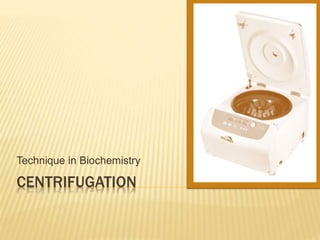
 A centrifuge is a device for separating particles from a
solution according to their size, shape, density, viscosity
of the medium and rotor speed.
 Action of centrifugal force is used to promote accelerated
settling of particles in a solid-liquid mixture.
 Biological centrifugation is a process that uses centrifugal
force to separate and purify mixtures of biological
particles in a liquid medium. It is a key technique for
isolating and analysing cells, subcellular fractions,
supramolecular complexes and isolated macromolecules
such as proteins or nucleicacid.
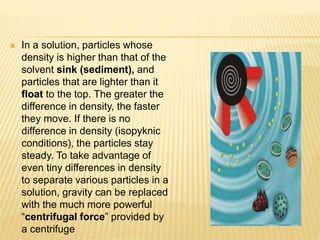
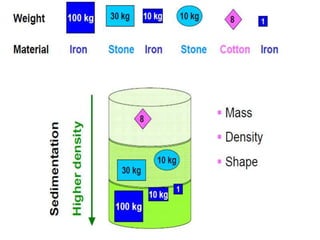
 In a solution, particles whose
density is higher than that of the
solvent sink (sediment), and
particles that are lighter than it
float to the top. The greater the
difference in density, the faster
they move. If there is no
difference in density (isopyknic
conditions), the particles stay
steady. To take advantage of
even tiny differences in density
to separate various particles in a
solution, gravity can be replaced
with the much more powerful
“centrifugal force” provided by
a centrifuge
PRINCIPLE OF CENTRIFUGATION
Basis of separation:
 -Size
 -Shape
 -Density
Methodology:
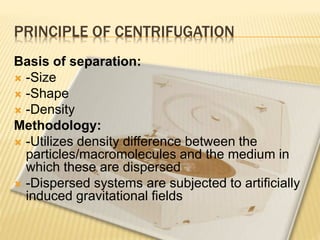
 -Utilizes density difference between the
particles/macromolecules and the medium in
which these are dispersed
 -Dispersed systems are subjected to artificially
induced gravitational fields
RELATIVE CENTRIFUGAL FORCE
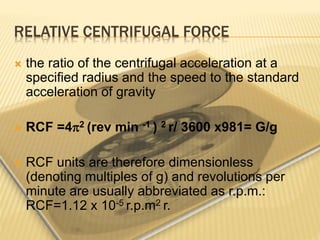
 the ratio of the centrifugal acceleration at a
specified radius and the speed to the standard
acceleration of gravity
 RCF =42 (rev min -1 ) 2 r/ 3600 x981= G/g
 RCF units are therefore dimensionless
(denoting multiples of g) and revolutions per
minute are usually abbreviated as r.p.m.:
RCF=1.12 x 10⁻⁵ r.p.m2 r.
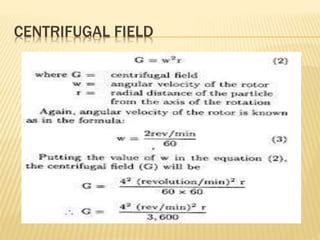
CENTRIFUGAL FIELD
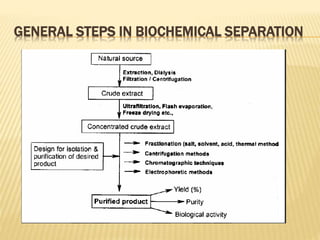
GENERAL STEPS IN BIOCHEMICAL SEPARATION
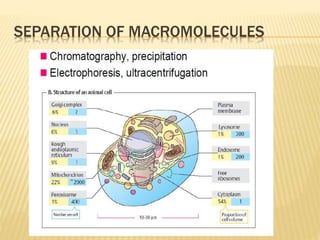
SEPARATION OF MACROMOLECULES
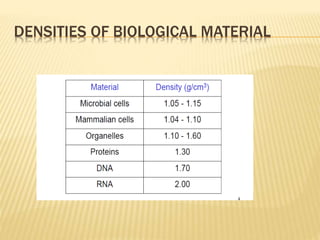
DENSITIES OF BIOLOGICAL MATERIAL
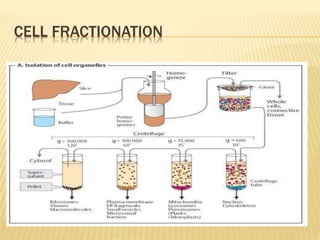
CELL FRACTIONATION
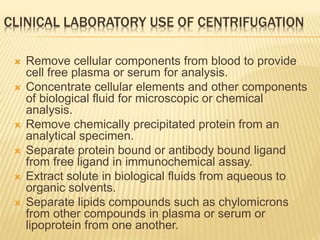
CLINICAL LABORATORY USE OF CENTRIFUGATION
 Remove cellular components from blood to provide
cell free plasma or serum for analysis.
 Concentrate cellular elements and other components
of biological fluid for microscopic or chemical
analysis.
 Remove chemically precipitated protein from an
analytical specimen.
 Separate protein bound or antibody bound ligand
from free ligand in immunochemical assay.
 Extract solute in biological fluids from aqueous to
organic solvents.
 Separate lipids compounds such as chylomicrons
from other compounds in plasma or serum or
lipoprotein from one another.
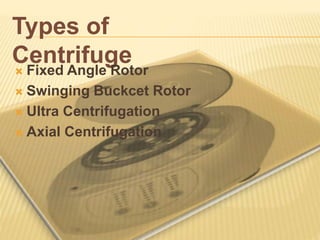
Types of
Centrifuge
 Fixed Angle Rotor
 Swinging Buckcet Rotor
 Ultra Centrifugation
 Axial Centrifugation
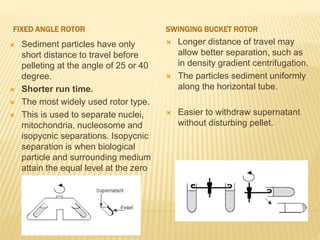
FIXED ANGLE ROTOR SWINGING BUCKET ROTOR
 Sediment particles have only
short distance to travel before
pelleting at the angle of 25 or 40
degree.
 Shorter run time.
 The most widely used rotor type.
 This is used to separate nuclei,
mitochondria, nucleosome and
isopycnic separations. Isopycnic
separation is when biological
particle and surrounding medium
attain the equal level at the zero
sedimentation rate.
 Longer distance of travel may
allow better separation, such as
in density gradient centrifugation.
 The particles sediment uniformly
along the horizontal tube.
 Easier to withdraw supernatant
without disturbing pellet.
ULTRACENTRIFUGATION AXIAL CENTRIFUGATION
 A very high speed
centrifuge with fixed head
rotors.
 Most important application
is in separating
lipoproteins.
 This is available both in
analytical and preparative
models.
 Allows tubes to spun in
vertical orientation which is
used in traditional
centrifugation.
THANK YOU

Centrifugation- Techniques in Biochemistry

  • 1.
  • 2.
     A centrifugeis a device for separating particles from a solution according to their size, shape, density, viscosity of the medium and rotor speed.  Action of centrifugal force is used to promote accelerated settling of particles in a solid-liquid mixture.  Biological centrifugation is a process that uses centrifugal force to separate and purify mixtures of biological particles in a liquid medium. It is a key technique for isolating and analysing cells, subcellular fractions, supramolecular complexes and isolated macromolecules such as proteins or nucleicacid.
  • 3.
     In asolution, particles whose density is higher than that of the solvent sink (sediment), and particles that are lighter than it float to the top. The greater the difference in density, the faster they move. If there is no difference in density (isopyknic conditions), the particles stay steady. To take advantage of even tiny differences in density to separate various particles in a solution, gravity can be replaced with the much more powerful “centrifugal force” provided by a centrifuge
  • 4.
    PRINCIPLE OF CENTRIFUGATION Basisof separation:  -Size  -Shape  -Density Methodology:  -Utilizes density difference between the particles/macromolecules and the medium in which these are dispersed  -Dispersed systems are subjected to artificially induced gravitational fields
  • 6.
    RELATIVE CENTRIFUGAL FORCE the ratio of the centrifugal acceleration at a specified radius and the speed to the standard acceleration of gravity  RCF =42 (rev min -1 ) 2 r/ 3600 x981= G/g  RCF units are therefore dimensionless (denoting multiples of g) and revolutions per minute are usually abbreviated as r.p.m.: RCF=1.12 x 10⁻⁵ r.p.m2 r.
  • 7.
  • 8.
    GENERAL STEPS INBIOCHEMICAL SEPARATION
  • 9.
  • 10.
  • 11.
  • 12.
    CLINICAL LABORATORY USEOF CENTRIFUGATION  Remove cellular components from blood to provide cell free plasma or serum for analysis.  Concentrate cellular elements and other components of biological fluid for microscopic or chemical analysis.  Remove chemically precipitated protein from an analytical specimen.  Separate protein bound or antibody bound ligand from free ligand in immunochemical assay.  Extract solute in biological fluids from aqueous to organic solvents.  Separate lipids compounds such as chylomicrons from other compounds in plasma or serum or lipoprotein from one another.
  • 13.
    Types of Centrifuge  FixedAngle Rotor  Swinging Buckcet Rotor  Ultra Centrifugation  Axial Centrifugation
  • 14.
    FIXED ANGLE ROTORSWINGING BUCKET ROTOR  Sediment particles have only short distance to travel before pelleting at the angle of 25 or 40 degree.  Shorter run time.  The most widely used rotor type.  This is used to separate nuclei, mitochondria, nucleosome and isopycnic separations. Isopycnic separation is when biological particle and surrounding medium attain the equal level at the zero sedimentation rate.  Longer distance of travel may allow better separation, such as in density gradient centrifugation.  The particles sediment uniformly along the horizontal tube.  Easier to withdraw supernatant without disturbing pellet.
  • 15.
    ULTRACENTRIFUGATION AXIAL CENTRIFUGATION A very high speed centrifuge with fixed head rotors.  Most important application is in separating lipoproteins.  This is available both in analytical and preparative models.  Allows tubes to spun in vertical orientation which is used in traditional centrifugation.
  • 16.