CSSD
PREPARED BY:
JIKHIL JOHN
SHIVANI R. BANGERA
4/6/2022
Master Hospital Administration 1
4/6/2022
Master Hospital Administration 2
Introduction:
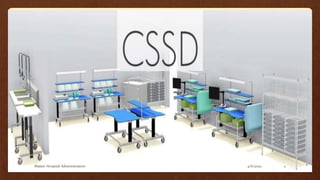
The Central Sterile Supply Department (CSSD) comprises services within
a hospital which receives; processes, distributes and controls professional
supplies and equipment, both sterile and non-sterile from to and from all
departments of the hospital for the care and safety of patients.
Ideally CSSD is an independent department with facilities to receive,
clean, pack, store and distribute instruments and supplies as per well
delineated protocols.
4/6/2022
Master Hospital Administration 3
Aim:
• Provide sterilized material from a central
department where sterilizing process is carried
out under properly controlled conditions.
• Alleviate the burden of work of the nursing
personnel, there by enabling them to devote
more of their time to patient care.
4/6/2022
Master Hospital Administration 4
Objectives and Functions
a) Provide sterilized material
b) Contributing a reduction in the incidence of hospital infection.
c) Maintains record of effectiveness of cleaning, disinfection
sterilization process.
d) Establish an inventory of supplies and equipment
e) Providing a safe environment for the patients and staff
4/6/2022
Master Hospital Administration 5
Layout
The department is designed in such a way that it is physically separated from
all other work areas.
The department is facilitate a unidirectional row from the “Dirty” area to
“Clean” area.
There is a changing area for the workers including toilet facilities and lockers
in proximity to the de-contamination area
The wash rooms, clean rooms and sterilizing is free from open windows and
unclean materials.
Master Hospital Administration 4/6/2022 6
Staffing:
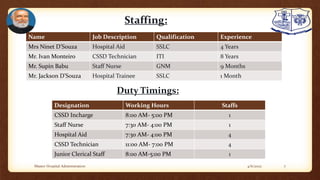
Name Job Description Qualification Experience
Mrs Ninet D’Souza Hospital Aid SSLC 4 Years
Mr. Ivan Monteiro CSSD Technician ITI 8 Years
Mr. Supin Babu Staff Nurse GNM 9 Months
Mr. Jackson D’Souza Hospital Trainee SSLC 1 Month
Master Hospital Administration 4/6/2022 7
Duty Timings:
Designation Working Hours Staffs
CSSD Incharge 8:00 AM- 5:00 PM 1
Staff Nurse 7:30 AM- 4:00 PM 1
Hospital Aid 7:30 AM- 4:00 PM 4
CSSD Technician 11:00 AM- 7:00 PM 4
Junior Clerical Staff 8:00 AM-5:00 PM 1
Role OF CSSD Incharge
• Maintenance and repair of equipment
• Inventory management of supplies and consumable
• Ensure quality of sterilization
• Ensure proper distribution and transport
• Cost control measure, to analyze and reduce the number of cycle
• Record keeping and data analysis
• Motivation of staff and training
• Inter departmental coordination
4/6/2022
Master Hospital Administration 8
a
4/6/2022
Master Hospital Administration 9
Cleaning Area
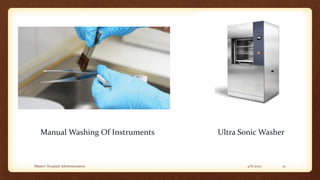
• Here the instruments are washed either manually or in the machines
• For manual washing, sinks with water supply and working counters are
organized. Detergents and brushes of various sizes and shapes are
required in this area.
• Ultrasonic washer is a machine used for cleaning surgical instruments.
It converts high frequency sound waves into mechanical vibration that
produces small bubbles that burst on the internal surfaces of
instruments and dislodge the waste particles.
• After the instruments are washed, they are dried in oven dryer and
shifted to packing area.
4/6/2022
Master Hospital Administration 10
Receiving Area
• Used item from various departments of the hospital are shifted to
CSSD for cleaning and sterilization.
• Ideally, the items that get soiled with blood or bodily fluid should be
decontaminated with Sodium Hydrochloride solution in the user
department itself before sending to CSSD.
• The receiving area of CSSD should have access to outside through a
window with a counter
• Necessaries entries and are made for records.
4/6/2022
Master Hospital Administration 11
Q
Manual Washing Of Instruments Ultra Sonic Washer
4/6/2022
Master Hospital Administration 12
Packing Area
• Clean and dry instruments are packed before sterilization. So that they
are not contaminated while handling after they are sterilized. Most of
the instruments are packed in trays that are wrapped with double layer
of cotton cloth
• Sealing machine is used for the sealing the plastic bags in which
instruments are packed. After packing and sealing the instruments are
shifted for sterilization.
4/6/2022
Master Hospital Administration 13
Items Commonly Handled by CSSD
1. Syringes
2. Procedure Sets: Lumbar Puncture; sternal puncture; aspiration;
tracheotomy ; suturing; cardiac resuscitation etc.
3. Needles
4. Gloves
5. I.V Fluids
6. Treatment Trays
7. O.T. Instruments
8. O.T. Linen
4/6/2022
Master Hospital Administration 14
Equipment's Used In CSSD
• Jet water cleaning gadgets
• Ultrasonic washers
• Needle sharpener
• Testing apparatus for efficiency of sterilization
4/6/2022
Master Hospital Administration 15
Sterilizing Area:
• Sterilization is done by either of the two methods in CSSD:
Steam Sterilization by Autoclaves
Gas Sterilization by ETO (Ethylene Oxide) Machines
• Autoclave:- Steam under pressure is the most cost effective method of
sterilization , “Autoclave” generates stem at a temperature of 121 degree
centigrade under 15 pounds of pressure. An exposure of 20 minutes is
required for sterilization
4/6/2022
Master Hospital Administration 16
a
• ETO Sterilizer: The items like cardiac catheters are thermos sensitive and
therefore cannot be sterilized by steam. Such items are sterilized by
Ethylene Oxide(ETO) Gas sterilization. The ETO is an expansive and toxic
gas. It is absolutely necessary to ensure that these items are made free of gas
molecules before using them on a patient. This is achieved by subjecting the
items to forced ventilation. The entire Cycle may take about 8-12 hrs.
4/6/2022
Master Hospital Administration 17
A
Autoclave ETO Sterilizer
4/6/2022
Master Hospital Administration 18
Recall Policies for Sterilizations
In case of the failure of all cycle, the CSSD staffs informs to all concerned
department to return storial material issued from the CSSD Autoclaving
The recall procedure include:
• Sending a recall notice to the department for which news is intended
• Includes the action to be taken by person recalling the notice
Report is prepared and completed defining:
• The reason for recall
• Number of patients potentially exposed
Master Hospital Administration 4/6/2022 19
Quality Indicators
• Mechanical Indicators:
Monitoring record time, temperature , humidity and pressure during the
sterilization cycle.
• Chemical Indicators:
Devices with a sensitive chemical/dye to monitor one or more parameters of a
sterilization cycle
• Biological Indicators:
Employ the principle of inhibition of growth of micro organism of high
resistance
4/6/2022
Master Hospital Administration 20
Chemical Indicator
Biological Indicator
4/6/2022
Master Hospital Administration 21
Quality Assurance
In order to ensure the quality of sterilization, the following measures are
taken:
• Ensure the equipment is fit i.e. in Autoclave the temperature is maintained
at 121 degrees centigrade, 15 pound pressure and holding time is minimum
20 minutes. Modern machines assure that and are fitted with good quality
monitors. They provide print outs of reading. The doors of the Autoclave do
not open unless the cycle is complete.
• Bowie Dick’s Tapes are fixed with every pack of items to be sterilized. This
tape changes color whenever the required temperature is attained. After a
cycle the tapes are checked for change of color.
4/6/2022
Master Hospital Administration 22
Contd..
However the change in color only indicates that the specific temperature has
been achieved during the cycle but cannot guarantee that the items are
sterilized. Indicators are also available for checking the quality of ETO
sterilization
Bowie Dick Strips Strip Indicator Test
4/6/2022
Master Hospital Administration 23
Quality Indicators:
• Class 1: External Indicator ( daily)
• Class 2: Internal Indicator
• Class 3: Single Parameter
• Class 4: BOWIE DICK ( Test Pack Daily)
• Class 5: Biological Indicator
Master Hospital Administration 4/6/2022 24
Records Maintained
• Duty Register – 1
• Autoclave Register – 1
• Steris Register – 1
• Sterrad Register – 1
• Training Register – 1
• Recall Register - 1
Master Hospital Administration 4/6/2022 25
Biological Waste
Is the waste that is generated during diagnosis treatment or
humanization of human beings in research activities in the production
or testing of biological matter, must be displaced within 40 hours of
collection and must be segregated as per categories:
Categories Of Health Care Waste:
1) Hazardous Health Care-waste: Used or unused sharps (E.g. auto
disable syringe, infusion set, blades and broken glass)
2) Infectious Waste:- Waste suspected to create pathogens and that
poses a risk of disease transmissions.
3) Non Hazardous Waste:- Waste that does not posses any particular
biological, chemical or physical hazard.
Master Hospital Administration 4/6/2022 26
SWOC Analysis
STRENGTH :
Dedicated Staff
Good Maintenance and Cleanliness level
WEAKNESS :
Poor Ventilation
Inadequate Space
Master Hospital Administration 4/6/2022 27
Contd..
OPPORTUNITIES :
Technology development in the market
Lower Prices of Raw Material
Better Physical Structure
CHALLENGES :
The transferring of packed items for sterilization from upstairs to ground
floor is difficult
Soft Wrap packing is prone to pinholes and tear
Master Hospital Administration 4/6/2022 28
Conclusion:
In most healthcare facilities, the Central Sterile Supply
Department(CSSD) plays a key role in providing the items required to
deliver quality patient care. A well planned, well managed and well
staffed CSSD can ensure an infection free environment of hospital and
save valuable life and money.
4/6/2022
Master Hospital Administration 29
A
4/6/2022
Master Hospital Administration 30

CSSD

  • 1.
    CSSD PREPARED BY: JIKHIL JOHN SHIVANIR. BANGERA 4/6/2022 Master Hospital Administration 1
  • 2.
  • 3.
    Introduction: The Central SterileSupply Department (CSSD) comprises services within a hospital which receives; processes, distributes and controls professional supplies and equipment, both sterile and non-sterile from to and from all departments of the hospital for the care and safety of patients. Ideally CSSD is an independent department with facilities to receive, clean, pack, store and distribute instruments and supplies as per well delineated protocols. 4/6/2022 Master Hospital Administration 3
  • 4.
    Aim: • Provide sterilizedmaterial from a central department where sterilizing process is carried out under properly controlled conditions. • Alleviate the burden of work of the nursing personnel, there by enabling them to devote more of their time to patient care. 4/6/2022 Master Hospital Administration 4
  • 5.
    Objectives and Functions a)Provide sterilized material b) Contributing a reduction in the incidence of hospital infection. c) Maintains record of effectiveness of cleaning, disinfection sterilization process. d) Establish an inventory of supplies and equipment e) Providing a safe environment for the patients and staff 4/6/2022 Master Hospital Administration 5
  • 6.
    Layout The department isdesigned in such a way that it is physically separated from all other work areas. The department is facilitate a unidirectional row from the “Dirty” area to “Clean” area. There is a changing area for the workers including toilet facilities and lockers in proximity to the de-contamination area The wash rooms, clean rooms and sterilizing is free from open windows and unclean materials. Master Hospital Administration 4/6/2022 6
  • 7.
    Staffing: Name Job DescriptionQualification Experience Mrs Ninet D’Souza Hospital Aid SSLC 4 Years Mr. Ivan Monteiro CSSD Technician ITI 8 Years Mr. Supin Babu Staff Nurse GNM 9 Months Mr. Jackson D’Souza Hospital Trainee SSLC 1 Month Master Hospital Administration 4/6/2022 7 Duty Timings: Designation Working Hours Staffs CSSD Incharge 8:00 AM- 5:00 PM 1 Staff Nurse 7:30 AM- 4:00 PM 1 Hospital Aid 7:30 AM- 4:00 PM 4 CSSD Technician 11:00 AM- 7:00 PM 4 Junior Clerical Staff 8:00 AM-5:00 PM 1
  • 8.
    Role OF CSSDIncharge • Maintenance and repair of equipment • Inventory management of supplies and consumable • Ensure quality of sterilization • Ensure proper distribution and transport • Cost control measure, to analyze and reduce the number of cycle • Record keeping and data analysis • Motivation of staff and training • Inter departmental coordination 4/6/2022 Master Hospital Administration 8
  • 9.
  • 10.
    Cleaning Area • Herethe instruments are washed either manually or in the machines • For manual washing, sinks with water supply and working counters are organized. Detergents and brushes of various sizes and shapes are required in this area. • Ultrasonic washer is a machine used for cleaning surgical instruments. It converts high frequency sound waves into mechanical vibration that produces small bubbles that burst on the internal surfaces of instruments and dislodge the waste particles. • After the instruments are washed, they are dried in oven dryer and shifted to packing area. 4/6/2022 Master Hospital Administration 10
  • 11.
    Receiving Area • Useditem from various departments of the hospital are shifted to CSSD for cleaning and sterilization. • Ideally, the items that get soiled with blood or bodily fluid should be decontaminated with Sodium Hydrochloride solution in the user department itself before sending to CSSD. • The receiving area of CSSD should have access to outside through a window with a counter • Necessaries entries and are made for records. 4/6/2022 Master Hospital Administration 11
  • 12.
    Q Manual Washing OfInstruments Ultra Sonic Washer 4/6/2022 Master Hospital Administration 12
  • 13.
    Packing Area • Cleanand dry instruments are packed before sterilization. So that they are not contaminated while handling after they are sterilized. Most of the instruments are packed in trays that are wrapped with double layer of cotton cloth • Sealing machine is used for the sealing the plastic bags in which instruments are packed. After packing and sealing the instruments are shifted for sterilization. 4/6/2022 Master Hospital Administration 13
  • 14.
    Items Commonly Handledby CSSD 1. Syringes 2. Procedure Sets: Lumbar Puncture; sternal puncture; aspiration; tracheotomy ; suturing; cardiac resuscitation etc. 3. Needles 4. Gloves 5. I.V Fluids 6. Treatment Trays 7. O.T. Instruments 8. O.T. Linen 4/6/2022 Master Hospital Administration 14
  • 15.
    Equipment's Used InCSSD • Jet water cleaning gadgets • Ultrasonic washers • Needle sharpener • Testing apparatus for efficiency of sterilization 4/6/2022 Master Hospital Administration 15
  • 16.
    Sterilizing Area: • Sterilizationis done by either of the two methods in CSSD: Steam Sterilization by Autoclaves Gas Sterilization by ETO (Ethylene Oxide) Machines • Autoclave:- Steam under pressure is the most cost effective method of sterilization , “Autoclave” generates stem at a temperature of 121 degree centigrade under 15 pounds of pressure. An exposure of 20 minutes is required for sterilization 4/6/2022 Master Hospital Administration 16
  • 17.
    a • ETO Sterilizer:The items like cardiac catheters are thermos sensitive and therefore cannot be sterilized by steam. Such items are sterilized by Ethylene Oxide(ETO) Gas sterilization. The ETO is an expansive and toxic gas. It is absolutely necessary to ensure that these items are made free of gas molecules before using them on a patient. This is achieved by subjecting the items to forced ventilation. The entire Cycle may take about 8-12 hrs. 4/6/2022 Master Hospital Administration 17
  • 18.
  • 19.
    Recall Policies forSterilizations In case of the failure of all cycle, the CSSD staffs informs to all concerned department to return storial material issued from the CSSD Autoclaving The recall procedure include: • Sending a recall notice to the department for which news is intended • Includes the action to be taken by person recalling the notice Report is prepared and completed defining: • The reason for recall • Number of patients potentially exposed Master Hospital Administration 4/6/2022 19
  • 20.
    Quality Indicators • MechanicalIndicators: Monitoring record time, temperature , humidity and pressure during the sterilization cycle. • Chemical Indicators: Devices with a sensitive chemical/dye to monitor one or more parameters of a sterilization cycle • Biological Indicators: Employ the principle of inhibition of growth of micro organism of high resistance 4/6/2022 Master Hospital Administration 20
  • 21.
  • 22.
    Quality Assurance In orderto ensure the quality of sterilization, the following measures are taken: • Ensure the equipment is fit i.e. in Autoclave the temperature is maintained at 121 degrees centigrade, 15 pound pressure and holding time is minimum 20 minutes. Modern machines assure that and are fitted with good quality monitors. They provide print outs of reading. The doors of the Autoclave do not open unless the cycle is complete. • Bowie Dick’s Tapes are fixed with every pack of items to be sterilized. This tape changes color whenever the required temperature is attained. After a cycle the tapes are checked for change of color. 4/6/2022 Master Hospital Administration 22
  • 23.
    Contd.. However the changein color only indicates that the specific temperature has been achieved during the cycle but cannot guarantee that the items are sterilized. Indicators are also available for checking the quality of ETO sterilization Bowie Dick Strips Strip Indicator Test 4/6/2022 Master Hospital Administration 23
  • 24.
    Quality Indicators: • Class1: External Indicator ( daily) • Class 2: Internal Indicator • Class 3: Single Parameter • Class 4: BOWIE DICK ( Test Pack Daily) • Class 5: Biological Indicator Master Hospital Administration 4/6/2022 24
  • 25.
    Records Maintained • DutyRegister – 1 • Autoclave Register – 1 • Steris Register – 1 • Sterrad Register – 1 • Training Register – 1 • Recall Register - 1 Master Hospital Administration 4/6/2022 25
  • 26.
    Biological Waste Is thewaste that is generated during diagnosis treatment or humanization of human beings in research activities in the production or testing of biological matter, must be displaced within 40 hours of collection and must be segregated as per categories: Categories Of Health Care Waste: 1) Hazardous Health Care-waste: Used or unused sharps (E.g. auto disable syringe, infusion set, blades and broken glass) 2) Infectious Waste:- Waste suspected to create pathogens and that poses a risk of disease transmissions. 3) Non Hazardous Waste:- Waste that does not posses any particular biological, chemical or physical hazard. Master Hospital Administration 4/6/2022 26
  • 27.
    SWOC Analysis STRENGTH : DedicatedStaff Good Maintenance and Cleanliness level WEAKNESS : Poor Ventilation Inadequate Space Master Hospital Administration 4/6/2022 27
  • 28.
    Contd.. OPPORTUNITIES : Technology developmentin the market Lower Prices of Raw Material Better Physical Structure CHALLENGES : The transferring of packed items for sterilization from upstairs to ground floor is difficult Soft Wrap packing is prone to pinholes and tear Master Hospital Administration 4/6/2022 28
  • 29.
    Conclusion: In most healthcarefacilities, the Central Sterile Supply Department(CSSD) plays a key role in providing the items required to deliver quality patient care. A well planned, well managed and well staffed CSSD can ensure an infection free environment of hospital and save valuable life and money. 4/6/2022 Master Hospital Administration 29
  • 30.