



Improvement Of Compatibility And Curing
Accelerators
• Determining Compatibility
• Improvement of Compatibility and General Properties
1
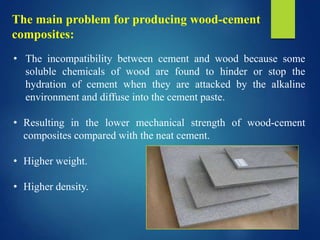
• The incompatibility between cement and wood because some
soluble chemicals of wood are found to hinder or stop the
hydration of cement when they are attacked by the alkaline
environment and diffuse into the cement paste.
• Resulting in the lower mechanical strength of wood-cement
composites compared with the neat cement.
• Higher weight.
• Higher density.
The main problem for producing wood-cement
composites:
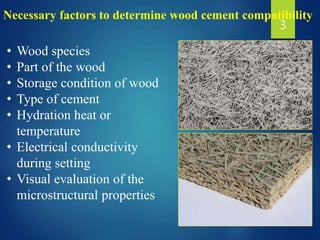
• Wood species
• Part of the wood
• Storage condition of wood
• Type of cement
• Hydration heat or
temperature
• Electrical conductivity
during setting
• Visual evaluation of the
microstructural properties
Necessary factors to determine wood cement compatibility
3
Improvement of Compatibility and General Properties
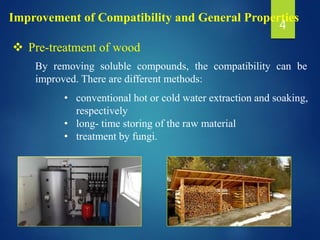
 Pre-treatment of wood
By removing soluble compounds, the compatibility can be
improved. There are different methods:
• conventional hot or cold water extraction and soaking,
respectively
• long- time storing of the raw material
• treatment by fungi.
4
• The addition of small amounts of cement setting
accelerators, such as CaCl2, MgCl2, FeCl3 and Al2(SO4)3.
 Addition of cement curing accelerators
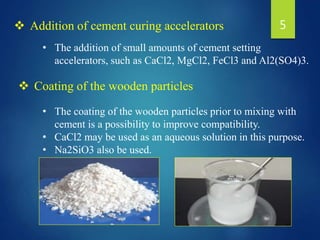
• The coating of the wooden particles prior to mixing with
cement is a possibility to improve compatibility.
• CaCl2 may be used as an aqueous solution in this purpose.
• Na2SiO3 also be used.
 Coating of the wooden particles
5
• The gaseous or supercritical CO2 accelerate the setting of cement
mixed with wood and improve the wood-cement compatibility.
• The use of CO2 is neutralized by calcium silicate in cement,
resulting in highly insoluble calcium carbonate.
• The carbonation reaction is confirmed to be a diffusion-controlled
process. It occurs very quickly in the first two minutes of reaction.
• Rapid carbonization might accelerate formation of the hydration
products (e.g., calcium carbonate and calcium silicate).
• It accelerates setting as well as curing time and improves
mechanical properties.
• Qi et al. (2006) found that significant strength development of
wood cement composites containing 14 or 20 % fiber occurred after
1-3 min CO2 injection.
 CO2 injection 6
7 Use of magnesium oxychloride cement (MOC)
rather than ordinary Portland cement (OPC)
• lower carbon emission
• higher fire resistance
• higher abrasion resistance
• higher temperature resistance
• lower thermal conductivity
• lower alkalinity
• lower shrinkage and creep and better durability
• Another approach is the replacement of parts of cement by
fumed silica (SiO2) in combination with superplasticizers
(also known as high range water reducers, such as
“Polycarboxylate ether superplasticizer”).
• This combination should increase the cohesiveness of the
fresh composite and reduce the water content.
• Improvement of mechanical properties as well as mitigation
of thickness swelling when fumed silica (10%) was added.
 Reducing water absorption capability
8
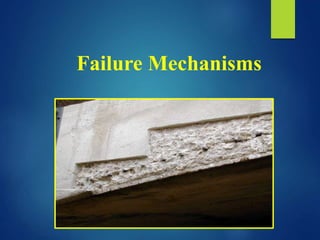
Failure Mechanisms
Failure Mechanisms
• As a building material pure concrete is primarily used in
compression, developing strengths of 32.5-52.5 N/mm².
• The addition of wood particles improves fracture
toughness by blocking crack propagation.
• This permits the composite to carry load to a higher
strain limit (Wolfe and Gjinolli 1996b).
• Wood cannot, however, improve compressive strength,
because the compressive strength of cement is much
higher than that of wood.
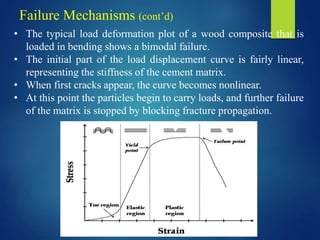
• The typical load deformation plot of a wood composite that is
loaded in bending shows a bimodal failure.
• The initial part of the load displacement curve is fairly linear,
representing the stiffness of the cement matrix.
• When first cracks appear, the curve becomes nonlinear.
• At this point the particles begin to carry loads, and further failure
of the matrix is stopped by blocking fracture propagation.
Failure Mechanisms (cont’d)
Coutts and Kightly (1982) showed that two different failure
mechanisms for fibre cement composites can occur.
They are:
• fibre fracture
• fibre pull-out.
• Controversial results are reported concerning the predominating failure
mode.
• On the other hand fibre pull-out was thought to be the predominating
failure mode.
• However, new results suggest that the interfacial bond between the two
components is relatively strong.
• Therefore, the failure mode depends on the fibre length and whether the
fibre length is above or below the critical fibre length of the composite.
Failure Mechanisms (cont’d)
• Due to the fact that the fibres are swelling because of water
insertion, considerable frictional forces are developed, which again
could lead to fibre fracture.
• Therefore, the interfacial bond strength between the fibre and the
cement matrix is influenced by the moisture content
• Wolfe and Gjinolli (1996b) proposed that the changing mechanical
behaviour can be explained by the reduced bending strength of wet
fibre, making it more flexible and less likely to inhibit cracking in
the cement matrix.
Failure Mechanisms (cont’d)
14

Wood cement board

  • 1.
    Improvement Of CompatibilityAnd Curing Accelerators • Determining Compatibility • Improvement of Compatibility and General Properties 1
  • 2.
    • The incompatibilitybetween cement and wood because some soluble chemicals of wood are found to hinder or stop the hydration of cement when they are attacked by the alkaline environment and diffuse into the cement paste. • Resulting in the lower mechanical strength of wood-cement composites compared with the neat cement. • Higher weight. • Higher density. The main problem for producing wood-cement composites:
  • 3.
    • Wood species •Part of the wood • Storage condition of wood • Type of cement • Hydration heat or temperature • Electrical conductivity during setting • Visual evaluation of the microstructural properties Necessary factors to determine wood cement compatibility 3
  • 4.
    Improvement of Compatibilityand General Properties  Pre-treatment of wood By removing soluble compounds, the compatibility can be improved. There are different methods: • conventional hot or cold water extraction and soaking, respectively • long- time storing of the raw material • treatment by fungi. 4
  • 5.
    • The additionof small amounts of cement setting accelerators, such as CaCl2, MgCl2, FeCl3 and Al2(SO4)3.  Addition of cement curing accelerators • The coating of the wooden particles prior to mixing with cement is a possibility to improve compatibility. • CaCl2 may be used as an aqueous solution in this purpose. • Na2SiO3 also be used.  Coating of the wooden particles 5
  • 6.
    • The gaseousor supercritical CO2 accelerate the setting of cement mixed with wood and improve the wood-cement compatibility. • The use of CO2 is neutralized by calcium silicate in cement, resulting in highly insoluble calcium carbonate. • The carbonation reaction is confirmed to be a diffusion-controlled process. It occurs very quickly in the first two minutes of reaction. • Rapid carbonization might accelerate formation of the hydration products (e.g., calcium carbonate and calcium silicate). • It accelerates setting as well as curing time and improves mechanical properties. • Qi et al. (2006) found that significant strength development of wood cement composites containing 14 or 20 % fiber occurred after 1-3 min CO2 injection.  CO2 injection 6
  • 7.
    7 Use ofmagnesium oxychloride cement (MOC) rather than ordinary Portland cement (OPC) • lower carbon emission • higher fire resistance • higher abrasion resistance • higher temperature resistance • lower thermal conductivity • lower alkalinity • lower shrinkage and creep and better durability
  • 8.
    • Another approachis the replacement of parts of cement by fumed silica (SiO2) in combination with superplasticizers (also known as high range water reducers, such as “Polycarboxylate ether superplasticizer”). • This combination should increase the cohesiveness of the fresh composite and reduce the water content. • Improvement of mechanical properties as well as mitigation of thickness swelling when fumed silica (10%) was added.  Reducing water absorption capability 8
  • 9.
  • 10.
    Failure Mechanisms • Asa building material pure concrete is primarily used in compression, developing strengths of 32.5-52.5 N/mm². • The addition of wood particles improves fracture toughness by blocking crack propagation. • This permits the composite to carry load to a higher strain limit (Wolfe and Gjinolli 1996b). • Wood cannot, however, improve compressive strength, because the compressive strength of cement is much higher than that of wood.
  • 11.
    • The typicalload deformation plot of a wood composite that is loaded in bending shows a bimodal failure. • The initial part of the load displacement curve is fairly linear, representing the stiffness of the cement matrix. • When first cracks appear, the curve becomes nonlinear. • At this point the particles begin to carry loads, and further failure of the matrix is stopped by blocking fracture propagation. Failure Mechanisms (cont’d)
  • 12.
    Coutts and Kightly(1982) showed that two different failure mechanisms for fibre cement composites can occur. They are: • fibre fracture • fibre pull-out. • Controversial results are reported concerning the predominating failure mode. • On the other hand fibre pull-out was thought to be the predominating failure mode. • However, new results suggest that the interfacial bond between the two components is relatively strong. • Therefore, the failure mode depends on the fibre length and whether the fibre length is above or below the critical fibre length of the composite. Failure Mechanisms (cont’d)
  • 13.
    • Due tothe fact that the fibres are swelling because of water insertion, considerable frictional forces are developed, which again could lead to fibre fracture. • Therefore, the interfacial bond strength between the fibre and the cement matrix is influenced by the moisture content • Wolfe and Gjinolli (1996b) proposed that the changing mechanical behaviour can be explained by the reduced bending strength of wet fibre, making it more flexible and less likely to inhibit cracking in the cement matrix. Failure Mechanisms (cont’d)
  • 14.