Cell, Tissue, and Organ
KEY POINTS
Humans—and other complex multicellular organisms—have
systems of organs that work together, carrying out
processes that keep us alive.
The body has levels of organization that build on each
other. Cells make up tissues, tissues make up organs, and
organs make up organ systems.
The function of an organ system depends on the integrated
activity of its organs. For instance, digestive system organs
cooperate to process food.
MAJOR SYSTEMS, ORGAN AND
TISSUES OF HUMAN BODY AND
THEIR FUNCTION
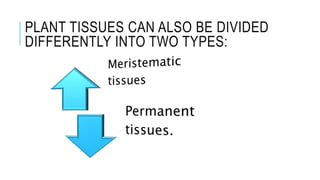
PLANT TISSUES CAN ALSO BE DIVIDED
DIFFERENTLY INTO TWO TYPES:
MERISTEMATIC TISSUES
Meristematic tissues consists of actively dividing cells, and leads to
increase in length and thickness of the plant. The primary growth of a
plant occurs only in certain, specific regions, such as in the tips of
stems or roots. It is in these regions that meristematic tissue is
present. Cells in these tissues are roughly spherical or polyhedral, to
rectangular in shape, and have thin cell walls.
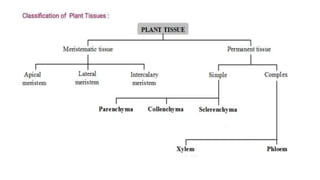
The types of Meristematic tissues are;
 Primary meristems
Secondary meristems
 Apical Meristem
Lateral Meristem
Intercalary Meristem
Primary meristems
– Those meristems which are derived directly from the
meristems of the embryo and persist throughout the life
of the plant are called primary meristems. They are
responsible for primary growth and lie mainly on the
apices of stems and roots.
SECONDARY MERISTEMS
• 1. Secondary meristem is formed later in the life.
• 2. Secondary meristem develops from the permanent cells due
to dedifferentiation.
• 3. The cells are commonly elongated.
• 4. The cells possess central vacuoles.
• 5. Secondary meristem gives rise to secondary or
supplementary tissues that constitute secondary growth.
Secondary tissues either supplement or replace the primary
tissues.
• 6. Secondary meristem produces growth in thickness.
THE TYPES OF SECONDARY MERISTEMS ARE;
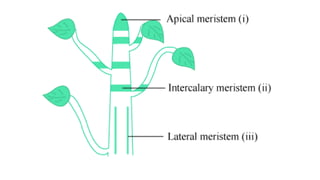
 Apical Meristem - It is present at the growing tips of stems and roots and increases the
length of the stem and root. They form growing parts at the apices of roots and stems and
are responsible for increase in length, also called primary growth. This meristem is responsible
for the linear growth of an organ.
 Lateral Meristem - This meristem consist of cells which mainly divide in one plane and cause
the organ to increase in diameter and growth. Lateral meristem usually occurs beneath the
bark of the tree in the form of Cork Cambium and in vascular bundles of dicots in the form
of vascular cambium. The activity of this cambium results in the formation of secondary
growth.
 Intercalary Meristem - This meristem is located in between permanent tissues. It is usually
present at the base of node, inter node and on leaf base. They are responsible for growth in
length of the plant and increasing the size of the internode, They result in branch formation
and growth.
Permanent tissues
 Meristematic tissues that take up a specific role lose the
ability to divide. This process of taking up a permanent
shape, size and a function is called cellular differentiation.
Cells of meristematic tissue differentiate to form different
types of permanent tissue. There are 3 types of permanent
tissues:
 simple permanent tissues
 complex permanent tissues
 special or secretory tissues (glandular).
Simple permanent tissues
•A group of cells which are similar in origin;
similar in structure and similar in function
are called simple permanent tissue. They
are of four types:
•Parenchyma
•Collenchyma
•Sclerenchyma
Complex permanent tissues
• The complex tissue consists of more than one type of cells which
work together as a unit. Complex tissues help in the
transportation of organic material, water and minerals up and
down the plants. That is why it is also known as conducting and
vascular tissue. The common types of complex permanent tissue
are:
• Xylem
• Phloem
Special Permanent Tissue
 The tissue which are concerned with the secretion of material
like gums, resins, oils, nectar, latex and other substances, are
called special tissue. The well-organized secretory structures
are called glands.
They are divided into two groups:
 Lactiferous tissues
 Glandular tissues
Cell, tissue and organs Presentation