Cell Survival Curve
DR. TARUNI BHATTACHARYA
D.N.B. RESIDENT
Cell Survival Curve
 It describes relationship between radiation dose and
the fraction of cells that “survive” that dose.
 This is mainly used to assess biological
effectiveness of radiation.
Cell Death
Cell death can have different meanings:
 loss of a specific function - differentiated cells
muscle, secretory cells)
(nerve,
 loss of the ability to divide - proliferating cells such as stem
cells in hematopoietic system or intestinal epithelium
 loss of reproductive integrity - “reproductive death”
3
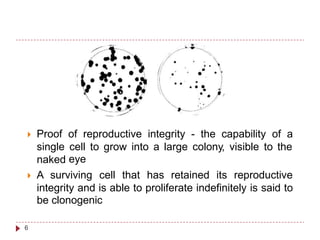
 Proof
single
naked
of reproductive integrity - the capability of a
cell to grow into a large colony, visible to the
eye
 A surviving cell that has retained its reproductive
integrity and is able to proliferate indefinitely is said to
be clonogenic
6
Estimating Survival
 In order to determine the surviving fraction, we
must know the plating efficiency
 PE is the percentage of cells
grow into colonies
P.E.= no of cells counted
no. of cells seeded
(in control batch) that
 in other words,
Process
those cells that survive the plating
7
Relevant Dose
 100 Gy
destroys cell function in non-proliferating
example: nerve, muscle cells)
Gy
systems (for
 2
 mean lethal dose for loss of proliferative capacity for
proliferating cells
4
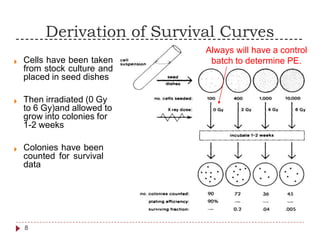
Derivation of Survival Curves
Always will have a control
batch to determine PE.Cells have been taken
from stock culture and
placed in seed dishes

Then irradiated (0 Gy
to 6 Gy)and allowed to
grow into colonies for
1-2 weeks

Colonies have been
counted for survival
data

8
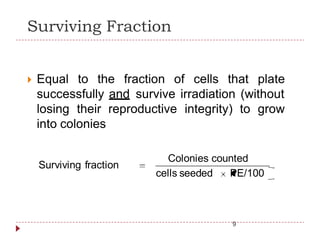
Surviving Fraction
 Equal to the fraction of cells that plate
successfully and survive irradiation (without
losing their reproductive integrity) to grow
into colonies
Colonies counted
Surviving fraction
cells seeded PE/100
9
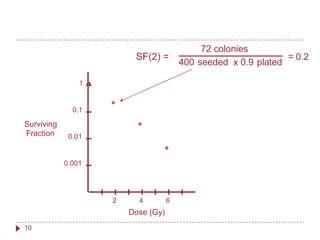
72 colonies
SF(2) = = 0.2
400 seeded x 0.9 plated
1
0.1
Surviving
Fraction 0.01
0.001
2 4 6
Dose (Gy)
10
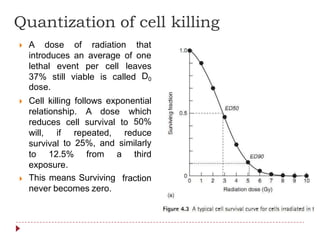
Quantization of cell killing
A dose of radiation that
introduces an average of one
lethal event per cell leaves
37%
dose.
still viable is called D0
Cell killing follows exponential
relationship. A dose which
50%reduces cell survival to
will, if repeated,
to 25%, and
reduce
similarlysurvival
to 12.5% from a third
exposure.
This means Surviving
never becomes zero.
fraction
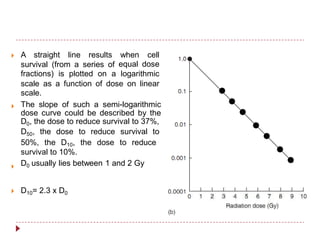
A straight line results when cell
equal dose
logarithmic

survival (from a series of
fractions) is plotted on a
scale as a function of dose on linear
scale.
The slope of such a semi-logarithmic
dose curve could be described by the
D0, the dose to reduce survival to 37%,
D50, the dose to reduce survival to
50%, the D10, the dose to reduce
survival to 10%.
D0 usually lies between 1 and 2 Gy


D10= 2.3 x D0
Survival Curve Features
 Simple to describe qualitatively
 Difficulty lies in explaining underlying
events
biophysical
 Many models have been proposed
 Steepness of curve represent the radio-
sensitiveness.
14
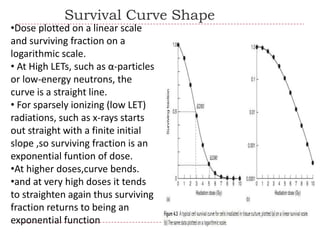
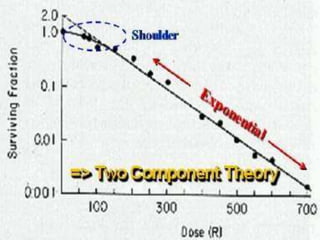
Survival Curve Shape
•Dose plotted on a linear scale
and surviving fraction on a
logarithmic scale.
• At High LETs, such as α-particles
or low-energy neutrons, the
curve is a straight line.
• For sparsely ionizing (low LET)
radiations, such as x-rays starts
out straight with a finite initial
slope ,so surviving fraction is an
exponential funtion of dose.
•At higher doses,curve bends.
•and at very high doses it tends
to straighten again thus surviving
fraction returns to being an
exponential function
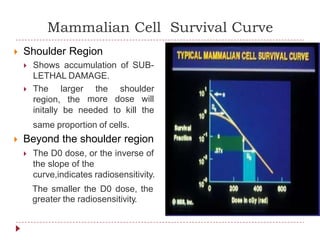
Mammalian Cell Survival Curve
 Shoulder Region
 Shows accumulation of SUB-
LETHAL DAMAGE.
 The larger the
more
shoulder
dose willregion, the
initally be needed to kill the
same proportion of cells.
 Beyond the shoulder region
 The D0 dose, or the inverse of
the slope of the
curve,indicates radiosensitivity.
The smaller the D0 dose, the
greater the radiosensitivity.
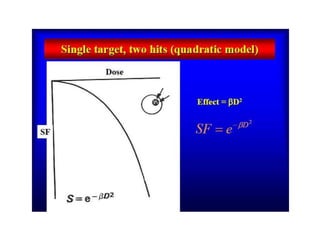
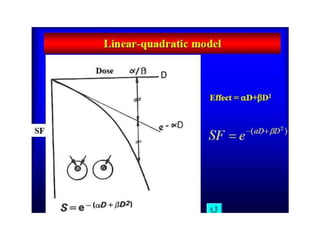
Survival Curve Models
 Linear-quadratic model
 “dual radiation action”
 first component - cell killing is proportional to dose
 second component - cell killing is proportional
dose squared
 Multi-target model
 based on probability of hitting the “target”
 widely used for many years; still has merit
to
17
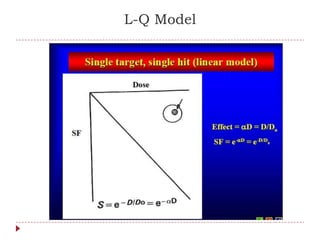
L-Q Model
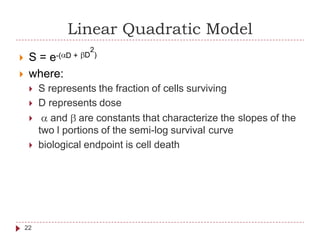
Linear Quadratic Model
2
e-( D + D ) S =
 where:
 S represents the fraction of cells surviving
 D represents dose
and are constants that characterize the slopes of the
two l portions of the semi-log survival curve
 biological endpoint is cell death
22
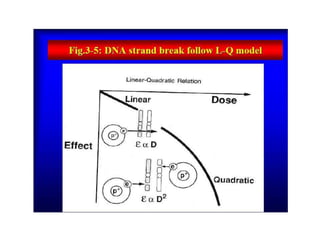
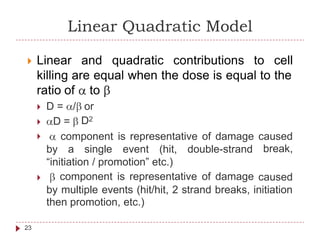
Linear Quadratic Model
 Linear and quadratic contributions to cell
killing are equal when the dose is equal to the
ratio of to
 D = / or
D2D =
 component is representative of damage caused
break,by a single event (hit, double-strand
“initiation / promotion” etc.)
component is representative of damage caused
by multiple events (hit/hit, 2 strand breaks, initiation
then promotion, etc.)
23
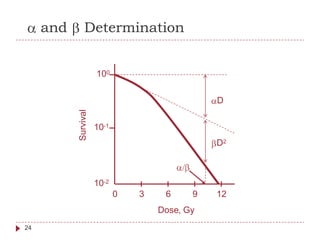
and Determination
100
10-1
10-2
0 3 6 9 12
Dose, Gy
24
Survival
D
D2
Multi-target Model
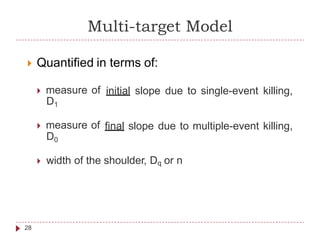
Multi-target Model
 Quantified in terms of:
 measure of
D1
 measure of
D0
 width of the
initial slope due to single-event killing,
final slope due to multiple-event killing,
shoulder, Dq or n
28
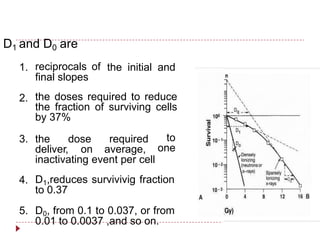
D1 and D0 are
1. reciprocals of
final slopes
the initial and
2. the doses required to reduce
the fraction of surviving cells
by 37%
3. the dose required to
onedeliver, on average,
inactivating event per cell
4. D1,reduces survivivig fraction
to 0.37
D0, from 0.1 to 0.037, or from
0.01 to 0.0037 ,and so on.
5.
Multi-target Model
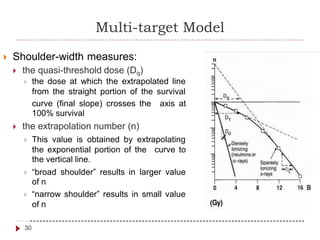
 Shoulder-width measures:
 the quasi-threshold dose (Dq)
 the dose at which the extrapolated line
from the straight portion of the survival
curve (final slope) crosses the
100% survival
 the extrapolation number (n)
axis at
 This value is obtained by extrapolating
the exponential portion of the
the vertical line.
curve to
 “broad shoulder” results in larger value
of n
 “narrow shoulder” results in small value
of n
30
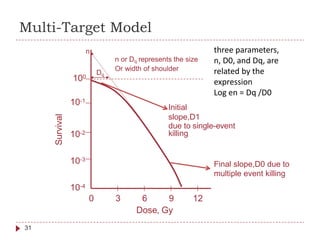
Multi-Target Model
n or Dq represents the size
Or width of shoulder
Dq
100
10-1
due to single-event
killing10-2
10-3
10-4
0 3 6 9 12
Dose, Gy
31
Survival
n
Initial
slope,D1
three parameters,
n, D0, and Dq, are
related by the
expression
Log en = Dq /D0
Final slope,D0 due to
multiple event killing
•For oxygenated mammalian cells, D0 is
about 150 rads (1.5 Gy).
•The D0 of the X-ray survival curves for most
cells cultured in vitro is 1-2 Gy.
Exceptions are cells of cancer prone
syndromes, eg. A.T., with D0 of 0.5 GY.
• Dq :defined as the dose at which the
straight portion of the survival curve,
extrapolated backward, cuts the dose axis
drawn through a survival fraction of unity.
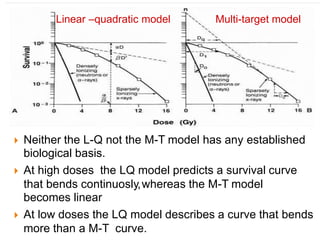
Linear –quadratic model Multi-target model
 Neither the L-Q not the M-T model
biological basis.
has any established
 At high doses the LQ model predicts a survival curve
that bends continuosly,
becomes linear
whereas the M-T model
 At low doses the LQ model describes a curve that bends
more than a M-T curve.
• Defined as “the induction of biologic effects
in cells that are not directly traversed by
a charged particle, but are in close proximity
to cells that are.”
• ~30% of bystander cells can be killed in this
situation.
• Presumably due to cytotoxic molecules
released into the medium.
BYSTANDER EFFECT
Factors affecting cell survival curve
1. LET
2. Fractionation
3. Dose rate effect
4. Intrinsic radiosesitivity
5. Cell age
6. Oxygen presence
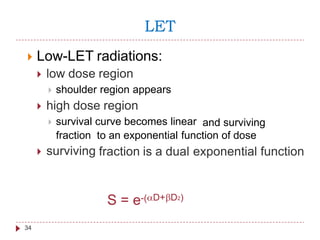
LET
 Low-LET radiations:
 low dose region
 shoulder region appears
 high dose region
 survival curve becomes linear and surviving
fraction
 surviving
to an exponential function of dose
fraction is a dual exponential function
e-( D+ D2)S =
34
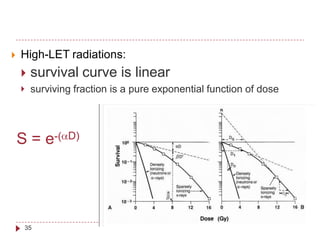
 High-LET radiations:
survival curve is linear
 surviving fraction is a pure exponential function of dose
e-( D)S =
35
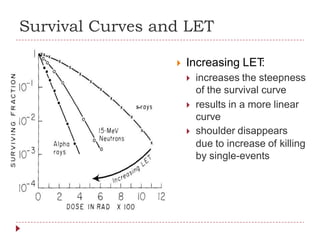
Survival Curves and LET
 Increasing LET:
 increases the steepness
of the survival curve
 results in a more linear
curve
 shoulder disappears
due to increase of killing
by single-events
Fractionation
If the dose is delivered as
equal fractions with sufficient
time ,repair of sub-lethal
damage ocurs

n = exp[D / D ]q 0
104
103
Elkind‟ s Recovery takes place 102
between radiation exposure ,
cell now acts as a fresh
target.
q
101
100
-1
10
Elkind & Sutton showed that
when two exposure were given
few hours apart ,the shoulder

-2
10 5 10 2515 20
Dose (Gy)
reappeared.
Dq
n = e
D
D0
-
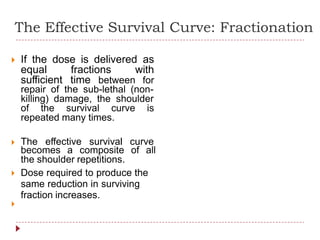
The Effective Survival Curve: Fractionation
If the dose is delivered as
equal fractions with
sufficient time between for
repair of the sub-lethal (non-
killing) damage, the shoulder
of the survival curve is
repeated many times.
The effective survival curve
becomes a composite of all
the shoulder repetitions.
Dose required to produce the
same reduction in surviving
fraction increases.


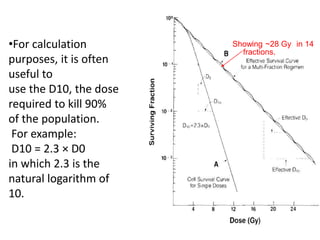
•For calculation
purposes, it is often
useful to
use the D10, the dose
required to kill 90%
of the population.
For example:
D10 = 2.3 × D0
in which 2.3 is the
natural logarithm of
10.
Showing ~28 Gy in 14
fractions.
Dose-rate effect
Dose rate determines biological impact
 reduction in dose rate causes reduced cell killing, due to
repair of SLD
 reduction in dose rate generally reduces survival-curve slope
(D0 increases)
 inverse dose-rate effect occurs in some cell lines at „optimal‟
dose rate due to accumulation of cells in G2
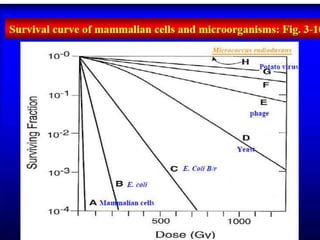
Intrinsic radiosensitivity
Mammalian cells are significantly more radio-sensitive
than microorganisms:
 Due to the differences in DNA content
 represents bigger target for radiation damage
 Sterilizing radiation dose for bacteria is 20,000 Gy
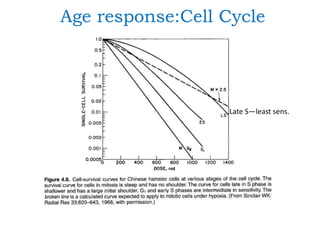
Age response:Cell Cycle
Late S—least sens.
 Cells are most sensitive to radiation at or close to M
 Cells are most resistant to radiation in late S
 For prolonged G1  a resistant period is evident
followed be a sensitive period in late G1
early G1
 Cells are usually sensitive to radiation in G2 (almost as
sensitive as in M)
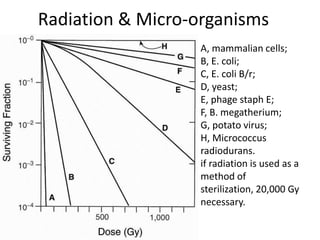
Radiation & Micro-organisms
A, mammalian cells;
B, E. coli;
C, E. coli B/r;
D, yeast;
E, phage staph E;
F, B. megatherium;
G, potato virus;
H, Micrococcus
radiodurans.
if radiation is used as a
method of
sterilization, 20,000 Gy
necessary.
Greek word meaning “falling off,” as in petals from
flowers or leaves from trees.
• First, apoptosis after radiation seems
commonly to be a p53-dependent proces.Here,the DNA
Electrophoresis pattern is like a ladder since here, the
DSBs occur in the liner region between nucleosomes to
produce DNA fragments that are multiples of 185 base
pairs.
• Mitotic death (commonest form of death): Cells die
attempting
to divide because of damaged chromosomes
The primary target for radiation induced lethality is,
specifically the DNA.
APOTOSIS AND MITOTIC DEATH
Summary
A cell survival curve is the relationship between the fraction of
cells retaining their reproductive integrity and absorbed dose.

Conventionally, surviving fraction on a logarithmic scale is
plotted on the Y-axis, the dose is on the X-axis . The shape of
the survival curve is important.
The cell-survival curve for densely ionizing radiations (α-
particles and low-energy neutrons) is a straight line on a log-
linear plot, that is survival is an exponential function of dose.
The cell-survival curve for sparsely ionizing radiations (X-
rays, gamma-rays has an initial slope, followed by a shoulder
after which it tends to straighten again at higher doses.
Summary
At low doses most cell killing results from “α-type” (single-hit, non-
repairable) injury, but that as the dose increases, the“β –type”
(multi-hit, repairable) injury becomes predominant, increasing as
the square of the dose.

Survival data are fitted by many models. Some of them are:
multitarget hypothesis, linear-quadratic hypothesis.
The survival curve for a multifraction regimen is also an
exponential function of dose.
The D10, the dose resulting in one decade of cell killing, is related
to the Do by the expression D10 = 2.3 x Do

Cell survival also depends on the dose, dose rate and the cell
type

Thank You

Cell survival curve

  • 1.
    Cell Survival Curve DR.TARUNI BHATTACHARYA D.N.B. RESIDENT
  • 2.
    Cell Survival Curve It describes relationship between radiation dose and the fraction of cells that “survive” that dose.  This is mainly used to assess biological effectiveness of radiation.
  • 3.
    Cell Death Cell deathcan have different meanings:  loss of a specific function - differentiated cells muscle, secretory cells) (nerve,  loss of the ability to divide - proliferating cells such as stem cells in hematopoietic system or intestinal epithelium  loss of reproductive integrity - “reproductive death” 3
  • 4.
     Proof single naked of reproductiveintegrity - the capability of a cell to grow into a large colony, visible to the eye  A surviving cell that has retained its reproductive integrity and is able to proliferate indefinitely is said to be clonogenic 6
  • 5.
    Estimating Survival  Inorder to determine the surviving fraction, we must know the plating efficiency  PE is the percentage of cells grow into colonies P.E.= no of cells counted no. of cells seeded (in control batch) that  in other words, Process those cells that survive the plating 7
  • 6.
    Relevant Dose  100Gy destroys cell function in non-proliferating example: nerve, muscle cells) Gy systems (for  2  mean lethal dose for loss of proliferative capacity for proliferating cells 4
  • 7.
    Derivation of SurvivalCurves Always will have a control batch to determine PE.Cells have been taken from stock culture and placed in seed dishes  Then irradiated (0 Gy to 6 Gy)and allowed to grow into colonies for 1-2 weeks  Colonies have been counted for survival data  8
  • 8.
    Surviving Fraction  Equalto the fraction of cells that plate successfully and survive irradiation (without losing their reproductive integrity) to grow into colonies Colonies counted Surviving fraction cells seeded PE/100 9
  • 9.
    72 colonies SF(2) == 0.2 400 seeded x 0.9 plated 1 0.1 Surviving Fraction 0.01 0.001 2 4 6 Dose (Gy) 10
  • 10.
    Quantization of cellkilling A dose of radiation that introduces an average of one lethal event per cell leaves 37% dose. still viable is called D0 Cell killing follows exponential relationship. A dose which 50%reduces cell survival to will, if repeated, to 25%, and reduce similarlysurvival to 12.5% from a third exposure. This means Surviving never becomes zero. fraction
  • 11.
    A straight lineresults when cell equal dose logarithmic  survival (from a series of fractions) is plotted on a scale as a function of dose on linear scale. The slope of such a semi-logarithmic dose curve could be described by the D0, the dose to reduce survival to 37%, D50, the dose to reduce survival to 50%, the D10, the dose to reduce survival to 10%. D0 usually lies between 1 and 2 Gy   D10= 2.3 x D0
  • 12.
    Survival Curve Features Simple to describe qualitatively  Difficulty lies in explaining underlying events biophysical  Many models have been proposed  Steepness of curve represent the radio- sensitiveness. 14
  • 13.
    Survival Curve Shape •Doseplotted on a linear scale and surviving fraction on a logarithmic scale. • At High LETs, such as α-particles or low-energy neutrons, the curve is a straight line. • For sparsely ionizing (low LET) radiations, such as x-rays starts out straight with a finite initial slope ,so surviving fraction is an exponential funtion of dose. •At higher doses,curve bends. •and at very high doses it tends to straighten again thus surviving fraction returns to being an exponential function
  • 15.
    Mammalian Cell SurvivalCurve  Shoulder Region  Shows accumulation of SUB- LETHAL DAMAGE.  The larger the more shoulder dose willregion, the initally be needed to kill the same proportion of cells.  Beyond the shoulder region  The D0 dose, or the inverse of the slope of the curve,indicates radiosensitivity. The smaller the D0 dose, the greater the radiosensitivity.
  • 16.
    Survival Curve Models Linear-quadratic model  “dual radiation action”  first component - cell killing is proportional to dose  second component - cell killing is proportional dose squared  Multi-target model  based on probability of hitting the “target”  widely used for many years; still has merit to 17
  • 17.
  • 21.
    Linear Quadratic Model 2 e-(D + D ) S =  where:  S represents the fraction of cells surviving  D represents dose and are constants that characterize the slopes of the two l portions of the semi-log survival curve  biological endpoint is cell death 22
  • 22.
    Linear Quadratic Model Linear and quadratic contributions to cell killing are equal when the dose is equal to the ratio of to  D = / or D2D =  component is representative of damage caused break,by a single event (hit, double-strand “initiation / promotion” etc.) component is representative of damage caused by multiple events (hit/hit, 2 strand breaks, initiation then promotion, etc.) 23
  • 23.
    and Determination 100 10-1 10-2 0 36 9 12 Dose, Gy 24 Survival D D2
  • 24.
  • 25.
    Multi-target Model  Quantifiedin terms of:  measure of D1  measure of D0  width of the initial slope due to single-event killing, final slope due to multiple-event killing, shoulder, Dq or n 28
  • 26.
    D1 and D0are 1. reciprocals of final slopes the initial and 2. the doses required to reduce the fraction of surviving cells by 37% 3. the dose required to onedeliver, on average, inactivating event per cell 4. D1,reduces survivivig fraction to 0.37 D0, from 0.1 to 0.037, or from 0.01 to 0.0037 ,and so on. 5.
  • 27.
    Multi-target Model  Shoulder-widthmeasures:  the quasi-threshold dose (Dq)  the dose at which the extrapolated line from the straight portion of the survival curve (final slope) crosses the 100% survival  the extrapolation number (n) axis at  This value is obtained by extrapolating the exponential portion of the the vertical line. curve to  “broad shoulder” results in larger value of n  “narrow shoulder” results in small value of n 30
  • 28.
    Multi-Target Model n orDq represents the size Or width of shoulder Dq 100 10-1 due to single-event killing10-2 10-3 10-4 0 3 6 9 12 Dose, Gy 31 Survival n Initial slope,D1 three parameters, n, D0, and Dq, are related by the expression Log en = Dq /D0 Final slope,D0 due to multiple event killing
  • 29.
    •For oxygenated mammaliancells, D0 is about 150 rads (1.5 Gy). •The D0 of the X-ray survival curves for most cells cultured in vitro is 1-2 Gy. Exceptions are cells of cancer prone syndromes, eg. A.T., with D0 of 0.5 GY. • Dq :defined as the dose at which the straight portion of the survival curve, extrapolated backward, cuts the dose axis drawn through a survival fraction of unity.
  • 30.
    Linear –quadratic modelMulti-target model  Neither the L-Q not the M-T model biological basis. has any established  At high doses the LQ model predicts a survival curve that bends continuosly, becomes linear whereas the M-T model  At low doses the LQ model describes a curve that bends more than a M-T curve.
  • 31.
    • Defined as“the induction of biologic effects in cells that are not directly traversed by a charged particle, but are in close proximity to cells that are.” • ~30% of bystander cells can be killed in this situation. • Presumably due to cytotoxic molecules released into the medium. BYSTANDER EFFECT
  • 32.
    Factors affecting cellsurvival curve 1. LET 2. Fractionation 3. Dose rate effect 4. Intrinsic radiosesitivity 5. Cell age 6. Oxygen presence
  • 33.
    LET  Low-LET radiations: low dose region  shoulder region appears  high dose region  survival curve becomes linear and surviving fraction  surviving to an exponential function of dose fraction is a dual exponential function e-( D+ D2)S = 34
  • 34.
     High-LET radiations: survivalcurve is linear  surviving fraction is a pure exponential function of dose e-( D)S = 35
  • 35.
    Survival Curves andLET  Increasing LET:  increases the steepness of the survival curve  results in a more linear curve  shoulder disappears due to increase of killing by single-events
  • 36.
    Fractionation If the doseis delivered as equal fractions with sufficient time ,repair of sub-lethal damage ocurs  n = exp[D / D ]q 0 104 103 Elkind‟ s Recovery takes place 102 between radiation exposure , cell now acts as a fresh target. q 101 100 -1 10 Elkind & Sutton showed that when two exposure were given few hours apart ,the shoulder  -2 10 5 10 2515 20 Dose (Gy) reappeared. Dq n = e D D0 -
  • 37.
    The Effective SurvivalCurve: Fractionation If the dose is delivered as equal fractions with sufficient time between for repair of the sub-lethal (non- killing) damage, the shoulder of the survival curve is repeated many times. The effective survival curve becomes a composite of all the shoulder repetitions. Dose required to produce the same reduction in surviving fraction increases.  
  • 38.
    •For calculation purposes, itis often useful to use the D10, the dose required to kill 90% of the population. For example: D10 = 2.3 × D0 in which 2.3 is the natural logarithm of 10. Showing ~28 Gy in 14 fractions.
  • 39.
    Dose-rate effect Dose ratedetermines biological impact  reduction in dose rate causes reduced cell killing, due to repair of SLD  reduction in dose rate generally reduces survival-curve slope (D0 increases)  inverse dose-rate effect occurs in some cell lines at „optimal‟ dose rate due to accumulation of cells in G2
  • 40.
    Intrinsic radiosensitivity Mammalian cellsare significantly more radio-sensitive than microorganisms:  Due to the differences in DNA content  represents bigger target for radiation damage  Sterilizing radiation dose for bacteria is 20,000 Gy
  • 42.
  • 43.
     Cells aremost sensitive to radiation at or close to M  Cells are most resistant to radiation in late S  For prolonged G1  a resistant period is evident followed be a sensitive period in late G1 early G1  Cells are usually sensitive to radiation in G2 (almost as sensitive as in M)
  • 44.
    Radiation & Micro-organisms A,mammalian cells; B, E. coli; C, E. coli B/r; D, yeast; E, phage staph E; F, B. megatherium; G, potato virus; H, Micrococcus radiodurans. if radiation is used as a method of sterilization, 20,000 Gy necessary.
  • 45.
    Greek word meaning“falling off,” as in petals from flowers or leaves from trees. • First, apoptosis after radiation seems commonly to be a p53-dependent proces.Here,the DNA Electrophoresis pattern is like a ladder since here, the DSBs occur in the liner region between nucleosomes to produce DNA fragments that are multiples of 185 base pairs. • Mitotic death (commonest form of death): Cells die attempting to divide because of damaged chromosomes The primary target for radiation induced lethality is, specifically the DNA. APOTOSIS AND MITOTIC DEATH
  • 46.
    Summary A cell survivalcurve is the relationship between the fraction of cells retaining their reproductive integrity and absorbed dose.  Conventionally, surviving fraction on a logarithmic scale is plotted on the Y-axis, the dose is on the X-axis . The shape of the survival curve is important. The cell-survival curve for densely ionizing radiations (α- particles and low-energy neutrons) is a straight line on a log- linear plot, that is survival is an exponential function of dose. The cell-survival curve for sparsely ionizing radiations (X- rays, gamma-rays has an initial slope, followed by a shoulder after which it tends to straighten again at higher doses.
  • 47.
    Summary At low dosesmost cell killing results from “α-type” (single-hit, non- repairable) injury, but that as the dose increases, the“β –type” (multi-hit, repairable) injury becomes predominant, increasing as the square of the dose.  Survival data are fitted by many models. Some of them are: multitarget hypothesis, linear-quadratic hypothesis. The survival curve for a multifraction regimen is also an exponential function of dose. The D10, the dose resulting in one decade of cell killing, is related to the Do by the expression D10 = 2.3 x Do  Cell survival also depends on the dose, dose rate and the cell type 
  • 48.