RADIATION RESPONSE
MODIFIERS
Dr. Himanshu Shekhar Mekap
MD, Radiation oncology
INTRODUCTION
• In Radiation Therapy There is a clear Dose-
Response relationship.
• Unfortunately damage to normal tissue also
increases as the radiation dose increases.
• Substantial effort has been made to modify
these dose response relationships & increase
the separation between tumour tissue &
normal tissue dose response curves.
RADIATION RESPONSE
1.THERAPEUTIC RATIO: TCP/NTCP
2.EFFICACY/TOXICITY PROFILE OF
CHEMICAL MODIFIER
HYPOXIC CELL
MODIFIERS
CHEMOTHERAPEUTIC
AGENTS
BIOLOGIC
MODIFIERS
RADIATION
PROTECTION
HYPERTHERMIA
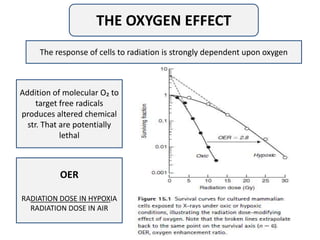
THE OXYGEN EFFECT
OER
RADIATION DOSE IN HYPOXIA
RADIATION DOSE IN AIR
The response of cells to radiation is strongly dependent upon oxygen
Addition of molecular O₂ to
target free radicals
produces altered chemical
str. That are potentially
lethal
OVERCOMING
TUMOR
HYPOXIA
AUGMENTATION OF TUMOR OXYGENATION
1.HYPERBARIC OXYGEN & RT
2.CARBOGEN WITH/WITHOUT NICOTINAMIDE
3.CORRECTION OF ANEMIA
SENSITIZATION OF HYPOXIC
CELLS
1.MISONIDAZOLE
2.NIMORAZOLE
PHARMACOLOGIC TARGETING OF
HYPOXIC CELLS
1.MITOMYCIN C
2.PORFIROMYCIN
3.TIRAPAZAMINE
BENEFIT
HEAD & NECK,
CERVIX
NO BENEFIT
CNS,LUNGS,
BLADDER,SKIN
FAILURE
NONCONVENTIONAL
HYPOFRACTIONATED REGIMENS,
PATIENT COMPLIANCE,EXPENSIVE
HYPERBARIC OXYGEN
AND RT
CARBOGEN WITH/WITHOUT
NICOTINAMIDE
RATIONALE
CO₂
RIGHT SHIFTS THE
OXYHEMOGLOBIN
CURVE
RATIONALE
NICOTINAMIDE
ENHANCES TUMOR
BLOOD FLOW
(Preclinical)
NICOTINAMIDE ADMINISTERED 1 TO 1.5 HOURS PRIOR TO
RT AT 60 TO 80 mg/kg.
FAILURE- 1.NAUSEA & VOMITING
2.COMPLIANCE
3.HYPERBARIC CHAMBERS
MISONIDAZOLE
DAHANCA-2 STUDY
626 Pts.,double blind
randomized, 11gm/m²
RESULT: Significant
improvement in
pharynx subgroup as
compared to larynx.
Significant
NEUROTOXICITY
NIMORAZOLE
DAHANCA-5 Study
PHASE III,1.2 gm/m²
Supraglottic Larynx &
Pharynx
RESULT:Improved
locoregional control
& disease free
survival
(49% vs 33%)
P=0.002
META-ANALYSIS: >11,000 Pts. In 91 Randomized trials-
RESULT: IMPROVED LOCOREGIONAL TUMOR CONTROL
MOSTLY IN HEAD AND NECK CA, BUT NO IMPROVEMENT IN
OVERALL SURVIVAL
(IN DENMARK NIMORAZOLE HAS BECOME PART OF THE
STANDARD RT IN HEAD AND NECK CANCER)
HYPOXIC CELL
RADIOSENSITIZERS
DAHANCA-5 STUDY
MODIFICATION BASED ON
HEMOGLOBIN
It is well established that haemoglobin
conc. Is an important prognostic factor
for the response to radiotherapy
especially squamous cell
ca.(Overgaard et al,1989)
Patients with low haemoglobin levels
have a reduced locoregional tumour
control & survival probability
Tumor hypoxia clearly is one of the
major factors
ANEMIA & CONCENTRATION OF
HEMOGLOBIN
• Thomas GM et al, 1st time showed the
potential benefit of increasing haemoglobin
conc. to 11 gm/dl By blood transfusion In
advanced ca. cervix with improved survival.
• DAHANCA study group had failed to show any
benefit of transfusion in head & neck ca.
• Hoskin pj,Robinson et al, hv failed to show any
benefit of erythropoietin in correction of
anemia in head & neck cancer Pts.
TARGETING OF HYPOXIC CELLS
METABOLISED IN REGIONS OF LOW
O₂ CONC.
PREFERENTIALLY CYTOTOXIC TO
HYPOXIC CELLS
MITOMYCIN C
DEFINITIVE NONSURGICAL
MANAGEMENT OF CA. ANUS
YALE University- 195 Head & neck ca.
68 Gy with/without MMC on days 1 & 43
of RT
RESULT- Locoregional RFS (54% to
76%,P=0.003) BUT OS not significant
PORFIROMYCIN- derivative, but showed
inferior results as compared to MMC IN 5
yr Loco-Regional Relapse Free Survival but
no difference in OS.
TIRAPAZAMINE
HEADSTART STUDY(Phase III)
RT+CISPLATIN/TPZ vs
CISPLATIN
NO DIFFERENCE
Rischin et al, showed benefit
of TIRAPAZAMINE in tumor
hypoxia in Loco-Regional
Failure.
STRATEGIES
CHEMOTHERAPY & IRRADIATION
SPATIAL
COOPERATION
CYTOTOXIC
ENHANCEMENT
INDEPENDENT
TOXICITIES
PROTECTION OF
NORMAL TISSUES
BIOLOGIC
COOPERATION
TEMPORAL
MODULATION
SPATIAL COOPERATION
• Chemotherapy acts systemically & Radiotherapy acts
locoregionally.
• Sequential therapy is best example
• Example- Adjuvant CT→RT in Breast cancer
RT in bulky disease in Lymphoma
PCI in small cell lung cancer
INDEPENDENT TOXICITY
• Normal tissue toxicity is the main dose limiting factor.
• CT Regimen with a toxicity profile different from RT.
• Increased tumor cell kill with minimal combined tissue
toxicity.
• Example- Adriamycin is not used with breast RT.
• BLEOMYCIN is not used with lung RT.
CYTOTOXIC ENHANCEMENT
• COMBINED modality therapy leads to Interaction
at molecular/cellular level resulting in greater
antitumor effect on the basis of additive actions.
PROTECTION OF NORMAL TISSUES
• Technical improvements in radiation delivery
• Chemical or biologic agents.
• Example- AMIFOSTINE protects against xerostomia
in head & neck ca.(limited success)
BIOLOGIC COOPERATION
Independent targeting of subpopulations of cells within
the tumor itself
EXAMPLE- TIRAPAZAMINE as it targets hypoxic sub
populations of cells which are radioresistant
TEMPORAL MODULATION
Implies therapeutics that target the FOUR R”S of
Radiotherapy
Repair,Repopulation,Redistribution,Reoxygenation
between fractionated radiation treatments
INCREASING INITIAL RADIATION DAMAGE
INHIBITION OF CELLULAR REPAIR
COUNTERACTING HYPOXIA ASSOCIATED
TUMOR RADIORESISTANCE
INHIBITION OF TUMOR CELL
REPOPULATION
CELL CYCLE REDISTRIBUTION
DRUG-
RADIATION
INTERACTIONS
INCREASING INITIAL RADIATION DAMAGE
• Radiation induces lesions in DNA molecule
such as SSBs, DSBs, DNA-DNA crosslinks.
• Drugs such as halogenated pyrimidines
incorporate into DNA & make it more
susceptible to radiation damage.
INHIBITION OF CELLULAR REPAIR-
• Many chemotherapeutic agents interact with
cellular repair mechanisms & inhibit Repair for
e.g- Halogenated pyrimidines, Gemcitabine in
Pre clinical studies.
COUNTERACTING HYPOXIA ASSOCIATED
TUMOR RADIORESISTANCE-
CT Preferentially kill proliferating cells,primarily
found in well oxygenated regions of the tumor,
as these regions are close to blood vessels.
Destruction of tumor cells in these areas leads
to an increased oxygen supply to hypoxic regions
Massive loss of cells after chemotherapy lowers
the interstitial pressure which allows re-
establishment of blood supply.
CELL CYCLE REDISRIBUTION
• Cytotoxic action of CT or RT depends on position
of cells in cell cycle.
• Cells in G₂ & M phase were approx. 3 times more
sensitive than S phase.
Example- 1. Taxanes can block transition of cells
through Mitosis resulting in cell accumulation in G₂
& M phase.
2. elimination of the Radioresistant S- phase cells
e.g, Fludarabine & Gemcitabine.
3. Accumulation of cells in G₂ & M phase by
parasynchronous movement
INHIBITION OF TUMOR CELL
REPOPULATION
• Repopulation- the cell loss after each fraction of
radiation during radiation therapy induces
compensatory cell regeneration.
• The rate of cell proliferation in tumors treated by
RT is higher than that in untreated tumors. This
treatment induced cell proliferation is termed
accelerated repopulation.
• Chemotherapeutic drugs, because of their cyto
toxic or cytostatic activity reduce the rate of
proliferation when given concurrently with RT.
PLATINUM
COMPOUNDS
Potent radiosensitizer for many years
MECHANISMS-1. Inhibition of DNA synthesis
2. Inhibition of transcription elongation by DNA interstrand
crosslinks.
3.Inhibition of repair of radiation induced DNA damage.
1.CISPLATIN
2.OXALIPLATIN
3.CARBOPLATIN
4.SATRAPLATIN
ANTIMETABOLITES
5-FLUOROURACIL
Target the radioresistant cells in S phase.
Used as bolus infusion, or continuous infusion
Mechanism of Radiosensitization
-1. Incorporation into RNA
2. Inhibition of thymidilate synthase
3. Direct incorporation into DNA
CAPECITABINE
Oral Prodrug of 5 FU.
Its converted to its cytotoxic form by thymidine
phosphorylase
RATIONALE- 1. thymidine phosphorylase is
overexpressed in tumor tissues.
2. Radiation stimulates expression of
thymidine phosphorylase.
ANTIMETABOLITES
GEMCITABINE
Nucleoside analogue, acts as a potent radiosensitizer, S
phase specific.
Mechanism- ↓DeoxyNTP
Direct incorporation into DNA
Drug induced apoptosis.
Preclinical evidence suggests that it’s a potent
Radiosensitiser
PEMETREXED
NOVEL multitargeted agent inhibiting multiple folate
requiring enzymes.
Shown synergistic activity with RT due to interference
with DNA synthesis.
Radiosensitization is not cell cycle phase specific.
Shown encouraging results in NSCLC
ALKYLATING
AGENTS
TEMOZOLOMIDE
2nd generation orally acting
Unique in its ability to cross BBB.
Radiosensitization- inhibition of DNA repair
1st line therapy in GBM concurrent with RT
TOPOISOMERASE
I INHIBITOR
TOPOTECAN,IRINOTECAN
MECHANISMS-1. Inhibition of Repair
2. Redistribution ino G₂ phase.
3.Conversion of RT induced SSBs into DSBs.
ANTIMICROTUBULES
TAXANES
MECHANISMS
1.Cellular arrest in G₂M phase of the cell cycle.
2.Induction of apoptosis.
3.Reoxygenation of tumor cells.
1.PACLITAXEL
2.DOCETAXEL
CHEMORADIATION THERAPY AS
STANDARD OF CARE
HEAD & NECK
(LOCALLY
ADVANCED)
CISPLATIN,5FU,
CARBOPLATIN,
CETUXIMAB
DEFINITIVE/
POST-OP.
CONCURRENT
LRC/DFS,OS BENEFIT
ORGAN PRESERVE
GLIOBLASTOMA
MULTIFORME
TEMOZOLOMIDE DEFINITIVE/
POST-OP.
CONCURRENT
OVERALL SURVIVAL
LOCALLY ADVANCED
NSCLC
CISPLATIN,CARBOPL
ATIN,
ETOPOSIDE,PACLITA
XEL
DEFINITIVE
CONCURRENT,
SEQUENTIAL
OVERALL SURVIVAL
LIMITED STAGE
SMALL CELL LUNG
CA
CISPLATIN/ETOPOSI
DE
DEFINITIVE
CONCURRENT
OVERALL SURVIVAL
ESOPHAGEAL CA. CISPLATIN/5FU PRE-OP./ DEFINITIVE
CONCURRENT
LOCAL CONTROL,OS
CHEMORADIATION THERAPY AS
STANDARD OF CARE
GASTRIC CA. 5FU POST-OP.
CONCURRENT
OVERALL SURVIVAL
PANCREATIC CA. 5FU,GEMCITABINE POST-OP./
DEFINITIVE
CONCURRENT
LOCOREGIONAL
CONTROL,POSSIBLY
SURVIVAL
LOCALLY ADVANCED
RECTAL CANCER
5FU,CAPECITABINE PRE-OP.
CONCURRENT
IMPROVED
SPHINCTER
PRESERVATION,OS
ANAL CA. 5FU,MITOMYCIN C DEFINITIVE
CONCURRENT
IMPROVED
COLOSTOMY FREE
SURVIVAL
CA. CERVIX CISPLATIN,5FU DEFINITIVE
CONCURRENT
OVERALL SURVIVAL
BLADDER CA. CISPLATIN,5FU DEFINITIVE
CONCURRENT
BLADDER
PRESERVATION
LONG-TERM TOXICITY OF COMBINED
CHEMORADIATION THERAPY
BLEOMYCIN PULMONARY
FIBROSIS/PNEUMONITIS
ACTINOMYCIN-D HEPATOPATHY
DOXORUBICIN CARDIOMYOPATHY
METHOTREXATE LEUKOENCEPHALOPATHY
CISPLATIN SENSORINEURAL HEARING
LOSS
CTRT IN HEAD & NECK CANCER
INT 0099,
1998
RT(70Gy) vs. RT(70Gy) +
Cisplatin(100mg/m²) with
adj. cisplatin+5-FU
At 5 yr PFS(58% vs 29%),
DFS(74% vs 46%), OS(67%
vs37%) favours CT/RT arm.
p<0.001
RTOG 9111,
2003
3 ARM-( Glottic &
supraglottic) –RT vs
sequential CT/RT vs
concurrent CT/RT
NO Diff. in OS, but
Concurrent arm had
superior local control &
highest organ preservation
EORTC 22931,
2004
Post-op. RT(66Gy) vs. post-
op. CTRT (66Gy+cisplatin)
5 yr OS(53% vs 40%), PFS
(47% vs. 36%), LRC (82% vs.
69%) p<0.05
MACH-NC
Meta analysis
93 randomised trials in
Head & Neck- 17,346
Patients
CT/RT Provides absolute 5-
yr OS BENEFIT OF 6.5%,
whereas induction CT
showed only 2.4%
CTRT IN CARCINOMA CERVIX
GOG-120,
1999
IIB-IVA; 3 ARMS;
RT+ CISPLATIN vs.
RT+CISPLATIN/5FU/HU vs.
RT+HU
IMPROVED PFS & OS IN
BOTH CISPLATIN ARMS
P<0.005
GOG-123,
1999
IB( TUMORS ≥4cm.) RT vs.
RT+ cisplatin
IMPROVED PFS(P<0.001)
& IMPROVED OS(P<0.008)
IN CISPLATIN ARM
INTERGROUP 0107,
2000
I-IIA( POST
HYSTERECTOMY)
WITH HIGH RISK, RT vs.
RT+CISPLATIN/5FU
IMPROVED PFS (P=0.003)
& IMPROVED OS(P=0.008)
IN CTRT ARM
RTOG 9001,
1999
IB-IIA(≥5cm. Or +ve pelvic
nodes), IIB-IVA
EFRT vs CTRT
IMPROVED 5 yr DFS
(P<0.001)& IMPROVED
5 yr OS(P=0.004) IN
CISPLATIN ARM
CETUXIMAB AS RADIOSENSITIZER
The median duration of overall survival was 49.0 months among
patients treated with combined therapy and 29.3 months among
those treated with radiotherapy alone (hazard ratio for death, 0.74;
P=0.03)
James A Bonner, K. Kian Ang, M.D., Ph.D.
N Engl J Med 2006; 354:567-578 February 9, 2006
RTOG-0522 INITIAL RESULTS
REPORTED AT ASCO-2011
• The randomized trial conducted by the RTOG
sought to determine if adding cetuximab to a
chemoradiotherapy treatment regimen would
improve progression-free and overall survival
for patients with Stage III-IV head and neck
squamous cell cancers.
Show No Survival Benefits by the Addition of
Cetuximab to Chemoradiation Treatment for Patients
with Locally Advanced Head and Neck Cancer
RADIOPROTECTORS
AMIFOSTINE is the only
Radioprotective drug
approved by U.S.FDA for
prevention of xerostomia
in head & neck ca.
MECHANISMS-
1.Free radical scavenging
2. Hydrogen atom donation
to facilitate DNA repair
RTOG PHASE III trial
demonstrated efficacy of
amifostine in reducing
xerostomia in head & neck
ca. receiving RT
FAILURE-
1.Possible tumor
protection
2. Loss of therapeutic gain
RADIOPROTECTORS
PALIFERMIN
KERATINOCYTE GROWTH
FACTOR is synthesised
predominantly by
mesenchymal cells
Preclinical models-potential
to ameliorate radiation
effects in oral
mucosa,skin,intestine,lung &
urinary bladder
Spielberger et al,2004
Randomised,placebo
controlled,double blinded phase III
Patients receiving total body
irradiation & high dose chemotherapy
in preparation for peripheral blood
progenitor cell transplantation-
Significant reduction in incidence &
duration of oral mucositis
HYPERTHERMIA
RATIONALE –
1. CAN lead to Reoxygenation, which further improves
Radiation Response.
2. Inhibits repair of both sublethal & potentially lethal
damage through its effect in inactivating crucial DNA
repair pathways.
3. With Hyperthermia,there is no difference in
sensitivity between aerobic & hypoxic cells.
4. Direct cytotoxicity.
RADIATION + HYPERTHERMIA- COMPLEMENTARY
EFFECTS
(S-PHASE →Radioresistant-Radiosensitive)
PHASE III TRIALS
AUTHOR SITE TREATMENT CR% LC% OS%
Valdagni
,1993
HEAD &
NECK
RT 41 24 _
RT+HT 83* 69 _
Vernon,1996 BREAST RT 41 _ 40
RT+HT 59* _ 40
Sneed,1998 BRAIN RT _ _ 15
RT+HT _ _ 31*
PHASE III TRIALS
AUTHOR SITE TREATMENT CR% LC% OS%
Van der
zee,2000
CERVIX RT 57 41 27
RT+HT 83* 61* 51*
Jones,2005 CHEST WALL RT 42 25 23
RT+HT 66* 48* 21
Hua,2011 NASOPHARY
NX
RT+CT 81 79 63
RT+HT+CT 96* 91* 73*
TAKE HOME MESSAGE
• The chemical modification of radiation
response both for enhancing treatment
efficacy & reducing therapy induced toxicity
remains an area of active investigation.
• Promising candidates identified in preclinical
& early phase trials have been less successful
in randomised phase III settings.
• Attempts to improve treatment efficacy by
augmenting tumor oxygen delivery have a
mixed record of success.
TAKE HOME MESSAGE
• The use of drugs that are preferentially
cytotoxic to hypoxic cells holds promise ,
although improved tools to identify those
patients most likely to benefit from targeted
therapy are needed.
• However, apart from the use of radiosensitizer
NIMORAZOLE in Denmark, none of these
treatments have become part of standard
radiation therapy.
TAKE HOME MESSAGE
• The use of radioprotectors is more
controversial. Proof of chemical
radioprotection has been established in
salivary glands but not elsewhere. There is
possibility of radioprotection in tumor as well.
• The combination of chemotherapy & radiation
has become a common strategy in locally
advanced cancers with emphasis on
concurrent delivery.
TAKE HOME MESSAGE
• Improvements in treatment outcome in terms
of both local control & survival have been
achieved with traditional chemotherapeutic
agents such as cisplatin & 5FU.
• In the era of new RT technologies, monoclonal
antibodies & novel chemotherapeutic agents
are associated with significant cost profiles. In
this regard hyperthermia is relatively
inexpensive,given the results already achieved
further investigation warranted.
Radiation response modifiers

Radiation response modifiers

  • 1.
    RADIATION RESPONSE MODIFIERS Dr. HimanshuShekhar Mekap MD, Radiation oncology
  • 2.
    INTRODUCTION • In RadiationTherapy There is a clear Dose- Response relationship. • Unfortunately damage to normal tissue also increases as the radiation dose increases. • Substantial effort has been made to modify these dose response relationships & increase the separation between tumour tissue & normal tissue dose response curves.
  • 3.
    RADIATION RESPONSE 1.THERAPEUTIC RATIO:TCP/NTCP 2.EFFICACY/TOXICITY PROFILE OF CHEMICAL MODIFIER
  • 4.
  • 5.
    THE OXYGEN EFFECT OER RADIATIONDOSE IN HYPOXIA RADIATION DOSE IN AIR The response of cells to radiation is strongly dependent upon oxygen Addition of molecular O₂ to target free radicals produces altered chemical str. That are potentially lethal
  • 6.
    OVERCOMING TUMOR HYPOXIA AUGMENTATION OF TUMOROXYGENATION 1.HYPERBARIC OXYGEN & RT 2.CARBOGEN WITH/WITHOUT NICOTINAMIDE 3.CORRECTION OF ANEMIA SENSITIZATION OF HYPOXIC CELLS 1.MISONIDAZOLE 2.NIMORAZOLE PHARMACOLOGIC TARGETING OF HYPOXIC CELLS 1.MITOMYCIN C 2.PORFIROMYCIN 3.TIRAPAZAMINE
  • 7.
    BENEFIT HEAD & NECK, CERVIX NOBENEFIT CNS,LUNGS, BLADDER,SKIN FAILURE NONCONVENTIONAL HYPOFRACTIONATED REGIMENS, PATIENT COMPLIANCE,EXPENSIVE HYPERBARIC OXYGEN AND RT
  • 8.
    CARBOGEN WITH/WITHOUT NICOTINAMIDE RATIONALE CO₂ RIGHT SHIFTSTHE OXYHEMOGLOBIN CURVE RATIONALE NICOTINAMIDE ENHANCES TUMOR BLOOD FLOW (Preclinical) NICOTINAMIDE ADMINISTERED 1 TO 1.5 HOURS PRIOR TO RT AT 60 TO 80 mg/kg. FAILURE- 1.NAUSEA & VOMITING 2.COMPLIANCE 3.HYPERBARIC CHAMBERS
  • 9.
    MISONIDAZOLE DAHANCA-2 STUDY 626 Pts.,doubleblind randomized, 11gm/m² RESULT: Significant improvement in pharynx subgroup as compared to larynx. Significant NEUROTOXICITY NIMORAZOLE DAHANCA-5 Study PHASE III,1.2 gm/m² Supraglottic Larynx & Pharynx RESULT:Improved locoregional control & disease free survival (49% vs 33%) P=0.002 META-ANALYSIS: >11,000 Pts. In 91 Randomized trials- RESULT: IMPROVED LOCOREGIONAL TUMOR CONTROL MOSTLY IN HEAD AND NECK CA, BUT NO IMPROVEMENT IN OVERALL SURVIVAL (IN DENMARK NIMORAZOLE HAS BECOME PART OF THE STANDARD RT IN HEAD AND NECK CANCER) HYPOXIC CELL RADIOSENSITIZERS
  • 10.
  • 11.
    MODIFICATION BASED ON HEMOGLOBIN Itis well established that haemoglobin conc. Is an important prognostic factor for the response to radiotherapy especially squamous cell ca.(Overgaard et al,1989) Patients with low haemoglobin levels have a reduced locoregional tumour control & survival probability Tumor hypoxia clearly is one of the major factors
  • 12.
    ANEMIA & CONCENTRATIONOF HEMOGLOBIN • Thomas GM et al, 1st time showed the potential benefit of increasing haemoglobin conc. to 11 gm/dl By blood transfusion In advanced ca. cervix with improved survival. • DAHANCA study group had failed to show any benefit of transfusion in head & neck ca. • Hoskin pj,Robinson et al, hv failed to show any benefit of erythropoietin in correction of anemia in head & neck cancer Pts.
  • 13.
    TARGETING OF HYPOXICCELLS METABOLISED IN REGIONS OF LOW O₂ CONC. PREFERENTIALLY CYTOTOXIC TO HYPOXIC CELLS MITOMYCIN C DEFINITIVE NONSURGICAL MANAGEMENT OF CA. ANUS YALE University- 195 Head & neck ca. 68 Gy with/without MMC on days 1 & 43 of RT RESULT- Locoregional RFS (54% to 76%,P=0.003) BUT OS not significant PORFIROMYCIN- derivative, but showed inferior results as compared to MMC IN 5 yr Loco-Regional Relapse Free Survival but no difference in OS. TIRAPAZAMINE HEADSTART STUDY(Phase III) RT+CISPLATIN/TPZ vs CISPLATIN NO DIFFERENCE Rischin et al, showed benefit of TIRAPAZAMINE in tumor hypoxia in Loco-Regional Failure.
  • 14.
  • 15.
    SPATIAL COOPERATION • Chemotherapyacts systemically & Radiotherapy acts locoregionally. • Sequential therapy is best example • Example- Adjuvant CT→RT in Breast cancer RT in bulky disease in Lymphoma PCI in small cell lung cancer INDEPENDENT TOXICITY • Normal tissue toxicity is the main dose limiting factor. • CT Regimen with a toxicity profile different from RT. • Increased tumor cell kill with minimal combined tissue toxicity. • Example- Adriamycin is not used with breast RT. • BLEOMYCIN is not used with lung RT.
  • 16.
    CYTOTOXIC ENHANCEMENT • COMBINEDmodality therapy leads to Interaction at molecular/cellular level resulting in greater antitumor effect on the basis of additive actions. PROTECTION OF NORMAL TISSUES • Technical improvements in radiation delivery • Chemical or biologic agents. • Example- AMIFOSTINE protects against xerostomia in head & neck ca.(limited success)
  • 17.
    BIOLOGIC COOPERATION Independent targetingof subpopulations of cells within the tumor itself EXAMPLE- TIRAPAZAMINE as it targets hypoxic sub populations of cells which are radioresistant TEMPORAL MODULATION Implies therapeutics that target the FOUR R”S of Radiotherapy Repair,Repopulation,Redistribution,Reoxygenation between fractionated radiation treatments
  • 18.
    INCREASING INITIAL RADIATIONDAMAGE INHIBITION OF CELLULAR REPAIR COUNTERACTING HYPOXIA ASSOCIATED TUMOR RADIORESISTANCE INHIBITION OF TUMOR CELL REPOPULATION CELL CYCLE REDISTRIBUTION DRUG- RADIATION INTERACTIONS
  • 19.
    INCREASING INITIAL RADIATIONDAMAGE • Radiation induces lesions in DNA molecule such as SSBs, DSBs, DNA-DNA crosslinks. • Drugs such as halogenated pyrimidines incorporate into DNA & make it more susceptible to radiation damage. INHIBITION OF CELLULAR REPAIR- • Many chemotherapeutic agents interact with cellular repair mechanisms & inhibit Repair for e.g- Halogenated pyrimidines, Gemcitabine in Pre clinical studies.
  • 20.
    COUNTERACTING HYPOXIA ASSOCIATED TUMORRADIORESISTANCE- CT Preferentially kill proliferating cells,primarily found in well oxygenated regions of the tumor, as these regions are close to blood vessels. Destruction of tumor cells in these areas leads to an increased oxygen supply to hypoxic regions Massive loss of cells after chemotherapy lowers the interstitial pressure which allows re- establishment of blood supply.
  • 21.
    CELL CYCLE REDISRIBUTION •Cytotoxic action of CT or RT depends on position of cells in cell cycle. • Cells in G₂ & M phase were approx. 3 times more sensitive than S phase. Example- 1. Taxanes can block transition of cells through Mitosis resulting in cell accumulation in G₂ & M phase. 2. elimination of the Radioresistant S- phase cells e.g, Fludarabine & Gemcitabine. 3. Accumulation of cells in G₂ & M phase by parasynchronous movement
  • 22.
    INHIBITION OF TUMORCELL REPOPULATION • Repopulation- the cell loss after each fraction of radiation during radiation therapy induces compensatory cell regeneration. • The rate of cell proliferation in tumors treated by RT is higher than that in untreated tumors. This treatment induced cell proliferation is termed accelerated repopulation. • Chemotherapeutic drugs, because of their cyto toxic or cytostatic activity reduce the rate of proliferation when given concurrently with RT.
  • 23.
    PLATINUM COMPOUNDS Potent radiosensitizer formany years MECHANISMS-1. Inhibition of DNA synthesis 2. Inhibition of transcription elongation by DNA interstrand crosslinks. 3.Inhibition of repair of radiation induced DNA damage. 1.CISPLATIN 2.OXALIPLATIN 3.CARBOPLATIN 4.SATRAPLATIN
  • 24.
    ANTIMETABOLITES 5-FLUOROURACIL Target the radioresistantcells in S phase. Used as bolus infusion, or continuous infusion Mechanism of Radiosensitization -1. Incorporation into RNA 2. Inhibition of thymidilate synthase 3. Direct incorporation into DNA CAPECITABINE Oral Prodrug of 5 FU. Its converted to its cytotoxic form by thymidine phosphorylase RATIONALE- 1. thymidine phosphorylase is overexpressed in tumor tissues. 2. Radiation stimulates expression of thymidine phosphorylase.
  • 25.
    ANTIMETABOLITES GEMCITABINE Nucleoside analogue, actsas a potent radiosensitizer, S phase specific. Mechanism- ↓DeoxyNTP Direct incorporation into DNA Drug induced apoptosis. Preclinical evidence suggests that it’s a potent Radiosensitiser PEMETREXED NOVEL multitargeted agent inhibiting multiple folate requiring enzymes. Shown synergistic activity with RT due to interference with DNA synthesis. Radiosensitization is not cell cycle phase specific. Shown encouraging results in NSCLC
  • 26.
    ALKYLATING AGENTS TEMOZOLOMIDE 2nd generation orallyacting Unique in its ability to cross BBB. Radiosensitization- inhibition of DNA repair 1st line therapy in GBM concurrent with RT TOPOISOMERASE I INHIBITOR TOPOTECAN,IRINOTECAN MECHANISMS-1. Inhibition of Repair 2. Redistribution ino G₂ phase. 3.Conversion of RT induced SSBs into DSBs.
  • 27.
    ANTIMICROTUBULES TAXANES MECHANISMS 1.Cellular arrest inG₂M phase of the cell cycle. 2.Induction of apoptosis. 3.Reoxygenation of tumor cells. 1.PACLITAXEL 2.DOCETAXEL
  • 28.
    CHEMORADIATION THERAPY AS STANDARDOF CARE HEAD & NECK (LOCALLY ADVANCED) CISPLATIN,5FU, CARBOPLATIN, CETUXIMAB DEFINITIVE/ POST-OP. CONCURRENT LRC/DFS,OS BENEFIT ORGAN PRESERVE GLIOBLASTOMA MULTIFORME TEMOZOLOMIDE DEFINITIVE/ POST-OP. CONCURRENT OVERALL SURVIVAL LOCALLY ADVANCED NSCLC CISPLATIN,CARBOPL ATIN, ETOPOSIDE,PACLITA XEL DEFINITIVE CONCURRENT, SEQUENTIAL OVERALL SURVIVAL LIMITED STAGE SMALL CELL LUNG CA CISPLATIN/ETOPOSI DE DEFINITIVE CONCURRENT OVERALL SURVIVAL ESOPHAGEAL CA. CISPLATIN/5FU PRE-OP./ DEFINITIVE CONCURRENT LOCAL CONTROL,OS
  • 29.
    CHEMORADIATION THERAPY AS STANDARDOF CARE GASTRIC CA. 5FU POST-OP. CONCURRENT OVERALL SURVIVAL PANCREATIC CA. 5FU,GEMCITABINE POST-OP./ DEFINITIVE CONCURRENT LOCOREGIONAL CONTROL,POSSIBLY SURVIVAL LOCALLY ADVANCED RECTAL CANCER 5FU,CAPECITABINE PRE-OP. CONCURRENT IMPROVED SPHINCTER PRESERVATION,OS ANAL CA. 5FU,MITOMYCIN C DEFINITIVE CONCURRENT IMPROVED COLOSTOMY FREE SURVIVAL CA. CERVIX CISPLATIN,5FU DEFINITIVE CONCURRENT OVERALL SURVIVAL BLADDER CA. CISPLATIN,5FU DEFINITIVE CONCURRENT BLADDER PRESERVATION
  • 30.
    LONG-TERM TOXICITY OFCOMBINED CHEMORADIATION THERAPY BLEOMYCIN PULMONARY FIBROSIS/PNEUMONITIS ACTINOMYCIN-D HEPATOPATHY DOXORUBICIN CARDIOMYOPATHY METHOTREXATE LEUKOENCEPHALOPATHY CISPLATIN SENSORINEURAL HEARING LOSS
  • 31.
    CTRT IN HEAD& NECK CANCER INT 0099, 1998 RT(70Gy) vs. RT(70Gy) + Cisplatin(100mg/m²) with adj. cisplatin+5-FU At 5 yr PFS(58% vs 29%), DFS(74% vs 46%), OS(67% vs37%) favours CT/RT arm. p<0.001 RTOG 9111, 2003 3 ARM-( Glottic & supraglottic) –RT vs sequential CT/RT vs concurrent CT/RT NO Diff. in OS, but Concurrent arm had superior local control & highest organ preservation EORTC 22931, 2004 Post-op. RT(66Gy) vs. post- op. CTRT (66Gy+cisplatin) 5 yr OS(53% vs 40%), PFS (47% vs. 36%), LRC (82% vs. 69%) p<0.05 MACH-NC Meta analysis 93 randomised trials in Head & Neck- 17,346 Patients CT/RT Provides absolute 5- yr OS BENEFIT OF 6.5%, whereas induction CT showed only 2.4%
  • 32.
    CTRT IN CARCINOMACERVIX GOG-120, 1999 IIB-IVA; 3 ARMS; RT+ CISPLATIN vs. RT+CISPLATIN/5FU/HU vs. RT+HU IMPROVED PFS & OS IN BOTH CISPLATIN ARMS P<0.005 GOG-123, 1999 IB( TUMORS ≥4cm.) RT vs. RT+ cisplatin IMPROVED PFS(P<0.001) & IMPROVED OS(P<0.008) IN CISPLATIN ARM INTERGROUP 0107, 2000 I-IIA( POST HYSTERECTOMY) WITH HIGH RISK, RT vs. RT+CISPLATIN/5FU IMPROVED PFS (P=0.003) & IMPROVED OS(P=0.008) IN CTRT ARM RTOG 9001, 1999 IB-IIA(≥5cm. Or +ve pelvic nodes), IIB-IVA EFRT vs CTRT IMPROVED 5 yr DFS (P<0.001)& IMPROVED 5 yr OS(P=0.004) IN CISPLATIN ARM
  • 33.
    CETUXIMAB AS RADIOSENSITIZER Themedian duration of overall survival was 49.0 months among patients treated with combined therapy and 29.3 months among those treated with radiotherapy alone (hazard ratio for death, 0.74; P=0.03) James A Bonner, K. Kian Ang, M.D., Ph.D. N Engl J Med 2006; 354:567-578 February 9, 2006
  • 34.
    RTOG-0522 INITIAL RESULTS REPORTEDAT ASCO-2011 • The randomized trial conducted by the RTOG sought to determine if adding cetuximab to a chemoradiotherapy treatment regimen would improve progression-free and overall survival for patients with Stage III-IV head and neck squamous cell cancers. Show No Survival Benefits by the Addition of Cetuximab to Chemoradiation Treatment for Patients with Locally Advanced Head and Neck Cancer
  • 35.
    RADIOPROTECTORS AMIFOSTINE is theonly Radioprotective drug approved by U.S.FDA for prevention of xerostomia in head & neck ca. MECHANISMS- 1.Free radical scavenging 2. Hydrogen atom donation to facilitate DNA repair RTOG PHASE III trial demonstrated efficacy of amifostine in reducing xerostomia in head & neck ca. receiving RT FAILURE- 1.Possible tumor protection 2. Loss of therapeutic gain
  • 36.
    RADIOPROTECTORS PALIFERMIN KERATINOCYTE GROWTH FACTOR issynthesised predominantly by mesenchymal cells Preclinical models-potential to ameliorate radiation effects in oral mucosa,skin,intestine,lung & urinary bladder Spielberger et al,2004 Randomised,placebo controlled,double blinded phase III Patients receiving total body irradiation & high dose chemotherapy in preparation for peripheral blood progenitor cell transplantation- Significant reduction in incidence & duration of oral mucositis
  • 37.
    HYPERTHERMIA RATIONALE – 1. CANlead to Reoxygenation, which further improves Radiation Response. 2. Inhibits repair of both sublethal & potentially lethal damage through its effect in inactivating crucial DNA repair pathways. 3. With Hyperthermia,there is no difference in sensitivity between aerobic & hypoxic cells. 4. Direct cytotoxicity. RADIATION + HYPERTHERMIA- COMPLEMENTARY EFFECTS (S-PHASE →Radioresistant-Radiosensitive)
  • 38.
    PHASE III TRIALS AUTHORSITE TREATMENT CR% LC% OS% Valdagni ,1993 HEAD & NECK RT 41 24 _ RT+HT 83* 69 _ Vernon,1996 BREAST RT 41 _ 40 RT+HT 59* _ 40 Sneed,1998 BRAIN RT _ _ 15 RT+HT _ _ 31*
  • 39.
    PHASE III TRIALS AUTHORSITE TREATMENT CR% LC% OS% Van der zee,2000 CERVIX RT 57 41 27 RT+HT 83* 61* 51* Jones,2005 CHEST WALL RT 42 25 23 RT+HT 66* 48* 21 Hua,2011 NASOPHARY NX RT+CT 81 79 63 RT+HT+CT 96* 91* 73*
  • 40.
    TAKE HOME MESSAGE •The chemical modification of radiation response both for enhancing treatment efficacy & reducing therapy induced toxicity remains an area of active investigation. • Promising candidates identified in preclinical & early phase trials have been less successful in randomised phase III settings. • Attempts to improve treatment efficacy by augmenting tumor oxygen delivery have a mixed record of success.
  • 41.
    TAKE HOME MESSAGE •The use of drugs that are preferentially cytotoxic to hypoxic cells holds promise , although improved tools to identify those patients most likely to benefit from targeted therapy are needed. • However, apart from the use of radiosensitizer NIMORAZOLE in Denmark, none of these treatments have become part of standard radiation therapy.
  • 42.
    TAKE HOME MESSAGE •The use of radioprotectors is more controversial. Proof of chemical radioprotection has been established in salivary glands but not elsewhere. There is possibility of radioprotection in tumor as well. • The combination of chemotherapy & radiation has become a common strategy in locally advanced cancers with emphasis on concurrent delivery.
  • 43.
    TAKE HOME MESSAGE •Improvements in treatment outcome in terms of both local control & survival have been achieved with traditional chemotherapeutic agents such as cisplatin & 5FU. • In the era of new RT technologies, monoclonal antibodies & novel chemotherapeutic agents are associated with significant cost profiles. In this regard hyperthermia is relatively inexpensive,given the results already achieved further investigation warranted.