Chemistry:
Matter and Energy
Chapter 1
3
Chemistry: A Science for the 21st Century
• Health and Medicine
• Sanitation systems
• Surgery with anesthesia
• Vaccines and antibiotics
• Gene therapy
•Energy and the Environment
• Fossil fuels
• Solar energy
• Nuclear energy
4
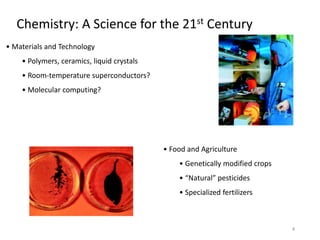
Chemistry: A Science for the 21st Century
• Materials and Technology
• Polymers, ceramics, liquid crystals
• Room-temperature superconductors?
• Molecular computing?
• Food and Agriculture
• Genetically modified crops
• “Natural” pesticides
• Specialized fertilizers
5
The Study of Chemistry
Macroscopic Microscopic
6
A theory is a unifying principle that explains a
body of facts and/or those laws that are based on
them.
A law is a concise statement of a relationship
between phenomena that is always the same
under the same conditions.
Atomic Theory
Force = mass x acceleration
7
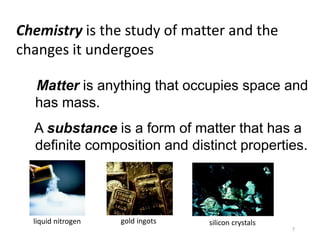
Matter is anything that occupies space and
has mass.
A substance is a form of matter that has a
definite composition and distinct properties.
Chemistry is the study of matter and the
changes it undergoes
liquid nitrogen gold ingots silicon crystals
8
Classifications of Matter
9
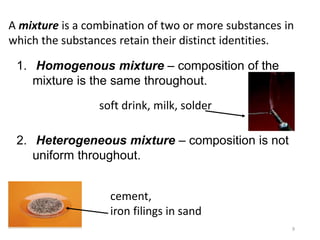
A mixture is a combination of two or more substances in
which the substances retain their distinct identities.
1. Homogenous mixture – composition of the
mixture is the same throughout.
2. Heterogeneous mixture – composition is not
uniform throughout.
soft drink, milk, solder
cement,
iron filings in sand
10
Physical means can be used to separate a mixture into its
pure components.
magnet
distillation
11
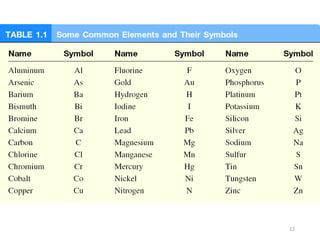
An element is a substance that cannot be separated
into simpler substances by chemical means.
• 114 elements have been identified
• 82 elements occur naturally on Earth
gold, aluminum, lead, oxygen, carbon, sulfur
• 32 elements have been created by scientists
technetium, americium, seaborgium
12
13
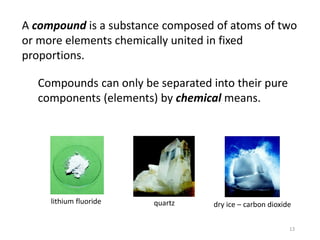
A compound is a substance composed of atoms of two
or more elements chemically united in fixed
proportions.
Compounds can only be separated into their pure
components (elements) by chemical means.
lithium fluoride quartz dry ice – carbon dioxide
14
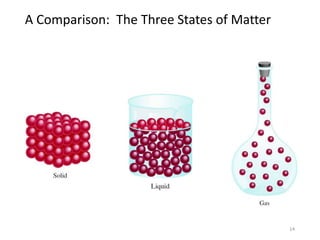
A Comparison: The Three States of Matter
15
A Comparison: The Three States of Matter
Gass :
- does not have a
definite shape or
volume.
- the particles are far
apart, have little
attraction to each
other, and move at
high speeds, taking the
shape and volume of
their container.
Solid :
- Definite Shape and
Volume
- Arranged in rigid
pattern
- strong attractive
forces hold the
particles such as
atoms or
molecules close
together
Liquid :
- definite volume, but
not a definite shap
- e particles move in
random directions
but are sufficiently
attracted to each
other to maintain a
definite volume,
although not a rigid
structure
16
An extensive property of a material depends upon how
much matter is is being considered.
An intensive property of a material does not depend
upon how much matter is is being considered.
• mass
• length
• volume
• density
• temperature
• color
Properties Of Matter
17
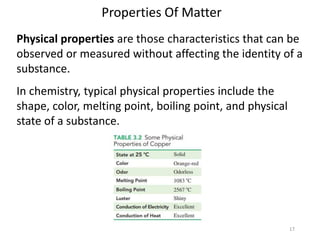
Physical properties are those characteristics that can be
observed or measured without affecting the identity of a
substance.
In chemistry, typical physical properties include the
shape, color, melting point, boiling point, and physical
state of a substance.
Properties Of Matter
18
Chemical properties are those that describe the ability of
a substance to change into a new substance.
When a chemical change takes place, the original
substance is converted into one or more new substances,
which have different physical and chemical properties.
Properties Of Matter
19
A physical change does not alter the composition or
identity of a substance.
A chemical change alters the composition or identity
of the substance(s) involved.
ice melting
sugar dissolving
in water
hydrogen burns in air to
form water
Types of Changes
20
The Three States of Matter: Effect of a Hot Poker on
a Block of Ice
solid
liquid
gas
21
K = 0C + 273.15
0F = x 0C + 32
9
5
273 K = 0 0C
373 K = 100 0C
32 0F = 0 0C
212 0F = 100 0C
A Comparison of Temperature Scales
22
Energy is defined as the ability to do work.
Kinetic energy is the energy of motion. Any object that
is moving has kinetic energy
Energy
Potential energy is determined by the position of an
object or by the chemical composition of a substance
Heat is the energy associated with the motion of
particles. An ice cube feels cold because heat flows
from your hand into the ice cube. The faster the
particles move, the greater the heat or thermal energy
of the substance
23
The SI unit of energy and work is the joule (J) . The joule
is a small amount of energy, so scientists often use the
kilojoule (kJ), 1000 joules.
Other unit of heat is calorie (cal), from the Latin
caloric, meaning “heat.” The calorie was originally
defined as the amount of energy (heat) needed to
raise the temperature of 1 g of water by 1 °C.
Energy
24
The food we eat provides energy to do work in the body,
which includes the growth and repair of cells.
Carbohydrates are the primary fuel for the body, but if
the carbohydrate reserves are exhausted, fats and then
proteins are used for energy.
For many years in the field of nutrition, the energy
from food was measured as Calories or kilocalories.
The nutritional unit Calorie, Cal (with an uppercase C),
is the same as 1000 cal, or 1 kcal.
Energy and Nutrition
25
In the nutrition laboratory, foods are burned in a
calorimeter to determine their energy value kJ/g or kcal/g
A sample of food is placed in a steel container called a
calorimeter filled with oxygen with a measured amount
of water that fills the surrounding chamber.
Energy and Nutrition
26
we can calculate the total energy for a food if the mass of
each food type is known.
Energy Values for Foods
27
At a fast-food restaurant, a hamburger contains 37 g
of carbohydrate, 19 g of fat, and 23 g of protein.
What is the energy from each food type and the
total energy, in kilocalories, for the hamburger?
Round off the kilocalories for each food type to the
tens place
Energy Values for Foods
28
The specific heat (H) for a substance is defined as the
amount of heat needed to raise the temperature of
exactly 1 g of a substance by exactly 1 °C. This
temperature change is written as ∆T (delta T), where
the delta symbol means “change in.
Specific Heat
29
Calculation Using Specific Heat
During cardiac arrest, surgery, and strokes, body temperature is lowered,
which reduces the amount of oxygen needed by the body. Some methods
used to lower body temperature include cooled saline solution, cool water
blankets, or cooling caps worn on the head. How many kilojoules are lost
when the body temperature of a surgery patient with a blood volume of
5500 mL is cooled from 38.5 °C to 33.2 °C? (Assume that the specific heat
and density of blood is the same as for water, 1.0 g/mL)
30
Evaporation, Boiling, and Condensation
Evaporation is taking place as water molecules with sufficient energy escape
from the liquid surface and enter the gas phase
At the boiling point (BP) , the molecules within a liquid have enough energy to
overcome their attractive forces and become a gas. We observe the boiling of a
liquid such as water as gas bubbles form throughout the liquid, rise to the
surface, and escape
In condensation, water vapor is converted back to liquid as the water
molecules lose kinetic energy and slow down. Condensation occurs at the same
temperature as boiling but differs because heat is remo
31
Evaporation, Boiling, and Condensation
32
Sublimation
In a process called sublimation, the particles on the surface of a solid change
directly to a gas with no temperature change and without going through the
liquid state. In the reverse process called deposition, gas particles change
directly to a solid.
33
Heat of Vaporiztion
The heat of vaporization is the energy that must be added to convert exactly 1
g of liquid to gas at its boiling point. For water, 540 cal 12260 J2 is needed to
convert 1 g of water to vapor at 100 °C
34
Heating and Cooling Curves
35
Assignment
1. Compost can be made at home from grass clippings, some kitchen scraps, and dry
leaves. As microbes break down organic matter, heat is generated and the compost
can reach a temperature of 155 °F, which kills most pathogens. What is this initial
temperature in degrees Celsius? In kelvins?
2. A 70.0-kg person had a quarter-pound cheeseburger, french fries, and a chocolate
shake.
a. Using Table 3.7, calculate the total kilocalories for each food type in this meal
1round off the kilocalories to the tens place2.
b. b. Determine the total kilocalories for the meal 1round off to the tens place2.
c. c. Using Table 3.10, determine the number of hours of sleeping needed to burn off
the kilocalories in this meal.
d. d. Using Table 3.10, determine the number of hours of running needed to burn off
the kilocalories in this meal.
Basic Chemistry-1-.pptx

Basic Chemistry-1-.pptx

  • 1.
  • 3.
    3 Chemistry: A Sciencefor the 21st Century • Health and Medicine • Sanitation systems • Surgery with anesthesia • Vaccines and antibiotics • Gene therapy •Energy and the Environment • Fossil fuels • Solar energy • Nuclear energy
  • 4.
    4 Chemistry: A Sciencefor the 21st Century • Materials and Technology • Polymers, ceramics, liquid crystals • Room-temperature superconductors? • Molecular computing? • Food and Agriculture • Genetically modified crops • “Natural” pesticides • Specialized fertilizers
  • 5.
    5 The Study ofChemistry Macroscopic Microscopic
  • 6.
    6 A theory isa unifying principle that explains a body of facts and/or those laws that are based on them. A law is a concise statement of a relationship between phenomena that is always the same under the same conditions. Atomic Theory Force = mass x acceleration
  • 7.
    7 Matter is anythingthat occupies space and has mass. A substance is a form of matter that has a definite composition and distinct properties. Chemistry is the study of matter and the changes it undergoes liquid nitrogen gold ingots silicon crystals
  • 8.
  • 9.
    9 A mixture isa combination of two or more substances in which the substances retain their distinct identities. 1. Homogenous mixture – composition of the mixture is the same throughout. 2. Heterogeneous mixture – composition is not uniform throughout. soft drink, milk, solder cement, iron filings in sand
  • 10.
    10 Physical means canbe used to separate a mixture into its pure components. magnet distillation
  • 11.
    11 An element isa substance that cannot be separated into simpler substances by chemical means. • 114 elements have been identified • 82 elements occur naturally on Earth gold, aluminum, lead, oxygen, carbon, sulfur • 32 elements have been created by scientists technetium, americium, seaborgium
  • 12.
  • 13.
    13 A compound isa substance composed of atoms of two or more elements chemically united in fixed proportions. Compounds can only be separated into their pure components (elements) by chemical means. lithium fluoride quartz dry ice – carbon dioxide
  • 14.
    14 A Comparison: TheThree States of Matter
  • 15.
    15 A Comparison: TheThree States of Matter Gass : - does not have a definite shape or volume. - the particles are far apart, have little attraction to each other, and move at high speeds, taking the shape and volume of their container. Solid : - Definite Shape and Volume - Arranged in rigid pattern - strong attractive forces hold the particles such as atoms or molecules close together Liquid : - definite volume, but not a definite shap - e particles move in random directions but are sufficiently attracted to each other to maintain a definite volume, although not a rigid structure
  • 16.
    16 An extensive propertyof a material depends upon how much matter is is being considered. An intensive property of a material does not depend upon how much matter is is being considered. • mass • length • volume • density • temperature • color Properties Of Matter
  • 17.
    17 Physical properties arethose characteristics that can be observed or measured without affecting the identity of a substance. In chemistry, typical physical properties include the shape, color, melting point, boiling point, and physical state of a substance. Properties Of Matter
  • 18.
    18 Chemical properties arethose that describe the ability of a substance to change into a new substance. When a chemical change takes place, the original substance is converted into one or more new substances, which have different physical and chemical properties. Properties Of Matter
  • 19.
    19 A physical changedoes not alter the composition or identity of a substance. A chemical change alters the composition or identity of the substance(s) involved. ice melting sugar dissolving in water hydrogen burns in air to form water Types of Changes
  • 20.
    20 The Three Statesof Matter: Effect of a Hot Poker on a Block of Ice solid liquid gas
  • 21.
    21 K = 0C+ 273.15 0F = x 0C + 32 9 5 273 K = 0 0C 373 K = 100 0C 32 0F = 0 0C 212 0F = 100 0C A Comparison of Temperature Scales
  • 22.
    22 Energy is definedas the ability to do work. Kinetic energy is the energy of motion. Any object that is moving has kinetic energy Energy Potential energy is determined by the position of an object or by the chemical composition of a substance Heat is the energy associated with the motion of particles. An ice cube feels cold because heat flows from your hand into the ice cube. The faster the particles move, the greater the heat or thermal energy of the substance
  • 23.
    23 The SI unitof energy and work is the joule (J) . The joule is a small amount of energy, so scientists often use the kilojoule (kJ), 1000 joules. Other unit of heat is calorie (cal), from the Latin caloric, meaning “heat.” The calorie was originally defined as the amount of energy (heat) needed to raise the temperature of 1 g of water by 1 °C. Energy
  • 24.
    24 The food weeat provides energy to do work in the body, which includes the growth and repair of cells. Carbohydrates are the primary fuel for the body, but if the carbohydrate reserves are exhausted, fats and then proteins are used for energy. For many years in the field of nutrition, the energy from food was measured as Calories or kilocalories. The nutritional unit Calorie, Cal (with an uppercase C), is the same as 1000 cal, or 1 kcal. Energy and Nutrition
  • 25.
    25 In the nutritionlaboratory, foods are burned in a calorimeter to determine their energy value kJ/g or kcal/g A sample of food is placed in a steel container called a calorimeter filled with oxygen with a measured amount of water that fills the surrounding chamber. Energy and Nutrition
  • 26.
    26 we can calculatethe total energy for a food if the mass of each food type is known. Energy Values for Foods
  • 27.
    27 At a fast-foodrestaurant, a hamburger contains 37 g of carbohydrate, 19 g of fat, and 23 g of protein. What is the energy from each food type and the total energy, in kilocalories, for the hamburger? Round off the kilocalories for each food type to the tens place Energy Values for Foods
  • 28.
    28 The specific heat(H) for a substance is defined as the amount of heat needed to raise the temperature of exactly 1 g of a substance by exactly 1 °C. This temperature change is written as ∆T (delta T), where the delta symbol means “change in. Specific Heat
  • 29.
    29 Calculation Using SpecificHeat During cardiac arrest, surgery, and strokes, body temperature is lowered, which reduces the amount of oxygen needed by the body. Some methods used to lower body temperature include cooled saline solution, cool water blankets, or cooling caps worn on the head. How many kilojoules are lost when the body temperature of a surgery patient with a blood volume of 5500 mL is cooled from 38.5 °C to 33.2 °C? (Assume that the specific heat and density of blood is the same as for water, 1.0 g/mL)
  • 30.
    30 Evaporation, Boiling, andCondensation Evaporation is taking place as water molecules with sufficient energy escape from the liquid surface and enter the gas phase At the boiling point (BP) , the molecules within a liquid have enough energy to overcome their attractive forces and become a gas. We observe the boiling of a liquid such as water as gas bubbles form throughout the liquid, rise to the surface, and escape In condensation, water vapor is converted back to liquid as the water molecules lose kinetic energy and slow down. Condensation occurs at the same temperature as boiling but differs because heat is remo
  • 31.
  • 32.
    32 Sublimation In a processcalled sublimation, the particles on the surface of a solid change directly to a gas with no temperature change and without going through the liquid state. In the reverse process called deposition, gas particles change directly to a solid.
  • 33.
    33 Heat of Vaporiztion Theheat of vaporization is the energy that must be added to convert exactly 1 g of liquid to gas at its boiling point. For water, 540 cal 12260 J2 is needed to convert 1 g of water to vapor at 100 °C
  • 34.
  • 35.
    35 Assignment 1. Compost canbe made at home from grass clippings, some kitchen scraps, and dry leaves. As microbes break down organic matter, heat is generated and the compost can reach a temperature of 155 °F, which kills most pathogens. What is this initial temperature in degrees Celsius? In kelvins? 2. A 70.0-kg person had a quarter-pound cheeseburger, french fries, and a chocolate shake. a. Using Table 3.7, calculate the total kilocalories for each food type in this meal 1round off the kilocalories to the tens place2. b. b. Determine the total kilocalories for the meal 1round off to the tens place2. c. c. Using Table 3.10, determine the number of hours of sleeping needed to burn off the kilocalories in this meal. d. d. Using Table 3.10, determine the number of hours of running needed to burn off the kilocalories in this meal.