Dr. SHWETA SINGH
Assistant Professor
Applied Sciences
Suresh Gyan Vihar University
Jaipur
Cell Differentiation
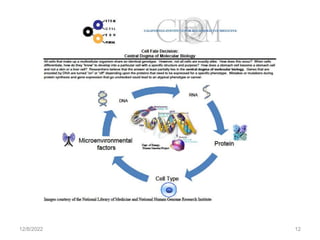
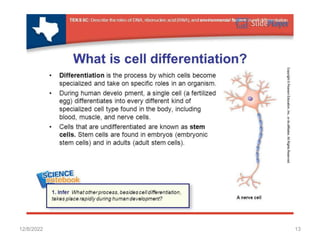
Cellular differentiation, or simply cell
differentiation, is the process through which a
cell undergoes changes in gene expression to
become a more specific type of cell.
The process of cell differentiation allows multi-
cellular organisms to create uniquely functional
cell types and body plans. The process of cell
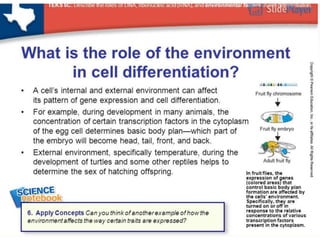
differentiation is driven by genetics, and their
interaction with the environment.
12/8/2022 2
• All organisms begin from a single cell.
• This single cell carries the DNA coding for all
the proteins the adult organism will use.
However, if this cell expressed all of these
proteins at once it would not be functional.
• This cell must divide repeatedly, and the cells
must begin the process of cell differentiation
as they divide.
12/8/2022 3
• The original mass of cells, which have not undergone
differentiation, are known as stem cells.
• Unlike normal cell division, which creates two
identical daughter cells, the division of stem cells is
asymmetric cell division.
• In this case, one of the cells remains identical to the
parent stem cell.
• In the other cell, chemical triggers activate the
process of cell differentiation, and the cell will start
to express the DNA of a specific cell type. Stem cells
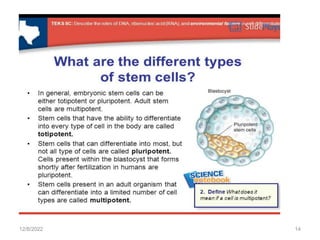
which can differentiate into entire organisms are
known as embryonic stem cells and are said to be
totipotent.
12/8/2022 4
Cell Differentiation Examples
• After the process of fertilization in animals, a single-
celled organism called the zygote is formed.
• The zygote is totipotent, and will eventually become
an entire organism. Even the largest animal on Earth,
the blue whale, starts as a single cell. The complex
tissues and organ systems, which are completely
different in their form and function, all come from
the zygote. The process of cell differentiation starts
early within the organism. By the time the gastrula
has formed, the cells have already started expressing
various portions of the DNA
12/8/2022 5
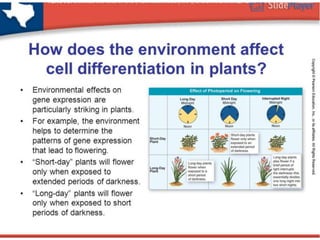
• While the plant lifecycle sometimes seems alien and
complex, the process of cell differentiation is very
similar.
• While there are different hormones involved, all
plants also develop from a single cell. A seed is
simply a protective housing for the zygote, which
also provides a food supply. It is very similar to an
egg in the animal world.
• The zygote inside undergoes cell division, and
becomes a small embryo. Development is halted, as
the seed is distributed into the world.
12/8/2022 6
Cell Differentiation Process
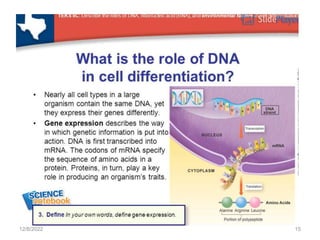
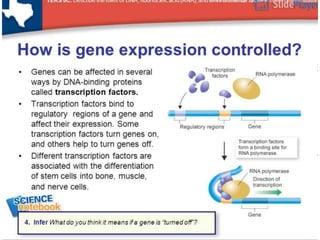
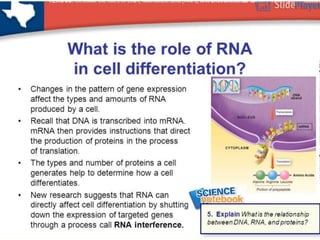
• One of the keys to the cell differentiation process is
transcription factors.
• This complex process is still being studied. Scientist
have made considerable advances in understanding
cell differentiation, starting with the complete
understanding of the nematode C. elegans. This tiny,
worm-like creature has a total of 959 cells as an adult
female.
12/8/2022 7
• With such a small number, they are relatively
easy to track from the zygote to the adult.
Tracing their cell lineage, scientists have
started to determine some of the complex and
epigenetic forces working on cell
differentiation. In other words, it matters not
only what DNA a cell has, but where and how
that DNA is expressed.
12/8/2022 8
• 1. Why is cell differentiation an important process?
A. It allows for multi-cellular life forms
B. It creates new species
C. We could do without it
A is correct. Without the process of cell differentiation,
multicellular organisms would not be possible. Some
algae live in colonies, but this is nowhere near the level
of complexity developed by insects or vertebrates. Cell
differentiation allows the creation of tissues and
organs, which can serve specific and useful functions
for an organism.
12/8/2022 9
• 2. What is the difference between cell
differentiation and development?
A. Development does not include differentiation
B. Cell differentiation is part of development
C. There is no difference
• B is correct. Development is the entire process of
creating a new organism from a single cell. It includes
everything from forming the correct tissues to
creating the neural connections to support a new
body. Cell differentiation is simply the process
through which cells begin to express only certain
portions of DNA, thereby becoming specialized cell
types.
12/8/2022 10
12/8/2022 11
12/8/2022 12
12/8/2022 13
12/8/2022 14
12/8/2022 15
12/8/2022 16
12/8/2022 17
12/8/2022 18
12/8/2022 19
12/8/2022 20
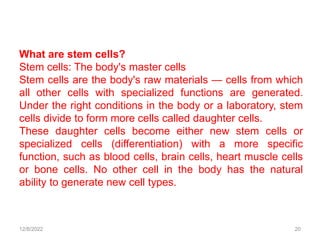
What are stem cells?
Stem cells: The body's master cells
Stem cells are the body's raw materials — cells from which
all other cells with specialized functions are generated.
Under the right conditions in the body or a laboratory, stem
cells divide to form more cells called daughter cells.
These daughter cells become either new stem cells or
specialized cells (differentiation) with a more specific
function, such as blood cells, brain cells, heart muscle cells
or bone cells. No other cell in the body has the natural
ability to generate new cell types.
12/8/2022 21
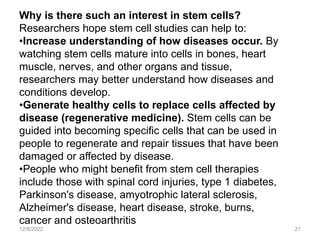
Why is there such an interest in stem cells?
Researchers hope stem cell studies can help to:
•Increase understanding of how diseases occur. By
watching stem cells mature into cells in bones, heart
muscle, nerves, and other organs and tissue,
researchers may better understand how diseases and
conditions develop.
•Generate healthy cells to replace cells affected by
disease (regenerative medicine). Stem cells can be
guided into becoming specific cells that can be used in
people to regenerate and repair tissues that have been
damaged or affected by disease.
•People who might benefit from stem cell therapies
include those with spinal cord injuries, type 1 diabetes,
Parkinson's disease, amyotrophic lateral sclerosis,
Alzheimer's disease, heart disease, stroke, burns,
cancer and osteoarthritis
12/8/2022 22
Where do stem cells come from?
There are several sources of stem cells:
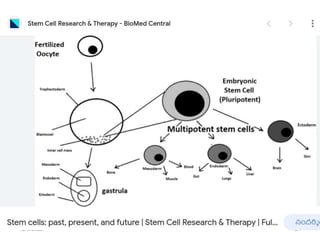
•Embryonic stem cells. These stem cells come from embryos that
are 3 to 5 days old. At this stage, an embryo is called a blastocyst and
has about 150 cells.
•These are pluripotent (ploo-RIP-uh-tunt) stem cells, meaning they can
divide into more stem cells or can become any type of cell in the body.
This versatility allows embryonic stem cells to be used to regenerate or
repair diseased tissue and organs.
•Adult stem cells. These stem cells are found in small numbers in
most adult tissues, such as bone marrow or fat. Compared with
embryonic stem cells, adult stem cells have a more limited ability to
give rise to various cells of the body.
•Until recently, researchers thought adult stem cells could create only
similar types of cells. For instance, researchers thought that stem cells
residing in the bone marrow could give rise only to blood cells.
12/8/2022 23
12/8/2022 24
• Mayo Clinic on Stem Cells therapy
• California Institute for regenerative medicine
• Stem Cell research paper (PubMed)
• Stem cell Research and Therapy (Biomed
Central)
12/8/2022 25
12/8/2022 26
THANKS

cell differentation.pptx

  • 1.
    Dr. SHWETA SINGH AssistantProfessor Applied Sciences Suresh Gyan Vihar University Jaipur
  • 2.
    Cell Differentiation Cellular differentiation,or simply cell differentiation, is the process through which a cell undergoes changes in gene expression to become a more specific type of cell. The process of cell differentiation allows multi- cellular organisms to create uniquely functional cell types and body plans. The process of cell differentiation is driven by genetics, and their interaction with the environment. 12/8/2022 2
  • 3.
    • All organismsbegin from a single cell. • This single cell carries the DNA coding for all the proteins the adult organism will use. However, if this cell expressed all of these proteins at once it would not be functional. • This cell must divide repeatedly, and the cells must begin the process of cell differentiation as they divide. 12/8/2022 3
  • 4.
    • The originalmass of cells, which have not undergone differentiation, are known as stem cells. • Unlike normal cell division, which creates two identical daughter cells, the division of stem cells is asymmetric cell division. • In this case, one of the cells remains identical to the parent stem cell. • In the other cell, chemical triggers activate the process of cell differentiation, and the cell will start to express the DNA of a specific cell type. Stem cells which can differentiate into entire organisms are known as embryonic stem cells and are said to be totipotent. 12/8/2022 4
  • 5.
    Cell Differentiation Examples •After the process of fertilization in animals, a single- celled organism called the zygote is formed. • The zygote is totipotent, and will eventually become an entire organism. Even the largest animal on Earth, the blue whale, starts as a single cell. The complex tissues and organ systems, which are completely different in their form and function, all come from the zygote. The process of cell differentiation starts early within the organism. By the time the gastrula has formed, the cells have already started expressing various portions of the DNA 12/8/2022 5
  • 6.
    • While theplant lifecycle sometimes seems alien and complex, the process of cell differentiation is very similar. • While there are different hormones involved, all plants also develop from a single cell. A seed is simply a protective housing for the zygote, which also provides a food supply. It is very similar to an egg in the animal world. • The zygote inside undergoes cell division, and becomes a small embryo. Development is halted, as the seed is distributed into the world. 12/8/2022 6
  • 7.
    Cell Differentiation Process •One of the keys to the cell differentiation process is transcription factors. • This complex process is still being studied. Scientist have made considerable advances in understanding cell differentiation, starting with the complete understanding of the nematode C. elegans. This tiny, worm-like creature has a total of 959 cells as an adult female. 12/8/2022 7
  • 8.
    • With sucha small number, they are relatively easy to track from the zygote to the adult. Tracing their cell lineage, scientists have started to determine some of the complex and epigenetic forces working on cell differentiation. In other words, it matters not only what DNA a cell has, but where and how that DNA is expressed. 12/8/2022 8
  • 9.
    • 1. Whyis cell differentiation an important process? A. It allows for multi-cellular life forms B. It creates new species C. We could do without it A is correct. Without the process of cell differentiation, multicellular organisms would not be possible. Some algae live in colonies, but this is nowhere near the level of complexity developed by insects or vertebrates. Cell differentiation allows the creation of tissues and organs, which can serve specific and useful functions for an organism. 12/8/2022 9
  • 10.
    • 2. Whatis the difference between cell differentiation and development? A. Development does not include differentiation B. Cell differentiation is part of development C. There is no difference • B is correct. Development is the entire process of creating a new organism from a single cell. It includes everything from forming the correct tissues to creating the neural connections to support a new body. Cell differentiation is simply the process through which cells begin to express only certain portions of DNA, thereby becoming specialized cell types. 12/8/2022 10
  • 11.
  • 12.
  • 13.
  • 14.
  • 15.
  • 16.
  • 17.
  • 18.
  • 19.
  • 20.
    12/8/2022 20 What arestem cells? Stem cells: The body's master cells Stem cells are the body's raw materials — cells from which all other cells with specialized functions are generated. Under the right conditions in the body or a laboratory, stem cells divide to form more cells called daughter cells. These daughter cells become either new stem cells or specialized cells (differentiation) with a more specific function, such as blood cells, brain cells, heart muscle cells or bone cells. No other cell in the body has the natural ability to generate new cell types.
  • 21.
    12/8/2022 21 Why isthere such an interest in stem cells? Researchers hope stem cell studies can help to: •Increase understanding of how diseases occur. By watching stem cells mature into cells in bones, heart muscle, nerves, and other organs and tissue, researchers may better understand how diseases and conditions develop. •Generate healthy cells to replace cells affected by disease (regenerative medicine). Stem cells can be guided into becoming specific cells that can be used in people to regenerate and repair tissues that have been damaged or affected by disease. •People who might benefit from stem cell therapies include those with spinal cord injuries, type 1 diabetes, Parkinson's disease, amyotrophic lateral sclerosis, Alzheimer's disease, heart disease, stroke, burns, cancer and osteoarthritis
  • 22.
    12/8/2022 22 Where dostem cells come from? There are several sources of stem cells: •Embryonic stem cells. These stem cells come from embryos that are 3 to 5 days old. At this stage, an embryo is called a blastocyst and has about 150 cells. •These are pluripotent (ploo-RIP-uh-tunt) stem cells, meaning they can divide into more stem cells or can become any type of cell in the body. This versatility allows embryonic stem cells to be used to regenerate or repair diseased tissue and organs. •Adult stem cells. These stem cells are found in small numbers in most adult tissues, such as bone marrow or fat. Compared with embryonic stem cells, adult stem cells have a more limited ability to give rise to various cells of the body. •Until recently, researchers thought adult stem cells could create only similar types of cells. For instance, researchers thought that stem cells residing in the bone marrow could give rise only to blood cells.
  • 23.
  • 24.
  • 25.
    • Mayo Clinicon Stem Cells therapy • California Institute for regenerative medicine • Stem Cell research paper (PubMed) • Stem cell Research and Therapy (Biomed Central) 12/8/2022 25
  • 26.