Cell biology
and
Biochemistry
Name: Mili Bhardwaj
Registration number:
16BCB0076
2/12/2018
1
2/12/2018
Cell nucleus
2
Introduction
• In cell biology, the nucleus is a membrane-enclosed organelle
found in eukaryotic cells.
• Eukaryotes usually have a single nucleus.
• But a few cell types, such as mammalian red blood cells, have
no nuclei, and a few others have many.
• Human skeletal muscle cells have more than one nucleus, as
do eukaryotes like fungi.
2/12/2018
An introduction to cell nucleus
3
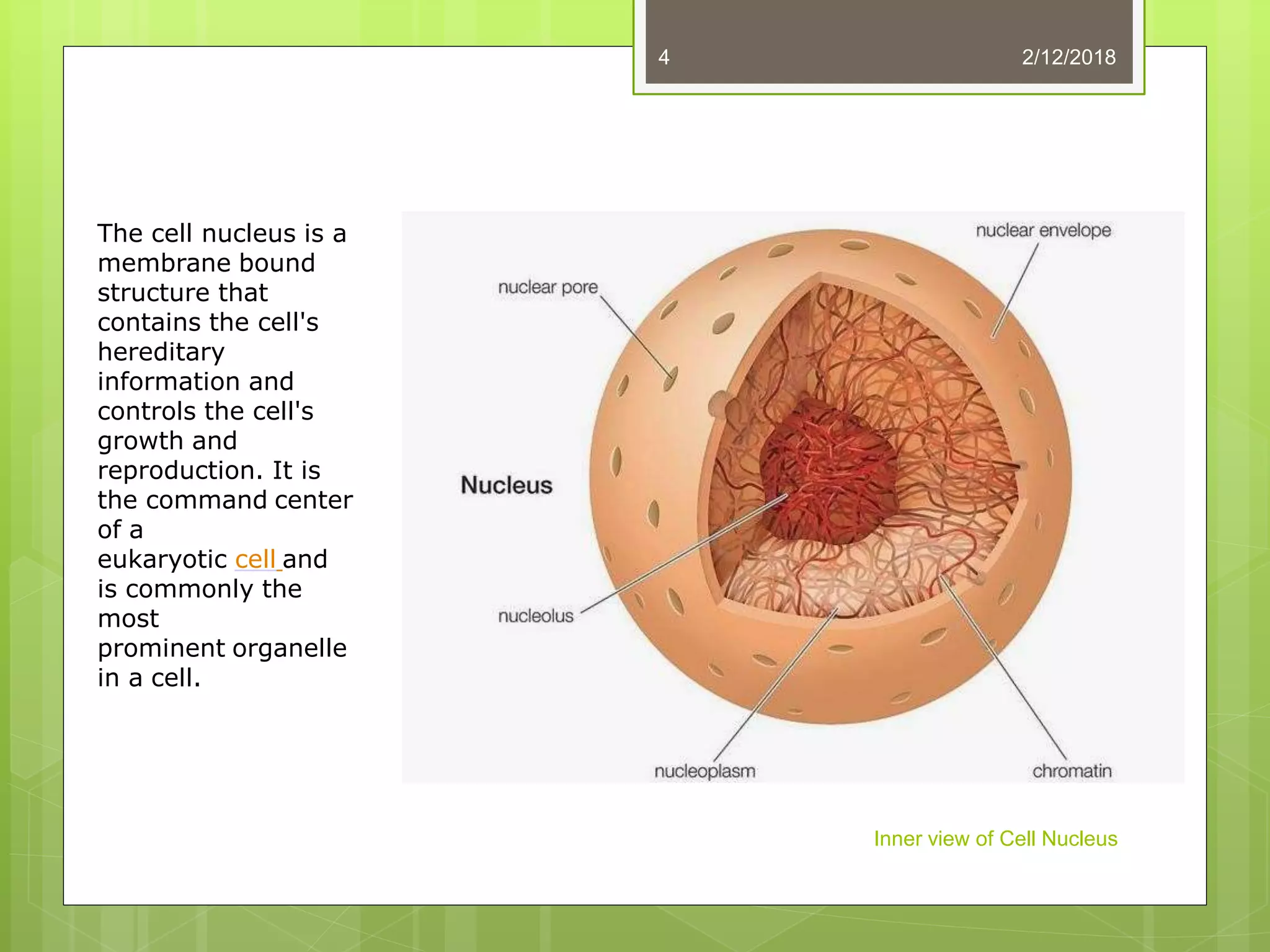
The cell nucleus is a
membrane bound
structure that
contains the cell's
hereditary
information and
controls the cell's
growth and
reproduction. It is
the command center
of a
eukaryotic cell and
is commonly the
most
prominent organelle
in a cell.
2/12/2018
Inner view of Cell Nucleus
4
Distinguishing characteristics• bound by a double membrane called the nuclear envelope
• the nuclear envelope consists of phospholipids that form a
lipid bilayer.
• The nucleus is the organelle which houses chromosomes.
• The nuclear envelope is connected with the endoplasmic
reticulum (ER)in such a way that the internal compartment
of the nuclear envelope is continuous with the lumen of the
ER.
• Chromosomes consist of DNA, which contains heredity
information and instructions for cell growth, development, and
reproduction.
2/12/20185
Nucleoplasm
• Nucleoplasm is the gelatinous substance within the nuclear
envelope.
• composed mainly of water with dissolved salts, enzymes, and
organic molecules suspended within.
• Nucleoplasm also supports the nucleus by helping to maintain
its shape.
• Substances are exchanged between the cytoplasm and
nucleoplasm through nuclear pores.
• Additionally, nucleoplasm provides a medium by which
materials, such as enzymes and nucleotides (DNA and RNA
subunits), can be transported throughout the nucleus.
2/12/2018
Components of the Cell
6
Nucleolus
• membrane-less structure composed of RNA
and proteins called the nucleolus.
• contains nucleolar organizers, which are parts of
chromosomes with the genes for ribosome synthesis on them.
• helps to synthesize ribosomes by transcribing and assembling
ribosomal RNA subunits.
• These subunits join together to form a ribosome during
protein synthesis.
2/12/2018
Components of the Cell
7
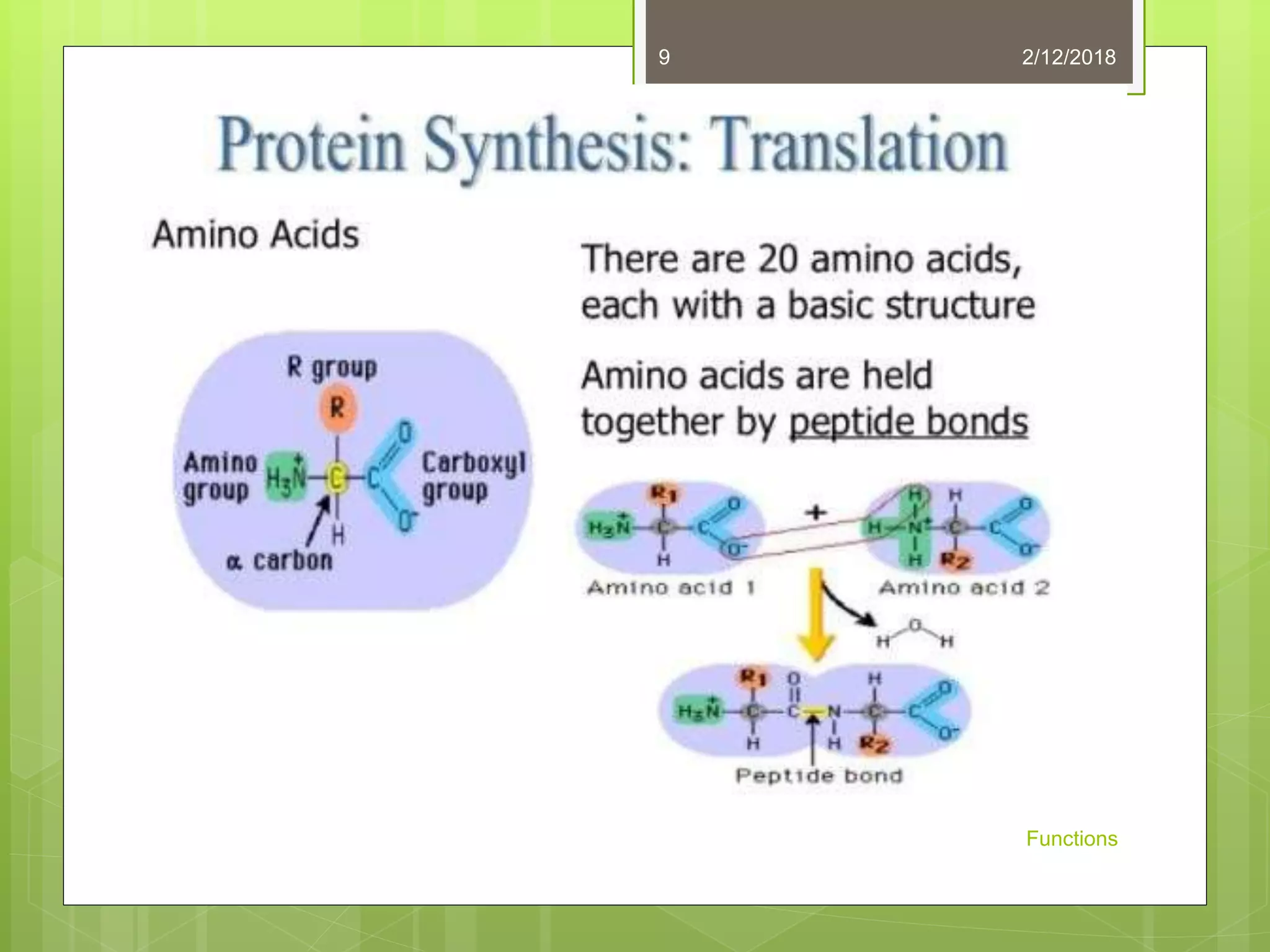
Protein synthesis
• The nucleus regulates the synthesis of proteins in the
cytoplasm through the use of messenger RNA (mRNA)
• Messenger RNA is a transcribed DNA segment that serves as a
template for protein production
• It is produced in the nucleus and travels to the cytoplasm
through the nuclear pores of the nuclear envelope.
• Once in the cytoplasm, ribosomes and another RNA molecule
called transfer RNA work together to translate mRNA to
produce proteins.
2/12/2018
Functions
8
2/12/2018
Functions
9
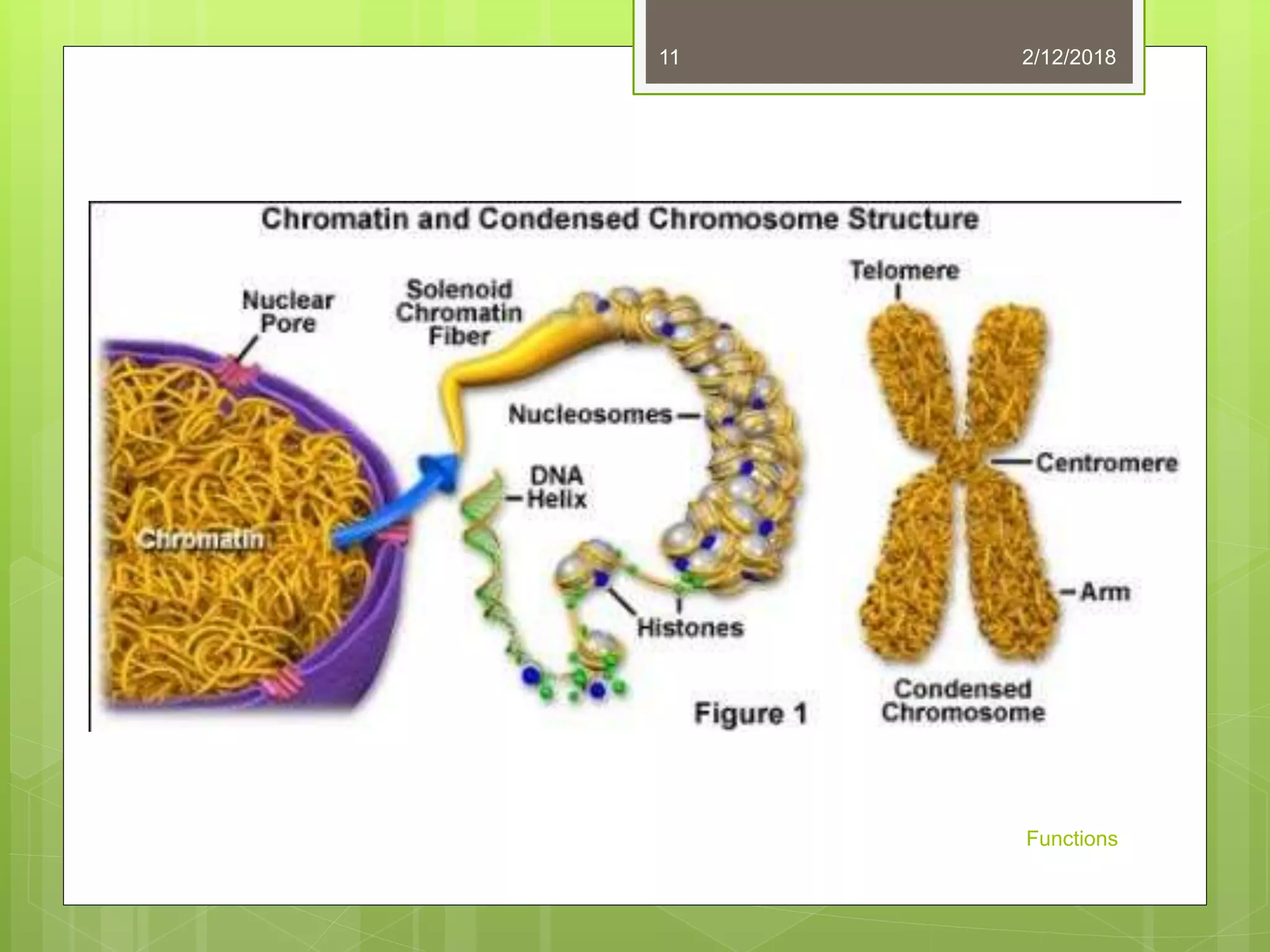
Chromatin and chromosomes• Packed inside the nucleus of every human cell is nearly 6 feet
of DNA, which is divided into 46 individual molecules, one for
each chromosome and each about 1.5 inches long.
• Packing all this material into a microscopic cell nucleus is an
extraordinary feat of packaging.
• For DNA to function, it can't be crammed into the nucleus like
a ball of string. Instead, it is combined with proteins and
organized into a precise, compact structure, a dense string-
like fiber called chromatin.
2/12/2018
Functions
10
2/12/2018
Functions
11
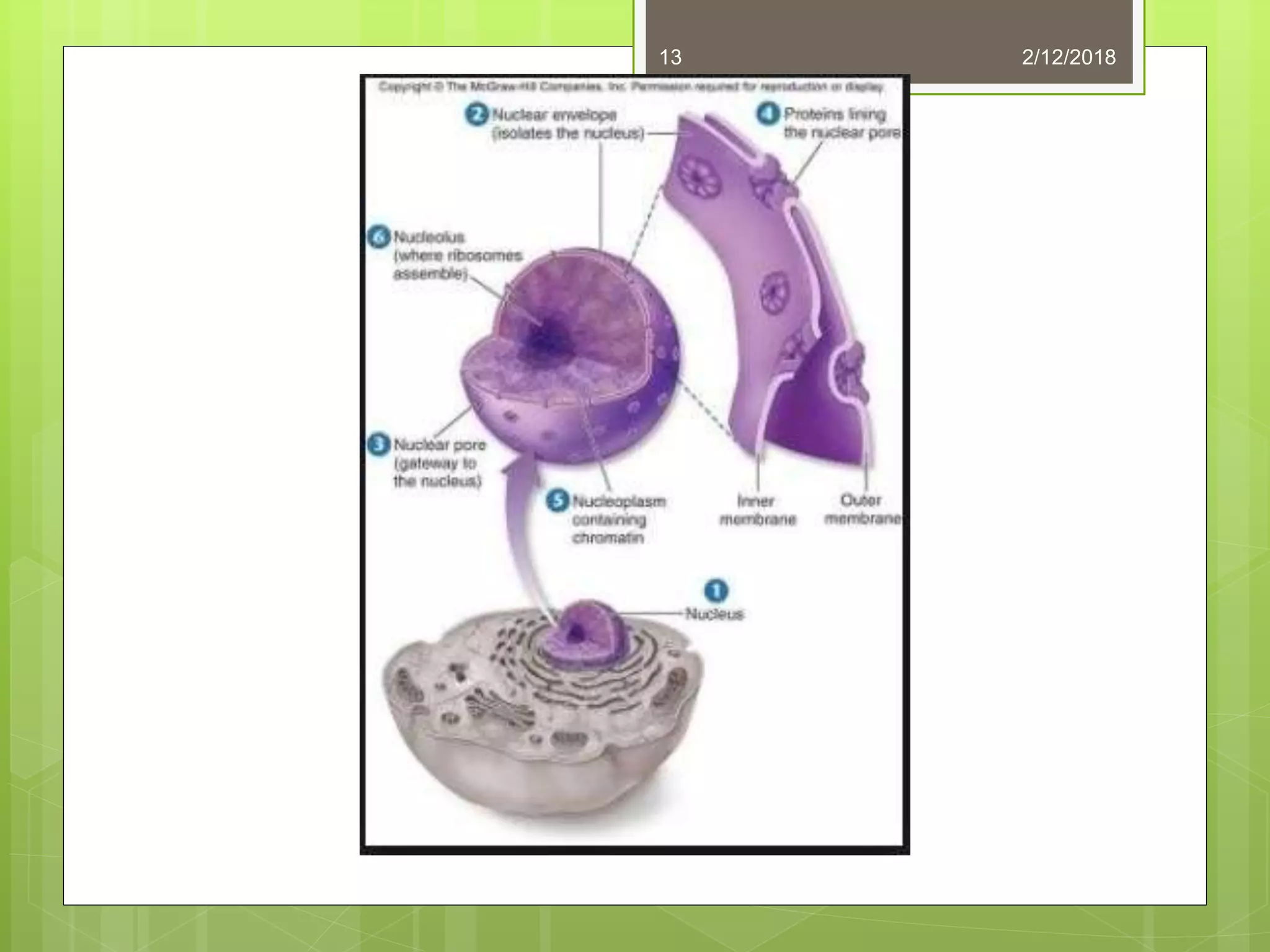
Nuclear pores
• The nuclear envelope is perforated with holes called nuclear
pores.
• These pores regulate the passage of molecules between the
nucleus and cytoplasm, permitting some to pass through the
membrane, but not others.
• Building blocks for building DNA and RNA are allowed into the
nucleus as well as molecules that provide the energy for
constructing genetic material.
2/12/201812
2/12/201813
Applications of Cell Nucleus
2/12/2018
Applications
14
Application od Cell Nucleus
2/12/201815

Cell bio and biochem

  • 1.
    Cell biology and Biochemistry Name: MiliBhardwaj Registration number: 16BCB0076 2/12/2018 1
  • 2.
  • 3.
    Introduction • In cellbiology, the nucleus is a membrane-enclosed organelle found in eukaryotic cells. • Eukaryotes usually have a single nucleus. • But a few cell types, such as mammalian red blood cells, have no nuclei, and a few others have many. • Human skeletal muscle cells have more than one nucleus, as do eukaryotes like fungi. 2/12/2018 An introduction to cell nucleus 3
  • 4.
    The cell nucleusis a membrane bound structure that contains the cell's hereditary information and controls the cell's growth and reproduction. It is the command center of a eukaryotic cell and is commonly the most prominent organelle in a cell. 2/12/2018 Inner view of Cell Nucleus 4
  • 5.
    Distinguishing characteristics• boundby a double membrane called the nuclear envelope • the nuclear envelope consists of phospholipids that form a lipid bilayer. • The nucleus is the organelle which houses chromosomes. • The nuclear envelope is connected with the endoplasmic reticulum (ER)in such a way that the internal compartment of the nuclear envelope is continuous with the lumen of the ER. • Chromosomes consist of DNA, which contains heredity information and instructions for cell growth, development, and reproduction. 2/12/20185
  • 6.
    Nucleoplasm • Nucleoplasm isthe gelatinous substance within the nuclear envelope. • composed mainly of water with dissolved salts, enzymes, and organic molecules suspended within. • Nucleoplasm also supports the nucleus by helping to maintain its shape. • Substances are exchanged between the cytoplasm and nucleoplasm through nuclear pores. • Additionally, nucleoplasm provides a medium by which materials, such as enzymes and nucleotides (DNA and RNA subunits), can be transported throughout the nucleus. 2/12/2018 Components of the Cell 6
  • 7.
    Nucleolus • membrane-less structurecomposed of RNA and proteins called the nucleolus. • contains nucleolar organizers, which are parts of chromosomes with the genes for ribosome synthesis on them. • helps to synthesize ribosomes by transcribing and assembling ribosomal RNA subunits. • These subunits join together to form a ribosome during protein synthesis. 2/12/2018 Components of the Cell 7
  • 8.
    Protein synthesis • Thenucleus regulates the synthesis of proteins in the cytoplasm through the use of messenger RNA (mRNA) • Messenger RNA is a transcribed DNA segment that serves as a template for protein production • It is produced in the nucleus and travels to the cytoplasm through the nuclear pores of the nuclear envelope. • Once in the cytoplasm, ribosomes and another RNA molecule called transfer RNA work together to translate mRNA to produce proteins. 2/12/2018 Functions 8
  • 9.
  • 10.
    Chromatin and chromosomes•Packed inside the nucleus of every human cell is nearly 6 feet of DNA, which is divided into 46 individual molecules, one for each chromosome and each about 1.5 inches long. • Packing all this material into a microscopic cell nucleus is an extraordinary feat of packaging. • For DNA to function, it can't be crammed into the nucleus like a ball of string. Instead, it is combined with proteins and organized into a precise, compact structure, a dense string- like fiber called chromatin. 2/12/2018 Functions 10
  • 11.
  • 12.
    Nuclear pores • Thenuclear envelope is perforated with holes called nuclear pores. • These pores regulate the passage of molecules between the nucleus and cytoplasm, permitting some to pass through the membrane, but not others. • Building blocks for building DNA and RNA are allowed into the nucleus as well as molecules that provide the energy for constructing genetic material. 2/12/201812
  • 13.
  • 14.
    Applications of CellNucleus 2/12/2018 Applications 14
  • 15.
    Application od CellNucleus 2/12/201815