CDPD
CDPD
• In 1992, AT&T Wireless Services developed the cellular digital packet data
(CDPD) protocol, a data-only protocol that (re-)uses the AMPS or IS-136
network. Packets (typically ~1.5 kilobytes) use vacant cellular channels - either an
assigned channel or between calls.
• CDPD does not communicate with the underlying network; but does utilize
knowledge of this network’s channel assignment algorithms to predict when
channels will be available for CDPD’s use.
• Mobile Data Base Stations - do channel sniffing to find idle channels It is
essentially an implementation of Mobile*IP [28] .. [30].
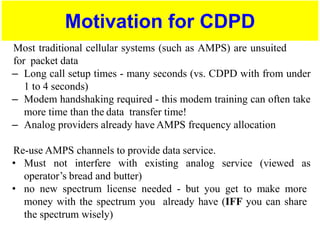
Motivation for CDPD
Most traditional cellular systems (such as AMPS) are unsuited
for packet data
– Long call setup times - many seconds (vs. CDPD with from under
1 to 4 seconds)
– Modem handshaking required - this modem training can often take
more time than the data transfer time!
– Analog providers already have AMPS frequency allocation
Re-use AMPS channels to provide data service.
• Must not interfere with existing analog service (viewed as
operator’s bread and butter)
• no new spectrum license needed - but you get to make more
money with the spectrum you already have (IFF you can share
the spectrum wisely)
Motivation for CDPD
Goals
• low speed data: Paging, short message, e-mail, (achieve 10-
12kbps)
• broadcast and multicast (for example, for fleet management)
• “always on-line” packet data service
• transparent to existing AMPS service, but shares spectrum with it
CDPD network architecture
• Mobile End System (M-ES), Mobile Data Basestation (MDBS),
• Mobile Data -Intermediate System (MD-IS)
AMPS
MSC
MD-IS
MD-IS
PSTN
PSDN
M-ES
MDBS
AMPS BS
Internet
CDPD Entities
Mobile End System (M-ES)
• Subscriber unit - interfaces with the radio at 19.2 kbps
• Subscriber Identity Module (SIM) - used to identify subscriber
• Mobile Application Subsystem - actually provides the functionality (could be a
PDA, Laptop, embedded processor, )
Mobile Data Base Station (MDBS)
• controls the radio: radio channel allocation, channel usage,
• one modem/transceiver per radio channel pair (up & down link)
• generally co-located with the AMPS base stations (so they can share antenna,
site, )
Mobile Data-Intermediate System (MD-IS)
• frame relay switch + packet router
• buffers packets destined to M-ES it knows about (=with TEI assigned)
• supports user mobility by a mobile location protocol
Limits
• No direct Mobile End System (M-ES) to M-ES
communication
• radius of a CDPD cell is limited to <10 miles (i.e. < 17km)
• each M-ES can only send two packets back to back - to avoid
hogging the channel

Cdpd

  • 1.
  • 2.
    CDPD • In 1992,AT&T Wireless Services developed the cellular digital packet data (CDPD) protocol, a data-only protocol that (re-)uses the AMPS or IS-136 network. Packets (typically ~1.5 kilobytes) use vacant cellular channels - either an assigned channel or between calls. • CDPD does not communicate with the underlying network; but does utilize knowledge of this network’s channel assignment algorithms to predict when channels will be available for CDPD’s use. • Mobile Data Base Stations - do channel sniffing to find idle channels It is essentially an implementation of Mobile*IP [28] .. [30].
  • 3.
    Motivation for CDPD Mosttraditional cellular systems (such as AMPS) are unsuited for packet data – Long call setup times - many seconds (vs. CDPD with from under 1 to 4 seconds) – Modem handshaking required - this modem training can often take more time than the data transfer time! – Analog providers already have AMPS frequency allocation Re-use AMPS channels to provide data service. • Must not interfere with existing analog service (viewed as operator’s bread and butter) • no new spectrum license needed - but you get to make more money with the spectrum you already have (IFF you can share the spectrum wisely)
  • 4.
    Motivation for CDPD Goals •low speed data: Paging, short message, e-mail, (achieve 10- 12kbps) • broadcast and multicast (for example, for fleet management) • “always on-line” packet data service • transparent to existing AMPS service, but shares spectrum with it
  • 5.
    CDPD network architecture •Mobile End System (M-ES), Mobile Data Basestation (MDBS), • Mobile Data -Intermediate System (MD-IS) AMPS MSC MD-IS MD-IS PSTN PSDN M-ES MDBS AMPS BS Internet
  • 6.
    CDPD Entities Mobile EndSystem (M-ES) • Subscriber unit - interfaces with the radio at 19.2 kbps • Subscriber Identity Module (SIM) - used to identify subscriber • Mobile Application Subsystem - actually provides the functionality (could be a PDA, Laptop, embedded processor, ) Mobile Data Base Station (MDBS) • controls the radio: radio channel allocation, channel usage, • one modem/transceiver per radio channel pair (up & down link) • generally co-located with the AMPS base stations (so they can share antenna, site, ) Mobile Data-Intermediate System (MD-IS) • frame relay switch + packet router • buffers packets destined to M-ES it knows about (=with TEI assigned) • supports user mobility by a mobile location protocol
  • 7.
    Limits • No directMobile End System (M-ES) to M-ES communication • radius of a CDPD cell is limited to <10 miles (i.e. < 17km) • each M-ES can only send two packets back to back - to avoid hogging the channel