Electrolyte Imbalance
12th Nov 2010
‘Primer on Critical Care’
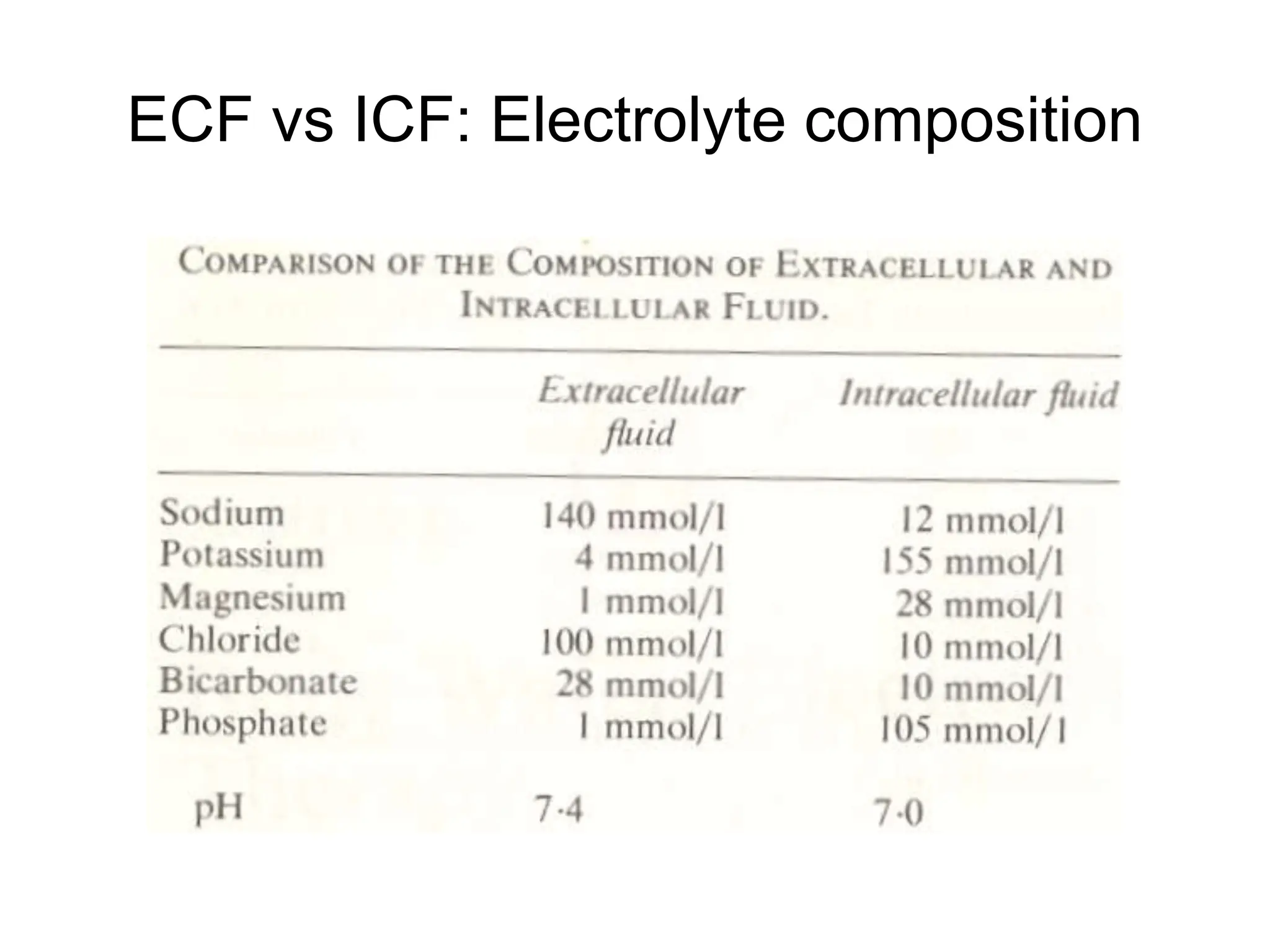
ECF vs ICF: Electrolyte composition
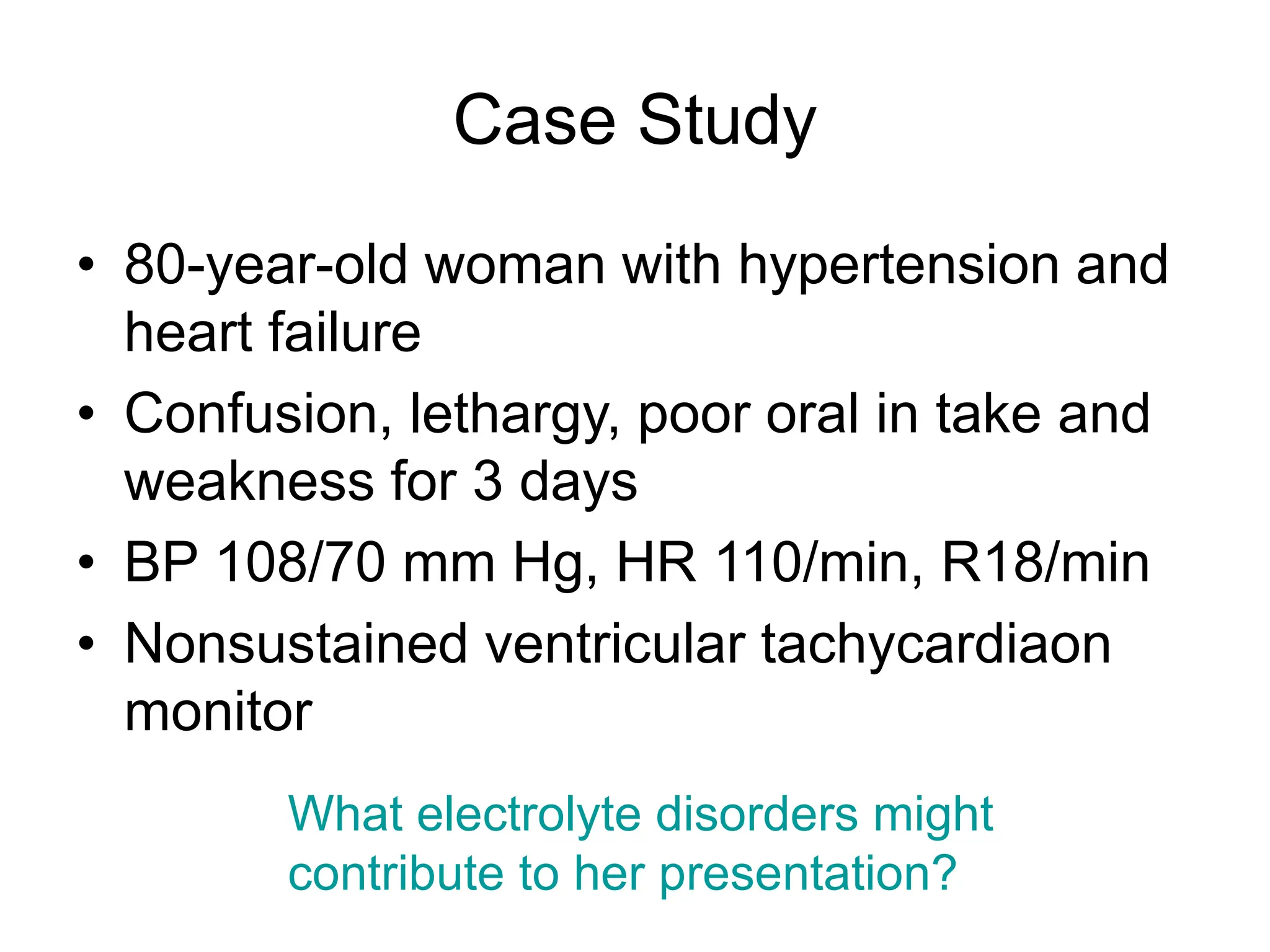
Case Study
• 80-year-old woman with hypertension and
heart failure
• Confusion, lethargy, poor oral in take and
weakness for 3 days
• BP 108/70 mm Hg, HR 110/min, R18/min
• Nonsustained ventricular tachycardiaon
monitor
What electrolyte disorders might
contribute to her presentation?
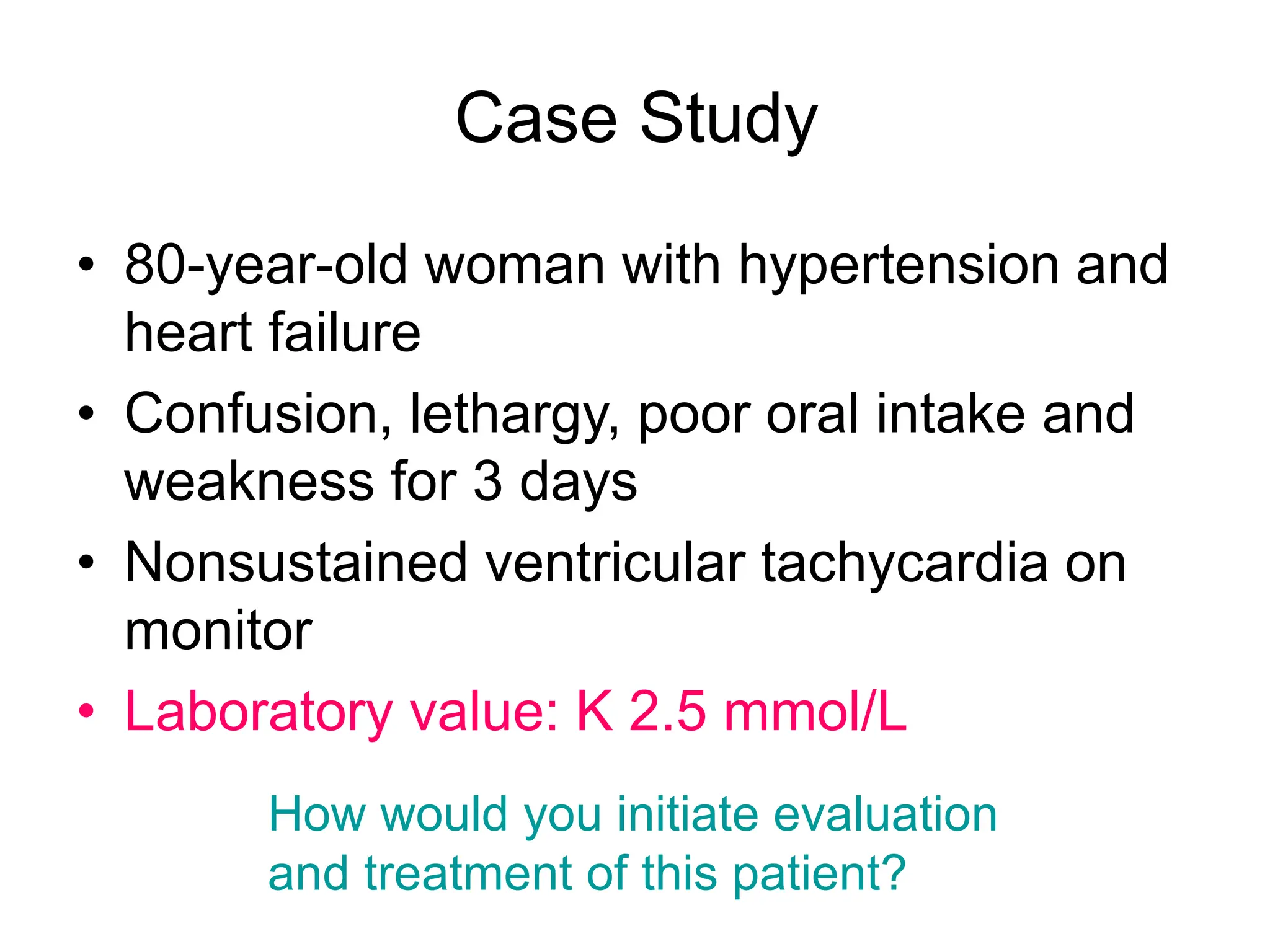
Case Study
• 80-year-old woman with hypertension and
heart failure
• Confusion, lethargy, poor oral intake and
weakness for 3 days
• Nonsustained ventricular tachycardia on
monitor
• Laboratory value: K 2.5 mmol/L
How would you initiate evaluation
and treatment of this patient?
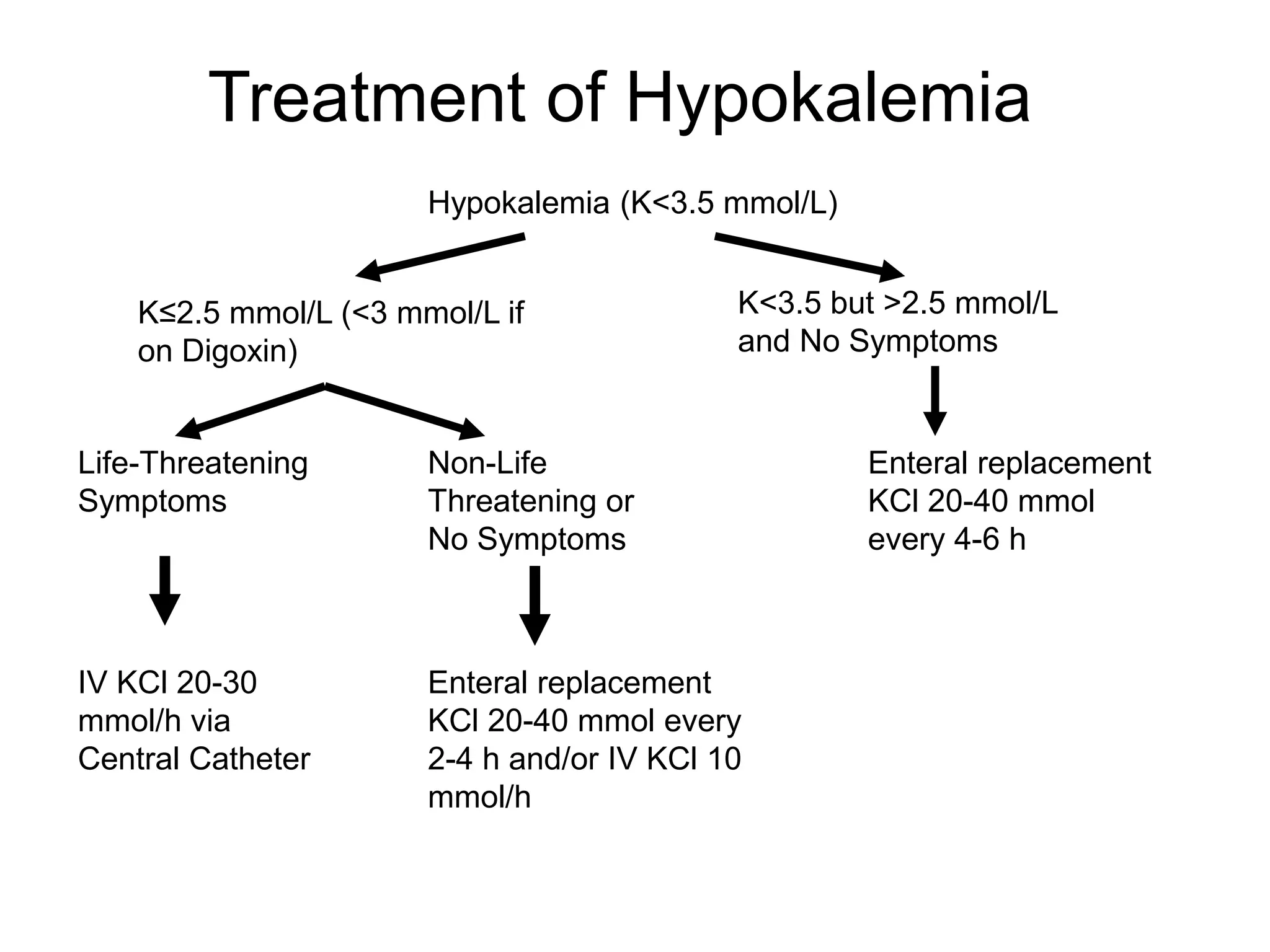
Hypokalemia (K<3.5 mmol/L)
K≤2.5 mmol/L (<3 mmol/L if
on Digoxin)
K<3.5 but >2.5 mmol/L
and No Symptoms
Life-Threatening
Symptoms
Non-Life
Threatening or
No Symptoms
Enteral replacement
KCl 20-40 mmol
every 4-6 h
IV KCl 20-30
mmol/h via
Central Catheter
Enteral replacement
KCl 20-40 mmol every
2-4 h and/or IV KCl 10
mmol/h
Treatment of Hypokalemia
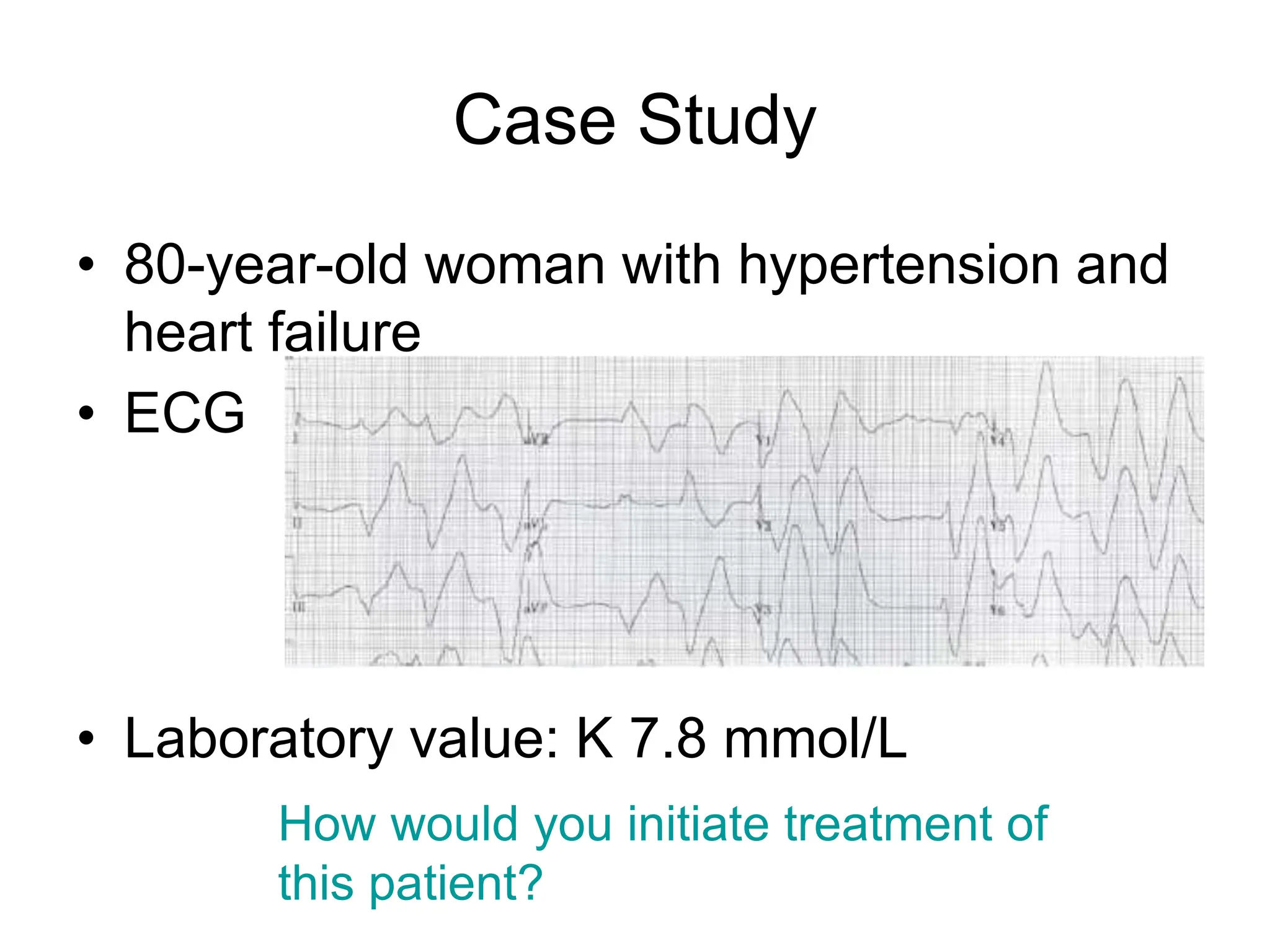
Case Study
• 80-year-old woman with hypertension and
heart failure
• ECG
• Laboratory value: K 7.8 mmol/L
How would you initiate treatment of
this patient?
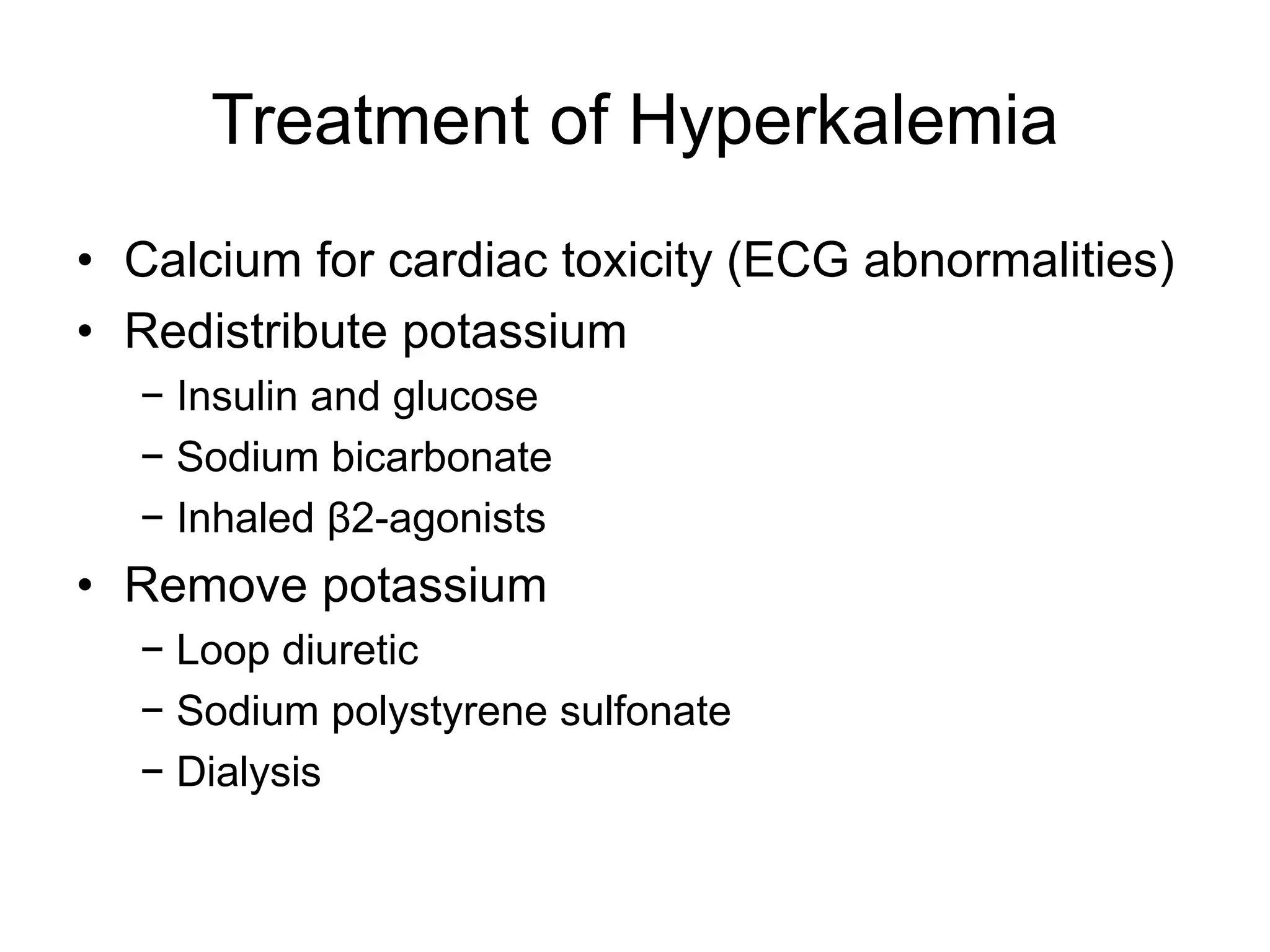
Treatment of Hyperkalemia
• Calcium for cardiac toxicity (ECG abnormalities)
• Redistribute potassium
− Insulin and glucose
− Sodium bicarbonate
− Inhaled β2-agonists
• Remove potassium
− Loop diuretic
− Sodium polystyrene sulfonate
− Dialysis
Case Study
• 80-year-old woman with hypertension and
heart failure
• Confusion, lethargy, poor oral intake
• and weakness for 3 days
• Laboratory value: Na 118 mmol/L
How would you initiate evaluation of
this patient to determine the etiology?
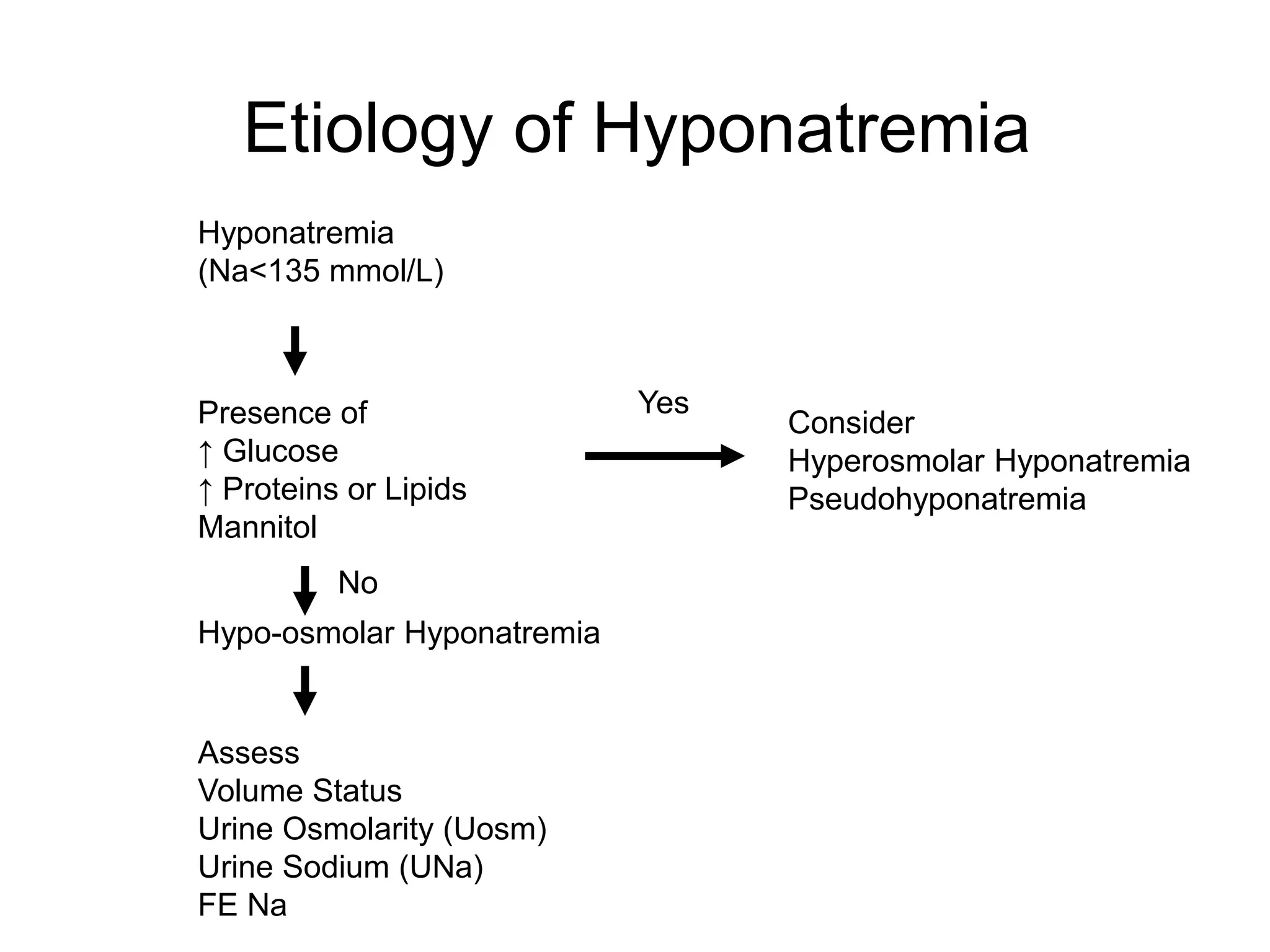
Etiology of Hyponatremia
Hyponatremia
(Na<135 mmol/L)
Presence of
↑ Glucose
↑ Proteins or Lipids
Mannitol
Consider
Hyperosmolar Hyponatremia
Pseudohyponatremia
Hypo-osmolar Hyponatremia
Assess
Volume Status
Urine Osmolarity (Uosm)
Urine Sodium (UNa)
FE Na
Yes
No
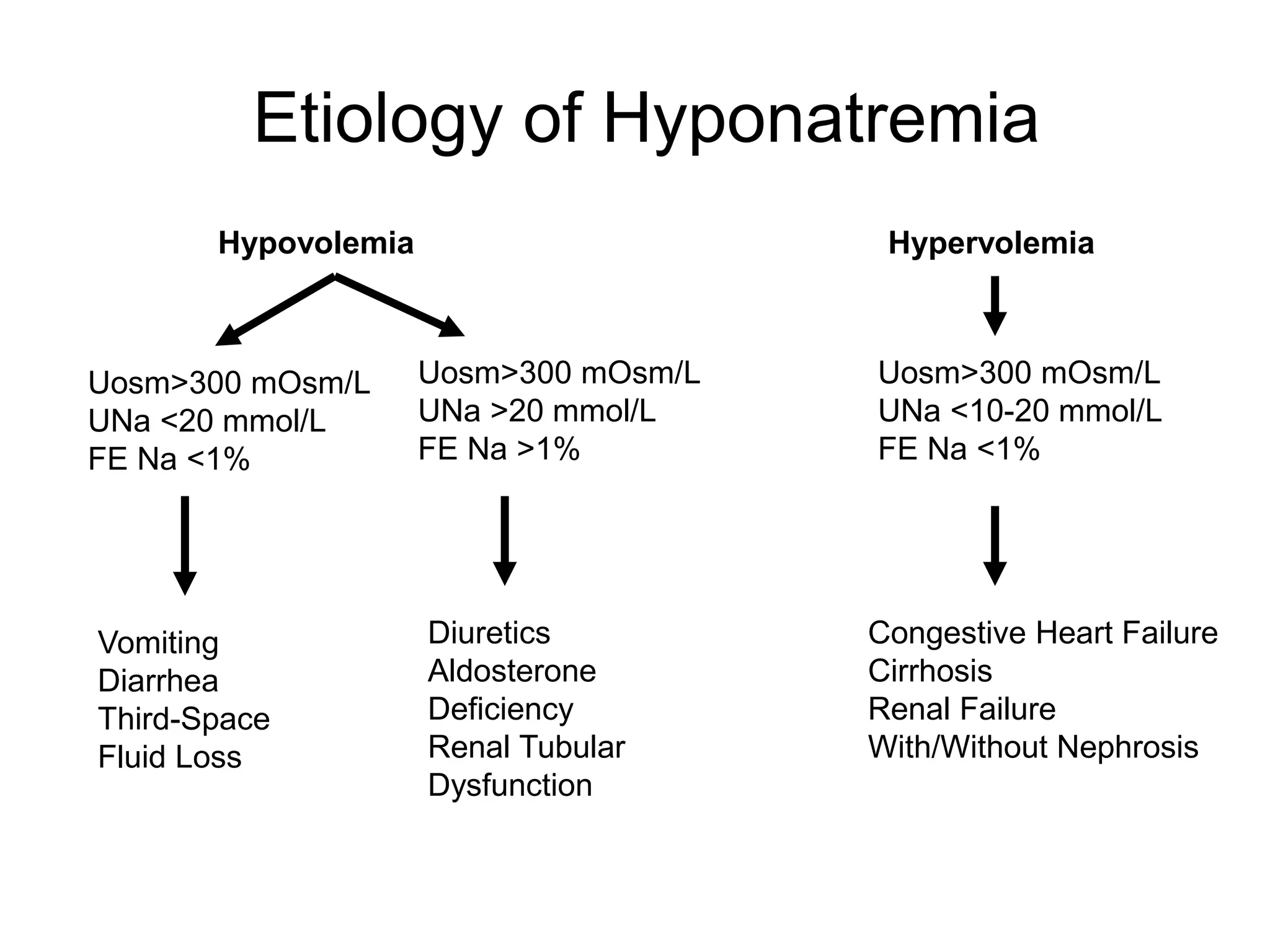
Etiology of Hyponatremia
Hypovolemia Hypervolemia
Uosm>300 mOsm/L
UNa <20 mmol/L
FE Na <1%
Uosm>300 mOsm/L
UNa >20 mmol/L
FE Na >1%
Uosm>300 mOsm/L
UNa <10-20 mmol/L
FE Na <1%
Vomiting
Diarrhea
Third-Space
Fluid Loss
Diuretics
Aldosterone
Deficiency
Renal Tubular
Dysfunction
Congestive Heart Failure
Cirrhosis
Renal Failure
With/Without Nephrosis
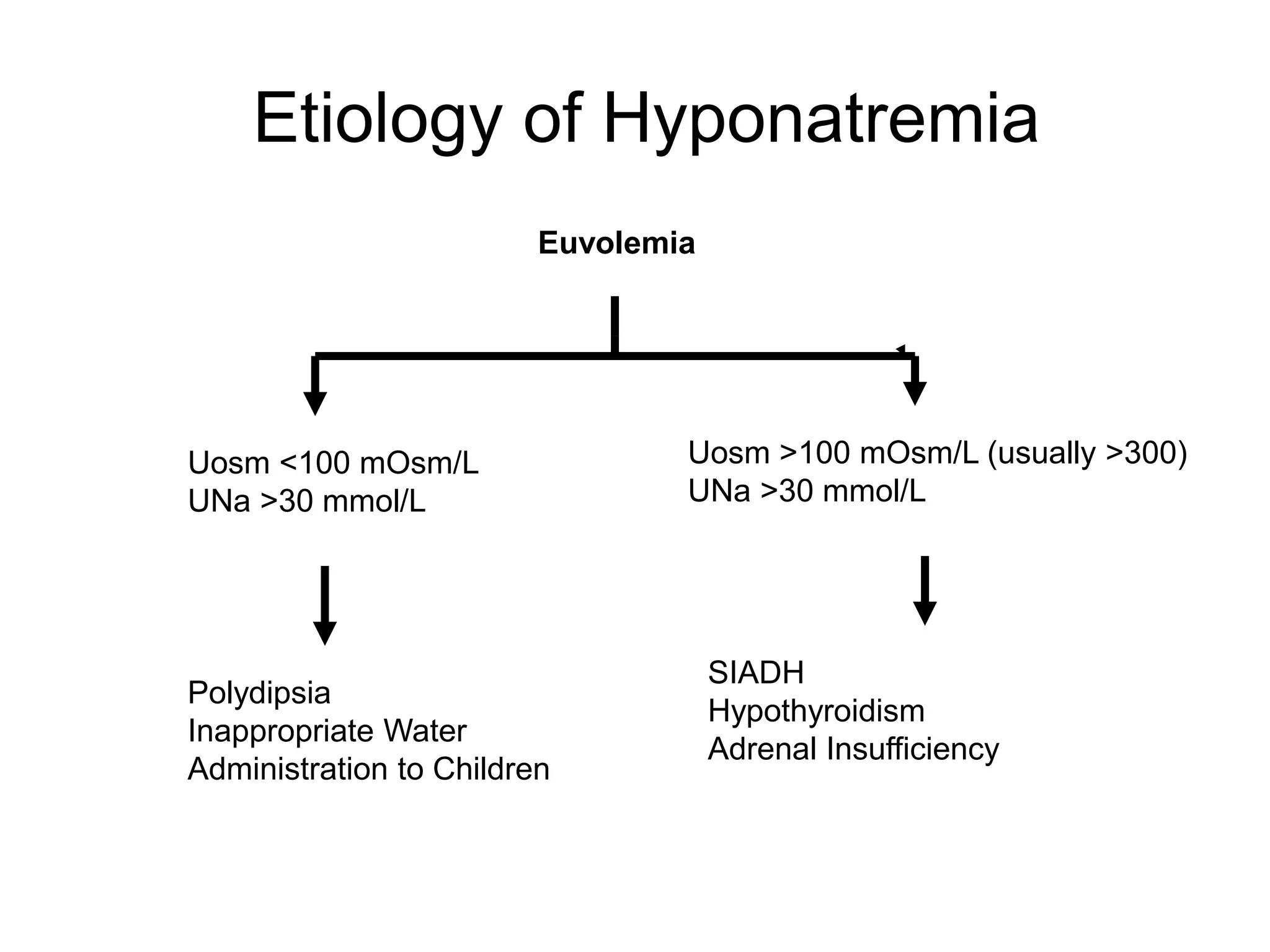
Etiology of Hyponatremia
Euvolemia
Uosm <100 mOsm/L
UNa >30 mmol/L
Uosm >100 mOsm/L (usually >300)
UNa >30 mmol/L
Polydipsia
Inappropriate Water
Administration to Children
SIADH
Hypothyroidism
Adrenal Insufficiency
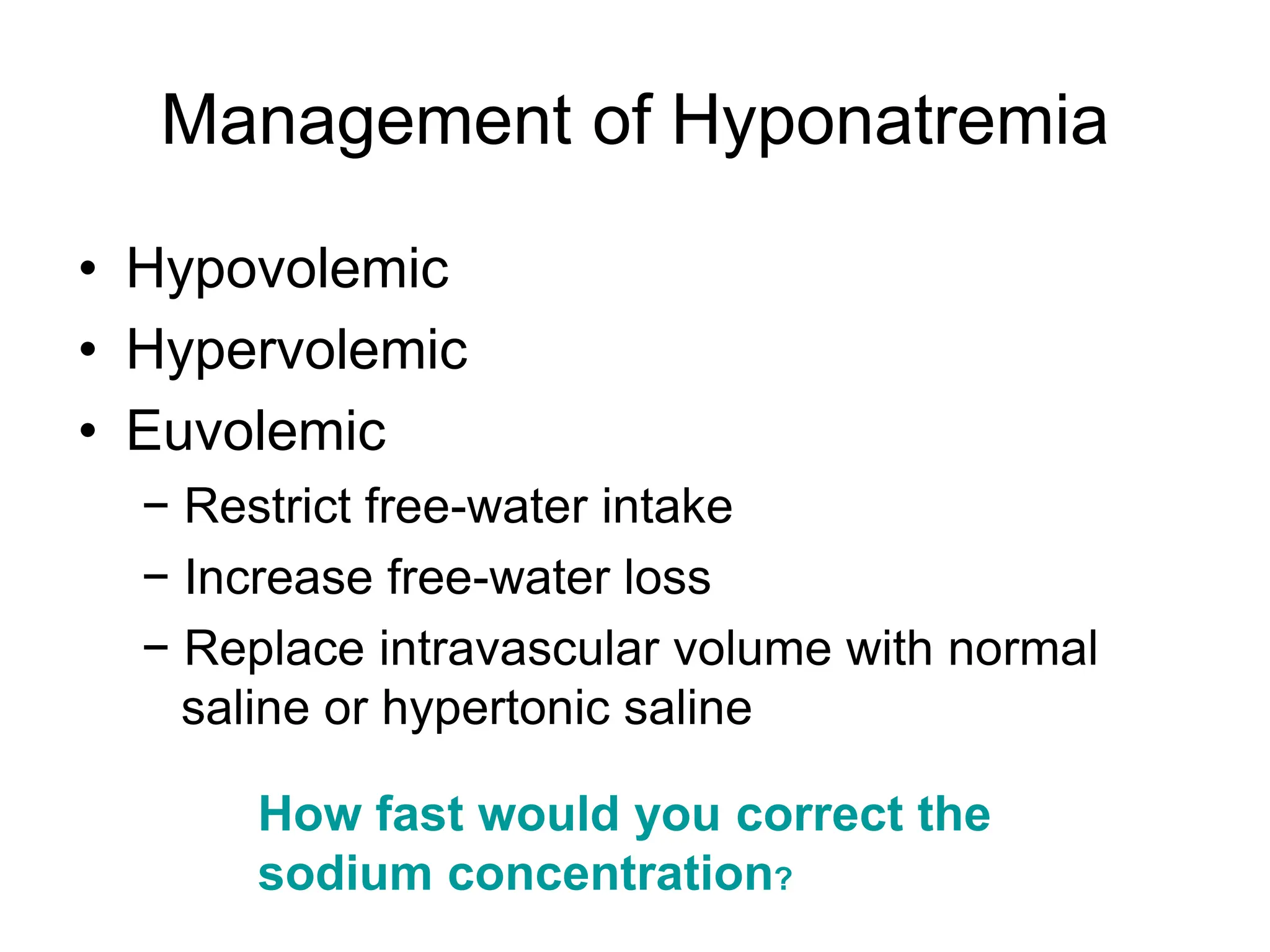
Management of Hyponatremia
• Hypovolemic
• Hypervolemic
• Euvolemic
− Restrict free-water intake
− Increase free-water loss
− Replace intravascular volume with normal
saline or hypertonic saline
How fast would you correct the
sodium concentration?
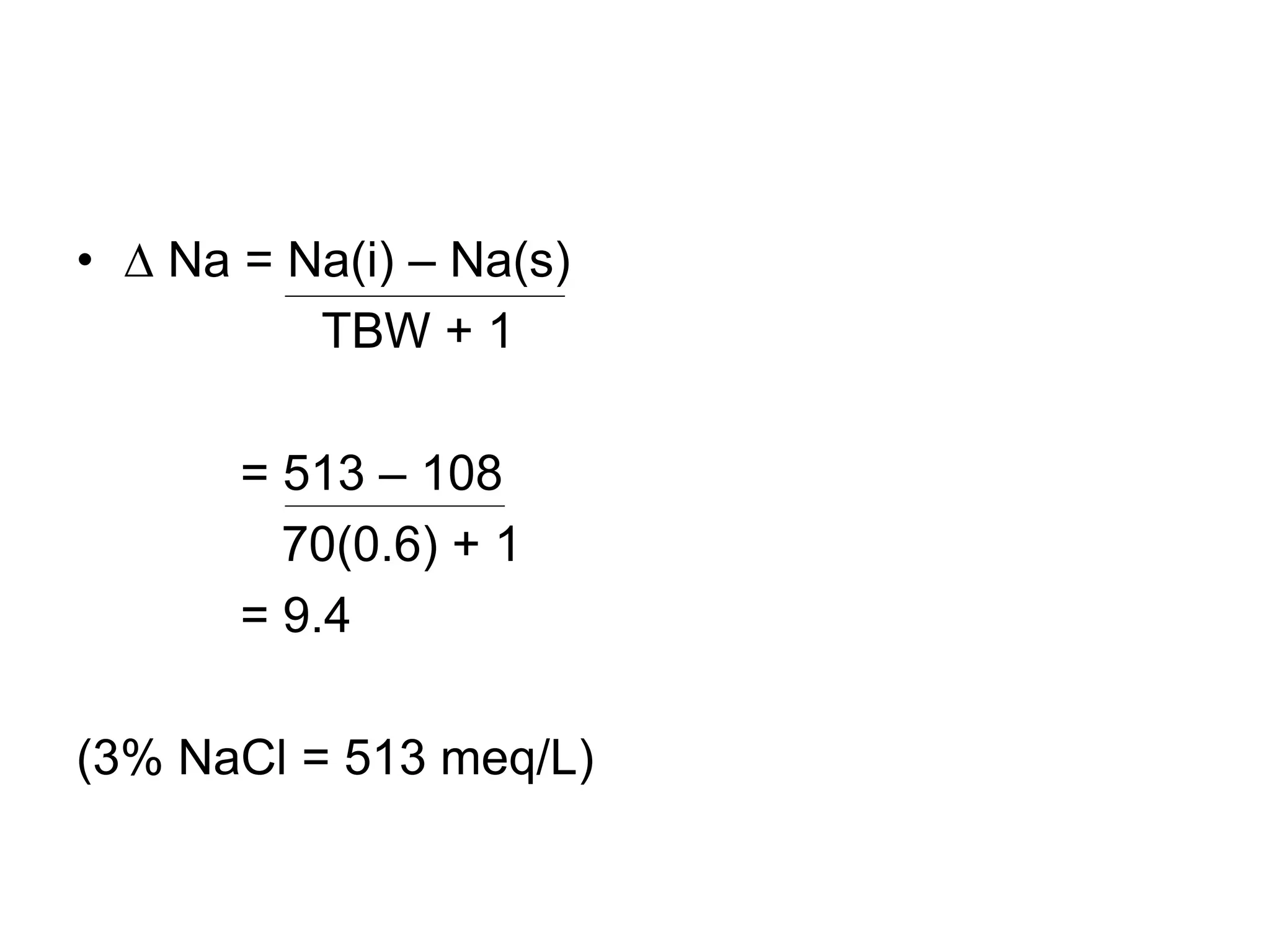
•  Na = Na(i) – Na(s)
TBW + 1
= 513 – 108
70(0.6) + 1
= 9.4
(3% NaCl = 513 meq/L)
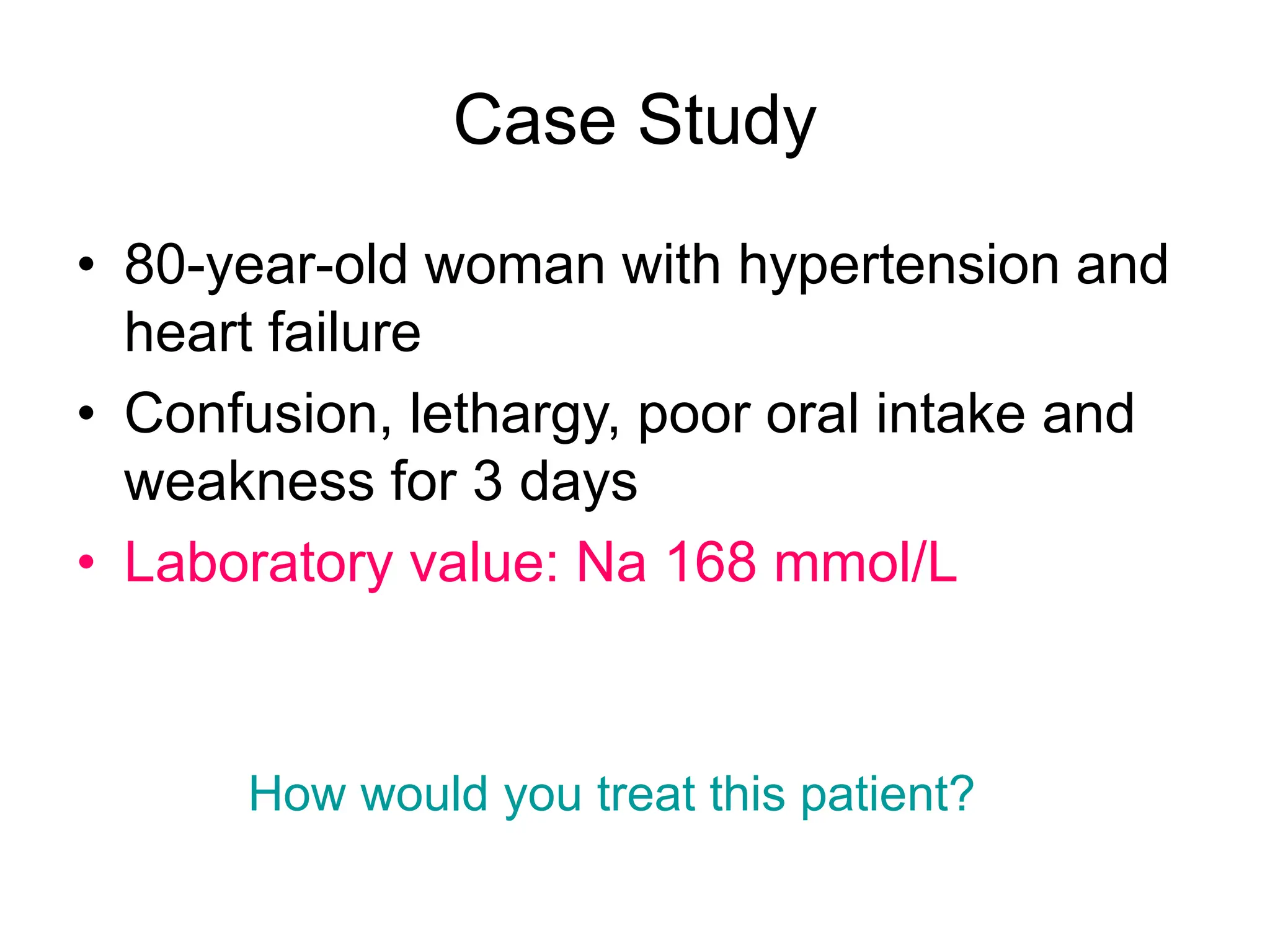
Case Study
• 80-year-old woman with hypertension and
heart failure
• Confusion, lethargy, poor oral intake and
weakness for 3 days
• Laboratory value: Na 168 mmol/L
How would you treat this patient?
Treatment of Hypernatremia
• Normal saline if hemodynamically unstable
• Hypotonic fluid when stable
− Intravenous fluids
− Enteral free water
• Quantity
H2O deficit (L) = [0.6 × wt (kg) ] × [Measured Na -140]
140
• Rate of correction
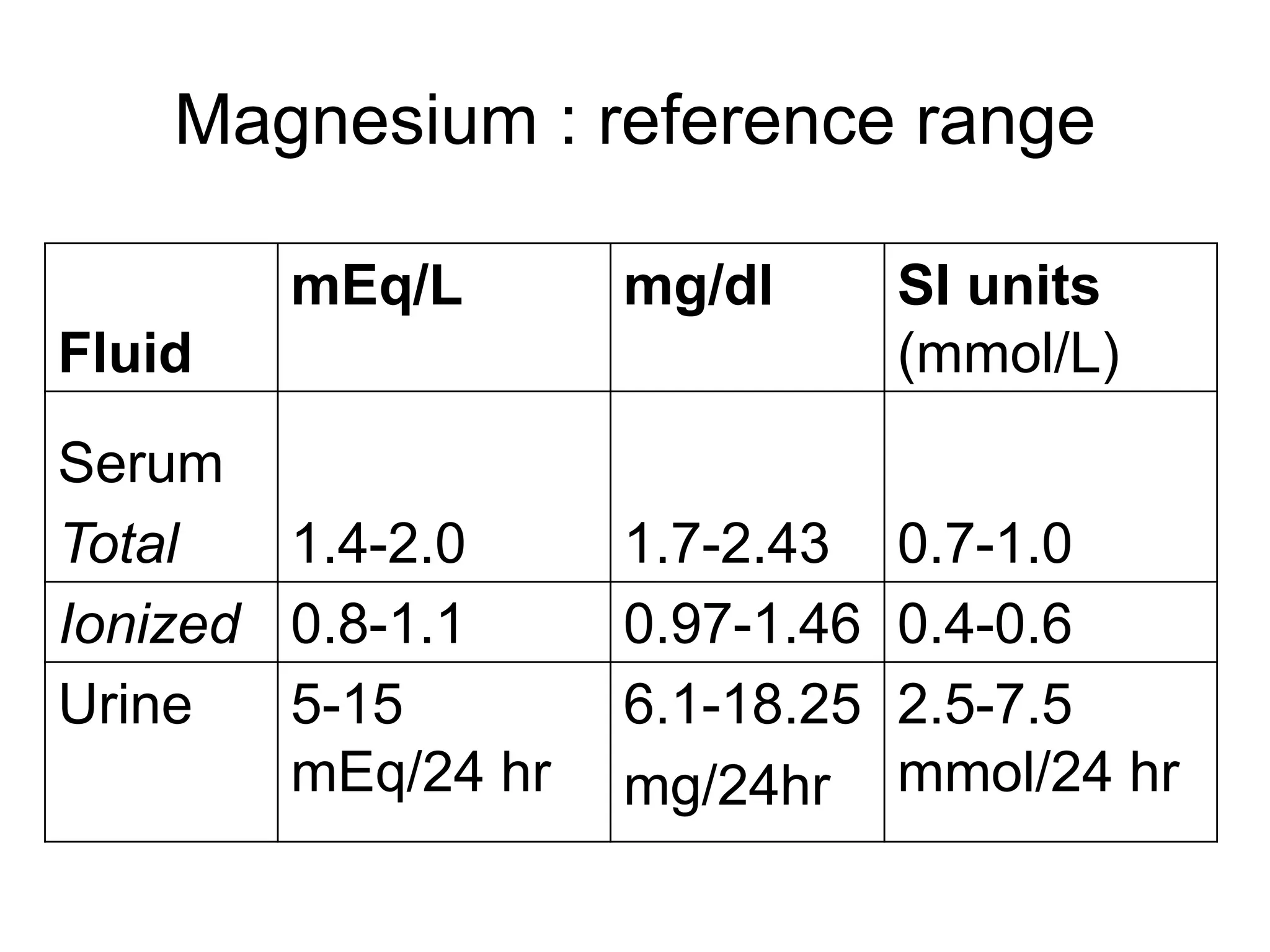
Magnesium : reference range
Fluid
mEq/L mg/dl SI units
(mmol/L)
Serum
Total 1.4-2.0 1.7-2.43 0.7-1.0
Ionized 0.8-1.1 0.97-1.46 0.4-0.6
Urine 5-15
mEq/24 hr
6.1-18.25
mg/24hr
2.5-7.5
mmol/24 hr
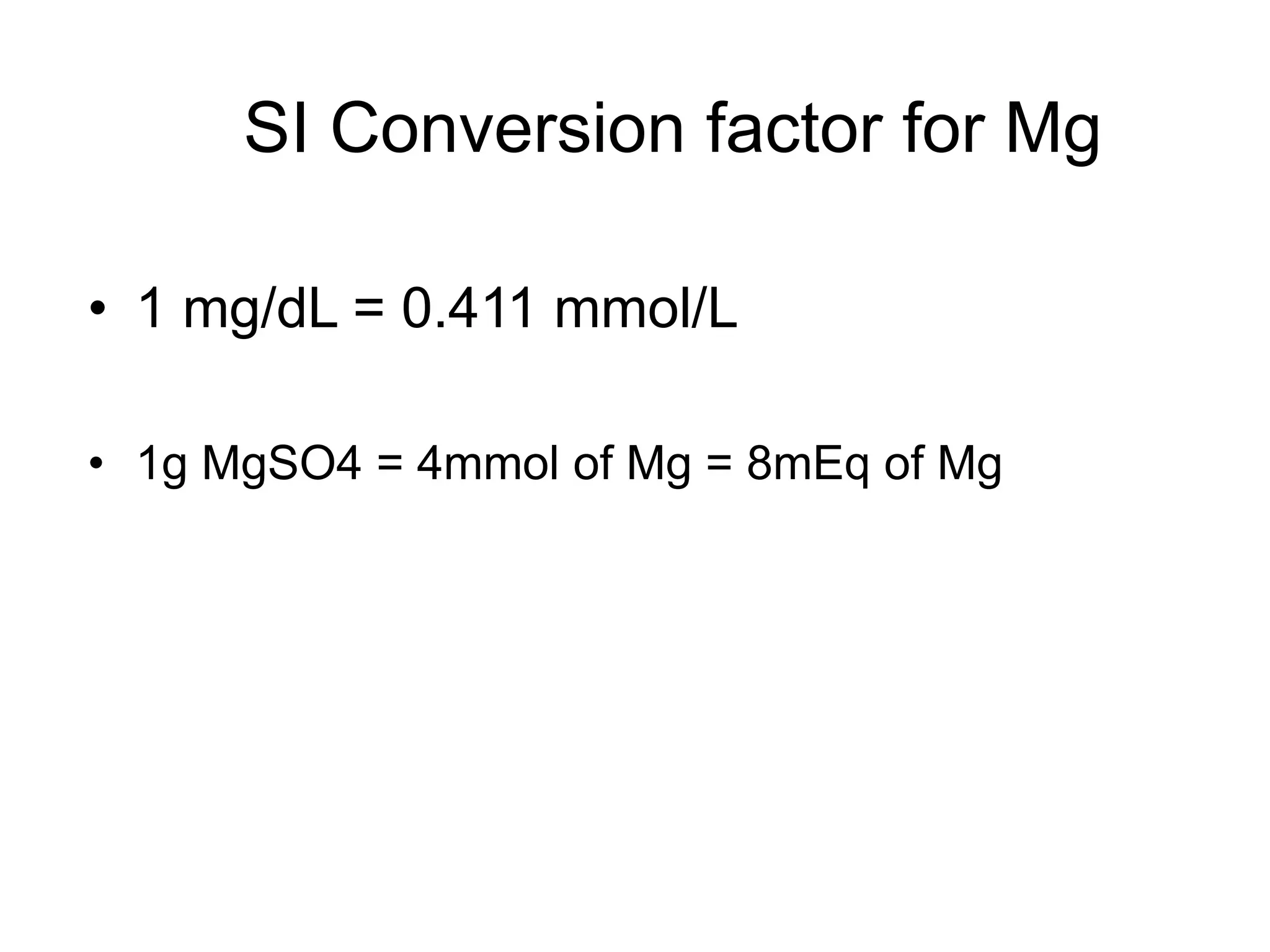
SI Conversion factor for Mg
• 1 mg/dL = 0.411 mmol/L
• 1g MgSO4 = 4mmol of Mg = 8mEq of Mg
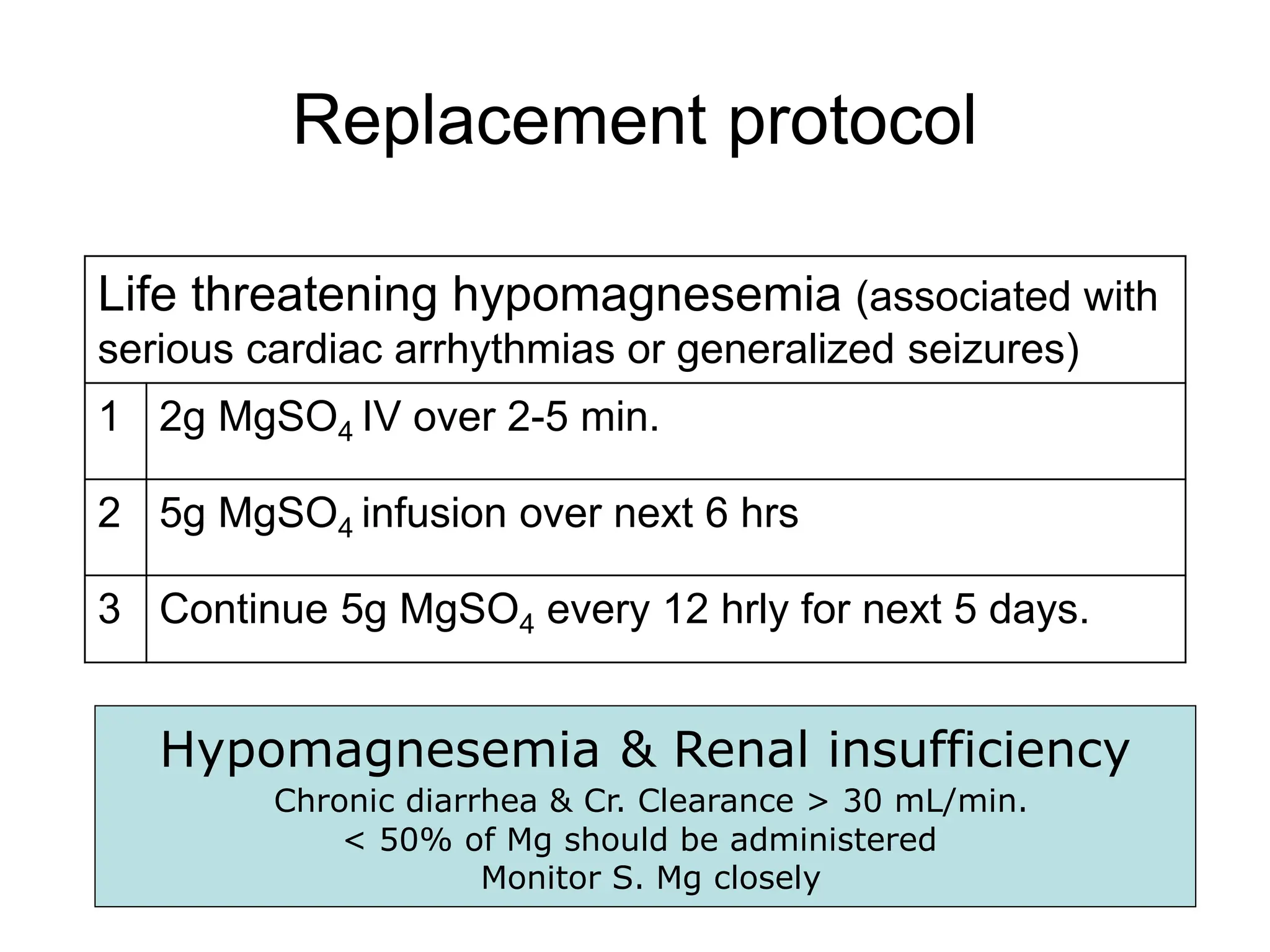
Replacement protocol
Life threatening hypomagnesemia (associated with
serious cardiac arrhythmias or generalized seizures)
1 2g MgSO4 IV over 2-5 min.
2 5g MgSO4 infusion over next 6 hrs
3 Continue 5g MgSO4 every 12 hrly for next 5 days.
Hypomagnesemia & Renal insufficiency
Chronic diarrhea & Cr. Clearance > 30 mL/min.
< 50% of Mg should be administered
Monitor S. Mg closely
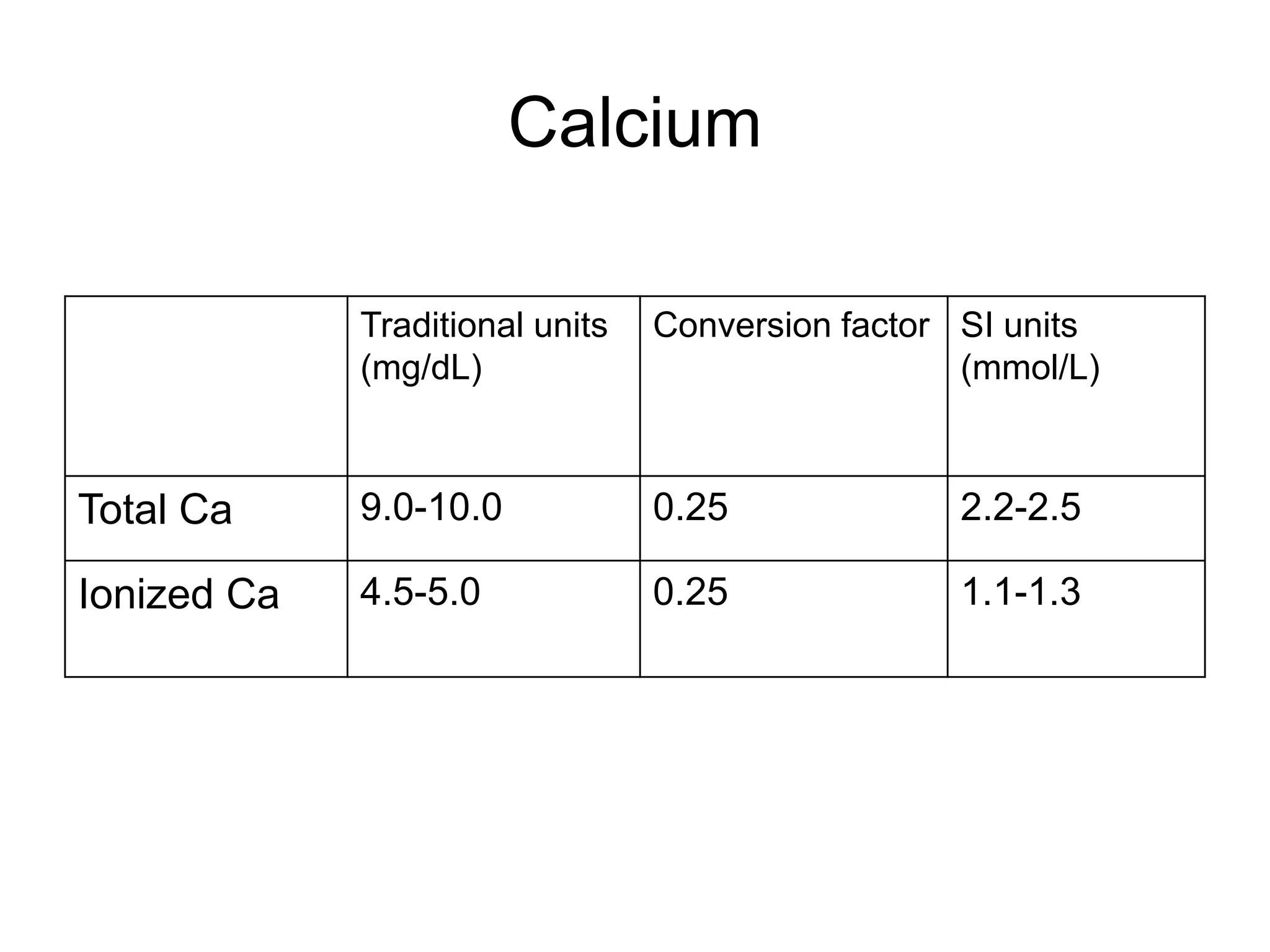
Calcium
Traditional units
(mg/dL)
Conversion factor SI units
(mmol/L)
Total Ca 9.0-10.0 0.25 2.2-2.5
Ionized Ca 4.5-5.0 0.25 1.1-1.3
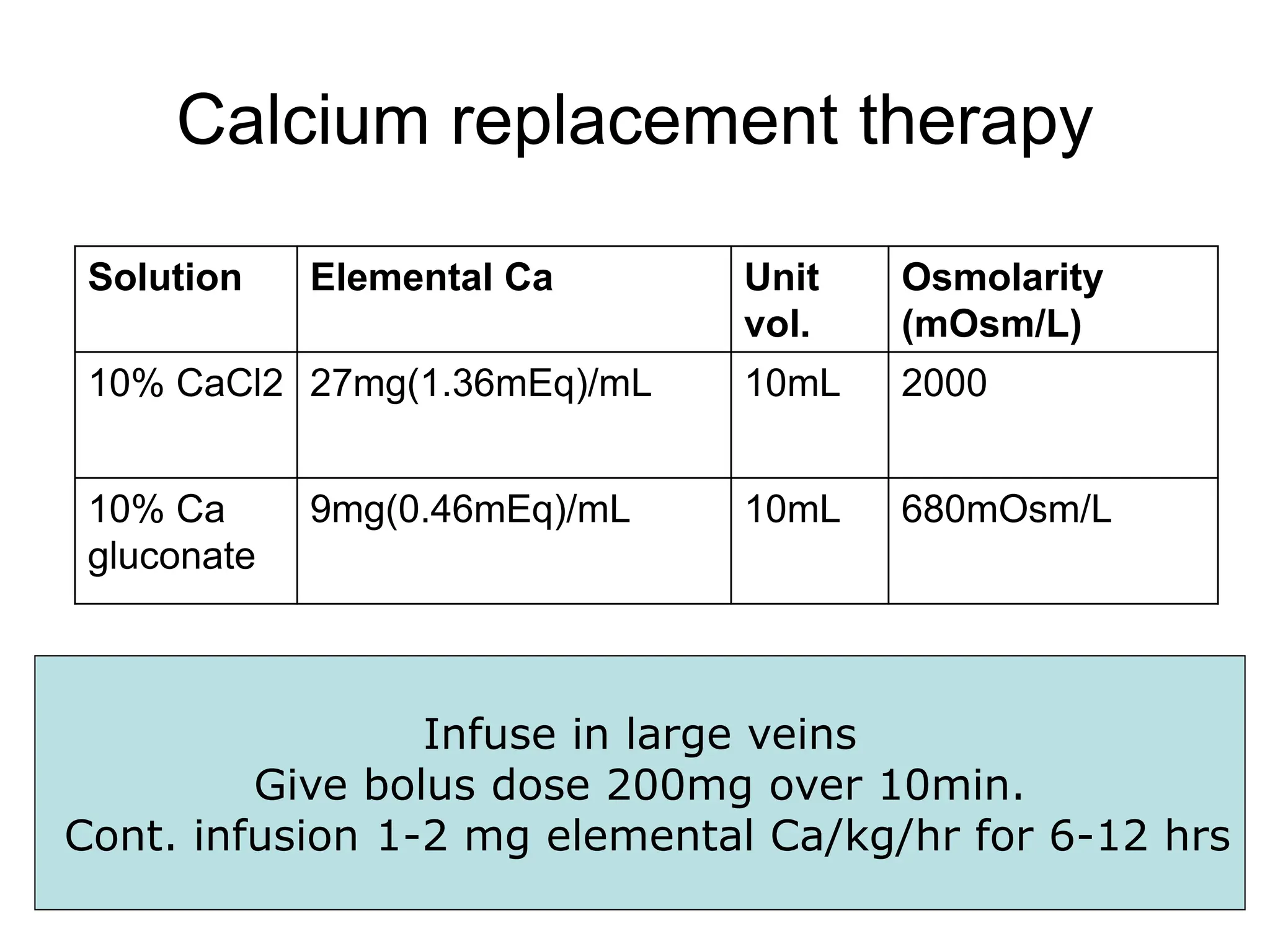
Calcium replacement therapy
Solution Elemental Ca Unit
vol.
Osmolarity
(mOsm/L)
10% CaCl2 27mg(1.36mEq)/mL 10mL 2000
10% Ca
gluconate
9mg(0.46mEq)/mL 10mL 680mOsm/L
Infuse in large veins
Give bolus dose 200mg over 10min.
Cont. infusion 1-2 mg elemental Ca/kg/hr for 6-12 hrs
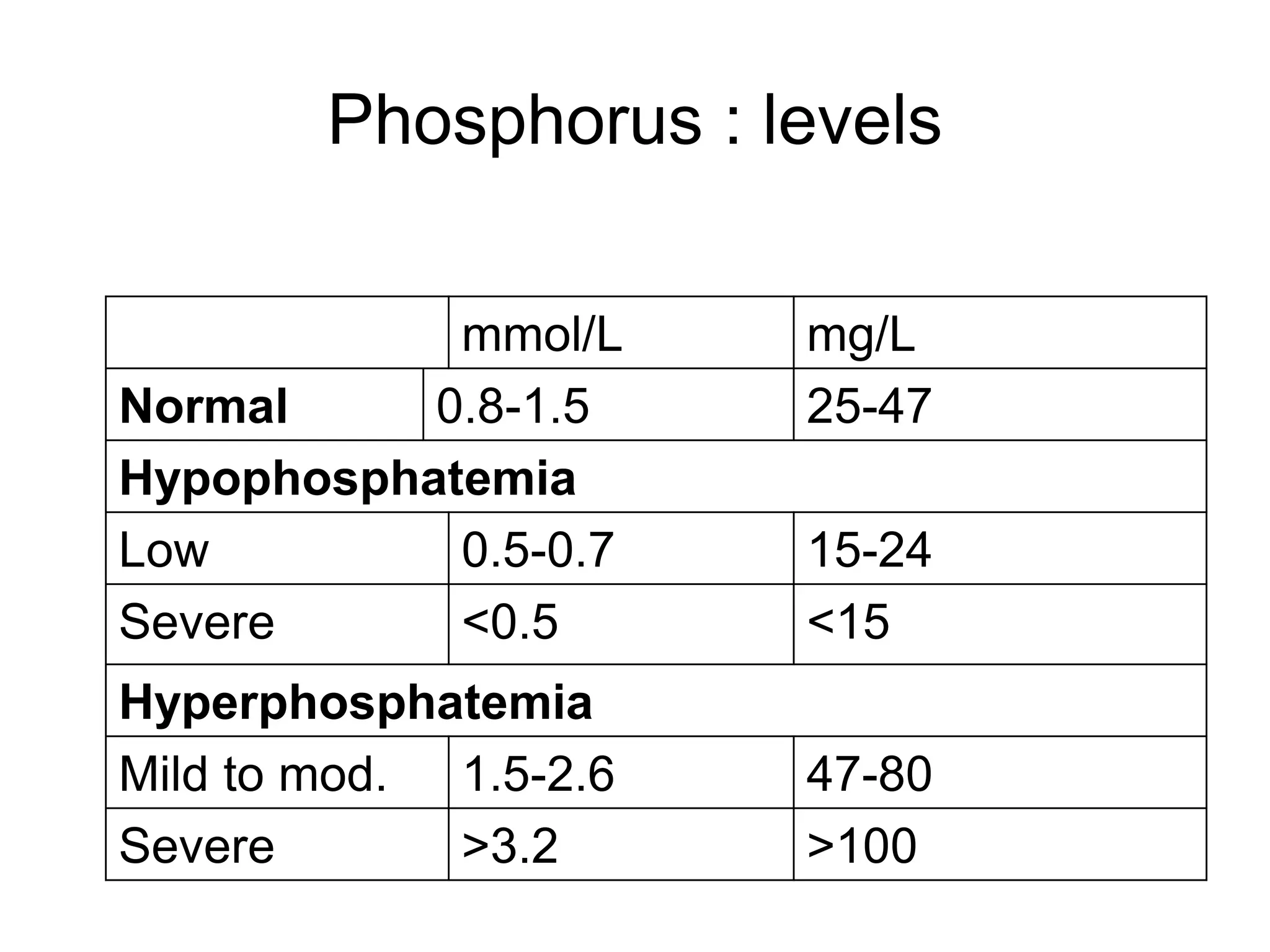
Phosphorus : levels
mmol/L mg/L
Normal 0.8-1.5 25-47
Hypophosphatemia
Low 0.5-0.7 15-24
Severe <0.5 <15
Hyperphosphatemia
Mild to mod. 1.5-2.6 47-80
Severe >3.2 >100
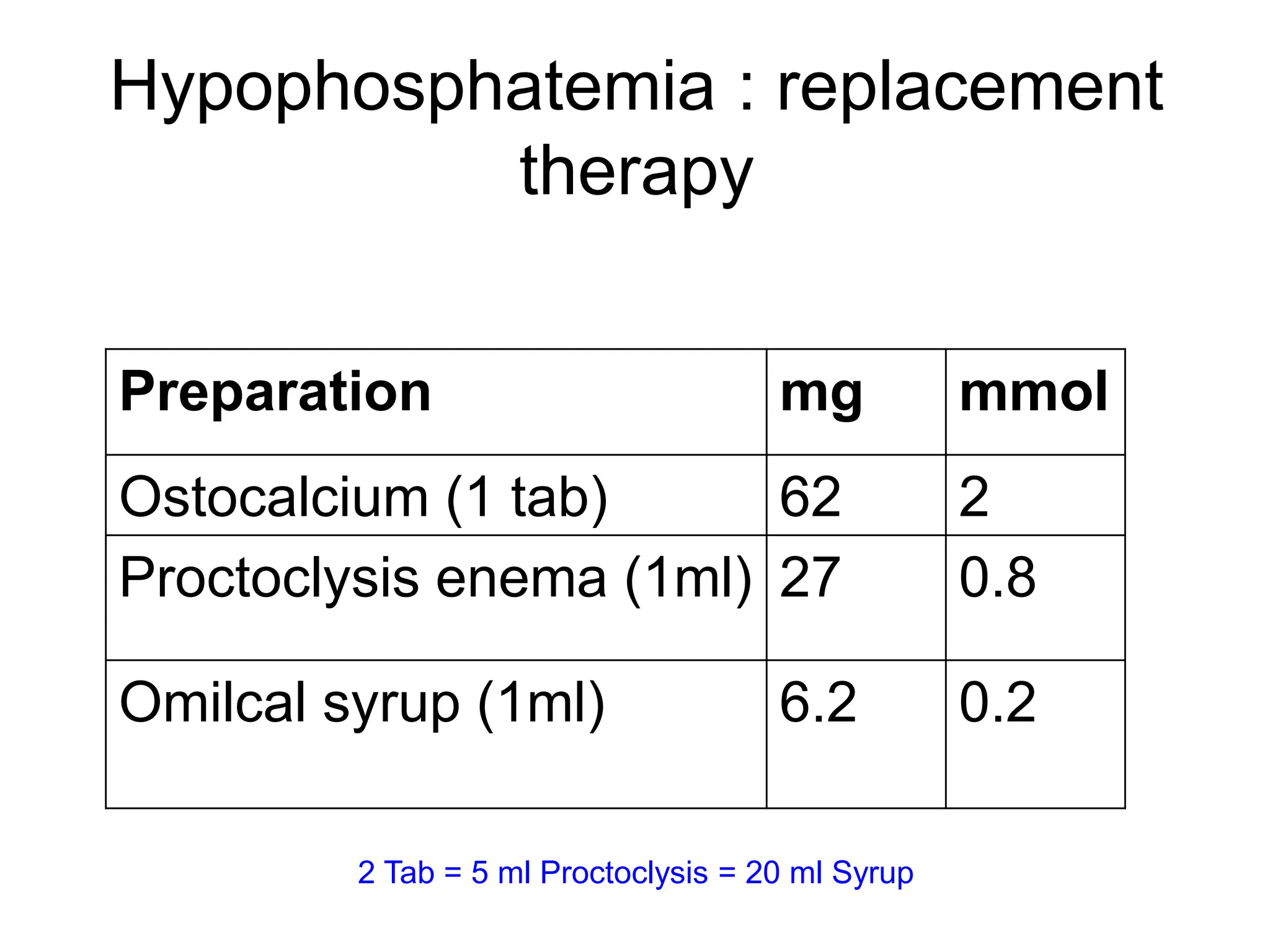
Hypophosphatemia : replacement
therapy
Preparation mg mmol
Ostocalcium (1 tab) 62 2
Proctoclysis enema (1ml) 27 0.8
Omilcal syrup (1ml) 6.2 0.2
2 Tab = 5 ml Proctoclysis = 20 ml Syrup
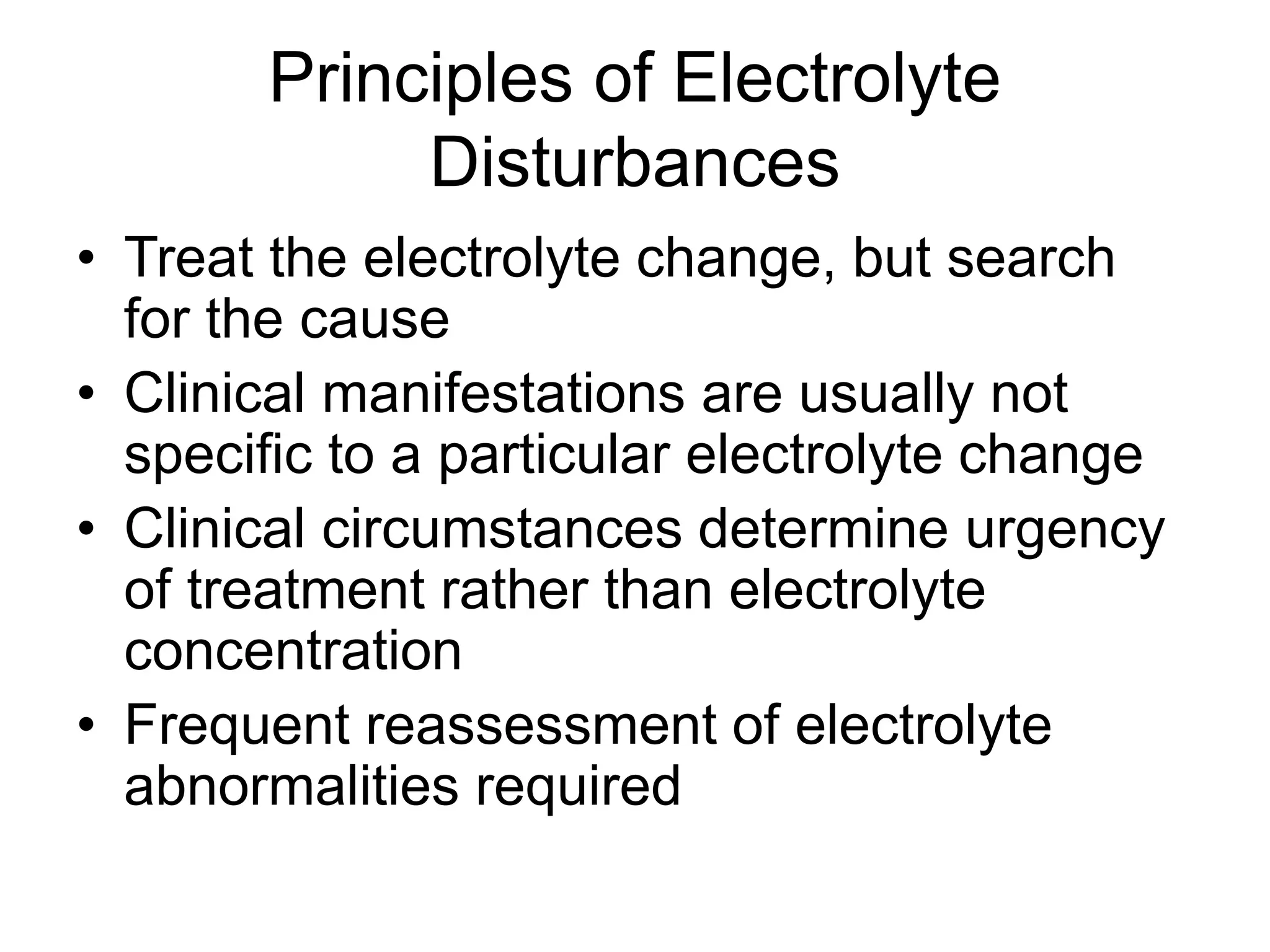
Principles of Electrolyte
Disturbances
• Treat the electrolyte change, but search
for the cause
• Clinical manifestations are usually not
specific to a particular electrolyte change
• Clinical circumstances determine urgency
of treatment rather than electrolyte
concentration
• Frequent reassessment of electrolyte
abnormalities required

CCM 01 Course (Electrolyte Imbalance).ppt

  • 1.
    Electrolyte Imbalance 12th Nov2010 ‘Primer on Critical Care’
  • 2.
    ECF vs ICF:Electrolyte composition
  • 3.
    Case Study • 80-year-oldwoman with hypertension and heart failure • Confusion, lethargy, poor oral in take and weakness for 3 days • BP 108/70 mm Hg, HR 110/min, R18/min • Nonsustained ventricular tachycardiaon monitor What electrolyte disorders might contribute to her presentation?
  • 4.
    Case Study • 80-year-oldwoman with hypertension and heart failure • Confusion, lethargy, poor oral intake and weakness for 3 days • Nonsustained ventricular tachycardia on monitor • Laboratory value: K 2.5 mmol/L How would you initiate evaluation and treatment of this patient?
  • 5.
    Hypokalemia (K<3.5 mmol/L) K≤2.5mmol/L (<3 mmol/L if on Digoxin) K<3.5 but >2.5 mmol/L and No Symptoms Life-Threatening Symptoms Non-Life Threatening or No Symptoms Enteral replacement KCl 20-40 mmol every 4-6 h IV KCl 20-30 mmol/h via Central Catheter Enteral replacement KCl 20-40 mmol every 2-4 h and/or IV KCl 10 mmol/h Treatment of Hypokalemia
  • 6.
    Case Study • 80-year-oldwoman with hypertension and heart failure • ECG • Laboratory value: K 7.8 mmol/L How would you initiate treatment of this patient?
  • 7.
    Treatment of Hyperkalemia •Calcium for cardiac toxicity (ECG abnormalities) • Redistribute potassium − Insulin and glucose − Sodium bicarbonate − Inhaled β2-agonists • Remove potassium − Loop diuretic − Sodium polystyrene sulfonate − Dialysis
  • 8.
    Case Study • 80-year-oldwoman with hypertension and heart failure • Confusion, lethargy, poor oral intake • and weakness for 3 days • Laboratory value: Na 118 mmol/L How would you initiate evaluation of this patient to determine the etiology?
  • 9.
    Etiology of Hyponatremia Hyponatremia (Na<135mmol/L) Presence of ↑ Glucose ↑ Proteins or Lipids Mannitol Consider Hyperosmolar Hyponatremia Pseudohyponatremia Hypo-osmolar Hyponatremia Assess Volume Status Urine Osmolarity (Uosm) Urine Sodium (UNa) FE Na Yes No
  • 10.
    Etiology of Hyponatremia HypovolemiaHypervolemia Uosm>300 mOsm/L UNa <20 mmol/L FE Na <1% Uosm>300 mOsm/L UNa >20 mmol/L FE Na >1% Uosm>300 mOsm/L UNa <10-20 mmol/L FE Na <1% Vomiting Diarrhea Third-Space Fluid Loss Diuretics Aldosterone Deficiency Renal Tubular Dysfunction Congestive Heart Failure Cirrhosis Renal Failure With/Without Nephrosis
  • 11.
    Etiology of Hyponatremia Euvolemia Uosm<100 mOsm/L UNa >30 mmol/L Uosm >100 mOsm/L (usually >300) UNa >30 mmol/L Polydipsia Inappropriate Water Administration to Children SIADH Hypothyroidism Adrenal Insufficiency
  • 12.
    Management of Hyponatremia •Hypovolemic • Hypervolemic • Euvolemic − Restrict free-water intake − Increase free-water loss − Replace intravascular volume with normal saline or hypertonic saline How fast would you correct the sodium concentration?
  • 13.
    •  Na= Na(i) – Na(s) TBW + 1 = 513 – 108 70(0.6) + 1 = 9.4 (3% NaCl = 513 meq/L)
  • 14.
    Case Study • 80-year-oldwoman with hypertension and heart failure • Confusion, lethargy, poor oral intake and weakness for 3 days • Laboratory value: Na 168 mmol/L How would you treat this patient?
  • 15.
    Treatment of Hypernatremia •Normal saline if hemodynamically unstable • Hypotonic fluid when stable − Intravenous fluids − Enteral free water • Quantity H2O deficit (L) = [0.6 × wt (kg) ] × [Measured Na -140] 140 • Rate of correction
  • 16.
    Magnesium : referencerange Fluid mEq/L mg/dl SI units (mmol/L) Serum Total 1.4-2.0 1.7-2.43 0.7-1.0 Ionized 0.8-1.1 0.97-1.46 0.4-0.6 Urine 5-15 mEq/24 hr 6.1-18.25 mg/24hr 2.5-7.5 mmol/24 hr
  • 17.
    SI Conversion factorfor Mg • 1 mg/dL = 0.411 mmol/L • 1g MgSO4 = 4mmol of Mg = 8mEq of Mg
  • 18.
    Replacement protocol Life threateninghypomagnesemia (associated with serious cardiac arrhythmias or generalized seizures) 1 2g MgSO4 IV over 2-5 min. 2 5g MgSO4 infusion over next 6 hrs 3 Continue 5g MgSO4 every 12 hrly for next 5 days. Hypomagnesemia & Renal insufficiency Chronic diarrhea & Cr. Clearance > 30 mL/min. < 50% of Mg should be administered Monitor S. Mg closely
  • 19.
    Calcium Traditional units (mg/dL) Conversion factorSI units (mmol/L) Total Ca 9.0-10.0 0.25 2.2-2.5 Ionized Ca 4.5-5.0 0.25 1.1-1.3
  • 20.
    Calcium replacement therapy SolutionElemental Ca Unit vol. Osmolarity (mOsm/L) 10% CaCl2 27mg(1.36mEq)/mL 10mL 2000 10% Ca gluconate 9mg(0.46mEq)/mL 10mL 680mOsm/L Infuse in large veins Give bolus dose 200mg over 10min. Cont. infusion 1-2 mg elemental Ca/kg/hr for 6-12 hrs
  • 21.
    Phosphorus : levels mmol/Lmg/L Normal 0.8-1.5 25-47 Hypophosphatemia Low 0.5-0.7 15-24 Severe <0.5 <15 Hyperphosphatemia Mild to mod. 1.5-2.6 47-80 Severe >3.2 >100
  • 22.
    Hypophosphatemia : replacement therapy Preparationmg mmol Ostocalcium (1 tab) 62 2 Proctoclysis enema (1ml) 27 0.8 Omilcal syrup (1ml) 6.2 0.2 2 Tab = 5 ml Proctoclysis = 20 ml Syrup
  • 23.
    Principles of Electrolyte Disturbances •Treat the electrolyte change, but search for the cause • Clinical manifestations are usually not specific to a particular electrolyte change • Clinical circumstances determine urgency of treatment rather than electrolyte concentration • Frequent reassessment of electrolyte abnormalities required