
CASE PRESENTATION
Guide : Prof. Ab. Rashid Reshi
Department of Nephrology
Moderator : Prof. Shariq Masoodi
Department of Endocrinology
Presented by: Dr. Shami Kumar
PG Medicine (1458)
Deptt. of Internal Medicine
Sher-I-Kashmir Institute of Medical Sciences, Soura
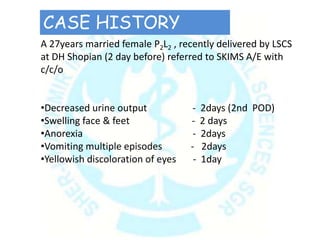
A 27years married female P2L2 , recently delivered by LSCS
at DH Shopian (2 day before) referred to SKIMS A/E with
c/c/o
•Decreased urine output - 2days (2nd POD)
•Swelling face & feet - 2 days
•Anorexia - 2days
•Vomiting multiple episodes - 2days
•Yellowish discoloration of eyes - 1day
CASE HISTORY
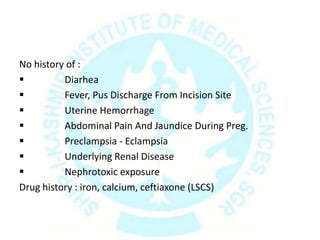
No history of :
 Diarhea
 Fever, Pus Discharge From Incision Site
 Uterine Hemorrhage
 Abdominal Pain And Jaundice During Preg.
 Preclampsia - Eclampsia
 Underlying Renal Disease
 Nephrotoxic exposure
Drug history : iron, calcium, ceftiaxone (LSCS)
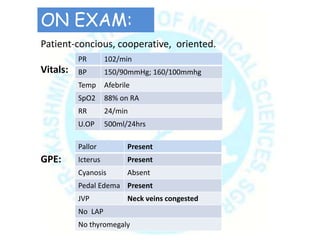
Patient-concious, cooperative, oriented.
Vitals:
GPE:
PR 102/min
BP 150/90mmHg; 160/100mmhg
Temp Afebrile
SpO2 88% on RA
RR 24/min
U.OP 500ml/24hrs
Pallor Present
Icterus Present
Cyanosis Absent
Pedal Edema Present
JVP Neck veins congested
No LAP
No thyromegaly
ON EXAM:
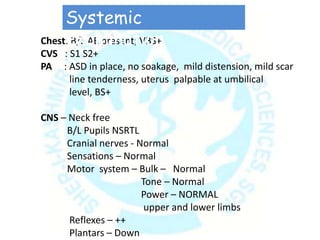
Chest: B/L AE present; VBS+
CVS : S1 S2+
PA : ASD in place, no soakage, mild distension, mild scar
line tenderness, uterus palpable at umbilical
level, BS+
CNS – Neck free
B/L Pupils NSRTL
Cranial nerves - Normal
Sensations – Normal
Motor system – Bulk – Normal
Tone – Normal
Power – NORMAL
upper and lower limbs
Reflexes – ++
Plantars – Down
Systemic
examination
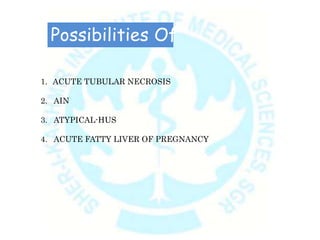
1. ACUTE TUBULAR NECROSIS
2. AIN
3. ATYPICAL-HUS
4. ACUTE FATTY LIVER OF PREGNANCY
Possibilities Of
Investigations
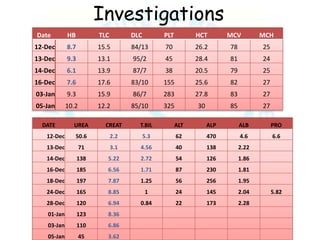
Date HB TLC DLC PLT HCT MCV MCH
12-Dec 8.7 15.5 84/13 70 26.2 78 25
13-Dec 9.3 13.1 95/2 45 28.4 81 24
14-Dec 6.1 13.9 87/7 38 20.5 79 25
16-Dec 7.6 17.6 83/10 155 25.6 82 27
03-Jan 9.3 15.9 86/7 283 27.8 83 27
05-Jan 10.2 12.2 85/10 325 30 85 27
DATE UREA CREAT T.BIL ALT ALP ALB PRO
12-Dec 50.6 2.2 5.3 62 470 4.6 6.6
13-Dec 71 3.1 4.56 40 138 2.22
14-Dec 138 5.22 2.72 54 126 1.86
16-Dec 185 6.56 1.71 87 230 1.81
18-Dec 197 7.87 1.25 56 256 1.95
24-Dec 165 8.85 1 24 145 2.04 5.82
28-Dec 120 6.94 0.84 22 173 2.28
01-Jan 123 8.36
03-Jan 110 6.86
05-Jan 45 3.62
0
2
4
6
8
10
12
HEMOGLOBIN
HB
0
50
100
150
200
250
300
350
PLATELET COUNT
PLT
0
1
2
3
4
5
6
T.BIL
T.BIL
0
1
2
3
4
5
6
7
8
9
10
SR. CREATININE
CREAT
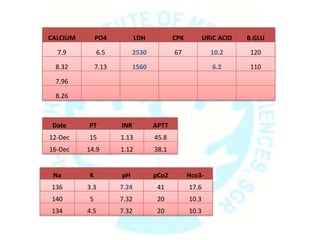
Date PT INR APTT
12-Dec 15 1.13 45.8
16-Dec 14.9 1.12 38.1
CALCIUM PO4 LDH CPK URIC ACID B.GLU
7.9 6.5 2530 67 10.2 120
8.32 7.13 1560 6.2 110
7.96
8.26
Na K pH pCo2 Hco3-
136 3.3 7.24 41 17.6
140 5 7.32 20 10.3
134 4.5 7.32 20 10.3
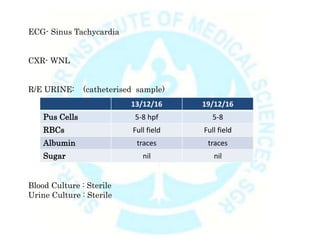
ECG- Sinus Tachycardia
CXR- WNL
R/E URINE: (catheterised sample)
Blood Culture : Sterile
Urine Culture : Sterile
13/12/16 19/12/16
Pus Cells 5-8 hpf 5-8
RBCs Full field Full field
Albumin traces traces
Sugar nil nil
PBF Predominant microcytic hypochromic RBCs with
schistocytes, fragmented RBC’s seen.
D-DIMER 3375
COOMB’S TEST (D/I) NEG
ANA NEG
P-ANCA NEG
C-ANCA NEG
APLA NEG
C3 LEVEL 107 mg/dl ( 90–180 mg/dL)
C4 LEVEL 28.9mg/dl (10–40 mg/dL)
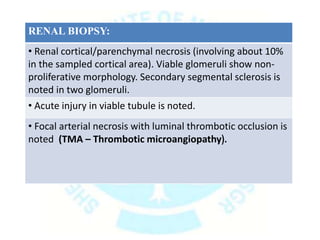
RENAL BIOPSY:
• Renal cortical/parenchymal necrosis (involving about 10%
in the sampled cortical area). Viable glomeruli show non-
proliferative morphology. Secondary segmental sclerosis is
noted in two glomeruli.
• Acute injury in viable tubule is noted.
• Focal arterial necrosis with luminal thrombotic occlusion is
noted (TMA – Thrombotic microangiopathy).
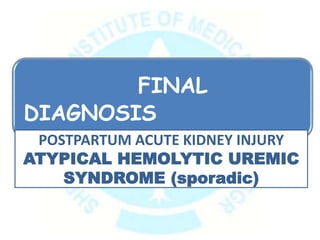
FINAL
DIAGNOSIS
POSTPARTUM ACUTE KIDNEY INJURY
ATYPICAL HEMOLYTIC UREMIC
SYNDROME (sporadic)
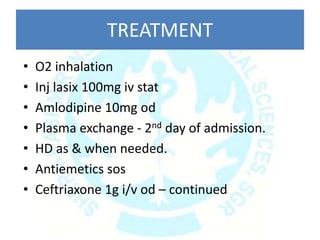
TREATMENT
• O2 inhalation
• Inj lasix 100mg iv stat
• Amlodipine 10mg od
• Plasma exchange - 2nd day of admission.
• HD as & when needed.
• Antiemetics sos
• Ceftriaxone 1g i/v od – continued
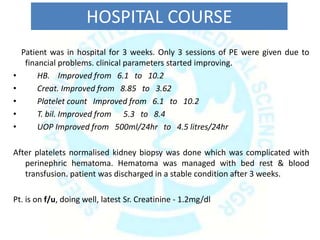
HOSPITAL COURSE
Patient was in hospital for 3 weeks. Only 3 sessions of PE were given due to
financial problems. clinical parameters started improving.
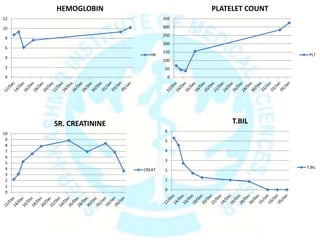
• HB. Improved from 6.1 to 10.2
• Creat. Improved from 8.85 to 3.62
• Platelet count Improved from 6.1 to 10.2
• T. bil. Improved from 5.3 to 8.4
• UOP Improved from 500ml/24hr to 4.5 litres/24hr
After platelets normalised kidney biopsy was done which was complicated with
perinephric hematoma. Hematoma was managed with bed rest & blood
transfusion. patient was discharged in a stable condition after 3 weeks.
Pt. is on f/u, doing well, latest Sr. Creatinine - 1.2mg/dl
CASE DISCUSSION
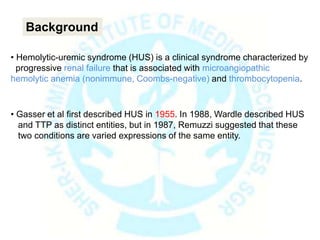
• Hemolytic-uremic syndrome (HUS) is a clinical syndrome characterized by
progressive renal failure that is associated with microangiopathic
hemolytic anemia (nonimmune, Coombs-negative) and thrombocytopenia.
• Gasser et al first described HUS in 1955. In 1988, Wardle described HUS
and TTP as distinct entities, but in 1987, Remuzzi suggested that these
two conditions are varied expressions of the same entity.
Background
 Damage to endothelial cells is the primary event in the pathogenesis of hemo-
lytic uremic syndrome (HUS).
 The cardinal lesion is composed of arteriolar and capillary microthrombi
(thrombotic microangiopathy [TMA]) and red blood cell (RBC) fragmentation.
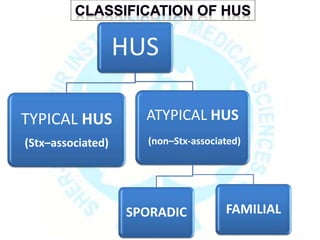
• HUS is classified into two main categories, depending on whether it is assoc-
ated with Shiga-like toxin (Stx) or not.
Pathophysiology
HUS
TYPICAL HUS
(Stx–associated)
ATYPICAL HUS
(non–Stx-associated)
SPORADIC FAMILIAL
Atypical (non–Stx-associated) HUS
• Less common than typical HUS and accounts for 5-10% of all cases.
• It may occur at all ages, but most frequent in adults and occurs without
prodromal diarrhea.
• Patients have an unfavorable prognosis.
• Atypical HUS can occur in sporadic cases or in families
Introduction : aHUS
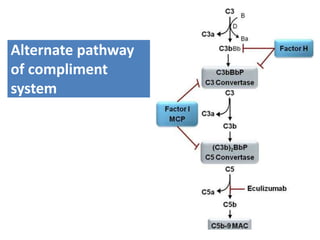
Alternate pathway
of compliment
system
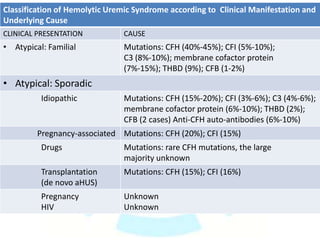
Classification of Hemolytic Uremic Syndrome according to Clinical Manifestation and
Underlying Cause
CLINICAL PRESENTATION CAUSE
• Atypical: Familial Mutations: CFH (40%-45%); CFI (5%-10%);
C3 (8%-10%); membrane cofactor protein
(7%-15%); THBD (9%); CFB (1-2%)
• Atypical: Sporadic
Idiopathic Mutations: CFH (15%-20%); CFI (3%-6%); C3 (4%-6%);
membrane cofactor protein (6%-10%); THBD (2%);
CFB (2 cases) Anti-CFH auto-antibodies (6%-10%)
Pregnancy-associated Mutations: CFH (20%); CFI (15%)
Drugs Mutations: rare CFH mutations, the large
majority unknown
Transplantation
(de novo aHUS)
Mutations: CFH (15%); CFI (16%)
Pregnancy
HIV
Unknown
Unknown
• Nonenteric infections
• Viruses
• Drugs
• Malignancies
• Transplantation
• Pregnancy
• Antiphospholipid syndrome [APL]
• Systemic lupus erythematosus [SLE]
Triggers for SPORADIC Atypical HUS:
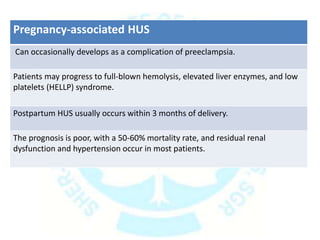
Pregnancy-associated HUS
Can occasionally develops as a complication of preeclampsia.
Patients may progress to full-blown hemolysis, elevated liver enzymes, and low
platelets (HELLP) syndrome.
Postpartum HUS usually occurs within 3 months of delivery.
The prognosis is poor, with a 50-60% mortality rate, and residual renal
dysfunction and hypertension occur in most patients.
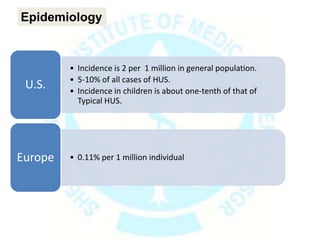
Epidemiology
• Incidence is 2 per 1 million in general population.
• 5-10% of all cases of HUS.
• Incidence in children is about one-tenth of that of
Typical HUS.
U.S.
• 0.11% per 1 million individualEurope
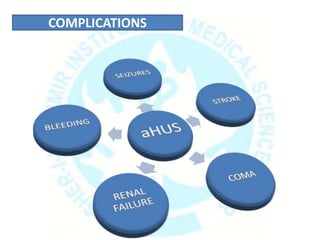
COMPLICATIONS
Mortality/Morbidity - Atypical HUS
• patients have poor outcomes
• 50% progressing to ESRD (50% - sporadic , 60% in
familial forms) or irreversible brain damage.
• As many as 25% die during the acute phase
• Recurrence rate in patients receiving renal
transplants is as high as 50%; (with graft loss >90%)
AtypicaL HUS
Prolonged oliguria or anuria
Severe HTN
Involvement of medium sized arteries
Severity of CNS symptoms
Persistent consumption of Clotting factors
Extensive glomerular involvement (80%)
Age older than 5 years
Factors predictive of poor prognosis
Diagnostic workup
Hematologic parameters:
•Severe anemia may be present.
•PBF for schistocytes (count >1% or two or more schistocytes in a 100× magnification
field strongly suggests microangiopathic hemolysis).
•Thrombocytopenia. The platelet count usually returns to normal
within 2 weeks.
KFT: blood urea nitrogen (BUN), serum creatinine, and serum
electrolyte levels
Determine aPTT, fibrinogen degradation product (FDP), and D-dimer
values.
Low LDH, Low Haptoglobin, increased T.bilirubin.
Urinalysis: Benign mild proteinuria; red blood cells (RBCs) and RBC
casts may be present.
ADAMTS-13 activity: ADAMTS-13 activity is often severely deficient (<
10% of normal) in patients with classic thrombotic thrombocytopenic
purpura (TTP)
Perform renal ultrasonography in patients with renal failure to rule
out obstruction.
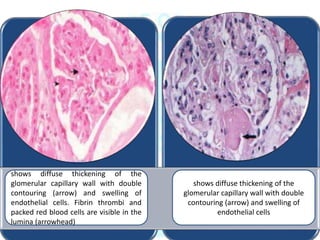
shows diffuse thickening of the
glomerular capillary wall with double
contouring (arrow) and swelling of
endothelial cells. Fibrin thrombi and
packed red blood cells are visible in the
lumina (arrowhead)
shows diffuse thickening of the
glomerular capillary wall with double
contouring (arrow) and swelling of
endothelial cells
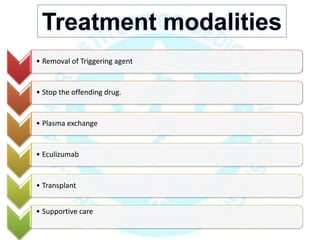
• Removal of Triggering agent
• Stop the offending drug.
• Plasma exchange
• Eculizumab
• Transplant
• Supportive care
PLASMA EXCHANGE
Plasma exchange is the initial treatment of choice in all adult
patients with atypical HUS as early as possible.
The findings of unexplained thrombocytopenia and
microangiopathic hemolytic anemia are sufficient to consider
thrombotic microangiopathy and initiate plasma exchange.
Should be started within 24 hours of the patient's presentation, to
decrease treatment failures. It should be continued once or twice a
day for at least 2 days after complete remission.
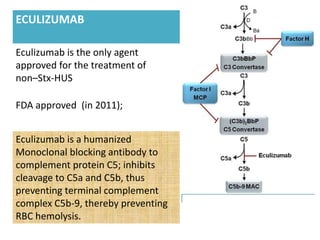
ECULIZUMAB
Eculizumab is the only agent
approved for the treatment of
non–Stx-HUS
FDA approved (in 2011);
Eculizumab is a humanized
Monoclonal blocking antibody to
complement protein C5; inhibits
cleavage to C5a and C5b, thus
preventing terminal complement
complex C5b-9, thereby preventing
RBC hemolysis.
RENAL TRANSPLANTATION
Renal transplantation is not an option for aHUS because of the
50% recurrence rate and >90% rate of graft failure in patients
with recurrence.
Recurrence rates (30-100%) are significantly higher in patients
with CFH mutations than in those without this mutation.
In patients with MCP mutation, however, outcomes are
favorable, and renal transplantation may correct the local MCP
dysfunction, as MCP is a membrane-bound protein that is highly
expressed in the kidney
COMBINED KIDNEY - LIVER TRANSPLANTATION
In patients with CFH genetic defect, liver transplantation was
thought to correct the defect, because CFH is a plasma protein of
hepatic origin.
At present, this procedure should not be performed unless a
patient is at imminent risk for life-threatening complications.
SUPPORTIVE THERAPY
Maintain fluid and electrolyte balance
Adequate blood-pressure control
For seizure control, consider prophylactic phenytoin in patients
with neurologic symptoms (20-40% of patients have seizures)
Control azotemia
Optimize nutrition
Thank you…

Atypical Hemolytic uremic syndrome

  • 1.
    CASE PRESENTATION Guide :Prof. Ab. Rashid Reshi Department of Nephrology Moderator : Prof. Shariq Masoodi Department of Endocrinology Presented by: Dr. Shami Kumar PG Medicine (1458) Deptt. of Internal Medicine Sher-I-Kashmir Institute of Medical Sciences, Soura
  • 2.
    A 27years marriedfemale P2L2 , recently delivered by LSCS at DH Shopian (2 day before) referred to SKIMS A/E with c/c/o •Decreased urine output - 2days (2nd POD) •Swelling face & feet - 2 days •Anorexia - 2days •Vomiting multiple episodes - 2days •Yellowish discoloration of eyes - 1day CASE HISTORY
  • 3.
    No history of:  Diarhea  Fever, Pus Discharge From Incision Site  Uterine Hemorrhage  Abdominal Pain And Jaundice During Preg.  Preclampsia - Eclampsia  Underlying Renal Disease  Nephrotoxic exposure Drug history : iron, calcium, ceftiaxone (LSCS)
  • 4.
    Patient-concious, cooperative, oriented. Vitals: GPE: PR102/min BP 150/90mmHg; 160/100mmhg Temp Afebrile SpO2 88% on RA RR 24/min U.OP 500ml/24hrs Pallor Present Icterus Present Cyanosis Absent Pedal Edema Present JVP Neck veins congested No LAP No thyromegaly ON EXAM:
  • 5.
    Chest: B/L AEpresent; VBS+ CVS : S1 S2+ PA : ASD in place, no soakage, mild distension, mild scar line tenderness, uterus palpable at umbilical level, BS+ CNS – Neck free B/L Pupils NSRTL Cranial nerves - Normal Sensations – Normal Motor system – Bulk – Normal Tone – Normal Power – NORMAL upper and lower limbs Reflexes – ++ Plantars – Down Systemic examination
  • 6.
    1. ACUTE TUBULARNECROSIS 2. AIN 3. ATYPICAL-HUS 4. ACUTE FATTY LIVER OF PREGNANCY Possibilities Of
  • 7.
    Investigations Date HB TLCDLC PLT HCT MCV MCH 12-Dec 8.7 15.5 84/13 70 26.2 78 25 13-Dec 9.3 13.1 95/2 45 28.4 81 24 14-Dec 6.1 13.9 87/7 38 20.5 79 25 16-Dec 7.6 17.6 83/10 155 25.6 82 27 03-Jan 9.3 15.9 86/7 283 27.8 83 27 05-Jan 10.2 12.2 85/10 325 30 85 27 DATE UREA CREAT T.BIL ALT ALP ALB PRO 12-Dec 50.6 2.2 5.3 62 470 4.6 6.6 13-Dec 71 3.1 4.56 40 138 2.22 14-Dec 138 5.22 2.72 54 126 1.86 16-Dec 185 6.56 1.71 87 230 1.81 18-Dec 197 7.87 1.25 56 256 1.95 24-Dec 165 8.85 1 24 145 2.04 5.82 28-Dec 120 6.94 0.84 22 173 2.28 01-Jan 123 8.36 03-Jan 110 6.86 05-Jan 45 3.62
  • 8.
  • 9.
    Date PT INRAPTT 12-Dec 15 1.13 45.8 16-Dec 14.9 1.12 38.1 CALCIUM PO4 LDH CPK URIC ACID B.GLU 7.9 6.5 2530 67 10.2 120 8.32 7.13 1560 6.2 110 7.96 8.26 Na K pH pCo2 Hco3- 136 3.3 7.24 41 17.6 140 5 7.32 20 10.3 134 4.5 7.32 20 10.3
  • 10.
    ECG- Sinus Tachycardia CXR-WNL R/E URINE: (catheterised sample) Blood Culture : Sterile Urine Culture : Sterile 13/12/16 19/12/16 Pus Cells 5-8 hpf 5-8 RBCs Full field Full field Albumin traces traces Sugar nil nil
  • 11.
    PBF Predominant microcytichypochromic RBCs with schistocytes, fragmented RBC’s seen. D-DIMER 3375 COOMB’S TEST (D/I) NEG ANA NEG P-ANCA NEG C-ANCA NEG APLA NEG C3 LEVEL 107 mg/dl ( 90–180 mg/dL) C4 LEVEL 28.9mg/dl (10–40 mg/dL)
  • 12.
    RENAL BIOPSY: • Renalcortical/parenchymal necrosis (involving about 10% in the sampled cortical area). Viable glomeruli show non- proliferative morphology. Secondary segmental sclerosis is noted in two glomeruli. • Acute injury in viable tubule is noted. • Focal arterial necrosis with luminal thrombotic occlusion is noted (TMA – Thrombotic microangiopathy).
  • 13.
    FINAL DIAGNOSIS POSTPARTUM ACUTE KIDNEYINJURY ATYPICAL HEMOLYTIC UREMIC SYNDROME (sporadic)
  • 14.
    TREATMENT • O2 inhalation •Inj lasix 100mg iv stat • Amlodipine 10mg od • Plasma exchange - 2nd day of admission. • HD as & when needed. • Antiemetics sos • Ceftriaxone 1g i/v od – continued
  • 15.
    HOSPITAL COURSE Patient wasin hospital for 3 weeks. Only 3 sessions of PE were given due to financial problems. clinical parameters started improving. • HB. Improved from 6.1 to 10.2 • Creat. Improved from 8.85 to 3.62 • Platelet count Improved from 6.1 to 10.2 • T. bil. Improved from 5.3 to 8.4 • UOP Improved from 500ml/24hr to 4.5 litres/24hr After platelets normalised kidney biopsy was done which was complicated with perinephric hematoma. Hematoma was managed with bed rest & blood transfusion. patient was discharged in a stable condition after 3 weeks. Pt. is on f/u, doing well, latest Sr. Creatinine - 1.2mg/dl
  • 16.
  • 17.
    • Hemolytic-uremic syndrome(HUS) is a clinical syndrome characterized by progressive renal failure that is associated with microangiopathic hemolytic anemia (nonimmune, Coombs-negative) and thrombocytopenia. • Gasser et al first described HUS in 1955. In 1988, Wardle described HUS and TTP as distinct entities, but in 1987, Remuzzi suggested that these two conditions are varied expressions of the same entity. Background
  • 18.
     Damage toendothelial cells is the primary event in the pathogenesis of hemo- lytic uremic syndrome (HUS).  The cardinal lesion is composed of arteriolar and capillary microthrombi (thrombotic microangiopathy [TMA]) and red blood cell (RBC) fragmentation. • HUS is classified into two main categories, depending on whether it is assoc- ated with Shiga-like toxin (Stx) or not. Pathophysiology
  • 19.
  • 20.
  • 21.
    • Less commonthan typical HUS and accounts for 5-10% of all cases. • It may occur at all ages, but most frequent in adults and occurs without prodromal diarrhea. • Patients have an unfavorable prognosis. • Atypical HUS can occur in sporadic cases or in families Introduction : aHUS
  • 22.
  • 23.
    Classification of HemolyticUremic Syndrome according to Clinical Manifestation and Underlying Cause CLINICAL PRESENTATION CAUSE • Atypical: Familial Mutations: CFH (40%-45%); CFI (5%-10%); C3 (8%-10%); membrane cofactor protein (7%-15%); THBD (9%); CFB (1-2%) • Atypical: Sporadic Idiopathic Mutations: CFH (15%-20%); CFI (3%-6%); C3 (4%-6%); membrane cofactor protein (6%-10%); THBD (2%); CFB (2 cases) Anti-CFH auto-antibodies (6%-10%) Pregnancy-associated Mutations: CFH (20%); CFI (15%) Drugs Mutations: rare CFH mutations, the large majority unknown Transplantation (de novo aHUS) Mutations: CFH (15%); CFI (16%) Pregnancy HIV Unknown Unknown
  • 24.
    • Nonenteric infections •Viruses • Drugs • Malignancies • Transplantation • Pregnancy • Antiphospholipid syndrome [APL] • Systemic lupus erythematosus [SLE] Triggers for SPORADIC Atypical HUS:
  • 25.
    Pregnancy-associated HUS Can occasionallydevelops as a complication of preeclampsia. Patients may progress to full-blown hemolysis, elevated liver enzymes, and low platelets (HELLP) syndrome. Postpartum HUS usually occurs within 3 months of delivery. The prognosis is poor, with a 50-60% mortality rate, and residual renal dysfunction and hypertension occur in most patients.
  • 26.
    Epidemiology • Incidence is2 per 1 million in general population. • 5-10% of all cases of HUS. • Incidence in children is about one-tenth of that of Typical HUS. U.S. • 0.11% per 1 million individualEurope
  • 27.
  • 28.
    Mortality/Morbidity - AtypicalHUS • patients have poor outcomes • 50% progressing to ESRD (50% - sporadic , 60% in familial forms) or irreversible brain damage. • As many as 25% die during the acute phase • Recurrence rate in patients receiving renal transplants is as high as 50%; (with graft loss >90%)
  • 29.
    AtypicaL HUS Prolonged oliguriaor anuria Severe HTN Involvement of medium sized arteries Severity of CNS symptoms Persistent consumption of Clotting factors Extensive glomerular involvement (80%) Age older than 5 years Factors predictive of poor prognosis
  • 30.
    Diagnostic workup Hematologic parameters: •Severeanemia may be present. •PBF for schistocytes (count >1% or two or more schistocytes in a 100× magnification field strongly suggests microangiopathic hemolysis). •Thrombocytopenia. The platelet count usually returns to normal within 2 weeks. KFT: blood urea nitrogen (BUN), serum creatinine, and serum electrolyte levels
  • 31.
    Determine aPTT, fibrinogendegradation product (FDP), and D-dimer values. Low LDH, Low Haptoglobin, increased T.bilirubin. Urinalysis: Benign mild proteinuria; red blood cells (RBCs) and RBC casts may be present. ADAMTS-13 activity: ADAMTS-13 activity is often severely deficient (< 10% of normal) in patients with classic thrombotic thrombocytopenic purpura (TTP) Perform renal ultrasonography in patients with renal failure to rule out obstruction.
  • 32.
    shows diffuse thickeningof the glomerular capillary wall with double contouring (arrow) and swelling of endothelial cells. Fibrin thrombi and packed red blood cells are visible in the lumina (arrowhead) shows diffuse thickening of the glomerular capillary wall with double contouring (arrow) and swelling of endothelial cells
  • 33.
    • Removal ofTriggering agent • Stop the offending drug. • Plasma exchange • Eculizumab • Transplant • Supportive care
  • 34.
    PLASMA EXCHANGE Plasma exchangeis the initial treatment of choice in all adult patients with atypical HUS as early as possible. The findings of unexplained thrombocytopenia and microangiopathic hemolytic anemia are sufficient to consider thrombotic microangiopathy and initiate plasma exchange. Should be started within 24 hours of the patient's presentation, to decrease treatment failures. It should be continued once or twice a day for at least 2 days after complete remission.
  • 35.
    ECULIZUMAB Eculizumab is theonly agent approved for the treatment of non–Stx-HUS FDA approved (in 2011); Eculizumab is a humanized Monoclonal blocking antibody to complement protein C5; inhibits cleavage to C5a and C5b, thus preventing terminal complement complex C5b-9, thereby preventing RBC hemolysis.
  • 36.
    RENAL TRANSPLANTATION Renal transplantationis not an option for aHUS because of the 50% recurrence rate and >90% rate of graft failure in patients with recurrence. Recurrence rates (30-100%) are significantly higher in patients with CFH mutations than in those without this mutation. In patients with MCP mutation, however, outcomes are favorable, and renal transplantation may correct the local MCP dysfunction, as MCP is a membrane-bound protein that is highly expressed in the kidney
  • 37.
    COMBINED KIDNEY -LIVER TRANSPLANTATION In patients with CFH genetic defect, liver transplantation was thought to correct the defect, because CFH is a plasma protein of hepatic origin. At present, this procedure should not be performed unless a patient is at imminent risk for life-threatening complications.
  • 38.
    SUPPORTIVE THERAPY Maintain fluidand electrolyte balance Adequate blood-pressure control For seizure control, consider prophylactic phenytoin in patients with neurologic symptoms (20-40% of patients have seizures) Control azotemia Optimize nutrition
  • 39.

Editor's Notes

  • #33 BIOPSY findings pathologically establish the diagnosis of hemolytic-uremic syndrome (HUS). However, kidney biopsy is not required in children. In adults, kidney biopsy is rarely required as diagnosis is usually clinical. Often cannot be performed in the acute stage due to thrombocytopenia. It may be indicated in partial forms where the diagnosis is in doubt, or in recurrent or severe disease, to confirm the diagnosis before starting aggressive therapies. In tHUS, predominantly fibrin thrombi are found in glomerular capillaries. In contrast, in aHUS, the thrombi are made up of a combination of fibrin, platelet and VWF clumps that involve larger renal and interlobular arterioles, thus causing ischemia and inflammation of larger volumes of renal parenchyma. Glomerular capillary wall thickening, occlusion or narrowing of capillary lumens,inflammation and necrosis of endothelial cells and Their detachment from the basement membrane may Be observed. Infiltration of inflammatory cells (macrophages and neutrophils) is seen. Tubular epithelial injury, mesangial expansion and mesangiolysis may also occur. Cortical necrosis is present in severe cases, and indicates a poor outcome arterial thrombotic microangiopathic lesions are the most frequent features in non – Stx-HUS