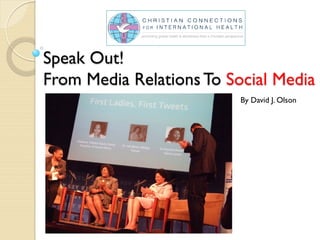
Speak Out!
From Media Relations To Social Media
                          By David J. Olson
What is social media?
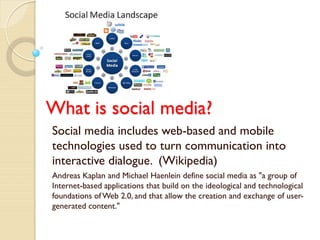
Social media includes web-based and mobile
technologies used to turn communication into
interactive dialogue. (Wikipedia)
Andreas Kaplan and Michael Haenlein define social media as "a group of
Internet-based applications that build on the ideological and technological
foundations of Web 2.0, and that allow the creation and exchange of user-
generated content."
Advantages of social media
•   They’re free (mostly)
•   They can help you tell your story cost-effectively
•   Most can be used on cell phones
•   Great way to connect with journalists, policymakers, potential
    employers, powers-that-be
•   With privacy settings, you can control what people see and who you are
    following
•   Great for researching topics for op-eds and blogs
•   Metrics allows you to know who you are reaching and the impact
Disadvantages of social media
•   Privacy concerns
•   Vulnerability to criticism or attack
•   Takes time to learn
•   Can be addictive and distracting
•   You have to look at a lot of junk before you find
    stuff that’s useful
Most popular social media
•   Facebook (personal & professional) – 1 billion+ users
    (second most visited website)
•   Twitter – 500 million+ users (8th most visited website)
•   YouTube – 800 unique users a month, owned by
    Google (3rd most visited website)
•   LinkedIn (professional) – 175 million+
•   Blogs (Huffington Post, Guardian, Daily Beast, etc.)
• An online social networking and micro-
  blogging service created in 2006
• Enables people to send and read text-based
  posts up to 140 characters, known as "tweets"
• Has 500m users, generates over 340m
  tweets/day and handles over 1.6 billion search
  queries/day
• Eighth most visited website on Internet
• Owned by Google
Applications for CCIH members
• To drive followers to your website, blog,
  video or a relevant news item
• To educate your stakeholders
• To advocate to key stakeholders
  (policymakers, journalists, etc.)
• Events (like London Family Planning Summit)
  work well for Twitter
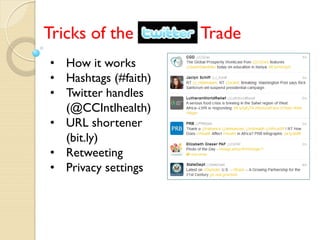
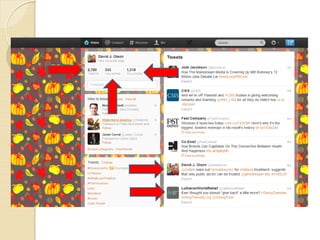
Tricks of the         Trade
• How it works
• Hashtags (#faith)
• Twitter handles
  (@CCIntlhealth)
• URL shortener
  (bit.ly)
• Retweeting
• Privacy settings
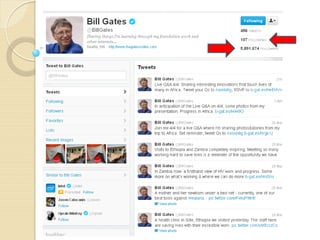
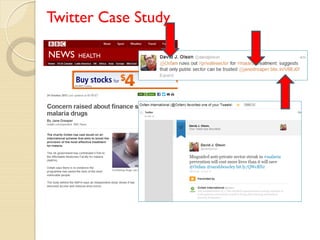
Twitter Case Study
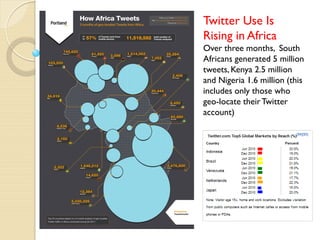
Twitter Use Is
Rising in Africa
Over three months, South
Africans generated 5 million
tweets, Kenya 2.5 million
and Nigeria 1.6 million (this
includes only those who
geo-locate their Twitter
account)
• Social networking site launched in 2004
• Most successful social network in world, and
  second most visited website on internet
• Over 1 billion active users (as of Sept. 2012)
• Users may join common interest groups
  organized by workplace, issues or profession
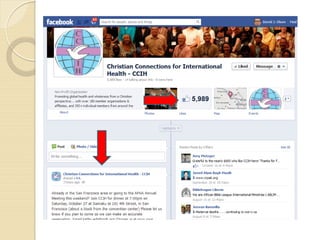
Applications for CCIH Members
• Sharing news (your own or others’) or
  photos, publicizing events or a call to
  advocacy
• For those with website, can serve as more
  engaging communications tool and reach
  different demographic
• For those without website, can serve as
  lower-maintenance, no-cost substitute
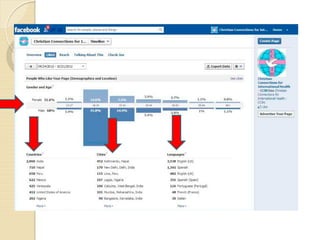
• Easy metrics shows demographics of fans
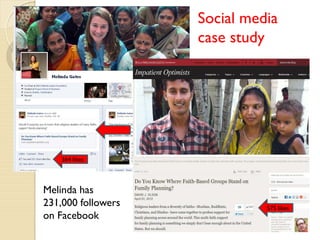
Social media
                    case study


    364 likes


Melinda has
231,000 followers             575 likes
on Facebook
Handling negative posts/tweets
 Interactivity is at the heart of social media
You have three options:
 Do nothing
 Respond to it
 Deleting it (if it’s on your social media)
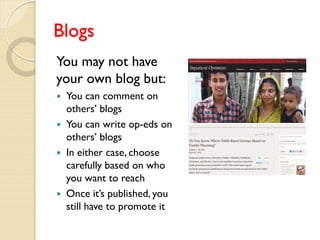
Blogs
You may not have
your own blog but:
   You can comment on
    others’ blogs
   You can write op-eds on
    others’ blogs
   In either case, choose
    carefully based on who
    you want to reach
   Once it’s published, you
    still have to promote it
(13th most visited website)


Applications for CCIH members
• Professional networking
• Job seeking and recruiting
• Expertise to enhance your professional
  credibility
• Finding groups on issue areas (LinkedIn
  Groups)
• Highlighting your issues
• Promoting your news, blogs, etc.
• Research for blogs and op-eds
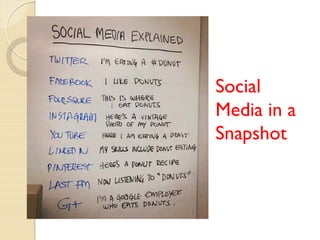
Social
Media in a
Snapshot
Resources
   NTEN (Nonprofit Technology Network):
    http://www.nten.org/
   Social Good, a podcast of Chronicle of Philanthropy:
    http://philanthropy.com/section/Social-Good/365/
   Beth’s Blog: http://www.bethkanter.org/
   Technorati Top 100 Blogs:
    http://technorati.com/blogs/top100/
   Measuring the Networked Nonprofit: Using Data to Change
    the World: http://bit.ly/Rk17pj
   Five Types of Nonprofit Tweets Guaranteed to Get
    Retweeted: http://bit.ly/SSe8dM
   Five Tweeters of Social Good You Have to Follow:
    http://bit.ly/QZEFPi
   Armchair Advocates: Where Social Media Meets Social Good:
    http://armchairadvocates.com/
Contacts


Email: david@olsonglobalcom.com
Website: www.olsonglobalcom.com
Twitter @davidjolson

Ccih webinar social_media_oct_25_2012_david_olson

  • 1.
    Speak Out! From MediaRelations To Social Media By David J. Olson
  • 2.
    What is socialmedia? Social media includes web-based and mobile technologies used to turn communication into interactive dialogue. (Wikipedia) Andreas Kaplan and Michael Haenlein define social media as "a group of Internet-based applications that build on the ideological and technological foundations of Web 2.0, and that allow the creation and exchange of user- generated content."
  • 3.
    Advantages of socialmedia • They’re free (mostly) • They can help you tell your story cost-effectively • Most can be used on cell phones • Great way to connect with journalists, policymakers, potential employers, powers-that-be • With privacy settings, you can control what people see and who you are following • Great for researching topics for op-eds and blogs • Metrics allows you to know who you are reaching and the impact
  • 4.
    Disadvantages of socialmedia • Privacy concerns • Vulnerability to criticism or attack • Takes time to learn • Can be addictive and distracting • You have to look at a lot of junk before you find stuff that’s useful
  • 5.
    Most popular socialmedia • Facebook (personal & professional) – 1 billion+ users (second most visited website) • Twitter – 500 million+ users (8th most visited website) • YouTube – 800 unique users a month, owned by Google (3rd most visited website) • LinkedIn (professional) – 175 million+ • Blogs (Huffington Post, Guardian, Daily Beast, etc.)
  • 6.
    • An onlinesocial networking and micro- blogging service created in 2006 • Enables people to send and read text-based posts up to 140 characters, known as "tweets" • Has 500m users, generates over 340m tweets/day and handles over 1.6 billion search queries/day • Eighth most visited website on Internet • Owned by Google
  • 7.
    Applications for CCIHmembers • To drive followers to your website, blog, video or a relevant news item • To educate your stakeholders • To advocate to key stakeholders (policymakers, journalists, etc.) • Events (like London Family Planning Summit) work well for Twitter
  • 8.
    Tricks of the Trade • How it works • Hashtags (#faith) • Twitter handles (@CCIntlhealth) • URL shortener (bit.ly) • Retweeting • Privacy settings
  • 11.
  • 12.
    Twitter Use Is Risingin Africa Over three months, South Africans generated 5 million tweets, Kenya 2.5 million and Nigeria 1.6 million (this includes only those who geo-locate their Twitter account)
  • 13.
    • Social networkingsite launched in 2004 • Most successful social network in world, and second most visited website on internet • Over 1 billion active users (as of Sept. 2012) • Users may join common interest groups organized by workplace, issues or profession
  • 14.
    Applications for CCIHMembers • Sharing news (your own or others’) or photos, publicizing events or a call to advocacy • For those with website, can serve as more engaging communications tool and reach different demographic • For those without website, can serve as lower-maintenance, no-cost substitute • Easy metrics shows demographics of fans
  • 17.
    Social media case study 364 likes Melinda has 231,000 followers 575 likes on Facebook
  • 18.
    Handling negative posts/tweets Interactivity is at the heart of social media You have three options:  Do nothing  Respond to it  Deleting it (if it’s on your social media)
  • 19.
    Blogs You may nothave your own blog but:  You can comment on others’ blogs  You can write op-eds on others’ blogs  In either case, choose carefully based on who you want to reach  Once it’s published, you still have to promote it
  • 20.
    (13th most visitedwebsite) Applications for CCIH members • Professional networking • Job seeking and recruiting • Expertise to enhance your professional credibility • Finding groups on issue areas (LinkedIn Groups) • Highlighting your issues • Promoting your news, blogs, etc. • Research for blogs and op-eds
  • 21.
  • 22.
    Resources  NTEN (Nonprofit Technology Network): http://www.nten.org/  Social Good, a podcast of Chronicle of Philanthropy: http://philanthropy.com/section/Social-Good/365/  Beth’s Blog: http://www.bethkanter.org/  Technorati Top 100 Blogs: http://technorati.com/blogs/top100/  Measuring the Networked Nonprofit: Using Data to Change the World: http://bit.ly/Rk17pj  Five Types of Nonprofit Tweets Guaranteed to Get Retweeted: http://bit.ly/SSe8dM  Five Tweeters of Social Good You Have to Follow: http://bit.ly/QZEFPi  Armchair Advocates: Where Social Media Meets Social Good: http://armchairadvocates.com/
  • 23.