VIRAL KERATITIS
DR.NAZISH ANWAR
Resident Ophthalmologist
AFH, Lahore
OBJECTIVES
 DESCRIBE THE INTRODUCTION AND PATHOPHYSIOLOGY OF
HERPES SIMPLEX VIRUS AND HERPES ZOSTER VIRUS
 DESCRIBE THE CLINICAL MANIFESTATIONS OF VIRAL
KERATITIS
 IDENTIFY THE MOST COMMON DIFFERENCES OF HERPES
SIMPLEX VIRUS AND HERPES ZOSTER VIRUS
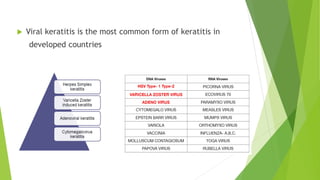
 Viral keratitis is the most common form of keratitis in
developed countries
Herpes Simplex Virus
 MODE OF INFECTION
 Lips, nose and cornea: HSV-1 (above abdomen)
(Close contact with patient suffering from
herpes labialis)
 Genitals: HSV-2 (below abdomen)
 (to eye of neonate through infected genitalia of
 Mother)
✴ Acute follicular conjunctivitis
✴ Keratoconjunctivitis (lymphadenopathy)
✴ Periocular & eyelid skin lesions
• HSV keratitis in a neonate
is invariably associated
with conjunctivitis.
• Features; Diffuse
microdendritis, serpiginous
epithelial defects or a punctate
keratitis.
PATHOPHYSIOLOGY (Trigger agents for
reactivation – fever,UV exposure, stress,ocular trauma,
immunocompromised)
INFCTIOUS EPITHELIAL KERATITIS
Dendrites; fluorescein along the length of lesion
Swollen epithelial borders; rose Bengal (devitalized
cells)
NEUROTROPHIC EPITHELIAL
KERATITIS
 • Arises from impaired corneal innervation combination with
decrease tear
 secretion.
 • Failure of re-epithelization resulting from corneal anaesthesia.
 Chronic post-herpetic corneal inflammation
 Defect is oval in shape,Smooth borders,STROMA
 beneath it is grey
and opaque
 COMPLICATIONS
 STROMAL SCARRING, NVZ, NECROSIS, PERFORATION ,SEC.
 BACTERIAL INFECTION
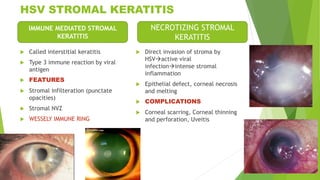
HSV STROMAL KERATITIS
IMMUNE MEDIATED STROMAL
KERATITIS
 Called interstitial keratitis
 Type 3 immune reaction by viral
antigen
 FEATURES
 Stromal infilteration (punctate
opacities)
 Stromal NVZ
 WESSELY IMMUNE RING
NECROTIZING STROMAL
KERATITIS
 Direct invasion of stroma by
HSV→active viral
infection→intense stromal
inflammation
 Epithelial defect, corneal necrosis
and melting
 COMPLICATIONS
 Corneal scarring, Corneal thinning
and perforation, Uveitis
IMMUNE MEDIATED STROMAL
KERATITIS
NECROTIZING STROMAL
KERATITIS
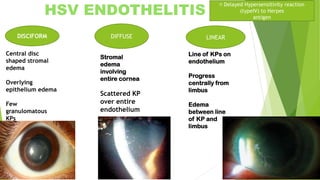
HSV ENDOTHELITIS
DISCIFORM DIFFUSE LINEAR
Central disc
shaped stromal
edema
Overlying
epithelium edema
Few
granulomatous
KPs
Stromal
edema
involving
entire cornea
Scattered KP
over entire
endothelium
Line of KPs on
endothelium
Progress
centrally from
limbus
Edema
between line
of KP and
limbus
Delayed Hypersensitivity reaction
(typeIV) to Herpes
antigen
HERPES ZOSTER OPHTHALMICUS
 known as shingles/Zoster, is a viral
disease
 characterized by a painful skin rash
in one or more dermatome
distributions of the fifth cranial
nerve, shared by the eye and orbit.
Anatomy of CN V
PATHOPHYSIOLOGY
Risk factors= age > 60 years, immunocompromised,
pregnant women, neonates, aids
 CLINICAL MANIFESTATIONS
 PRODROML PHASE
(fever,malaise,headache,eyepa
in)
 Erythmetaous skin lesions
 Macules->papules->vesicles-
>pustules->scabes
 If the vesicles are present on
the side and tip of the nose,
 (Hutchinson's sign), the
external division of the
nasociliary branch is affected
: probability of involvement of
eye 76%
 OCULAR
 70% HZO patients have
ocular involvement
 -
conjunctivitis/episcleritis:
53%
 - epithelial keratitis: 33%
 - uveitis: 32%
 - stromal keratitis: 14.5%
 - endothelitis: 6.5
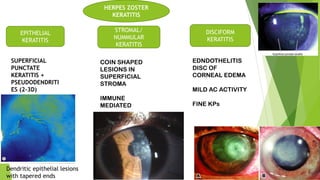
HERPES ZOSTER
KERATITIS
EPITHELIAL
KERATITIS
STROMAL/
NUMMULAR
KERATITIS
DISCIFORM
KERATITIS
SUPERFICIAL
PUNCTATE
KERATITIS +
PSEUDODENDRITI
ES (2-3D)
COIN SHAPED
LESIONS IN
SUPERFICIAL
STROMA
IMMUNE
MEDIATED
EDNDOTHELITIS
DISC OF
CORNEAL EDEMA
MILD AC ACTIVITY
FINE KPs
Dendritic epithelial lesions
with tapered ends
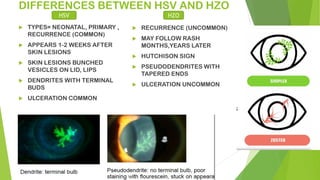
DIFFERENCE BETWEEN HSV AND HZO
DIFFERENCES BETWEEN HSV AND HZO
 TYPES= NEONATAL, PRIMARY ,
RECURRENCE (COMMON)
 APPEARS 1-2 WEEKS AFTER
SKIN LESIONS
 SKIN LESIONS BUNCHED
VESICLES ON LID, LIPS
 DENDRITES WITH TERMINAL
BUDS
 ULCERATION COMMON
 RECURRENCE (UNCOMMON)
 MAY FOLLOW RASH
MONTHS,YEARS LATER
 HUTCHISON SIGN
 PSEUDODENDRITES WITH
TAPERED ENDS
 ULCERATION UNCOMMON
HSV HZO
THANKYOU

Viral Keratitis.pdf

  • 1.
    VIRAL KERATITIS DR.NAZISH ANWAR ResidentOphthalmologist AFH, Lahore
  • 2.
    OBJECTIVES  DESCRIBE THEINTRODUCTION AND PATHOPHYSIOLOGY OF HERPES SIMPLEX VIRUS AND HERPES ZOSTER VIRUS  DESCRIBE THE CLINICAL MANIFESTATIONS OF VIRAL KERATITIS  IDENTIFY THE MOST COMMON DIFFERENCES OF HERPES SIMPLEX VIRUS AND HERPES ZOSTER VIRUS
  • 3.
     Viral keratitisis the most common form of keratitis in developed countries
  • 4.
    Herpes Simplex Virus MODE OF INFECTION  Lips, nose and cornea: HSV-1 (above abdomen) (Close contact with patient suffering from herpes labialis)  Genitals: HSV-2 (below abdomen)  (to eye of neonate through infected genitalia of  Mother)
  • 5.
    ✴ Acute follicularconjunctivitis ✴ Keratoconjunctivitis (lymphadenopathy) ✴ Periocular & eyelid skin lesions • HSV keratitis in a neonate is invariably associated with conjunctivitis. • Features; Diffuse microdendritis, serpiginous epithelial defects or a punctate keratitis.
  • 6.
    PATHOPHYSIOLOGY (Trigger agentsfor reactivation – fever,UV exposure, stress,ocular trauma, immunocompromised)
  • 9.
    INFCTIOUS EPITHELIAL KERATITIS Dendrites;fluorescein along the length of lesion Swollen epithelial borders; rose Bengal (devitalized cells)
  • 10.
    NEUROTROPHIC EPITHELIAL KERATITIS  •Arises from impaired corneal innervation combination with decrease tear  secretion.  • Failure of re-epithelization resulting from corneal anaesthesia.  Chronic post-herpetic corneal inflammation  Defect is oval in shape,Smooth borders,STROMA  beneath it is grey and opaque  COMPLICATIONS  STROMAL SCARRING, NVZ, NECROSIS, PERFORATION ,SEC.  BACTERIAL INFECTION
  • 11.
    HSV STROMAL KERATITIS IMMUNEMEDIATED STROMAL KERATITIS  Called interstitial keratitis  Type 3 immune reaction by viral antigen  FEATURES  Stromal infilteration (punctate opacities)  Stromal NVZ  WESSELY IMMUNE RING NECROTIZING STROMAL KERATITIS  Direct invasion of stroma by HSV→active viral infection→intense stromal inflammation  Epithelial defect, corneal necrosis and melting  COMPLICATIONS  Corneal scarring, Corneal thinning and perforation, Uveitis IMMUNE MEDIATED STROMAL KERATITIS NECROTIZING STROMAL KERATITIS
  • 12.
    HSV ENDOTHELITIS DISCIFORM DIFFUSELINEAR Central disc shaped stromal edema Overlying epithelium edema Few granulomatous KPs Stromal edema involving entire cornea Scattered KP over entire endothelium Line of KPs on endothelium Progress centrally from limbus Edema between line of KP and limbus Delayed Hypersensitivity reaction (typeIV) to Herpes antigen
  • 13.
    HERPES ZOSTER OPHTHALMICUS known as shingles/Zoster, is a viral disease  characterized by a painful skin rash in one or more dermatome distributions of the fifth cranial nerve, shared by the eye and orbit. Anatomy of CN V
  • 14.
  • 15.
    Risk factors= age> 60 years, immunocompromised, pregnant women, neonates, aids  CLINICAL MANIFESTATIONS  PRODROML PHASE (fever,malaise,headache,eyepa in)  Erythmetaous skin lesions  Macules->papules->vesicles- >pustules->scabes  If the vesicles are present on the side and tip of the nose,  (Hutchinson's sign), the external division of the nasociliary branch is affected : probability of involvement of eye 76%  OCULAR  70% HZO patients have ocular involvement  - conjunctivitis/episcleritis: 53%  - epithelial keratitis: 33%  - uveitis: 32%  - stromal keratitis: 14.5%  - endothelitis: 6.5
  • 16.
    HERPES ZOSTER KERATITIS EPITHELIAL KERATITIS STROMAL/ NUMMULAR KERATITIS DISCIFORM KERATITIS SUPERFICIAL PUNCTATE KERATITIS + PSEUDODENDRITI ES(2-3D) COIN SHAPED LESIONS IN SUPERFICIAL STROMA IMMUNE MEDIATED EDNDOTHELITIS DISC OF CORNEAL EDEMA MILD AC ACTIVITY FINE KPs Dendritic epithelial lesions with tapered ends
  • 17.
  • 18.
    DIFFERENCES BETWEEN HSVAND HZO  TYPES= NEONATAL, PRIMARY , RECURRENCE (COMMON)  APPEARS 1-2 WEEKS AFTER SKIN LESIONS  SKIN LESIONS BUNCHED VESICLES ON LID, LIPS  DENDRITES WITH TERMINAL BUDS  ULCERATION COMMON  RECURRENCE (UNCOMMON)  MAY FOLLOW RASH MONTHS,YEARS LATER  HUTCHISON SIGN  PSEUDODENDRITES WITH TAPERED ENDS  ULCERATION UNCOMMON HSV HZO
  • 19.