DDoS Attack Detection
& Mitigation in SDN
FINAL VIVA PRESENTATION 2014-12-08
COMSE-6998
Presented by Chao CHEN (cc3736)
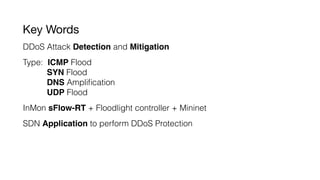
Key Words
DDoS Attack Detection and Mitigation
Type: ICMP Flood
SYN Flood
DNS Amplification
UDP Flood
InMon sFlow-RT + Floodlight controller + Mininet
SDN Application to perform DDoS Protection
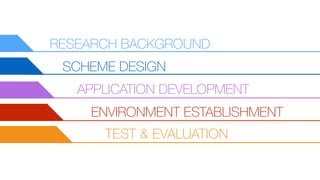
RESEARCH BACKGROUND
SCHEME DESIGN
APPLICATION DEVELOPMENT
ENVIRONMENT ESTABLISHMENT
TEST & EVALUATION
RESEARCH BACKGROUND
Research Background
Real Time detection and mitigation with lowest cost of device deployment
Research Background
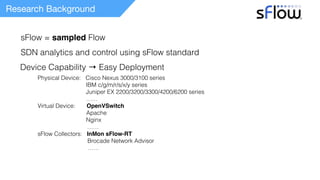
sFlow = sampled Flow
Device Capability → Easy Deployment
Physical Device: Cisco Nexus 3000/3100 series
IBM c/g/m/r/s/x/y series
Juniper EX 2200/3200/3300/4200/6200 series
……
Virtual Device: OpenVSwitch
Apache
Nginx
……
sFlow Collectors: InMon sFlow-RT
Brocade Network Advisor
……
SDN analytics and control using sFlow standard
Research Background
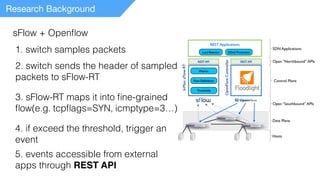
sFlow + Openflow
1. switch samples packets
2. switch sends the header of sampled
packets to sFlow-RT
3. sFlow-RT maps it into fine-grained
flow(e.g. tcpflags=SYN, icmptype=3…)
4. if exceed the threshold, trigger an
event
5. events accessible from external
apps through REST API
Research Background
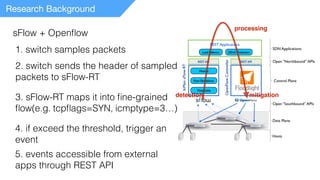
sFlow + Openflow
1. switch samples packets
2. switch sends the header of sampled
packets to sFlow-RT
3. sFlow-RT maps it into fine-grained
flow(e.g. tcpflags=SYN, icmptype=3…)
4. if exceed the threshold, trigger an
event
5. events accessible from external
apps through REST API
detection mitigation
processing
SCHEME DESIGN
Scheme Design
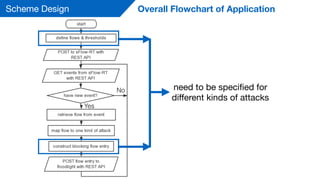
Yes
No
Overall Flowchart of Application
need to be specified for
different kinds of attacks
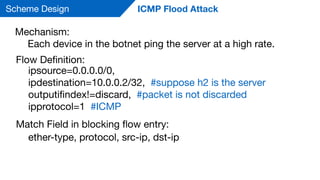
Scheme Design ICMP Flood Attack
Mechanism:
Each device in the botnet ping the server at a high rate.
Flow Definition:
ipsource=0.0.0.0/0, 

ipdestination=10.0.0.2/32, #suppose h2 is the server

outputifindex!=discard, #packet is not discarded

ipprotocol=1 #ICMP
Match Field in blocking flow entry:
ether-type, protocol, src-ip, dst-ip
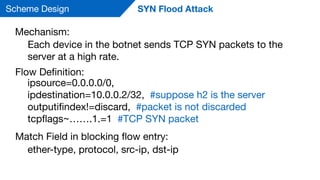
Scheme Design SYN Flood Attack
Mechanism:
Each device in the botnet sends TCP SYN packets to the
server at a high rate.
Flow Definition:
ipsource=0.0.0.0/0, 

ipdestination=10.0.0.2/32, #suppose h2 is the server

outputifindex!=discard, #packet is not discarded

tcpflags~…….1.=1 #TCP SYN packet
Match Field in blocking flow entry:
ether-type, protocol, src-ip, dst-ip
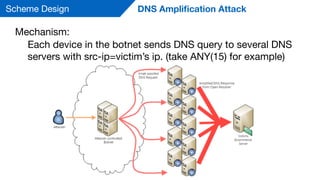
Scheme Design DNS Amplification Attack
Mechanism:
Each device in the botnet sends DNS query to several DNS
servers with src-ip=victim’s ip. (take ANY(15) for example)
Scheme Design DNS Amplification Attack
Flow Definition:
ipsource=0.0.0.0/0, 

ipdestination=[10.0.0.1/32, 10.0.0.2/32], #suppose h1 and
h2 are the DNS servers

outputifindex!=discard, #packet is not discarded

dnsqr=false,

dnsqtype=255
Match Field in blocking flow entry:
ether-type, protocol, src-ip, dst-ip
Protect at the DNS servers (instead of the victim)
Scheme Design UDP Flood Attack
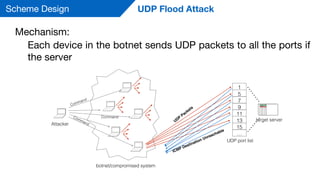
Mechanism:
Each device in the botnet sends UDP packets to all the ports if
the server
Attacker
botnet/compromised system
target server
Command
Command
Command
1
5
7
9
11
13
15
…
UDP port list
UDP
Packets
ICMP Destination Unreachable
Scheme Design UDP Flood Attack
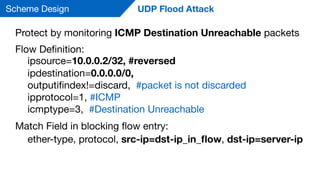
Flow Definition:
ipsource=10.0.0.2/32, #reversed

ipdestination=0.0.0.0/0, 

outputifindex!=discard, #packet is not discarded

ipprotocol=1, #ICMP 

icmptype=3, #Destination Unreachable
Match Field in blocking flow entry:
ether-type, protocol, src-ip=dst-ip_in_flow, dst-ip=server-ip
Protect by monitoring ICMP Destination Unreachable packets
APPLICATION DEVELOPMENT
Application Development
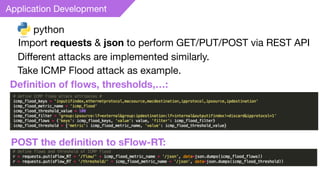
python
Import requests & json to perform GET/PUT/POST via REST API
Different attacks are implemented similarly.
Take ICMP Flood attack as example.
Definition of flows, thresholds,…:
POST the definition to sFlow-RT:
Application Development
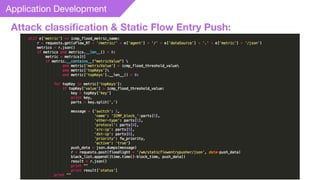
Attack classification & Static Flow Entry Push:
ENVIRONMENT ESTABLISHMENT
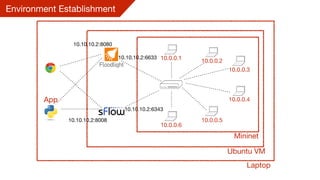
Environment Establishment
Laptop
Ubuntu VM
App
Mininet
10.0.0.1 10.0.0.2
10.0.0.3
10.0.0.4
10.0.0.5
10.0.0.6
10.10.10.2:6633
10.10.10.2:8080
10.10.10.2:8008
10.10.10.2:6343
TEST & EVALUATION
Test & Evaluation
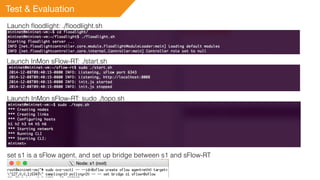
Launch floodlight: ./floodlight.sh
Launch InMon sFlow-RT: ./start.sh
Launch InMon sFlow-RT: sudo ./topo.sh
set s1 is a sFlow agent, and set up bridge between s1 and sFlow-RT
Test & Evaluation
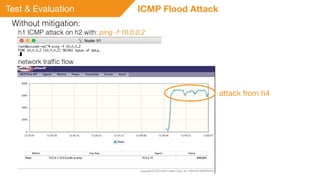
Without mitigation:
h1 ICMP attack on h2 with: ping -f 10.0.0.2
network traffic flow
attack from h4
ICMP Flood Attack
Test & Evaluation
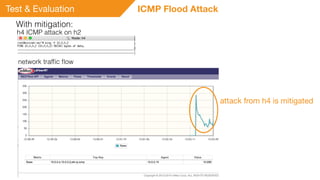
With mitigation:
h4 ICMP attack on h2
network traffic flow
attack from h4 is mitigated
ICMP Flood Attack
Test & Evaluation
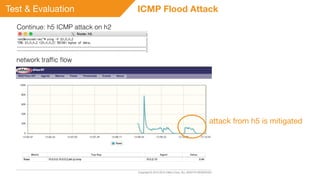
Continue: h5 ICMP attack on h2
network traffic flow
attack from h5 is mitigated
ICMP Flood Attack
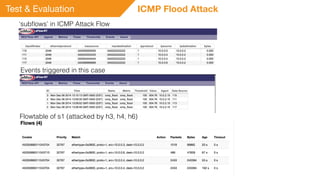
Test & Evaluation ICMP Flood Attack
‘subflows’ in ICMP Attack Flow
Events triggered in this case
Flowtable of s1 (attacked by h3, h4, h6)
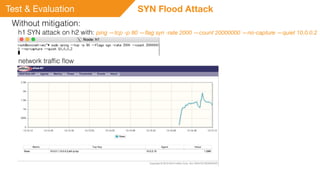
Test & Evaluation SYN Flood Attack
Without mitigation:
h1 SYN attack on h2 with: ping —tcp -p 80 —flag syn -rate 2000 —count 20000000 —no-capture —quiet 10.0.0.2
network traffic flow
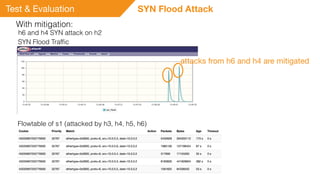
Test & Evaluation SYN Flood Attack
With mitigation:
h6 and h4 SYN attack on h2
SYN Flood Traffic
Flowtable of s1 (attacked by h3, h4, h5, h6)
attacks from h6 and h4 are mitigated
Test & Evaluation
DNS Amplification Attack & UDP Flood Attack:
Cannot simulate attacks → No test result yet
Test & Evaluation
Future Work:
1. Test on DNS Amplification Attack & UDP Flood Attack
2. {new_sample_rate, new_threshold}
=update(old_sample_rate, old_threshold, network_congestion, server_status,…)
3. Sample Theory is efficient on large flows.
Think about {tiny flows x n}
4. Reasonable unblock mechanism
Q&A

DDoS Attack Detection & Mitigation in SDN

  • 1.
    DDoS Attack Detection &Mitigation in SDN FINAL VIVA PRESENTATION 2014-12-08 COMSE-6998 Presented by Chao CHEN (cc3736)
  • 2.
    Key Words DDoS AttackDetection and Mitigation Type: ICMP Flood SYN Flood DNS Amplification UDP Flood InMon sFlow-RT + Floodlight controller + Mininet SDN Application to perform DDoS Protection
  • 3.
    RESEARCH BACKGROUND SCHEME DESIGN APPLICATIONDEVELOPMENT ENVIRONMENT ESTABLISHMENT TEST & EVALUATION
  • 4.
  • 5.
    Research Background Real Timedetection and mitigation with lowest cost of device deployment
  • 6.
    Research Background sFlow =sampled Flow Device Capability → Easy Deployment Physical Device: Cisco Nexus 3000/3100 series IBM c/g/m/r/s/x/y series Juniper EX 2200/3200/3300/4200/6200 series …… Virtual Device: OpenVSwitch Apache Nginx …… sFlow Collectors: InMon sFlow-RT Brocade Network Advisor …… SDN analytics and control using sFlow standard
  • 7.
    Research Background sFlow +Openflow 1. switch samples packets 2. switch sends the header of sampled packets to sFlow-RT 3. sFlow-RT maps it into fine-grained flow(e.g. tcpflags=SYN, icmptype=3…) 4. if exceed the threshold, trigger an event 5. events accessible from external apps through REST API
  • 8.
    Research Background sFlow +Openflow 1. switch samples packets 2. switch sends the header of sampled packets to sFlow-RT 3. sFlow-RT maps it into fine-grained flow(e.g. tcpflags=SYN, icmptype=3…) 4. if exceed the threshold, trigger an event 5. events accessible from external apps through REST API detection mitigation processing
  • 9.
  • 10.
    Scheme Design Yes No Overall Flowchartof Application need to be specified for different kinds of attacks
  • 11.
    Scheme Design ICMPFlood Attack Mechanism: Each device in the botnet ping the server at a high rate. Flow Definition: ipsource=0.0.0.0/0, ipdestination=10.0.0.2/32, #suppose h2 is the server outputifindex!=discard, #packet is not discarded ipprotocol=1 #ICMP Match Field in blocking flow entry: ether-type, protocol, src-ip, dst-ip
  • 12.
    Scheme Design SYNFlood Attack Mechanism: Each device in the botnet sends TCP SYN packets to the server at a high rate. Flow Definition: ipsource=0.0.0.0/0, ipdestination=10.0.0.2/32, #suppose h2 is the server outputifindex!=discard, #packet is not discarded tcpflags~…….1.=1 #TCP SYN packet Match Field in blocking flow entry: ether-type, protocol, src-ip, dst-ip
  • 13.
    Scheme Design DNSAmplification Attack Mechanism: Each device in the botnet sends DNS query to several DNS servers with src-ip=victim’s ip. (take ANY(15) for example)
  • 14.
    Scheme Design DNSAmplification Attack Flow Definition: ipsource=0.0.0.0/0, ipdestination=[10.0.0.1/32, 10.0.0.2/32], #suppose h1 and h2 are the DNS servers outputifindex!=discard, #packet is not discarded dnsqr=false, dnsqtype=255 Match Field in blocking flow entry: ether-type, protocol, src-ip, dst-ip Protect at the DNS servers (instead of the victim)
  • 15.
    Scheme Design UDPFlood Attack Mechanism: Each device in the botnet sends UDP packets to all the ports if the server Attacker botnet/compromised system target server Command Command Command 1 5 7 9 11 13 15 … UDP port list UDP Packets ICMP Destination Unreachable
  • 16.
    Scheme Design UDPFlood Attack Flow Definition: ipsource=10.0.0.2/32, #reversed ipdestination=0.0.0.0/0, outputifindex!=discard, #packet is not discarded ipprotocol=1, #ICMP icmptype=3, #Destination Unreachable Match Field in blocking flow entry: ether-type, protocol, src-ip=dst-ip_in_flow, dst-ip=server-ip Protect by monitoring ICMP Destination Unreachable packets
  • 17.
  • 18.
    Application Development python Import requests& json to perform GET/PUT/POST via REST API Different attacks are implemented similarly. Take ICMP Flood attack as example. Definition of flows, thresholds,…: POST the definition to sFlow-RT:
  • 19.
  • 20.
  • 21.
    Environment Establishment Laptop Ubuntu VM App Mininet 10.0.0.110.0.0.2 10.0.0.3 10.0.0.4 10.0.0.5 10.0.0.6 10.10.10.2:6633 10.10.10.2:8080 10.10.10.2:8008 10.10.10.2:6343
  • 22.
  • 23.
    Test & Evaluation Launchfloodlight: ./floodlight.sh Launch InMon sFlow-RT: ./start.sh Launch InMon sFlow-RT: sudo ./topo.sh set s1 is a sFlow agent, and set up bridge between s1 and sFlow-RT
  • 24.
    Test & Evaluation Withoutmitigation: h1 ICMP attack on h2 with: ping -f 10.0.0.2 network traffic flow attack from h4 ICMP Flood Attack
  • 25.
    Test & Evaluation Withmitigation: h4 ICMP attack on h2 network traffic flow attack from h4 is mitigated ICMP Flood Attack
  • 26.
    Test & Evaluation Continue:h5 ICMP attack on h2 network traffic flow attack from h5 is mitigated ICMP Flood Attack
  • 27.
    Test & EvaluationICMP Flood Attack ‘subflows’ in ICMP Attack Flow Events triggered in this case Flowtable of s1 (attacked by h3, h4, h6)
  • 28.
    Test & EvaluationSYN Flood Attack Without mitigation: h1 SYN attack on h2 with: ping —tcp -p 80 —flag syn -rate 2000 —count 20000000 —no-capture —quiet 10.0.0.2 network traffic flow
  • 29.
    Test & EvaluationSYN Flood Attack With mitigation: h6 and h4 SYN attack on h2 SYN Flood Traffic Flowtable of s1 (attacked by h3, h4, h5, h6) attacks from h6 and h4 are mitigated
  • 30.
    Test & Evaluation DNSAmplification Attack & UDP Flood Attack: Cannot simulate attacks → No test result yet
  • 31.
    Test & Evaluation FutureWork: 1. Test on DNS Amplification Attack & UDP Flood Attack 2. {new_sample_rate, new_threshold} =update(old_sample_rate, old_threshold, network_congestion, server_status,…) 3. Sample Theory is efficient on large flows. Think about {tiny flows x n} 4. Reasonable unblock mechanism
  • 32.