Common Core Standards: a tool for the
      21st Century Classroom
                  By Sussan Oladipo
                      PresenterMedia.com
Think Aloud

   Three things you already know about the CCSS

Two   reasons why we need the CCSS right now

One question you have about the implementation of
 CSSS
Session Objectives

Communicate    background and major shifts of the
CCSS

Unpack   CCSS standards

Create   CCSS performance tasks
Background and Overview of CCSS

   Why CCSS?

   Who is leading the effort?

   What is the significance of the CCSS work?

   How is the document organized?

   What is the implication of the CCSS for educators?
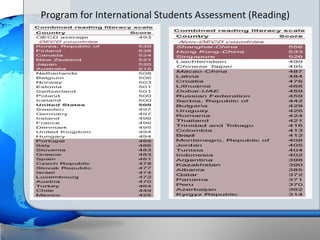
Program for International Students Assessment (Reading)
Four Major Shifts

Emphasizing    Informational Text
Literacy   standards for all content areas
Text   complexity
The   special place of argument
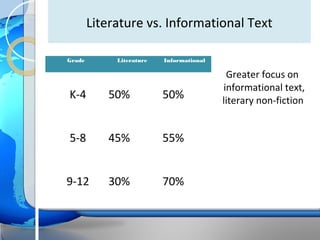
Literature vs. Informational Text

Grade        Literature   Informational

                                           Greater focus on
                                          informational text,
K-4        50%            50%             literary non-fiction


5-8        45%            55%


9-12       30%            70%
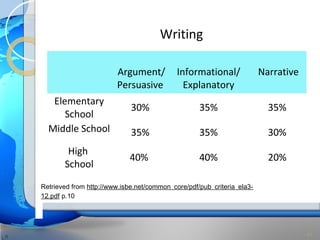
Writing

                            Argument/           Informational/              Narrative
                            Persuasive            Explanatory
       Elementary
                                 30%                   35%                    35%
          School
      Middle School              35%                   35%                    30%
            High
                                40%                    40%                    20%
           School

    Retrieved from http://www.isbe.net/common_core/pdf/pub_criteria_ela3-
    12.pdf p.10


                                                                                        41
9
+
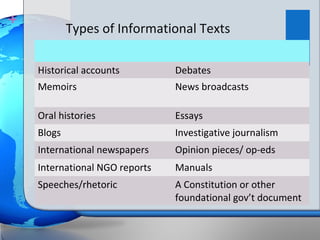
            Types of Informational Texts

    Historical accounts         Debates
    Memoirs                     News broadcasts

    Oral histories              Essays
    Blogs                       Investigative journalism
    International newspapers    Opinion pieces/ op-eds
    International NGO reports   Manuals
    Speeches/rhetoric           A Constitution or other
                                foundational gov’t document
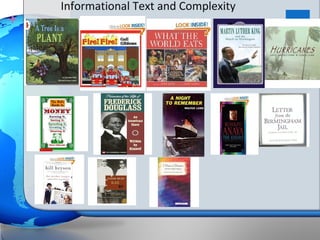
Informational Text and Complexity
+   K-3
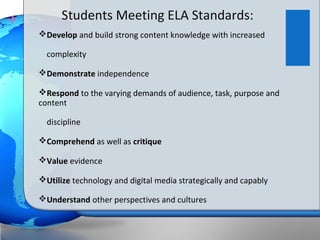
+         Students Meeting ELA Standards:
    Develop and build strong content knowledge with increased

      complexity

    Demonstrate independence

    Respond to the varying demands of audience, task, purpose and
    content

      discipline

    Comprehend as well as critique

    Value evidence

    Utilize technology and digital media strategically and capably

    Understand other perspectives and cultures
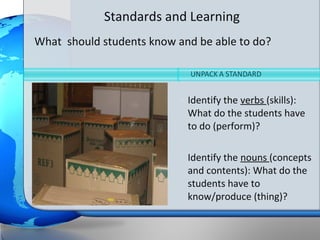
Standards and Learning
What should students know and be able to do?


                           •   Identify the verbs (skills):
                               What do the students have
                               to do (perform)?

                           •   Identify the nouns (concepts
                               and contents): What do the
                               students have to
                               know/produce (thing)?
Writing Standard 7.8
What do students need to know and be able to do?
   Gather relevant information
  from multiple print and
  digital sources, using search
  terms effectively; assess the
  credibility and accuracy of
  each source; and quote or
  paraphrase the data and
  conclusions of others while
  avoiding plagiarism and
  following a standard format
  for citation.
Writing Standard 7.8
What do students need to do? (verbs)

  Gather relevant information
  from multiple print and
  digital sources, using search
  terms effectively; assess the
  credibility and accuracy of
  each source; and quote or
  paraphrase the data and
  conclusions of others while
  avoiding plagiarism and
  following a standard format
  for citation.
Writing Standard 7.8
What do students need to produce? (Noun)

  Gather relevant information
  from multiple print and
  digital sources, using search
  terms effectively; assess the
  credibility and accuracy of
  each source; and quote or
  paraphrase the data and
  conclusions of others while
  avoiding plagiarism and
  following a standard format
  for citation.
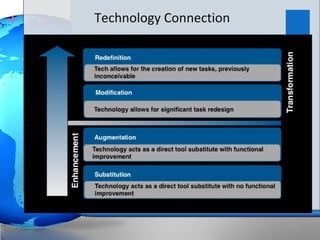
+   Technology Connection
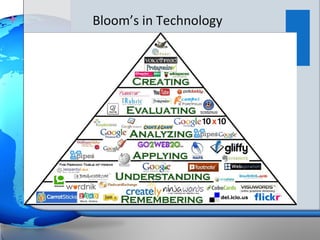
+   Bloom’s in Technology
+                   Performance Task

    1.Listtypes of skills, concepts and contents
        students should acquire

    2. Design performance task that measures targeted
     skills

    3. Develop explicit performance criteria (rubric)
+                   Performance Tasks

          What have students learned? (know and can do?)
    [RI.K.10]                               [RI.6.8]

    [RI.1.7]                                [RI.7.6]

    [RI.2.6]                                [RI.8.2

    [RI.3.5]                                [RI.9–10.9]


    [RI.4.8]                               [RI.11–12.8]

    [RI.5.3]

    Create performance task using any of these standards
Reflective Thoughts-Think Aloud

 Are   standards worthwhile in teaching and learning?

 What    professional learning needs are needed?

 What    monitoring system works?

 What    resources should be prioritized?

 Aside   from standards, what other factors affecting students should be

 focused on?


                                                                        21
Resources

Ainsworth, L. (2003). Unwrapping the standards: A
 simple process to make standards manageable.
 Englewood, CO: Lead + Learn Press. Common core
Weber, S. (2008). Benefits of unpacking the
 standards. Mebane, NC
www.corestandards.org

www.parcconline.org
http://www.corestandards.org/assets/Appendix_B.pdf
Ccss ppt

Ccss ppt

  • 1.
    Common Core Standards:a tool for the 21st Century Classroom By Sussan Oladipo PresenterMedia.com
  • 2.
    Think Aloud  Three things you already know about the CCSS Two reasons why we need the CCSS right now One question you have about the implementation of CSSS
  • 3.
    Session Objectives Communicate background and major shifts of the CCSS Unpack CCSS standards Create CCSS performance tasks
  • 4.
    Background and Overviewof CCSS  Why CCSS?  Who is leading the effort?  What is the significance of the CCSS work?  How is the document organized?  What is the implication of the CCSS for educators?
  • 6.
    Program for InternationalStudents Assessment (Reading)
  • 7.
    Four Major Shifts Emphasizing Informational Text Literacy standards for all content areas Text complexity The special place of argument
  • 8.
    Literature vs. InformationalText Grade Literature Informational Greater focus on informational text, K-4 50% 50% literary non-fiction 5-8 45% 55% 9-12 30% 70%
  • 9.
    Writing Argument/ Informational/ Narrative Persuasive Explanatory Elementary 30% 35% 35% School Middle School 35% 35% 30% High 40% 40% 20% School Retrieved from http://www.isbe.net/common_core/pdf/pub_criteria_ela3- 12.pdf p.10 41 9
  • 10.
    + Types of Informational Texts Historical accounts Debates Memoirs News broadcasts Oral histories Essays Blogs Investigative journalism International newspapers Opinion pieces/ op-eds International NGO reports Manuals Speeches/rhetoric A Constitution or other foundational gov’t document
  • 11.
    Informational Text andComplexity + K-3
  • 12.
    + Students Meeting ELA Standards: Develop and build strong content knowledge with increased complexity Demonstrate independence Respond to the varying demands of audience, task, purpose and content discipline Comprehend as well as critique Value evidence Utilize technology and digital media strategically and capably Understand other perspectives and cultures
  • 13.
    Standards and Learning Whatshould students know and be able to do? • Identify the verbs (skills): What do the students have to do (perform)? • Identify the nouns (concepts and contents): What do the students have to know/produce (thing)?
  • 14.
    Writing Standard 7.8 Whatdo students need to know and be able to do? Gather relevant information from multiple print and digital sources, using search terms effectively; assess the credibility and accuracy of each source; and quote or paraphrase the data and conclusions of others while avoiding plagiarism and following a standard format for citation.
  • 15.
    Writing Standard 7.8 Whatdo students need to do? (verbs) Gather relevant information from multiple print and digital sources, using search terms effectively; assess the credibility and accuracy of each source; and quote or paraphrase the data and conclusions of others while avoiding plagiarism and following a standard format for citation.
  • 16.
    Writing Standard 7.8 Whatdo students need to produce? (Noun) Gather relevant information from multiple print and digital sources, using search terms effectively; assess the credibility and accuracy of each source; and quote or paraphrase the data and conclusions of others while avoiding plagiarism and following a standard format for citation.
  • 17.
    + Technology Connection
  • 18.
    + Bloom’s in Technology
  • 19.
    + Performance Task 1.Listtypes of skills, concepts and contents students should acquire 2. Design performance task that measures targeted skills 3. Develop explicit performance criteria (rubric)
  • 20.
    + Performance Tasks What have students learned? (know and can do?) [RI.K.10] [RI.6.8] [RI.1.7] [RI.7.6] [RI.2.6] [RI.8.2 [RI.3.5] [RI.9–10.9] [RI.4.8] [RI.11–12.8] [RI.5.3] Create performance task using any of these standards
  • 21.
    Reflective Thoughts-Think Aloud Are standards worthwhile in teaching and learning?  What professional learning needs are needed?  What monitoring system works?  What resources should be prioritized?  Aside from standards, what other factors affecting students should be focused on? 21
  • 22.
    Resources Ainsworth, L. (2003).Unwrapping the standards: A simple process to make standards manageable. Englewood, CO: Lead + Learn Press. Common core Weber, S. (2008). Benefits of unpacking the standards. Mebane, NC www.corestandards.org www.parcconline.org http://www.corestandards.org/assets/Appendix_B.pdf

Editor's Notes

  • #4 Ice breaker
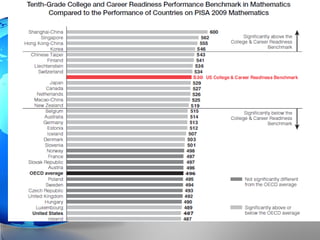
  • #6 In 2011, less than one out of every four high school juniors in Illinois met college ready benchmarks in English, Reading, Math and Science on the ACT In 2009, the U.S. ranked 14th in reading, 17th in science and 25th in math out of 34 countries on the PISA, an international assessment that asks high school students to apply skills to real-world situations.
  • #9 Standards demand a greater focus on informational text literary non fiction Major focus in 6-12
  • #20 Cognitive skills (communicating in writing, analyzing issues, solving problem) Social and affective skills (work independently, to work cooperatively with others, to have confidence, to be conscientious) Meta-cognitive skills(to reflect on the writing process they use; to evaluate the effectiveness of their research strategies, to review their progress over time) Problem based(research, open ended) Concepts and principles based (cause and effect relationship, applications of principles) 2. I t should be motivating, challenging and achievable
  • #21 K6, 1.8,