Literate Environment Analysis
Presentation
By: Ophelia Holloway
June 17, 2015
Walden University
READ-6706-1Literacy Development PreK-
3
Professor: Martha Moore
Literate Environment Analysis
Get to Known Emergent and Beginning
Literacy Learners
Selecting Texts
Emergent Literacy Learner Lesson
Beginning Literacy Learner Lesson
References
Getting to Know Emergent and
Beginning Learners (Part 1)
Getting to know your emergent and beginning
learners is vital to teaching them to be successful
readers.
Having background knowledge helps the teacher
to connect with the students in a way that is
exciting and engaging.
Assessing the students’ cognitive and non-
cognitive levels gives teachers pertinent
information about students to assist them in
differentiating their instructions.
Getting to Know Emergent and
Beginning Learners (Part 2)
Assessments administrated to emergent
learner:
 Story Retelling Evaluation
Measures the student’s ability to listen and then recall
events from story.
“Listening comprehension is generally thought to be a
good predictor of students’ future success in reading
comprehension” (Reutzel & Cooter, 2015, p. 67).
Getting to Know Emergent and
Beginning Learners (Part 3)
Mow-Motorcycle Task Assessment
Used to determine how effectively the student could relate
printed words to spoken words.
Recognizing Rhyming Words Task
Tests for phonemic awareness was an assessment given to
the student to gauge her basic phonemic awareness.
“Before children learn to read print, they must learn
that words are made of speech sounds or phonemes”
(Partnership for Reading, 2001, para. 1).
Getting to Know Emergent and
Beginning Learners (Part 4)
A beginning literacy learner’s growth in reading
and writing must be aggressively cultivated just
as much as the emergent reader’s growth.
Assessments administered to the beginning
learner
One-Minute of Reading Test plus Prosody Assessment for
fluency
Bloom’s Question Stems and Question Verbs for
comprehension.
Flynt/Cooter Reading Attitude Survey to assess interests
and/or motivation
Getting to Know Emergent and
Beginning Learners (Part 5)
According to Reutzel and Cooter (2015), reading
fluency should be measured in four areas:
accurate decoding of text, words read per minute
(wrpm), prosody, and mature phrasing or
chunking of text (p. 229).
 “We often ask questions after children have read
a story or poem to check their understanding. As
with most other assessments, questioning should
follow a structure or framework to have
diagnostic value” (Reutzel & Cooter, 2015, p.
271).
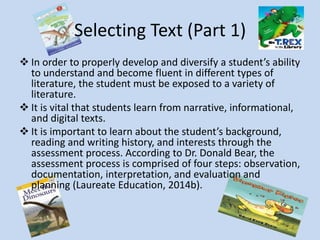
Selecting Text (Part 1)
 In order to properly develop and diversify a student’s ability
to understand and become fluent in different types of
literature, the student must be exposed to a variety of
literature.
 It is vital that students learn from narrative, informational,
and digital texts.
 It is important to learn about the student’s background,
reading and writing history, and interests through the
assessment process. According to Dr. Donald Bear, the
assessment process is comprised of four steps: observation,
documentation, interpretation, and evaluation and
planning (Laureate Education, 2014b).
Selecting Texts (Part 2)
Important Vocabulary
Narrative: Fiction
Informational: Nonfiction
Digital: Accessed electronically
Linguisitc: Words
Semiotic: Pictures
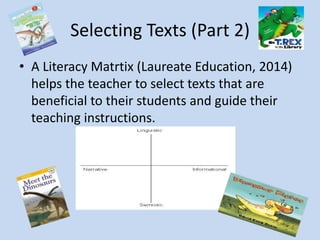
A Literacy Matrtix (Laureate Education, 2014)
helps the teacher to select texts that are
beneficial to their students and guide their
teaching instructions.
Selecting Texts (Part 3)
Literacy Matrix
Emergent Literacy Learner Lesson
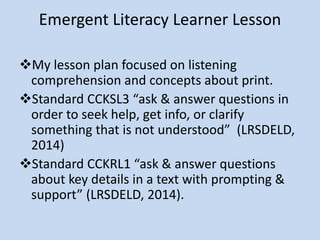
My lesson plan focused on listening
comprehension and concepts about print.
Standard CCKSL3 “ask & answer questions in
order to seek help, get info, or clarify
something that is not understood” (LRSDELD,
2014)
Standard CCKRL1 “ask & answer questions
about key details in a text with prompting &
support” (LRSDELD, 2014).
Beginning Literacy Learner Lesson
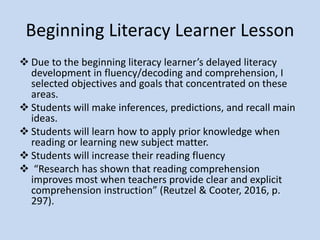
 Due to the beginning literacy learner’s delayed literacy
development in fluency/decoding and comprehension, I
selected objectives and goals that concentrated on these
areas.
 Goals of Lesson
Students will make inferences, predictions, and recall main ideas.
Students will learn how to apply prior knowledge when reading or
learning new subject matter.
Students will increase their reading fluency
 “Research has shown that reading comprehension improves
most when teachers provide clear and explicit comprehension
instruction” (Reutzel & Cooter, 2016, p. 297).
References
 Laureate Education (Producer). (2014a). Analyzing and selecting
text [Video file]. Baltimore, MD: author.
 Laureate Education (Producer). (2014b). Assessing word
knowledge [Video file]. Baltimore, MD: author.
 National Governors Association Center for Best Practices & Council
of Chief State School Officers. (2010). Common Core State
Standards for English language arts and literacy in history/social
studies, science, and technical subjects. Washington, DC: Authors.
 Phonemic Awareness: An Introduction. (2001). Retrieved from
http://www.readingrockets.org/article/phonemic-awareness-
introduction
 Reutzel, D. R., & Cooter, R. B. (2016). Strategies for reading
assessment and instruction: Helping every child succeed (5th ed.).
Boston, MA: Pearson.

Digital Storytelling Project-Walden University

  • 1.
    Literate Environment Analysis Presentation By:Ophelia Holloway June 17, 2015 Walden University READ-6706-1Literacy Development PreK- 3 Professor: Martha Moore
  • 2.
    Literate Environment Analysis Getto Known Emergent and Beginning Literacy Learners Selecting Texts Emergent Literacy Learner Lesson Beginning Literacy Learner Lesson References
  • 3.
    Getting to KnowEmergent and Beginning Learners (Part 1) Getting to know your emergent and beginning learners is vital to teaching them to be successful readers. Having background knowledge helps the teacher to connect with the students in a way that is exciting and engaging. Assessing the students’ cognitive and non- cognitive levels gives teachers pertinent information about students to assist them in differentiating their instructions.
  • 4.
    Getting to KnowEmergent and Beginning Learners (Part 2) Assessments administrated to emergent learner:  Story Retelling Evaluation Measures the student’s ability to listen and then recall events from story. “Listening comprehension is generally thought to be a good predictor of students’ future success in reading comprehension” (Reutzel & Cooter, 2015, p. 67).
  • 5.
    Getting to KnowEmergent and Beginning Learners (Part 3) Mow-Motorcycle Task Assessment Used to determine how effectively the student could relate printed words to spoken words. Recognizing Rhyming Words Task Tests for phonemic awareness was an assessment given to the student to gauge her basic phonemic awareness. “Before children learn to read print, they must learn that words are made of speech sounds or phonemes” (Partnership for Reading, 2001, para. 1).
  • 6.
    Getting to KnowEmergent and Beginning Learners (Part 4) A beginning literacy learner’s growth in reading and writing must be aggressively cultivated just as much as the emergent reader’s growth. Assessments administered to the beginning learner One-Minute of Reading Test plus Prosody Assessment for fluency Bloom’s Question Stems and Question Verbs for comprehension. Flynt/Cooter Reading Attitude Survey to assess interests and/or motivation
  • 7.
    Getting to KnowEmergent and Beginning Learners (Part 5) According to Reutzel and Cooter (2015), reading fluency should be measured in four areas: accurate decoding of text, words read per minute (wrpm), prosody, and mature phrasing or chunking of text (p. 229).  “We often ask questions after children have read a story or poem to check their understanding. As with most other assessments, questioning should follow a structure or framework to have diagnostic value” (Reutzel & Cooter, 2015, p. 271).
  • 8.
    Selecting Text (Part1)  In order to properly develop and diversify a student’s ability to understand and become fluent in different types of literature, the student must be exposed to a variety of literature.  It is vital that students learn from narrative, informational, and digital texts.  It is important to learn about the student’s background, reading and writing history, and interests through the assessment process. According to Dr. Donald Bear, the assessment process is comprised of four steps: observation, documentation, interpretation, and evaluation and planning (Laureate Education, 2014b).
  • 9.
    Selecting Texts (Part2) Important Vocabulary Narrative: Fiction Informational: Nonfiction Digital: Accessed electronically Linguisitc: Words Semiotic: Pictures A Literacy Matrtix (Laureate Education, 2014) helps the teacher to select texts that are beneficial to their students and guide their teaching instructions.
  • 10.
    Selecting Texts (Part3) Literacy Matrix
  • 11.
    Emergent Literacy LearnerLesson My lesson plan focused on listening comprehension and concepts about print. Standard CCKSL3 “ask & answer questions in order to seek help, get info, or clarify something that is not understood” (LRSDELD, 2014) Standard CCKRL1 “ask & answer questions about key details in a text with prompting & support” (LRSDELD, 2014).
  • 12.
    Beginning Literacy LearnerLesson  Due to the beginning literacy learner’s delayed literacy development in fluency/decoding and comprehension, I selected objectives and goals that concentrated on these areas.  Goals of Lesson Students will make inferences, predictions, and recall main ideas. Students will learn how to apply prior knowledge when reading or learning new subject matter. Students will increase their reading fluency  “Research has shown that reading comprehension improves most when teachers provide clear and explicit comprehension instruction” (Reutzel & Cooter, 2016, p. 297).
  • 13.
    References  Laureate Education(Producer). (2014a). Analyzing and selecting text [Video file]. Baltimore, MD: author.  Laureate Education (Producer). (2014b). Assessing word knowledge [Video file]. Baltimore, MD: author.  National Governors Association Center for Best Practices & Council of Chief State School Officers. (2010). Common Core State Standards for English language arts and literacy in history/social studies, science, and technical subjects. Washington, DC: Authors.  Phonemic Awareness: An Introduction. (2001). Retrieved from http://www.readingrockets.org/article/phonemic-awareness- introduction  Reutzel, D. R., & Cooter, R. B. (2016). Strategies for reading assessment and instruction: Helping every child succeed (5th ed.). Boston, MA: Pearson.