DESIGN OF THE QUESTION PAPER
PHYSICS - CLASS XII
Time : 3 Hrs.

Max. Marks : 70

The weightage of the distribution of marks over different dimensions of the question paper shall be as follows:
A. Weightage to content/ subject units

du

B. Weightage to form of questions
Form of Questions

1.
2.
3.
4.

Long Answer Type (LA)
Short Answer (SA I)
Short Answer (SA II)
Very Short Answer (VSA)
TOTAL

.e

S.No.

Marks for each
Question
5
3
2
1
-

No. of
Questions
3
09
10
08
30

Total Marks
15
27
20
08
70

w

w
w

Marks
08
07
08
08
03
14
04
06
07
05
70

rit
e.
co
m

Unit
Electrostatics
Current Electricity
Magnetic Effect of Current & Magnetism
Electromagnetic Induction and Alternating current
Electromagnetic Waves
Optics
Dual Nature of Matter
Atoms and Nuclei
Electronic Devices
Communication Systems
Total

C. Scheme of Options
1. There will be no overall option.
2. Internal choices (either / or type) on a very selective basis has been given in five questions. This internal
choice is given in any one question of 2 marks, any one question of 3 marks and all three questions of 5
marks weightage.
D. A Weightage of about 15 marks in total, has been assigned to numericals
E. Weightage to difficulty level of questions.
S.No.
Estimated difficlty level
Percentage
1.
Easy
15
2.
Average
70
3.
Difficult
15
A weightage of 20% has been assigned to questions which test higher order thinking skills of students.
(74)
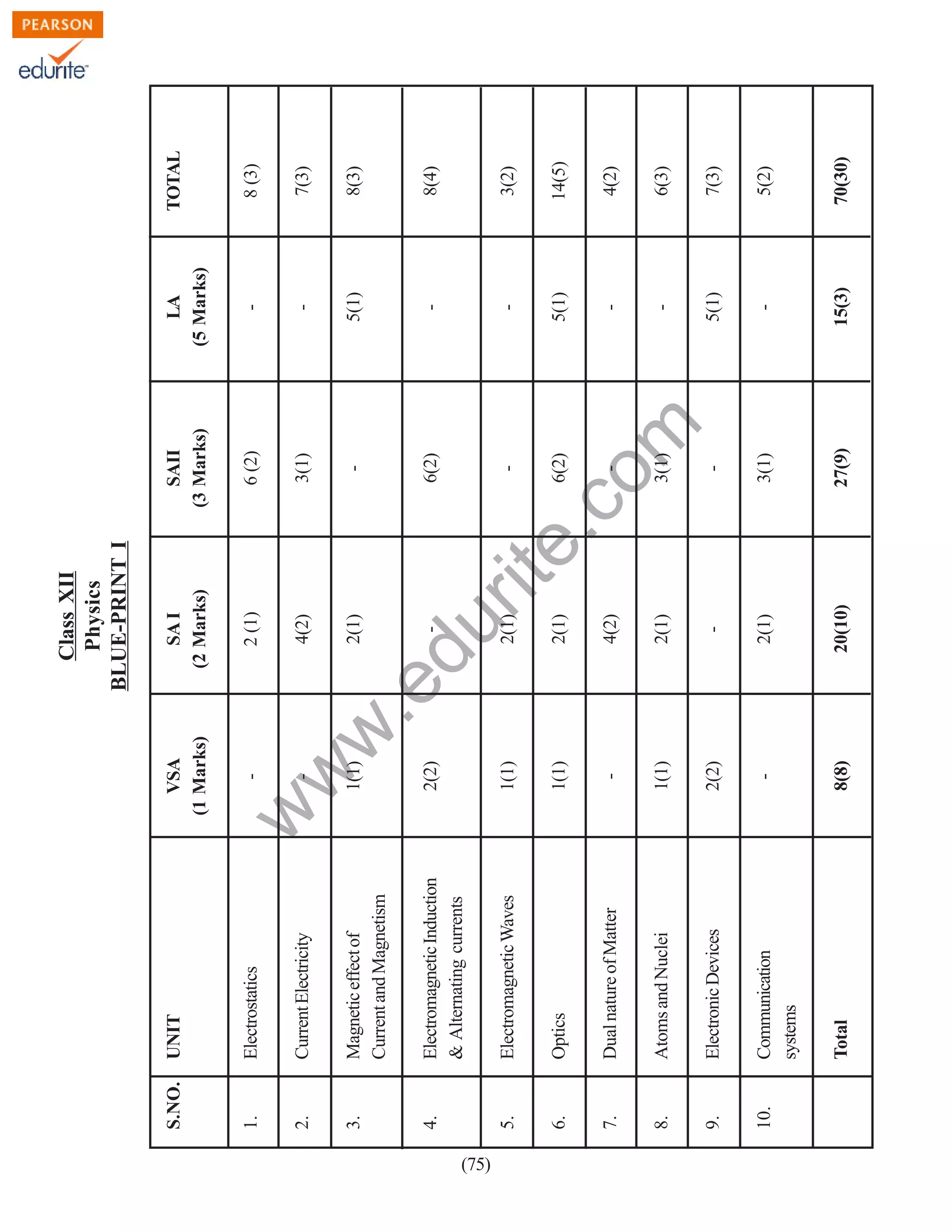
(75)

Electrostatics

Current Electricity

Magnetic effect of
Current and Magnetism

Electromagnetic Induction
& Alternating currents

Electromagnetic Waves

Optics

Dual nature of Matter

Atoms and Nuclei

Electronic Devices

Communication
systems

1.

2.

3.

4.

5.

6.

7.

8.

9.

10.

Total

UNIT

S.NO.

w

8(8)

-

2(2)

1(1)

-

1(1)

1(1)

2(2)

1(1)

2(1)

4(2)

2 (1)

SA I
(2 Marks)

2(1)

4(2)

2(1)

20(10)

2(1)

-

6(2)

-

3(1)

6 (2)

SAII
(3 Marks)

27(9)

3(1)

-

3(1)

-

6(2)

-

rit
e.
co
m
2(1)

-

du

.e

w
w

-

VSA
(1 Marks)

Class XII
Physics
BLUE-PRINT I

15(3)

-

5(1)

-

-

5(1)

-

-

5(1)

-

-

LA
(5 Marks)

70(30)

5(2)

7(3)

6(3)

4(2)

14(5)

3(2)

8(4)

8(3)

7(3)

8 (3)

TOTAL
SAMPLE PAPER I
XII - PHYSICS
Time : Three Hours

(c)

(d)
(e)

General Instructions
All questions are compulsory.
There are 30 questions in total. Questions 1 to 8 carry one mark each, questions 9 to 18 carry two marks each,
questions 19 to 27 carry three marks each and questions 28 to 30 carry five marks each.
There is no overall choice. However, an internal choice has been provided in one question of two marks, one
question of three marks and all three questions of five marks each. You have to attempt only one of the given
choices in such questions.
Use of calculators is not permitted.
You may use the following physical constants wherever necessary :
c
h
e
µo

=
=
=
=

3 x 10⁸ms-1
6.6 x 10⁻³⁴Js
1.6 x 10⁻¹⁹ C
4 π x 10−7 T m A −1

rit
e.
co
m

(a)
(b)

Max. Marks : 70

Boltzmann constant k = 1.38 x 10²³ JK-1
Avogadro’s number NA = 6.023 x 10²³/mole
Mass of neutron
mn = 1.6 x 10⁻²⁷ kg

Two identical charged particles moving with same speed enter a region of uniform magnetic field. If one of these
enters normal to the field direction and the other enters along a direction at 300 with the field, what would be the
ratio of their angular frequencies?

2.

Why does a metallic piece become very hot when it is surrounded by a coil carrying high frequency alternating
current?

3.

How is a sample of an n-type semiconductor electrically neutral though it has an excess of negative charge carriers?

4.

Name the characteristics of electromagnetic waves that
(i) increases
(ii) remains constant
in the electromagnetic spectrum as one moves from radiowave region towards ultravoilet region.

5.

How would the angular separation of interference fringes in young’s double slit experiment change when the
distance of separation between the slits and the screen is doubled?

6.

Calculate the ratio of energies of photons produced due to transition of electron of hydrogen atom from its,

w

w
w

.e

du

1.

(i) Second permitted energy level to the first level, and
(ii) Highest permitted energy level to the second permitted level
7.

Give expression for the average value of the a c voltage
V = V0 Sin ωt
(76)
over the time interval t = 0 and t =
8.

How is the band gap, Eg, of a photo diode related to the maximum wavelength,

9.

Keeping the voltage of the the charging source constant, what would be the percentage change in the energy stored
in a parallel plate capacitor if the separation between its plates were to be decreased by 10%?

10.

Explain how the average velocity of free electrons in a metal at constant temperature, in an electric field, remain
constant even though the electrons are being constantly accelarated by this electric field?

11.

How is the resolving power of a microscope affected when,
(i) the wavelength of illuminating radiations is decreased?
(ii) the diameter of the objective lens is decreased?
Justify your answer.

12.

What is the basic difference between the atom or molecule of a diamagnetic and a paramagnetic material? Why are
elements with even atomic number more likely to be diamagnetic?

13.

Why are infrared radiations referred to as heat waves also? Name the radiations which are next to these radiations
in electromagnetic specturm having
(i) Shorter wavelength.
(ii) Longer wavelength.

14.

The following data was recorded for values of object distance and the corresponding values of image distance in
the experiment on study of real image formation by a convex lens of power +5D. One of these observations is
incorrect. Indentify this observation and give reason for your choice:
S.No.
1
2
3
4
5
6

, that can be detected by it?

w
w

.e

du

rit
e.
co
m

m

25

30

35

45

50

55

Image distance
(cm)

97

61

37

35

32

30

w

Object distance
(cm)

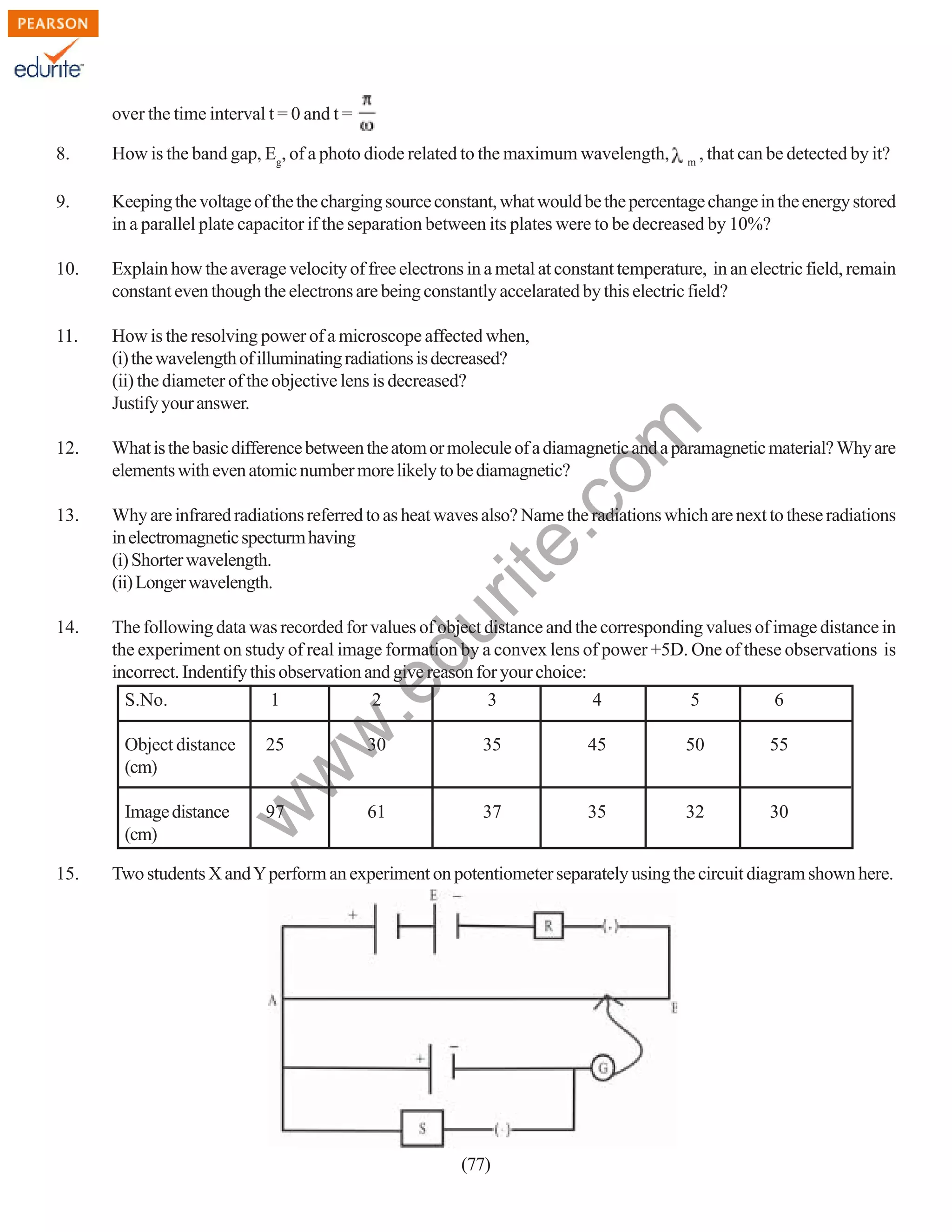
15.

Two students X and Y perform an experiment on potentiometer separately using the circuit diagram shown here.

(77)
Keeping other things unchanged
(i) X increases the value of distance R
(ii) Y decreases the value of resistance S in the set up.
How would these changes affect the position of null point in each case and why?
16.

The following table gives the values of work function for a few photo sensitive metals
Metal

Work Function
(eV)

1.

Na

1.92

2.

K

2.15

3.

Mo

4.17

rit
e.
co
m

S.No.

If each of these metals is exposed to radiations of wavelength 300 nm, which of them will not emit photo electrons
and why?
OR
By how much would the stopping potential for a given photosensitive surface go up if the frequency of the incident
radiations were to be increased from 4 x 10¹⁵ Hz to 8 x 10¹⁵ Hz?
Given h = 6.4 x 10⁻³⁴ J-s, e = 1.6 x 10⁻¹⁹ C and c = 3 x 10⁸ ms-1
Prove that the instantaneous rate of change of the activity of a radioactive substance is inversely proportional to the
square of its half life.

18.

What does the term LOS communication mean? Name the types of waves that are used for this communication.
Which of the two-height of transmitting antenna and height of receiving antenna - can affect the range over which
this mode of communication remains effective?

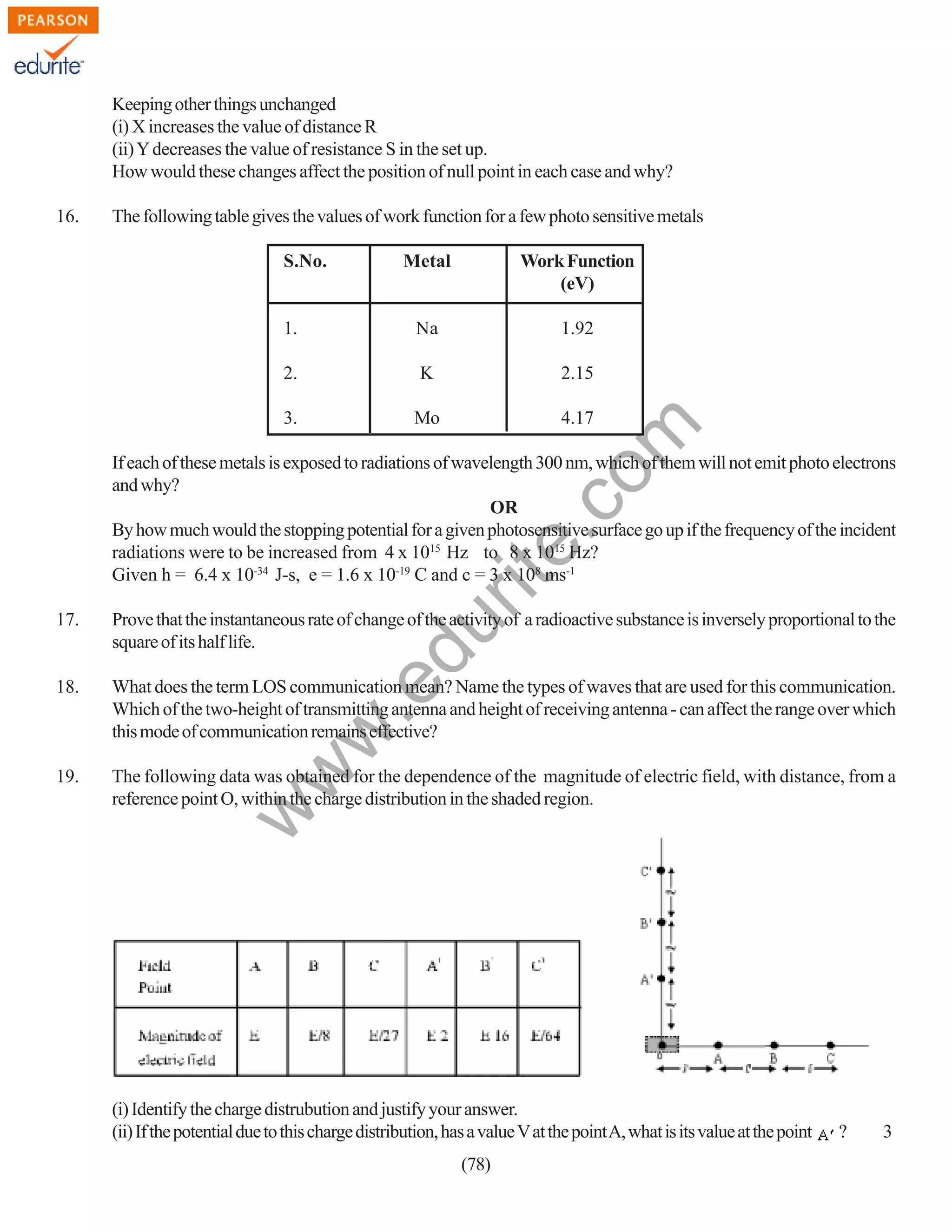
19.

The following data was obtained for the dependence of the magnitude of electric field, with distance, from a
reference point O, within the charge distribution in the shaded region.

w

w
w

.e

du

17.

(i) Identify the charge distrubution and justify your answer.
(ii) If the potential due to this charge distribution, has a value V at the point A, what is its value at the point
(78)

?

3
20.

A charge Q located at a point

is in equilibrium under the combined electric field of three charges q1,q2, q3. If the

charges q1, q2 are located at points
of q1,q2,

respectively, find the direction of the force on Q, due to q3 in terms

.

3

, are arranged in m rows each containing n cells connected
12 cells, each of emf 1.5V and internal resistance
in series, as shown. Calculate the values of n and m for which this combination would send maximum current
through an external resistance of
.

du

rit
e.
co
m

21.

and

OR

w
w

.e

For the circuit shown here, calculate the potential difference between points B and D

w

3

22.

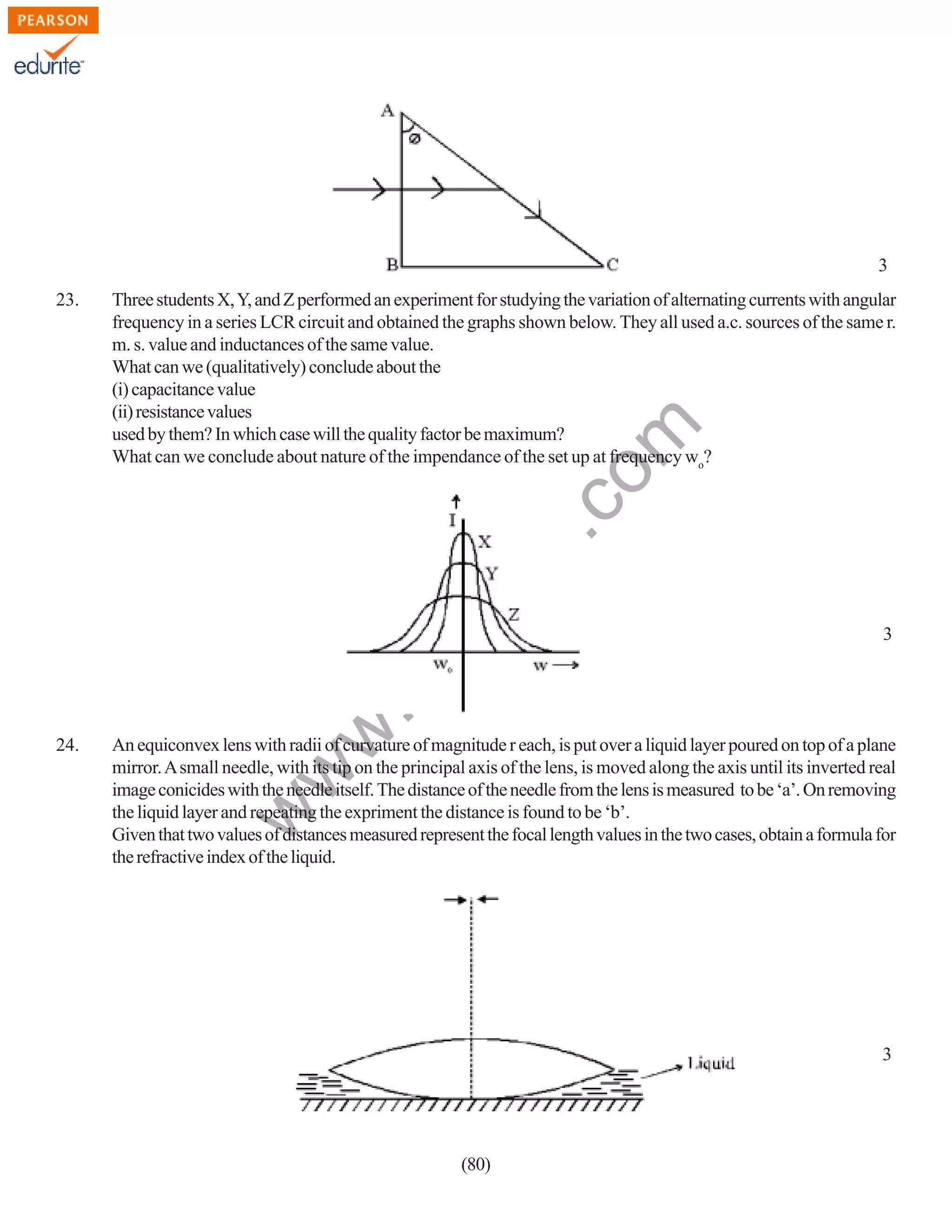
A beam of light of wavelength 400 nm is incident normally on a right angled prism as shown. It is observed that the
light just grazes along the surface AC after falling on it. Given that the refractive index of the material of the prism
varies with the wavelength as per the relation

calculate the value of b and the refractive index of the prism material for a wavelength
[(Given = Sin-1 (0.625)]
(79)

.
3
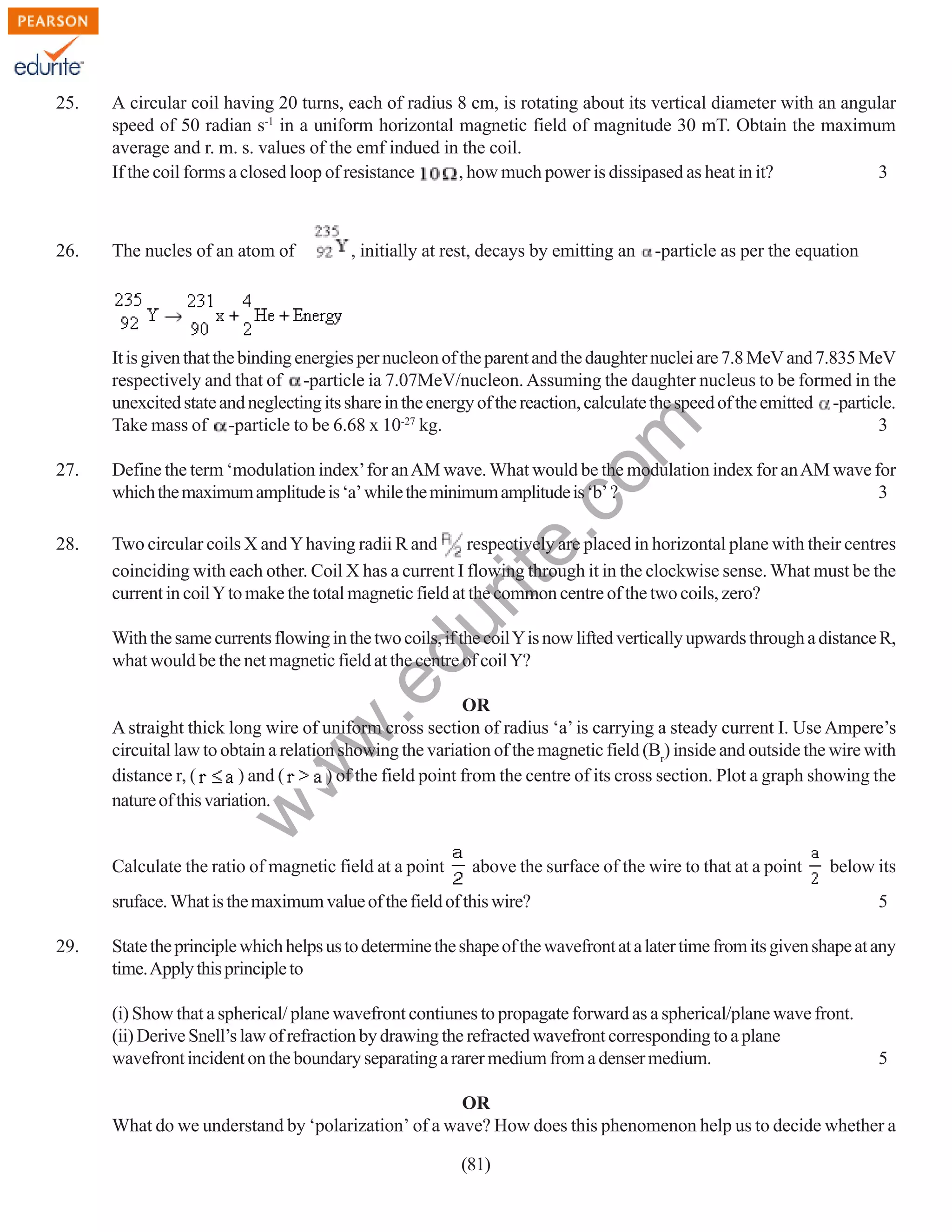
Three students X, Y, and Z performed an experiment for studying the variation of alternating currents with angular
frequency in a series LCR circuit and obtained the graphs shown below. They all used a.c. sources of the same r.
m. s. value and inductances of the same value.
What can we (qualitatively) conclude about the
(i) capacitance value
(ii) resistance values
used by them? In which case will the quality factor be maximum?
What can we conclude about nature of the impendance of the set up at frequency wo?

3

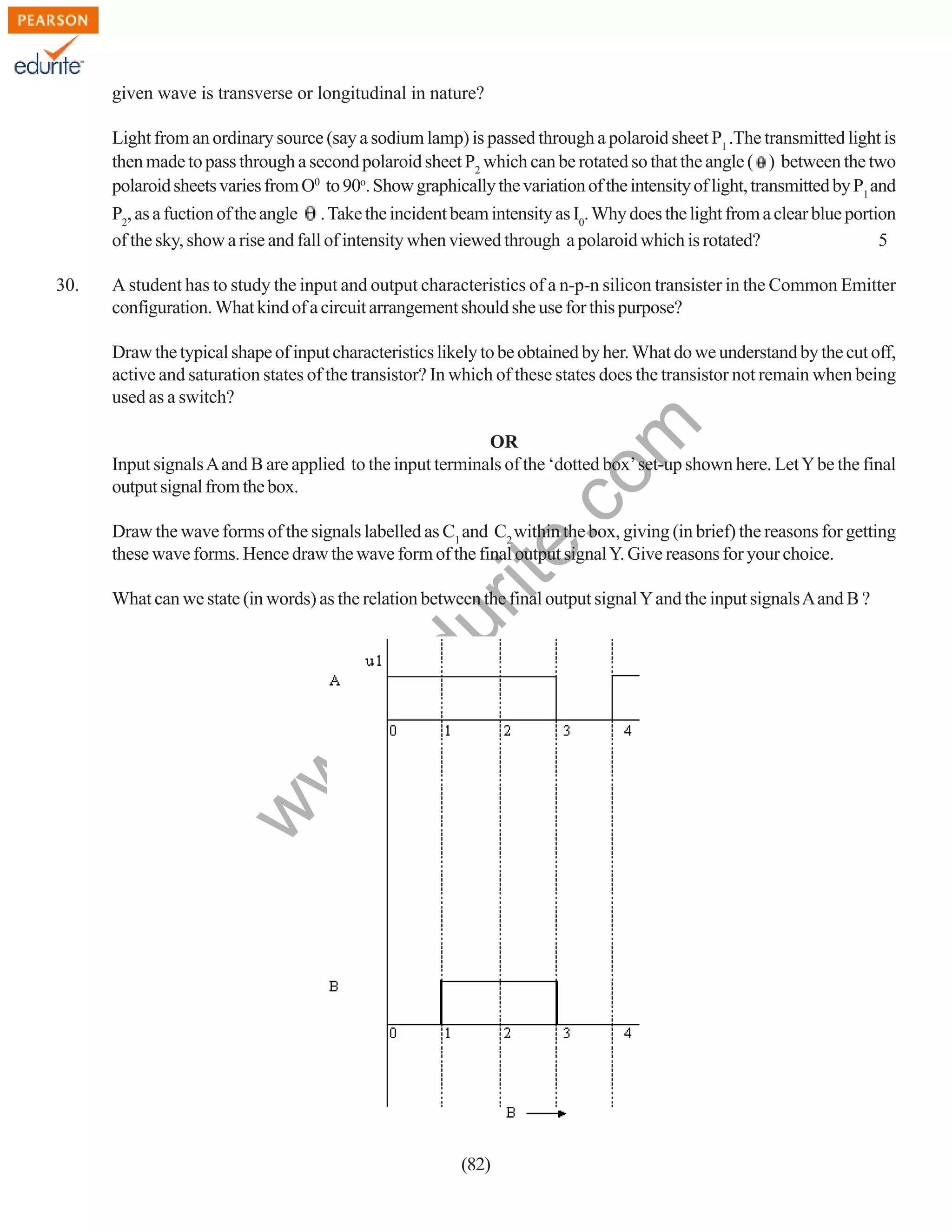
An equiconvex lens with radii of curvature of magnitude r each, is put over a liquid layer poured on top of a plane
mirror. A small needle, with its tip on the principal axis of the lens, is moved along the axis until its inverted real
image conicides with the needle itself. The distance of the needle from the lens is measured to be ‘a’. On removing
the liquid layer and repeating the expriment the distance is found to be ‘b’.
Given that two values of distances measured represent the focal length values in the two cases, obtain a formula for
the refractive index of the liquid.

w

24.

w
w

.e

du

rit
e.
co
m

23.

3

(80)
25.

A circular coil having 20 turns, each of radius 8 cm, is rotating about its vertical diameter with an angular
speed of 50 radian s-1 in a uniform horizontal magnetic field of magnitude 30 mT. Obtain the maximum
average and r. m. s. values of the emf indued in the coil.
If the coil forms a closed loop of resistance
, how much power is dissipased as heat in it?
3

26.

The nucles of an atom of

, initially at rest, decays by emitting an

-particle as per the equation

rit
e.
co
m

It is given that the binding energies per nucleon of the parent and the daughter nuclei are 7.8 MeV and 7.835 MeV
respectively and that of -particle ia 7.07MeV/nucleon. Assuming the daughter nucleus to be formed in the
unexcited state and neglecting its share in the energy of the reaction, calculate the speed of the emitted -particle.
Take mass of -particle to be 6.68 x 10⁻²⁷ kg.
3
Define the term ‘modulation index’ for an AM wave. What would be the modulation index for an AM wave for
which the maximum amplitude is ‘a’ while the minimum amplitude is ‘b’ ?
3

28.

respectively are placed in horizontal plane with their centres
Two circular coils X and Y having radii R and
coinciding with each other. Coil X has a current I flowing through it in the clockwise sense. What must be the
current in coil Y to make the total magnetic field at the common centre of the two coils, zero?

du

27.

.e

With the same currents flowing in the two coils, if the coil Y is now lifted vertically upwards through a distance R,
what would be the net magnetic field at the centre of coil Y?

w

w
w

OR
A straight thick long wire of uniform cross section of radius ‘a’ is carrying a steady current I. Use Ampere’s
circuital law to obtain a relation showing the variation of the magnetic field (Br) inside and outside the wire with
distance r, (
) and (
) of the field point from the centre of its cross section. Plot a graph showing the
nature of this variation.

Calculate the ratio of magnetic field at a point

above the surface of the wire to that at a point

below its

sruface. What is the maximum value of the field of this wire?
29.

5

State the principle which helps us to determine the shape of the wavefront at a later time from its given shape at any
time. Apply this principle to
(i) Show that a spherical/ plane wavefront contiunes to propagate forward as a spherical/plane wave front.
(ii) Derive Snell’s law of refraction by drawing the refracted wavefront corresponding to a plane
wavefront incident on the boundary separating a rarer medium from a denser medium.

5

OR
What do we understand by ‘polarization’ of a wave? How does this phenomenon help us to decide whether a
(81)
given wave is transverse or longitudinal in nature?
Light from an ordinary source (say a sodium lamp) is passed through a polaroid sheet P1 .The transmitted light is
then made to pass through a second polaroid sheet P2 which can be rotated so that the angle ( ) between the two
polaroid sheets varies from O0 to 90o. Show graphically the variation of the intensity of light, transmitted by P1 and
P2, as a fuction of the angle . Take the incident beam intensity as I0. Why does the light from a clear blue portion
of the sky, show a rise and fall of intensity when viewed through a polaroid which is rotated?
5
A student has to study the input and output characteristics of a n-p-n silicon transister in the Common Emitter
configuration. What kind of a circuit arrangement should she use for this purpose?

rit
e.
co
m

Draw the typical shape of input characteristics likely to be obtained by her. What do we understand by the cut off,
active and saturation states of the transistor? In which of these states does the transistor not remain when being
used as a switch?
OR
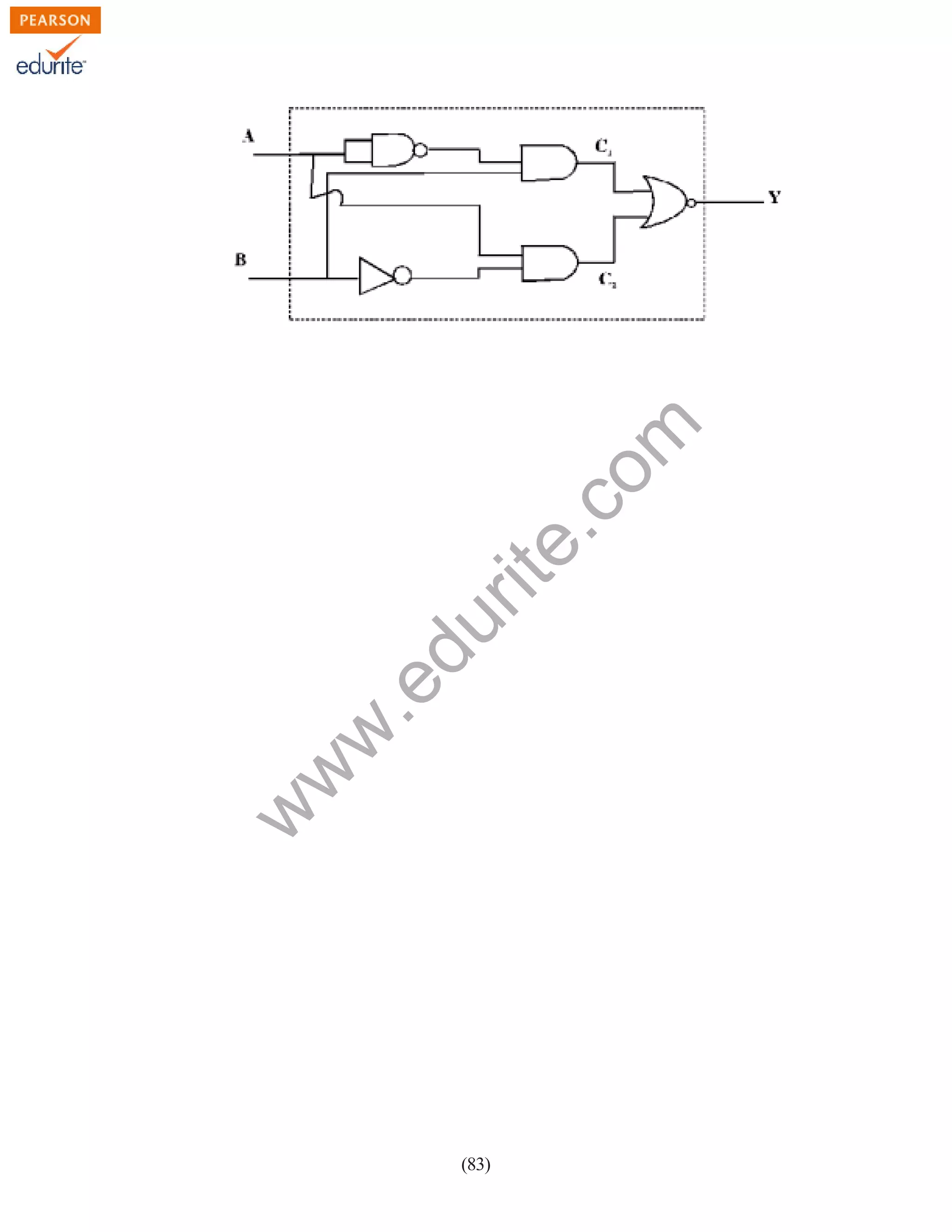
Input signals A and B are applied to the input terminals of the ‘dotted box’ set-up shown here. Let Y be the final
output signal from the box.
Draw the wave forms of the signals labelled as C1 and C2 within the box, giving (in brief) the reasons for getting
these wave forms. Hence draw the wave form of the final output signal Y. Give reasons for your choice.

w
w

.e

du

What can we state (in words) as the relation between the final output signal Y and the input signals A and B ?

w

30.

(82)
(83)

w
rit
e.
co
m

du

.e

w
w
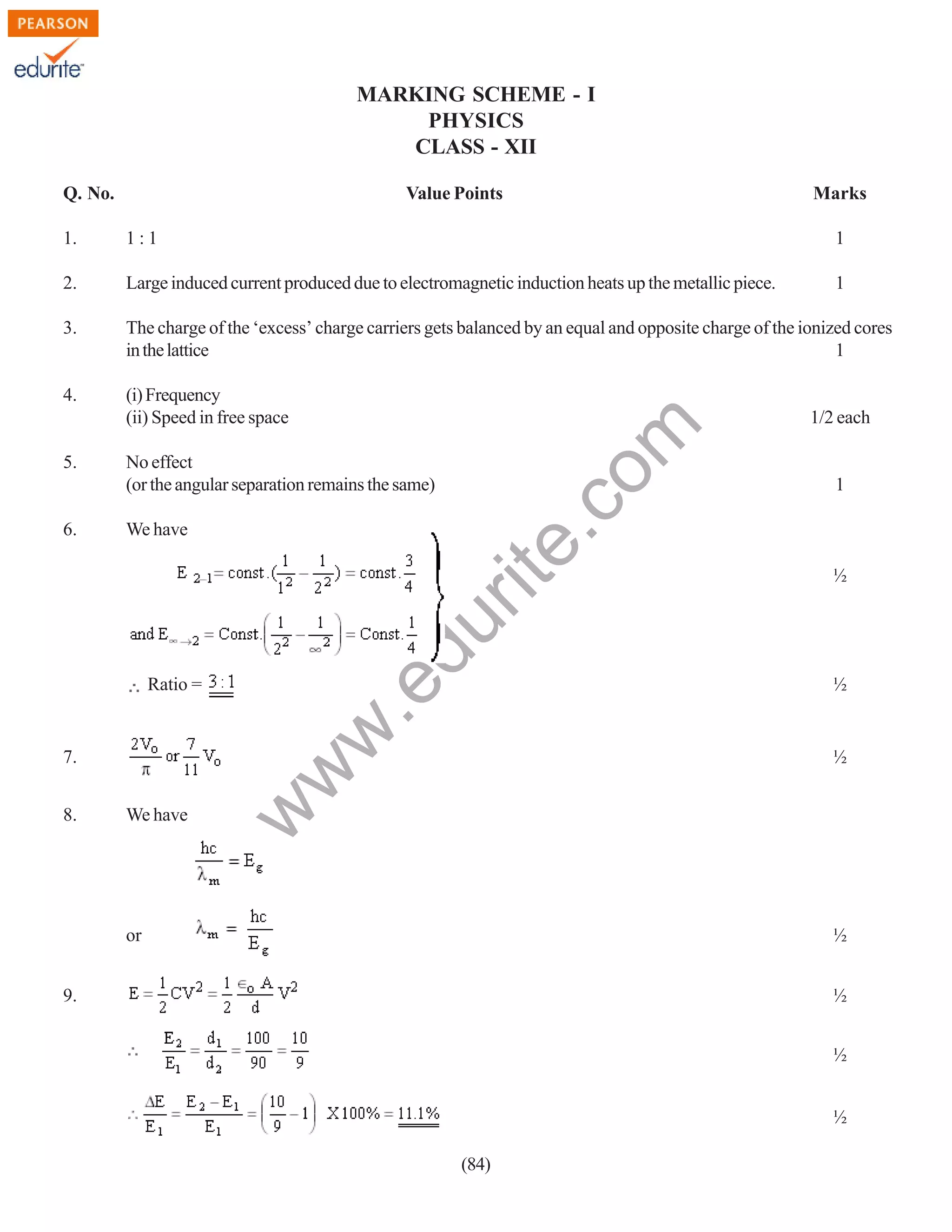
MARKING SCHEME - I
PHYSICS
CLASS - XII
Q. No.

Value Points

Marks

1:1

1

2.

Large induced current produced due to electromagnetic induction heats up the metallic piece.

1

3.

The charge of the ‘excess’ charge carriers gets balanced by an equal and opposite charge of the ionized cores
in the lattice
1

4.

(i) Frequency
(ii) Speed in free space

6.

No effect
(or the angular separation remains the same)
We have

du

5.

w
w

.e

Ratio =

We have

1/2 each

1

½

½

½

w

7.
8.

rit
e.
co
m

1.

or

½

9.

½
½
½
(84)
Q. No.
10.

Value Points

Marks
½

We have

½
= zero (Random nature of motion and collisions)

½

= constant
as

, the average time between collisions, remains contant under constant temprature conditions

½

(i) It increases
(ii) It decreases
(iii) Justification

12.

The atom/molecule of a diamagnetic material has zero net magnetic moment. For a paramagnetic material it is
not so.
1

rit
e.
co
m

11.

½+½
½+½
½

du

With an even atomic number, the electrons in an atom of an element can ‘pair off’, which can makes the net
magnetic moment of each pair as zero. This makes the element more likely to be diamagnetic.
1
Infrared radiations get readily absorbed by water molecules in most materials. This increases their thermal
motion and heats them up.
1
(i) visible light
(ii) Microwaves
½+½

14.

Focal length of the lens

½

Obervation at S-No-3 is incorrect

½

w

w
w

.e

13.

This observation is incorrect because for an object distance lying between f and 2f, the image distance has to be
more than 2f.
1
15.

For student X, the null point would shift towards right (i.e. towards B)
[Increase in R decreases the potential gradient. Hence a greater length of wire would be needed for balancing the
same emf.]
For student Y, the null point would shift towards left (ie. toward A) [A decrease of S would decrease the terminal
p.d.V across the unknown battery ( V = E - ir and

increases as S decreases] and hence a smaller

length (for the same potential gradient) would be needed for balancing it]
16.

1

Energy of a photon of the incident radiation

½

(85)
Q. No.

Value Points

Marks

1
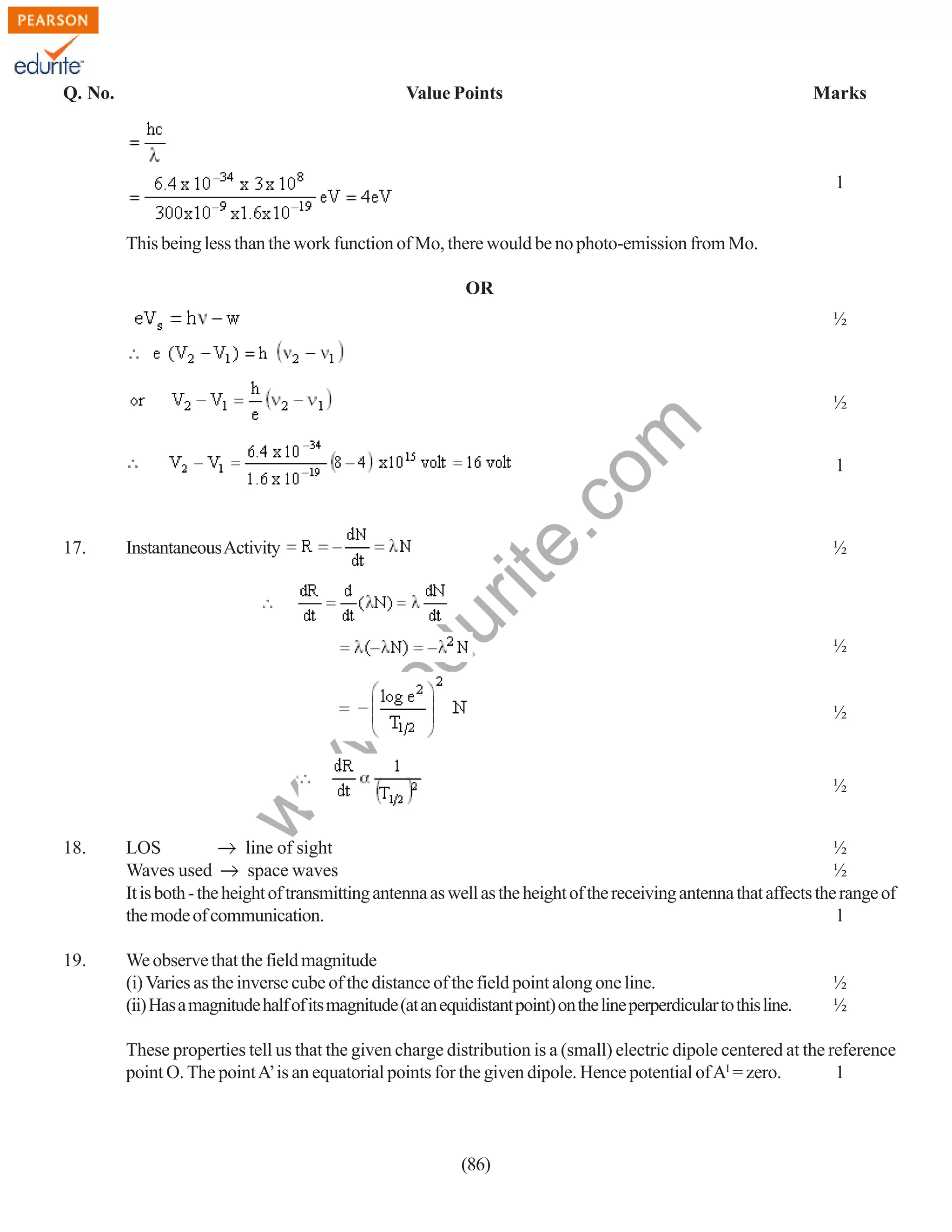
This being less than the work function of Mo, there would be no photo-emission from Mo.
OR
½

Instantaneous Activity

.e

du

17.

rit
e.
co
m

½
1

½

½

w
w

½

w

½

18.

LOS
line of sight
½
Waves used
space waves
½
It is both - the height of transmitting antenna as well as the height of the receiving antenna that affects the range of
the mode of communication.
1

19.

We observe that the field magnitude
(i) Varies as the inverse cube of the distance of the field point along one line.
(ii) Has a magnitude half of its magnitude (at an equidistant point) on the line perperdicular to this line.

½
½

These properties tell us that the given charge distribution is a (small) electric dipole centered at the reference
point O. The point A’ is an equatorial points for the given dipole. Hence potential of AI = zero.
1

(86)
Q. No.

20.

Value Points

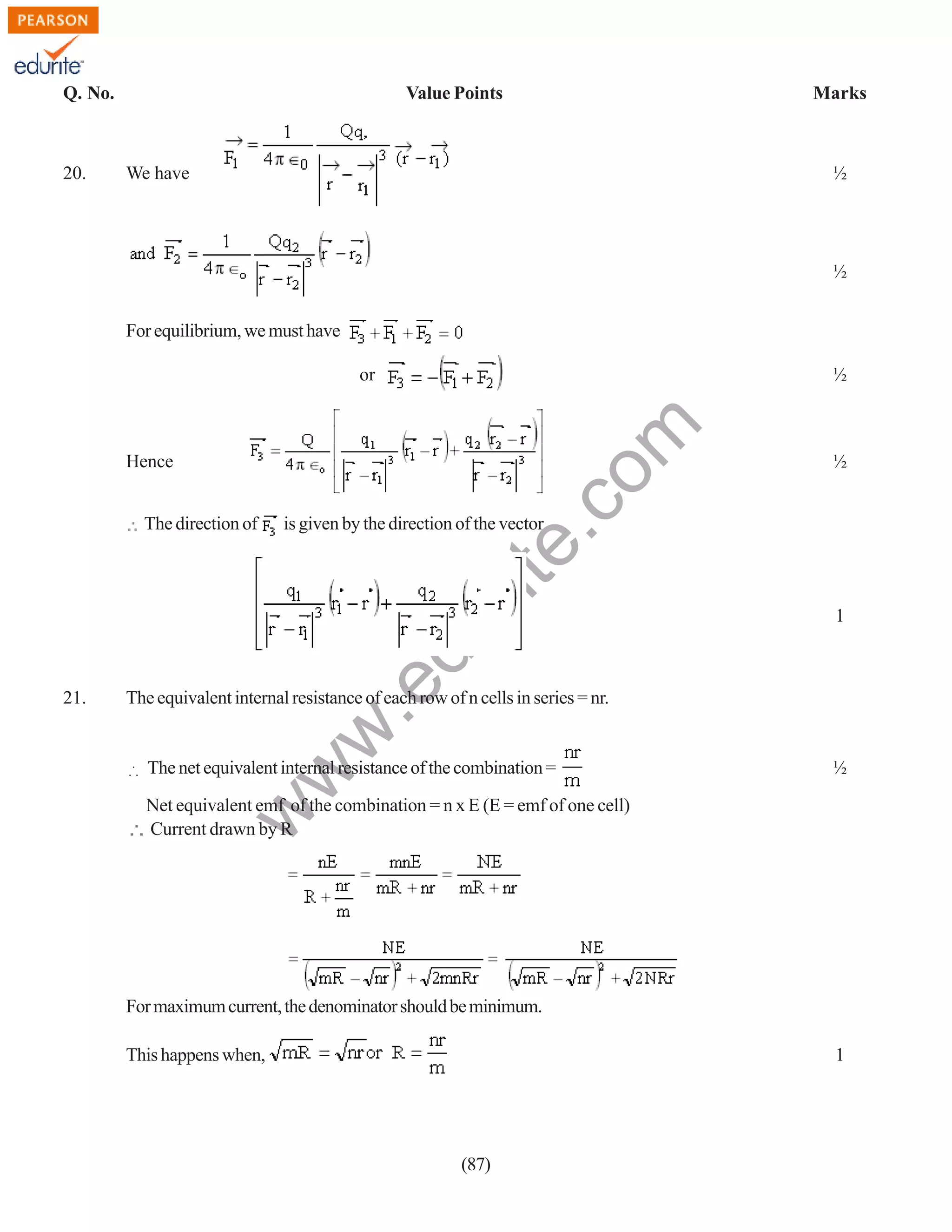
We have

Marks

½

½
For equilibrium, we must have
½

rit
e.
co
m

or

Hence

is given by the direction of the vector

w
w

The equivalent internal resistance of each row of n cells in series = nr.

The net equivalent internal resistance of the combination =

½

Net equivalent emf of the combination = n x E (E = emf of one cell)
Current drawn by R

w

21.

1

.e

du

The direction of

½

For maximum current, the denominator should be minimum.
This happens when,

1

(87)
Q. No.

Value Points

Marks

1

rit
e.
co
m

OR
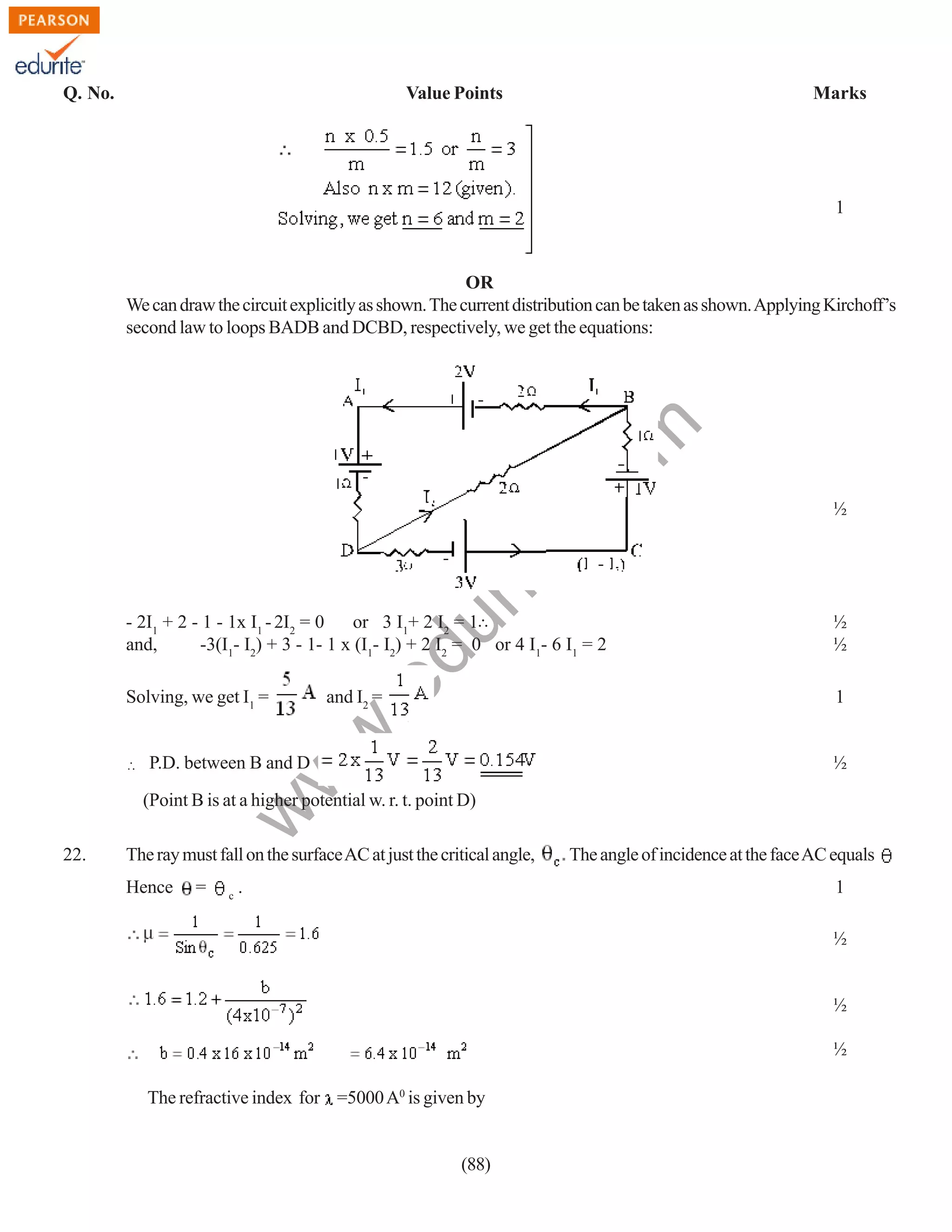
We can draw the circuit explicitly as shown. The current distribution can be taken as shown. Applying Kirchoff’s
second law to loops BADB and DCBD, respectively, we get the equations:

½
½

and I2 =

1

w
w

Solving, we get I1 =

.e

du

- 2I1 + 2 - 1 - 1x I1 - 2I2 = 0
or 3 I1+ 2 I2 = 1∴
and,
-3(I1- I2) + 3 - 1- 1 x (I1- I2) + 2 I2 = 0 or 4 I1- 6 I1 = 2

½

½

P.D. between B and D

w

(Point B is at a higher potential w. r. t. point D)
22.

The ray must fall on the surface AC at just the critical angle,
Hence

=

c

.

The angle of incidence at the face AC equals
1
½

½
½
The refractive index for =5000 A0 is given by

(88)
Q. No.

Value Points

Marks

½

23.

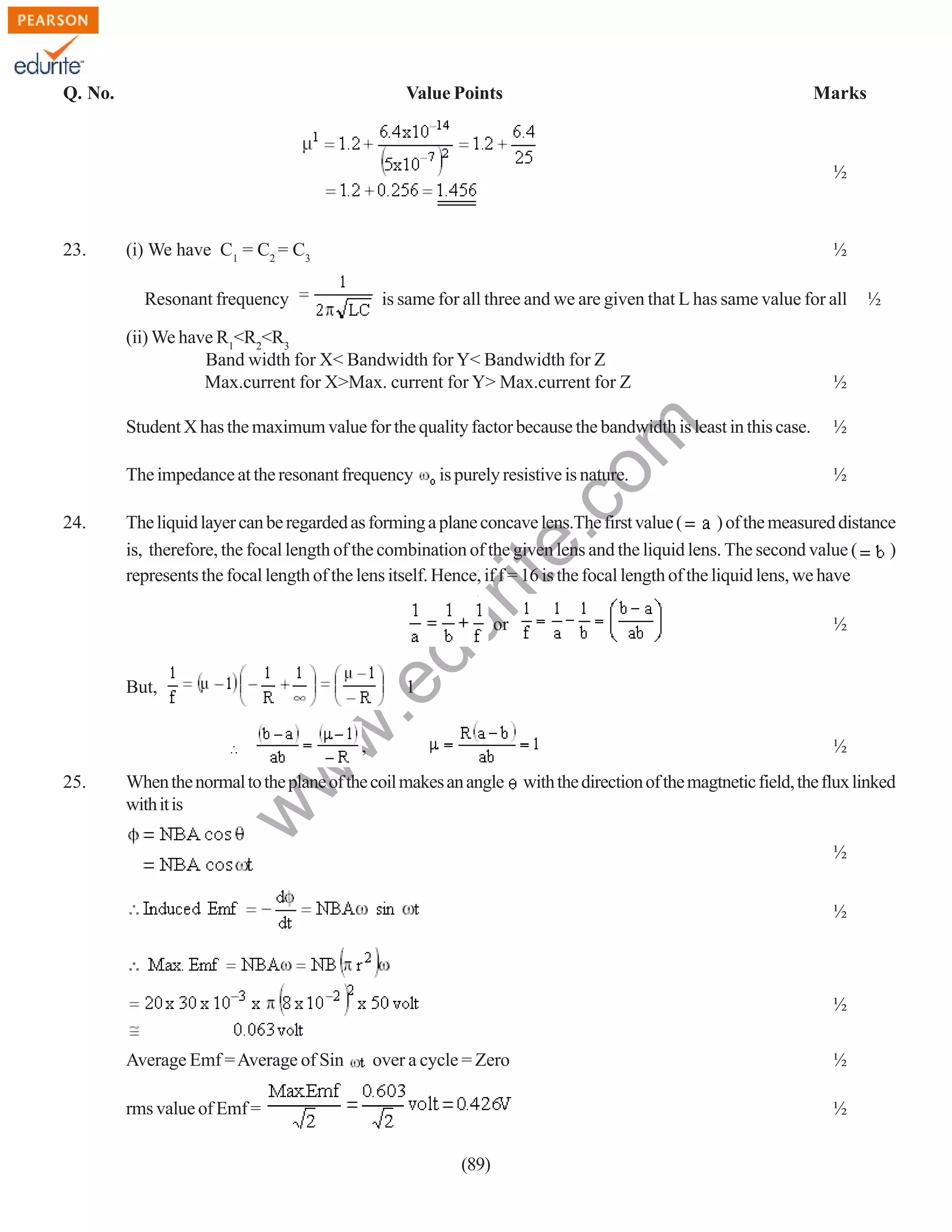
(i) We have C1 = C2 = C3

½

Resonant frequency

is same for all three and we are given that L has same value for all

½

Student X has the maximum value for the quality factor because the bandwidth is least in this case.

½

The impedance at the resonant frequency
24.

rit
e.
co
m

(ii) We have R1<R2<R3
Band width for X< Bandwidth for Y< Bandwidth for Z
Max.current for X>Max. current for Y> Max.current for Z

is purely resistive is nature.

½

The liquid layer can be regarded as forming a plane concave lens.The first value (
) of the measured distance
is, therefore, the focal length of the combination of the given lens and the liquid lens. The second value (
)
represents the focal length of the lens itself. Hence, if f = 16 is the focal length of the liquid lens, we have

du

∴ or

½

1

w
w

.e

But,

,

½

When the normal to the plane of the coil makes an angle
with it is

w

25.

½

with the direction of the magtnetic field, the flux linked

½
½

½
Average Emf = Average of Sin

over a cycle = Zero

rms value of Emf =

½
½

(89)
Q. No.

Value Points

Marks

Power dissipated =
26.

½

Total B.E. of parent Nucleus
= 7.8 x 235 MeV = 1833MeV

½

= 7.835 x 231 MeV = 1809.9MeV

½

= 7.07 x 4 MeV = 28.28 MeV

½

Total B.E. of daughter nucleus
Total B.E. of

-particle

Increase in B.E. after the reaction

rit
e.
co
m

= [(180.9+28.28) - (1833)]MeV = 5.18 MeV
This is the energy released in the reaction, since it assumed to be taken up totally by the

27.

½

½

du

mv2 = 5.18 x 1.6 x 10-13 J

-particle,

The modulation index ( ) for an AM wave equals the ratio of the peak value of the modulating signal (Am) to the

w
w

½

w

Given that

.e

peak value of the carrier wave (Ac )

½

1

28.

We have

½

½

(90)
Q. No.

Value Points

Marks

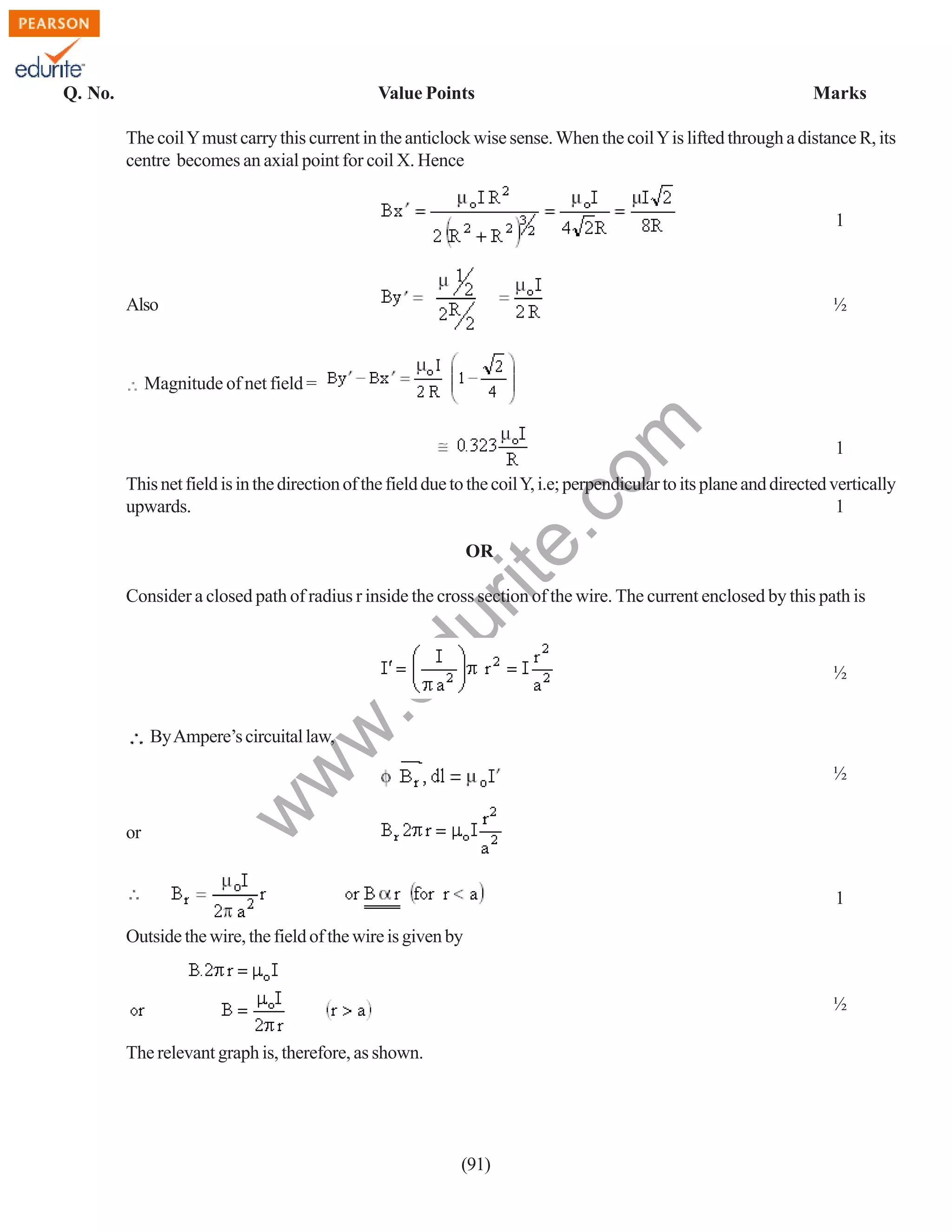
The coil Y must carry this current in the anticlock wise sense. When the coil Y is lifted through a distance R, its
centre becomes an axial point for coil X. Hence
1

Also

½

rit
e.
co
m

Magnitude of net field =

1

This net field is in the direction of the field due to the coil Y, i.e; perpendicular to its plane and directed vertically
upwards.
1
OR

w
w

.e

du

Consider a closed path of radius r inside the cross section of the wire. The current enclosed by this path is

½

By Ampere’s circuital law,

w

or

½

1
Outside the wire, the field of the wire is given by

½
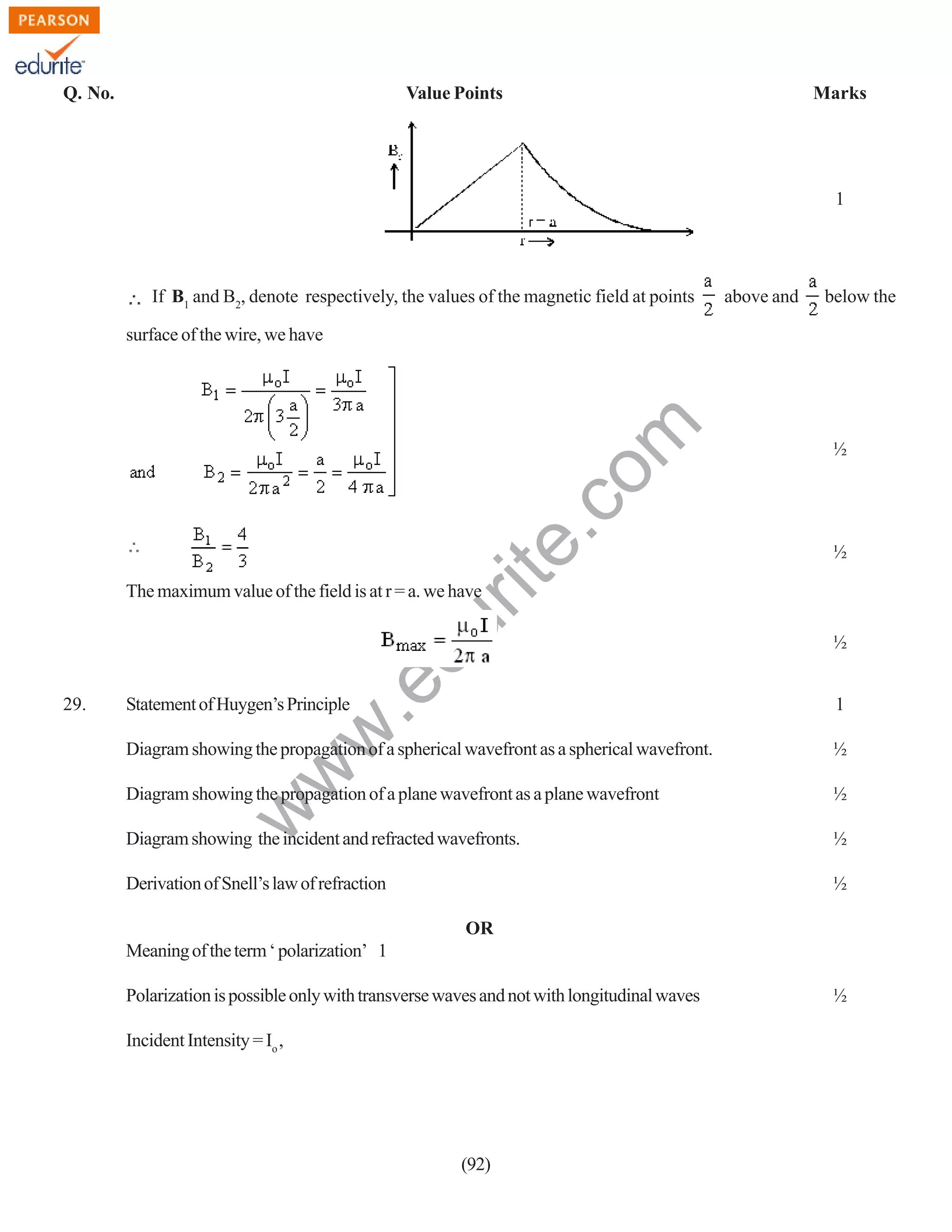
The relevant graph is, therefore, as shown.

(91)
Q. No.

Value Points

Marks

1

If B1 and B2, denote respectively, the values of the magnetic field at points

above and

below the

rit
e.
co
m

surface of the wire, we have

½

½

½
1

w
w

Statement of Huygen’s Principle

Diagram showing the propagation of a spherical wavefront as a spherical wavefront.

½

Diagram showing the propagation of a plane wavefront as a plane wavefront

½

w

29.

.e

du

The maximum value of the field is at r = a. we have

Diagram showing the incident and refracted wavefronts.

½

Derivation of Snell’s law of refraction

½
OR

Meaning of the term ‘ polarization’ 1
Polarization is possible only with transverse waves and not with longitudinal waves
Incident Intensity = Io ,

(92)

½
Q. No.

Value Points
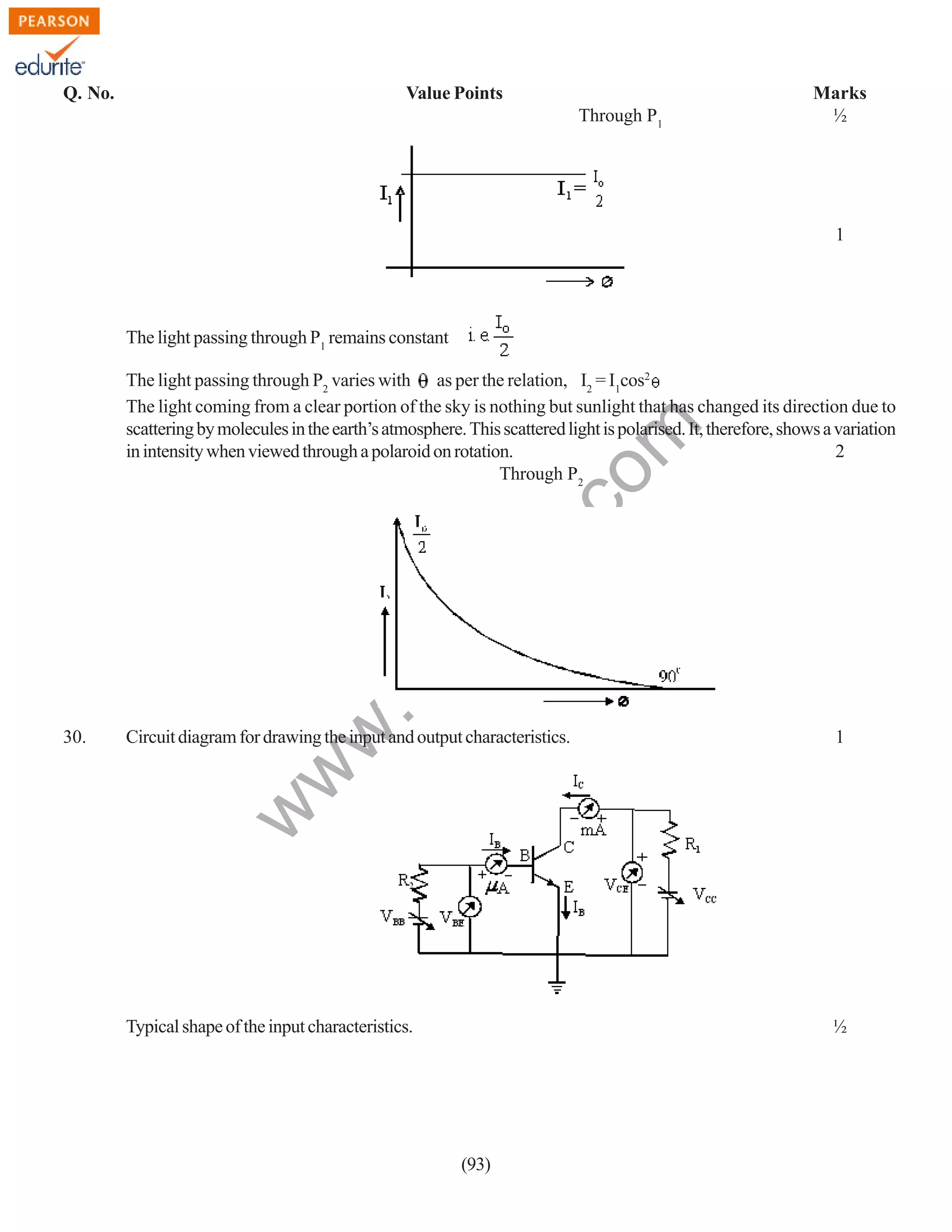
Through P1

Marks
½

1

The light passing through P1 remains constant

Circuit diagram for drawing the input and output characteristics.

1

w

30.

w
w

.e

du

rit
e.
co
m

The light passing through P2 varies with as per the relation, I2 = I1cos2
The light coming from a clear portion of the sky is nothing but sunlight that has changed its direction due to
scattering by molecules in the earth’s atmosphere. This scattered light is polarised. It, therefore, shows a variation
in intensity when viewed through a polaroid on rotation.
2
Through P2

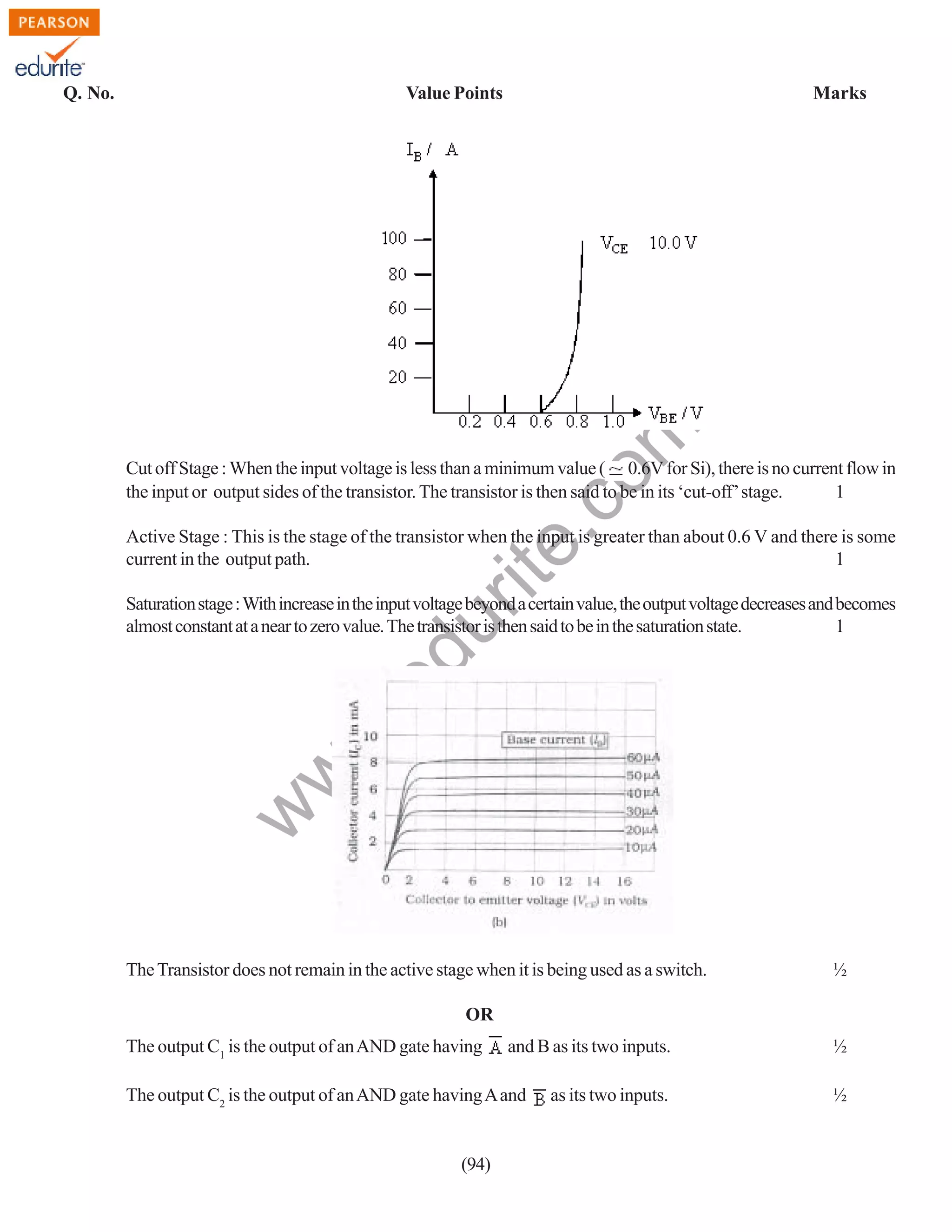
Typical shape of the input characteristics.

½

(93)
Value Points

Marks

rit
e.
co
m

Q. No.

Cut off Stage : When the input voltage is less than a minimum value ( 0.6V for Si), there is no current flow in
the input or output sides of the transistor. The transistor is then said to be in its ‘cut-off’ stage.
1
Active Stage : This is the stage of the transistor when the input is greater than about 0.6 V and there is some
current in the output path.
1

w

w
w

.e

du

Saturation stage : With increase in the input voltage beyond a certain value, the output voltage decreases and becomes
almost constant at a near to zero value. The transistor is then said to be in the saturation state.
1

The Transistor does not remain in the active stage when it is being used as a switch.

½

OR
The output C1 is the output of an AND gate having

and B as its two inputs.

The output C2 is the output of an AND gate having A and

(94)

as its two inputs.

½
½
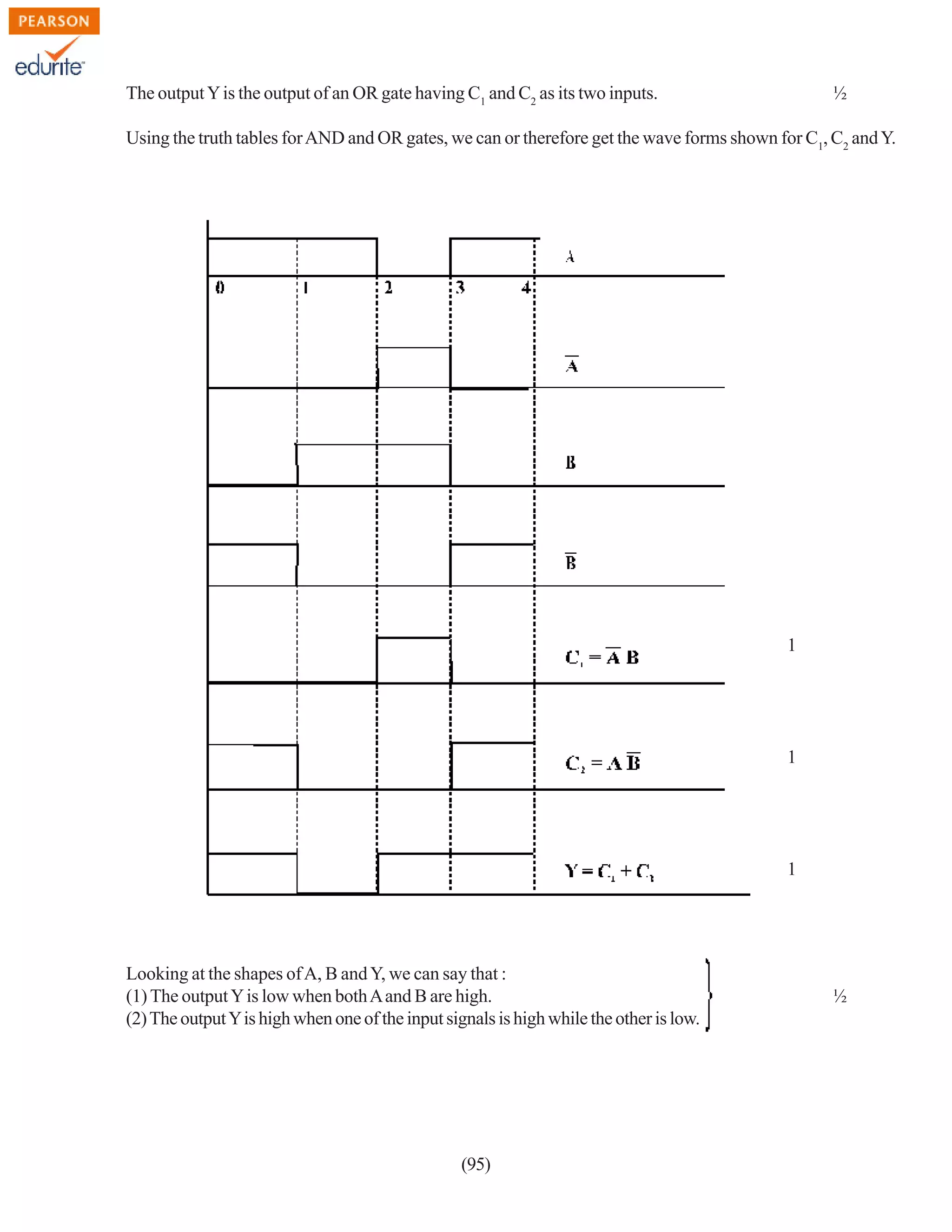
The output Y is the output of an OR gate having C1 and C2 as its two inputs.

½

1

w
w

.e

du

rit
e.
co
m

Using the truth tables for AND and OR gates, we can or therefore get the wave forms shown for C1, C2 and Y.

w

1

1

Looking at the shapes of A, B and Y, we can say that :
(1) The output Y is low when both A and B are high.
(2) The output Y is high when one of the input signals is high while the other is low.

(95)

½

Cbse Class 12 Physics Sample Paper 2010 Model 1

  • 1.
    DESIGN OF THEQUESTION PAPER PHYSICS - CLASS XII Time : 3 Hrs. Max. Marks : 70 The weightage of the distribution of marks over different dimensions of the question paper shall be as follows: A. Weightage to content/ subject units du B. Weightage to form of questions Form of Questions 1. 2. 3. 4. Long Answer Type (LA) Short Answer (SA I) Short Answer (SA II) Very Short Answer (VSA) TOTAL .e S.No. Marks for each Question 5 3 2 1 - No. of Questions 3 09 10 08 30 Total Marks 15 27 20 08 70 w w w Marks 08 07 08 08 03 14 04 06 07 05 70 rit e. co m Unit Electrostatics Current Electricity Magnetic Effect of Current & Magnetism Electromagnetic Induction and Alternating current Electromagnetic Waves Optics Dual Nature of Matter Atoms and Nuclei Electronic Devices Communication Systems Total C. Scheme of Options 1. There will be no overall option. 2. Internal choices (either / or type) on a very selective basis has been given in five questions. This internal choice is given in any one question of 2 marks, any one question of 3 marks and all three questions of 5 marks weightage. D. A Weightage of about 15 marks in total, has been assigned to numericals E. Weightage to difficulty level of questions. S.No. Estimated difficlty level Percentage 1. Easy 15 2. Average 70 3. Difficult 15 A weightage of 20% has been assigned to questions which test higher order thinking skills of students. (74)
  • 2.
    (75) Electrostatics Current Electricity Magnetic effectof Current and Magnetism Electromagnetic Induction & Alternating currents Electromagnetic Waves Optics Dual nature of Matter Atoms and Nuclei Electronic Devices Communication systems 1. 2. 3. 4. 5. 6. 7. 8. 9. 10. Total UNIT S.NO. w 8(8) - 2(2) 1(1) - 1(1) 1(1) 2(2) 1(1) 2(1) 4(2) 2 (1) SA I (2 Marks) 2(1) 4(2) 2(1) 20(10) 2(1) - 6(2) - 3(1) 6 (2) SAII (3 Marks) 27(9) 3(1) - 3(1) - 6(2) - rit e. co m 2(1) - du .e w w - VSA (1 Marks) Class XII Physics BLUE-PRINT I 15(3) - 5(1) - - 5(1) - - 5(1) - - LA (5 Marks) 70(30) 5(2) 7(3) 6(3) 4(2) 14(5) 3(2) 8(4) 8(3) 7(3) 8 (3) TOTAL
  • 3.
    SAMPLE PAPER I XII- PHYSICS Time : Three Hours (c) (d) (e) General Instructions All questions are compulsory. There are 30 questions in total. Questions 1 to 8 carry one mark each, questions 9 to 18 carry two marks each, questions 19 to 27 carry three marks each and questions 28 to 30 carry five marks each. There is no overall choice. However, an internal choice has been provided in one question of two marks, one question of three marks and all three questions of five marks each. You have to attempt only one of the given choices in such questions. Use of calculators is not permitted. You may use the following physical constants wherever necessary : c h e µo = = = = 3 x 10⁸ms-1 6.6 x 10⁻³⁴Js 1.6 x 10⁻¹⁹ C 4 π x 10−7 T m A −1 rit e. co m (a) (b) Max. Marks : 70 Boltzmann constant k = 1.38 x 10²³ JK-1 Avogadro’s number NA = 6.023 x 10²³/mole Mass of neutron mn = 1.6 x 10⁻²⁷ kg Two identical charged particles moving with same speed enter a region of uniform magnetic field. If one of these enters normal to the field direction and the other enters along a direction at 300 with the field, what would be the ratio of their angular frequencies? 2. Why does a metallic piece become very hot when it is surrounded by a coil carrying high frequency alternating current? 3. How is a sample of an n-type semiconductor electrically neutral though it has an excess of negative charge carriers? 4. Name the characteristics of electromagnetic waves that (i) increases (ii) remains constant in the electromagnetic spectrum as one moves from radiowave region towards ultravoilet region. 5. How would the angular separation of interference fringes in young’s double slit experiment change when the distance of separation between the slits and the screen is doubled? 6. Calculate the ratio of energies of photons produced due to transition of electron of hydrogen atom from its, w w w .e du 1. (i) Second permitted energy level to the first level, and (ii) Highest permitted energy level to the second permitted level 7. Give expression for the average value of the a c voltage V = V0 Sin ωt (76)
  • 4.
    over the timeinterval t = 0 and t = 8. How is the band gap, Eg, of a photo diode related to the maximum wavelength, 9. Keeping the voltage of the the charging source constant, what would be the percentage change in the energy stored in a parallel plate capacitor if the separation between its plates were to be decreased by 10%? 10. Explain how the average velocity of free electrons in a metal at constant temperature, in an electric field, remain constant even though the electrons are being constantly accelarated by this electric field? 11. How is the resolving power of a microscope affected when, (i) the wavelength of illuminating radiations is decreased? (ii) the diameter of the objective lens is decreased? Justify your answer. 12. What is the basic difference between the atom or molecule of a diamagnetic and a paramagnetic material? Why are elements with even atomic number more likely to be diamagnetic? 13. Why are infrared radiations referred to as heat waves also? Name the radiations which are next to these radiations in electromagnetic specturm having (i) Shorter wavelength. (ii) Longer wavelength. 14. The following data was recorded for values of object distance and the corresponding values of image distance in the experiment on study of real image formation by a convex lens of power +5D. One of these observations is incorrect. Indentify this observation and give reason for your choice: S.No. 1 2 3 4 5 6 , that can be detected by it? w w .e du rit e. co m m 25 30 35 45 50 55 Image distance (cm) 97 61 37 35 32 30 w Object distance (cm) 15. Two students X and Y perform an experiment on potentiometer separately using the circuit diagram shown here. (77)
  • 5.
    Keeping other thingsunchanged (i) X increases the value of distance R (ii) Y decreases the value of resistance S in the set up. How would these changes affect the position of null point in each case and why? 16. The following table gives the values of work function for a few photo sensitive metals Metal Work Function (eV) 1. Na 1.92 2. K 2.15 3. Mo 4.17 rit e. co m S.No. If each of these metals is exposed to radiations of wavelength 300 nm, which of them will not emit photo electrons and why? OR By how much would the stopping potential for a given photosensitive surface go up if the frequency of the incident radiations were to be increased from 4 x 10¹⁵ Hz to 8 x 10¹⁵ Hz? Given h = 6.4 x 10⁻³⁴ J-s, e = 1.6 x 10⁻¹⁹ C and c = 3 x 10⁸ ms-1 Prove that the instantaneous rate of change of the activity of a radioactive substance is inversely proportional to the square of its half life. 18. What does the term LOS communication mean? Name the types of waves that are used for this communication. Which of the two-height of transmitting antenna and height of receiving antenna - can affect the range over which this mode of communication remains effective? 19. The following data was obtained for the dependence of the magnitude of electric field, with distance, from a reference point O, within the charge distribution in the shaded region. w w w .e du 17. (i) Identify the charge distrubution and justify your answer. (ii) If the potential due to this charge distribution, has a value V at the point A, what is its value at the point (78) ? 3
  • 6.
    20. A charge Qlocated at a point is in equilibrium under the combined electric field of three charges q1,q2, q3. If the charges q1, q2 are located at points of q1,q2, respectively, find the direction of the force on Q, due to q3 in terms . 3 , are arranged in m rows each containing n cells connected 12 cells, each of emf 1.5V and internal resistance in series, as shown. Calculate the values of n and m for which this combination would send maximum current through an external resistance of . du rit e. co m 21. and OR w w .e For the circuit shown here, calculate the potential difference between points B and D w 3 22. A beam of light of wavelength 400 nm is incident normally on a right angled prism as shown. It is observed that the light just grazes along the surface AC after falling on it. Given that the refractive index of the material of the prism varies with the wavelength as per the relation calculate the value of b and the refractive index of the prism material for a wavelength [(Given = Sin-1 (0.625)] (79) .
  • 7.
    3 Three students X,Y, and Z performed an experiment for studying the variation of alternating currents with angular frequency in a series LCR circuit and obtained the graphs shown below. They all used a.c. sources of the same r. m. s. value and inductances of the same value. What can we (qualitatively) conclude about the (i) capacitance value (ii) resistance values used by them? In which case will the quality factor be maximum? What can we conclude about nature of the impendance of the set up at frequency wo? 3 An equiconvex lens with radii of curvature of magnitude r each, is put over a liquid layer poured on top of a plane mirror. A small needle, with its tip on the principal axis of the lens, is moved along the axis until its inverted real image conicides with the needle itself. The distance of the needle from the lens is measured to be ‘a’. On removing the liquid layer and repeating the expriment the distance is found to be ‘b’. Given that two values of distances measured represent the focal length values in the two cases, obtain a formula for the refractive index of the liquid. w 24. w w .e du rit e. co m 23. 3 (80)
  • 8.
    25. A circular coilhaving 20 turns, each of radius 8 cm, is rotating about its vertical diameter with an angular speed of 50 radian s-1 in a uniform horizontal magnetic field of magnitude 30 mT. Obtain the maximum average and r. m. s. values of the emf indued in the coil. If the coil forms a closed loop of resistance , how much power is dissipased as heat in it? 3 26. The nucles of an atom of , initially at rest, decays by emitting an -particle as per the equation rit e. co m It is given that the binding energies per nucleon of the parent and the daughter nuclei are 7.8 MeV and 7.835 MeV respectively and that of -particle ia 7.07MeV/nucleon. Assuming the daughter nucleus to be formed in the unexcited state and neglecting its share in the energy of the reaction, calculate the speed of the emitted -particle. Take mass of -particle to be 6.68 x 10⁻²⁷ kg. 3 Define the term ‘modulation index’ for an AM wave. What would be the modulation index for an AM wave for which the maximum amplitude is ‘a’ while the minimum amplitude is ‘b’ ? 3 28. respectively are placed in horizontal plane with their centres Two circular coils X and Y having radii R and coinciding with each other. Coil X has a current I flowing through it in the clockwise sense. What must be the current in coil Y to make the total magnetic field at the common centre of the two coils, zero? du 27. .e With the same currents flowing in the two coils, if the coil Y is now lifted vertically upwards through a distance R, what would be the net magnetic field at the centre of coil Y? w w w OR A straight thick long wire of uniform cross section of radius ‘a’ is carrying a steady current I. Use Ampere’s circuital law to obtain a relation showing the variation of the magnetic field (Br) inside and outside the wire with distance r, ( ) and ( ) of the field point from the centre of its cross section. Plot a graph showing the nature of this variation. Calculate the ratio of magnetic field at a point above the surface of the wire to that at a point below its sruface. What is the maximum value of the field of this wire? 29. 5 State the principle which helps us to determine the shape of the wavefront at a later time from its given shape at any time. Apply this principle to (i) Show that a spherical/ plane wavefront contiunes to propagate forward as a spherical/plane wave front. (ii) Derive Snell’s law of refraction by drawing the refracted wavefront corresponding to a plane wavefront incident on the boundary separating a rarer medium from a denser medium. 5 OR What do we understand by ‘polarization’ of a wave? How does this phenomenon help us to decide whether a (81)
  • 9.
    given wave istransverse or longitudinal in nature? Light from an ordinary source (say a sodium lamp) is passed through a polaroid sheet P1 .The transmitted light is then made to pass through a second polaroid sheet P2 which can be rotated so that the angle ( ) between the two polaroid sheets varies from O0 to 90o. Show graphically the variation of the intensity of light, transmitted by P1 and P2, as a fuction of the angle . Take the incident beam intensity as I0. Why does the light from a clear blue portion of the sky, show a rise and fall of intensity when viewed through a polaroid which is rotated? 5 A student has to study the input and output characteristics of a n-p-n silicon transister in the Common Emitter configuration. What kind of a circuit arrangement should she use for this purpose? rit e. co m Draw the typical shape of input characteristics likely to be obtained by her. What do we understand by the cut off, active and saturation states of the transistor? In which of these states does the transistor not remain when being used as a switch? OR Input signals A and B are applied to the input terminals of the ‘dotted box’ set-up shown here. Let Y be the final output signal from the box. Draw the wave forms of the signals labelled as C1 and C2 within the box, giving (in brief) the reasons for getting these wave forms. Hence draw the wave form of the final output signal Y. Give reasons for your choice. w w .e du What can we state (in words) as the relation between the final output signal Y and the input signals A and B ? w 30. (82)
  • 10.
  • 11.
    MARKING SCHEME -I PHYSICS CLASS - XII Q. No. Value Points Marks 1:1 1 2. Large induced current produced due to electromagnetic induction heats up the metallic piece. 1 3. The charge of the ‘excess’ charge carriers gets balanced by an equal and opposite charge of the ionized cores in the lattice 1 4. (i) Frequency (ii) Speed in free space 6. No effect (or the angular separation remains the same) We have du 5. w w .e Ratio = We have 1/2 each 1 ½ ½ ½ w 7. 8. rit e. co m 1. or ½ 9. ½ ½ ½ (84)
  • 12.
    Q. No. 10. Value Points Marks ½ Wehave ½ = zero (Random nature of motion and collisions) ½ = constant as , the average time between collisions, remains contant under constant temprature conditions ½ (i) It increases (ii) It decreases (iii) Justification 12. The atom/molecule of a diamagnetic material has zero net magnetic moment. For a paramagnetic material it is not so. 1 rit e. co m 11. ½+½ ½+½ ½ du With an even atomic number, the electrons in an atom of an element can ‘pair off’, which can makes the net magnetic moment of each pair as zero. This makes the element more likely to be diamagnetic. 1 Infrared radiations get readily absorbed by water molecules in most materials. This increases their thermal motion and heats them up. 1 (i) visible light (ii) Microwaves ½+½ 14. Focal length of the lens ½ Obervation at S-No-3 is incorrect ½ w w w .e 13. This observation is incorrect because for an object distance lying between f and 2f, the image distance has to be more than 2f. 1 15. For student X, the null point would shift towards right (i.e. towards B) [Increase in R decreases the potential gradient. Hence a greater length of wire would be needed for balancing the same emf.] For student Y, the null point would shift towards left (ie. toward A) [A decrease of S would decrease the terminal p.d.V across the unknown battery ( V = E - ir and increases as S decreases] and hence a smaller length (for the same potential gradient) would be needed for balancing it] 16. 1 Energy of a photon of the incident radiation ½ (85)
  • 13.
    Q. No. Value Points Marks 1 Thisbeing less than the work function of Mo, there would be no photo-emission from Mo. OR ½ Instantaneous Activity .e du 17. rit e. co m ½ 1 ½ ½ w w ½ w ½ 18. LOS line of sight ½ Waves used space waves ½ It is both - the height of transmitting antenna as well as the height of the receiving antenna that affects the range of the mode of communication. 1 19. We observe that the field magnitude (i) Varies as the inverse cube of the distance of the field point along one line. (ii) Has a magnitude half of its magnitude (at an equidistant point) on the line perperdicular to this line. ½ ½ These properties tell us that the given charge distribution is a (small) electric dipole centered at the reference point O. The point A’ is an equatorial points for the given dipole. Hence potential of AI = zero. 1 (86)
  • 14.
    Q. No. 20. Value Points Wehave Marks ½ ½ For equilibrium, we must have ½ rit e. co m or Hence is given by the direction of the vector w w The equivalent internal resistance of each row of n cells in series = nr. The net equivalent internal resistance of the combination = ½ Net equivalent emf of the combination = n x E (E = emf of one cell) Current drawn by R w 21. 1 .e du The direction of ½ For maximum current, the denominator should be minimum. This happens when, 1 (87)
  • 15.
    Q. No. Value Points Marks 1 rit e. co m OR Wecan draw the circuit explicitly as shown. The current distribution can be taken as shown. Applying Kirchoff’s second law to loops BADB and DCBD, respectively, we get the equations: ½ ½ and I2 = 1 w w Solving, we get I1 = .e du - 2I1 + 2 - 1 - 1x I1 - 2I2 = 0 or 3 I1+ 2 I2 = 1∴ and, -3(I1- I2) + 3 - 1- 1 x (I1- I2) + 2 I2 = 0 or 4 I1- 6 I1 = 2 ½ ½ P.D. between B and D w (Point B is at a higher potential w. r. t. point D) 22. The ray must fall on the surface AC at just the critical angle, Hence = c . The angle of incidence at the face AC equals 1 ½ ½ ½ The refractive index for =5000 A0 is given by (88)
  • 16.
    Q. No. Value Points Marks ½ 23. (i)We have C1 = C2 = C3 ½ Resonant frequency is same for all three and we are given that L has same value for all ½ Student X has the maximum value for the quality factor because the bandwidth is least in this case. ½ The impedance at the resonant frequency 24. rit e. co m (ii) We have R1<R2<R3 Band width for X< Bandwidth for Y< Bandwidth for Z Max.current for X>Max. current for Y> Max.current for Z is purely resistive is nature. ½ The liquid layer can be regarded as forming a plane concave lens.The first value ( ) of the measured distance is, therefore, the focal length of the combination of the given lens and the liquid lens. The second value ( ) represents the focal length of the lens itself. Hence, if f = 16 is the focal length of the liquid lens, we have du ∴ or ½ 1 w w .e But, , ½ When the normal to the plane of the coil makes an angle with it is w 25. ½ with the direction of the magtnetic field, the flux linked ½ ½ ½ Average Emf = Average of Sin over a cycle = Zero rms value of Emf = ½ ½ (89)
  • 17.
    Q. No. Value Points Marks Powerdissipated = 26. ½ Total B.E. of parent Nucleus = 7.8 x 235 MeV = 1833MeV ½ = 7.835 x 231 MeV = 1809.9MeV ½ = 7.07 x 4 MeV = 28.28 MeV ½ Total B.E. of daughter nucleus Total B.E. of -particle Increase in B.E. after the reaction rit e. co m = [(180.9+28.28) - (1833)]MeV = 5.18 MeV This is the energy released in the reaction, since it assumed to be taken up totally by the 27. ½ ½ du mv2 = 5.18 x 1.6 x 10-13 J -particle, The modulation index ( ) for an AM wave equals the ratio of the peak value of the modulating signal (Am) to the w w ½ w Given that .e peak value of the carrier wave (Ac ) ½ 1 28. We have ½ ½ (90)
  • 18.
    Q. No. Value Points Marks Thecoil Y must carry this current in the anticlock wise sense. When the coil Y is lifted through a distance R, its centre becomes an axial point for coil X. Hence 1 Also ½ rit e. co m Magnitude of net field = 1 This net field is in the direction of the field due to the coil Y, i.e; perpendicular to its plane and directed vertically upwards. 1 OR w w .e du Consider a closed path of radius r inside the cross section of the wire. The current enclosed by this path is ½ By Ampere’s circuital law, w or ½ 1 Outside the wire, the field of the wire is given by ½ The relevant graph is, therefore, as shown. (91)
  • 19.
    Q. No. Value Points Marks 1 IfB1 and B2, denote respectively, the values of the magnetic field at points above and below the rit e. co m surface of the wire, we have ½ ½ ½ 1 w w Statement of Huygen’s Principle Diagram showing the propagation of a spherical wavefront as a spherical wavefront. ½ Diagram showing the propagation of a plane wavefront as a plane wavefront ½ w 29. .e du The maximum value of the field is at r = a. we have Diagram showing the incident and refracted wavefronts. ½ Derivation of Snell’s law of refraction ½ OR Meaning of the term ‘ polarization’ 1 Polarization is possible only with transverse waves and not with longitudinal waves Incident Intensity = Io , (92) ½
  • 20.
    Q. No. Value Points ThroughP1 Marks ½ 1 The light passing through P1 remains constant Circuit diagram for drawing the input and output characteristics. 1 w 30. w w .e du rit e. co m The light passing through P2 varies with as per the relation, I2 = I1cos2 The light coming from a clear portion of the sky is nothing but sunlight that has changed its direction due to scattering by molecules in the earth’s atmosphere. This scattered light is polarised. It, therefore, shows a variation in intensity when viewed through a polaroid on rotation. 2 Through P2 Typical shape of the input characteristics. ½ (93)
  • 21.
    Value Points Marks rit e. co m Q. No. Cutoff Stage : When the input voltage is less than a minimum value ( 0.6V for Si), there is no current flow in the input or output sides of the transistor. The transistor is then said to be in its ‘cut-off’ stage. 1 Active Stage : This is the stage of the transistor when the input is greater than about 0.6 V and there is some current in the output path. 1 w w w .e du Saturation stage : With increase in the input voltage beyond a certain value, the output voltage decreases and becomes almost constant at a near to zero value. The transistor is then said to be in the saturation state. 1 The Transistor does not remain in the active stage when it is being used as a switch. ½ OR The output C1 is the output of an AND gate having and B as its two inputs. The output C2 is the output of an AND gate having A and (94) as its two inputs. ½ ½
  • 22.
    The output Yis the output of an OR gate having C1 and C2 as its two inputs. ½ 1 w w .e du rit e. co m Using the truth tables for AND and OR gates, we can or therefore get the wave forms shown for C1, C2 and Y. w 1 1 Looking at the shapes of A, B and Y, we can say that : (1) The output Y is low when both A and B are high. (2) The output Y is high when one of the input signals is high while the other is low. (95) ½