IIT JEE –Past papersPHYSICS- UNSOLVED PAPER - 1994
SECTION – IMultiple correct Answer typeIn each part of this question four alternatives are given of which one or more alternative(s) is/are correct. Select  the correct alternative(s)  and write  down the  corresponding  letters(s)  a, b, c, d in your  answer  book against the sub-question number,  marks  will be  awarded only if all the correct alternative(s), and  no wrong  alternatives  are selected.
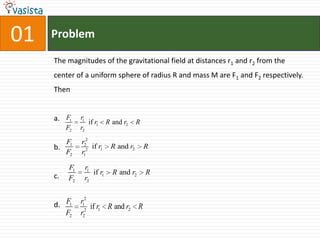
01ProblemThe magnitudes of the gravitational field at distances r1 and r2 from the center of a uniform sphere of radius R and mass M are F1 and F2 respectively. Thena.b.c.d.
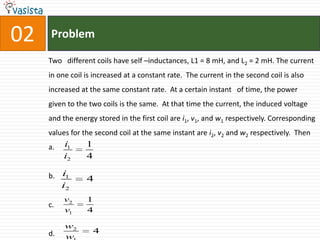
Problem02Two   different coils have self –inductances, L1 = 8 mH, and L2 = 2 mH. The current in one coil is increased at a constant rate.  The current in the second coil is also increased at the same constant rate.  At a certain instant   of time, the power given to the two coils is the same.  At that time the current, the induced voltage and the energy stored in the first coil are i1, v1, and w1 respectively. Corresponding values for the second coil at the same instant are i2, v2 and w2 respectively.  Then a.b.c.d.
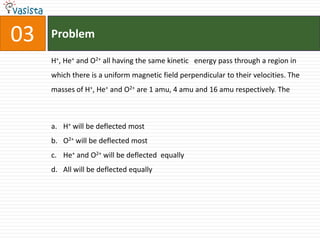
Problem03H+, He+ and O2+ all having the same kinetic   energy pass through a region in which there is a uniform magnetic field perpendicular to their velocities. The masses of H+, He+ and O2+ are 1 amu, 4 amu and 16 amu respectively. The H+ will be deflected mostO2+ will be deflected mostHe+ and O2+ will be deflected  equally All will be deflected equally
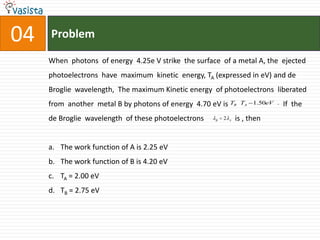
Problem04When  photons  of energy  4.25e V strike  the surface  of a metal A, the  ejected  photoelectrons  have  maximum  kinetic  energy, TA (expressed in eV) and de Broglie  wavelength,  The maximum Kinetic energy  of photoelectrons  liberated  from  another  metal B by photons of energy  4.70 eV is                              If  the de Broglie  wavelength  of these photoelectrons                 is , then  The work function of A is 2.25 eVThe work function of B is 4.20 eVTA = 2.00 eVTB = 2.75 eV
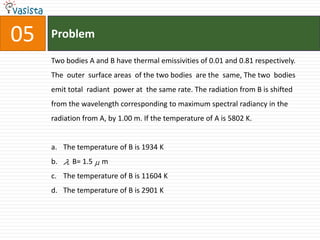
Problem05Two bodies A and B have thermal emissivities of 0.01 and 0.81 respectively. The  outer  surface areas  of the two bodies  are the  same, The two  bodies  emit total  radiant  power at  the same rate. The radiation from B is shifted from the wavelength corresponding to maximum spectral radiancy in the radiation from A, by 1.00 m. If the temperature of A is 5802 K. The temperature of B is 1934 K     B= 1.5     mThe temperature of B is 11604 KThe temperature of B is 2901 K 
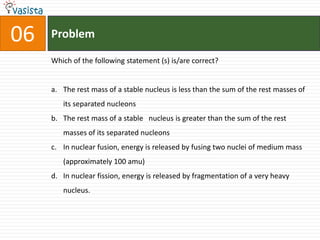
Problem06Which of the following statement (s) is/are correct?The rest mass of a stable nucleus is less than the sum of the rest masses of its separated nucleonsThe rest mass of a stable   nucleus is greater than the sum of the rest masses of its separated nucleonsIn nuclear fusion, energy is released by fusing two nuclei of medium mass (approximately 100 amu)In nuclear fission, energy is released by fragmentation of a very heavy nucleus.
SECTION – II Fill in the blanksFill in the blanks in the following. In  your  answer book,  write  down  the sub-question  number (I, ii , iii etc.) and your  answer against  it corresponding  to each blank.  Your answer should be in the sequence I, ii, etc. as given in the question paper
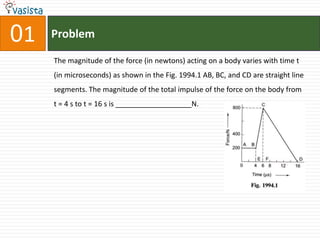
01ProblemThe magnitude of the force (in newtons) acting on a body varies with time t (in microseconds) as shown in the Fig. 1994.1 AB, BC, and CD are straight line segments. The magnitude of the total impulse of the force on the body from t = 4 s to t = 16 s is ___________________N.
Problem02An object of mass 0.2 kg executes simple harmonic oscillations along the x-axis with a frequency of (25/ ) Hz. At the position x = 0.04 m, the object has kinetic energy of 0.5 J and potential energy of 0.4 J.  The amplitude of oscillations is _____________m.
Problem03An ideal gas with pressure P, volume V, and potential T is expanded isothermally to a volume 2V and a final pressure Pi. If the same gas is expanded adiabatically to a volume 2V, the final pressure is P=. The ratio of the specific heat capacities for the gas is 1.67. The ratio Pa/Pi is _____________________.
Problem04A bus is moving towards a huge wall with a velocity of 5 ms-1. The driver sounds a horn of frequency 200 Hz. The frequency of the beats heard by a passenger of the bus will be _________________ Hz. (Speed of sound in air = 342 m s-1)
Problem05A horizontal pipeline carries water in a streamline flow. At a point along the pipe where the cross-sectional area is 10 cm2, the water velocity is 1 m s-1 and the pressure is 2000 Pa.  The pressure of water at another point where the cross-sectional area is 5 cm2, is ________________ Pa. (Density of water = 103 kg m-3.)
SECTION – IIISingle Correct Answer TypeIn each part of this question, a statement is followed by four alternatives of which only one alternative is correct. Select the correct alternative and write down the corresponding letter a, b, c, d in your answer book against the sub-question number. In your answers. The sequence of the sub-question should be the same as in the question paper
01ProblemA block of mass 0.1 kg is held against a wall by applying a horizontal force of 5N on the block. If the coefficient of friction between the block and the wall is 0.5, the magnitude of the frictional force acting on the block is  2.5 N0.98 N4.9 N0.49 N
Problem02Fast neutrons can easily be slowed down by The use of lead shielding Passing them through water Elastic collisions with heavy nucleiApplying a strong electric field
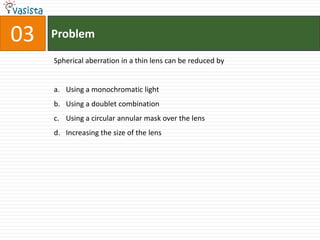
Problem03Spherical aberration in a thin lens can be reduced by Using a monochromatic lightUsing a doublet combinationUsing a circular annular mask over the lensIncreasing the size of the lens
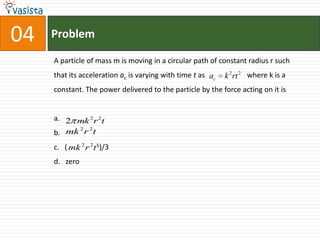
Problem04A particle of mass m is moving in a circular path of constant radius r such that its acceleration ac is varying with time t as                       where k is a constant. The power delivered to the particle by the force acting on it is a.b.c.   (                5)/3d.   zero
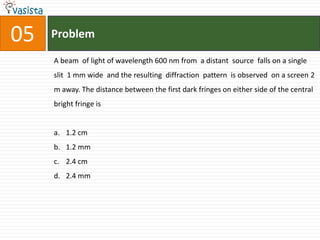
Problem05A beam  of light of wavelength 600 nm from  a distant  source  falls on a single  slit  1 mm wide  and the resulting  diffraction  pattern  is observed  on a screen 2 m away. The distance between the first dark fringes on either side of the central bright fringe is  1.2 cm1.2 mm2.4 cm2.4 mm
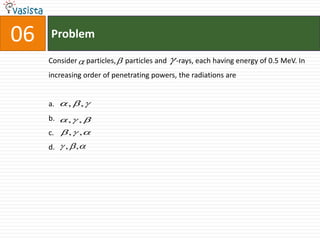
Problem06Consider     particles,     particles and     -rays, each having energy of 0.5 MeV. In increasing order of penetrating powers, the radiations are a.b.c.   d.
FOR SOLUTION VISIT WWW.VASISTA.NET

IIT JEE Physics 1994

  • 1.
    IIT JEE –PastpapersPHYSICS- UNSOLVED PAPER - 1994
  • 2.
    SECTION – IMultiplecorrect Answer typeIn each part of this question four alternatives are given of which one or more alternative(s) is/are correct. Select the correct alternative(s) and write down the corresponding letters(s) a, b, c, d in your answer book against the sub-question number, marks will be awarded only if all the correct alternative(s), and no wrong alternatives are selected.
  • 3.
    01ProblemThe magnitudes ofthe gravitational field at distances r1 and r2 from the center of a uniform sphere of radius R and mass M are F1 and F2 respectively. Thena.b.c.d.
  • 4.
    Problem02Two different coils have self –inductances, L1 = 8 mH, and L2 = 2 mH. The current in one coil is increased at a constant rate. The current in the second coil is also increased at the same constant rate. At a certain instant of time, the power given to the two coils is the same. At that time the current, the induced voltage and the energy stored in the first coil are i1, v1, and w1 respectively. Corresponding values for the second coil at the same instant are i2, v2 and w2 respectively. Then a.b.c.d.
  • 5.
    Problem03H+, He+ andO2+ all having the same kinetic energy pass through a region in which there is a uniform magnetic field perpendicular to their velocities. The masses of H+, He+ and O2+ are 1 amu, 4 amu and 16 amu respectively. The H+ will be deflected mostO2+ will be deflected mostHe+ and O2+ will be deflected equally All will be deflected equally
  • 6.
    Problem04When photons of energy 4.25e V strike the surface of a metal A, the ejected photoelectrons have maximum kinetic energy, TA (expressed in eV) and de Broglie wavelength, The maximum Kinetic energy of photoelectrons liberated from another metal B by photons of energy 4.70 eV is If the de Broglie wavelength of these photoelectrons is , then  The work function of A is 2.25 eVThe work function of B is 4.20 eVTA = 2.00 eVTB = 2.75 eV
  • 7.
    Problem05Two bodies Aand B have thermal emissivities of 0.01 and 0.81 respectively. The outer surface areas of the two bodies are the same, The two bodies emit total radiant power at the same rate. The radiation from B is shifted from the wavelength corresponding to maximum spectral radiancy in the radiation from A, by 1.00 m. If the temperature of A is 5802 K. The temperature of B is 1934 K B= 1.5 mThe temperature of B is 11604 KThe temperature of B is 2901 K 
  • 8.
    Problem06Which of thefollowing statement (s) is/are correct?The rest mass of a stable nucleus is less than the sum of the rest masses of its separated nucleonsThe rest mass of a stable nucleus is greater than the sum of the rest masses of its separated nucleonsIn nuclear fusion, energy is released by fusing two nuclei of medium mass (approximately 100 amu)In nuclear fission, energy is released by fragmentation of a very heavy nucleus.
  • 9.
    SECTION – IIFill in the blanksFill in the blanks in the following. In your answer book, write down the sub-question number (I, ii , iii etc.) and your answer against it corresponding to each blank. Your answer should be in the sequence I, ii, etc. as given in the question paper
  • 10.
    01ProblemThe magnitude ofthe force (in newtons) acting on a body varies with time t (in microseconds) as shown in the Fig. 1994.1 AB, BC, and CD are straight line segments. The magnitude of the total impulse of the force on the body from t = 4 s to t = 16 s is ___________________N.
  • 11.
    Problem02An object ofmass 0.2 kg executes simple harmonic oscillations along the x-axis with a frequency of (25/ ) Hz. At the position x = 0.04 m, the object has kinetic energy of 0.5 J and potential energy of 0.4 J. The amplitude of oscillations is _____________m.
  • 12.
    Problem03An ideal gaswith pressure P, volume V, and potential T is expanded isothermally to a volume 2V and a final pressure Pi. If the same gas is expanded adiabatically to a volume 2V, the final pressure is P=. The ratio of the specific heat capacities for the gas is 1.67. The ratio Pa/Pi is _____________________.
  • 13.
    Problem04A bus ismoving towards a huge wall with a velocity of 5 ms-1. The driver sounds a horn of frequency 200 Hz. The frequency of the beats heard by a passenger of the bus will be _________________ Hz. (Speed of sound in air = 342 m s-1)
  • 14.
    Problem05A horizontal pipelinecarries water in a streamline flow. At a point along the pipe where the cross-sectional area is 10 cm2, the water velocity is 1 m s-1 and the pressure is 2000 Pa. The pressure of water at another point where the cross-sectional area is 5 cm2, is ________________ Pa. (Density of water = 103 kg m-3.)
  • 15.
    SECTION – IIISingleCorrect Answer TypeIn each part of this question, a statement is followed by four alternatives of which only one alternative is correct. Select the correct alternative and write down the corresponding letter a, b, c, d in your answer book against the sub-question number. In your answers. The sequence of the sub-question should be the same as in the question paper
  • 16.
    01ProblemA block ofmass 0.1 kg is held against a wall by applying a horizontal force of 5N on the block. If the coefficient of friction between the block and the wall is 0.5, the magnitude of the frictional force acting on the block is  2.5 N0.98 N4.9 N0.49 N
  • 17.
    Problem02Fast neutrons caneasily be slowed down by The use of lead shielding Passing them through water Elastic collisions with heavy nucleiApplying a strong electric field
  • 18.
    Problem03Spherical aberration ina thin lens can be reduced by Using a monochromatic lightUsing a doublet combinationUsing a circular annular mask over the lensIncreasing the size of the lens
  • 19.
    Problem04A particle ofmass m is moving in a circular path of constant radius r such that its acceleration ac is varying with time t as where k is a constant. The power delivered to the particle by the force acting on it is a.b.c. ( 5)/3d. zero
  • 20.
    Problem05A beam of light of wavelength 600 nm from a distant source falls on a single slit 1 mm wide and the resulting diffraction pattern is observed on a screen 2 m away. The distance between the first dark fringes on either side of the central bright fringe is  1.2 cm1.2 mm2.4 cm2.4 mm
  • 21.
    Problem06Consider particles, particles and -rays, each having energy of 0.5 MeV. In increasing order of penetrating powers, the radiations are a.b.c. d.
  • 22.
    FOR SOLUTION VISITWWW.VASISTA.NET