EXCESSIVE WORKLOAD


INTRODUCTION
Workload is the amount of work an individual has to do. There is a
distinction between the actual amount of work and the individual's
perception of the workload. Workload can also be classified as
quantitative (the amount of work to be done) or qualitative (the
difficulty of the work). The assessment of operator workload has a
vital impact on the design of new human-machine systems.
In an occupational setting, dealing with workload can be stressful
and serve as a stressor for employees. There are three aspects of
workload that can be stressful.
 Quantitative workload or overload:
 Qualitative workload:
 Under load:
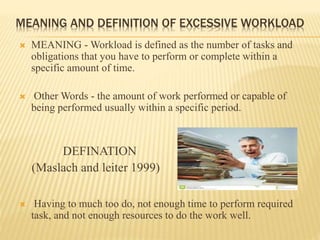
MEANING AND DEFINITION OF EXCESSIVE WORKLOAD
 MEANING - Workload is defined as the number of tasks and
obligations that you have to perform or complete within a
specific amount of time.
 Other Words - the amount of work performed or capable of
being performed usually within a specific period.
DEFINATION
(Maslach and leiter 1999)
 Having to much too do, not enough time to perform required
task, and not enough resources to do the work well.
HOW TO RECOGNISE HEAVY WORKLOAD
 Feel stressed, overwhelmed, overworked at work
 Work longer hours
 Constantly juggle multiple tasks and responsibilities
 Unhappy
 Start looking for another job and feel resentful of
your current work
 Constantly try to keep up with everything your boss
asks.
 Have a poor work-life balance
CAUSES OF EXCESSIVE WORKLOAD
 A heavy workload causes stress, which leads a series of health problems.
 Employees exposed to a heavy workload sometimes become disgruntled with their work.
 Employees working under the stress of a heavy workload can make mistakes, however,
and the quality control personnel who are also feeling the workload stress can miss those
mistakes
 Heavy worklaod Stress- * including psychological disorders
* and other types of emotional ,strain
* maladaptive behaviours
* cognitive impairment
In turn, these conditions may lead to poor work performance, higher absenteeism, less
work productivity.
 Occupational workload stress include sleep disorders, headache, mood disorders, upset
stomach, hypertension, high cholesterol, autoimmune disease, cardiovascular disease,.
Stress at work can also increase the risk of acquiring an infection and the risk of
accidents at work.
IDENTIFYING PEOPLE WHO NEED
COUNSELING
 Those who look troubled, tensed or anxious
 Those whose behaviour has noticeably changed.
 Those who have a self-defeating or self-destructive
behaviour
 Those who are not mobilizing their energy.
 They are not capable to make right decisions.
 Misunderstanding and negative perceptions
 Performance problems 6
 Those who look troubled, tensed or anxious
 Those whose behaviour has noticeably
changed.
 Those who have a self-defeating or self-
destructive behaviour
 Those who are not mobilizing their
energy.
 They are not capable to make right decisions.
 Misunderstanding and negative perceptions
 Performance problems
WHO CAN COUNSEL?
 Only a professional who has developed
the essential skills and gained experiences
over a period of time ……
IMPORTANCE OF COUNSELING IN THE
ORGANIZATION …
 Problems may be personal or relating to one’s occupation.
Whatever the case may be, a helpful and timely and
effective advice is the valuable source to support him in all
walks of life.
 It would thus not only suggest us to seek advice whenever
necessary but also reminds the importance of advice.
 However, a piece of advice or recommendations about
actions to be taken must be received from a knowledgeable,
experienced and expert person.
 to seek advice whenever necessary….
 It is through the process of counseling to help the employees in solving their
psychological or job related problems so that they can perform their tasks
effectively and their efficiencies may be reached the extent to which the
management has anticipated.
 One of the positive aspects of counseling in a business organization is that it
makes an employee feel less anxious or worried about the existing problems
while motivating him to face and solve the problems successfully.
 Besides, the process involves providing the required professional help and
assistance as and when it is necessary.
 It is very essential to implement and maintain effective communication
process in the business organization that the functioning state of a business
may be enhanced and the overall performance may be improved effectively
and efficiently.
 A great source of releasing tensions and worries while increasing their
enthusiasm towards the accomplishments of the organizational objectives.
It is a way of reassurance to the employees that encourages them to stay firm in
the face of difficulties and gives confidence while at work so that the end results of
a business may be attained as wanted.
Reduce the cost of capital : Management can constantly decrease the Cost
Capital in the Human Resource by reduction in Labour Turn Overism.Reduction in
Training , Techonolgy adoption etc…
Maximizing utilization of human resources.
If employees are unhappy, anxious, or stressed they will not be able to
perform well on their jobs. Their productivity and performance will go down.
Allowing the employees to express their feelings, ideas and suggestions that in
turn may be conveyed to the higher management for review and implementation
accordingly.
Increase sense belongings and higher productive employees.
THANK YOU

Cb presentation

  • 1.
  • 2.
    INTRODUCTION Workload is theamount of work an individual has to do. There is a distinction between the actual amount of work and the individual's perception of the workload. Workload can also be classified as quantitative (the amount of work to be done) or qualitative (the difficulty of the work). The assessment of operator workload has a vital impact on the design of new human-machine systems. In an occupational setting, dealing with workload can be stressful and serve as a stressor for employees. There are three aspects of workload that can be stressful.  Quantitative workload or overload:  Qualitative workload:  Under load:
  • 3.
    MEANING AND DEFINITIONOF EXCESSIVE WORKLOAD  MEANING - Workload is defined as the number of tasks and obligations that you have to perform or complete within a specific amount of time.  Other Words - the amount of work performed or capable of being performed usually within a specific period. DEFINATION (Maslach and leiter 1999)  Having to much too do, not enough time to perform required task, and not enough resources to do the work well.
  • 4.
    HOW TO RECOGNISEHEAVY WORKLOAD  Feel stressed, overwhelmed, overworked at work  Work longer hours  Constantly juggle multiple tasks and responsibilities  Unhappy  Start looking for another job and feel resentful of your current work  Constantly try to keep up with everything your boss asks.  Have a poor work-life balance
  • 5.
    CAUSES OF EXCESSIVEWORKLOAD  A heavy workload causes stress, which leads a series of health problems.  Employees exposed to a heavy workload sometimes become disgruntled with their work.  Employees working under the stress of a heavy workload can make mistakes, however, and the quality control personnel who are also feeling the workload stress can miss those mistakes  Heavy worklaod Stress- * including psychological disorders * and other types of emotional ,strain * maladaptive behaviours * cognitive impairment In turn, these conditions may lead to poor work performance, higher absenteeism, less work productivity.  Occupational workload stress include sleep disorders, headache, mood disorders, upset stomach, hypertension, high cholesterol, autoimmune disease, cardiovascular disease,. Stress at work can also increase the risk of acquiring an infection and the risk of accidents at work.
  • 6.
    IDENTIFYING PEOPLE WHONEED COUNSELING  Those who look troubled, tensed or anxious  Those whose behaviour has noticeably changed.  Those who have a self-defeating or self-destructive behaviour  Those who are not mobilizing their energy.  They are not capable to make right decisions.  Misunderstanding and negative perceptions  Performance problems 6  Those who look troubled, tensed or anxious  Those whose behaviour has noticeably changed.  Those who have a self-defeating or self- destructive behaviour  Those who are not mobilizing their energy.  They are not capable to make right decisions.  Misunderstanding and negative perceptions  Performance problems
  • 7.
    WHO CAN COUNSEL? Only a professional who has developed the essential skills and gained experiences over a period of time ……
  • 8.
    IMPORTANCE OF COUNSELINGIN THE ORGANIZATION …  Problems may be personal or relating to one’s occupation. Whatever the case may be, a helpful and timely and effective advice is the valuable source to support him in all walks of life.  It would thus not only suggest us to seek advice whenever necessary but also reminds the importance of advice.  However, a piece of advice or recommendations about actions to be taken must be received from a knowledgeable, experienced and expert person.  to seek advice whenever necessary….
  • 9.
     It isthrough the process of counseling to help the employees in solving their psychological or job related problems so that they can perform their tasks effectively and their efficiencies may be reached the extent to which the management has anticipated.  One of the positive aspects of counseling in a business organization is that it makes an employee feel less anxious or worried about the existing problems while motivating him to face and solve the problems successfully.  Besides, the process involves providing the required professional help and assistance as and when it is necessary.  It is very essential to implement and maintain effective communication process in the business organization that the functioning state of a business may be enhanced and the overall performance may be improved effectively and efficiently.
  • 10.
     A greatsource of releasing tensions and worries while increasing their enthusiasm towards the accomplishments of the organizational objectives. It is a way of reassurance to the employees that encourages them to stay firm in the face of difficulties and gives confidence while at work so that the end results of a business may be attained as wanted. Reduce the cost of capital : Management can constantly decrease the Cost Capital in the Human Resource by reduction in Labour Turn Overism.Reduction in Training , Techonolgy adoption etc… Maximizing utilization of human resources. If employees are unhappy, anxious, or stressed they will not be able to perform well on their jobs. Their productivity and performance will go down. Allowing the employees to express their feelings, ideas and suggestions that in turn may be conveyed to the higher management for review and implementation accordingly. Increase sense belongings and higher productive employees.
  • 11.

Editor's Notes

  • #6 Heavy workload may leads to the many consequences or causes like ---