EU and
UKRAINE
Existing and
future
economic
relations –
Kherson 4
February 2015
Ukraine and the EU: trade relations (2013)
• Ukraine's total exports to the rest of the world: €48,5 bn
• Ukraine's total imports from the rest of the world: €59,0 bn
• Trade balance: -€10,5 bn (7,9% of GDP)
• Exports to EU: €12,9 bn (26,5% of exports)
• Imports from EU: €20,7 bn (35,1% of imports)
• Trade balance with the EU: -€8,6 bn
• Exports to Russia: €11,6bn (23,8% of exports)
• Imports from Russia: €17,8bn (30.2% of imports)
• Trade balance with Russia: -€6,2bn
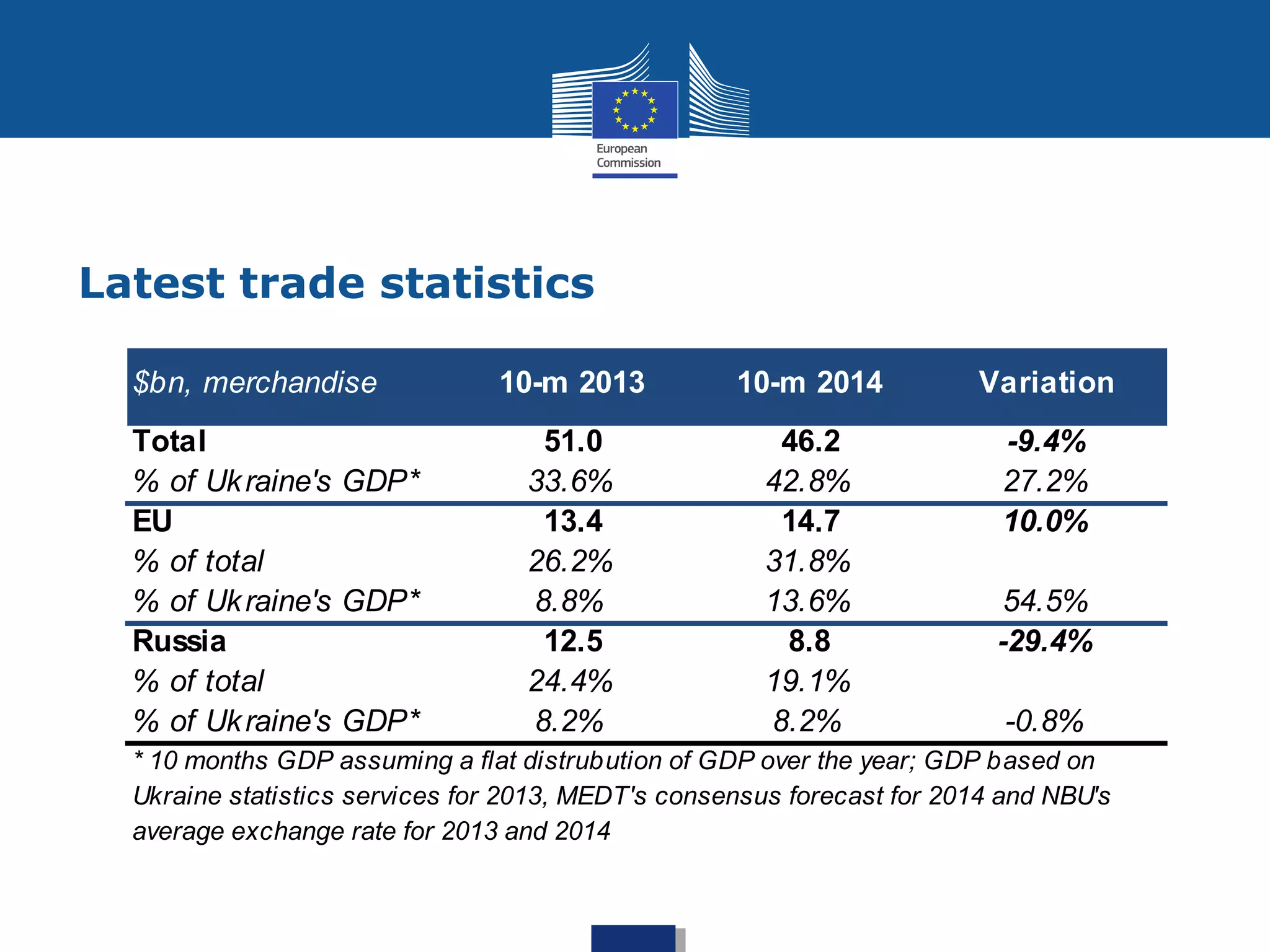
Latest trade statistics
$bn, merchandise 10-m 2013 10-m 2014 Variation
Total 51.0 46.2 -9.4%
% of Ukraine's GDP* 33.6% 42.8% 27.2%
EU 13.4 14.7 10.0%
% of total 26.2% 31.8%
% of Ukraine's GDP* 8.8% 13.6% 54.5%
Russia 12.5 8.8 -29.4%
% of total 24.4% 19.1%
% of Ukraine's GDP* 8.2% 8.2% -0.8%
* 10 months GDP assuming a flat distrubution of GDP over the year; GDP based on
Ukraine statistics services for 2013, MEDT's consensus forecast for 2014 and NBU's
average exchange rate for 2013 and 2014
Latest trade statistics
• While in 2013 the EU and Russia were more or less equivalent
export destinations for Ukrainian goods, the picture changes in
2014, since the EU now represents close to a third of Ukraine's
exports and Russia barely a fifth
• Exports to the EU have grown by 10,0% when measured in
US dollars. It can also be observed that this figure is somewhat
smaller as if it was expressed in quantities, due to the depreciation,
as highlighted by the share of exports to the EU as a share of
Ukraine's GDP, which rose from 8,8% to 13,6%.
• In terms of product analysis in the EU, agricultural goods
represent the lion's share of the increase
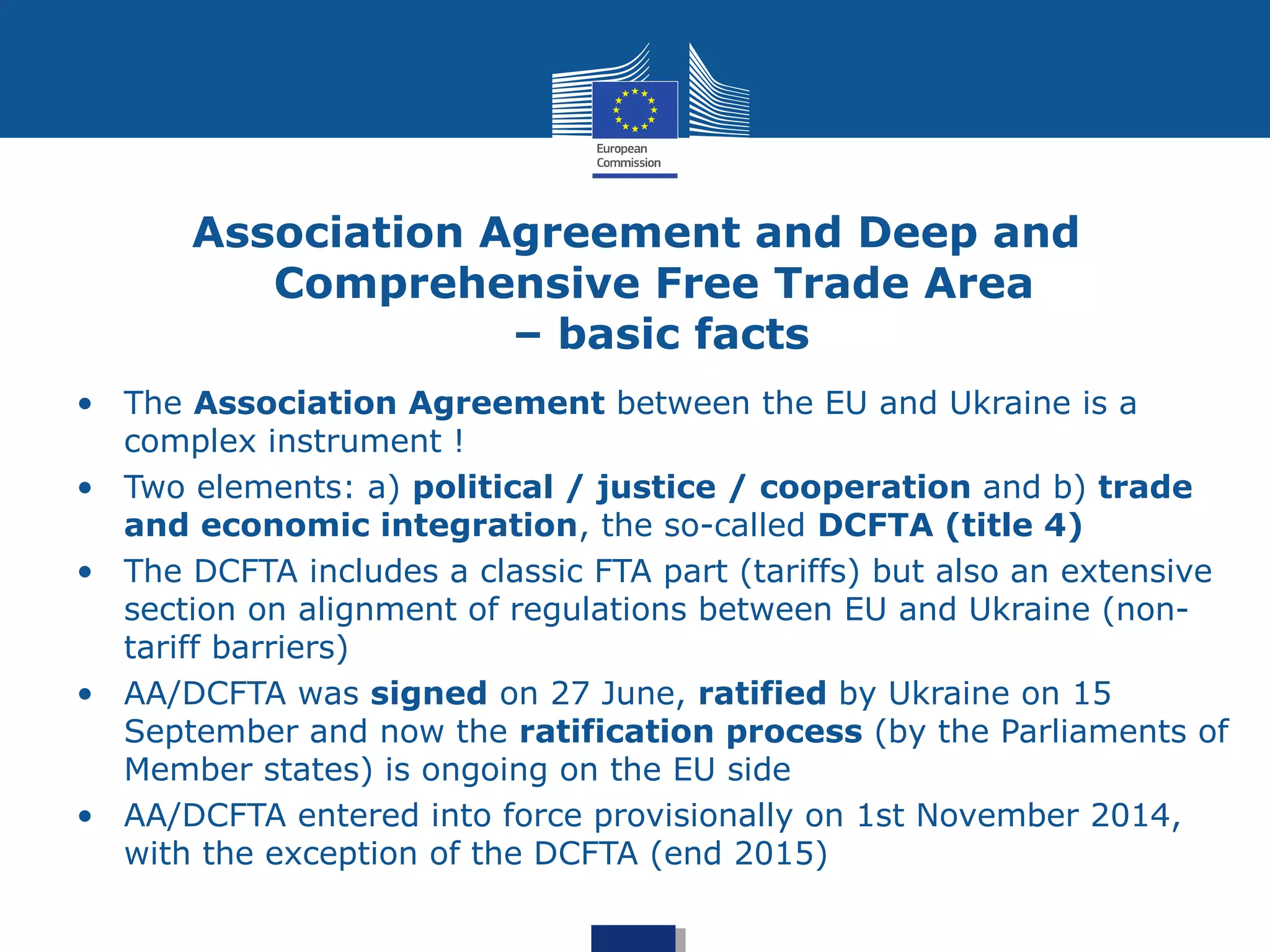
Association Agreement and Deep and
Comprehensive Free Trade Area
– basic facts
• The Association Agreement between the EU and Ukraine is a
complex instrument !
• Two elements: a) political / justice / cooperation and b) trade
and economic integration, the so-called DCFTA (title 4)
• The DCFTA includes a classic FTA part (tariffs) but also an extensive
section on alignment of regulations between EU and Ukraine (non-
tariff barriers)
• AA/DCFTA was signed on 27 June, ratified by Ukraine on 15
September and now the ratification process (by the Parliaments of
Member states) is ongoing on the EU side
• AA/DCFTA entered into force provisionally on 1st November 2014,
with the exception of the DCFTA (end 2015)
What is the DCFTA ?
• Objectives :
• To facilitate and increase trade between the EU and Ukraine
• To stimulate economic growth, new jobs
• To integrate better the EU and Ukrainian economies
• To improve the business and investment climate in Ukraine
• How? by tackling tariff and non-tariff barriers
• Tariff barriers (the FTA part): Most import tariffs and duties
will be removed or reduced
• Non-tariff barriers (the "DC" part): Ukrainian legislation,
norms, standards and practices will be aligned with EU rules
"FTA part" of the DCFTA
• FTA is a core element of any bilateral trade agreement
• Liberalises most tariffs both ways, in line with the provision of
the WTO / GATT (elimination of "substantially all the trade")
• Phase-in periods for many products – up to 7 years
• EU-UA FTA is asymmetrical: Ukraine has more time to adapt
• Tariff rate quotas (TRQs) for certain agricultural products
(NOT absolute import quotas)
• Details specified in the AA/DCFTA (in two annexes, one for
Ukraine, one for the EU)
Autonomous trade measures (ATMs)
• In normal circumstances, the FTA annexes (tariff reductions and
increase of TRQs) would come into force on first day of entry into
force of AA/DCFTA
• But, due to economic, security and political challenges faced by
Ukraine, and EU desire to assist and support Ukraine's economic
reform and integration with EU, ATMs were introduced in April 2014
• Unilateral action by EU: no reciprocal action expected by Ukraine
• EU has anticipated year one of the tariff schedules in DCFTA – ie. EU
has begun elimination and reduction of tariffs and opening of TRQs
foreseen in DCFTA
Examples of non-tariff barriers
• Licenses
• Standards
• Red tape (at the border and beyond)
• Monetary restrictions
• Geographical indications (GIs)
• Public procurement rules
• State subsidies which distort competition
• Investment protection rules
• Many other instruments (e.g. car recycling fee in Russian
Federation)
Association agreement (486 articles)
• PREAMBLE
• Title I GENERAL PRINCIPLES
• Title II POLITICAL DIALOGUE AND REFORM, POLITICAL
ASSOCIATION, COOPERATION IN THE FIELD OF FOREIGN
AND SECURITY POLICY
• Title III JUSTICE AND FREEDOM
• Title IV TRADE AND TRADE RELATED MATTERS (art 25-336)
• Title V ECONOMIC AND SECTOR COOPERATION
• Title VI FINANCIAL COOPERATION
• Title VII INSTITUTIONNAL, GENERAL AND FINAL
PROVISIONS
• …and lots of annexes!
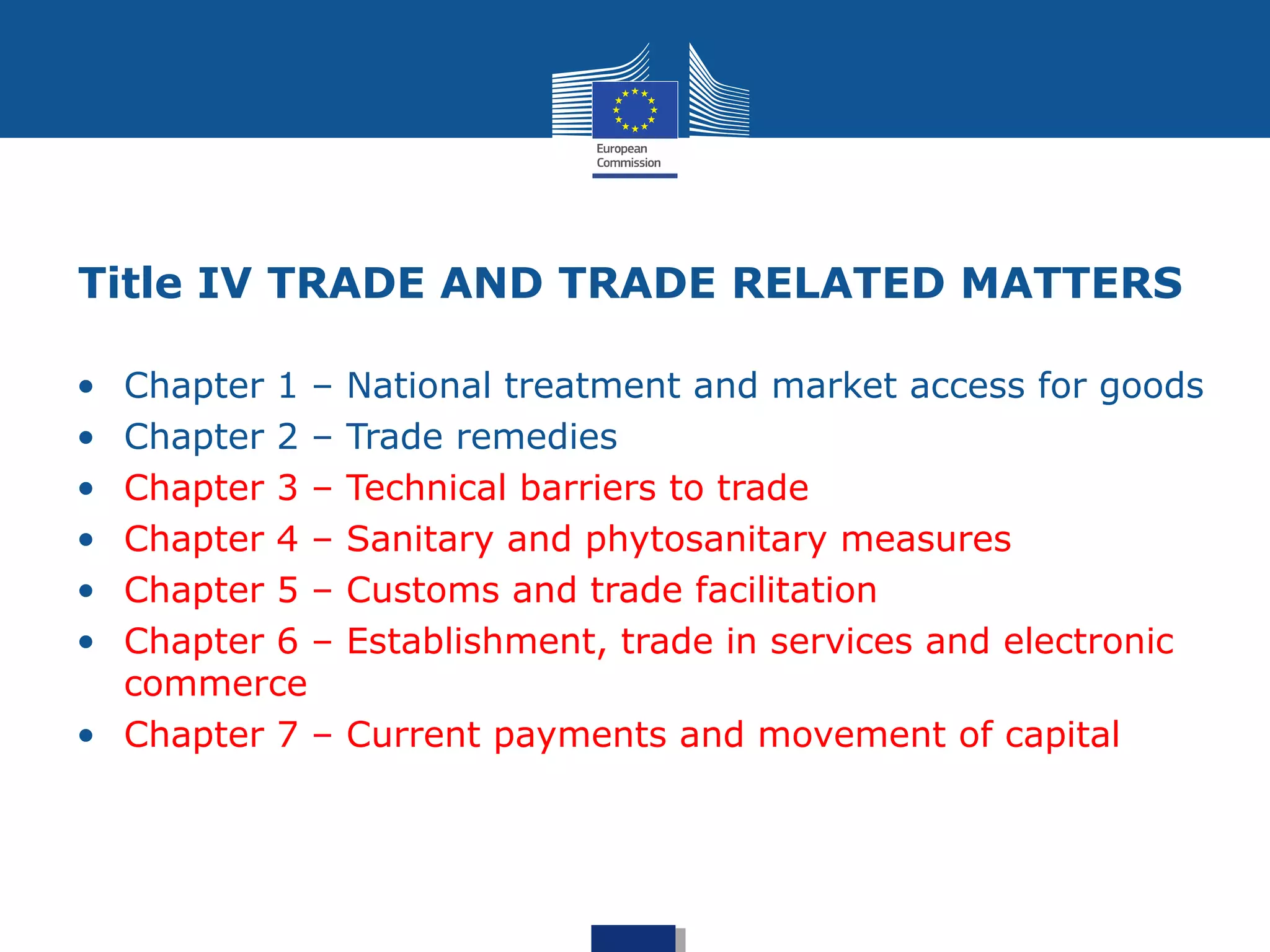
Title IV TRADE AND TRADE RELATED MATTERS
• Chapter 1 – National treatment and market access for goods
• Chapter 2 – Trade remedies
• Chapter 3 – Technical barriers to trade
• Chapter 4 – Sanitary and phytosanitary measures
• Chapter 5 – Customs and trade facilitation
• Chapter 6 – Establishment, trade in services and electronic
commerce
• Chapter 7 – Current payments and movement of capital
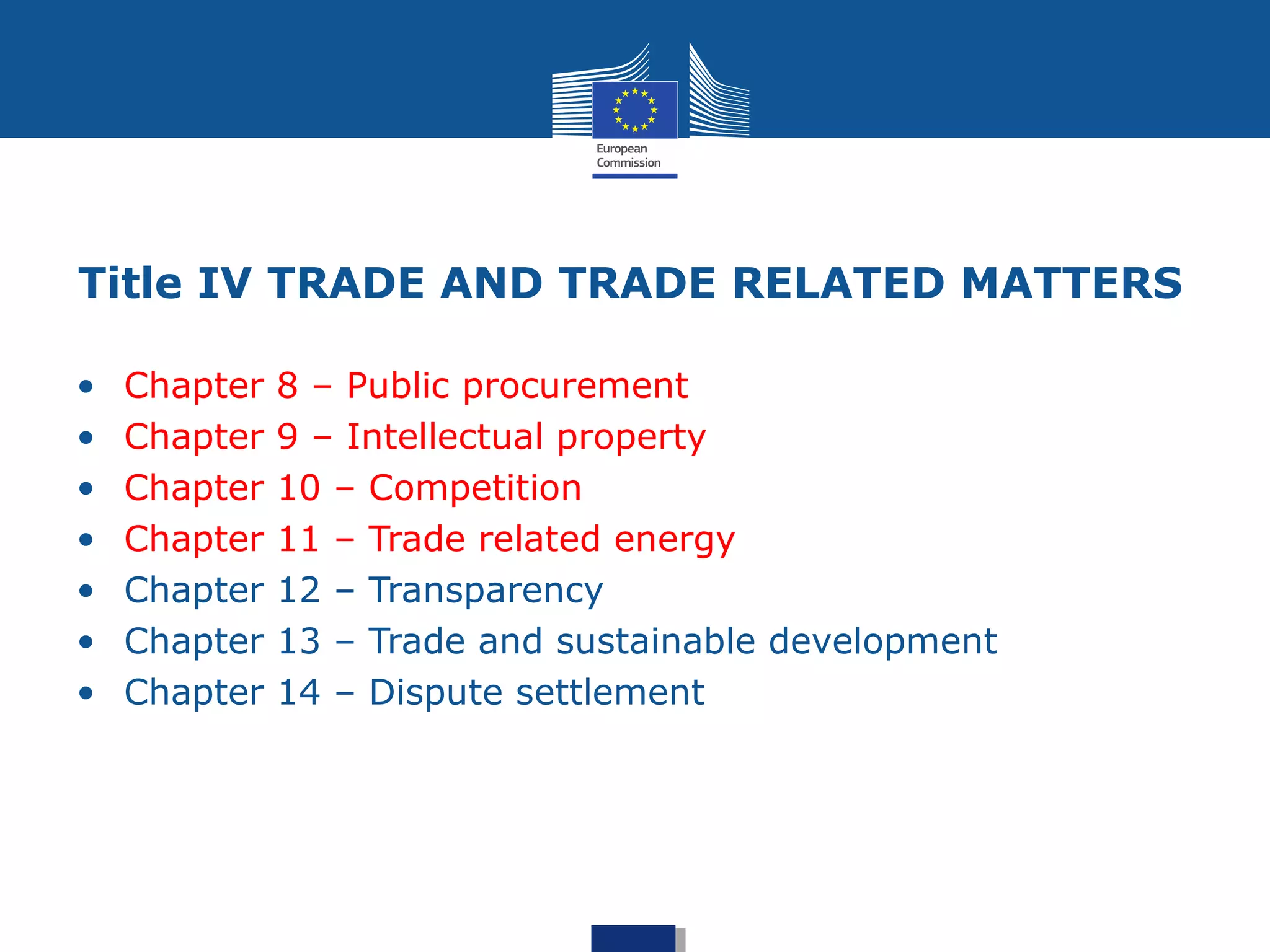
Title IV TRADE AND TRADE RELATED MATTERS
• Chapter 8 – Public procurement
• Chapter 9 – Intellectual property
• Chapter 10 – Competition
• Chapter 11 – Trade related energy
• Chapter 12 – Transparency
• Chapter 13 – Trade and sustainable development
• Chapter 14 – Dispute settlement
Industrial goods - Technical Barriers to Trade
(TBTs)
• The DCFTA foresees widespread alignment between
Ukrainian and EU standards, both for industrial goods and
agricultural products
• In 2005-2006, Ukrainian companies wishing to export to the
EU faced additional production costs of about 14% on
average in order to ensure that their products met EU
standards
• The use of EU standards will not only make Ukrainian
products more competitive on the EU market but also in the
rest of the world – the growing markets of the Far East,
Middle East, Africa and America
Animals, animal products, plants and plant
products – SPS
• In parallel with its commitments on technical barriers to
trade, Ukraine also commits itself in the DCFTA to align with
EU legislation and standards on all animal health, food
safety and plant health measures
• A number of trade facilitation measures are foreseen, e.g.
relating to listing of establishments, verification procedures
etc.
Services
• In the field of services, the DCFTA is unprecedented in the
extent of its liberalisation
• The services chapter is based on the services part of the
association agreements that were concluded with countries
acceding to the EU – for example with Croatia
• It provides for a complete freedom of establishment in
all services and non-services sectors (with a limited
number of reservations). Furthermore, the DCFTA foresees
gradual legislative alignment in financial services, telecom
services, postal and courier services, and maritime services
Other fields (1/2)
• Provisions on freer capital movement will help to enhance
economic growth by allowing easier access to capital and
better allocation of capital to its most productive use
• There will be gradual alignment of UA's legislation on public
procurement with that of the EU. With the sole exception of
the defence sector, this would allow mutual unrestricted
access of EU and UA suppliers and service providers to each
others public procurement markets
• Competition policy is another area which should see major
improvements. UA has agreed to progressively align its
legislation with that of the EU
Other fields (2/2)
• There are very detailed provisions in the DCFTA regarding
intellectual property rights, including a strong section on
enforcement of legislation based on EU rules and detailed
provisions on so-called geographical indications (GIs)
• Regarding customs, we already have relatively good
cooperation but the DCFTA enhances this by establishing a
framework for mutual administrative assistance to ensure the
correct application of customs legislation, cooperation on
customs irregularities and fraud etc.
• There are a number of trade related energy provisions
which will establish rules on the pricing of energy goods (to
let market prices prevail and to prohibit dual pricing)
How does the EU help Ukraine in this process?
• Financial assistance (loans) to the government to help the
stabilization of the economy (in cooperation with the IMF)
• Technical assistance to the government to help with
reforms
• Budget support (grants) also targeted to specific reforms
• Project support through EIB and EBRD (both to private and
public projects)
• Overall, 11 bn€ of direct support from the EU in 2014
Questions
• Are many of you exporting already to the EU?
• Do you feel close to do so or is this a very remote
perspective?
• What is the most difficult in your view for that?
• Which information is the most needed? Do you receive
enough information?
• What is the general mood of the business here?
• How do feel the impact of Russian sanctions and trade
restrictions towards Ukraine?

EU and UKRAINE Existing and future economic relations

  • 1.
  • 2.
    Ukraine and theEU: trade relations (2013) • Ukraine's total exports to the rest of the world: €48,5 bn • Ukraine's total imports from the rest of the world: €59,0 bn • Trade balance: -€10,5 bn (7,9% of GDP) • Exports to EU: €12,9 bn (26,5% of exports) • Imports from EU: €20,7 bn (35,1% of imports) • Trade balance with the EU: -€8,6 bn • Exports to Russia: €11,6bn (23,8% of exports) • Imports from Russia: €17,8bn (30.2% of imports) • Trade balance with Russia: -€6,2bn
  • 3.
    Latest trade statistics $bn,merchandise 10-m 2013 10-m 2014 Variation Total 51.0 46.2 -9.4% % of Ukraine's GDP* 33.6% 42.8% 27.2% EU 13.4 14.7 10.0% % of total 26.2% 31.8% % of Ukraine's GDP* 8.8% 13.6% 54.5% Russia 12.5 8.8 -29.4% % of total 24.4% 19.1% % of Ukraine's GDP* 8.2% 8.2% -0.8% * 10 months GDP assuming a flat distrubution of GDP over the year; GDP based on Ukraine statistics services for 2013, MEDT's consensus forecast for 2014 and NBU's average exchange rate for 2013 and 2014
  • 4.
    Latest trade statistics •While in 2013 the EU and Russia were more or less equivalent export destinations for Ukrainian goods, the picture changes in 2014, since the EU now represents close to a third of Ukraine's exports and Russia barely a fifth • Exports to the EU have grown by 10,0% when measured in US dollars. It can also be observed that this figure is somewhat smaller as if it was expressed in quantities, due to the depreciation, as highlighted by the share of exports to the EU as a share of Ukraine's GDP, which rose from 8,8% to 13,6%. • In terms of product analysis in the EU, agricultural goods represent the lion's share of the increase
  • 5.
    Association Agreement andDeep and Comprehensive Free Trade Area – basic facts • The Association Agreement between the EU and Ukraine is a complex instrument ! • Two elements: a) political / justice / cooperation and b) trade and economic integration, the so-called DCFTA (title 4) • The DCFTA includes a classic FTA part (tariffs) but also an extensive section on alignment of regulations between EU and Ukraine (non- tariff barriers) • AA/DCFTA was signed on 27 June, ratified by Ukraine on 15 September and now the ratification process (by the Parliaments of Member states) is ongoing on the EU side • AA/DCFTA entered into force provisionally on 1st November 2014, with the exception of the DCFTA (end 2015)
  • 6.
    What is theDCFTA ? • Objectives : • To facilitate and increase trade between the EU and Ukraine • To stimulate economic growth, new jobs • To integrate better the EU and Ukrainian economies • To improve the business and investment climate in Ukraine • How? by tackling tariff and non-tariff barriers • Tariff barriers (the FTA part): Most import tariffs and duties will be removed or reduced • Non-tariff barriers (the "DC" part): Ukrainian legislation, norms, standards and practices will be aligned with EU rules
  • 7.
    "FTA part" ofthe DCFTA • FTA is a core element of any bilateral trade agreement • Liberalises most tariffs both ways, in line with the provision of the WTO / GATT (elimination of "substantially all the trade") • Phase-in periods for many products – up to 7 years • EU-UA FTA is asymmetrical: Ukraine has more time to adapt • Tariff rate quotas (TRQs) for certain agricultural products (NOT absolute import quotas) • Details specified in the AA/DCFTA (in two annexes, one for Ukraine, one for the EU)
  • 8.
    Autonomous trade measures(ATMs) • In normal circumstances, the FTA annexes (tariff reductions and increase of TRQs) would come into force on first day of entry into force of AA/DCFTA • But, due to economic, security and political challenges faced by Ukraine, and EU desire to assist and support Ukraine's economic reform and integration with EU, ATMs were introduced in April 2014 • Unilateral action by EU: no reciprocal action expected by Ukraine • EU has anticipated year one of the tariff schedules in DCFTA – ie. EU has begun elimination and reduction of tariffs and opening of TRQs foreseen in DCFTA
  • 9.
    Examples of non-tariffbarriers • Licenses • Standards • Red tape (at the border and beyond) • Monetary restrictions • Geographical indications (GIs) • Public procurement rules • State subsidies which distort competition • Investment protection rules • Many other instruments (e.g. car recycling fee in Russian Federation)
  • 10.
    Association agreement (486articles) • PREAMBLE • Title I GENERAL PRINCIPLES • Title II POLITICAL DIALOGUE AND REFORM, POLITICAL ASSOCIATION, COOPERATION IN THE FIELD OF FOREIGN AND SECURITY POLICY • Title III JUSTICE AND FREEDOM • Title IV TRADE AND TRADE RELATED MATTERS (art 25-336) • Title V ECONOMIC AND SECTOR COOPERATION • Title VI FINANCIAL COOPERATION • Title VII INSTITUTIONNAL, GENERAL AND FINAL PROVISIONS • …and lots of annexes!
  • 11.
    Title IV TRADEAND TRADE RELATED MATTERS • Chapter 1 – National treatment and market access for goods • Chapter 2 – Trade remedies • Chapter 3 – Technical barriers to trade • Chapter 4 – Sanitary and phytosanitary measures • Chapter 5 – Customs and trade facilitation • Chapter 6 – Establishment, trade in services and electronic commerce • Chapter 7 – Current payments and movement of capital
  • 12.
    Title IV TRADEAND TRADE RELATED MATTERS • Chapter 8 – Public procurement • Chapter 9 – Intellectual property • Chapter 10 – Competition • Chapter 11 – Trade related energy • Chapter 12 – Transparency • Chapter 13 – Trade and sustainable development • Chapter 14 – Dispute settlement
  • 13.
    Industrial goods -Technical Barriers to Trade (TBTs) • The DCFTA foresees widespread alignment between Ukrainian and EU standards, both for industrial goods and agricultural products • In 2005-2006, Ukrainian companies wishing to export to the EU faced additional production costs of about 14% on average in order to ensure that their products met EU standards • The use of EU standards will not only make Ukrainian products more competitive on the EU market but also in the rest of the world – the growing markets of the Far East, Middle East, Africa and America
  • 14.
    Animals, animal products,plants and plant products – SPS • In parallel with its commitments on technical barriers to trade, Ukraine also commits itself in the DCFTA to align with EU legislation and standards on all animal health, food safety and plant health measures • A number of trade facilitation measures are foreseen, e.g. relating to listing of establishments, verification procedures etc.
  • 15.
    Services • In thefield of services, the DCFTA is unprecedented in the extent of its liberalisation • The services chapter is based on the services part of the association agreements that were concluded with countries acceding to the EU – for example with Croatia • It provides for a complete freedom of establishment in all services and non-services sectors (with a limited number of reservations). Furthermore, the DCFTA foresees gradual legislative alignment in financial services, telecom services, postal and courier services, and maritime services
  • 16.
    Other fields (1/2) •Provisions on freer capital movement will help to enhance economic growth by allowing easier access to capital and better allocation of capital to its most productive use • There will be gradual alignment of UA's legislation on public procurement with that of the EU. With the sole exception of the defence sector, this would allow mutual unrestricted access of EU and UA suppliers and service providers to each others public procurement markets • Competition policy is another area which should see major improvements. UA has agreed to progressively align its legislation with that of the EU
  • 17.
    Other fields (2/2) •There are very detailed provisions in the DCFTA regarding intellectual property rights, including a strong section on enforcement of legislation based on EU rules and detailed provisions on so-called geographical indications (GIs) • Regarding customs, we already have relatively good cooperation but the DCFTA enhances this by establishing a framework for mutual administrative assistance to ensure the correct application of customs legislation, cooperation on customs irregularities and fraud etc. • There are a number of trade related energy provisions which will establish rules on the pricing of energy goods (to let market prices prevail and to prohibit dual pricing)
  • 18.
    How does theEU help Ukraine in this process? • Financial assistance (loans) to the government to help the stabilization of the economy (in cooperation with the IMF) • Technical assistance to the government to help with reforms • Budget support (grants) also targeted to specific reforms • Project support through EIB and EBRD (both to private and public projects) • Overall, 11 bn€ of direct support from the EU in 2014
  • 19.
    Questions • Are manyof you exporting already to the EU? • Do you feel close to do so or is this a very remote perspective? • What is the most difficult in your view for that? • Which information is the most needed? Do you receive enough information? • What is the general mood of the business here? • How do feel the impact of Russian sanctions and trade restrictions towards Ukraine?