Ishikawa-Diagram
Structure
Kaoru Ishikawa
basic concept
aim
theoretical conversion
practical example
exercise
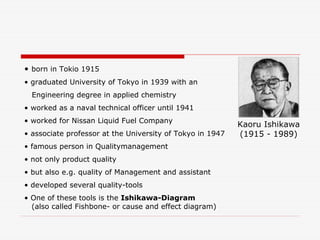
Kaoru Ishikawa
(1915 - 1989)
• born in Tokio 1915
• graduated University of Tokyo in 1939 with an
Engineering degree in applied chemistry
• worked as a naval technical officer until 1941
• worked for Nissan Liquid Fuel Company
• associate professor at the University of Tokyo in 1947
• famous person in Qualitymanagement
• not only product quality
• but also e.g. quality of Management and assistant
• developed several quality-tools
• One of these tools is the Ishikawa-Diagram
(also called Fishbone- or cause and effect diagram)
basic concept
The Idea:
think about possible causes and reasons leading to
an effect or a problem
find solution for preventing those problems
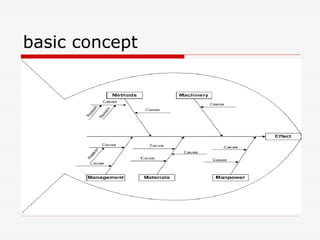
basic concept
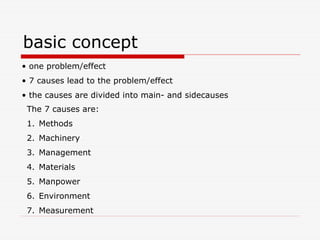
• one problem/effect
• 7 causes lead to the problem/effect
• the causes are divided into main- and sidecauses
The 7 causes are:
1. Methods
2. Machinery
3. Management
4. Materials
5. Manpower
6. Environment
7. Measurement
basic concept
individual problem/effect needs individual factors
basic concept
individual problem/effect needs individual factors
not all 7 factors are needed in the diagram
basic concept
individual problem/effect needs individual factors
not all 7 factors are needed in the diagram
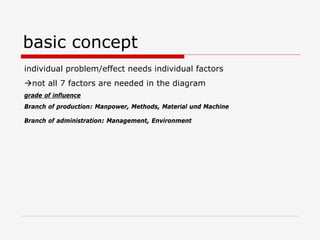
grade of influence
Branch of production: Manpower, Methods, Material und Machine
Branch of administration: Management, Environment
basic concept
individual problem/effect needs individual factors
not all 7 factors are needed in the diagram
grade of influence
Branch of production: Manpower, Methods, Material und Machine
Branch of administration: Management, Environment
e.g. Methods, Machinery, Management, Materials, Manpower
basic concept
individual problem/effect needs individual factors
not all 7 factors are needed in the diagram
grade of influence
Branch of production: Manpower, Methods, Material und Machine
Branch of administration: Management, Environment
e.g. Methods, Machinery, Management, Materials, Manpower
5 M‘s
basic concept
individual problem/effect needs individual factors
not all 7 factors are needed in the diagram
grade of influence
Branch of production: Manpower, Methods, Material und Machine
Branch of administration: Management, Environment
e.g. Methods, Machinery, Management, Materials, Manpower
5 M‘s
4P (Place, Procedures, People, Policies )
4S (Surroundings, Suppliers, Systems, Skills)
basic concept
aim
• find the causes, main- and sidecauses
• clarity
• interdependence of the causes
• improve them for having the wanted effect
or eliminate them for solving the problem
theoretical conversion
1. sketch the diagram and inscript the needed causes
theoretical conversion
1. sketch the diagram and inscript the needed causes
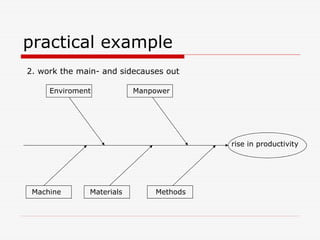
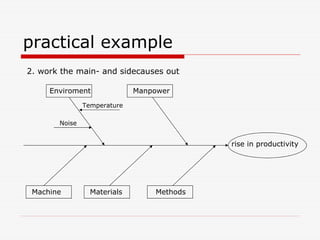
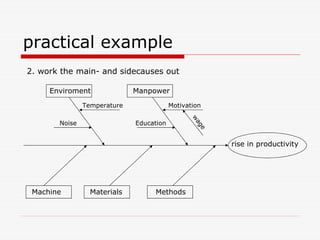
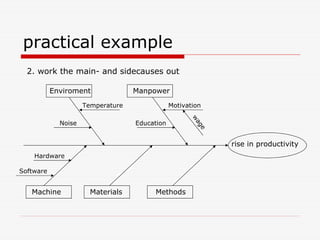
2. work the main- and sidecauses out
theoretical conversion
1. sketch the diagram and inscript the needed causes
2. work the main- and sidecauses out
3. check the completeness
theoretical conversion
1. sketch the diagram and inscript the needed causes
2. work the main- and sidecauses out
3. check the completeness
4. weight the the main- & sidecauses in terms of meaning & influence
theoretical conversion
1. sketch the diagram and inscript the needed causes
2. work the main- and sidecauses out
3. check the completeness
4. weight the the main- & sidecauses in terms of meaning & influence
5. check the selected causes for rightness
theoretical conversion
1. sketch the diagram and inscript the needed causes
2. work the main- and sidecauses out
3. check the completeness
4. weight the the main- & sidecauses in terms of meaning & influence
5. check the selected causes for rightness
6. The team discusses about the solution
theoretical conversion
6. The team discusses about the solution
• causes that can be improved or eliminated easily will be finished
first of all (no need to be weighted)
• The weighted causes are in a list of priority and will be finished in
turn
theoretical conversion
It‘s important
theoretical conversion
It‘s important
that the team has skilled workers involved in discussion
theoretical conversion
It‘s important
that the team has skilled workers involved in discussion
e.g. supplier, clients etc
practical example
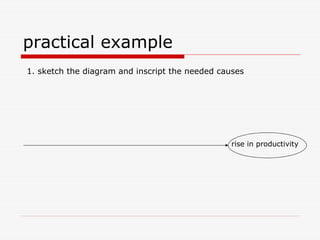
rise in productivity
practical example
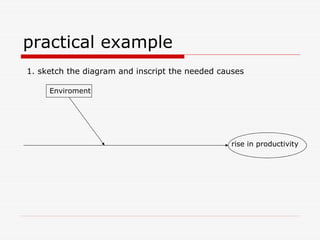
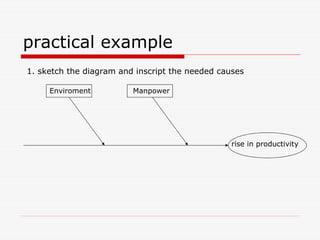
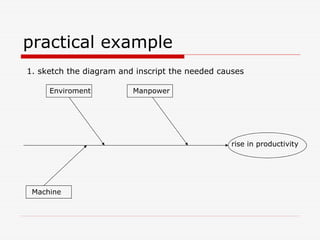
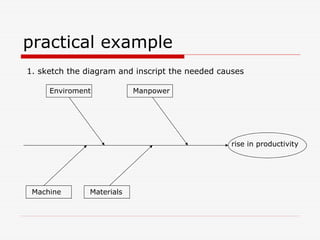
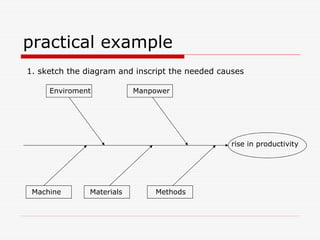
1. sketch the diagram and inscript the needed causes
practical example
1. sketch the diagram and inscript the needed causes
practical example
1. sketch the diagram and inscript the needed causes
rise in productivity
practical example
1. sketch the diagram and inscript the needed causes
rise in productivity
Enviroment
practical example
1. sketch the diagram and inscript the needed causes
rise in productivity
ManpowerEnviroment
practical example
1. sketch the diagram and inscript the needed causes
rise in productivity
ManpowerEnviroment
Machine
practical example
1. sketch the diagram and inscript the needed causes
rise in productivity
ManpowerEnviroment
Machine Materials
practical example
1. sketch the diagram and inscript the needed causes
rise in productivity
ManpowerEnviroment
Machine Materials Methods
practical example
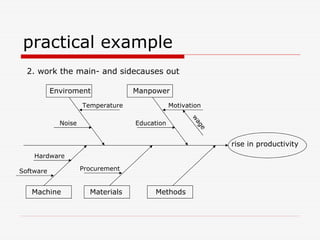
2. work the main- and sidecauses out
rise in productivity
ManpowerEnviroment
Machine Materials Methods
practical example
2. work the main- and sidecauses out
rise in productivity
ManpowerEnviroment
Machine Materials Methods
Noise
Temperature
practical example
2. work the main- and sidecauses out
rise in productivity
ManpowerEnviroment
Machine Materials Methods
Noise
Temperature
Education
Motivation
w
age
practical example
2. work the main- and sidecauses out
rise in productivity
ManpowerEnviroment
Machine Materials Methods
Noise
Temperature
Education
Motivation
w
age
Software
Hardware
practical example
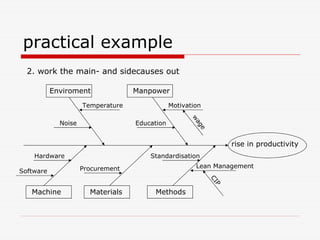
2. work the main- and sidecauses out
rise in productivity
ManpowerEnviroment
Machine Materials Methods
Noise
Temperature
Education
Motivation
w
age
Software
Hardware
Procurement
practical example
2. work the main- and sidecauses out
rise in productivity
ManpowerEnviroment
Machine Materials Methods
Noise
Temperature
Education
Motivation
w
age
Software
Hardware
Procurement
Standardisation
Lean Management
CIP
practical example
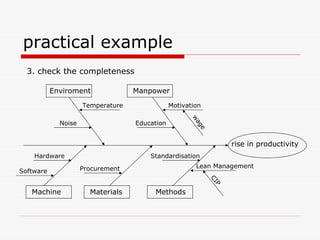
3. check the completeness
rise in productivity
ManpowerEnviroment
Machine Materials Methods
Noise
Temperature
Education
Motivation
w
age
Software
Hardware
Procurement
Standardisation
Lean Management
CIP
practical example
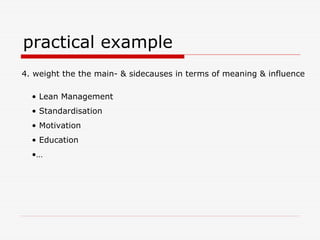
4. weight the the main- & sidecauses in terms of meaning & influence
• Lean Management
• Standardisation
• Motivation
• Education
•…
practical example
5. check the selected causes for rightness
• Lean Management
• Standardisation
• Motivation
• Education
•…
practical example
6. The team discusses about the solution
causes that can be improved or eliminated easily:
• Hardware
• Software
• Temperature
• Noise
practical example
6. The team discusses about the solution
weighted causes
• Lean Management
• Standardisation
• Motivation
• Education
exercise
excessive drop of paper
Henner Graubitz
October 23rd 2006
exercise
1. sketch the diagram and inscript the needed causes
2. work the main- and sidecauses out
3. check the completeness
4. weight the the main- & sidecauses in terms of meaning & influence
5. check the selected causes for rightness
6. The team discusses about the solution
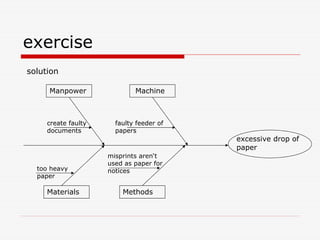
exercise
solution
excessive drop of
paper
Manpower Machine
Materials Methods
create faulty
documents
faulty feeder of
papers
too heavy
paper
misprints aren‘t
used as paper for
notices
Advantage:
• different opinions by teamwork
• easy to apply
• little effort to practise
• better understanding for causes and
effects
Advantage:
• different opinions by teamwork
• easy to apply
• little effort to practise
• better understanding for causes and
effects
Disadvantage:
• No clarity in very complex problems
• Interactions and chronological
dependence can’t be displayed

Ishikawa diagram

  • 1.
  • 2.
    Structure Kaoru Ishikawa basic concept aim theoreticalconversion practical example exercise
  • 3.
    Kaoru Ishikawa (1915 -1989) • born in Tokio 1915 • graduated University of Tokyo in 1939 with an Engineering degree in applied chemistry • worked as a naval technical officer until 1941 • worked for Nissan Liquid Fuel Company • associate professor at the University of Tokyo in 1947 • famous person in Qualitymanagement • not only product quality • but also e.g. quality of Management and assistant • developed several quality-tools • One of these tools is the Ishikawa-Diagram (also called Fishbone- or cause and effect diagram)
  • 4.
    basic concept The Idea: thinkabout possible causes and reasons leading to an effect or a problem find solution for preventing those problems
  • 5.
    basic concept • oneproblem/effect • 7 causes lead to the problem/effect • the causes are divided into main- and sidecauses The 7 causes are: 1. Methods 2. Machinery 3. Management 4. Materials 5. Manpower 6. Environment 7. Measurement
  • 6.
  • 7.
    basic concept individual problem/effectneeds individual factors not all 7 factors are needed in the diagram
  • 8.
    basic concept individual problem/effectneeds individual factors not all 7 factors are needed in the diagram grade of influence Branch of production: Manpower, Methods, Material und Machine Branch of administration: Management, Environment
  • 9.
    basic concept individual problem/effectneeds individual factors not all 7 factors are needed in the diagram grade of influence Branch of production: Manpower, Methods, Material und Machine Branch of administration: Management, Environment e.g. Methods, Machinery, Management, Materials, Manpower
  • 10.
    basic concept individual problem/effectneeds individual factors not all 7 factors are needed in the diagram grade of influence Branch of production: Manpower, Methods, Material und Machine Branch of administration: Management, Environment e.g. Methods, Machinery, Management, Materials, Manpower 5 M‘s
  • 11.
    basic concept individual problem/effectneeds individual factors not all 7 factors are needed in the diagram grade of influence Branch of production: Manpower, Methods, Material und Machine Branch of administration: Management, Environment e.g. Methods, Machinery, Management, Materials, Manpower 5 M‘s 4P (Place, Procedures, People, Policies ) 4S (Surroundings, Suppliers, Systems, Skills)
  • 12.
  • 13.
    aim • find thecauses, main- and sidecauses • clarity • interdependence of the causes • improve them for having the wanted effect or eliminate them for solving the problem
  • 14.
    theoretical conversion 1. sketchthe diagram and inscript the needed causes
  • 15.
    theoretical conversion 1. sketchthe diagram and inscript the needed causes 2. work the main- and sidecauses out
  • 16.
    theoretical conversion 1. sketchthe diagram and inscript the needed causes 2. work the main- and sidecauses out 3. check the completeness
  • 17.
    theoretical conversion 1. sketchthe diagram and inscript the needed causes 2. work the main- and sidecauses out 3. check the completeness 4. weight the the main- & sidecauses in terms of meaning & influence
  • 18.
    theoretical conversion 1. sketchthe diagram and inscript the needed causes 2. work the main- and sidecauses out 3. check the completeness 4. weight the the main- & sidecauses in terms of meaning & influence 5. check the selected causes for rightness
  • 19.
    theoretical conversion 1. sketchthe diagram and inscript the needed causes 2. work the main- and sidecauses out 3. check the completeness 4. weight the the main- & sidecauses in terms of meaning & influence 5. check the selected causes for rightness 6. The team discusses about the solution
  • 20.
    theoretical conversion 6. Theteam discusses about the solution • causes that can be improved or eliminated easily will be finished first of all (no need to be weighted) • The weighted causes are in a list of priority and will be finished in turn
  • 21.
  • 22.
    theoretical conversion It‘s important thatthe team has skilled workers involved in discussion
  • 23.
    theoretical conversion It‘s important thatthe team has skilled workers involved in discussion e.g. supplier, clients etc
  • 24.
  • 25.
    practical example 1. sketchthe diagram and inscript the needed causes
  • 26.
    practical example 1. sketchthe diagram and inscript the needed causes
  • 27.
    practical example 1. sketchthe diagram and inscript the needed causes rise in productivity
  • 28.
    practical example 1. sketchthe diagram and inscript the needed causes rise in productivity Enviroment
  • 29.
    practical example 1. sketchthe diagram and inscript the needed causes rise in productivity ManpowerEnviroment
  • 30.
    practical example 1. sketchthe diagram and inscript the needed causes rise in productivity ManpowerEnviroment Machine
  • 31.
    practical example 1. sketchthe diagram and inscript the needed causes rise in productivity ManpowerEnviroment Machine Materials
  • 32.
    practical example 1. sketchthe diagram and inscript the needed causes rise in productivity ManpowerEnviroment Machine Materials Methods
  • 33.
    practical example 2. workthe main- and sidecauses out rise in productivity ManpowerEnviroment Machine Materials Methods
  • 34.
    practical example 2. workthe main- and sidecauses out rise in productivity ManpowerEnviroment Machine Materials Methods Noise Temperature
  • 35.
    practical example 2. workthe main- and sidecauses out rise in productivity ManpowerEnviroment Machine Materials Methods Noise Temperature Education Motivation w age
  • 36.
    practical example 2. workthe main- and sidecauses out rise in productivity ManpowerEnviroment Machine Materials Methods Noise Temperature Education Motivation w age Software Hardware
  • 37.
    practical example 2. workthe main- and sidecauses out rise in productivity ManpowerEnviroment Machine Materials Methods Noise Temperature Education Motivation w age Software Hardware Procurement
  • 38.
    practical example 2. workthe main- and sidecauses out rise in productivity ManpowerEnviroment Machine Materials Methods Noise Temperature Education Motivation w age Software Hardware Procurement Standardisation Lean Management CIP
  • 39.
    practical example 3. checkthe completeness rise in productivity ManpowerEnviroment Machine Materials Methods Noise Temperature Education Motivation w age Software Hardware Procurement Standardisation Lean Management CIP
  • 40.
    practical example 4. weightthe the main- & sidecauses in terms of meaning & influence • Lean Management • Standardisation • Motivation • Education •…
  • 41.
    practical example 5. checkthe selected causes for rightness • Lean Management • Standardisation • Motivation • Education •…
  • 42.
    practical example 6. Theteam discusses about the solution causes that can be improved or eliminated easily: • Hardware • Software • Temperature • Noise
  • 43.
    practical example 6. Theteam discusses about the solution weighted causes • Lean Management • Standardisation • Motivation • Education
  • 44.
    exercise excessive drop ofpaper Henner Graubitz October 23rd 2006
  • 45.
    exercise 1. sketch thediagram and inscript the needed causes 2. work the main- and sidecauses out 3. check the completeness 4. weight the the main- & sidecauses in terms of meaning & influence 5. check the selected causes for rightness 6. The team discusses about the solution
  • 46.
    exercise solution excessive drop of paper ManpowerMachine Materials Methods create faulty documents faulty feeder of papers too heavy paper misprints aren‘t used as paper for notices
  • 47.
    Advantage: • different opinionsby teamwork • easy to apply • little effort to practise • better understanding for causes and effects
  • 48.
    Advantage: • different opinionsby teamwork • easy to apply • little effort to practise • better understanding for causes and effects Disadvantage: • No clarity in very complex problems • Interactions and chronological dependence can’t be displayed