Urinary
Catheterization
Prashant Singh
UG Tutor, TPCON
TMU
• Catheterization of the urinary bladder is the
insertion of a hollow tube through the urethra
into the bladder for removing urine. It is an
aseptic procedure for which sterile
equipment is required.
PURPOSES OF URINARY Catheterization
• Relieve Urinary Retention.
• Obtain a Sterile Urine Specimen from a
Female Patient.
• Measure Residual Urine.
• Empty the Bladder Before, During, or After
Surgery.
• Allows accurate measurement of urine output.
INDICATIONS OF URINARY CATHETERIZATION:
Diagnostic:
a) Collection of uncontaminated urine specimen.
b) For accurate measurement & monitoring of urine output.
c) For urodynamic studies.
Therapeutic:
d) To relieve urinary retention.
e) For bladder irrigation.
f) Intermittent decompression for neurogenic bladder.
g) To empty the Bladder before, during, or after surgery.
h) Intravesical chemotherapy.
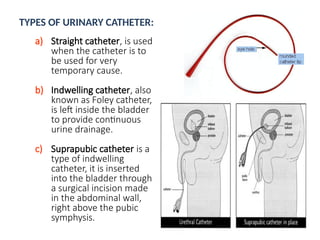
TYPES OF URINARY CATHETER:
a) Straight catheter, is used
when the catheter is to
be used for very
temporary cause.
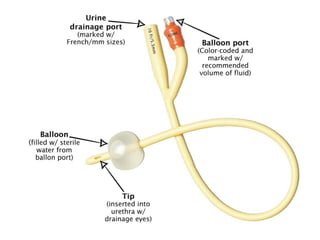
b) Indwelling catheter, also
known as Foley catheter,
is left inside the bladder
to provide continuous
urine drainage.
c) Suprapubic catheter is a
type of indwelling
catheter, it is inserted
into the bladder through
a surgical incision made
in the abdominal wall,
right above the pubic
symphysis.
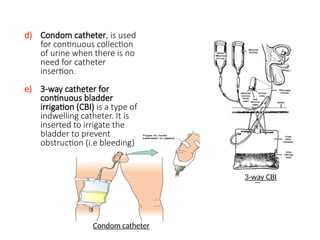
d) Condom catheter, is used
for continuous collection
of urine when there is no
need for catheter
insertion.
e) 3-way catheter for
continuous bladder
irrigation (CBI) is a type of
indwelling catheter. It is
inserted to irrigate the
bladder to prevent
obstruction (i.e bleeding)
Condom catheter
3-way CBI
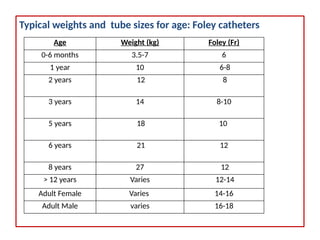
Typical weights and tube sizes for age: Foley catheters
Age Weight (kg) Foley (Fr)
0-6 months 3.5-7 6
1 year 10 6-8
2 years 12 8
3 years 14 8-10
5 years 18 10
6 years 21 12
8 years 27 12
> 12 years Varies 12-14
Adult Female Varies 14-16
Adult Male varies 16-18
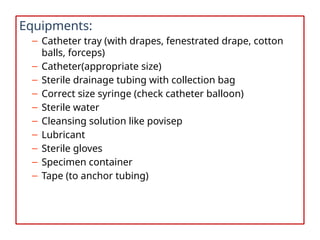
Equipments:
– Catheter tray (with drapes, fenestrated drape, cotton
balls, forceps)
– Catheter(appropriate size)
– Sterile drainage tubing with collection bag
– Correct size syringe (check catheter balloon)
– Sterile water
– Cleansing solution like povisep
– Lubricant
– Sterile gloves
– Specimen container
– Tape (to anchor tubing)
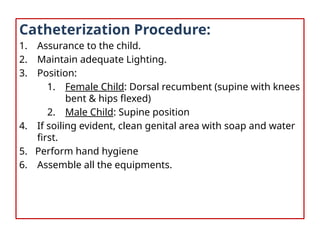
Catheterization Procedure:
1. Assurance to the child.
2. Maintain adequate Lighting.
3. Position:
1. Female Child: Dorsal recumbent (supine with knees
bent & hips flexed)
2. Male Child: Supine position
4. If soiling evident, clean genital area with soap and water
first.
5. Perform hand hygiene
6. Assemble all the equipments.
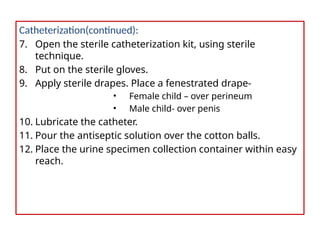
Catheterization(continued):
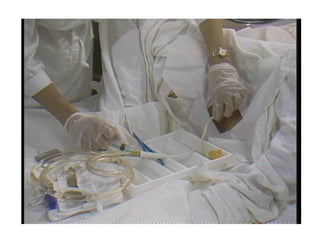
7. Open the sterile catheterization kit, using sterile
technique.
8. Put on the sterile gloves.
9. Apply sterile drapes. Place a fenestrated drape-
• Female child – over perineum
• Male child- over penis
10. Lubricate the catheter.
11. Pour the antiseptic solution over the cotton balls.
12. Place the urine specimen collection container within easy
reach.
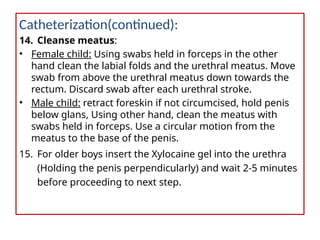
Catheterization(continued):
14. Cleanse meatus:
• Female child: Using swabs held in forceps in the other
hand clean the labial folds and the urethral meatus. Move
swab from above the urethral meatus down towards the
rectum. Discard swab after each urethral stroke.
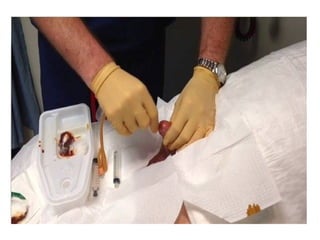
• Male child: retract foreskin if not circumcised, hold penis
below glans, Using other hand, clean the meatus with
swabs held in forceps. Use a circular motion from the
meatus to the base of the penis.
15. For older boys insert the Xylocaine gel into the urethra
(Holding the penis perpendicularly) and wait 2-5 minutes
before proceeding to next step.
Catheterization(continued):
15. Insert catheter until urine flows, advance 2.5-5cm
more.
16. Then inflate the balloon with distilled water.
17. Gently pull catheter until resistance is felt.
18. Connect catheter to drainage system.
19. Secure the catheter to thigh.
20. Position drainage bag lower than the bladder.
21. Dispose the gloves & other disposable articles.
22. Perform hand hygiene.
23. Documentation of the procedure.
THANK YOU

Catheterization Procedure for Childs and Adults

  • 1.
  • 2.
    • Catheterization ofthe urinary bladder is the insertion of a hollow tube through the urethra into the bladder for removing urine. It is an aseptic procedure for which sterile equipment is required.
  • 3.
    PURPOSES OF URINARYCatheterization • Relieve Urinary Retention. • Obtain a Sterile Urine Specimen from a Female Patient. • Measure Residual Urine. • Empty the Bladder Before, During, or After Surgery. • Allows accurate measurement of urine output.
  • 5.
    INDICATIONS OF URINARYCATHETERIZATION: Diagnostic: a) Collection of uncontaminated urine specimen. b) For accurate measurement & monitoring of urine output. c) For urodynamic studies. Therapeutic: d) To relieve urinary retention. e) For bladder irrigation. f) Intermittent decompression for neurogenic bladder. g) To empty the Bladder before, during, or after surgery. h) Intravesical chemotherapy.
  • 6.
    TYPES OF URINARYCATHETER: a) Straight catheter, is used when the catheter is to be used for very temporary cause. b) Indwelling catheter, also known as Foley catheter, is left inside the bladder to provide continuous urine drainage. c) Suprapubic catheter is a type of indwelling catheter, it is inserted into the bladder through a surgical incision made in the abdominal wall, right above the pubic symphysis.
  • 7.
    d) Condom catheter,is used for continuous collection of urine when there is no need for catheter insertion. e) 3-way catheter for continuous bladder irrigation (CBI) is a type of indwelling catheter. It is inserted to irrigate the bladder to prevent obstruction (i.e bleeding) Condom catheter 3-way CBI
  • 8.
    Typical weights andtube sizes for age: Foley catheters Age Weight (kg) Foley (Fr) 0-6 months 3.5-7 6 1 year 10 6-8 2 years 12 8 3 years 14 8-10 5 years 18 10 6 years 21 12 8 years 27 12 > 12 years Varies 12-14 Adult Female Varies 14-16 Adult Male varies 16-18
  • 9.
    Equipments: – Catheter tray(with drapes, fenestrated drape, cotton balls, forceps) – Catheter(appropriate size) – Sterile drainage tubing with collection bag – Correct size syringe (check catheter balloon) – Sterile water – Cleansing solution like povisep – Lubricant – Sterile gloves – Specimen container – Tape (to anchor tubing)
  • 10.
    Catheterization Procedure: 1. Assuranceto the child. 2. Maintain adequate Lighting. 3. Position: 1. Female Child: Dorsal recumbent (supine with knees bent & hips flexed) 2. Male Child: Supine position 4. If soiling evident, clean genital area with soap and water first. 5. Perform hand hygiene 6. Assemble all the equipments.
  • 11.
    Catheterization(continued): 7. Open thesterile catheterization kit, using sterile technique. 8. Put on the sterile gloves. 9. Apply sterile drapes. Place a fenestrated drape- • Female child – over perineum • Male child- over penis 10. Lubricate the catheter. 11. Pour the antiseptic solution over the cotton balls. 12. Place the urine specimen collection container within easy reach.
  • 12.
    Catheterization(continued): 14. Cleanse meatus: •Female child: Using swabs held in forceps in the other hand clean the labial folds and the urethral meatus. Move swab from above the urethral meatus down towards the rectum. Discard swab after each urethral stroke. • Male child: retract foreskin if not circumcised, hold penis below glans, Using other hand, clean the meatus with swabs held in forceps. Use a circular motion from the meatus to the base of the penis. 15. For older boys insert the Xylocaine gel into the urethra (Holding the penis perpendicularly) and wait 2-5 minutes before proceeding to next step.
  • 15.
    Catheterization(continued): 15. Insert catheteruntil urine flows, advance 2.5-5cm more. 16. Then inflate the balloon with distilled water. 17. Gently pull catheter until resistance is felt. 18. Connect catheter to drainage system. 19. Secure the catheter to thigh. 20. Position drainage bag lower than the bladder. 21. Dispose the gloves & other disposable articles. 22. Perform hand hygiene. 23. Documentation of the procedure.
  • 16.