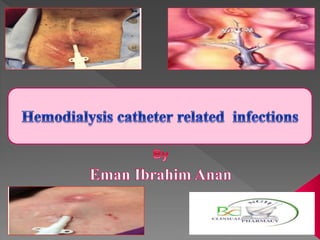
-CDC core intervention for dialysis blood stream infection ( BSI )
prevention
-Protocol of management of hemodialysis catheter related
infections
Exit site infection
Tunnel infection
Hemodialysis catheter related blood stream infection ( CRSBI )
• ( )
1-Catheter reduction .
2-Staff education and competency .
3-Surveillance and feedback
Using CDC’s National Healthcare Safety Network (NHSN).
4-Hand hygiene observations .
5-Catheter/vascular access care observations
Assess staff adherence to aseptic technique when connecting and disconnecting
catheters and during dressing changes .
6-Catheter hub disinfection
Scrub catheter hubs with an appropriate antiseptic after cap is removed and
before accessing.
Perform every time catheter is accessed or disconnected.
7-Patient education
8-Chlorhexidine for skin antisepsis
Use an alcohol-based chlorhexidine (>0.5%) solution as the first line skin
antiseptic agent for central line insertion and during dressing changes .
Alternatives for patients with chlorhexidine intolerance:
Povidone-iodine (preferably with alcohol) or 70% alcohol .
9-Antimicrobial ointment for hemodialysis catheter exit site
(after catheter insertion and at each hemodialysis session ) .
Povidone iodine
ointment
or
Bacitracin/gramicidin/polymyxin B ointment
( not available in U.S) .
Bacitracin/neomycin/polymyxin B
(is available )and might have a similar benefit but studies
have not thoroughly evaluated its effect for prevention of
blood stream and exit-site infections .
Other ointment have been studied (Mupirocin)
However, concerns exist about development of antimicrobial resistance and also
their ability to cover the spectrum of potential pathogens (e.g., gram-negative
and gram-positive bacteria) that can cause bloodstream infections in dialysis
patients.
Antimicrobial ointment for hemodialysis
catheter exit site ( ERBP )
.
Do not administer systemic antimicrobial prophylaxis routinely before insertion
or during use of an intravascular catheter to prevent catheter colonization or
CRBSI . (Category IB )
Use prophylactic antimicrobial lock solution in patients with long term catheters
who have a history of multiple CRBSI despite optimal maximal adherence to
aseptic technique . (Category II )
a a e e t of
e o i l s s a h t r n e t o s
.
1- x t i e n e t o
-Definition 1-Hyperemia, induration, and/or tenderness ≤2 cm
from catheter exit site.
2-May be associated with fever and purulent
drainage from the exit site .
3-It may or may not be associated with bacteremia
-If there is purulent
drainage
It should be collected and sent for Gram staining
and culture before antibiotic administration .
Draw blood sample for blood culture
-The patient should be
investigated for nasal
carriage of
Staphylococcus
If present, treated with
intranasal mupirocin
cream
Twice a day to each
nostril for 5 days
Empiric antibiotic
-Exit site
without fever
-Topical antibiotic +/ - systemic antibiotic
-Modify the antibiotic regimen once culture and sensitivity result available
-Duration 7 to 14 days
Depending on the microorganism isolated .
If the infection
persists after
an initial course of
systemic antibiotics
2- u n l n e t o
Definition 1-Tenderness, hyperemia, and/or induration that extends
>2 cm from the exit site and along the subcutaneous
tunnel.
2-It may or may not be associated with bacteremia .
If there is
purulent
drainage
It should be collected and sent for Gram staining and
culture before antibiotic administration .
Draw blood sample for blood culture
Empiric Treatment
Start broad spectrum empiric antibiotics to cover both gram-positive and
negative organisms .
Modify antibiotic regimen when culture and sensitivity results are available.
Duration In the absence of a concurrent CRBSI
Are typically treated for 10 to 14 days
Depending on the microorganism isolated and local practice.
Duration If a CRBSI is also present
The duration of therapy will be as CRBSI
Catheter
removal
The catheter
should always
be removed,
without
exchange over
a guidewire
A new
catheter
should be
inserted at a
separate
site.
3- a h t r r l t d
l o s r a
i f c io
(CRBSI )
 RISK FACTORS
History of previous
catheter-related
Bacteremia,
Recent surgery,
Dabetes mellitus,
Iron overload,
Immunosuppression,
Hypoalbuminemia
COMPLICATIONS
Metastatic complications
as osteomyelitis,
Endocarditis,
Septic arthritis,
or epidural abscess.
1-Suspect CRSBI in patient with
-Fever and/or chills
-Hemodynamic instability, altered mental status, and other symptoms
and/or signs of sepsis , such as hypothermia, acidosis, and hypotension
Not related to another infection site .
2- Paired Blood Culture ( prior to antibiotic initiation )
therapy )
1- Peripheral + central from catheter hub ( if catheter retained )
2-Centeral from the catheter + dialysis circuit ( from hemodialysis line )
in case of peripheral vein absent
3- Peripheral + catheter tip if catheter removed ( distal 5 cm from tip )
Consideration for blood sample
1-Obtain samples for blood culture prior to the initiation of antibiotic therapy
2-Marke the bottles to reflect the site from which the samples were obtained
(catheter and peripheral vein ) .
3- For percutaneously drawn blood samples
Skin preparation with use of alcohol or alcoholic chlorhexidine( 10.5%)
(allow adequate skin contact and drying times to mitigate blood culture
contamination )
4-Peripheral blood samples should be from vessels that are not intended for
future use in creating a dialysis fistula (e.g., hand veins)
5-If a blood sample is obtained through a catheter
Clean the catheter hub with either alcohol or tincture of iodine or alcoholic
chlorhexidine (10.5%)
6-The volume of the locking solution should be removed prior to blood culture
collection .
3-Empiric antimicrobial therapy for hemodialysis catheter related
blood stream infection
CRBSI result from a broad array of Gram positive and Gram
negative organism
Gram +ve microorganisms -Staphylococcus aureus ( MSSA or
MRSA)
-Enetrococci
- Coagulase negative Staphylococci
Gram -ve bacilli -Pseudomonas species and others
Fungi -Candida species
Polymicrobial --------------------------------------------------
Others --------------------------------------------------
-Choice of antimicrobial agent for CRBSI based on coverage of
Gram +ve bactria + Gram -ve bactria +/- fungal infection
M.O Antimicrobial agent
For Gram
+ve M.O
- Cefazolin ( MSSA )
- Vancomycin or teicoplanin (MRSA )
For Gram
-ve M.O
- 3rd generation cephalosporin :Ceftazidim
- 4th generation cephalosporin :Cefepime
- Beta lactam / Beta lactamase inhibitor :Piperacillin /Tazobactam
- Carbapenem : (Imipenem / cilastatin )-Meropenem
Fungal
infection
Fluconazole
( if risk for C.glabarata – C .Krusei is low )
(If no previous exposure in the last 3 months )
Amphotericin
Indication for
fungal
infection
Septic patient with following risk factor
1- Prolonged use of broad spectrum antibiotic
2-Femoral catheter
3- Hematological malignancy
4-Bone marrow or organ transplant
5-TPN
6-Colonization of candida at multiple site
-Fever
-Chills
-Hemodynamic instability
-Or altered mental status
Resolve within 2-3 days and there is no metatstatic infection or
exit siteinfection or tunnel infection .
The catheter can be retained,
and an antibiotic lock can be
used as adjunctive therapy
after each dialysis session for
10–14 days
The infected catheter can
be exchanged over a
guidewire for a new,
longterm hemodialysis
catheter
Definitive diagnosis of dialysis catheter-induced bacteremia requires
one of
-Concurrent positive blood cultures of the same organism from the catheter and a
peripheral vein.
-Culture of the same organism from both the catheter tip and at least one
percutaneous blood culture .
CRSBI diagnosis unlikely
Both sets of initial blood cultures have negative results
If there is no other identified source of infection and signs and symptoms of
bacteremia have resolved Stopping empiric therapy
1-De- escalation to single antibiotic once culture available.
2-Patients who receive empirical vancomycin or
teicoplanin and who are found to have CRBSI due to
methicillin-susceptible S. aureus should be switched to
cefazolin .
3-Patients who have CRBSI due to vancomycin- resistant
enterococci can be treated with oral linezolid .
If peripheral blood culture –ve and catheter culture +ve
Antibiotic are not generaly recommended
The exception is patients whose catheter tips grow S.
aureus and have negative blood culture
These patients should receive 5–7 days of antibiotic
Complicated
Infection
-Port abscess
-Osteomyelitis
-Septic
arthritis
-Endocarditis
Tunnel
infection
Sever
sepsis
Hemodynamic
instability
If fever and bacterimia
persist 48 -72 hr after
initiaition of antibiotic to
which the organism is
susceptible
S. aureus
Pseudomonas species
Candida species
MDR organism
Catheter
salvage
Cultures should
be collected
after 72 hours
of adequate
antibiotic
therapy
catheter should
be removed if
the blood
culture results
remain positive
A-Placement of a temporary non-tunneled catheter is typically
the best alternative option for short-term dialysis
access.
B- A temporary non tunneled catheter should be inserted into another
anatomical site .
C- If absolutely no alternative sites are available for catheter insertion, then
exchange the infected catheter over a guide
wire.
D-After a hemodialysis catheter is removed for CRBSI, a long-term
hemodialysis catheter can be placed once blood cultures with negative results
are obtained.
Table 1 :Treatment duration for CRBSI
Gram –ve bacilli 10 – 14 days
Coagulase -ve
Staphylococcus
species
Catheter is remove
Treat wih antibiotic for 5-7 days
Catheter retained
Treat for 10 -14 day
Enterococcus Catheter retained (Treat with antibiotic for 7-10) days
Staphylococcus
auerus
1-Antibiotic for 4-6 weeks unless patient have exception
recommended in 2
2- Short duration of antimicroibial ( minimum 14 days)
If patient
-Not diabetic
-Not immune suppressed
( not receiving systemic steroid or other immune suppressive
drugs , and is non neutropenic)
-If catheter removed,
-If patient has no prosthetic intravascular device (e.g pacemaker
or recently placed vascular graft )
-If fever and bacteremia resolve within 72 hr after initiation of
antimicrobial therapy
Table 1 :Treatment duration for CRBSI
-Candida SPP 14 days after 1st –ve blood culture
-Endocarditis 4–6-week
-Septic thrombophlebitis 4–6-week
-Osteomyelitis 6–8 weeks of therapy
(ALT) involves instillation of a highly concentrated antibiotic solution
into an intravascular catheter lumen
For CRBSI, antibiotic lock should not be used alone; instead, it should be used in
conjunction with systemic antimicrobial therapy .
Antibiotic lock is indicated for patients with CRBSI involving long-term catheters with
no signs of exit site or tunnel infection for whom catheter salvage is the goal .
The antibiotic/heparin lock solution is prepared immediately before instillation
into the catheter lumen .
The antibiotic lock should be replaced every 48 hours, after each HD session .
This mixture of antibiotic and anticoagulant is then instilled ("locked") into
each catheter lumen at the end of each dialysis session, in place of standard
heparin locks, for the duration of the systemic antibiotic ( 10- 14 days ).
Table 1:Antibiotic lock therapy ( ALT ) preparation
Antibiotic and dosage Heparin or saline, IU/mL
Vancomycin, 2.5 mg/ ml 2500 or 5000
Vancomycin, 2.0 mg/mL 10
Vancomycin, 5.0 mg/mL 0 or 5000
Ceftazidime, 0.5 mg/mL 100
Cefazolin, 5.0 mg/mL 2500 or 5000
Ciprofloxacin, 0.2 mg/mL 5000
Gentamicin, 1.0 mg/mL 2500
Ampicillin 10.0 mg/mL 10 or 5000
1- These antibiotic lock solutions will not precipitate at the given concentrations.
2-A precipitate appears when mixing a 10 mg/mL of vancomycin with 10,000
IU/mL of heparin; however, by agitating the solution for 10 s, the precipitation
resolves and the solution remains precipitate-free for72 h at 37C
3-A Vancomycin at 5 mg/mL is more efficacious than at 1 mg/mL in eradicating
staphylococci embedded within biofilm .
Catheter
Salvage
Blood culture
should be
obtained 1 week
after completion
of antibiotic
treatment
If the result
positiveThe
catheter should
be removed
1-Blood culture :Obtain blood cultures from catheter and peripheral vein or
bloodline if peripheral vein not feasible
2- Empiric antibiotic
Blood
culture
-ve
Stop
ABX
Resolution of bactremia and fungemia in 2-3 days and
fever
Presistant
bacteremia /
fungmia and
fever
Coagulase
–ve
Staphylococci
Gram
–ve
bacilli
S.aureus
Candida
albican Remove
CVC
Retain CVC
Antibiotic
for 10 -14
day
,Continue
ABL
Or
guidewire
exchange
Retain
CVC
Antibiotic
for 10 -14
day
,Continue
ABL
Or
guidewire
exchange
Remove
CVC
And
Antibiotic
x 3 weeks
If TEE
–ve
Guidewire
CVC
exchange
Antifungal
for 14 day
after 1st
-ve blood
culture
Antibiotic
x4-6 and
look of
metastatic
Infection
Antibiotic Dose
Cefazolin 20 mg/kg (actual body weight),
rounded to the nearest 500-mg increment,
after dialysis
Ceftazidim 500 mg to 1gm q 24 hr or 1- 2 gm q 48 – 72 hr
after dialysis
Cefepime 1 gm on day 1 then 0.5 -1 gm q 24 hr or 1-2 gm q 48 -
72 ( after dialysis )
Piperacillin/ Tazobactam 2.25 gm q 12 hr after hemodialysis session
Vancomycin 20 mg/ kg loading dose infused during last hr of
Dialysis session
Then 500 mg during the last 30 min of the following
dialysis session
Meropenem 500 mg every 24 hr after hemodialysis
Assume 3 times weekly and complete IHD sessions
Imipenem / Cilastatin 250 mg to 500 mg q 12 hr after hemodialysis session
Linezolide 600 mg every 12 hr after hemodialysis
Antifungal Dose
Fluconazole iv 100 – 200 q 24 hr
Or 200 – 400 q 48 – 72 hr
Amphotericin B
Caspofungin 70 mg iv loading dose followed by 50 mg iv
daily
Micafungin 100 mg iv daily
 References
1. Mermel LA, Allon M, Bouza E, et al. Clinical practice guidelines for the
diagnosis and management of intravascular catheter-related infection
update by the infectious disease society of america. Clin Infec Dis.( 2009 )
. 2-CDC Guidelines for the Prevention of Intravascular Catheter-Related Infections.
( 2011 )
3-UpToDate (Dialysis catheter infection )
4- NKF KDOQI Vascular access guideline. ( 2006 )
5- Diagnosis, prevention and treatment of haemodialysis catheter-related
bloodstream infections (CRBSI): a position statement of European
Renal Best Practice (ERBP) NDT Plus (2010)
6-Canadian Journal of Kidney Healthand DiseaseVolume 3: 1–11 ( 2016 )
7 - Hand book of dialysis 5th edition
8-Johns Hoppikens antimicrobial guidline (2015 – 2016 )
Catheter

Catheter

  • 2.
    -CDC core interventionfor dialysis blood stream infection ( BSI ) prevention -Protocol of management of hemodialysis catheter related infections Exit site infection Tunnel infection Hemodialysis catheter related blood stream infection ( CRSBI )
  • 4.
  • 6.
    1-Catheter reduction . 2-Staffeducation and competency . 3-Surveillance and feedback Using CDC’s National Healthcare Safety Network (NHSN).
  • 7.
  • 8.
    5-Catheter/vascular access careobservations Assess staff adherence to aseptic technique when connecting and disconnecting catheters and during dressing changes . 6-Catheter hub disinfection Scrub catheter hubs with an appropriate antiseptic after cap is removed and before accessing. Perform every time catheter is accessed or disconnected.
  • 11.
  • 12.
    8-Chlorhexidine for skinantisepsis Use an alcohol-based chlorhexidine (>0.5%) solution as the first line skin antiseptic agent for central line insertion and during dressing changes . Alternatives for patients with chlorhexidine intolerance: Povidone-iodine (preferably with alcohol) or 70% alcohol .
  • 13.
    9-Antimicrobial ointment forhemodialysis catheter exit site (after catheter insertion and at each hemodialysis session ) . Povidone iodine ointment or Bacitracin/gramicidin/polymyxin B ointment ( not available in U.S) . Bacitracin/neomycin/polymyxin B (is available )and might have a similar benefit but studies have not thoroughly evaluated its effect for prevention of blood stream and exit-site infections . Other ointment have been studied (Mupirocin) However, concerns exist about development of antimicrobial resistance and also their ability to cover the spectrum of potential pathogens (e.g., gram-negative and gram-positive bacteria) that can cause bloodstream infections in dialysis patients.
  • 14.
    Antimicrobial ointment forhemodialysis catheter exit site ( ERBP )
  • 15.
  • 18.
    Do not administersystemic antimicrobial prophylaxis routinely before insertion or during use of an intravascular catheter to prevent catheter colonization or CRBSI . (Category IB ) Use prophylactic antimicrobial lock solution in patients with long term catheters who have a history of multiple CRBSI despite optimal maximal adherence to aseptic technique . (Category II )
  • 19.
    a a ee t of e o i l s s a h t r n e t o s
  • 21.
  • 22.
    1- x ti e n e t o
  • 23.
    -Definition 1-Hyperemia, induration,and/or tenderness ≤2 cm from catheter exit site. 2-May be associated with fever and purulent drainage from the exit site . 3-It may or may not be associated with bacteremia -If there is purulent drainage It should be collected and sent for Gram staining and culture before antibiotic administration . Draw blood sample for blood culture -The patient should be investigated for nasal carriage of Staphylococcus If present, treated with intranasal mupirocin cream Twice a day to each nostril for 5 days
  • 24.
    Empiric antibiotic -Exit site withoutfever -Topical antibiotic +/ - systemic antibiotic -Modify the antibiotic regimen once culture and sensitivity result available -Duration 7 to 14 days Depending on the microorganism isolated .
  • 25.
    If the infection persistsafter an initial course of systemic antibiotics
  • 26.
    2- u nl n e t o
  • 27.
    Definition 1-Tenderness, hyperemia,and/or induration that extends >2 cm from the exit site and along the subcutaneous tunnel. 2-It may or may not be associated with bacteremia . If there is purulent drainage It should be collected and sent for Gram staining and culture before antibiotic administration . Draw blood sample for blood culture
  • 28.
    Empiric Treatment Start broadspectrum empiric antibiotics to cover both gram-positive and negative organisms . Modify antibiotic regimen when culture and sensitivity results are available. Duration In the absence of a concurrent CRBSI Are typically treated for 10 to 14 days Depending on the microorganism isolated and local practice. Duration If a CRBSI is also present The duration of therapy will be as CRBSI
  • 29.
    Catheter removal The catheter should always beremoved, without exchange over a guidewire A new catheter should be inserted at a separate site.
  • 30.
    3- a ht r r l t d l o s r a i f c io (CRBSI )
  • 32.
     RISK FACTORS Historyof previous catheter-related Bacteremia, Recent surgery, Dabetes mellitus, Iron overload, Immunosuppression, Hypoalbuminemia COMPLICATIONS Metastatic complications as osteomyelitis, Endocarditis, Septic arthritis, or epidural abscess.
  • 33.
    1-Suspect CRSBI inpatient with -Fever and/or chills -Hemodynamic instability, altered mental status, and other symptoms and/or signs of sepsis , such as hypothermia, acidosis, and hypotension Not related to another infection site .
  • 34.
    2- Paired BloodCulture ( prior to antibiotic initiation ) therapy ) 1- Peripheral + central from catheter hub ( if catheter retained ) 2-Centeral from the catheter + dialysis circuit ( from hemodialysis line ) in case of peripheral vein absent 3- Peripheral + catheter tip if catheter removed ( distal 5 cm from tip )
  • 35.
    Consideration for bloodsample 1-Obtain samples for blood culture prior to the initiation of antibiotic therapy 2-Marke the bottles to reflect the site from which the samples were obtained (catheter and peripheral vein ) . 3- For percutaneously drawn blood samples Skin preparation with use of alcohol or alcoholic chlorhexidine( 10.5%) (allow adequate skin contact and drying times to mitigate blood culture contamination ) 4-Peripheral blood samples should be from vessels that are not intended for future use in creating a dialysis fistula (e.g., hand veins) 5-If a blood sample is obtained through a catheter Clean the catheter hub with either alcohol or tincture of iodine or alcoholic chlorhexidine (10.5%) 6-The volume of the locking solution should be removed prior to blood culture collection .
  • 36.
    3-Empiric antimicrobial therapyfor hemodialysis catheter related blood stream infection CRBSI result from a broad array of Gram positive and Gram negative organism Gram +ve microorganisms -Staphylococcus aureus ( MSSA or MRSA) -Enetrococci - Coagulase negative Staphylococci Gram -ve bacilli -Pseudomonas species and others Fungi -Candida species Polymicrobial -------------------------------------------------- Others --------------------------------------------------
  • 37.
    -Choice of antimicrobialagent for CRBSI based on coverage of Gram +ve bactria + Gram -ve bactria +/- fungal infection M.O Antimicrobial agent For Gram +ve M.O - Cefazolin ( MSSA ) - Vancomycin or teicoplanin (MRSA ) For Gram -ve M.O - 3rd generation cephalosporin :Ceftazidim - 4th generation cephalosporin :Cefepime - Beta lactam / Beta lactamase inhibitor :Piperacillin /Tazobactam - Carbapenem : (Imipenem / cilastatin )-Meropenem Fungal infection Fluconazole ( if risk for C.glabarata – C .Krusei is low ) (If no previous exposure in the last 3 months ) Amphotericin Indication for fungal infection Septic patient with following risk factor 1- Prolonged use of broad spectrum antibiotic 2-Femoral catheter 3- Hematological malignancy 4-Bone marrow or organ transplant 5-TPN 6-Colonization of candida at multiple site
  • 38.
    -Fever -Chills -Hemodynamic instability -Or alteredmental status Resolve within 2-3 days and there is no metatstatic infection or exit siteinfection or tunnel infection . The catheter can be retained, and an antibiotic lock can be used as adjunctive therapy after each dialysis session for 10–14 days The infected catheter can be exchanged over a guidewire for a new, longterm hemodialysis catheter
  • 39.
    Definitive diagnosis ofdialysis catheter-induced bacteremia requires one of -Concurrent positive blood cultures of the same organism from the catheter and a peripheral vein. -Culture of the same organism from both the catheter tip and at least one percutaneous blood culture . CRSBI diagnosis unlikely Both sets of initial blood cultures have negative results If there is no other identified source of infection and signs and symptoms of bacteremia have resolved Stopping empiric therapy
  • 40.
    1-De- escalation tosingle antibiotic once culture available. 2-Patients who receive empirical vancomycin or teicoplanin and who are found to have CRBSI due to methicillin-susceptible S. aureus should be switched to cefazolin . 3-Patients who have CRBSI due to vancomycin- resistant enterococci can be treated with oral linezolid .
  • 41.
    If peripheral bloodculture –ve and catheter culture +ve Antibiotic are not generaly recommended The exception is patients whose catheter tips grow S. aureus and have negative blood culture These patients should receive 5–7 days of antibiotic
  • 42.
    Complicated Infection -Port abscess -Osteomyelitis -Septic arthritis -Endocarditis Tunnel infection Sever sepsis Hemodynamic instability If feverand bacterimia persist 48 -72 hr after initiaition of antibiotic to which the organism is susceptible S. aureus Pseudomonas species Candida species MDR organism
  • 43.
    Catheter salvage Cultures should be collected after72 hours of adequate antibiotic therapy catheter should be removed if the blood culture results remain positive
  • 44.
    A-Placement of atemporary non-tunneled catheter is typically the best alternative option for short-term dialysis access. B- A temporary non tunneled catheter should be inserted into another anatomical site . C- If absolutely no alternative sites are available for catheter insertion, then exchange the infected catheter over a guide wire. D-After a hemodialysis catheter is removed for CRBSI, a long-term hemodialysis catheter can be placed once blood cultures with negative results are obtained.
  • 45.
    Table 1 :Treatmentduration for CRBSI Gram –ve bacilli 10 – 14 days Coagulase -ve Staphylococcus species Catheter is remove Treat wih antibiotic for 5-7 days Catheter retained Treat for 10 -14 day Enterococcus Catheter retained (Treat with antibiotic for 7-10) days Staphylococcus auerus 1-Antibiotic for 4-6 weeks unless patient have exception recommended in 2 2- Short duration of antimicroibial ( minimum 14 days) If patient -Not diabetic -Not immune suppressed ( not receiving systemic steroid or other immune suppressive drugs , and is non neutropenic) -If catheter removed, -If patient has no prosthetic intravascular device (e.g pacemaker or recently placed vascular graft ) -If fever and bacteremia resolve within 72 hr after initiation of antimicrobial therapy
  • 46.
    Table 1 :Treatmentduration for CRBSI -Candida SPP 14 days after 1st –ve blood culture -Endocarditis 4–6-week -Septic thrombophlebitis 4–6-week -Osteomyelitis 6–8 weeks of therapy
  • 47.
    (ALT) involves instillationof a highly concentrated antibiotic solution into an intravascular catheter lumen For CRBSI, antibiotic lock should not be used alone; instead, it should be used in conjunction with systemic antimicrobial therapy . Antibiotic lock is indicated for patients with CRBSI involving long-term catheters with no signs of exit site or tunnel infection for whom catheter salvage is the goal . The antibiotic/heparin lock solution is prepared immediately before instillation into the catheter lumen . The antibiotic lock should be replaced every 48 hours, after each HD session . This mixture of antibiotic and anticoagulant is then instilled ("locked") into each catheter lumen at the end of each dialysis session, in place of standard heparin locks, for the duration of the systemic antibiotic ( 10- 14 days ).
  • 48.
    Table 1:Antibiotic locktherapy ( ALT ) preparation Antibiotic and dosage Heparin or saline, IU/mL Vancomycin, 2.5 mg/ ml 2500 or 5000 Vancomycin, 2.0 mg/mL 10 Vancomycin, 5.0 mg/mL 0 or 5000 Ceftazidime, 0.5 mg/mL 100 Cefazolin, 5.0 mg/mL 2500 or 5000 Ciprofloxacin, 0.2 mg/mL 5000 Gentamicin, 1.0 mg/mL 2500 Ampicillin 10.0 mg/mL 10 or 5000 1- These antibiotic lock solutions will not precipitate at the given concentrations. 2-A precipitate appears when mixing a 10 mg/mL of vancomycin with 10,000 IU/mL of heparin; however, by agitating the solution for 10 s, the precipitation resolves and the solution remains precipitate-free for72 h at 37C 3-A Vancomycin at 5 mg/mL is more efficacious than at 1 mg/mL in eradicating staphylococci embedded within biofilm .
  • 49.
    Catheter Salvage Blood culture should be obtained1 week after completion of antibiotic treatment If the result positiveThe catheter should be removed
  • 50.
    1-Blood culture :Obtainblood cultures from catheter and peripheral vein or bloodline if peripheral vein not feasible 2- Empiric antibiotic Blood culture -ve Stop ABX Resolution of bactremia and fungemia in 2-3 days and fever Presistant bacteremia / fungmia and fever Coagulase –ve Staphylococci Gram –ve bacilli S.aureus Candida albican Remove CVC Retain CVC Antibiotic for 10 -14 day ,Continue ABL Or guidewire exchange Retain CVC Antibiotic for 10 -14 day ,Continue ABL Or guidewire exchange Remove CVC And Antibiotic x 3 weeks If TEE –ve Guidewire CVC exchange Antifungal for 14 day after 1st -ve blood culture Antibiotic x4-6 and look of metastatic Infection
  • 51.
    Antibiotic Dose Cefazolin 20mg/kg (actual body weight), rounded to the nearest 500-mg increment, after dialysis Ceftazidim 500 mg to 1gm q 24 hr or 1- 2 gm q 48 – 72 hr after dialysis Cefepime 1 gm on day 1 then 0.5 -1 gm q 24 hr or 1-2 gm q 48 - 72 ( after dialysis ) Piperacillin/ Tazobactam 2.25 gm q 12 hr after hemodialysis session Vancomycin 20 mg/ kg loading dose infused during last hr of Dialysis session Then 500 mg during the last 30 min of the following dialysis session Meropenem 500 mg every 24 hr after hemodialysis Assume 3 times weekly and complete IHD sessions Imipenem / Cilastatin 250 mg to 500 mg q 12 hr after hemodialysis session Linezolide 600 mg every 12 hr after hemodialysis
  • 52.
    Antifungal Dose Fluconazole iv100 – 200 q 24 hr Or 200 – 400 q 48 – 72 hr Amphotericin B Caspofungin 70 mg iv loading dose followed by 50 mg iv daily Micafungin 100 mg iv daily
  • 53.
     References 1. MermelLA, Allon M, Bouza E, et al. Clinical practice guidelines for the diagnosis and management of intravascular catheter-related infection update by the infectious disease society of america. Clin Infec Dis.( 2009 ) . 2-CDC Guidelines for the Prevention of Intravascular Catheter-Related Infections. ( 2011 ) 3-UpToDate (Dialysis catheter infection ) 4- NKF KDOQI Vascular access guideline. ( 2006 ) 5- Diagnosis, prevention and treatment of haemodialysis catheter-related bloodstream infections (CRBSI): a position statement of European Renal Best Practice (ERBP) NDT Plus (2010) 6-Canadian Journal of Kidney Healthand DiseaseVolume 3: 1–11 ( 2016 ) 7 - Hand book of dialysis 5th edition 8-Johns Hoppikens antimicrobial guidline (2015 – 2016 )