Unit-9
General Issues and Problems of
Specific Disciplines
By: Atif Hussain
 1. Strategies for Specific Area Readings
 1.1. Instruction Frame in the Content Area
 1.2. Pre-reading
 1.3. Knowledge Rating
 1.4. Anticipation Guides
 2. Specific Textbook-Issues and Models
 2.1. Woolfok’s Model-General Level
 2.2. Dr. Durrani’s Model-Middle Level
 2.3. Singapore Model Specific Use
 2.4. A Specific Model for Higher Levels
 2.5. GTZ, Peshawar’s Model
 This unit is opening discussion of textbook development for specific
disciplines in view of their general needs.
 It also opens a window to validation and testing feasibility of the
textbooks to be introduced.
 The first portion of the unit describes strategies for specific reading
and its knowledge rating.
 The second part provides lesson designing models for general,
middle and higher level. These will help to design specific lessons.
 Activities and self-learning exercises are given to enhance the
learning. Specific needs will be discussed in their respective units.
The examples enhanced the unit volume.
After studying this unit, you will be able to:
1. know specific area issues and their general
forms as well as the lesson designing models.
2. prepare yourself to study feasibility testing of
textbooks.
3. develop strategies to visualize and prepare a
general lesson model.
Some strategies for reading were suggested
by the international consultant on textbooks.
Dr. N.N. Hermosa in the Middle School
Project of the Ministry of Education in 1998
and the textbooks so designed were tested
accordingly.
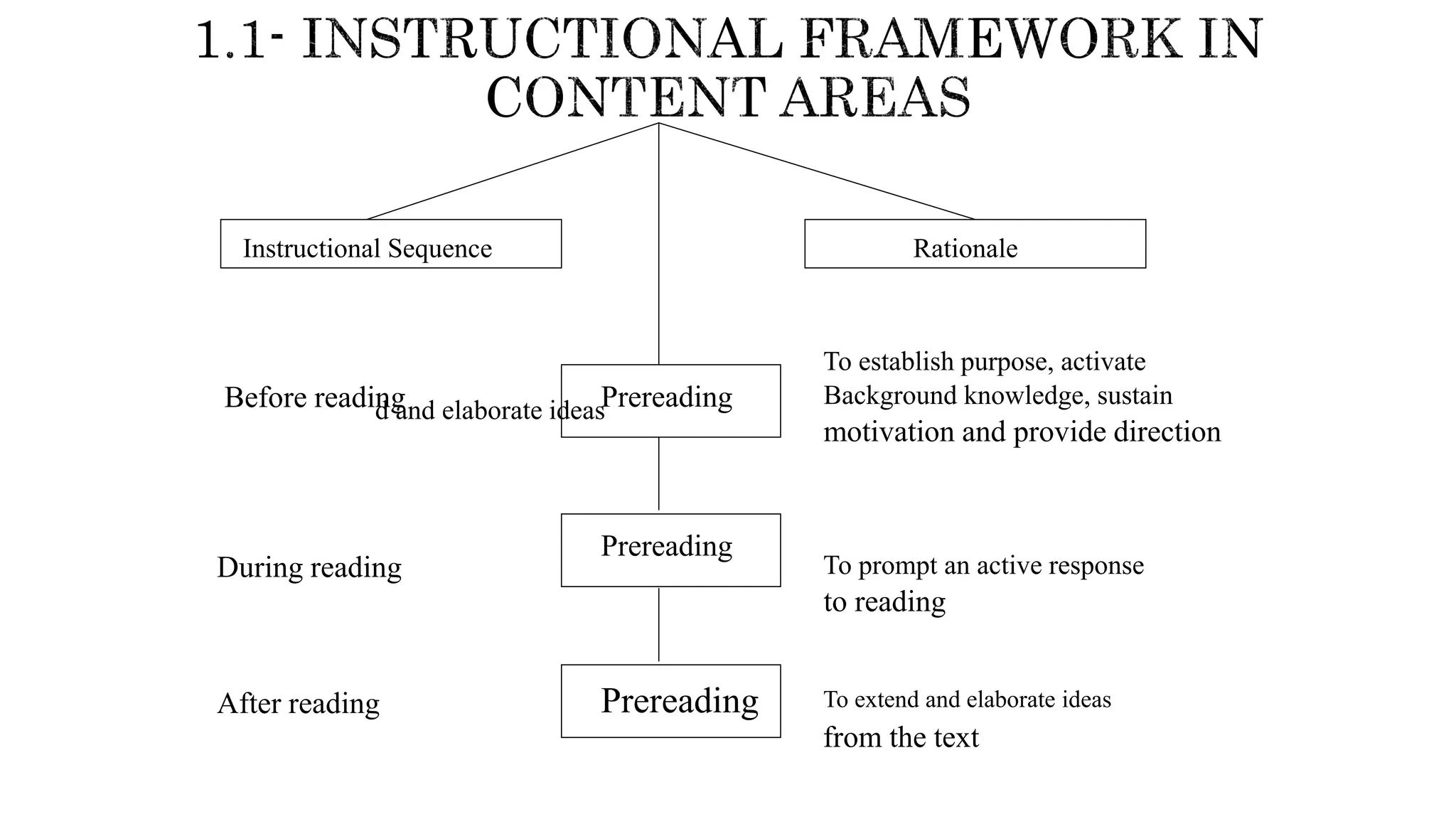
It has some steps to be followed as:
To establish purpose, activate
Before reading Background knowledge, sustain
motivation and provide direction
During reading To prompt an active response
to reading
After reading To extend and elaborate ideas
from the text
Instructional Sequence Rationale
Prereading
Prereading
Prereading
d and elaborate ideas
Semantic Maps (Brainstorming and Clustering)
 Semantic maps may be used to depict spatial relationships among words. They
include brainstorming and the use of collaborative small groups, allowing
students to cluster words/ideas belonging to categories and to distinguish
relationships among words.
 1. The teacher or the students decide on the core concept to be explored.
 2. Students, depending on what they have been studying and on their
background knowledge and experiences, offer as many words or phrases as
possible related to the concept term. these are recorded by the teacher on the
chalkboard.
 3. Small groups of students create semantic maps and share their
constructions in class discussion. A consolidated semantic map may be
constructed.
 4. The semantic map can be expanded and/or refined at the post reading
phase. In this manner, students learn to organize new and prior information
systematically.
Lion Bear Cat Parrot
Leopard Gorilla Dog Rabbit
Buffalo Elephant Dargon Unicorn
Horse Donkey
Wild Animals
ANIMALS
Pets
Work Animals Imaginary Animals
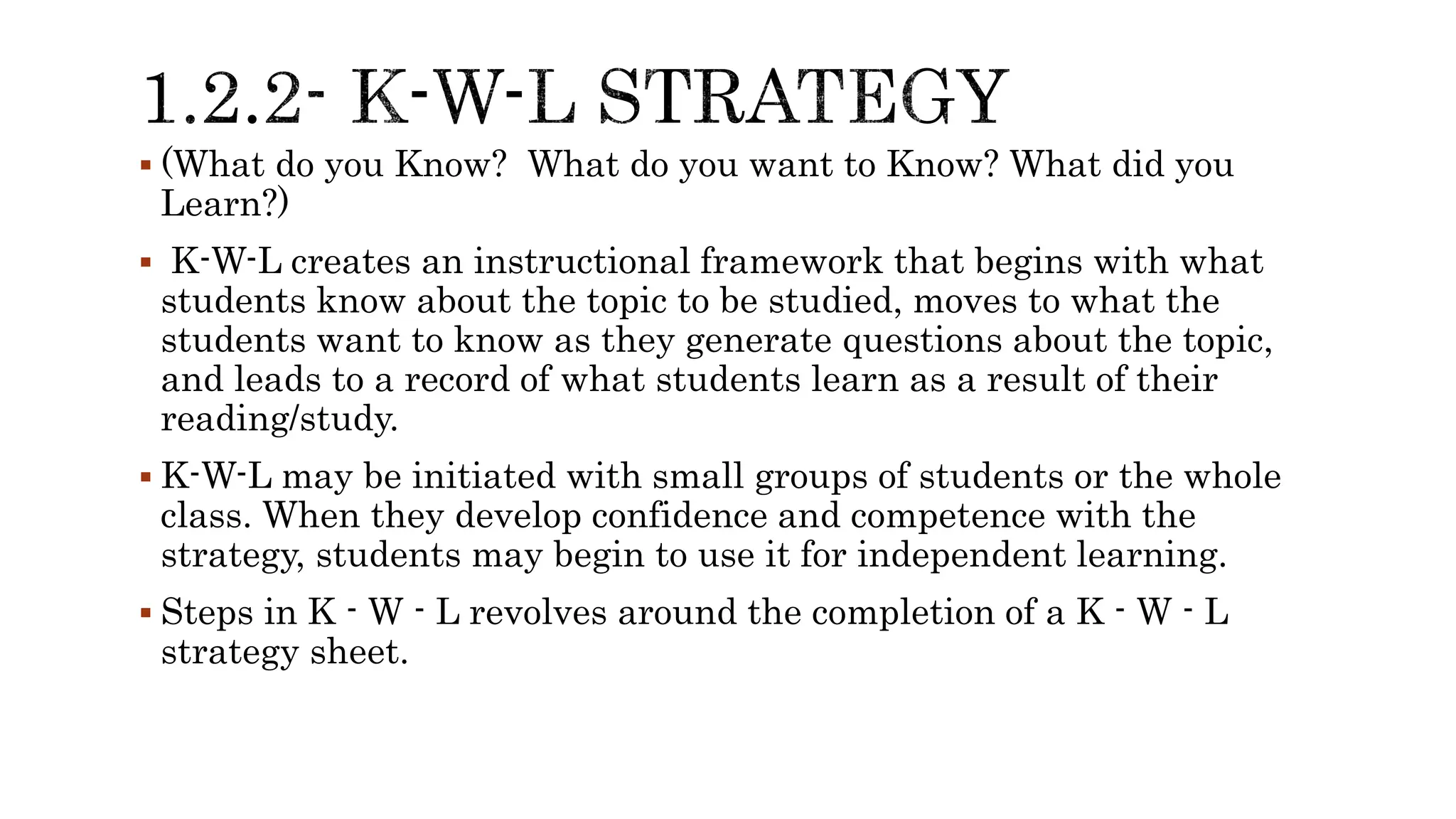
 (What do you Know? What do you want to Know? What did you
Learn?)
 K-W-L creates an instructional framework that begins with what
students know about the topic to be studied, moves to what the
students want to know as they generate questions about the topic,
and leads to a record of what students learn as a result of their
reading/study.
 K-W-L may be initiated with small groups of students or the whole
class. When they develop confidence and competence with the
strategy, students may begin to use it for independent learning.
 Steps in K - W - L revolves around the completion of a K - W - L
strategy sheet.
K- What I know W - What I want to Know L-What I Learned and
still want to Learn
Planetary motion
Spirals
4 seasons
landscaping
multiplying populations
phases of the moon.
What does a pineapple have to
do with Math?
How are growth patterns in
plants related to Math?
How is mathematics
specifically related to nature?
Pineapples are hexagons on
the surface that are arranged in
sets of spirals These spirals are
related to Fibonacci numbers.
Fibonacci numbers found in
leaf arrangements in plants.
The rate that bees regenerate
males is related to Fibonacci
numbers.
KRs get students to analyze what they know about a topic. The steps are:
 1. Present students with a list of vocabulary in a survey like format and ask them
to analyze each word individually as in this example. . From a newspaper unit in a
language arts class:
 2. Follow up with a discussion: Which are the hardest words? Which do you think
most of the class doesn't know? Which are the easiest ones? Which do most of us know?
 3. Within the context of the discussion, encourage students to share what they
know about the words. In this way, you can get some idea of the knowledge the class
brings to the text reading or a larger unit of study.
How much do you know about these words?
A lot! Some Not much
Wire service X
AP X
Copy X
Dateline X
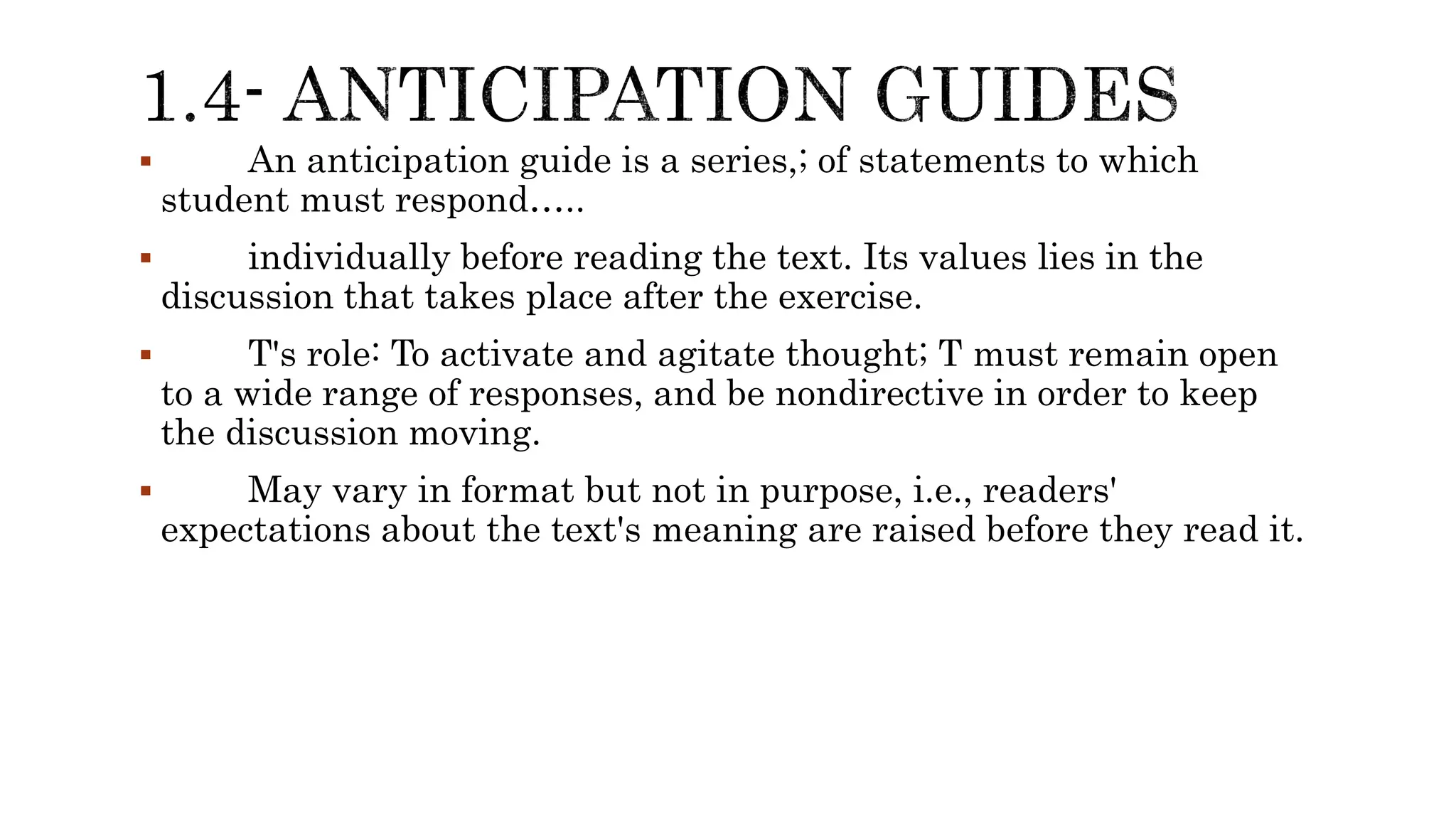
 An anticipation guide is a series,; of statements to which
student must respond…..
 individually before reading the text. Its values lies in the
discussion that takes place after the exercise.
 T's role: To activate and agitate thought; T must remain open
to a wide range of responses, and be nondirective in order to keep
the discussion moving.
 May vary in format but not in purpose, i.e., readers'
expectations about the text's meaning are raised before they read it.
1. Analyze material to be read. Determine major ideas-explicit and
implicit with which students will interact.
2. Write those ideas in short, clear declarative statements. These
statements should reflect the world the students live in or know
about. Avoid abstractions.
3. Put statements in a format that will elicit anticipation and
prediction making.
4. Discuss students' predictions and anticipation before they read the
text selection.
5. Assign text selection. Have students evaluate the statements in
light of author's intent and purpose.
6. Contrast the readers' predictions with the author's intended
meaning.
Expectation outlines help students ask questions about the text before reading and
approach the material with inquisitive minds. There are several ways of
approaching this.
For factual material, the following steps may be followed:
 1. Students preview the text. Then teacher asks: "What do you think is your
assignment going to be about? Have students formulate questions about their
expectations.
 2. As questions are suggested, teacher writes and groups them on the
chalkboard. Teacher asks: "What prompted you to ask this question?" Students
can refer to the text to support their questions.
 3. Students label each set of questions. Through discussion, they being to see
the major topics which will emerge from the reading. Teacher should point gaps, if
there are any and may add a topic or two to the outline about which no questions
were raised.
 4. Students read the text to answer the questions generated.
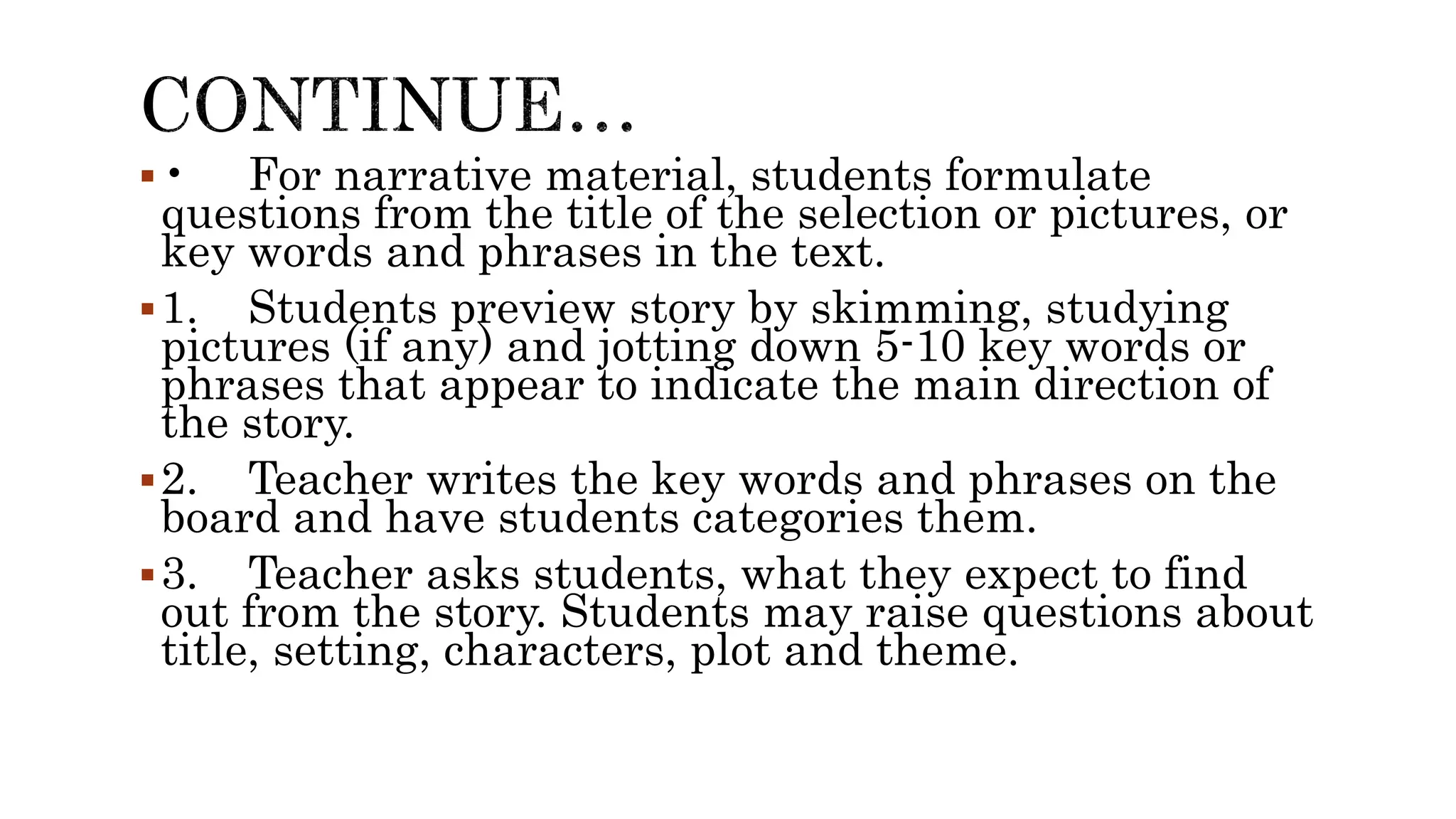
• For narrative material, students formulate
questions from the title of the selection or pictures, or
key words and phrases in the text.
1. Students preview story by skimming, studying
pictures (if any) and jotting down 5-10 key words or
phrases that appear to indicate the main direction of
the story.
2. Teacher writes the key words and phrases on the
board and have students categories them.
3. Teacher asks students, what they expect to find
out from the story. Students may raise questions about
title, setting, characters, plot and theme.
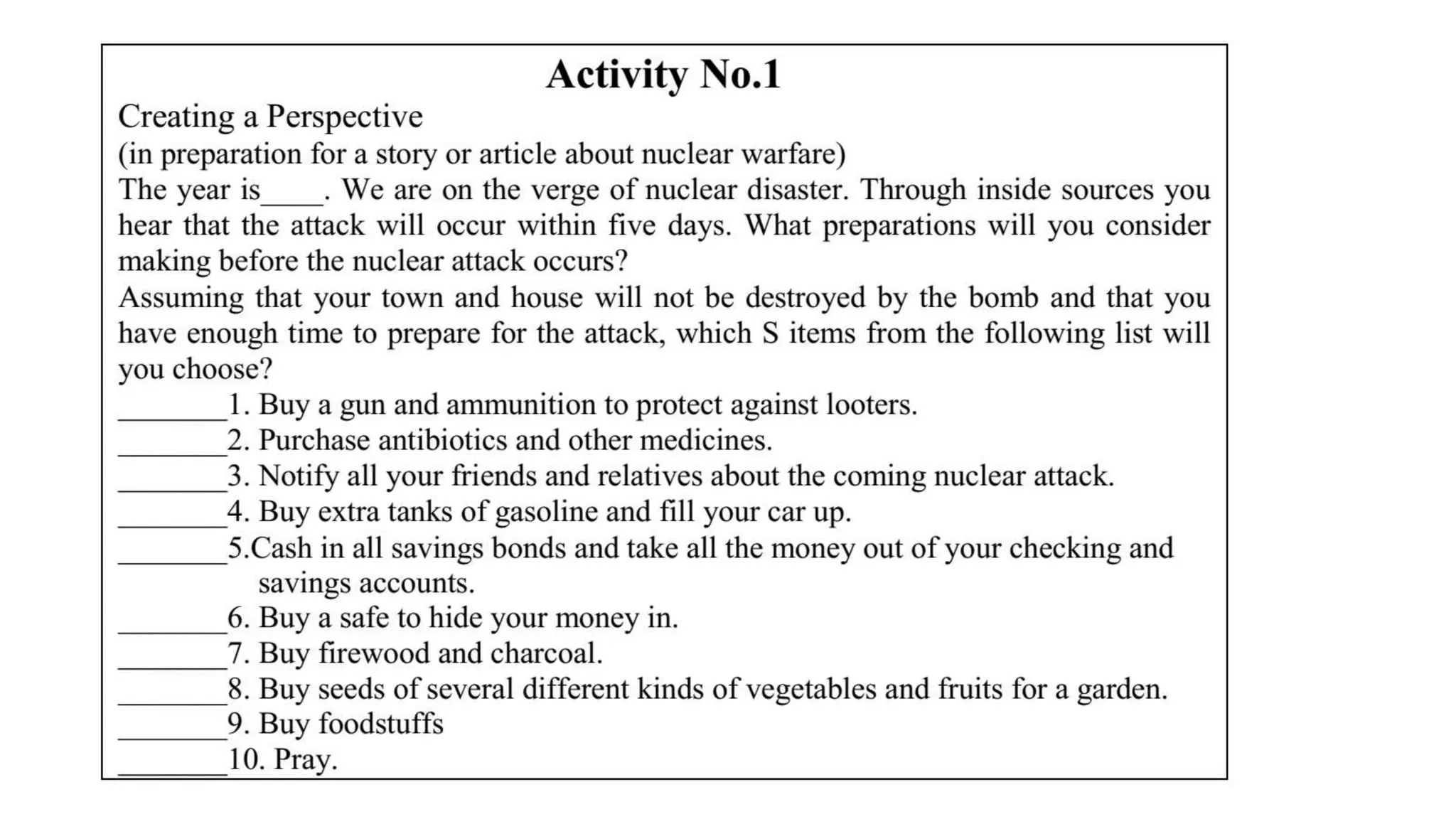
 Creating problems to be solved or perspectives from which students
approach text material provides an imaginative entry into a text
selection.
 Teacher's role: 1) Provide the time for students (in small groups) to
discuss the problem, raise questions and seek possible solutions
before reading; and 2) Assign the reading material that will help
lead to resolution and conceptual development.
 Key a problem situation directly to the text to be studied.
 Take into account, where appropriate, an examination of values,
attitudes and
 controversial issues related to the subject matter.
 The general problems and issues of the textbooks in specific subjects
are related to the culture tables and practices.
 The general public, parents and teachers think that there are some
themes to be read in textbook rather concepts.
 The most of the problem are with the books on Urdu, English, Social
Studies, History, Geography, Islamiat, Religion and Biology.
 The science and mathematics look several experiences throughout
the world-English books also get designs from the foreign books but
the other subjects are subject to the social practices and norms
especially Islamiat, Pakistan Studies, History etc. need to be
improved.
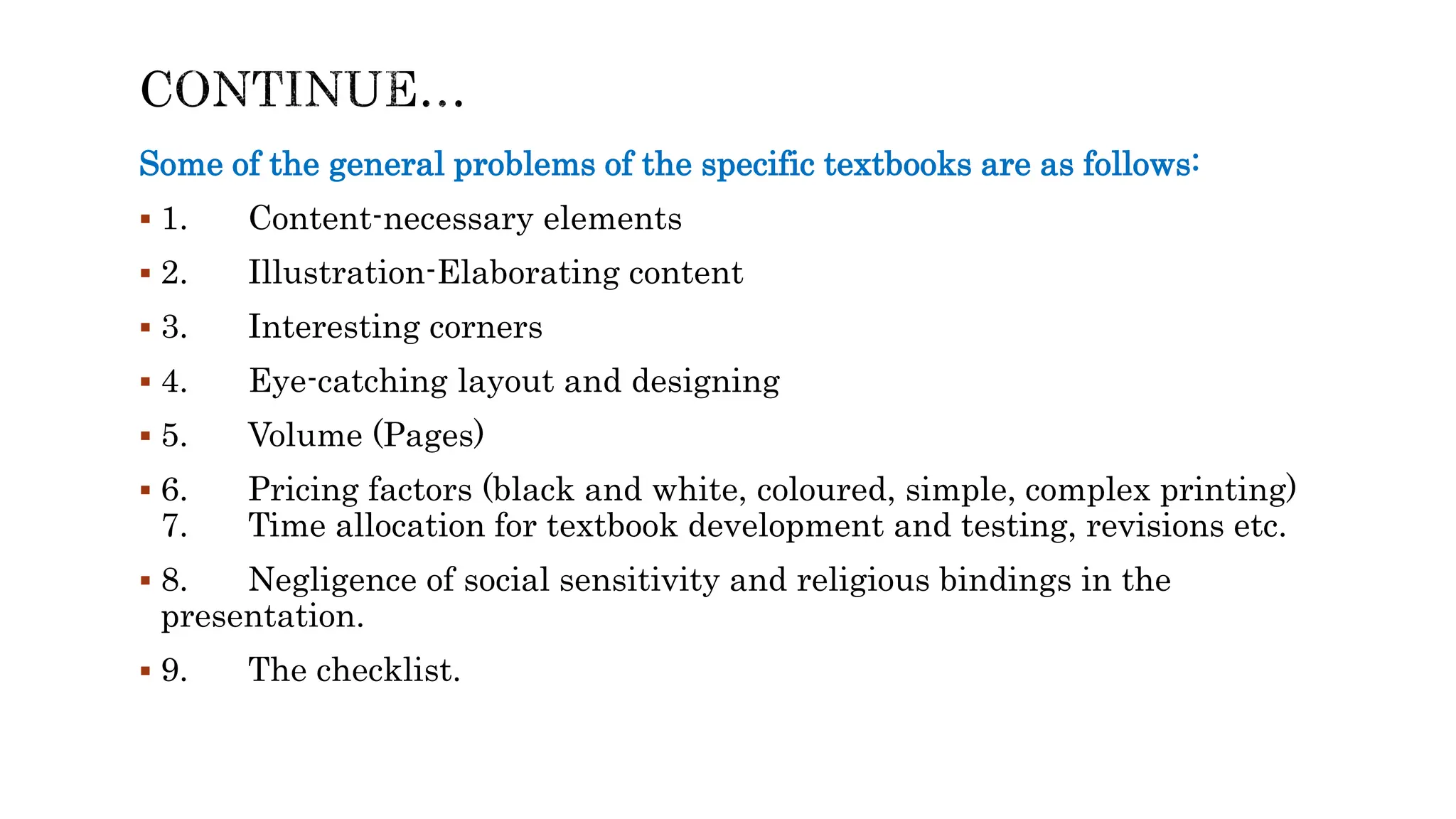
Some of the general problems of the specific textbooks are as follows:
 1. Content-necessary elements
 2. Illustration-Elaborating content
 3. Interesting corners
 4. Eye-catching layout and designing
 5. Volume (Pages)
 6. Pricing factors (black and white, coloured, simple, complex printing)
7. Time allocation for textbook development and testing, revisions etc.
 8. Negligence of social sensitivity and religious bindings in the
presentation.
 9. The checklist.
Woolfok's lesson designing of "Educational Psychology" has some special features to be
mentioned as:
 (a) Aids to Understanding
 At the beginning of each chapter one will find and outline of the key topics with page
numbers for quick reference. An overview provides a chapter "orientation" along with
a list of Learning
 Within the chapter, headings point out themes, questions and problems as they arise,
so one can look up information easily. These can also serve as a quick review of
important points. When a new term or concept is introduced, it appears in boldface
type along with a brief margin definition. These key terms are also listed
alphabetically at the end of each chapter with page references and in the index of key
terms at the back of the text. This index gives the page in the text where the key term
is discussed so one can study and understand the term in its larger context. After
every major section of the chapter, a new feature of this edition asks one to focus on
Learning by checking one’s understanding of the material. Throughout the book,
graphs, tables, photos and cartoons have been chosen to clarify and extend the text
material-and to add to enjoyment.
 Each chapter ends with summary of the key ideas in each main heading. With the
information from the chapter as a base, students are ready to solve the problems posed
in the "What would you do?" application exercises at the end of each chapter.
(b) Other Text Features
As in the previous editions, every chapter in the sixth edition includes Guidelines
and the Teachers' Casebook. And because educational psychology is developing so
rapidly today, several new Point/Counterpoints are added on such issues as
supported inclusion, values in the schools, "paying" kids to learn and alternatives to
direct teaching.
(c) Guidelines
An important reason for studying educational psychology is to gain skills in solving
classroom problems. Often texts give pages of theory and research findings but little
assistance in translating theory into practice. This text is different. Included in
each chapter are several sets of Guidelines. These are teaching tips and practical
suggestions based on the theory and research discussed in the chapter. Each
suggestion is clarified by two or three specific examples. Although the Guidelines
cannot cover every possible situation, they do provide a needed bridge between
knowledge and practice and should help to transfer the text's information to new
situations.
(d) Teacher's Casebook
 This highly acclaimed and popular feature from the first five editions is back in
revised form. At the end of each chapter, master teachers from all over the
country, including many Teacher of the Year award winners, offer their own
solutions to many of the diverse problems one is likely to encounter in the
classroom at every grade level. Their ideas truly show educational psychology at
work in a range of everyday situations. The Teachers' Casebook brings to life the
topics and principles discussed in each chapter. This edition emphasizes real
rather than hypothetical cases and how expert teachers handle them.
 ( e) Point/Counterpoint
 There is a section in every chapter called Point/Counterpoint, a debate that
examines two contrasting perspectives on an important question or controversy
related to research or practice in educational psychology. Many of the topics
considered in these Point/Counterpoints have "made the news" recently and are
central to the discussions of educational reformers.
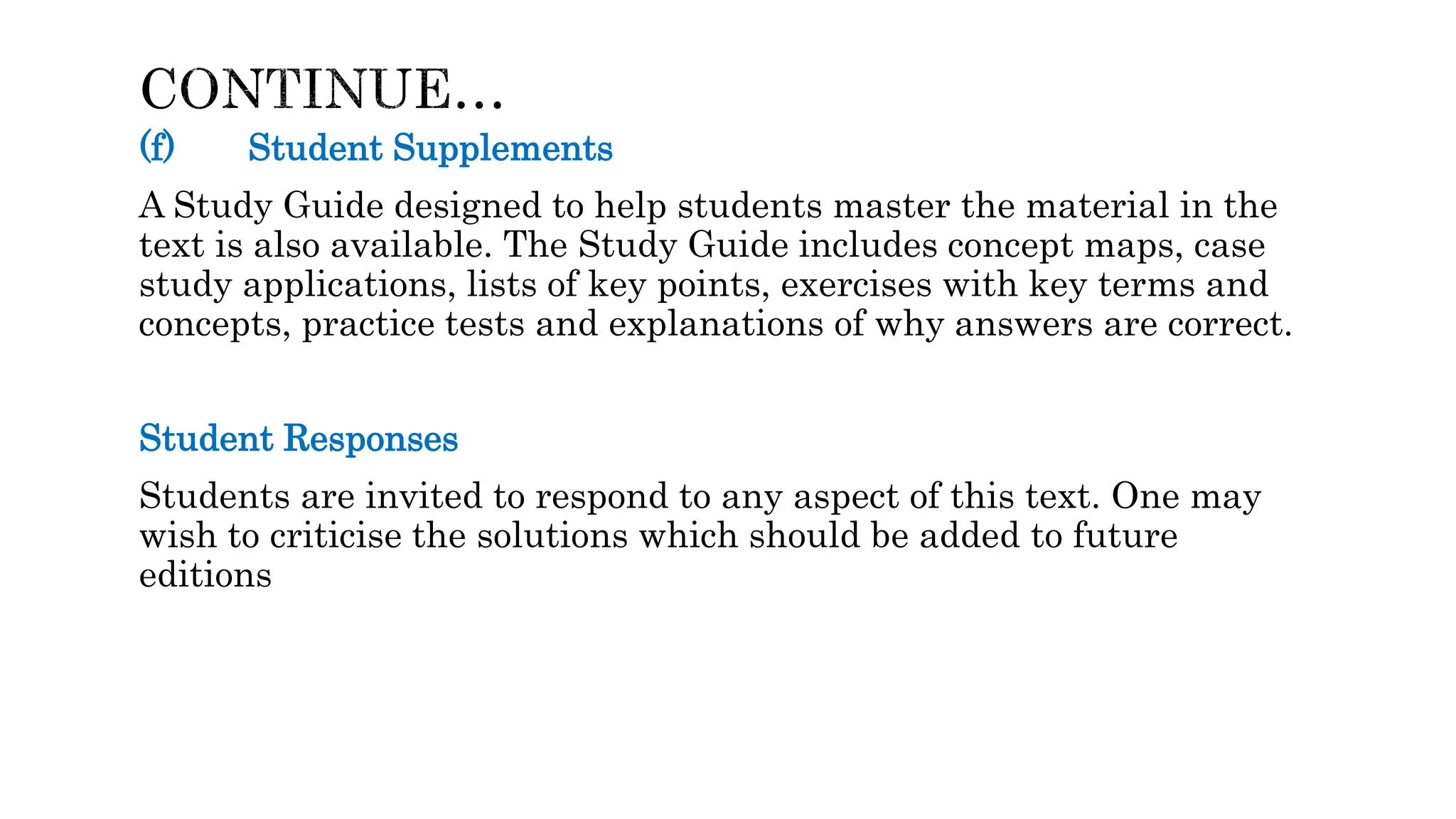
(f) Student Supplements
A Study Guide designed to help students master the material in the
text is also available. The Study Guide includes concept maps, case
study applications, lists of key points, exercises with key terms and
concepts, practice tests and explanations of why answers are correct.
Student Responses
Students are invited to respond to any aspect of this text. One may
wish to criticise the solutions which should be added to future
editions
 This model for textbook lessons was developed for class VI, VII, VIII in the
Middle School Project and the textbook boards were trained in 1998
accordingly.
 A Feasibility testing was also held in all the provinces of Pakistan and the
books were revised and handed over to the textbook boards.
 The basic point of view to develop these lesson design is "Student
Centered" text.
 Language issues of listening, speaking, reading and writing with
comprehension and skills were treated and pre and post activities for
instruction were introduced.
 Illustrations were made as per ideal designing. Additional studies,
reinforcement activities, dramatization, discussion, research, teacher's and
student's corners are its main characteristics.
 The model can be viewed in the language unit. Here some pages are
exemplary for a general guidance.
 The Curriculum Development Institute, Singapore developed a series geography
textbooks in 1996 and provided a model.
 In a textbook no.2 (for class 7) you will be studying about the earth's natural
resources and how human activities can improve or damage our environment.
 When the environment is affected, people are also affected as they are a part of it.
That is why it is important to study how to protect our environment.
(a) Materials
 The textbook, Understanding Geography2, is colourful, and illustrated with many
interesting maps, diagrams, photographs and cartoons.
 There are also two workbooks, overhead transparencies, an ETV programme and
a game chart that accompany the textbook.
(b) What this Course Provides
 As some works through this course he will:
 • gain greater knowledge and an understanding of how when we use the earth's
resources, we affect our environment.
 • develop geographical skills and thinking skills which our can apply in his daily
life.
 • develop and awareness of the need to protect our environment.
 (c) How the Course is Organized
The textbook is organized according to four themes:
 • Using Natural Resources
 • Improving Our environment
 • Damaging Our Environment
 • Protecting Our Environment
These four themes are covered in nine units.
 Each unit is divided into sections beginning with a 'let's
find out...' box which tells what one will be studying.
 At the end of each unit, the meanings of geographical
terms which are highlighted in bold letters in the text will
be given in a 'key words... 'box for student’s information.
 One will find some parts of the text set against a yellow
background. These parts (case study) are optional for
Normal (Academic) pupils.
The book chosen for this specific model is Leading and Management in Nursing.
2.4.I-Concept and Practice Combined
 Innovative in both content and presentation, merges theory, research, and
practical application in key leadership and management areas.
 Prime concern throughout the writing of this book has been to create a text that,
while well grounded in theory and concept, presents the content in a way that is
real.
 Wherever possible, they used real-world examples from the continuum of today's
healthcare settings to illustrate the concepts.
 Because each chapter contributor has focused on synthesizing his or her assigned
content, you will find no lengthy quotations in these chapters- Instead, made
every effort to make the content as engaging, inviting, and interesting as possible.
Reflecting we view of the real world of nursing management today,
the following themes pervade the text:
 The focus of health care is shifting from the hospital to the
community.
 Healthcare clients and the healthcare work force are becoming
increasingly culturally diverse.
 Today, virtually every professional nurse leads and manages
regardless of his or her position.
 Consumer relationships now play a central role in the delivery
of nursing and healthcare.
 Communication, collaboration, team building, and other
interpersonal skills form the foundation of effective nursing
leadership and management.
2.4.2- Diversity of Perspectives
 Among this book's strengths is that the contributors themselves have been
recruited from diverse settings and diverse geographical areas, enabling
them to offer a broad perspective on the critical elements of nursing
leadership and management roles.
2.4.3- Audience
 This book is designed for undergraduate students in nursing leadership
and management courses.
 Because today's students tend to be more visually oriented than students a
decade ago, incorporated illustrations, boxes, and a functional full color
design to stimulate their interest and maximize their learning.
 In addition, have included numerous examples and "A Manager's
Viewpoint" in each chapter in response to common student complaints that
most nursing management texts lack relevance to the real world of
nursing.
 They have organized this text around issues that are key to the success of professional
nurses in today's constantly changing healthcare environment:
 Part I, Managing and Leading Presents basic concepts of managing and leading, with
emphasis on their application to today's changing healthcare system. It includes
coverage of legal and ethical issues, strategic planning, leading change in an evolving
healthcare environment, and problem solving and decision making.
 Part 11, Managing the Organization Discusses healthcare organizations, cultural
diversity in healthcare, and various organizational structures.
 Part Ill, Managing Resources Explains the principles and practice of quality, risk,
time, information, and financial management.
 Part IV, Leading and Managing People Includes discussions on team building, staff
development, communication, and conflict management.
 Part V, Managing Consumer Care Focuses on consumer relationships, care delivery
systems, and patient-related issues.
 Part VI, Managing Personal Resources Offers career management and guidance via
discussion of roles, power and politics, stress management, and career management.
2.4.5- Design
 A functional full-color design distinguishes this text from any other nursing
management text ever published.
 As described in the sections below, the design .is used to emphasize and' identify
the text's many teaching/learning strategies features to enhance learning.
 Full color photographs provide visual reinforcement of concepts such as body
language and the changes occurring in contemporary healthcare settings, while
adding visual interest- Figures elucidate and graphically depict concepts and
activities described in the text.
 (A)Teaching/Learning Strategies
 The numerous teaching/learning strategies features in this text are designed both
to stimulate student interest and to provide constant reinforcement throughout
the learning process. In addition, the visually appealing, full-color design itself
serves a pedagogical purpose.
1. Preview briefly describes the purpose and scope of the
chapter.
2. Objectives articulate the chapter's learning goals at
the application level or higher.
3. Questions to Consider stimulate students to think
about their personal viewpoint or experience of the topics
and issues discussed in the chapter.
4. A Manager's Viewpoint presents a contemporary
nurse manager's real world view of the aspect of managing
addressed in the chapter.
 1. Margin Annotations serve as quick locators for topics in the chapter and a
convenient study/review aid. Margin annotations always appear in bold italic type
in the margins of every chapter.
 2. Glossary Terms appear in bold type in every chapter. They are also listed in
the "Terms to Know" at the end of the "Chapter Checklist." Definitions appear in
the Glossary at the end of the text.
 3. Exercises stimulate students to think critically about how to apply chapter
content to the workplace and other "real world" situations. They provide
experiential reinforcement of key leading and managing skills. Exercises always
appear in yellow boxes within the margins of every chapter and are numbered
sequentially to facilitate using them as assignments or activities.
 4. Research, Theory, and Literature Perspectives illustrate the relevance and
applicability of current scholarship to practice. Perspectives always appear in
green boxes with an "open book" logo.
 5. Boxes contain lists, tools such as forms and worksheets, and other
information relevant to chapter content that students would find useful and
interesting. Boxes appear on a pale orange background in every chapter.
 1. Chapter Checklists summarize key concepts from the
chapter in both paragraph and itemized list form. A list of
glossary "Terms to Know" is included as an additional
study/review aid.
 2. References and Suggested Readings provide the student
with a list of key sources for further reading on topics found in
the chapter.
Other Teaching/Learning Strategies
 3. End-of- Text Glossary contains a comprehensive list of
definitions of all boldfaced terms used in the chapters. As a
further study aid, each definition ends with a cross-reference
indicating the page number (s) in which that term is discussed.
 Together with Learning and Managing in Nursing, the companion work book, the
accompanying video series, and the instructor's resource manual comprise a complete
teaching and learning package.
 Because students learn most successfully when information is presented in a variety of
ways, the work book and video series are designed to give students the opportunity to
reinforce their learning both experientially and visually.
 Video 1: Problem Solving and Decision Making: Critical Thinking in Action
 Video 2: Dealing with Difficult People
 Video 3: Effective Communication
 Video 4: Managing Change
 Video 5: Building Teams
 Video 6: Delegating Effectively and Appropriately
 Video 7: Managing Conflict
 Video 8: Leadership
Each video is approximately 25 minutes long and is available either individually or as
part of the set. An Instructor's Resource Booklet accompanies each video.
 With Transparency Masters and Test Bank Prepared by Ginny
Wacker Guido, R.N., J.D., M.S.N. (also a contributor to the text), the
Instructor's Resource Manual is a compendium of teaching
suggestions prepared by contributors to the text.
 This manual offers practical suggestions and resources' for
presenting material in the text, making the most effective use of the
companion workbook and video series in conjunction with the text,
and testing.
 The chapter-by-chapter test bank includes a total of 229 multiple
choice questions, with answer keys at the end of each set of chapter
questions.
 The manual also includes 36 transparency masters of key
illustrations from the text and other materials of interest.
Aiou.pptx
Aiou.pptx

Aiou.pptx

  • 2.
    Unit-9 General Issues andProblems of Specific Disciplines By: Atif Hussain
  • 3.
     1. Strategiesfor Specific Area Readings  1.1. Instruction Frame in the Content Area  1.2. Pre-reading  1.3. Knowledge Rating  1.4. Anticipation Guides  2. Specific Textbook-Issues and Models  2.1. Woolfok’s Model-General Level  2.2. Dr. Durrani’s Model-Middle Level  2.3. Singapore Model Specific Use  2.4. A Specific Model for Higher Levels  2.5. GTZ, Peshawar’s Model
  • 4.
     This unitis opening discussion of textbook development for specific disciplines in view of their general needs.  It also opens a window to validation and testing feasibility of the textbooks to be introduced.  The first portion of the unit describes strategies for specific reading and its knowledge rating.  The second part provides lesson designing models for general, middle and higher level. These will help to design specific lessons.  Activities and self-learning exercises are given to enhance the learning. Specific needs will be discussed in their respective units. The examples enhanced the unit volume.
  • 5.
    After studying thisunit, you will be able to: 1. know specific area issues and their general forms as well as the lesson designing models. 2. prepare yourself to study feasibility testing of textbooks. 3. develop strategies to visualize and prepare a general lesson model.
  • 6.
    Some strategies forreading were suggested by the international consultant on textbooks. Dr. N.N. Hermosa in the Middle School Project of the Ministry of Education in 1998 and the textbooks so designed were tested accordingly. It has some steps to be followed as:
  • 7.
    To establish purpose,activate Before reading Background knowledge, sustain motivation and provide direction During reading To prompt an active response to reading After reading To extend and elaborate ideas from the text Instructional Sequence Rationale Prereading Prereading Prereading d and elaborate ideas
  • 8.
    Semantic Maps (Brainstormingand Clustering)  Semantic maps may be used to depict spatial relationships among words. They include brainstorming and the use of collaborative small groups, allowing students to cluster words/ideas belonging to categories and to distinguish relationships among words.  1. The teacher or the students decide on the core concept to be explored.  2. Students, depending on what they have been studying and on their background knowledge and experiences, offer as many words or phrases as possible related to the concept term. these are recorded by the teacher on the chalkboard.  3. Small groups of students create semantic maps and share their constructions in class discussion. A consolidated semantic map may be constructed.  4. The semantic map can be expanded and/or refined at the post reading phase. In this manner, students learn to organize new and prior information systematically.
  • 9.
    Lion Bear CatParrot Leopard Gorilla Dog Rabbit Buffalo Elephant Dargon Unicorn Horse Donkey Wild Animals ANIMALS Pets Work Animals Imaginary Animals
  • 10.
     (What doyou Know? What do you want to Know? What did you Learn?)  K-W-L creates an instructional framework that begins with what students know about the topic to be studied, moves to what the students want to know as they generate questions about the topic, and leads to a record of what students learn as a result of their reading/study.  K-W-L may be initiated with small groups of students or the whole class. When they develop confidence and competence with the strategy, students may begin to use it for independent learning.  Steps in K - W - L revolves around the completion of a K - W - L strategy sheet.
  • 11.
    K- What Iknow W - What I want to Know L-What I Learned and still want to Learn Planetary motion Spirals 4 seasons landscaping multiplying populations phases of the moon. What does a pineapple have to do with Math? How are growth patterns in plants related to Math? How is mathematics specifically related to nature? Pineapples are hexagons on the surface that are arranged in sets of spirals These spirals are related to Fibonacci numbers. Fibonacci numbers found in leaf arrangements in plants. The rate that bees regenerate males is related to Fibonacci numbers.
  • 12.
    KRs get studentsto analyze what they know about a topic. The steps are:  1. Present students with a list of vocabulary in a survey like format and ask them to analyze each word individually as in this example. . From a newspaper unit in a language arts class:  2. Follow up with a discussion: Which are the hardest words? Which do you think most of the class doesn't know? Which are the easiest ones? Which do most of us know?  3. Within the context of the discussion, encourage students to share what they know about the words. In this way, you can get some idea of the knowledge the class brings to the text reading or a larger unit of study. How much do you know about these words? A lot! Some Not much Wire service X AP X Copy X Dateline X
  • 13.
     An anticipationguide is a series,; of statements to which student must respond…..  individually before reading the text. Its values lies in the discussion that takes place after the exercise.  T's role: To activate and agitate thought; T must remain open to a wide range of responses, and be nondirective in order to keep the discussion moving.  May vary in format but not in purpose, i.e., readers' expectations about the text's meaning are raised before they read it.
  • 14.
    1. Analyze materialto be read. Determine major ideas-explicit and implicit with which students will interact. 2. Write those ideas in short, clear declarative statements. These statements should reflect the world the students live in or know about. Avoid abstractions. 3. Put statements in a format that will elicit anticipation and prediction making. 4. Discuss students' predictions and anticipation before they read the text selection. 5. Assign text selection. Have students evaluate the statements in light of author's intent and purpose. 6. Contrast the readers' predictions with the author's intended meaning.
  • 16.
    Expectation outlines helpstudents ask questions about the text before reading and approach the material with inquisitive minds. There are several ways of approaching this. For factual material, the following steps may be followed:  1. Students preview the text. Then teacher asks: "What do you think is your assignment going to be about? Have students formulate questions about their expectations.  2. As questions are suggested, teacher writes and groups them on the chalkboard. Teacher asks: "What prompted you to ask this question?" Students can refer to the text to support their questions.  3. Students label each set of questions. Through discussion, they being to see the major topics which will emerge from the reading. Teacher should point gaps, if there are any and may add a topic or two to the outline about which no questions were raised.  4. Students read the text to answer the questions generated.
  • 17.
    • For narrativematerial, students formulate questions from the title of the selection or pictures, or key words and phrases in the text. 1. Students preview story by skimming, studying pictures (if any) and jotting down 5-10 key words or phrases that appear to indicate the main direction of the story. 2. Teacher writes the key words and phrases on the board and have students categories them. 3. Teacher asks students, what they expect to find out from the story. Students may raise questions about title, setting, characters, plot and theme.
  • 18.
     Creating problemsto be solved or perspectives from which students approach text material provides an imaginative entry into a text selection.  Teacher's role: 1) Provide the time for students (in small groups) to discuss the problem, raise questions and seek possible solutions before reading; and 2) Assign the reading material that will help lead to resolution and conceptual development.  Key a problem situation directly to the text to be studied.  Take into account, where appropriate, an examination of values, attitudes and  controversial issues related to the subject matter.
  • 20.
     The generalproblems and issues of the textbooks in specific subjects are related to the culture tables and practices.  The general public, parents and teachers think that there are some themes to be read in textbook rather concepts.  The most of the problem are with the books on Urdu, English, Social Studies, History, Geography, Islamiat, Religion and Biology.  The science and mathematics look several experiences throughout the world-English books also get designs from the foreign books but the other subjects are subject to the social practices and norms especially Islamiat, Pakistan Studies, History etc. need to be improved.
  • 21.
    Some of thegeneral problems of the specific textbooks are as follows:  1. Content-necessary elements  2. Illustration-Elaborating content  3. Interesting corners  4. Eye-catching layout and designing  5. Volume (Pages)  6. Pricing factors (black and white, coloured, simple, complex printing) 7. Time allocation for textbook development and testing, revisions etc.  8. Negligence of social sensitivity and religious bindings in the presentation.  9. The checklist.
  • 22.
    Woolfok's lesson designingof "Educational Psychology" has some special features to be mentioned as:  (a) Aids to Understanding  At the beginning of each chapter one will find and outline of the key topics with page numbers for quick reference. An overview provides a chapter "orientation" along with a list of Learning  Within the chapter, headings point out themes, questions and problems as they arise, so one can look up information easily. These can also serve as a quick review of important points. When a new term or concept is introduced, it appears in boldface type along with a brief margin definition. These key terms are also listed alphabetically at the end of each chapter with page references and in the index of key terms at the back of the text. This index gives the page in the text where the key term is discussed so one can study and understand the term in its larger context. After every major section of the chapter, a new feature of this edition asks one to focus on Learning by checking one’s understanding of the material. Throughout the book, graphs, tables, photos and cartoons have been chosen to clarify and extend the text material-and to add to enjoyment.  Each chapter ends with summary of the key ideas in each main heading. With the information from the chapter as a base, students are ready to solve the problems posed in the "What would you do?" application exercises at the end of each chapter.
  • 23.
    (b) Other TextFeatures As in the previous editions, every chapter in the sixth edition includes Guidelines and the Teachers' Casebook. And because educational psychology is developing so rapidly today, several new Point/Counterpoints are added on such issues as supported inclusion, values in the schools, "paying" kids to learn and alternatives to direct teaching. (c) Guidelines An important reason for studying educational psychology is to gain skills in solving classroom problems. Often texts give pages of theory and research findings but little assistance in translating theory into practice. This text is different. Included in each chapter are several sets of Guidelines. These are teaching tips and practical suggestions based on the theory and research discussed in the chapter. Each suggestion is clarified by two or three specific examples. Although the Guidelines cannot cover every possible situation, they do provide a needed bridge between knowledge and practice and should help to transfer the text's information to new situations.
  • 24.
    (d) Teacher's Casebook This highly acclaimed and popular feature from the first five editions is back in revised form. At the end of each chapter, master teachers from all over the country, including many Teacher of the Year award winners, offer their own solutions to many of the diverse problems one is likely to encounter in the classroom at every grade level. Their ideas truly show educational psychology at work in a range of everyday situations. The Teachers' Casebook brings to life the topics and principles discussed in each chapter. This edition emphasizes real rather than hypothetical cases and how expert teachers handle them.  ( e) Point/Counterpoint  There is a section in every chapter called Point/Counterpoint, a debate that examines two contrasting perspectives on an important question or controversy related to research or practice in educational psychology. Many of the topics considered in these Point/Counterpoints have "made the news" recently and are central to the discussions of educational reformers.
  • 25.
    (f) Student Supplements AStudy Guide designed to help students master the material in the text is also available. The Study Guide includes concept maps, case study applications, lists of key points, exercises with key terms and concepts, practice tests and explanations of why answers are correct. Student Responses Students are invited to respond to any aspect of this text. One may wish to criticise the solutions which should be added to future editions
  • 26.
     This modelfor textbook lessons was developed for class VI, VII, VIII in the Middle School Project and the textbook boards were trained in 1998 accordingly.  A Feasibility testing was also held in all the provinces of Pakistan and the books were revised and handed over to the textbook boards.  The basic point of view to develop these lesson design is "Student Centered" text.  Language issues of listening, speaking, reading and writing with comprehension and skills were treated and pre and post activities for instruction were introduced.  Illustrations were made as per ideal designing. Additional studies, reinforcement activities, dramatization, discussion, research, teacher's and student's corners are its main characteristics.  The model can be viewed in the language unit. Here some pages are exemplary for a general guidance.
  • 30.
     The CurriculumDevelopment Institute, Singapore developed a series geography textbooks in 1996 and provided a model.  In a textbook no.2 (for class 7) you will be studying about the earth's natural resources and how human activities can improve or damage our environment.  When the environment is affected, people are also affected as they are a part of it. That is why it is important to study how to protect our environment. (a) Materials  The textbook, Understanding Geography2, is colourful, and illustrated with many interesting maps, diagrams, photographs and cartoons.  There are also two workbooks, overhead transparencies, an ETV programme and a game chart that accompany the textbook.
  • 31.
    (b) What thisCourse Provides  As some works through this course he will:  • gain greater knowledge and an understanding of how when we use the earth's resources, we affect our environment.  • develop geographical skills and thinking skills which our can apply in his daily life.  • develop and awareness of the need to protect our environment.  (c) How the Course is Organized The textbook is organized according to four themes:  • Using Natural Resources  • Improving Our environment  • Damaging Our Environment  • Protecting Our Environment
  • 32.
    These four themesare covered in nine units.  Each unit is divided into sections beginning with a 'let's find out...' box which tells what one will be studying.  At the end of each unit, the meanings of geographical terms which are highlighted in bold letters in the text will be given in a 'key words... 'box for student’s information.  One will find some parts of the text set against a yellow background. These parts (case study) are optional for Normal (Academic) pupils.
  • 33.
    The book chosenfor this specific model is Leading and Management in Nursing. 2.4.I-Concept and Practice Combined  Innovative in both content and presentation, merges theory, research, and practical application in key leadership and management areas.  Prime concern throughout the writing of this book has been to create a text that, while well grounded in theory and concept, presents the content in a way that is real.  Wherever possible, they used real-world examples from the continuum of today's healthcare settings to illustrate the concepts.  Because each chapter contributor has focused on synthesizing his or her assigned content, you will find no lengthy quotations in these chapters- Instead, made every effort to make the content as engaging, inviting, and interesting as possible.
  • 34.
    Reflecting we viewof the real world of nursing management today, the following themes pervade the text:  The focus of health care is shifting from the hospital to the community.  Healthcare clients and the healthcare work force are becoming increasingly culturally diverse.  Today, virtually every professional nurse leads and manages regardless of his or her position.  Consumer relationships now play a central role in the delivery of nursing and healthcare.  Communication, collaboration, team building, and other interpersonal skills form the foundation of effective nursing leadership and management.
  • 35.
    2.4.2- Diversity ofPerspectives  Among this book's strengths is that the contributors themselves have been recruited from diverse settings and diverse geographical areas, enabling them to offer a broad perspective on the critical elements of nursing leadership and management roles. 2.4.3- Audience  This book is designed for undergraduate students in nursing leadership and management courses.  Because today's students tend to be more visually oriented than students a decade ago, incorporated illustrations, boxes, and a functional full color design to stimulate their interest and maximize their learning.  In addition, have included numerous examples and "A Manager's Viewpoint" in each chapter in response to common student complaints that most nursing management texts lack relevance to the real world of nursing.
  • 36.
     They haveorganized this text around issues that are key to the success of professional nurses in today's constantly changing healthcare environment:  Part I, Managing and Leading Presents basic concepts of managing and leading, with emphasis on their application to today's changing healthcare system. It includes coverage of legal and ethical issues, strategic planning, leading change in an evolving healthcare environment, and problem solving and decision making.  Part 11, Managing the Organization Discusses healthcare organizations, cultural diversity in healthcare, and various organizational structures.  Part Ill, Managing Resources Explains the principles and practice of quality, risk, time, information, and financial management.  Part IV, Leading and Managing People Includes discussions on team building, staff development, communication, and conflict management.  Part V, Managing Consumer Care Focuses on consumer relationships, care delivery systems, and patient-related issues.  Part VI, Managing Personal Resources Offers career management and guidance via discussion of roles, power and politics, stress management, and career management.
  • 37.
    2.4.5- Design  Afunctional full-color design distinguishes this text from any other nursing management text ever published.  As described in the sections below, the design .is used to emphasize and' identify the text's many teaching/learning strategies features to enhance learning.  Full color photographs provide visual reinforcement of concepts such as body language and the changes occurring in contemporary healthcare settings, while adding visual interest- Figures elucidate and graphically depict concepts and activities described in the text.  (A)Teaching/Learning Strategies  The numerous teaching/learning strategies features in this text are designed both to stimulate student interest and to provide constant reinforcement throughout the learning process. In addition, the visually appealing, full-color design itself serves a pedagogical purpose.
  • 38.
    1. Preview brieflydescribes the purpose and scope of the chapter. 2. Objectives articulate the chapter's learning goals at the application level or higher. 3. Questions to Consider stimulate students to think about their personal viewpoint or experience of the topics and issues discussed in the chapter. 4. A Manager's Viewpoint presents a contemporary nurse manager's real world view of the aspect of managing addressed in the chapter.
  • 39.
     1. MarginAnnotations serve as quick locators for topics in the chapter and a convenient study/review aid. Margin annotations always appear in bold italic type in the margins of every chapter.  2. Glossary Terms appear in bold type in every chapter. They are also listed in the "Terms to Know" at the end of the "Chapter Checklist." Definitions appear in the Glossary at the end of the text.  3. Exercises stimulate students to think critically about how to apply chapter content to the workplace and other "real world" situations. They provide experiential reinforcement of key leading and managing skills. Exercises always appear in yellow boxes within the margins of every chapter and are numbered sequentially to facilitate using them as assignments or activities.  4. Research, Theory, and Literature Perspectives illustrate the relevance and applicability of current scholarship to practice. Perspectives always appear in green boxes with an "open book" logo.  5. Boxes contain lists, tools such as forms and worksheets, and other information relevant to chapter content that students would find useful and interesting. Boxes appear on a pale orange background in every chapter.
  • 40.
     1. ChapterChecklists summarize key concepts from the chapter in both paragraph and itemized list form. A list of glossary "Terms to Know" is included as an additional study/review aid.  2. References and Suggested Readings provide the student with a list of key sources for further reading on topics found in the chapter. Other Teaching/Learning Strategies  3. End-of- Text Glossary contains a comprehensive list of definitions of all boldfaced terms used in the chapters. As a further study aid, each definition ends with a cross-reference indicating the page number (s) in which that term is discussed.
  • 41.
     Together withLearning and Managing in Nursing, the companion work book, the accompanying video series, and the instructor's resource manual comprise a complete teaching and learning package.  Because students learn most successfully when information is presented in a variety of ways, the work book and video series are designed to give students the opportunity to reinforce their learning both experientially and visually.  Video 1: Problem Solving and Decision Making: Critical Thinking in Action  Video 2: Dealing with Difficult People  Video 3: Effective Communication  Video 4: Managing Change  Video 5: Building Teams  Video 6: Delegating Effectively and Appropriately  Video 7: Managing Conflict  Video 8: Leadership Each video is approximately 25 minutes long and is available either individually or as part of the set. An Instructor's Resource Booklet accompanies each video.
  • 42.
     With TransparencyMasters and Test Bank Prepared by Ginny Wacker Guido, R.N., J.D., M.S.N. (also a contributor to the text), the Instructor's Resource Manual is a compendium of teaching suggestions prepared by contributors to the text.  This manual offers practical suggestions and resources' for presenting material in the text, making the most effective use of the companion workbook and video series in conjunction with the text, and testing.  The chapter-by-chapter test bank includes a total of 229 multiple choice questions, with answer keys at the end of each set of chapter questions.  The manual also includes 36 transparency masters of key illustrations from the text and other materials of interest.