CATEGORISATION OF DIFFERENT
LIMNETIC FISHERIES RESOURCES
Presentation by:
V.Rishika
Jr mfsc
Dept of: AEM
WHAT IS LIMNETIC?
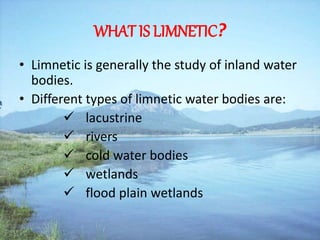
• Limnetic is generally the study of inland water
bodies.
• Different types of limnetic water bodies are:
 lacustrine
 rivers
 cold water bodies
 wetlands
 flood plain wetlands
WHAT IS LACUSTRINE?
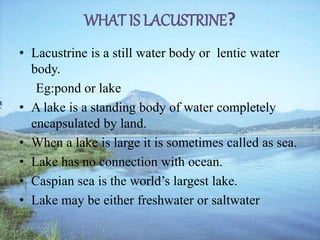
• Lacustrine is a still water body or lentic water
body.
Eg:pond or lake
• A lake is a standing body of water completely
encapsulated by land.
• When a lake is large it is sometimes called as sea.
• Lake has no connection with ocean.
• Caspian sea is the world’s largest lake.
• Lake may be either freshwater or saltwater
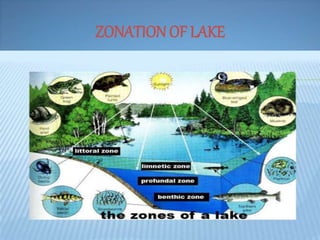
ZONATION OF LAKE
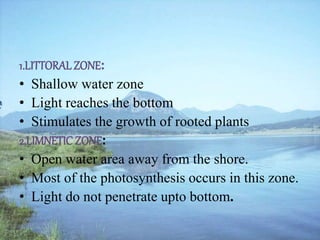
1.LITTORAL ZONE:
• Shallow water zone
• Light reaches the bottom
• Stimulates the growth of rooted plants
2.LIMNETIC ZONE:
• Open water area away from the shore.
• Most of the photosynthesis occurs in this zone.
• Light do not penetrate upto bottom.
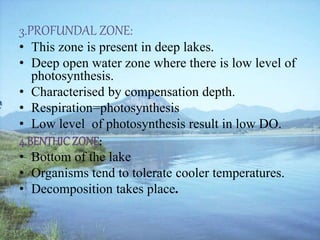
3.PROFUNDAL ZONE:
• This zone is present in deep lakes.
• Deep open water zone where there is low level of
photosynthesis.
• Characterised by compensation depth.
• Respiration=photosynthesis
• Low level of photosynthesis result in low DO.
4.BENTHIC ZONE:
• Bottom of the lake
• Organisms tend to tolerate cooler temperatures.
• Decomposition takes place.
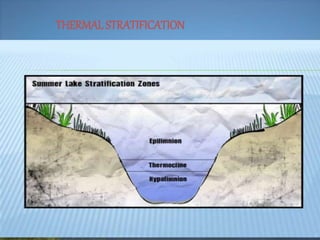
THERMALSTRATIFICATION
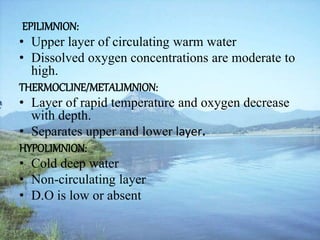
EPILIMNION:
• Upper layer of circulating warm water
• Dissolved oxygen concentrations are moderate to
high.
THERMOCLINE/METALIMNION:
• Layer of rapid temperature and oxygen decrease
with depth.
• Separates upper and lower layer.
HYPOLIMNION:
• Cold deep water
• Non-circulating layer
• D.O is low or absent
CLASSIFICATIONOF LAKES BASEDON PRODUCTIVITY:
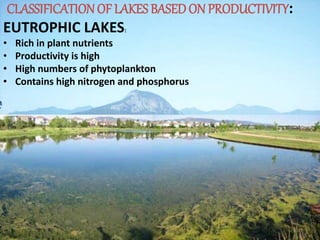
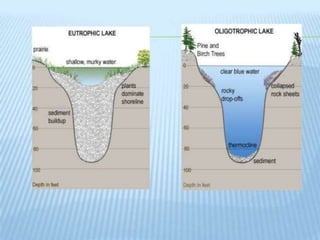
EUTROPHIC LAKES:
• Rich in plant nutrients
• Productivity is high
• High numbers of phytoplankton
• Contains high nitrogen and phosphorus
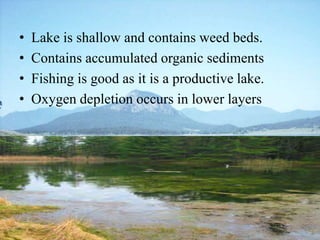
• Lake is shallow and contains weed beds.
• Contains accumulated organic sediments
• Fishing is good as it is a productive lake.
• Oxygen depletion occurs in lower layers
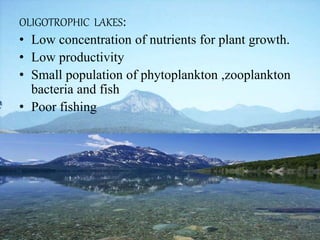
OLIGOTROPHIC LAKES:
• Low concentration of nutrients for plant growth.
• Low productivity
• Small population of phytoplankton ,zooplankton
bacteria and fish
• Poor fishing
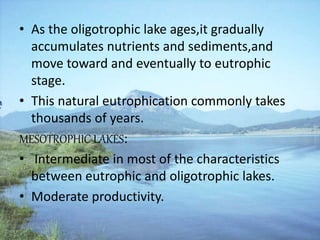
• As the oligotrophic lake ages,it gradually
accumulates nutrients and sediments,and
move toward and eventually to eutrophic
stage.
• This natural eutrophication commonly takes
thousands of years.
MESOTROPHIC LAKES:
• Intermediate in most of the characteristics
between eutrophic and oligotrophic lakes.
• Moderate productivity.
DYSTROPHIC LAKES:
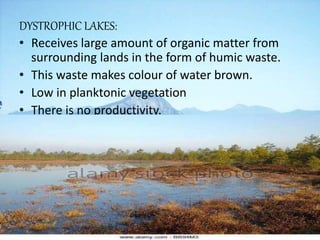
• Receives large amount of organic matter from
surrounding lands in the form of humic waste.
• This waste makes colour of water brown.
• Low in planktonic vegetation
• There is no productivity.
CLASSIFICATION BASED ON ORIGIN
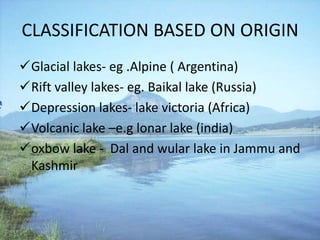
Glacial lakes- eg .Alpine ( Argentina)
Rift valley lakes- eg. Baikal lake (Russia)
Depression lakes- lake victoria (Africa)
Volcanic lake –e.g lonar lake (india)
oxbow lake - Dal and wular lake in Jammu and
Kashmir
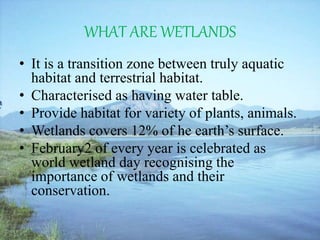
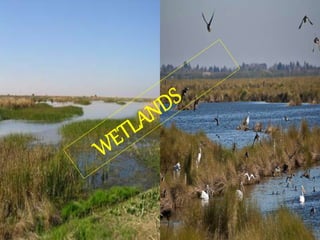
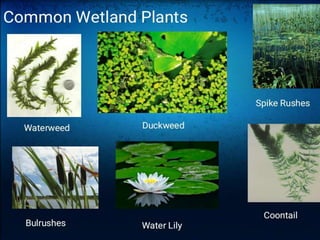
WHAT ARE WETLANDS
• It is a transition zone between truly aquatic
habitat and terrestrial habitat.
• Characterised as having water table.
• Provide habitat for variety of plants, animals.
• Wetlands covers 12% of he earth’s surface.
• February2 of every year is celebrated as
world wetland day recognising the
importance of wetlands and their
conservation.
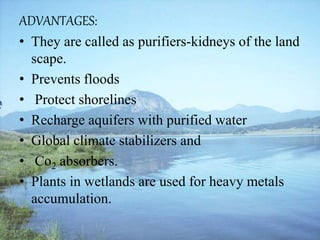
ADVANTAGES:
• They are called as purifiers-kidneys of the land
scape.
• Prevents floods
• Protect shorelines
• Recharge aquifers with purified water
• Global climate stabilizers and
• Co2 absorbers.
• Plants in wetlands are used for heavy metals
accumulation.
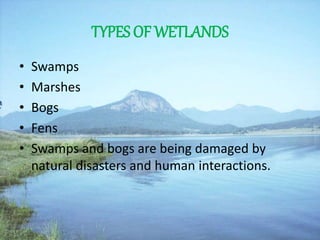
TYPES OF WETLANDS
• Swamps
• Marshes
• Bogs
• Fens
• Swamps and bogs are being damaged by
natural disasters and human interactions.
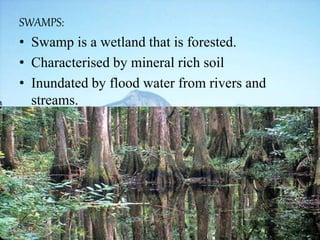
SWAMPS:
• Swamp is a wetland that is forested.
• Characterised by mineral rich soil
• Inundated by flood water from rivers and
streams.
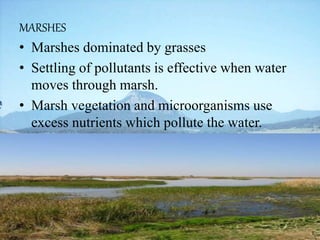
MARSHES
• Marshes dominated by grasses
• Settling of pollutants is effective when water
moves through marsh.
• Marsh vegetation and microorganisms use
excess nutrients which pollute the water.
BOGS
• Made by accumulation of peat material(dead
plant material).
• Bog is low fertile and decaying is slow
resulting in peat accumulation.
• Bogs Appear where the water at the ground
surface is acidic.
• Bogs are generally filled by rain water.
• Peat acts as a carbon sink
• Dried peat can be used as fuel
• Due to the removal of peat the bog wetland is
getting destroyed.
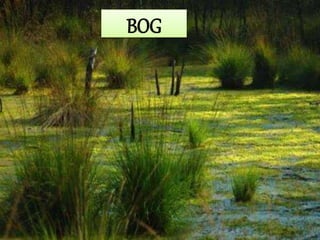
BOG
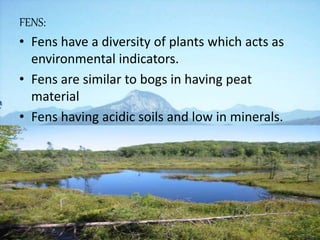
FENS:
• Fens have a diversity of plants which acts as
environmental indicators.
• Fens are similar to bogs in having peat
material
• Fens having acidic soils and low in minerals.
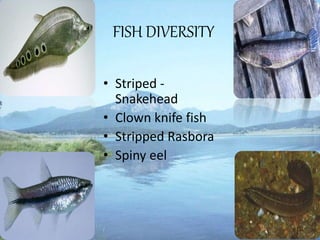
FISH DIVERSITY
• Striped -
Snakehead
• Clown knife fish
• Stripped Rasbora
• Spiny eel
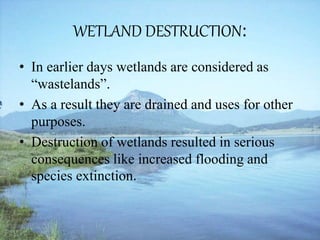
WETLAND DESTRUCTION:
• In earlier days wetlands are considered as
“wastelands”.
• As a result they are drained and uses for other
purposes.
• Destruction of wetlands resulted in serious
consequences like increased flooding and
species extinction.
FLOOD PLAIN WETLANDS:
• A flood plain is an area of land adjacent to
stream or rivers.
• These are subjected to periodic or permanent
flooding from the adjacent rivers.
• They are also called as low lying lands.
3 categories:
• Riverine flooding:by rivers and channels
• Coastal flooding:by hurricanes and several
storms
• Shallow flooding:urban drainage
ADVANTAGES:
• Rich habitat for fish, plants and wild life.
• Water entering flood plains carries
pollutants,allows them to filter through the
soil.
• Protection against floods ,when water enters
from rivers
• Acts as aquifers in soil by groundwater
recharge
• As they are productive areas ,they can be used
for agriculture.
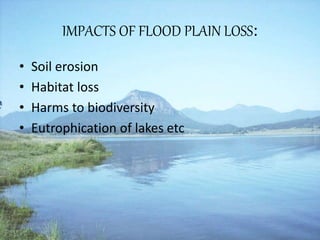
IMPACTS OF FLOOD PLAIN LOSS:
• Soil erosion
• Habitat loss
• Harms to biodiversity
• Eutrophication of lakes etc
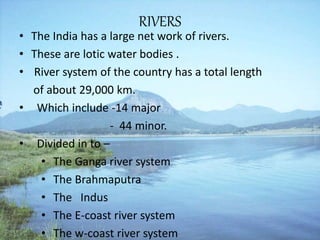
RIVERS
• The India has a large net work of rivers.
• These are lotic water bodies .
• River system of the country has a total length
of about 29,000 km.
• Which include -14 major
- 44 minor.
• Divided in to –
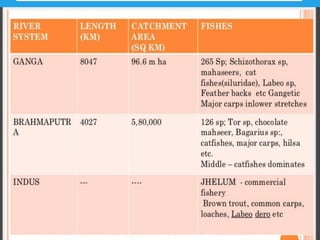
• The Ganga river system
• The Brahmaputra
• The Indus
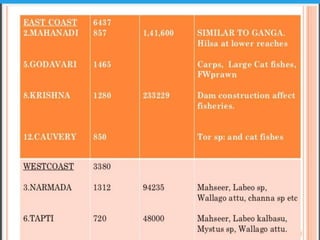
• The E-coast river system
• The w-coast river system
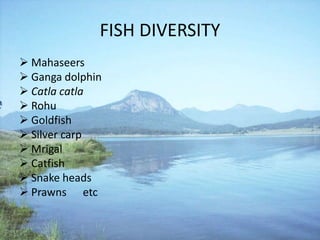
FISH DIVERSITY
 Mahaseers
 Ganga dolphin
 Catla catla
 Rohu
 Goldfish
 Silver carp
 Mrigal
 Catfish
 Snake heads
 Prawns etc
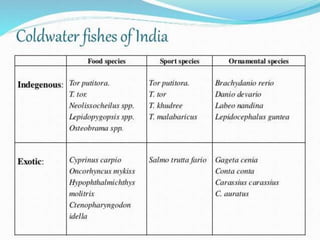
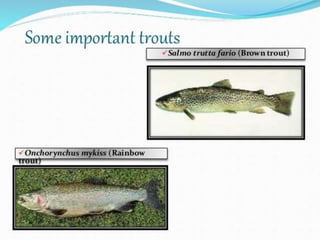
COLD WATER FISHERY RESOURCES
• Cold water resources comprise high and mid
altitude lakes,rivers and streams.
• Fishes having temperature tolerance limits
between 0-20℃ are called as cold water fishes.
• Optimum temperature range is 10-12℃
• Water maintains relatively low
temperature,which supports low production
levels.
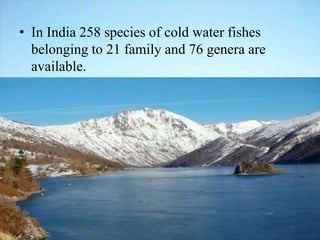
• In India 258 species of cold water fishes
belonging to 21 family and 76 genera are
available.
MAJOR THREATS
• Introduction of exotic species
• over fishing activities
• Pollution
• industrial runoff
• habitat degradation and
• Predation etc.
CONSERVATION MEASURES:
• Ranching
• increase public awareness
• restoration / mitigation effort etc.
REFERENCES
• https://www.epa.gov
• https://www.worldwildlife.org
• https://www.sswm.info
• ca.water.usgs.gov/projects/2013-33.htm
Categorisation of limnetic fisheries resources

Categorisation of limnetic fisheries resources

  • 1.
    CATEGORISATION OF DIFFERENT LIMNETICFISHERIES RESOURCES Presentation by: V.Rishika Jr mfsc Dept of: AEM
  • 2.
    WHAT IS LIMNETIC? •Limnetic is generally the study of inland water bodies. • Different types of limnetic water bodies are:  lacustrine  rivers  cold water bodies  wetlands  flood plain wetlands
  • 3.
    WHAT IS LACUSTRINE? •Lacustrine is a still water body or lentic water body. Eg:pond or lake • A lake is a standing body of water completely encapsulated by land. • When a lake is large it is sometimes called as sea. • Lake has no connection with ocean. • Caspian sea is the world’s largest lake. • Lake may be either freshwater or saltwater
  • 4.
  • 5.
    1.LITTORAL ZONE: • Shallowwater zone • Light reaches the bottom • Stimulates the growth of rooted plants 2.LIMNETIC ZONE: • Open water area away from the shore. • Most of the photosynthesis occurs in this zone. • Light do not penetrate upto bottom.
  • 6.
    3.PROFUNDAL ZONE: • Thiszone is present in deep lakes. • Deep open water zone where there is low level of photosynthesis. • Characterised by compensation depth. • Respiration=photosynthesis • Low level of photosynthesis result in low DO. 4.BENTHIC ZONE: • Bottom of the lake • Organisms tend to tolerate cooler temperatures. • Decomposition takes place.
  • 7.
  • 8.
    EPILIMNION: • Upper layerof circulating warm water • Dissolved oxygen concentrations are moderate to high. THERMOCLINE/METALIMNION: • Layer of rapid temperature and oxygen decrease with depth. • Separates upper and lower layer. HYPOLIMNION: • Cold deep water • Non-circulating layer • D.O is low or absent
  • 9.
    CLASSIFICATIONOF LAKES BASEDONPRODUCTIVITY: EUTROPHIC LAKES: • Rich in plant nutrients • Productivity is high • High numbers of phytoplankton • Contains high nitrogen and phosphorus
  • 10.
    • Lake isshallow and contains weed beds. • Contains accumulated organic sediments • Fishing is good as it is a productive lake. • Oxygen depletion occurs in lower layers
  • 11.
    OLIGOTROPHIC LAKES: • Lowconcentration of nutrients for plant growth. • Low productivity • Small population of phytoplankton ,zooplankton bacteria and fish • Poor fishing
  • 12.
    • As theoligotrophic lake ages,it gradually accumulates nutrients and sediments,and move toward and eventually to eutrophic stage. • This natural eutrophication commonly takes thousands of years. MESOTROPHIC LAKES: • Intermediate in most of the characteristics between eutrophic and oligotrophic lakes. • Moderate productivity.
  • 13.
    DYSTROPHIC LAKES: • Receiveslarge amount of organic matter from surrounding lands in the form of humic waste. • This waste makes colour of water brown. • Low in planktonic vegetation • There is no productivity.
  • 15.
    CLASSIFICATION BASED ONORIGIN Glacial lakes- eg .Alpine ( Argentina) Rift valley lakes- eg. Baikal lake (Russia) Depression lakes- lake victoria (Africa) Volcanic lake –e.g lonar lake (india) oxbow lake - Dal and wular lake in Jammu and Kashmir
  • 16.
    WHAT ARE WETLANDS •It is a transition zone between truly aquatic habitat and terrestrial habitat. • Characterised as having water table. • Provide habitat for variety of plants, animals. • Wetlands covers 12% of he earth’s surface. • February2 of every year is celebrated as world wetland day recognising the importance of wetlands and their conservation.
  • 17.
    ADVANTAGES: • They arecalled as purifiers-kidneys of the land scape. • Prevents floods • Protect shorelines • Recharge aquifers with purified water • Global climate stabilizers and • Co2 absorbers. • Plants in wetlands are used for heavy metals accumulation.
  • 19.
    TYPES OF WETLANDS •Swamps • Marshes • Bogs • Fens • Swamps and bogs are being damaged by natural disasters and human interactions.
  • 20.
    SWAMPS: • Swamp isa wetland that is forested. • Characterised by mineral rich soil • Inundated by flood water from rivers and streams.
  • 21.
    MARSHES • Marshes dominatedby grasses • Settling of pollutants is effective when water moves through marsh. • Marsh vegetation and microorganisms use excess nutrients which pollute the water.
  • 22.
    BOGS • Made byaccumulation of peat material(dead plant material). • Bog is low fertile and decaying is slow resulting in peat accumulation. • Bogs Appear where the water at the ground surface is acidic. • Bogs are generally filled by rain water. • Peat acts as a carbon sink • Dried peat can be used as fuel • Due to the removal of peat the bog wetland is getting destroyed.
  • 23.
  • 24.
    FENS: • Fens havea diversity of plants which acts as environmental indicators. • Fens are similar to bogs in having peat material • Fens having acidic soils and low in minerals.
  • 25.
    FISH DIVERSITY • Striped- Snakehead • Clown knife fish • Stripped Rasbora • Spiny eel
  • 29.
    WETLAND DESTRUCTION: • Inearlier days wetlands are considered as “wastelands”. • As a result they are drained and uses for other purposes. • Destruction of wetlands resulted in serious consequences like increased flooding and species extinction.
  • 30.
    FLOOD PLAIN WETLANDS: •A flood plain is an area of land adjacent to stream or rivers. • These are subjected to periodic or permanent flooding from the adjacent rivers. • They are also called as low lying lands. 3 categories: • Riverine flooding:by rivers and channels • Coastal flooding:by hurricanes and several storms • Shallow flooding:urban drainage
  • 31.
    ADVANTAGES: • Rich habitatfor fish, plants and wild life. • Water entering flood plains carries pollutants,allows them to filter through the soil. • Protection against floods ,when water enters from rivers • Acts as aquifers in soil by groundwater recharge • As they are productive areas ,they can be used for agriculture.
  • 32.
    IMPACTS OF FLOODPLAIN LOSS: • Soil erosion • Habitat loss • Harms to biodiversity • Eutrophication of lakes etc
  • 33.
    RIVERS • The Indiahas a large net work of rivers. • These are lotic water bodies . • River system of the country has a total length of about 29,000 km. • Which include -14 major - 44 minor. • Divided in to – • The Ganga river system • The Brahmaputra • The Indus • The E-coast river system • The w-coast river system
  • 36.
    FISH DIVERSITY  Mahaseers Ganga dolphin  Catla catla  Rohu  Goldfish  Silver carp  Mrigal  Catfish  Snake heads  Prawns etc
  • 37.
    COLD WATER FISHERYRESOURCES • Cold water resources comprise high and mid altitude lakes,rivers and streams. • Fishes having temperature tolerance limits between 0-20℃ are called as cold water fishes. • Optimum temperature range is 10-12℃ • Water maintains relatively low temperature,which supports low production levels.
  • 38.
    • In India258 species of cold water fishes belonging to 21 family and 76 genera are available.
  • 41.
    MAJOR THREATS • Introductionof exotic species • over fishing activities • Pollution • industrial runoff • habitat degradation and • Predation etc. CONSERVATION MEASURES: • Ranching • increase public awareness • restoration / mitigation effort etc.
  • 42.
    REFERENCES • https://www.epa.gov • https://www.worldwildlife.org •https://www.sswm.info • ca.water.usgs.gov/projects/2013-33.htm