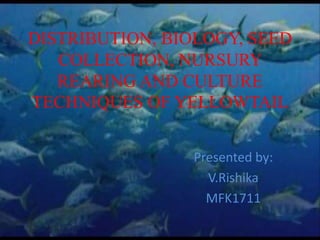
DISTRIBUTION, BIOLOGY, SEED
COLLECTION, NURSURY
REARING AND CULTURE
TECHNIQUES OF YELLOWTAIL
Presented by:
V.Rishika
MFK1711
Kingdom : Animalia
Phylum : Chordata
Class : Actinopterygii
Order : Perciformes
Family : Carangidae
Genus : Seriola
SCIENTIFIC CLASSIFICATION
INTRODUCTION
• Yellow tail belongs to the family Carangidae
• 11 species of yellow tail have been recognized
• 4 species-commercial culture
SCIENTIFIC NAME COMMON NAME
 Seriola quinqueradiata
 Seriola lalandi
 Seriola rivoliana
 Seriola dumerii
Seriola fasciata
Seriola carpenteri
Seriola hippos
Seriola peruana
Seriola zonata
Japanese amberjack
Yellow tail amberjack
Long fin yellow tail
Greater amberjack
Lesser amberjack
Guinean amberjack
Samson fish
Fortune jack
Banded rudder fish
Seriola aureovitta Asian yellow tail amberjack
Seriola dorsalis California yellow tail
amberjack
Japanese amberjack
Greater amberjack
Yellow tail amberjack
Long fin yellow tail
GLOBAL STATUS
• Production-280,000 tonnes anually
• 80% of production is contributed by Japanese amberjack
(Seriola quinqueradiata)
• Yellow tail production contributes about 70% of total finfish
aquaculture production in Japan
MAIN PRODUCER COUNTRIES
Main producer countries of Seriola quinqueradiata (FAO Fishery Statistics, 2012)
• Seriola quinqueradiata or yellow tail is commonly known as
hamachi in Japan
• Juveniles that weigh less than 50g are called “mojako”
• Yellowtail weighing less than 5kg are called “hamachi”
• Yellowtail weighing heavier than 5kg are called “buri”
DISTRIBUTION
• Cool temperate waters of the Pacific and Indian Oceans
primarily of Japan, southern Australia and the United States of
America
• In Australian waters, Yellowtail Kingfish are distributed from
North Reef in Queensland and around the southern coast to
Trigg Island in Western Australia
• They also occur off the east coast of Tasmania, around Lord
Howe and Norfolk Islands
HABITAT
• They inhabit rocky reefs and adjacent sandy areas in coastal
waters and occasionally enter estuaries
• They are found from shallow water down to depths of around
50 m
• Young fish up to 7 kg are known to form shoals generally
found close to the coast.
• Juveniles are yellow with black bands this coloration fades as
the fish ages and by about 30 cm in length
BIOLOGICAL FEATURES
• Body elongated, laterally compressed, and without scutes on
lateral line
• Body with longitudinal yellow stripes
• Fast swimming pelagic carnivorous fish, feeding on smaller
fish, such as mackerels, horse-mackerels, and sardines
• This species is highly piscivorous species and it reaches a
maximum size of 150 cm TL and 40 kg.
• Juveniles generally inhabit seaweeds and they feed on
zooplankton and small fishes while drifting with the seaweed.
• After reaching a size of 10 to 14 cm, they disperse from the
floating seaweed and swim towards the shore where they are
caught in set nets.
SEED COLLECTION
• Culture of amberjack is primarily dependent on seed supply
from wild
• Soon after spawning, larvae less than 15 mm long are brought
near the coast by the Kuroshio Current and they are caught in
fine mesh nets.
• Juveniles are associated with drifting seaweeds and they move
towards shore when they reach a size of 10-14cm and they are
caught by set nets.
• Wild seed is also imported from other countries, such as the
Republic of Korea and Viet Nam.
SEED COLLECTION PROCEDURE
NURSERY REARING
• Wild caught Japanese amberjack juveniles (<10 g), are reared in
5x5x5 m net pens and sold when they reach 50-200g
• In 5 x 5 x 5 m net pens the stocking rate of 0.5-10 g ranges from
10,000 to 30,000 juveniles
• Small juvenile amberjacks are sensitive to feed deprivation
• If young fish are not fed for more than 3 days they fail to adapt to
artificial feeds.
• Feeding includes enriched rotifers from first feeding and artemia
from 12 days after hatching
CULTURE TECHNIQUES
• Chile is currently trialing sea cage and land-based farming
methods of yellow tail
• In Japan traditional square sea cages are used
• In recent years polar circle types cages were also introduced in
Australia
CULTURE MORTALITY
Production cycle of Seriola quinqueradiata
PRODUCTION STATISTICS
• In 1970, the output of Japanese
amberjack was just over 107 000
tonnes
• Total production reached a peak of
nearly 263 000 tonnes in 2014
• Currently Japanese amberjack
aquaculture is severely constrained
by the increase in production costs,
due to increases in juvenile and
feed prices
DISEASES
• Vibriosis
• Pseudotuberculosis
• Streptococcus infection
• Nocardia
• Fungal infection
• Flatworm infection
• Trematode infection
CONTD:
• The main problem in culture is flat worm parasites that inhabit
the skin and gills in yellow tail
• These flatworms can cause reduced appetite, slower growth
and in extreme cases can cause death of the host by loss of
osmotic control.
GILL FLUKE SKIN FLUKE
DEFORMITIES
• One of the biggest problem in Seriola spp culture is the level
of deformities that occur in hatchery-reared fish.
• This problem is common in Japan, Australia, New Zealand and
prevents the utilization of artificial seedlings for aquaculture
by fish farmers.
• Deformities range from skeleton deformities,such as fused
vertebrae and scoliosis, jaw deformities including bended
lower jaw and compacted body and tail
FUTURE NEEDS
Several improvements are needed for culture of Seriola spp :
• Improved production of juveniles year around, which have
better growth rates and less vulnerability to diseases
• Increases resistance to parasites in cage culture systems
• Reduced incidence of deformities in hatchery reared fish
• Development of more efficient environment friendly feeds.
INTRODUCTION
• A self-feeding technique that enables fish to feed on demand
has been used in many studies of fish feeding behaviour.
• It has been used, to study the the diel feeding-pattern,
circadian rhythms of self-feeding ,regulation of food intake
and food preferences .
• It as an aquaculture technique, self-feeding drastically reduces
food waste and lowers the environmental impact because it
adjusts the food supply to the appetite of the fish.
OBJECTIVE
• The aim of the present experiment was to study the self-
feeding pattern of yellowtail maintained in floating net cages
throughout a year and to examine the influences of seasonal
changes of natural photoperiod and water temperature on these
patterns.
MATERIALS AND METHODS
• The experiment were performed from at the Fisheries
Research Laboratory of Mie University at Wagu, Japan.
• The experimental animals were wild, juvenile yellowtail
caught by local fishermen
• Two experimental net cages (2ˣ3ˣ4 m deep), designated as
Cage A and Cage B, were established, and the selected
yellowtail were then divided into two groups with 50 fish in
each net cage.
• The mean initial body weights in Cage A and Cage B were
55.1 and 88.5 g respectively.
• The experiment was divided into five periods with a duration
of two months.
• Before and after each experimental period, all fish were
removed from their cage, anesthetized and individually
weighed to know size of fish.
• During each experimental period, fish were fed with a
recommended size of commercial diet for yellowtail,
according to the size of the fish.
SELF FEEDING DEVICE
• A Touch Feed 990 system was used as the self feeding
apparatus.
• This system consisted of a trigger, a control unit and a feeder
and was useable for larger-scale experiments
• A set consisting of a trigger and a feeder was placed at the
center of each net cage.
• The trigger was stored in a PVC pipe and the feeder was set in
a large plastic box with the bottom removed to avoid damage
by the salt air or seawater.
• The trigger was a stainless steel wire type and a nylon string
that ended in a small plastic ball was attached to the end of the
wire.
Contd:
• The small plastic ball was located about 10 cm below the
surface of the seawater..
• The feeder and the control unit were adjusted to deliver a set
quantity of pellets when the trigger was actuated by a fish
pulling the plastic ball in its mouth.
• The amount of feed dispensed was calculated every few days
from the weight of the feed added and of that remaining in the
feeder.
• The daily food demand was obtained from the number of daily
feeder actuations
RESULTS AND DISCUSSION
• The present study revealed that it is possible to cultivate
yellowtail in net cages throughout the year using self-feeders.
• Moreover, it demonstrated that environmental factors, such as
water temperature and light intensity, have a great influence on
the self feeding behavior of yellowtail.
• The seasonal changes of water temperature influenced the
number of daily food demands, and the temporal changes in
light intensity greatly influenced the feeding pattern in a 24-h
period.
• When the water temperature fell to less than 180C a decrease
of food demand occurred simultaneously, and when it rise to
more than 18 0C a marked increase of food demand occurred
simultaneously.
• This suggests the existence of a marginal temperature at which
yellowtail can maintain high feeding activity, and it must be
around 18 0C.
• Just after the experiments started, the feeding activity was
observed mostly during the night time.
• This scotophase feeding lasted for 25 days in Cage A and 10
days in Cage B, and it may mainly be due to an avoidance of
high light intensity during the daytime.
• Yellowtail, requires 11–15 days to reach a stable level of self-
feeding both day and night.
• In outdoor experiments under the natural light conditions,
however, a high self-feeding activity was observed at dawn
and dusk in some species.
• In present study it was observed that young yellowtail started
to feed actively a little before sunrise, that the activity seemed
to be low in the daytime and that they then started to eat again
vigorously at sunset.
• so, yellow tail have two peak feeding periods
CONCLUSION
• The present study revealed that it is possible to cultivate
yellowtail in net cages throughout the year using self-feeders.
• Annual observations revealed that yellowtail showed generally
nocturnal feeding behavior and had two peaks of feeding
activity a day.
• The results suggest that a change in light intensity might
stimulate the appetite of yellowtail or that there is a light level
at which yellowtail prefer to eat.
Yellow tail

Yellow tail

  • 1.
    DISTRIBUTION, BIOLOGY, SEED COLLECTION,NURSURY REARING AND CULTURE TECHNIQUES OF YELLOWTAIL Presented by: V.Rishika MFK1711
  • 2.
    Kingdom : Animalia Phylum: Chordata Class : Actinopterygii Order : Perciformes Family : Carangidae Genus : Seriola SCIENTIFIC CLASSIFICATION
  • 3.
    INTRODUCTION • Yellow tailbelongs to the family Carangidae • 11 species of yellow tail have been recognized • 4 species-commercial culture SCIENTIFIC NAME COMMON NAME  Seriola quinqueradiata  Seriola lalandi  Seriola rivoliana  Seriola dumerii Seriola fasciata Seriola carpenteri Seriola hippos Seriola peruana Seriola zonata Japanese amberjack Yellow tail amberjack Long fin yellow tail Greater amberjack Lesser amberjack Guinean amberjack Samson fish Fortune jack Banded rudder fish Seriola aureovitta Asian yellow tail amberjack Seriola dorsalis California yellow tail amberjack
  • 4.
    Japanese amberjack Greater amberjack Yellowtail amberjack Long fin yellow tail
  • 5.
    GLOBAL STATUS • Production-280,000tonnes anually • 80% of production is contributed by Japanese amberjack (Seriola quinqueradiata) • Yellow tail production contributes about 70% of total finfish aquaculture production in Japan
  • 6.
    MAIN PRODUCER COUNTRIES Mainproducer countries of Seriola quinqueradiata (FAO Fishery Statistics, 2012)
  • 7.
    • Seriola quinqueradiataor yellow tail is commonly known as hamachi in Japan • Juveniles that weigh less than 50g are called “mojako” • Yellowtail weighing less than 5kg are called “hamachi” • Yellowtail weighing heavier than 5kg are called “buri”
  • 8.
    DISTRIBUTION • Cool temperatewaters of the Pacific and Indian Oceans primarily of Japan, southern Australia and the United States of America • In Australian waters, Yellowtail Kingfish are distributed from North Reef in Queensland and around the southern coast to Trigg Island in Western Australia • They also occur off the east coast of Tasmania, around Lord Howe and Norfolk Islands
  • 9.
    HABITAT • They inhabitrocky reefs and adjacent sandy areas in coastal waters and occasionally enter estuaries • They are found from shallow water down to depths of around 50 m • Young fish up to 7 kg are known to form shoals generally found close to the coast. • Juveniles are yellow with black bands this coloration fades as the fish ages and by about 30 cm in length
  • 10.
    BIOLOGICAL FEATURES • Bodyelongated, laterally compressed, and without scutes on lateral line • Body with longitudinal yellow stripes • Fast swimming pelagic carnivorous fish, feeding on smaller fish, such as mackerels, horse-mackerels, and sardines
  • 11.
    • This speciesis highly piscivorous species and it reaches a maximum size of 150 cm TL and 40 kg. • Juveniles generally inhabit seaweeds and they feed on zooplankton and small fishes while drifting with the seaweed. • After reaching a size of 10 to 14 cm, they disperse from the floating seaweed and swim towards the shore where they are caught in set nets.
  • 12.
    SEED COLLECTION • Cultureof amberjack is primarily dependent on seed supply from wild • Soon after spawning, larvae less than 15 mm long are brought near the coast by the Kuroshio Current and they are caught in fine mesh nets. • Juveniles are associated with drifting seaweeds and they move towards shore when they reach a size of 10-14cm and they are caught by set nets. • Wild seed is also imported from other countries, such as the Republic of Korea and Viet Nam.
  • 13.
  • 14.
    NURSERY REARING • Wildcaught Japanese amberjack juveniles (<10 g), are reared in 5x5x5 m net pens and sold when they reach 50-200g • In 5 x 5 x 5 m net pens the stocking rate of 0.5-10 g ranges from 10,000 to 30,000 juveniles • Small juvenile amberjacks are sensitive to feed deprivation • If young fish are not fed for more than 3 days they fail to adapt to artificial feeds. • Feeding includes enriched rotifers from first feeding and artemia from 12 days after hatching
  • 15.
    CULTURE TECHNIQUES • Chileis currently trialing sea cage and land-based farming methods of yellow tail • In Japan traditional square sea cages are used • In recent years polar circle types cages were also introduced in Australia
  • 16.
  • 17.
    Production cycle ofSeriola quinqueradiata
  • 18.
    PRODUCTION STATISTICS • In1970, the output of Japanese amberjack was just over 107 000 tonnes • Total production reached a peak of nearly 263 000 tonnes in 2014 • Currently Japanese amberjack aquaculture is severely constrained by the increase in production costs, due to increases in juvenile and feed prices
  • 19.
    DISEASES • Vibriosis • Pseudotuberculosis •Streptococcus infection • Nocardia • Fungal infection • Flatworm infection • Trematode infection
  • 20.
    CONTD: • The mainproblem in culture is flat worm parasites that inhabit the skin and gills in yellow tail • These flatworms can cause reduced appetite, slower growth and in extreme cases can cause death of the host by loss of osmotic control. GILL FLUKE SKIN FLUKE
  • 21.
    DEFORMITIES • One ofthe biggest problem in Seriola spp culture is the level of deformities that occur in hatchery-reared fish. • This problem is common in Japan, Australia, New Zealand and prevents the utilization of artificial seedlings for aquaculture by fish farmers. • Deformities range from skeleton deformities,such as fused vertebrae and scoliosis, jaw deformities including bended lower jaw and compacted body and tail
  • 22.
    FUTURE NEEDS Several improvementsare needed for culture of Seriola spp : • Improved production of juveniles year around, which have better growth rates and less vulnerability to diseases • Increases resistance to parasites in cage culture systems • Reduced incidence of deformities in hatchery reared fish • Development of more efficient environment friendly feeds.
  • 24.
    INTRODUCTION • A self-feedingtechnique that enables fish to feed on demand has been used in many studies of fish feeding behaviour. • It has been used, to study the the diel feeding-pattern, circadian rhythms of self-feeding ,regulation of food intake and food preferences . • It as an aquaculture technique, self-feeding drastically reduces food waste and lowers the environmental impact because it adjusts the food supply to the appetite of the fish.
  • 25.
    OBJECTIVE • The aimof the present experiment was to study the self- feeding pattern of yellowtail maintained in floating net cages throughout a year and to examine the influences of seasonal changes of natural photoperiod and water temperature on these patterns.
  • 26.
    MATERIALS AND METHODS •The experiment were performed from at the Fisheries Research Laboratory of Mie University at Wagu, Japan. • The experimental animals were wild, juvenile yellowtail caught by local fishermen • Two experimental net cages (2ˣ3ˣ4 m deep), designated as Cage A and Cage B, were established, and the selected yellowtail were then divided into two groups with 50 fish in each net cage. • The mean initial body weights in Cage A and Cage B were 55.1 and 88.5 g respectively.
  • 27.
    • The experimentwas divided into five periods with a duration of two months. • Before and after each experimental period, all fish were removed from their cage, anesthetized and individually weighed to know size of fish. • During each experimental period, fish were fed with a recommended size of commercial diet for yellowtail, according to the size of the fish.
  • 28.
    SELF FEEDING DEVICE •A Touch Feed 990 system was used as the self feeding apparatus. • This system consisted of a trigger, a control unit and a feeder and was useable for larger-scale experiments • A set consisting of a trigger and a feeder was placed at the center of each net cage. • The trigger was stored in a PVC pipe and the feeder was set in a large plastic box with the bottom removed to avoid damage by the salt air or seawater. • The trigger was a stainless steel wire type and a nylon string that ended in a small plastic ball was attached to the end of the wire.
  • 29.
    Contd: • The smallplastic ball was located about 10 cm below the surface of the seawater.. • The feeder and the control unit were adjusted to deliver a set quantity of pellets when the trigger was actuated by a fish pulling the plastic ball in its mouth. • The amount of feed dispensed was calculated every few days from the weight of the feed added and of that remaining in the feeder. • The daily food demand was obtained from the number of daily feeder actuations
  • 30.
    RESULTS AND DISCUSSION •The present study revealed that it is possible to cultivate yellowtail in net cages throughout the year using self-feeders. • Moreover, it demonstrated that environmental factors, such as water temperature and light intensity, have a great influence on the self feeding behavior of yellowtail. • The seasonal changes of water temperature influenced the number of daily food demands, and the temporal changes in light intensity greatly influenced the feeding pattern in a 24-h period.
  • 31.
    • When thewater temperature fell to less than 180C a decrease of food demand occurred simultaneously, and when it rise to more than 18 0C a marked increase of food demand occurred simultaneously. • This suggests the existence of a marginal temperature at which yellowtail can maintain high feeding activity, and it must be around 18 0C.
  • 32.
    • Just afterthe experiments started, the feeding activity was observed mostly during the night time. • This scotophase feeding lasted for 25 days in Cage A and 10 days in Cage B, and it may mainly be due to an avoidance of high light intensity during the daytime. • Yellowtail, requires 11–15 days to reach a stable level of self- feeding both day and night. • In outdoor experiments under the natural light conditions, however, a high self-feeding activity was observed at dawn and dusk in some species.
  • 33.
    • In presentstudy it was observed that young yellowtail started to feed actively a little before sunrise, that the activity seemed to be low in the daytime and that they then started to eat again vigorously at sunset. • so, yellow tail have two peak feeding periods
  • 34.
    CONCLUSION • The presentstudy revealed that it is possible to cultivate yellowtail in net cages throughout the year using self-feeders. • Annual observations revealed that yellowtail showed generally nocturnal feeding behavior and had two peaks of feeding activity a day. • The results suggest that a change in light intensity might stimulate the appetite of yellowtail or that there is a light level at which yellowtail prefer to eat.