The smart way to learn online
http://www.snapwiz.co.in
Quantitative Ability Formula Sheet
CAT and Management Entrance Tests
Visit http://www.snapwiz.co.in for free mock CAT tests Page 1
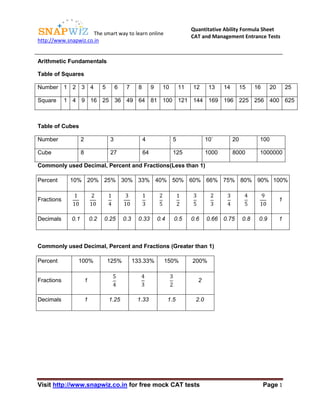
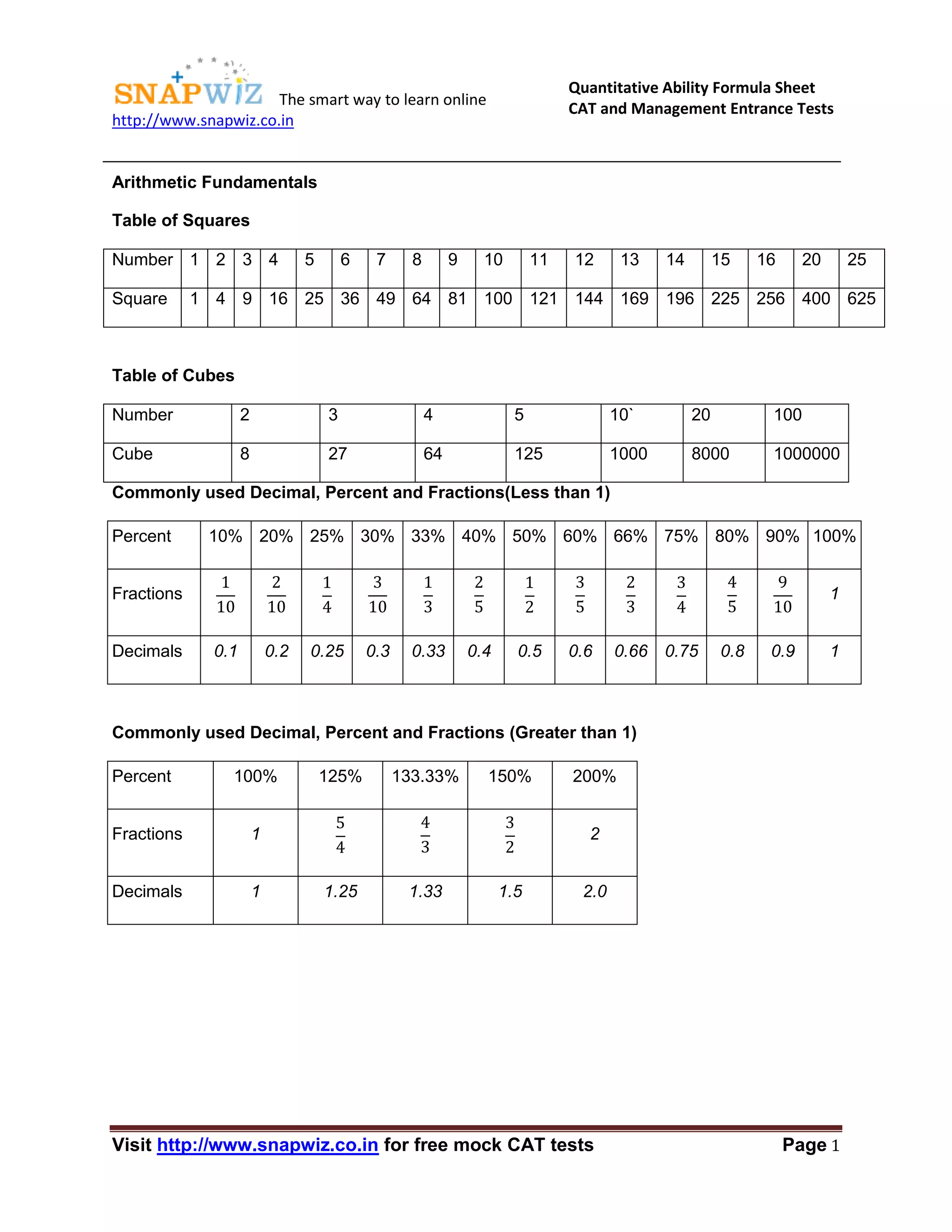
Arithmetic Fundamentals
Table of Squares
Number 1 2 3 4 5 6 7 8 9 10 11 12 13 14 15 16 20 25
Square 1 4 9 16 25 36 49 64 81 100 121 144 169 196 225 256 400 625
Table of Cubes
Number 2 3 4 5 10` 20 100
Cube 8 27 64 125 1000 8000 1000000
Commonly used Decimal, Percent and Fractions(Less than 1)
Percent 10% 20% 25% 30% 33% 40% 50% 60% 66% 75% 80% 90% 100%
Fractions
1
10
2
10
1
4
3
10
1
3
2
5
1
2
3
5
2
3
3
4
4
5
9
10
1
Decimals 0.1 0.2 0.25 0.3 0.33 0.4 0.5 0.6 0.66 0.75 0.8 0.9 1
Commonly used Decimal, Percent and Fractions (Greater than 1)
Percent 100% 125% 133.33% 150% 200%
Fractions 1
5
4
4
3
3
2
2
Decimals 1 1.25 1.33 1.5 2.0
The smart way to learn online
http://www.snapwiz.co.in
Quantitative Ability Formula Sheet
CAT and Management Entrance Tests
Visit http://www.snapwiz.co.in for free mock CAT tests Page 2
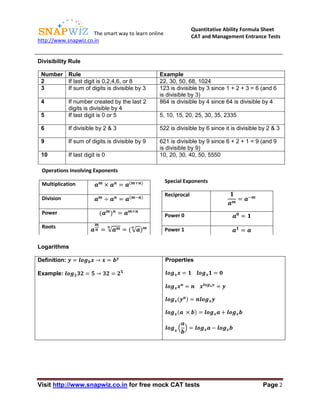
Divisibility Rule
Number Rule Example
2 If last digit is 0,2,4,6, or 8 22, 30, 50, 68, 1024
3 If sum of digits is divisible by 3 123 is divisible by 3 since 1 + 2 + 3 = 6 (and 6
is divisible by 3)
4 If number created by the last 2
digits is divisible by 4
864 is divisible by 4 since 64 is divisible by 4
5 If last digit is 0 or 5 5, 10, 15, 20, 25, 30, 35, 2335
6 If divisible by 2 & 3 522 is divisible by 6 since it is divisible by 2 & 3
9 If sum of digits is divisible by 9 621 is divisible by 9 since 6 + 2 + 1 = 9 (and 9
is divisible by 9)
10 If last digit is 0 10, 20, 30, 40, 50, 5550
Logarithms
Definition: 𝒚 = 𝒍𝒐𝒈 𝒃 𝒙 → 𝒙 = 𝒃 𝒚
Example: 𝒍𝒐𝒈 𝟐 𝟑𝟐 = 𝟓 → 𝟑𝟐 = 𝟐 𝟓
Properties
𝒍𝒐𝒈 𝒙 𝒙 = 𝟏 𝒍𝒐𝒈 𝒙 𝟏 = 𝟎
𝒍𝒐𝒈 𝒙 𝒙 𝒏
= 𝒏 𝒙𝒍𝒐𝒈 𝒙 𝒚
= 𝒚
𝒍𝒐𝒈 𝒙 𝒚 𝒏
= 𝒏𝒍𝒐𝒈 𝒙 𝒚
𝒍𝒐𝒈 𝒙 𝒂 × 𝒃 = 𝒍𝒐𝒈 𝒙 𝒂 + 𝒍𝒐𝒈 𝒙 𝒃
𝒍𝒐𝒈 𝒙
𝒂
𝒃
= 𝒍𝒐𝒈 𝒙 𝒂 − 𝒍𝒐𝒈 𝒙 𝒃
Special Exponents
Reciprocal 𝟏
𝒂 𝒎
= 𝒂−𝒎
Power 0 𝒂 𝟎
= 𝟏
Power 1 𝒂 𝟏
= 𝒂
Operations Involving Exponents
Multiplication 𝒂 𝒎
× 𝒂 𝒏
= 𝒂(𝒎+𝒏)
Division 𝒂 𝒎
÷ 𝒂 𝒏
= 𝒂(𝒎−𝒏)
Power (𝒂 𝒎
) 𝒏
= 𝒂 𝒎×𝒏
Roots
𝒂
𝒎
𝒏 = 𝒂 𝒎𝒏
= ( 𝒂
𝒏
) 𝒎
The smart way to learn online
http://www.snapwiz.co.in
Quantitative Ability Formula Sheet
CAT and Management Entrance Tests
Visit http://www.snapwiz.co.in for free mock CAT tests Page 3
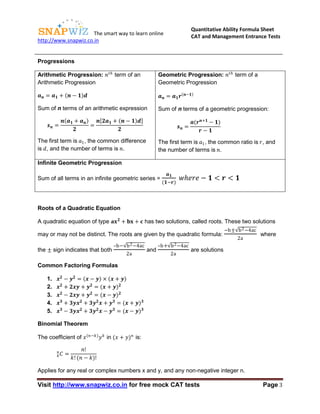
Progressions
Arithmetic Progression: 𝑛 𝑡𝑕
term of an
Arithmetic Progression
𝒂 𝒏 = 𝒂 𝟏 + 𝒏 − 𝟏 𝒅
Sum of n terms of an arithmetic expression
𝒔 𝒏 =
𝒏 𝒂 𝟏 + 𝒂 𝒏
𝟐
=
𝒏 𝟐𝒂 𝟏 + 𝒏 − 𝟏 𝒅
𝟐
The first term is 𝑎1, the common difference
is 𝑑, and the number of terms is 𝑛.
Geometric Progression: 𝑛 𝑡𝑕
term of a
Geometric Progression
𝒂 𝒏 = 𝒂 𝟏 𝒓 𝒏−𝟏
Sum of n terms of a geometric progression:
𝒔 𝒏 =
𝒂(𝒓 𝒏+𝟏
− 𝟏)
𝒓 − 𝟏
The first term is 𝑎1, the common ratio is 𝑟, and
the number of terms is 𝑛.
Infinite Geometric Progression
Sum of all terms in an infinite geometric series =
𝒂 𝟏
(𝟏−𝒓)
𝑤𝑕𝑒𝑟𝑒 − 𝟏 < 𝒓 < 𝟏
Roots of a Quadratic Equation
A quadratic equation of type 𝐚𝐱 𝟐
+ 𝐛𝐱 + 𝐜 has two solutions, called roots. These two solutions
may or may not be distinct. The roots are given by the quadratic formula:
−b± b2−4ac
2a
where
the ± sign indicates that both
–b− b2−4ac
2a
and
–b+ b2−4ac
2a
are solutions
Common Factoring Formulas
1. 𝒙 𝟐
− 𝒚 𝟐
= 𝒙 − 𝒚 × 𝒙 + 𝒚
2. 𝒙 𝟐
+ 𝟐𝒙𝒚 + 𝒚 𝟐
= (𝒙 + 𝒚) 𝟐
3. 𝒙 𝟐
− 𝟐𝒙𝒚 + 𝒚 𝟐
= (𝒙 − 𝒚) 𝟐
4. 𝒙 𝟑
+ 𝟑𝒚𝒙 𝟐
+ 𝟑𝒚 𝟐
𝒙 + 𝒚 𝟑
= (𝒙 + 𝒚) 𝟑
5. 𝒙 𝟑
− 𝟑𝒚𝒙 𝟐
+ 𝟑𝒚 𝟐
𝒙 − 𝒚 𝟑
= (𝒙 − 𝒚) 𝟑
Binomial Theorem
The coefficient of 𝑥(𝑛−𝑘)
𝑦 𝑘
in (𝑥 + 𝑦) 𝑛
is:
𝐶𝑘
𝑛
=
𝑛!
𝑘! (𝑛 − 𝑘)!
Applies for any real or complex numbers x and y, and any non-negative integer n.
The smart way to learn online
http://www.snapwiz.co.in
Quantitative Ability Formula Sheet
CAT and Management Entrance Tests
Visit http://www.snapwiz.co.in for free mock CAT tests Page 4
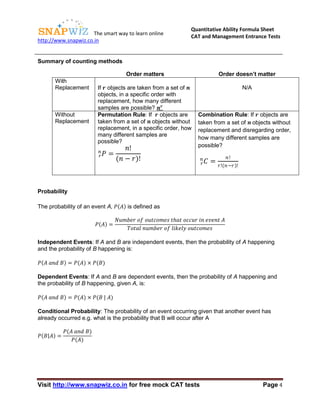
Summary of counting methods
Order matters Order doesn’t matter
With
Replacement If 𝒓 objects are taken from a set of 𝒏
objects, in a specific order with
replacement, how many different
samples are possible? 𝒏 𝒓
N/A
Without
Replacement
Permutation Rule: If 𝒓 objects are
taken from a set of 𝒏 objects without
replacement, in a specific order, how
many different samples are
possible?
𝑃𝑟
𝑛
=
𝑛!
(𝑛 − 𝑟)!
Combination Rule: If 𝒓 objects are
taken from a set of 𝒏 objects without
replacement and disregarding order,
how many different samples are
possible?
𝐶𝑟
𝑛
=
𝑛!
𝑟!(𝑛−𝑟)!
Probability
The probability of an event A, 𝑃 𝐴 is defined as
𝑃 𝐴 =
𝑁𝑢𝑚𝑏𝑒𝑟 𝑜𝑓 𝑜𝑢𝑡𝑐𝑜𝑚𝑒𝑠 𝑡𝑕𝑎𝑡 𝑜𝑐𝑐𝑢𝑟 𝑖𝑛 𝑒𝑣𝑒𝑛𝑡 𝐴
𝑇𝑜𝑡𝑎𝑙 𝑛𝑢𝑚𝑏𝑒𝑟 𝑜𝑓 𝑙𝑖𝑘𝑒𝑙𝑦 𝑜𝑢𝑡𝑐𝑜𝑚𝑒𝑠
Independent Events: If A and B are independent events, then the probability of A happening
and the probability of B happening is:
𝑃 𝐴 𝑎𝑛𝑑 𝐵 = 𝑃(𝐴) × 𝑃(𝐵)
Dependent Events: If A and B are dependent events, then the probability of A happening and
the probability of B happening, given A, is:
𝑃 𝐴 𝑎𝑛𝑑 𝐵 = 𝑃(𝐴) × 𝑃(𝐵 | 𝐴)
Conditional Probability: The probability of an event occurring given that another event has
already occurred e.g. what is the probability that B will occur after A
𝑃 𝐵 𝐴 =
𝑃(𝐴 𝑎𝑛𝑑 𝐵)
𝑃(𝐴)
The smart way to learn online
http://www.snapwiz.co.in
Quantitative Ability Formula Sheet
CAT and Management Entrance Tests
Visit http://www.snapwiz.co.in for free mock CAT tests Page 5
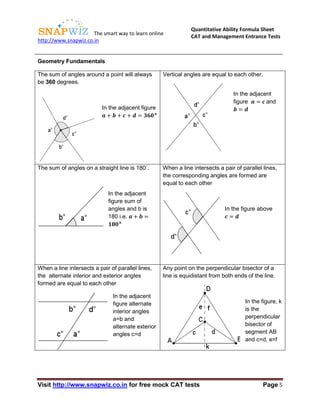
Geometry Fundamentals
The sum of angles around a point will always
be 360 degrees.
In the adjacent figure
𝒂 + 𝒃 + 𝒄 + 𝒅 = 𝟑𝟔𝟎°
Vertical angles are equal to each other.
In the adjacent
figure 𝒂 = 𝒄 and
𝒃 = 𝒅
The sum of angles on a straight line is 180˚.
In the adjacent
figure sum of
angles and b is
180 i.e. 𝒂 + 𝒃 =
𝟏𝟖𝟎°
When a line intersects a pair of parallel lines,
the corresponding angles are formed are
equal to each other
In the figure above
𝒄 = 𝒅
When a line intersects a pair of parallel lines,
the alternate interior and exterior angles
formed are equal to each other
In the adjacent
figure alternate
interior angles
a=b and
alternate exterior
angles c=d
Any point on the perpendicular bisector of a
line is equidistant from both ends of the line.
In the figure, k
is the
perpendicular
bisector of
segment AB
and c=d, e=f
The smart way to learn online
http://www.snapwiz.co.in
Quantitative Ability Formula Sheet
CAT and Management Entrance Tests
Visit http://www.snapwiz.co.in for free mock CAT tests Page 6
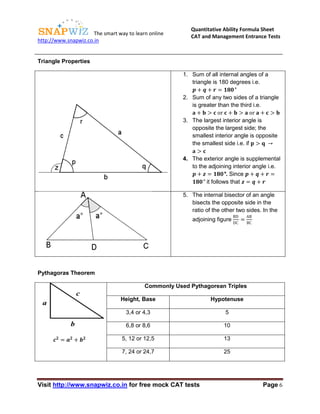
Triangle Properties
1. Sum of all internal angles of a
triangle is 180 degrees i.e.
𝒑 + 𝒒 + 𝒓 = 𝟏𝟖𝟎°
2. Sum of any two sides of a triangle
is greater than the third i.e.
𝐚 + 𝐛 > 𝐜 or 𝐜 + 𝐛 > 𝐚 or 𝐚 + 𝐜 > 𝐛
3. The largest interior angle is
opposite the largest side; the
smallest interior angle is opposite
the smallest side i.e. if 𝐩 > 𝐪 →
𝐚 > 𝐜
4. The exterior angle is supplemental
to the adjoining interior angle i.e.
𝒑 + 𝒛 = 𝟏𝟖𝟎°. Since 𝒑 + 𝒒 + 𝒓 =
𝟏𝟖𝟎° it follows that 𝒛 = 𝒒 + 𝒓
5. The internal bisector of an angle
bisects the opposite side in the
ratio of the other two sides. In the
adjoining figure
BD
DC
=
AB
BC
Pythagoras Theorem
𝒄 𝟐
= 𝒂 𝟐
+ 𝒃 𝟐
Commonly Used Pythagorean Triples
Height, Base Hypotenuse
3,4 or 4,3 5
6,8 or 8,6 10
5, 12 or 12,5 13
7, 24 or 24,7 25
The smart way to learn online
http://www.snapwiz.co.in
Quantitative Ability Formula Sheet
CAT and Management Entrance Tests
Visit http://www.snapwiz.co.in for free mock CAT tests Page 7
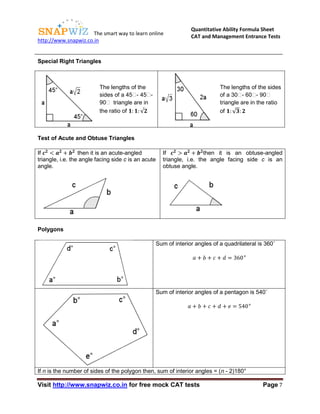
Special Right Triangles
The lengths of the
sides of a 45- 45-
90 triangle are in
the ratio of 𝟏: 𝟏: 𝟐
The lengths of the sides
of a 30- 60- 90
triangle are in the ratio
of 𝟏: 𝟑: 𝟐
Test of Acute and Obtuse Triangles
If 𝒄 𝟐
< 𝒂 𝟐
+ 𝒃 𝟐
then it is an acute-angled
triangle, i.e. the angle facing side c is an acute
angle.
If 𝒄 𝟐
> 𝒂 𝟐
+ 𝒃 𝟐
then it is an obtuse-angled
triangle, i.e. the angle facing side c is an
obtuse angle.
Polygons
Sum of interior angles of a quadrilateral is 360˚
𝑎 + 𝑏 + 𝑐 + 𝑑 = 360°
Sum of interior angles of a pentagon is 540˚
𝑎 + 𝑏 + 𝑐 + 𝑑 + 𝑒 = 540°
If n is the number of sides of the polygon then, sum of interior angles = (n - 2)180°
The smart way to learn online
http://www.snapwiz.co.in
Quantitative Ability Formula Sheet
CAT and Management Entrance Tests
Visit http://www.snapwiz.co.in for free mock CAT tests Page 8
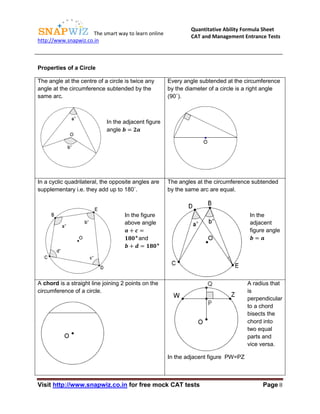
Properties of a Circle
The angle at the centre of a circle is twice any
angle at the circumference subtended by the
same arc.
In the adjacent figure
angle 𝒃 = 𝟐𝒂
Every angle subtended at the circumference
by the diameter of a circle is a right angle
(90˚).
In a cyclic quadrilateral, the opposite angles are
supplementary i.e. they add up to 180˚.
In the figure
above angle
𝒂 + 𝒄 =
𝟏𝟖𝟎° and
𝒃 + 𝒅 = 𝟏𝟖𝟎°
The angles at the circumference subtended
by the same arc are equal.
In the
adjacent
figure angle
𝒃 = 𝒂
A chord is a straight line joining 2 points on the
circumference of a circle.
A radius that
is
perpendicular
to a chord
bisects the
chord into
two equal
parts and
vice versa.
In the adjacent figure PW=PZ
The smart way to learn online
http://www.snapwiz.co.in
Quantitative Ability Formula Sheet
CAT and Management Entrance Tests
Visit http://www.snapwiz.co.in for free mock CAT tests Page 9
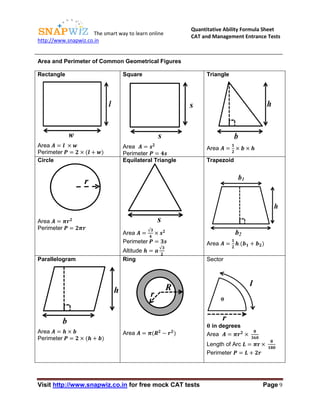
Area and Perimeter of Common Geometrical Figures
Rectangle
Area 𝑨 = 𝒍 × 𝒘
Perimeter 𝑷 = 𝟐 × (𝒍 + 𝒘)
Square
Area 𝑨 = 𝒔 𝟐
Perimeter 𝑷 = 𝟒𝒔
Triangle
Area 𝑨 =
𝟏
𝟐
× 𝒃 × 𝒉
Circle
Area 𝑨 = 𝝅𝒓 𝟐
Perimeter 𝑷 = 𝟐𝝅𝒓
Equilateral Triangle
Area 𝑨 =
𝟑
𝟒
× 𝒔 𝟐
Perimeter 𝑷 = 𝟑𝒔
Altitude 𝒉 = 𝒂
𝟑
𝟐
Trapezoid
Area 𝑨 =
𝟏
𝟐
𝒉 (𝒃 𝟏 + 𝒃 𝟐)
Parallelogram
Area 𝑨 = 𝒉 × 𝒃
Perimeter 𝑷 = 𝟐 × (𝒉 + 𝒃)
Ring
Area 𝑨 = 𝝅(𝑹 𝟐
− 𝒓 𝟐
)
Sector
𝛉 in degrees
Area 𝑨 = 𝝅𝒓 𝟐
×
𝛉
𝟑𝟔𝟎
Length of Arc 𝑳 = 𝝅𝐫 ×
𝛉
𝟏𝟖𝟎
Perimeter 𝑷 = 𝑳 + 𝟐𝒓
The smart way to learn online
http://www.snapwiz.co.in
Quantitative Ability Formula Sheet
CAT and Management Entrance Tests
Visit http://www.snapwiz.co.in for free mock CAT tests Page 10
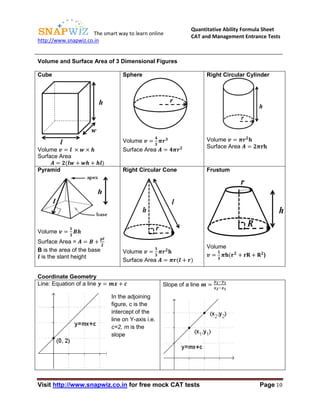
Volume and Surface Area of 3 Dimensional Figures
Cube
Volume 𝒗 = 𝒍 × 𝒘 × 𝒉
Surface Area
𝑨 = 𝟐(𝒍𝒘 + 𝒘𝒉 + 𝒉𝒍)
Sphere
Volume 𝒗 =
𝟒
𝟑
𝝅𝒓 𝟑
Surface Area 𝑨 = 𝟒𝝅𝒓 𝟐
Right Circular Cylinder
Volume 𝒗 = 𝝅𝒓 𝟐
𝐡
Surface Area 𝑨 = 𝟐𝝅𝐫𝐡
Pyramid
Volume 𝒗 =
𝟏
𝟑
𝑩𝒉
Surface Area = 𝑨 = 𝑩 +
𝒑𝒍
𝟐
B is the area of the base
𝒍 is the slant height
Right Circular Cone
Volume 𝒗 =
𝟏
𝟑
𝝅𝒓 𝟐
𝐡
Surface Area 𝑨 = 𝝅𝒓(𝒍 + 𝒓)
Frustum
Volume
𝒗 =
𝟏
𝟑
𝝅𝐡(𝐫 𝟐
+ 𝐫𝐑 + 𝐑 𝟐
)
Coordinate Geometry
Line: Equation of a line 𝒚 = 𝒎𝒙 + 𝒄
In the adjoining
figure, c is the
intercept of the
line on Y-axis i.e.
c=2, m is the
slope
Slope of a line 𝒎 =
𝒚 𝟐−𝒚 𝟏
𝒙 𝟐−𝒙 𝟏
The smart way to learn online
http://www.snapwiz.co.in
Quantitative Ability Formula Sheet
CAT and Management Entrance Tests
Visit http://www.snapwiz.co.in for free mock CAT tests Page 11
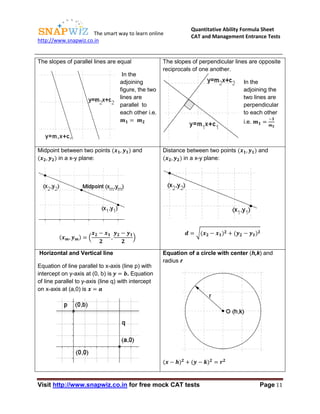
The slopes of parallel lines are equal
In the
adjoining
figure, the two
lines are
parallel to
each other i.e.
𝒎 𝟏 = 𝒎 𝟐
The slopes of perpendicular lines are opposite
reciprocals of one another.
In the
adjoining the
two lines are
perpendicular
to each other
i.e. 𝒎 𝟏 =
−𝟏
𝒎 𝟐
Midpoint between two points (𝒙 𝟏, 𝒚 𝟏) and
(𝒙 𝟐, 𝒚 𝟐) in a x-y plane:
𝒙 𝒎, 𝒚 𝒎 =
𝒙 𝟐 − 𝒙 𝟏
𝟐
,
𝒚 𝟐 − 𝒚 𝟏
𝟐
Distance between two points (𝒙 𝟏, 𝒚 𝟏) and
(𝒙 𝟐, 𝒚 𝟐) in a x-y plane:
𝒅 = (𝒙 𝟐 − 𝒙 𝟏) 𝟐 + (𝒚 𝟐 − 𝒚 𝟏) 𝟐
Horizontal and Vertical line
Equation of line parallel to x-axis (line p) with
intercept on y-axis at (0, b) is 𝒚 = 𝒃. Equation
of line parallel to y-axis (line q) with intercept
on x-axis at (a,0) is 𝒙 = 𝒂
Equation of a circle with center (h,k) and
radius r
(𝒙 − 𝒉) 𝟐
+ (𝒚 − 𝒌) 𝟐
= 𝒓 𝟐
The smart way to learn online
http://www.snapwiz.co.in
Quantitative Ability Formula Sheet
CAT and Management Entrance Tests
Visit http://www.snapwiz.co.in for free mock CAT tests Page 12
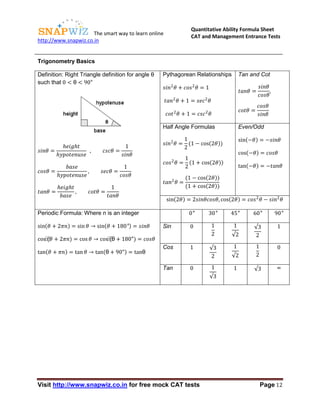
Trigonometry Basics
Definition: Right Triangle definition for angle θ
such that 0 < θ < 90°
𝑠𝑖𝑛𝜃 =
𝑕𝑒𝑖𝑔𝑕𝑡
𝑕𝑦𝑝𝑜𝑡𝑒𝑛𝑢𝑠𝑒
, 𝑐𝑠𝑐𝜃 =
1
𝑠𝑖𝑛𝜃
𝑐𝑜𝑠𝜃 =
𝑏𝑎𝑠𝑒
𝑕𝑦𝑝𝑜𝑡𝑒𝑛𝑢𝑠𝑒
, 𝑠𝑒𝑐𝜃 =
1
𝑐𝑜𝑠𝜃
𝑡𝑎𝑛𝜃 =
𝑕𝑒𝑖𝑔𝑕𝑡
𝑏𝑎𝑠𝑒
, 𝑐𝑜𝑡𝜃 =
1
𝑡𝑎𝑛𝜃
Pythagorean Relationships
𝑠𝑖𝑛2
𝜃 + 𝑐𝑜𝑠2
𝜃 = 1
𝑡𝑎𝑛2
𝜃 + 1 = 𝑠𝑒𝑐2
𝜃
𝑐𝑜𝑡2
𝜃 + 1 = 𝑐𝑠𝑐2
𝜃
Tan and Cot
𝑡𝑎𝑛𝜃 =
𝑠𝑖𝑛𝜃
𝑐𝑜𝑠𝜃
,
𝑐𝑜𝑡𝜃 =
𝑐𝑜𝑠𝜃
𝑠𝑖𝑛𝜃
Half Angle Formulas
𝑠𝑖𝑛2
𝜃 =
1
2
(1 − cos 2𝜃 )
𝑐𝑜𝑠2
𝜃 =
1
2
1 + cos 2𝜃
𝑡𝑎𝑛2
𝜃 =
(1 − cos 2𝜃 )
(1 + cos 2𝜃 )
Even/Odd
sin −𝜃 = −𝑠𝑖𝑛𝜃
cos −𝜃 = 𝑐𝑜𝑠𝜃
tan −𝜃 = −𝑡𝑎𝑛𝜃
sin 2𝜃 = 2𝑠𝑖𝑛𝜃𝑐𝑜𝑠𝜃, cos 2𝜃 = 𝑐𝑜𝑠2
𝜃 − 𝑠𝑖𝑛2
𝜃
Periodic Formula: Where n is an integer
sin 𝜃 + 2𝜋𝑛 = sin 𝜃 → sin 𝜃 + 180° = 𝑠𝑖𝑛𝜃
cos⁡(𝜃 + 2𝜋𝑛) = cos 𝜃 → cos⁡(θ + 180°) = 𝑐𝑜𝑠𝜃
tan 𝜃 + 𝜋𝑛 = tan 𝜃 → tan θ + 90° = tanθ
0° 30° 45° 60° 90°
Sin 0 1
2
1
2
3
2
1
Cos 1 3
2
1
2
1
2
0
Tan 0 1
3
1 3 ∞

Cat Quant Cheat Sheet

  • 1.
    The smart wayto learn online http://www.snapwiz.co.in Quantitative Ability Formula Sheet CAT and Management Entrance Tests Visit http://www.snapwiz.co.in for free mock CAT tests Page 1 Arithmetic Fundamentals Table of Squares Number 1 2 3 4 5 6 7 8 9 10 11 12 13 14 15 16 20 25 Square 1 4 9 16 25 36 49 64 81 100 121 144 169 196 225 256 400 625 Table of Cubes Number 2 3 4 5 10` 20 100 Cube 8 27 64 125 1000 8000 1000000 Commonly used Decimal, Percent and Fractions(Less than 1) Percent 10% 20% 25% 30% 33% 40% 50% 60% 66% 75% 80% 90% 100% Fractions 1 10 2 10 1 4 3 10 1 3 2 5 1 2 3 5 2 3 3 4 4 5 9 10 1 Decimals 0.1 0.2 0.25 0.3 0.33 0.4 0.5 0.6 0.66 0.75 0.8 0.9 1 Commonly used Decimal, Percent and Fractions (Greater than 1) Percent 100% 125% 133.33% 150% 200% Fractions 1 5 4 4 3 3 2 2 Decimals 1 1.25 1.33 1.5 2.0
  • 2.
    The smart wayto learn online http://www.snapwiz.co.in Quantitative Ability Formula Sheet CAT and Management Entrance Tests Visit http://www.snapwiz.co.in for free mock CAT tests Page 2 Divisibility Rule Number Rule Example 2 If last digit is 0,2,4,6, or 8 22, 30, 50, 68, 1024 3 If sum of digits is divisible by 3 123 is divisible by 3 since 1 + 2 + 3 = 6 (and 6 is divisible by 3) 4 If number created by the last 2 digits is divisible by 4 864 is divisible by 4 since 64 is divisible by 4 5 If last digit is 0 or 5 5, 10, 15, 20, 25, 30, 35, 2335 6 If divisible by 2 & 3 522 is divisible by 6 since it is divisible by 2 & 3 9 If sum of digits is divisible by 9 621 is divisible by 9 since 6 + 2 + 1 = 9 (and 9 is divisible by 9) 10 If last digit is 0 10, 20, 30, 40, 50, 5550 Logarithms Definition: 𝒚 = 𝒍𝒐𝒈 𝒃 𝒙 → 𝒙 = 𝒃 𝒚 Example: 𝒍𝒐𝒈 𝟐 𝟑𝟐 = 𝟓 → 𝟑𝟐 = 𝟐 𝟓 Properties 𝒍𝒐𝒈 𝒙 𝒙 = 𝟏 𝒍𝒐𝒈 𝒙 𝟏 = 𝟎 𝒍𝒐𝒈 𝒙 𝒙 𝒏 = 𝒏 𝒙𝒍𝒐𝒈 𝒙 𝒚 = 𝒚 𝒍𝒐𝒈 𝒙 𝒚 𝒏 = 𝒏𝒍𝒐𝒈 𝒙 𝒚 𝒍𝒐𝒈 𝒙 𝒂 × 𝒃 = 𝒍𝒐𝒈 𝒙 𝒂 + 𝒍𝒐𝒈 𝒙 𝒃 𝒍𝒐𝒈 𝒙 𝒂 𝒃 = 𝒍𝒐𝒈 𝒙 𝒂 − 𝒍𝒐𝒈 𝒙 𝒃 Special Exponents Reciprocal 𝟏 𝒂 𝒎 = 𝒂−𝒎 Power 0 𝒂 𝟎 = 𝟏 Power 1 𝒂 𝟏 = 𝒂 Operations Involving Exponents Multiplication 𝒂 𝒎 × 𝒂 𝒏 = 𝒂(𝒎+𝒏) Division 𝒂 𝒎 ÷ 𝒂 𝒏 = 𝒂(𝒎−𝒏) Power (𝒂 𝒎 ) 𝒏 = 𝒂 𝒎×𝒏 Roots 𝒂 𝒎 𝒏 = 𝒂 𝒎𝒏 = ( 𝒂 𝒏 ) 𝒎
  • 3.
    The smart wayto learn online http://www.snapwiz.co.in Quantitative Ability Formula Sheet CAT and Management Entrance Tests Visit http://www.snapwiz.co.in for free mock CAT tests Page 3 Progressions Arithmetic Progression: 𝑛 𝑡𝑕 term of an Arithmetic Progression 𝒂 𝒏 = 𝒂 𝟏 + 𝒏 − 𝟏 𝒅 Sum of n terms of an arithmetic expression 𝒔 𝒏 = 𝒏 𝒂 𝟏 + 𝒂 𝒏 𝟐 = 𝒏 𝟐𝒂 𝟏 + 𝒏 − 𝟏 𝒅 𝟐 The first term is 𝑎1, the common difference is 𝑑, and the number of terms is 𝑛. Geometric Progression: 𝑛 𝑡𝑕 term of a Geometric Progression 𝒂 𝒏 = 𝒂 𝟏 𝒓 𝒏−𝟏 Sum of n terms of a geometric progression: 𝒔 𝒏 = 𝒂(𝒓 𝒏+𝟏 − 𝟏) 𝒓 − 𝟏 The first term is 𝑎1, the common ratio is 𝑟, and the number of terms is 𝑛. Infinite Geometric Progression Sum of all terms in an infinite geometric series = 𝒂 𝟏 (𝟏−𝒓) 𝑤𝑕𝑒𝑟𝑒 − 𝟏 < 𝒓 < 𝟏 Roots of a Quadratic Equation A quadratic equation of type 𝐚𝐱 𝟐 + 𝐛𝐱 + 𝐜 has two solutions, called roots. These two solutions may or may not be distinct. The roots are given by the quadratic formula: −b± b2−4ac 2a where the ± sign indicates that both –b− b2−4ac 2a and –b+ b2−4ac 2a are solutions Common Factoring Formulas 1. 𝒙 𝟐 − 𝒚 𝟐 = 𝒙 − 𝒚 × 𝒙 + 𝒚 2. 𝒙 𝟐 + 𝟐𝒙𝒚 + 𝒚 𝟐 = (𝒙 + 𝒚) 𝟐 3. 𝒙 𝟐 − 𝟐𝒙𝒚 + 𝒚 𝟐 = (𝒙 − 𝒚) 𝟐 4. 𝒙 𝟑 + 𝟑𝒚𝒙 𝟐 + 𝟑𝒚 𝟐 𝒙 + 𝒚 𝟑 = (𝒙 + 𝒚) 𝟑 5. 𝒙 𝟑 − 𝟑𝒚𝒙 𝟐 + 𝟑𝒚 𝟐 𝒙 − 𝒚 𝟑 = (𝒙 − 𝒚) 𝟑 Binomial Theorem The coefficient of 𝑥(𝑛−𝑘) 𝑦 𝑘 in (𝑥 + 𝑦) 𝑛 is: 𝐶𝑘 𝑛 = 𝑛! 𝑘! (𝑛 − 𝑘)! Applies for any real or complex numbers x and y, and any non-negative integer n.
  • 4.
    The smart wayto learn online http://www.snapwiz.co.in Quantitative Ability Formula Sheet CAT and Management Entrance Tests Visit http://www.snapwiz.co.in for free mock CAT tests Page 4 Summary of counting methods Order matters Order doesn’t matter With Replacement If 𝒓 objects are taken from a set of 𝒏 objects, in a specific order with replacement, how many different samples are possible? 𝒏 𝒓 N/A Without Replacement Permutation Rule: If 𝒓 objects are taken from a set of 𝒏 objects without replacement, in a specific order, how many different samples are possible? 𝑃𝑟 𝑛 = 𝑛! (𝑛 − 𝑟)! Combination Rule: If 𝒓 objects are taken from a set of 𝒏 objects without replacement and disregarding order, how many different samples are possible? 𝐶𝑟 𝑛 = 𝑛! 𝑟!(𝑛−𝑟)! Probability The probability of an event A, 𝑃 𝐴 is defined as 𝑃 𝐴 = 𝑁𝑢𝑚𝑏𝑒𝑟 𝑜𝑓 𝑜𝑢𝑡𝑐𝑜𝑚𝑒𝑠 𝑡𝑕𝑎𝑡 𝑜𝑐𝑐𝑢𝑟 𝑖𝑛 𝑒𝑣𝑒𝑛𝑡 𝐴 𝑇𝑜𝑡𝑎𝑙 𝑛𝑢𝑚𝑏𝑒𝑟 𝑜𝑓 𝑙𝑖𝑘𝑒𝑙𝑦 𝑜𝑢𝑡𝑐𝑜𝑚𝑒𝑠 Independent Events: If A and B are independent events, then the probability of A happening and the probability of B happening is: 𝑃 𝐴 𝑎𝑛𝑑 𝐵 = 𝑃(𝐴) × 𝑃(𝐵) Dependent Events: If A and B are dependent events, then the probability of A happening and the probability of B happening, given A, is: 𝑃 𝐴 𝑎𝑛𝑑 𝐵 = 𝑃(𝐴) × 𝑃(𝐵 | 𝐴) Conditional Probability: The probability of an event occurring given that another event has already occurred e.g. what is the probability that B will occur after A 𝑃 𝐵 𝐴 = 𝑃(𝐴 𝑎𝑛𝑑 𝐵) 𝑃(𝐴)
  • 5.
    The smart wayto learn online http://www.snapwiz.co.in Quantitative Ability Formula Sheet CAT and Management Entrance Tests Visit http://www.snapwiz.co.in for free mock CAT tests Page 5 Geometry Fundamentals The sum of angles around a point will always be 360 degrees. In the adjacent figure 𝒂 + 𝒃 + 𝒄 + 𝒅 = 𝟑𝟔𝟎° Vertical angles are equal to each other. In the adjacent figure 𝒂 = 𝒄 and 𝒃 = 𝒅 The sum of angles on a straight line is 180˚. In the adjacent figure sum of angles and b is 180 i.e. 𝒂 + 𝒃 = 𝟏𝟖𝟎° When a line intersects a pair of parallel lines, the corresponding angles are formed are equal to each other In the figure above 𝒄 = 𝒅 When a line intersects a pair of parallel lines, the alternate interior and exterior angles formed are equal to each other In the adjacent figure alternate interior angles a=b and alternate exterior angles c=d Any point on the perpendicular bisector of a line is equidistant from both ends of the line. In the figure, k is the perpendicular bisector of segment AB and c=d, e=f
  • 6.
    The smart wayto learn online http://www.snapwiz.co.in Quantitative Ability Formula Sheet CAT and Management Entrance Tests Visit http://www.snapwiz.co.in for free mock CAT tests Page 6 Triangle Properties 1. Sum of all internal angles of a triangle is 180 degrees i.e. 𝒑 + 𝒒 + 𝒓 = 𝟏𝟖𝟎° 2. Sum of any two sides of a triangle is greater than the third i.e. 𝐚 + 𝐛 > 𝐜 or 𝐜 + 𝐛 > 𝐚 or 𝐚 + 𝐜 > 𝐛 3. The largest interior angle is opposite the largest side; the smallest interior angle is opposite the smallest side i.e. if 𝐩 > 𝐪 → 𝐚 > 𝐜 4. The exterior angle is supplemental to the adjoining interior angle i.e. 𝒑 + 𝒛 = 𝟏𝟖𝟎°. Since 𝒑 + 𝒒 + 𝒓 = 𝟏𝟖𝟎° it follows that 𝒛 = 𝒒 + 𝒓 5. The internal bisector of an angle bisects the opposite side in the ratio of the other two sides. In the adjoining figure BD DC = AB BC Pythagoras Theorem 𝒄 𝟐 = 𝒂 𝟐 + 𝒃 𝟐 Commonly Used Pythagorean Triples Height, Base Hypotenuse 3,4 or 4,3 5 6,8 or 8,6 10 5, 12 or 12,5 13 7, 24 or 24,7 25
  • 7.
    The smart wayto learn online http://www.snapwiz.co.in Quantitative Ability Formula Sheet CAT and Management Entrance Tests Visit http://www.snapwiz.co.in for free mock CAT tests Page 7 Special Right Triangles The lengths of the sides of a 45- 45- 90 triangle are in the ratio of 𝟏: 𝟏: 𝟐 The lengths of the sides of a 30- 60- 90 triangle are in the ratio of 𝟏: 𝟑: 𝟐 Test of Acute and Obtuse Triangles If 𝒄 𝟐 < 𝒂 𝟐 + 𝒃 𝟐 then it is an acute-angled triangle, i.e. the angle facing side c is an acute angle. If 𝒄 𝟐 > 𝒂 𝟐 + 𝒃 𝟐 then it is an obtuse-angled triangle, i.e. the angle facing side c is an obtuse angle. Polygons Sum of interior angles of a quadrilateral is 360˚ 𝑎 + 𝑏 + 𝑐 + 𝑑 = 360° Sum of interior angles of a pentagon is 540˚ 𝑎 + 𝑏 + 𝑐 + 𝑑 + 𝑒 = 540° If n is the number of sides of the polygon then, sum of interior angles = (n - 2)180°
  • 8.
    The smart wayto learn online http://www.snapwiz.co.in Quantitative Ability Formula Sheet CAT and Management Entrance Tests Visit http://www.snapwiz.co.in for free mock CAT tests Page 8 Properties of a Circle The angle at the centre of a circle is twice any angle at the circumference subtended by the same arc. In the adjacent figure angle 𝒃 = 𝟐𝒂 Every angle subtended at the circumference by the diameter of a circle is a right angle (90˚). In a cyclic quadrilateral, the opposite angles are supplementary i.e. they add up to 180˚. In the figure above angle 𝒂 + 𝒄 = 𝟏𝟖𝟎° and 𝒃 + 𝒅 = 𝟏𝟖𝟎° The angles at the circumference subtended by the same arc are equal. In the adjacent figure angle 𝒃 = 𝒂 A chord is a straight line joining 2 points on the circumference of a circle. A radius that is perpendicular to a chord bisects the chord into two equal parts and vice versa. In the adjacent figure PW=PZ
  • 9.
    The smart wayto learn online http://www.snapwiz.co.in Quantitative Ability Formula Sheet CAT and Management Entrance Tests Visit http://www.snapwiz.co.in for free mock CAT tests Page 9 Area and Perimeter of Common Geometrical Figures Rectangle Area 𝑨 = 𝒍 × 𝒘 Perimeter 𝑷 = 𝟐 × (𝒍 + 𝒘) Square Area 𝑨 = 𝒔 𝟐 Perimeter 𝑷 = 𝟒𝒔 Triangle Area 𝑨 = 𝟏 𝟐 × 𝒃 × 𝒉 Circle Area 𝑨 = 𝝅𝒓 𝟐 Perimeter 𝑷 = 𝟐𝝅𝒓 Equilateral Triangle Area 𝑨 = 𝟑 𝟒 × 𝒔 𝟐 Perimeter 𝑷 = 𝟑𝒔 Altitude 𝒉 = 𝒂 𝟑 𝟐 Trapezoid Area 𝑨 = 𝟏 𝟐 𝒉 (𝒃 𝟏 + 𝒃 𝟐) Parallelogram Area 𝑨 = 𝒉 × 𝒃 Perimeter 𝑷 = 𝟐 × (𝒉 + 𝒃) Ring Area 𝑨 = 𝝅(𝑹 𝟐 − 𝒓 𝟐 ) Sector 𝛉 in degrees Area 𝑨 = 𝝅𝒓 𝟐 × 𝛉 𝟑𝟔𝟎 Length of Arc 𝑳 = 𝝅𝐫 × 𝛉 𝟏𝟖𝟎 Perimeter 𝑷 = 𝑳 + 𝟐𝒓
  • 10.
    The smart wayto learn online http://www.snapwiz.co.in Quantitative Ability Formula Sheet CAT and Management Entrance Tests Visit http://www.snapwiz.co.in for free mock CAT tests Page 10 Volume and Surface Area of 3 Dimensional Figures Cube Volume 𝒗 = 𝒍 × 𝒘 × 𝒉 Surface Area 𝑨 = 𝟐(𝒍𝒘 + 𝒘𝒉 + 𝒉𝒍) Sphere Volume 𝒗 = 𝟒 𝟑 𝝅𝒓 𝟑 Surface Area 𝑨 = 𝟒𝝅𝒓 𝟐 Right Circular Cylinder Volume 𝒗 = 𝝅𝒓 𝟐 𝐡 Surface Area 𝑨 = 𝟐𝝅𝐫𝐡 Pyramid Volume 𝒗 = 𝟏 𝟑 𝑩𝒉 Surface Area = 𝑨 = 𝑩 + 𝒑𝒍 𝟐 B is the area of the base 𝒍 is the slant height Right Circular Cone Volume 𝒗 = 𝟏 𝟑 𝝅𝒓 𝟐 𝐡 Surface Area 𝑨 = 𝝅𝒓(𝒍 + 𝒓) Frustum Volume 𝒗 = 𝟏 𝟑 𝝅𝐡(𝐫 𝟐 + 𝐫𝐑 + 𝐑 𝟐 ) Coordinate Geometry Line: Equation of a line 𝒚 = 𝒎𝒙 + 𝒄 In the adjoining figure, c is the intercept of the line on Y-axis i.e. c=2, m is the slope Slope of a line 𝒎 = 𝒚 𝟐−𝒚 𝟏 𝒙 𝟐−𝒙 𝟏
  • 11.
    The smart wayto learn online http://www.snapwiz.co.in Quantitative Ability Formula Sheet CAT and Management Entrance Tests Visit http://www.snapwiz.co.in for free mock CAT tests Page 11 The slopes of parallel lines are equal In the adjoining figure, the two lines are parallel to each other i.e. 𝒎 𝟏 = 𝒎 𝟐 The slopes of perpendicular lines are opposite reciprocals of one another. In the adjoining the two lines are perpendicular to each other i.e. 𝒎 𝟏 = −𝟏 𝒎 𝟐 Midpoint between two points (𝒙 𝟏, 𝒚 𝟏) and (𝒙 𝟐, 𝒚 𝟐) in a x-y plane: 𝒙 𝒎, 𝒚 𝒎 = 𝒙 𝟐 − 𝒙 𝟏 𝟐 , 𝒚 𝟐 − 𝒚 𝟏 𝟐 Distance between two points (𝒙 𝟏, 𝒚 𝟏) and (𝒙 𝟐, 𝒚 𝟐) in a x-y plane: 𝒅 = (𝒙 𝟐 − 𝒙 𝟏) 𝟐 + (𝒚 𝟐 − 𝒚 𝟏) 𝟐 Horizontal and Vertical line Equation of line parallel to x-axis (line p) with intercept on y-axis at (0, b) is 𝒚 = 𝒃. Equation of line parallel to y-axis (line q) with intercept on x-axis at (a,0) is 𝒙 = 𝒂 Equation of a circle with center (h,k) and radius r (𝒙 − 𝒉) 𝟐 + (𝒚 − 𝒌) 𝟐 = 𝒓 𝟐
  • 12.
    The smart wayto learn online http://www.snapwiz.co.in Quantitative Ability Formula Sheet CAT and Management Entrance Tests Visit http://www.snapwiz.co.in for free mock CAT tests Page 12 Trigonometry Basics Definition: Right Triangle definition for angle θ such that 0 < θ < 90° 𝑠𝑖𝑛𝜃 = 𝑕𝑒𝑖𝑔𝑕𝑡 𝑕𝑦𝑝𝑜𝑡𝑒𝑛𝑢𝑠𝑒 , 𝑐𝑠𝑐𝜃 = 1 𝑠𝑖𝑛𝜃 𝑐𝑜𝑠𝜃 = 𝑏𝑎𝑠𝑒 𝑕𝑦𝑝𝑜𝑡𝑒𝑛𝑢𝑠𝑒 , 𝑠𝑒𝑐𝜃 = 1 𝑐𝑜𝑠𝜃 𝑡𝑎𝑛𝜃 = 𝑕𝑒𝑖𝑔𝑕𝑡 𝑏𝑎𝑠𝑒 , 𝑐𝑜𝑡𝜃 = 1 𝑡𝑎𝑛𝜃 Pythagorean Relationships 𝑠𝑖𝑛2 𝜃 + 𝑐𝑜𝑠2 𝜃 = 1 𝑡𝑎𝑛2 𝜃 + 1 = 𝑠𝑒𝑐2 𝜃 𝑐𝑜𝑡2 𝜃 + 1 = 𝑐𝑠𝑐2 𝜃 Tan and Cot 𝑡𝑎𝑛𝜃 = 𝑠𝑖𝑛𝜃 𝑐𝑜𝑠𝜃 , 𝑐𝑜𝑡𝜃 = 𝑐𝑜𝑠𝜃 𝑠𝑖𝑛𝜃 Half Angle Formulas 𝑠𝑖𝑛2 𝜃 = 1 2 (1 − cos 2𝜃 ) 𝑐𝑜𝑠2 𝜃 = 1 2 1 + cos 2𝜃 𝑡𝑎𝑛2 𝜃 = (1 − cos 2𝜃 ) (1 + cos 2𝜃 ) Even/Odd sin −𝜃 = −𝑠𝑖𝑛𝜃 cos −𝜃 = 𝑐𝑜𝑠𝜃 tan −𝜃 = −𝑡𝑎𝑛𝜃 sin 2𝜃 = 2𝑠𝑖𝑛𝜃𝑐𝑜𝑠𝜃, cos 2𝜃 = 𝑐𝑜𝑠2 𝜃 − 𝑠𝑖𝑛2 𝜃 Periodic Formula: Where n is an integer sin 𝜃 + 2𝜋𝑛 = sin 𝜃 → sin 𝜃 + 180° = 𝑠𝑖𝑛𝜃 cos⁡(𝜃 + 2𝜋𝑛) = cos 𝜃 → cos⁡(θ + 180°) = 𝑐𝑜𝑠𝜃 tan 𝜃 + 𝜋𝑛 = tan 𝜃 → tan θ + 90° = tanθ 0° 30° 45° 60° 90° Sin 0 1 2 1 2 3 2 1 Cos 1 3 2 1 2 1 2 0 Tan 0 1 3 1 3 ∞