PROJECT WORK
OF
MAHEMATICS
Submitted by: Siddhartha Maharjan
Submitted to: Tika Ram Sir
SETS
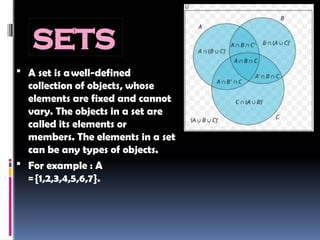
 A set is awell-defined
collection of objects, whose
elements are fixed and cannot
vary. The objects in a set are
called its elements or
members. The elements in a set
can be any types of objects.
 For example : A
={1,2,3,4,5,6,7}.
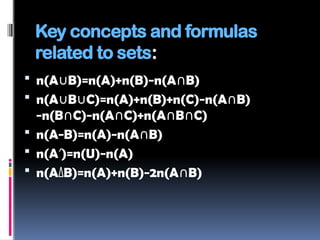
Key concepts and formulas
related to sets:
 n(A B)=n(A)+n(B)−n(A B)
∪ ∩
 n(A B C)=n(A)+n(B)+n(C)−n(A B)
∪ ∪ ∩
−n(B C)−n(A C)+n(A B C)
∩ ∩ ∩ ∩
 n(A−B)=n(A)−n(A B)
∩
 n(A )=n(U)−n(A)
′
 n(AΔB)=n(A)+n(B)−2n(A B)
∩
TAX
Tax is money that a government or
government agencies collect from people
based on laws or constitutions.
Some formulas are:
Taxable income + Tax exempt income = Total Income
Basic Salary + Dearness allowance = Monthly Income
Total income – Tax Exempt income = Taxable Income
Commission, Bonus
& Dividend
Commission: A commission is a percentage of the
selling amount that an agent receives. The
commission is usually given to the agent by the
buyer, seller, or both.
•Dividend: A dividend is a portion of a company's
or co-operative's profit given to shareholders.
Quick Tips :
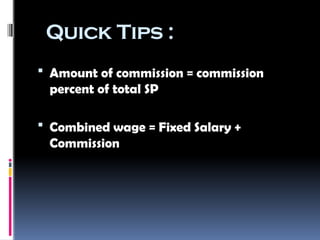
 Amount of commission = commission
percent of total SP
 Combined wage = Fixed Salary +
Commission
House Hold Arithmetic
 Household arithmetic refers to the
practical use of basic mathematical
operations like addition, subtraction,
multiplication, and division to manage
daily household tasks, such as budgeting,
calculating bills, measuring space, and
handling expenses.
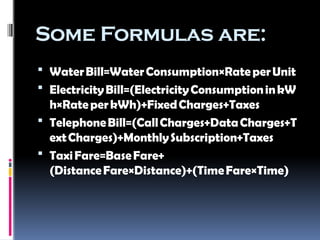
Some Formulas are:
 WaterBill=WaterConsumption×RateperUnit
 ElectricityBill=(ElectricityConsumptioninkW
h×RateperkWh)+FixedCharges+Taxes
 TelephoneBill=(CallCharges+DataCharges+T
extCharges)+MonthlySubscription+Taxes
 TaxiFare=BaseFare+
(DistanceFare×Distance)+(TimeFare×Time)
Area
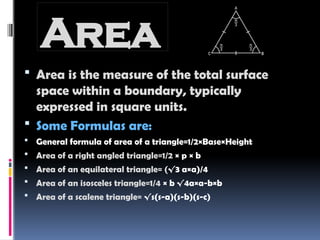
 Area is the measure of the total surface
space within a boundary, typically
expressed in square units.
 Some Formulas are:
 General formula of area of a triangle=1/2​
×Base×Height
 Area of a right angled triangle=1/2 ​
× p ​
× b
 Area of an equilateral triangle= (√3 a×a)/4
 Area of an isosceles triangle=1/4 ​
× b √4a×a-b×b
 Area of a scalene triangle= √s(s-a)(s-b)(s-c)
Prism
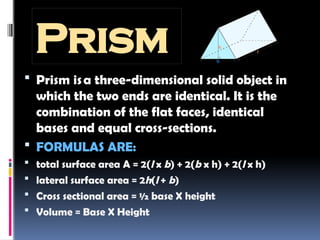
 Prism isa three-dimensional solid object in
which the two ends are identical. It is the
combination of the flat faces, identical
bases and equal cross-sections.
 FORMULAS ARE:
 total surface area A = 2(l x b) + 2(b x h) + 2(l x h)
 lateral surface area = 2h(l + b)
 Cross sectional area = ½ base X height
 Volume = Base X Height
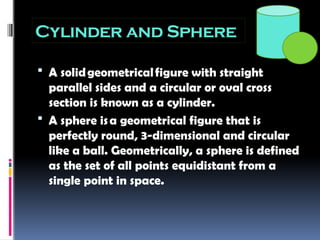
Cylinder and Sphere
 A solidgeometricalfigure with straight
parallel sides and a circular or oval cross
section is known as a cylinder.
 A sphere isa geometrical figure that is
perfectly round, 3-dimensional and circular
like a ball. Geometrically, a sphere is defined
as the set of all points equidistant from a
single point in space.
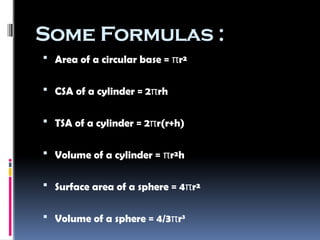
Some Formulas :
 Area of a circular base = πr²
 CSA of a cylinder = 2πrh
 TSA of a cylinder = 2πr(r+h)
 Volume of a cylinder = πr²h
 Surface area of a sphere = 4πr²
 Volume of a sphere = 4/3πr3
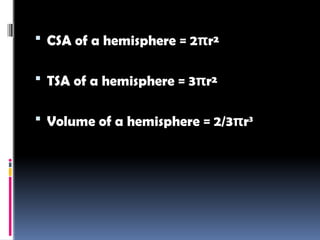
 CSA of a hemisphere = 2πr²
 TSA of a hemisphere = 3πr²
 Volume of a hemisphere = 2/3πr3
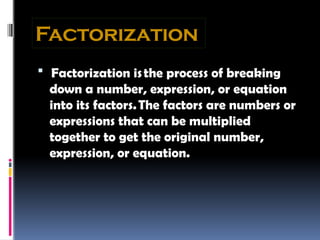
Factorization
 Factorization isthe process of breaking
down a number, expression, or equation
into its factors.The factors are numbers or
expressions that can be multiplied
together to get the original number,
expression, or equation.
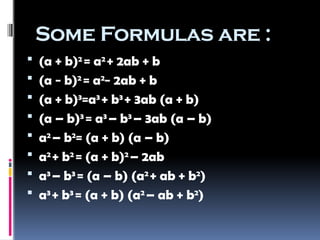
Some Formulas are :
 (a + b)2
= a2
+ 2ab + b
 (a − b)2
= a2
− 2ab + b
 (a + b)3
=a3
+ b3
+ 3ab (a + b)
 (a – b)3
= a3
– b3
– 3ab (a – b)
 a2
– b2
= (a + b) (a – b)
 a2
+ b2
= (a + b)2
– 2ab
 a3
– b3
= (a – b) (a2
+ ab + b2
)
 a3
+ b3
= (a + b) (a2
– ab + b2
)
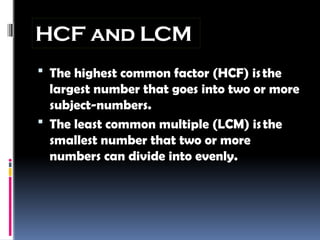
HCF and LCM
 The highest common factor (HCF) isthe
largest number that goes into two or more
subject-numbers.
 The least common multiple (LCM) isthe
smallest number that two or more
numbers can divide into evenly.
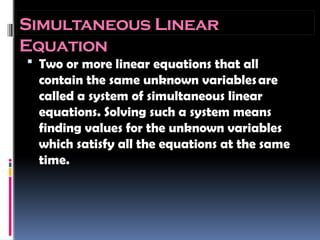
Simultaneous Linear
Equation
 Two or more linear equations that all
contain the same unknown variablesare
called a system of simultaneous linear
equations. Solving such a system means
finding values for the unknown variables
which satisfy all the equations at the same
time.
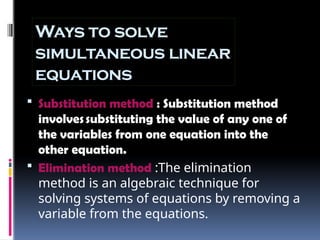
Ways to solve
simultaneous linear
equations
 Substitution method : Substitution method
involvessubstituting the value of any one of
the variables from one equation into the
other equation.
 Elimination method :The elimination
method is an algebraic technique for
solving systems of equations by removing a
variable from the equations.
And . . .
 Graphical method :The procedure of
solving a system of linear equations by
drawing the graphis known as the
graphical method.
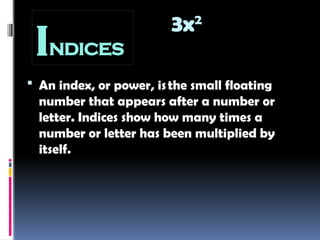
INDICES
 An index, or power, isthe small floating
number that appears after a number or
letter. Indices show how many times a
number or letter has been multiplied by
itself.
𝑦 n
y m
3x2
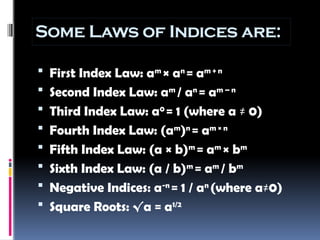
Some Laws of Indices are:
 First Index Law: am
× an
= am + n
 Second Index Law: am
/ an
= am – n
 Third Index Law: a0
= 1 (where a ≠ 0)
 Fourth Index Law: (am
)n
= am × n
 Fifth Index Law: (a × b)m
= am
× bm
 Sixth Index Law: (a / b)m
= am
/ bm
 Negative Indices: a-n
= 1 / an
(where a≠0)
 Square Roots: √a = a1/2
Sequence and Series :
 A sequence is a list of numbers or objects in
a specific order, while a series is the sum of
all the terms in a sequence.A sequence is
seperated by comma while series is
seperated by “+” or
 “–” sign.
Sequence and Series
Formulas :
 General Term (nth Term) in arithmetic
progression = an = a + (n-1)d
 General Term (nth Term) in geometric
progression = an = ar(n-1)
 Sn = n/2 [2a + (n-1)d]
Triangles
 A triangle is a closed plane figure
bounded by three line segments.
 Types of triangles:
 Congruent triangles: Congruent triangles
aretriangles having corresponding sides and angles
to be equal.
 Similar triangles: Similar triangles aretriangles that
have the same shape, but their sizes may vary
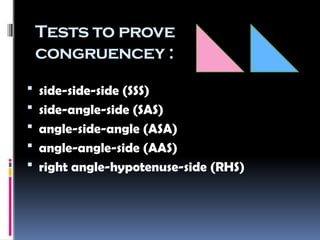
Tests to prove
congruencey :
 side-side-side (SSS)
 side-angle-side (SAS)
 angle-side-angle (ASA)
 angle-angle-side (AAS)
 right angle-hypotenuse-side (RHS)
Quadrilateral
 A quadrilateral is a four-sided polygon
with four angles, and its sides can be of
varying lengths and arrangements.
Types of Quadrilaterals :
•
The source mentions specific types of quadrilaterals such as squares,
rectangles, parallelograms, rhombus and trapezoids.
Parallelograms as Quadrilaterals:
•
A quadrilateral with opposite sides parallel is called a parallelogram.
•
Properties and theorems related to parallelograms are discussed
extensively.
Trapeziums as Quadrilaterals:
•
A quadrilateral with one pair of opposite sides parallel is called a
trapezium.
Construction of Quadrilaterals:
•
The source provides instructions on how to construct different types
of quadrilaterals, including squares, rectangles, parallelograms,
rhombuses, and trapeziums, given specific conditions.
General Properties and Theorems:
•
The sum of the internal angles of a quadrilateral is equal to 360°.
Mid-Points of a Quadrilateral
•
A quadrilateral formed by joining the mid-points of the sides of a
Construction
 In mathematics , construction isthe process
of accurately drawing geometric shapes,
lines, and angles using only a compass and
a scale, essentially creating precise figures
without relying on numerical
calculations;it's considered a "pure" form
of geometric manipulation where only
visual relationships are used to create the
desired shapes.
CIRCLE
•A circle is a plane figure traced out by a
moving point in a plane under the
geometrical condition that it remains
equidistant from some point.
Parts of a Circle:
•The source refers to parts of a circle,
including: radius, circumference, chord,
diameter, arc, semi-circle, sector, segment.
THEOREMS OF CIRCLE
• Theorem 1 : A perpendicular drawn from the centre of a
circle to a chord bisects the chord.
• Theorem 2 : A line segment joining the centre of a circle to
the mid-point of its chord is perpendicular to the chord.
• Theorem 3 : The perpendicular bisector of a chord of a circle
passes through the centre of that circle.

• Theorem 4 : The equal chords of a circle are equidistant
from the centre of the circle.

• Theorem 5 : (Converse of theorem 4) In any circle, the chords
that are equidistant from the centre are equal to each other.
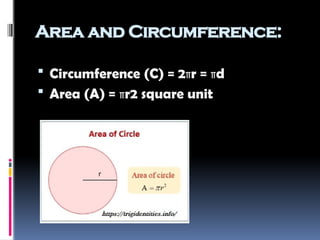
Area and Circumference:
 Circumference (C) = 2πr = πd
 Area (A) = πr2 square unit
STATISTICS
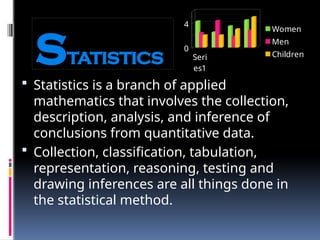
 Statistics is a branch of applied
mathematics that involves the collection,
description, analysis, and inference of
conclusions from quantitative data.
 Collection, classification, tabulation,
representation, reasoning, testing and
drawing inferences are all things done in
the statistical method.
Seri
es1
0
4
Women
Men
Children
Key Terms:
•Frequency: The number of times a
particular data value occurs.
•Class interval: A range of values within
which data is grouped.
•Cumulative frequency: The sum of
frequencies up to a certain point in a
data set.
Measures of Central
Tendencies :
Arithmetic mean (average): The sum of all values divided by the
number of values.
•For individual series: Mean = (Sum of all items) / (Total number of
items).
•For discrete series: Mean = fx / f (where fx is the product of each
Σ Σ
item and its frequency).
Median: The middle value in an ordered data set.
•For individual data, the median is the ((N+1)/2)th value, where N
is the number of data points.
Mode: The most frequently occurring value in a data set.
Quartiles: Values that divide the data into four equal parts.
•Q1 (first quartile): The 25th percentile.
•Q3 (third quartile): The 75th percentile.
PROBABILITY
 Probability is used to estimate different events
that can happen in daily life. It deals with
uncertain forecast and possibilities.
Calculating Probability:
 The probability of an event P(E) is
calculated as: P(E) = (Number of
favourable outcomes) / (Total number of
possible outcomes)
TRIGONOMETRY
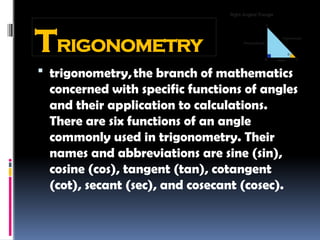
 trigonometry,the branch of mathematics
concerned with specific functions of angles
and their application to calculations.
There are six functions of an angle
commonly used in trigonometry. Their
names and abbreviations are sine (sin),
cosine (cos), tangent (tan), cotangent
(cot), secant (sec), and cosecant (cosec).
Fundamental
Trigonometric Ratios:
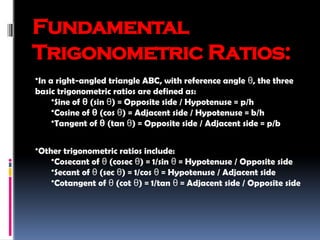
•In a right-angled triangle ABC, with reference angle , the three
θ
basic trigonometric ratios are defined as:
•Sine of θ (sin ) = Opposite side / Hypotenuse = p/h
θ
•Cosine of θ (cos ) = Adjacent side / Hypotenuse = b/h
θ
•Tangent of θ (tan ) = Opposite side / Adjacent side = p/b
θ
•Other trigonometric ratios include:
•Cosecant of (cosec ) = 1/sin = Hypotenuse / Opposite side
θ θ θ
•Secant of (sec ) = 1/cos = Hypotenuse / Adjacent side
θ θ θ
•Cotangent of (cot ) = 1/tan = Adjacent side / Opposite side
θ θ θ
Questions :
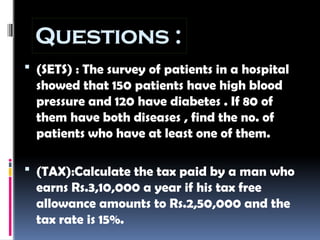
 (SETS) : The survey of patients in a hospital
showed that 150 patients have high blood
pressure and 120 have diabetes . If 80 of
them have both diseases , find the no. of
patients who have at least one of them.
 (TAX):Calculate the tax paid by a man who
earns Rs.3,10,000 a year if his tax free
allowance amounts to Rs.2,50,000 and the
tax rate is 15%.
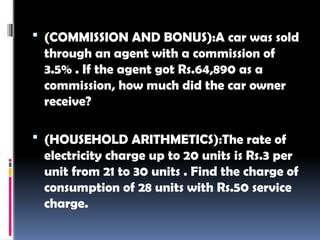
 (COMMISSION AND BONUS):A car was sold
through an agent with a commission of
3.5% . If the agent got Rs.64,890 as a
commission, how much did the car owner
receive?
 (HOUSEHOLD ARITHMETICS):The rate of
electricity charge up to 20 units is Rs.3 per
unit from 21 to 30 units . Find the charge of
consumption of 28 units with Rs.50 service
charge.
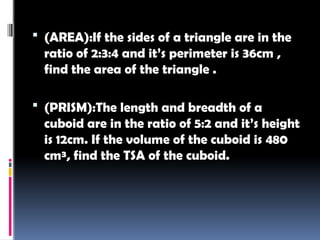
 (AREA):If the sides of a triangle are in the
ratio of 2:3:4 and it’s perimeter is 36cm ,
find the area of the triangle .
 (PRISM):The length and breadth of a
cuboid are in the ratio of 5:2 and it’s height
is 12cm. If the volume of the cuboid is 480
cm³, find the TSA of the cuboid.
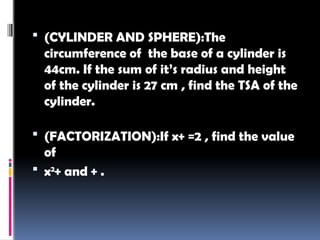
 (CYLINDER AND SPHERE):The
circumference of the base of a cylinder is
44cm. If the sum of it’s radius and height
of the cylinder is 27 cm , find the TSA of the
cylinder.
 (FACTORIZATION):If x+ =2 , find the value
of
 x2
+ and + .
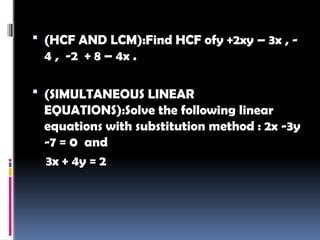
 (HCF AND LCM):Find HCF ofy +2xy – 3x , -
4 , -2 + 8 – 4x .
 (SIMULTANEOUS LINEAR
EQUATIONS):Solve the following linear
equations with substitution method : 2x -3y
-7 = 0 and
3x + 4y = 2
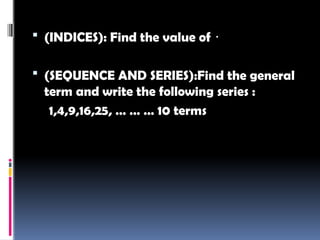
 (INDICES): Find the value of .
 (SEQUENCE AND SERIES):Find the general
term and write the following series :
1,4,9,16,25, … … … 10 terms
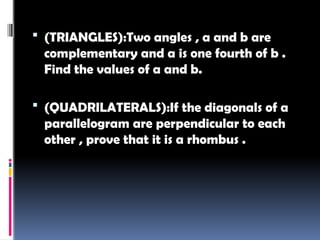
 (TRIANGLES):Two angles , a and b are
complementary and a is one fourth of b .
Find the values of a and b.
 (QUADRILATERALS):If the diagonals of a
parallelogram are perpendicular to each
other , prove that it is a rhombus .
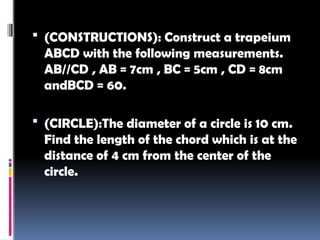
 (CONSTRUCTIONS): Construct a trapeium
ABCD with the following measurements.
AB//CD , AB = 7cm , BC = 5cm , CD = 8cm
andBCD = 60.
 (CIRCLE):The diameter of a circle is 10 cm.
Find the length of the chord which is at the
distance of 4 cm from the center of the
circle.
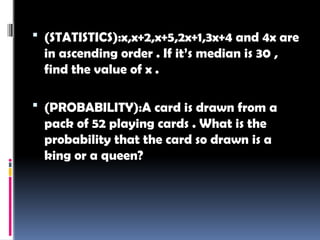
 (STATISTICS):x,x+2,x+5,2x+1,3x+4 and 4x are
in ascending order . If it’s median is 30 ,
find the value of x .
 (PROBABILITY):A card is drawn from a
pack of 52 playing cards . What is the
probability that the card so drawn is a
king or a queen?
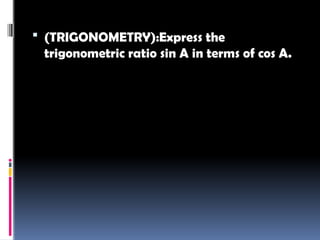
 (TRIGONOMETRY):Express the
trigonometric ratio sin A in terms of cos A.
THANK YOU!!!

PROJECT WORK OF MATHEMATICS CHAPTERS.pptx

  • 1.
    PROJECT WORK OF MAHEMATICS Submitted by:Siddhartha Maharjan Submitted to: Tika Ram Sir
  • 2.
    SETS  A setis awell-defined collection of objects, whose elements are fixed and cannot vary. The objects in a set are called its elements or members. The elements in a set can be any types of objects.  For example : A ={1,2,3,4,5,6,7}.
  • 3.
    Key concepts andformulas related to sets:  n(A B)=n(A)+n(B)−n(A B) ∪ ∩  n(A B C)=n(A)+n(B)+n(C)−n(A B) ∪ ∪ ∩ −n(B C)−n(A C)+n(A B C) ∩ ∩ ∩ ∩  n(A−B)=n(A)−n(A B) ∩  n(A )=n(U)−n(A) ′  n(AΔB)=n(A)+n(B)−2n(A B) ∩
  • 4.
    TAX Tax is moneythat a government or government agencies collect from people based on laws or constitutions. Some formulas are: Taxable income + Tax exempt income = Total Income Basic Salary + Dearness allowance = Monthly Income Total income – Tax Exempt income = Taxable Income
  • 5.
    Commission, Bonus & Dividend Commission:A commission is a percentage of the selling amount that an agent receives. The commission is usually given to the agent by the buyer, seller, or both. •Dividend: A dividend is a portion of a company's or co-operative's profit given to shareholders.
  • 6.
    Quick Tips : Amount of commission = commission percent of total SP  Combined wage = Fixed Salary + Commission
  • 7.
    House Hold Arithmetic Household arithmetic refers to the practical use of basic mathematical operations like addition, subtraction, multiplication, and division to manage daily household tasks, such as budgeting, calculating bills, measuring space, and handling expenses.
  • 8.
    Some Formulas are: WaterBill=WaterConsumption×RateperUnit  ElectricityBill=(ElectricityConsumptioninkW h×RateperkWh)+FixedCharges+Taxes  TelephoneBill=(CallCharges+DataCharges+T extCharges)+MonthlySubscription+Taxes  TaxiFare=BaseFare+ (DistanceFare×Distance)+(TimeFare×Time)
  • 9.
    Area  Area isthe measure of the total surface space within a boundary, typically expressed in square units.  Some Formulas are:  General formula of area of a triangle=1/2​ ×Base×Height  Area of a right angled triangle=1/2 ​ × p ​ × b  Area of an equilateral triangle= (√3 a×a)/4  Area of an isosceles triangle=1/4 ​ × b √4a×a-b×b  Area of a scalene triangle= √s(s-a)(s-b)(s-c)
  • 10.
    Prism  Prism isathree-dimensional solid object in which the two ends are identical. It is the combination of the flat faces, identical bases and equal cross-sections.  FORMULAS ARE:  total surface area A = 2(l x b) + 2(b x h) + 2(l x h)  lateral surface area = 2h(l + b)  Cross sectional area = ½ base X height  Volume = Base X Height
  • 11.
    Cylinder and Sphere A solidgeometricalfigure with straight parallel sides and a circular or oval cross section is known as a cylinder.  A sphere isa geometrical figure that is perfectly round, 3-dimensional and circular like a ball. Geometrically, a sphere is defined as the set of all points equidistant from a single point in space.
  • 12.
    Some Formulas : Area of a circular base = πr²  CSA of a cylinder = 2πrh  TSA of a cylinder = 2πr(r+h)  Volume of a cylinder = πr²h  Surface area of a sphere = 4πr²  Volume of a sphere = 4/3πr3
  • 13.
     CSA ofa hemisphere = 2πr²  TSA of a hemisphere = 3πr²  Volume of a hemisphere = 2/3πr3
  • 14.
    Factorization  Factorization istheprocess of breaking down a number, expression, or equation into its factors.The factors are numbers or expressions that can be multiplied together to get the original number, expression, or equation.
  • 15.
    Some Formulas are:  (a + b)2 = a2 + 2ab + b  (a − b)2 = a2 − 2ab + b  (a + b)3 =a3 + b3 + 3ab (a + b)  (a – b)3 = a3 – b3 – 3ab (a – b)  a2 – b2 = (a + b) (a – b)  a2 + b2 = (a + b)2 – 2ab  a3 – b3 = (a – b) (a2 + ab + b2 )  a3 + b3 = (a + b) (a2 – ab + b2 )
  • 16.
    HCF and LCM The highest common factor (HCF) isthe largest number that goes into two or more subject-numbers.  The least common multiple (LCM) isthe smallest number that two or more numbers can divide into evenly.
  • 17.
    Simultaneous Linear Equation  Twoor more linear equations that all contain the same unknown variablesare called a system of simultaneous linear equations. Solving such a system means finding values for the unknown variables which satisfy all the equations at the same time.
  • 18.
    Ways to solve simultaneouslinear equations  Substitution method : Substitution method involvessubstituting the value of any one of the variables from one equation into the other equation.  Elimination method :The elimination method is an algebraic technique for solving systems of equations by removing a variable from the equations.
  • 19.
    And . ..  Graphical method :The procedure of solving a system of linear equations by drawing the graphis known as the graphical method.
  • 20.
    INDICES  An index,or power, isthe small floating number that appears after a number or letter. Indices show how many times a number or letter has been multiplied by itself. 𝑦 n y m 3x2
  • 21.
    Some Laws ofIndices are:  First Index Law: am × an = am + n  Second Index Law: am / an = am – n  Third Index Law: a0 = 1 (where a ≠ 0)  Fourth Index Law: (am )n = am × n  Fifth Index Law: (a × b)m = am × bm  Sixth Index Law: (a / b)m = am / bm  Negative Indices: a-n = 1 / an (where a≠0)  Square Roots: √a = a1/2
  • 22.
    Sequence and Series:  A sequence is a list of numbers or objects in a specific order, while a series is the sum of all the terms in a sequence.A sequence is seperated by comma while series is seperated by “+” or  “–” sign.
  • 23.
    Sequence and Series Formulas:  General Term (nth Term) in arithmetic progression = an = a + (n-1)d  General Term (nth Term) in geometric progression = an = ar(n-1)  Sn = n/2 [2a + (n-1)d]
  • 24.
    Triangles  A triangleis a closed plane figure bounded by three line segments.  Types of triangles:  Congruent triangles: Congruent triangles aretriangles having corresponding sides and angles to be equal.  Similar triangles: Similar triangles aretriangles that have the same shape, but their sizes may vary
  • 25.
    Tests to prove congruencey:  side-side-side (SSS)  side-angle-side (SAS)  angle-side-angle (ASA)  angle-angle-side (AAS)  right angle-hypotenuse-side (RHS)
  • 26.
    Quadrilateral  A quadrilateralis a four-sided polygon with four angles, and its sides can be of varying lengths and arrangements.
  • 27.
    Types of Quadrilaterals: • The source mentions specific types of quadrilaterals such as squares, rectangles, parallelograms, rhombus and trapezoids. Parallelograms as Quadrilaterals: • A quadrilateral with opposite sides parallel is called a parallelogram. • Properties and theorems related to parallelograms are discussed extensively. Trapeziums as Quadrilaterals: • A quadrilateral with one pair of opposite sides parallel is called a trapezium. Construction of Quadrilaterals: • The source provides instructions on how to construct different types of quadrilaterals, including squares, rectangles, parallelograms, rhombuses, and trapeziums, given specific conditions. General Properties and Theorems: • The sum of the internal angles of a quadrilateral is equal to 360°. Mid-Points of a Quadrilateral • A quadrilateral formed by joining the mid-points of the sides of a
  • 28.
    Construction  In mathematics, construction isthe process of accurately drawing geometric shapes, lines, and angles using only a compass and a scale, essentially creating precise figures without relying on numerical calculations;it's considered a "pure" form of geometric manipulation where only visual relationships are used to create the desired shapes.
  • 29.
    CIRCLE •A circle isa plane figure traced out by a moving point in a plane under the geometrical condition that it remains equidistant from some point. Parts of a Circle: •The source refers to parts of a circle, including: radius, circumference, chord, diameter, arc, semi-circle, sector, segment.
  • 30.
    THEOREMS OF CIRCLE •Theorem 1 : A perpendicular drawn from the centre of a circle to a chord bisects the chord. • Theorem 2 : A line segment joining the centre of a circle to the mid-point of its chord is perpendicular to the chord. • Theorem 3 : The perpendicular bisector of a chord of a circle passes through the centre of that circle.  • Theorem 4 : The equal chords of a circle are equidistant from the centre of the circle.  • Theorem 5 : (Converse of theorem 4) In any circle, the chords that are equidistant from the centre are equal to each other.
  • 31.
    Area and Circumference: Circumference (C) = 2πr = πd  Area (A) = πr2 square unit
  • 32.
    STATISTICS  Statistics isa branch of applied mathematics that involves the collection, description, analysis, and inference of conclusions from quantitative data.  Collection, classification, tabulation, representation, reasoning, testing and drawing inferences are all things done in the statistical method. Seri es1 0 4 Women Men Children
  • 33.
    Key Terms: •Frequency: Thenumber of times a particular data value occurs. •Class interval: A range of values within which data is grouped. •Cumulative frequency: The sum of frequencies up to a certain point in a data set.
  • 34.
    Measures of Central Tendencies: Arithmetic mean (average): The sum of all values divided by the number of values. •For individual series: Mean = (Sum of all items) / (Total number of items). •For discrete series: Mean = fx / f (where fx is the product of each Σ Σ item and its frequency). Median: The middle value in an ordered data set. •For individual data, the median is the ((N+1)/2)th value, where N is the number of data points. Mode: The most frequently occurring value in a data set. Quartiles: Values that divide the data into four equal parts. •Q1 (first quartile): The 25th percentile. •Q3 (third quartile): The 75th percentile.
  • 35.
    PROBABILITY  Probability isused to estimate different events that can happen in daily life. It deals with uncertain forecast and possibilities. Calculating Probability:  The probability of an event P(E) is calculated as: P(E) = (Number of favourable outcomes) / (Total number of possible outcomes)
  • 36.
    TRIGONOMETRY  trigonometry,the branchof mathematics concerned with specific functions of angles and their application to calculations. There are six functions of an angle commonly used in trigonometry. Their names and abbreviations are sine (sin), cosine (cos), tangent (tan), cotangent (cot), secant (sec), and cosecant (cosec).
  • 37.
    Fundamental Trigonometric Ratios: •In aright-angled triangle ABC, with reference angle , the three θ basic trigonometric ratios are defined as: •Sine of θ (sin ) = Opposite side / Hypotenuse = p/h θ •Cosine of θ (cos ) = Adjacent side / Hypotenuse = b/h θ •Tangent of θ (tan ) = Opposite side / Adjacent side = p/b θ •Other trigonometric ratios include: •Cosecant of (cosec ) = 1/sin = Hypotenuse / Opposite side θ θ θ •Secant of (sec ) = 1/cos = Hypotenuse / Adjacent side θ θ θ •Cotangent of (cot ) = 1/tan = Adjacent side / Opposite side θ θ θ
  • 38.
    Questions :  (SETS): The survey of patients in a hospital showed that 150 patients have high blood pressure and 120 have diabetes . If 80 of them have both diseases , find the no. of patients who have at least one of them.  (TAX):Calculate the tax paid by a man who earns Rs.3,10,000 a year if his tax free allowance amounts to Rs.2,50,000 and the tax rate is 15%.
  • 39.
     (COMMISSION ANDBONUS):A car was sold through an agent with a commission of 3.5% . If the agent got Rs.64,890 as a commission, how much did the car owner receive?  (HOUSEHOLD ARITHMETICS):The rate of electricity charge up to 20 units is Rs.3 per unit from 21 to 30 units . Find the charge of consumption of 28 units with Rs.50 service charge.
  • 40.
     (AREA):If thesides of a triangle are in the ratio of 2:3:4 and it’s perimeter is 36cm , find the area of the triangle .  (PRISM):The length and breadth of a cuboid are in the ratio of 5:2 and it’s height is 12cm. If the volume of the cuboid is 480 cm³, find the TSA of the cuboid.
  • 41.
     (CYLINDER ANDSPHERE):The circumference of the base of a cylinder is 44cm. If the sum of it’s radius and height of the cylinder is 27 cm , find the TSA of the cylinder.  (FACTORIZATION):If x+ =2 , find the value of  x2 + and + .
  • 42.
     (HCF ANDLCM):Find HCF ofy +2xy – 3x , - 4 , -2 + 8 – 4x .  (SIMULTANEOUS LINEAR EQUATIONS):Solve the following linear equations with substitution method : 2x -3y -7 = 0 and 3x + 4y = 2
  • 43.
     (INDICES): Findthe value of .  (SEQUENCE AND SERIES):Find the general term and write the following series : 1,4,9,16,25, … … … 10 terms
  • 44.
     (TRIANGLES):Two angles, a and b are complementary and a is one fourth of b . Find the values of a and b.  (QUADRILATERALS):If the diagonals of a parallelogram are perpendicular to each other , prove that it is a rhombus .
  • 45.
     (CONSTRUCTIONS): Constructa trapeium ABCD with the following measurements. AB//CD , AB = 7cm , BC = 5cm , CD = 8cm andBCD = 60.  (CIRCLE):The diameter of a circle is 10 cm. Find the length of the chord which is at the distance of 4 cm from the center of the circle.
  • 46.
     (STATISTICS):x,x+2,x+5,2x+1,3x+4 and4x are in ascending order . If it’s median is 30 , find the value of x .  (PROBABILITY):A card is drawn from a pack of 52 playing cards . What is the probability that the card so drawn is a king or a queen?
  • 47.
     (TRIGONOMETRY):Express the trigonometricratio sin A in terms of cos A.
  • 48.