FORMULAS
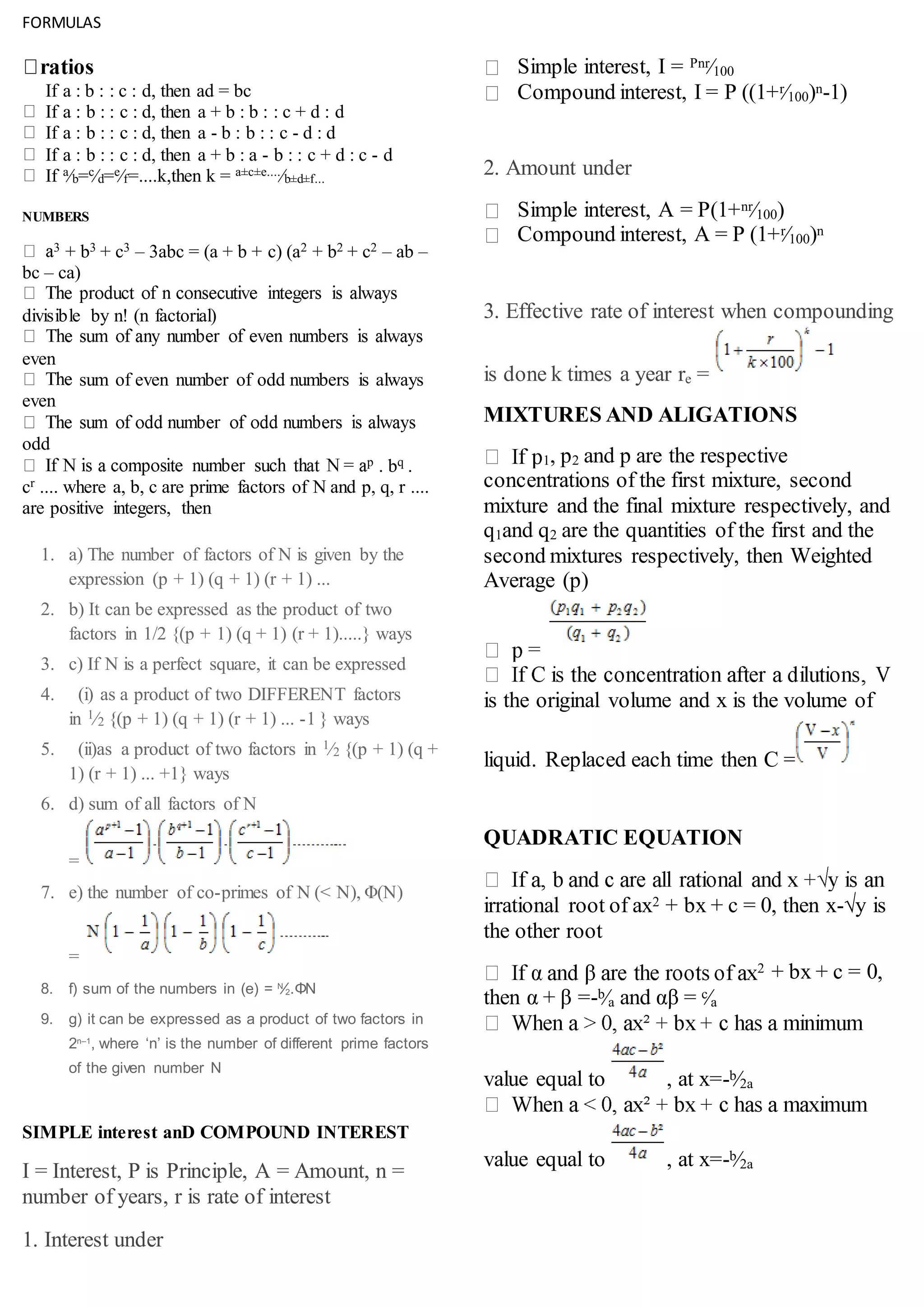
If a : b : : c : d, then ad = bc
If a : b : : c : d, then a + b : b : : c + d : d
If a : b : : c : d, then a - b : b : : c - d : d
If a : b : : c : d, then a + b : a - b : : c + d : c - d
If a⁄b=c⁄d=e⁄f=....k,then k = a±c±e....⁄b±d±f...
NUMBERS
3 + b3 + c3 – 3abc = (a + b + c) (a2 + b2 + c2 – ab –
bc – ca)
divisible by n! (n factorial)
even
sum of even number of odd numbers is always
even
odd
p . bq .
cr .... where a, b, c are prime factors of N and p, q, r ....
are positive integers, then
1. a) The number of factors of N is given by the
expression (p + 1) (q + 1) (r + 1) ...
2. b) It can be expressed as the product of two
factors in 1/2 {(p + 1) (q + 1) (r + 1).....} ways
3. c) If N is a perfect square, it can be expressed
4. (i) as a product of two DIFFERENT factors
in 1⁄2 {(p + 1) (q + 1) (r + 1) ... -1 } ways
5. (ii)as a product of two factors in 1⁄2 {(p + 1) (q +
1) (r + 1) ... +1} ways
6. d) sum of all factors of N
=
7. e) the number of co-primes of N (< N), Φ(N)
=
8. f) sum of the numbers in (e) = N
⁄2.ΦN
9. g) it can be expressed as a product of two factors in
2n–1
, where ‘n’ is the number of different prime factors
of the given number N
SIMPLE interest anD COMPOUND INTEREST
I = Interest, P is Principle, A = Amount, n =
number of years, r is rate of interest
1. Interest under
Simple interest, I = Pnr⁄100
Compound interest, I = P ((1+r⁄100)n-1)
2. Amount under
Simple interest, A = P(1+nr⁄100)
Compound interest, A = P (1+r⁄100)n
3. Effective rate of interest when compounding
is done k times a year re =
MIXTURES AND ALIGATIONS
1, p2 and p are the respective
concentrations of the first mixture, second
mixture and the final mixture respectively, and
q1and q2 are the quantities of the first and the
second mixtures respectively, then Weighted
Average (p)
is the original volume and x is the volume of
liquid. Replaced each time then C =
QUADRATIC EQUATION
irrational root of ax2 + bx + c = 0, then x-√y is
the other root
2 + bx + c = 0,
then α + β =-b⁄a and αβ = c⁄a
value equal to , at x=-b⁄2a
FORMULAS
Arithmetic Progression (A.P)
 a is the first term, d is the last term and n is the number of
terms
 Tn = a + (n – 1)d
 Sn =1
⁄2(first term+last term)X n = 1
⁄2(2a+(n-1)d)× n
 Tn = Sn – Sn-1
 Sn = A.M × n
Geometric Progression (G.P)
 a is the first term, r is the common ratio and n is the number of
terms
 Tn = arn-1
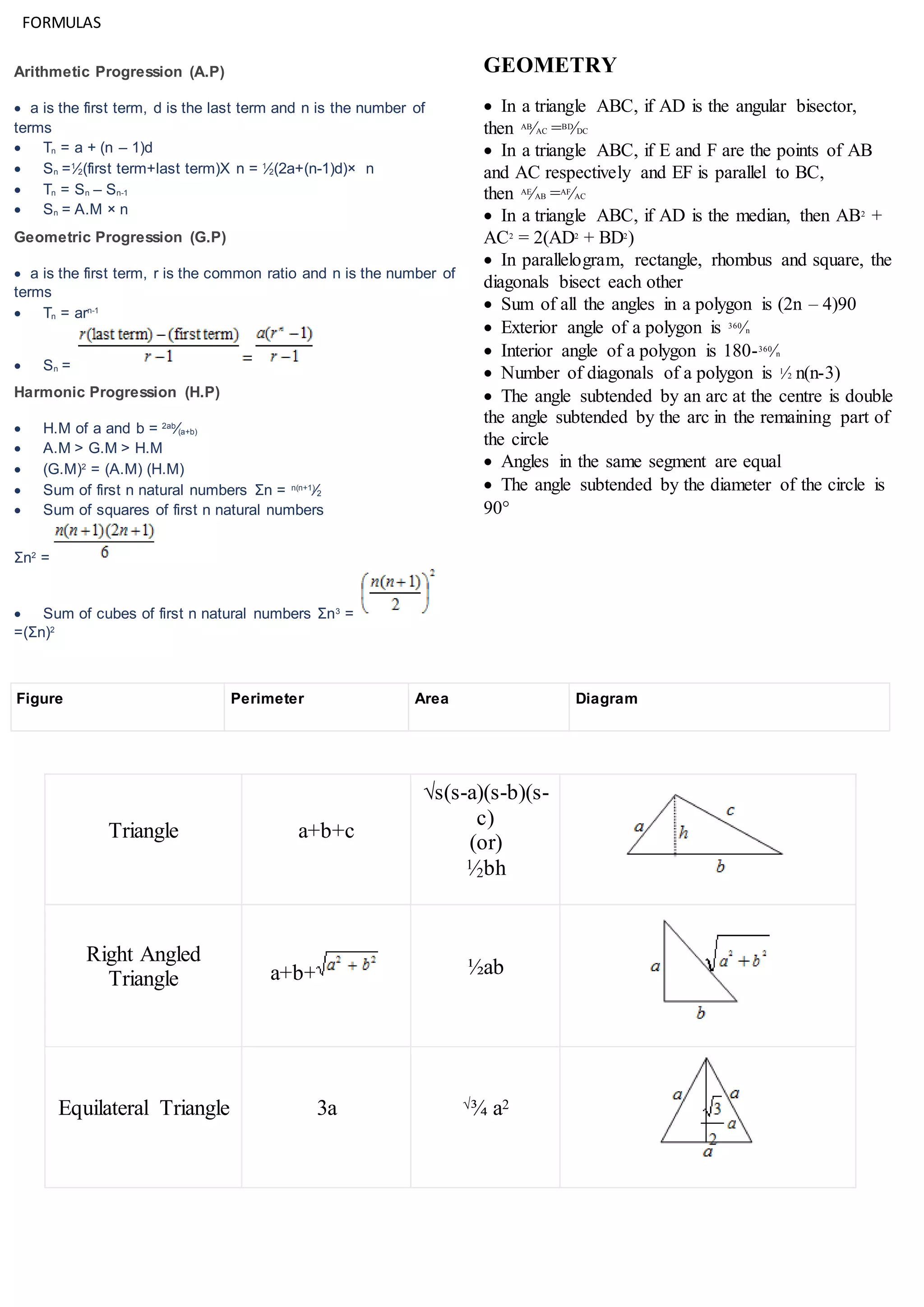
 Sn =
Harmonic Progression (H.P)
 H.M of a and b = 2ab
⁄(a+b)
 A.M > G.M > H.M
 (G.M)2
= (A.M) (H.M)
 Sum of first n natural numbers Σn = n(n+1)
⁄2
 Sum of squares of first n natural numbers
Σn2
=
 Sum of cubes of first n natural numbers Σn3
=
=(Σn)2
GEOMETRY
 In a triangle ABC, if AD is the angular bisector,
then AB
⁄AC =BD
⁄DC
 In a triangle ABC, if E and F are the points of AB
and AC respectively and EF is parallel to BC,
then AE
⁄AB =AF
⁄AC
 In a triangle ABC, if AD is the median, then AB2
+
AC2
= 2(AD2
+ BD2
)
 In parallelogram, rectangle, rhombus and square, the
diagonals bisect each other
 Sum of all the angles in a polygon is (2n – 4)90
 Exterior angle of a polygon is 360
⁄n
 Interior angle of a polygon is 180-360
⁄n
 Number of diagonals of a polygon is 1
⁄2 n(n-3)
 The angle subtended by an arc at the centre is double
the angle subtended by the arc in the remaining part of
the circle
 Angles in the same segment are equal
 The angle subtended by the diameter of the circle is
90°
Figure Perimeter Area Diagram
Triangle a+b+c
√s(s-a)(s-b)(s-
c)
(or)
1⁄2bh
Right Angled
Triangle a+b+ ½ab
Equilateral Triangle 3a √¾ a2
FORMULAS
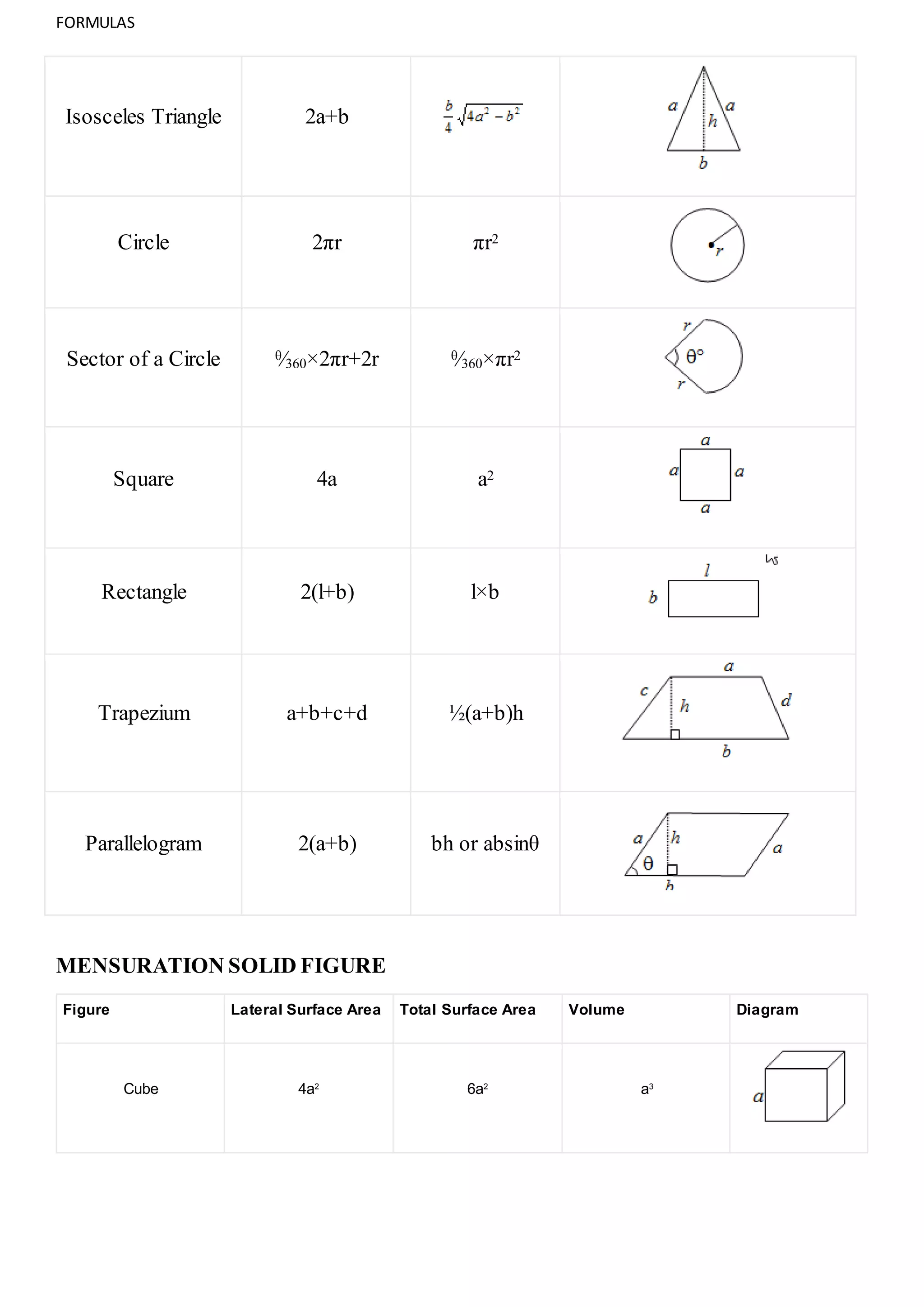
Isosceles Triangle 2a+b
Circle 2πr πr2
Sector of a Circle θ⁄360×2πr+2r θ⁄360×πr2
Square 4a a2
Rectangle 2(l+b) l×b
Trapezium a+b+c+d ½(a+b)h
Parallelogram 2(a+b) bh or absinθ
MENSURATION SOLID FIGURE
Figure Lateral Surface Area Total Surface Area Volume Diagram
Cube 4a2
6a2
a3
FORMULAS
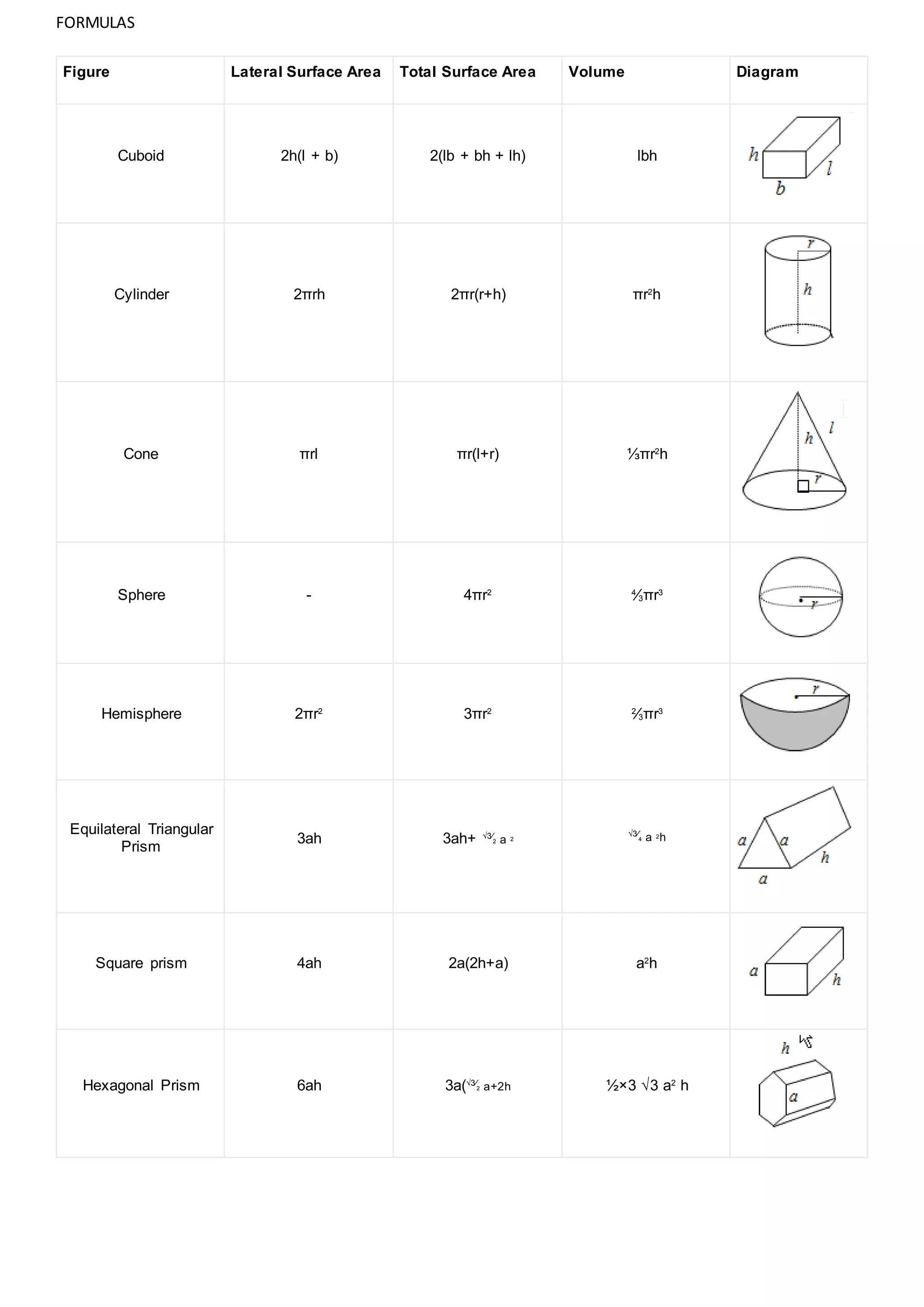
Figure Lateral Surface Area Total Surface Area Volume Diagram
Cuboid 2h(l + b) 2(lb + bh + lh) lbh
Cylinder 2πrh 2πr(r+h) πr2
h
Cone πrl πr(l+r) ⅓πr2
h
Sphere - 4πr2 4
⁄3πr3
Hemisphere 2πr2
3πr2 2
⁄3πr3
Equilateral Triangular
Prism
3ah 3ah+ √3⁄
2 a 2
√3⁄
4 a 2h
Square prism 4ah 2a(2h+a) a2
h
Hexagonal Prism 6ah 3a(√3⁄
2 a+2h ½×3 √3 a2
h
FORMULAS
Figure Lateral Surface Area Total Surface Area Volume Diagram
Frustum of a cone
πl(R + r)where,l=√(R-
r)2
+h2 π(R2
+ r2
+ Rl + rl) ⅓πh(R2
+Rr+r2
)
Frustum of a Pyramid
½× perimeter of base
× Slant Height
L.S.A + A1 + A2 ½× h(A1+A2+√A1A2)
Torus - 4π2
ra 2π2
r2
a
PERMUTATION AND COMBINATION
∪ B) = n (A) + n (B) – n (A ∩ B)
A and B are two tasks that must be performed such that A can be performed in 'p' ways
and for each possible way of performing A, say there are 'q' ways of performing B, then the
two tasks A and B can be performed in p × q ways
iding (p + q) items into two groups containing p and q items
respectively is
, when
the two groups have distinct identity and , when the two groups do not have distinct
identity
nCr = nCn– r
(p + q + r + .....)items where p are alike of one kind, q alike of a second kind, r alike of a
third kind and so on is {(p + 1) (q + 1) (r + 1) ....}−1
and 0 ≤ P(Event) ≤ 1
∪ B) = 1, if A and B are exhaustive events
i)]× [Monetary value associated with event Ei]
STATS, NUMBER SYSTEM , MODULUS
1;.x2;...... .xn)1/n
(i) A.M. ≥ G.M. ≥ H.M. (ii) (G.M.)2 = (A.M.) (H.M.)
FORMULAS
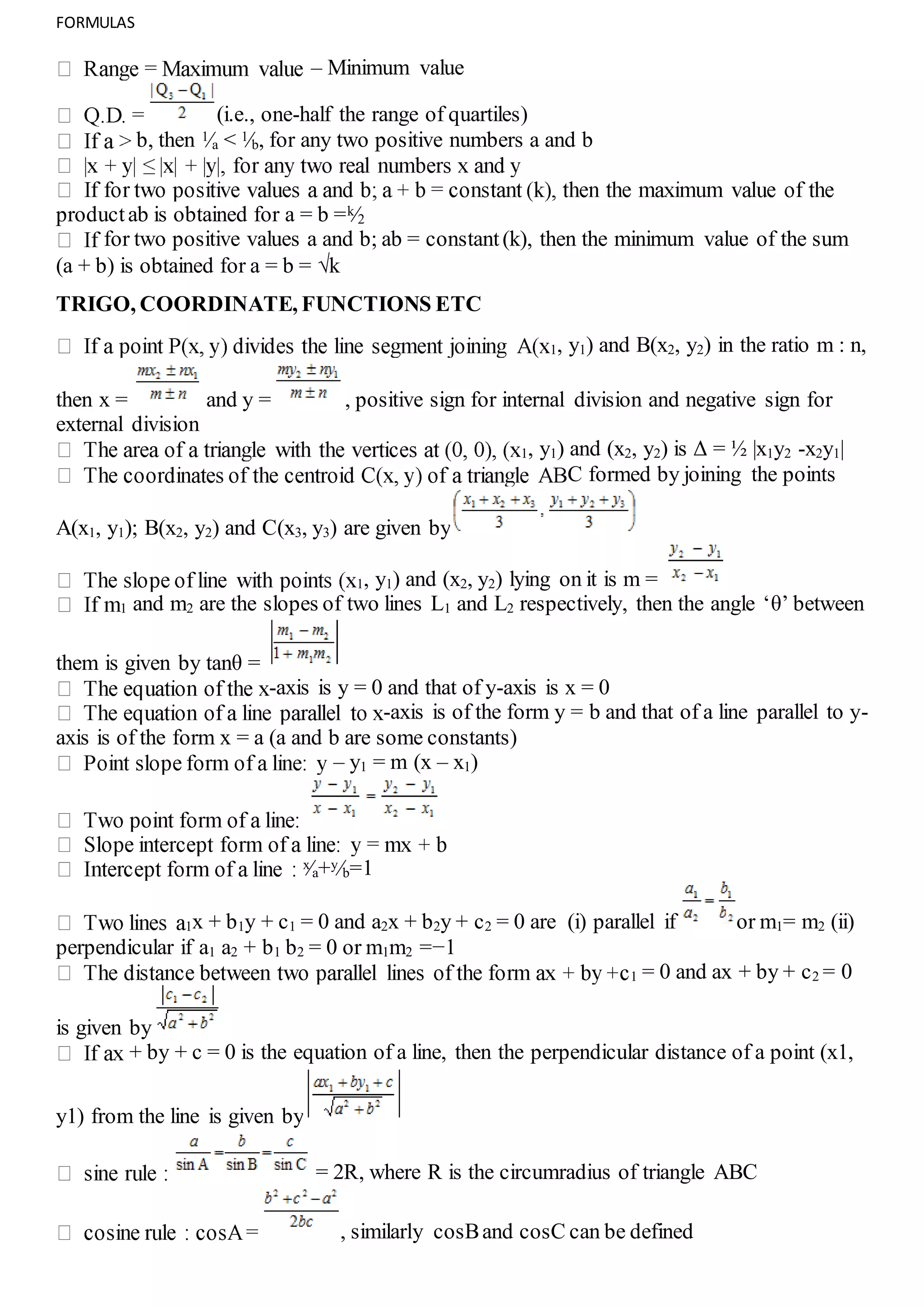
– Minimum value
(i.e., one-half the range of quartiles)
b, then 1⁄a < 1⁄b, for any two positive numbers a and b
productab is obtained for a = b =k⁄2
for two positive values a and b; ab = constant(k), then the minimum value of the sum
(a + b) is obtained for a = b = √k
TRIGO, COORDINATE, FUNCTIONS ETC
1, y1) and B(x2, y2) in the ratio m : n,
then x = and y = , positive sign for internal division and negative sign for
external division
1, y1) and (x2, y2) is Δ = ½ |x1y2 -x2y1|
C formed by joining the points
A(x1, y1); B(x2, y2) and C(x3, y3) are given by
1, y1) and (x2, y2) lying on it is m =
1 and m2 are the slopes of two lines L1 and L2 respectively, then the angle ‘θ’ between
them is given by tanθ =
-axis is y = 0 and that of y-axis is x = 0
-axis is of the form y = b and that of a line parallel to y-
axis is of the form x = a (a and b are some constants)
– y1 = m (x – x1)
x⁄a+y⁄b=1
1x + b1y + c1 = 0 and a2x + b2y + c2 = 0 are (i) parallel if or m1= m2 (ii)
perpendicular if a1 a2 + b1 b2 = 0 or m1m2 =−1
1 = 0 and ax + by + c2 = 0
is given by
+ by + c = 0 is the equation of a line, then the perpendicular distance of a point (x1,
y1) from the line is given by
= 2R, where R is the circumradius of triangle ABC
, similarly cosBand cosC can be defined

Maths formulas

  • 1.
    FORMULAS If a :b : : c : d, then ad = bc If a : b : : c : d, then a + b : b : : c + d : d If a : b : : c : d, then a - b : b : : c - d : d If a : b : : c : d, then a + b : a - b : : c + d : c - d If a⁄b=c⁄d=e⁄f=....k,then k = a±c±e....⁄b±d±f... NUMBERS 3 + b3 + c3 – 3abc = (a + b + c) (a2 + b2 + c2 – ab – bc – ca) divisible by n! (n factorial) even sum of even number of odd numbers is always even odd p . bq . cr .... where a, b, c are prime factors of N and p, q, r .... are positive integers, then 1. a) The number of factors of N is given by the expression (p + 1) (q + 1) (r + 1) ... 2. b) It can be expressed as the product of two factors in 1/2 {(p + 1) (q + 1) (r + 1).....} ways 3. c) If N is a perfect square, it can be expressed 4. (i) as a product of two DIFFERENT factors in 1⁄2 {(p + 1) (q + 1) (r + 1) ... -1 } ways 5. (ii)as a product of two factors in 1⁄2 {(p + 1) (q + 1) (r + 1) ... +1} ways 6. d) sum of all factors of N = 7. e) the number of co-primes of N (< N), Φ(N) = 8. f) sum of the numbers in (e) = N ⁄2.ΦN 9. g) it can be expressed as a product of two factors in 2n–1 , where ‘n’ is the number of different prime factors of the given number N SIMPLE interest anD COMPOUND INTEREST I = Interest, P is Principle, A = Amount, n = number of years, r is rate of interest 1. Interest under Simple interest, I = Pnr⁄100 Compound interest, I = P ((1+r⁄100)n-1) 2. Amount under Simple interest, A = P(1+nr⁄100) Compound interest, A = P (1+r⁄100)n 3. Effective rate of interest when compounding is done k times a year re = MIXTURES AND ALIGATIONS 1, p2 and p are the respective concentrations of the first mixture, second mixture and the final mixture respectively, and q1and q2 are the quantities of the first and the second mixtures respectively, then Weighted Average (p) is the original volume and x is the volume of liquid. Replaced each time then C = QUADRATIC EQUATION irrational root of ax2 + bx + c = 0, then x-√y is the other root 2 + bx + c = 0, then α + β =-b⁄a and αβ = c⁄a value equal to , at x=-b⁄2a value equal to , at x=-b⁄2a
  • 2.
    FORMULAS Arithmetic Progression (A.P) a is the first term, d is the last term and n is the number of terms  Tn = a + (n – 1)d  Sn =1 ⁄2(first term+last term)X n = 1 ⁄2(2a+(n-1)d)× n  Tn = Sn – Sn-1  Sn = A.M × n Geometric Progression (G.P)  a is the first term, r is the common ratio and n is the number of terms  Tn = arn-1  Sn = Harmonic Progression (H.P)  H.M of a and b = 2ab ⁄(a+b)  A.M > G.M > H.M  (G.M)2 = (A.M) (H.M)  Sum of first n natural numbers Σn = n(n+1) ⁄2  Sum of squares of first n natural numbers Σn2 =  Sum of cubes of first n natural numbers Σn3 = =(Σn)2 GEOMETRY  In a triangle ABC, if AD is the angular bisector, then AB ⁄AC =BD ⁄DC  In a triangle ABC, if E and F are the points of AB and AC respectively and EF is parallel to BC, then AE ⁄AB =AF ⁄AC  In a triangle ABC, if AD is the median, then AB2 + AC2 = 2(AD2 + BD2 )  In parallelogram, rectangle, rhombus and square, the diagonals bisect each other  Sum of all the angles in a polygon is (2n – 4)90  Exterior angle of a polygon is 360 ⁄n  Interior angle of a polygon is 180-360 ⁄n  Number of diagonals of a polygon is 1 ⁄2 n(n-3)  The angle subtended by an arc at the centre is double the angle subtended by the arc in the remaining part of the circle  Angles in the same segment are equal  The angle subtended by the diameter of the circle is 90° Figure Perimeter Area Diagram Triangle a+b+c √s(s-a)(s-b)(s- c) (or) 1⁄2bh Right Angled Triangle a+b+ ½ab Equilateral Triangle 3a √¾ a2
  • 3.
    FORMULAS Isosceles Triangle 2a+b Circle2πr πr2 Sector of a Circle θ⁄360×2πr+2r θ⁄360×πr2 Square 4a a2 Rectangle 2(l+b) l×b Trapezium a+b+c+d ½(a+b)h Parallelogram 2(a+b) bh or absinθ MENSURATION SOLID FIGURE Figure Lateral Surface Area Total Surface Area Volume Diagram Cube 4a2 6a2 a3
  • 4.
    FORMULAS Figure Lateral SurfaceArea Total Surface Area Volume Diagram Cuboid 2h(l + b) 2(lb + bh + lh) lbh Cylinder 2πrh 2πr(r+h) πr2 h Cone πrl πr(l+r) ⅓πr2 h Sphere - 4πr2 4 ⁄3πr3 Hemisphere 2πr2 3πr2 2 ⁄3πr3 Equilateral Triangular Prism 3ah 3ah+ √3⁄ 2 a 2 √3⁄ 4 a 2h Square prism 4ah 2a(2h+a) a2 h Hexagonal Prism 6ah 3a(√3⁄ 2 a+2h ½×3 √3 a2 h
  • 5.
    FORMULAS Figure Lateral SurfaceArea Total Surface Area Volume Diagram Frustum of a cone πl(R + r)where,l=√(R- r)2 +h2 π(R2 + r2 + Rl + rl) ⅓πh(R2 +Rr+r2 ) Frustum of a Pyramid ½× perimeter of base × Slant Height L.S.A + A1 + A2 ½× h(A1+A2+√A1A2) Torus - 4π2 ra 2π2 r2 a PERMUTATION AND COMBINATION ∪ B) = n (A) + n (B) – n (A ∩ B) A and B are two tasks that must be performed such that A can be performed in 'p' ways and for each possible way of performing A, say there are 'q' ways of performing B, then the two tasks A and B can be performed in p × q ways iding (p + q) items into two groups containing p and q items respectively is , when the two groups have distinct identity and , when the two groups do not have distinct identity nCr = nCn– r (p + q + r + .....)items where p are alike of one kind, q alike of a second kind, r alike of a third kind and so on is {(p + 1) (q + 1) (r + 1) ....}−1 and 0 ≤ P(Event) ≤ 1 ∪ B) = 1, if A and B are exhaustive events i)]× [Monetary value associated with event Ei] STATS, NUMBER SYSTEM , MODULUS 1;.x2;...... .xn)1/n (i) A.M. ≥ G.M. ≥ H.M. (ii) (G.M.)2 = (A.M.) (H.M.)
  • 6.
    FORMULAS – Minimum value (i.e.,one-half the range of quartiles) b, then 1⁄a < 1⁄b, for any two positive numbers a and b productab is obtained for a = b =k⁄2 for two positive values a and b; ab = constant(k), then the minimum value of the sum (a + b) is obtained for a = b = √k TRIGO, COORDINATE, FUNCTIONS ETC 1, y1) and B(x2, y2) in the ratio m : n, then x = and y = , positive sign for internal division and negative sign for external division 1, y1) and (x2, y2) is Δ = ½ |x1y2 -x2y1| C formed by joining the points A(x1, y1); B(x2, y2) and C(x3, y3) are given by 1, y1) and (x2, y2) lying on it is m = 1 and m2 are the slopes of two lines L1 and L2 respectively, then the angle ‘θ’ between them is given by tanθ = -axis is y = 0 and that of y-axis is x = 0 -axis is of the form y = b and that of a line parallel to y- axis is of the form x = a (a and b are some constants) – y1 = m (x – x1) x⁄a+y⁄b=1 1x + b1y + c1 = 0 and a2x + b2y + c2 = 0 are (i) parallel if or m1= m2 (ii) perpendicular if a1 a2 + b1 b2 = 0 or m1m2 =−1 1 = 0 and ax + by + c2 = 0 is given by + by + c = 0 is the equation of a line, then the perpendicular distance of a point (x1, y1) from the line is given by = 2R, where R is the circumradius of triangle ABC , similarly cosBand cosC can be defined