Casual mass parallel data
processing in Java
Alexey Ragozin
Mar 2014
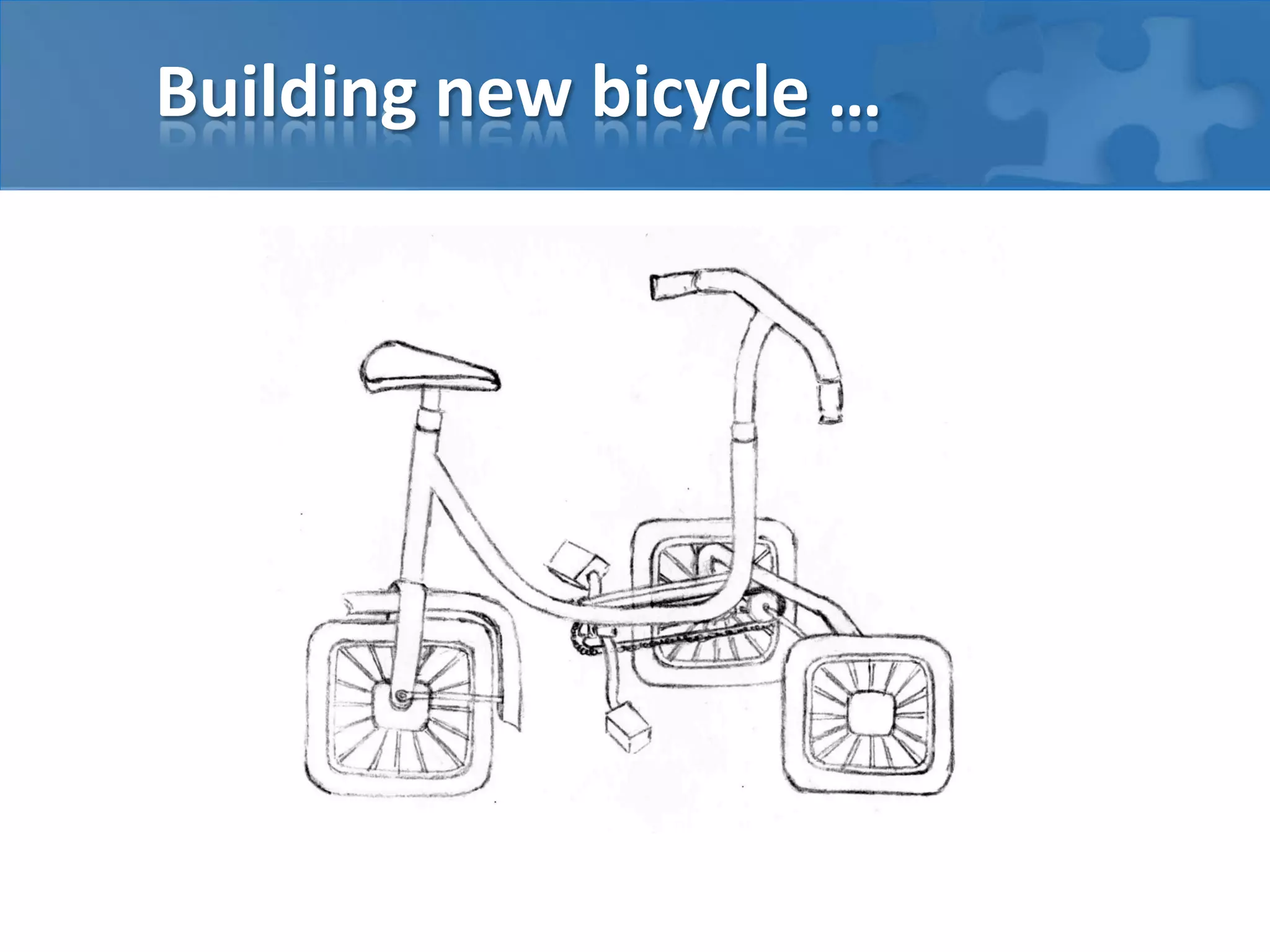
Building new bicycle …
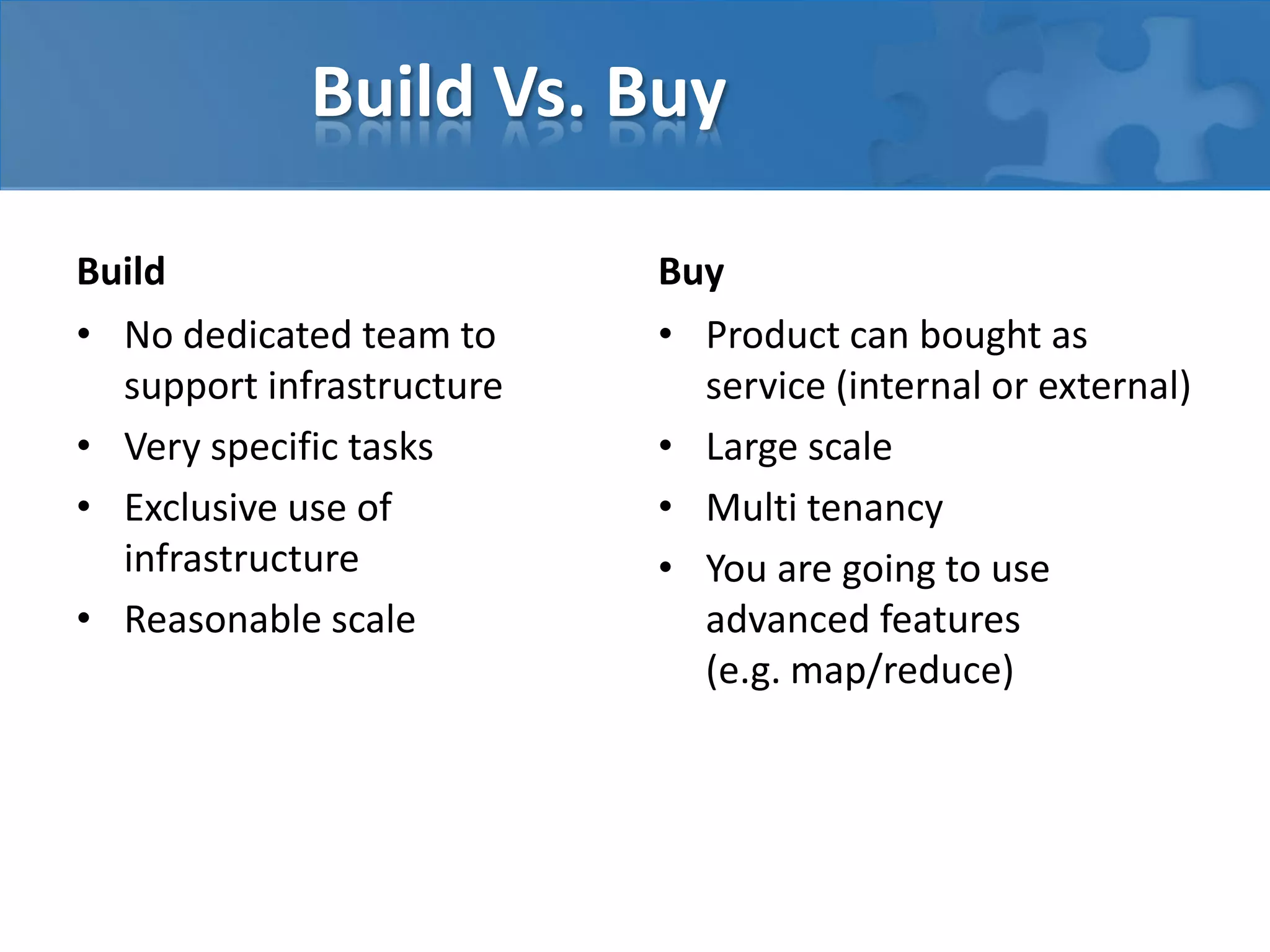
Build Vs. Buy
Build
• No dedicated team to
support infrastructure
• Very specific tasks
• Exclusive use of
infrastructure
• Reasonable scale
Buy
• Product can bought as
service (internal or external)
• Large scale
• Multi tenancy
• You are going to use
advanced features
(e.g. map/reduce)
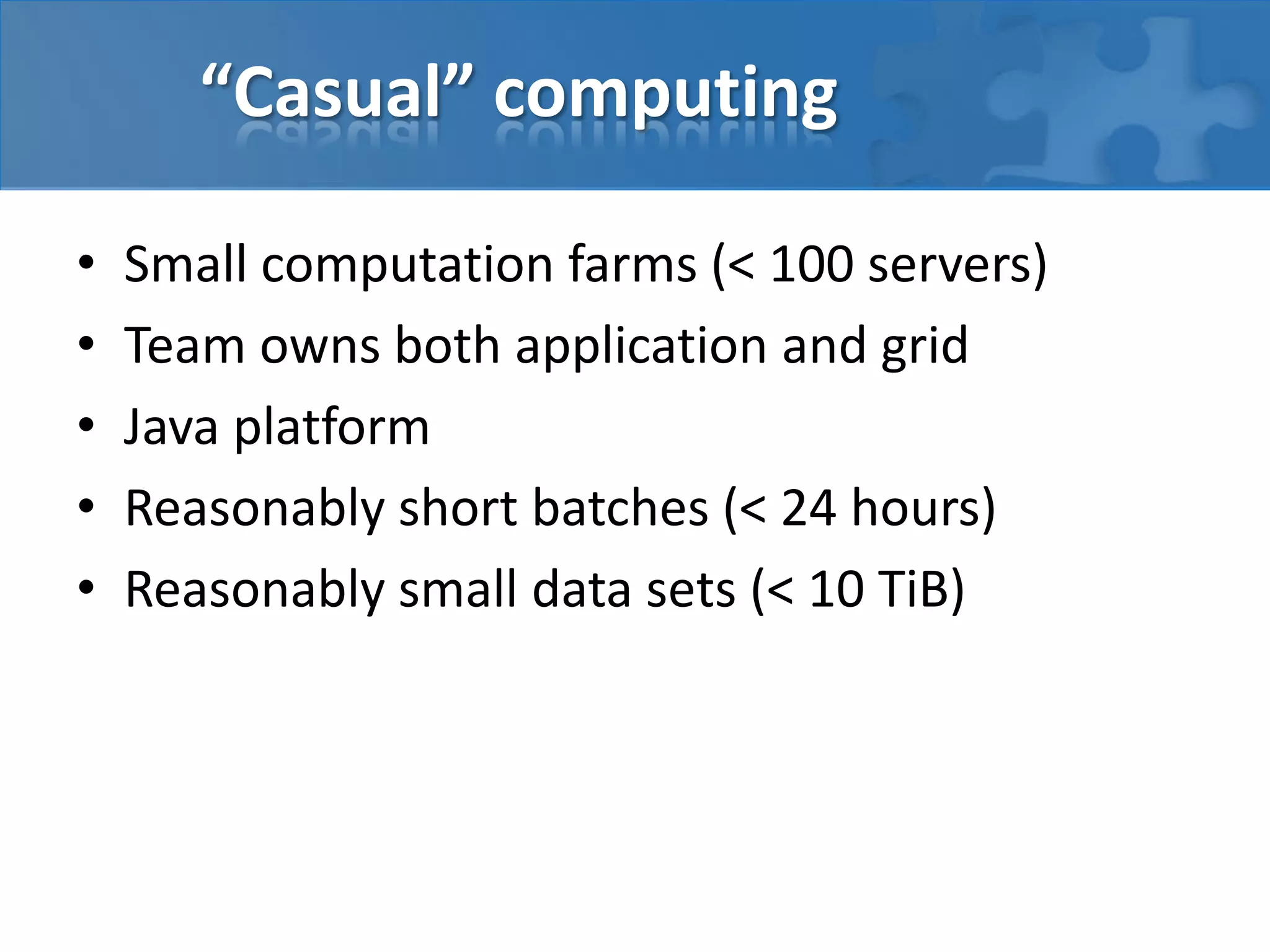
“Casual” computing
• Small computation farms (< 100 servers)
• Team owns both application and grid
• Java platform
• Reasonably short batches (< 24 hours)
• Reasonably small data sets (< 10 TiB)
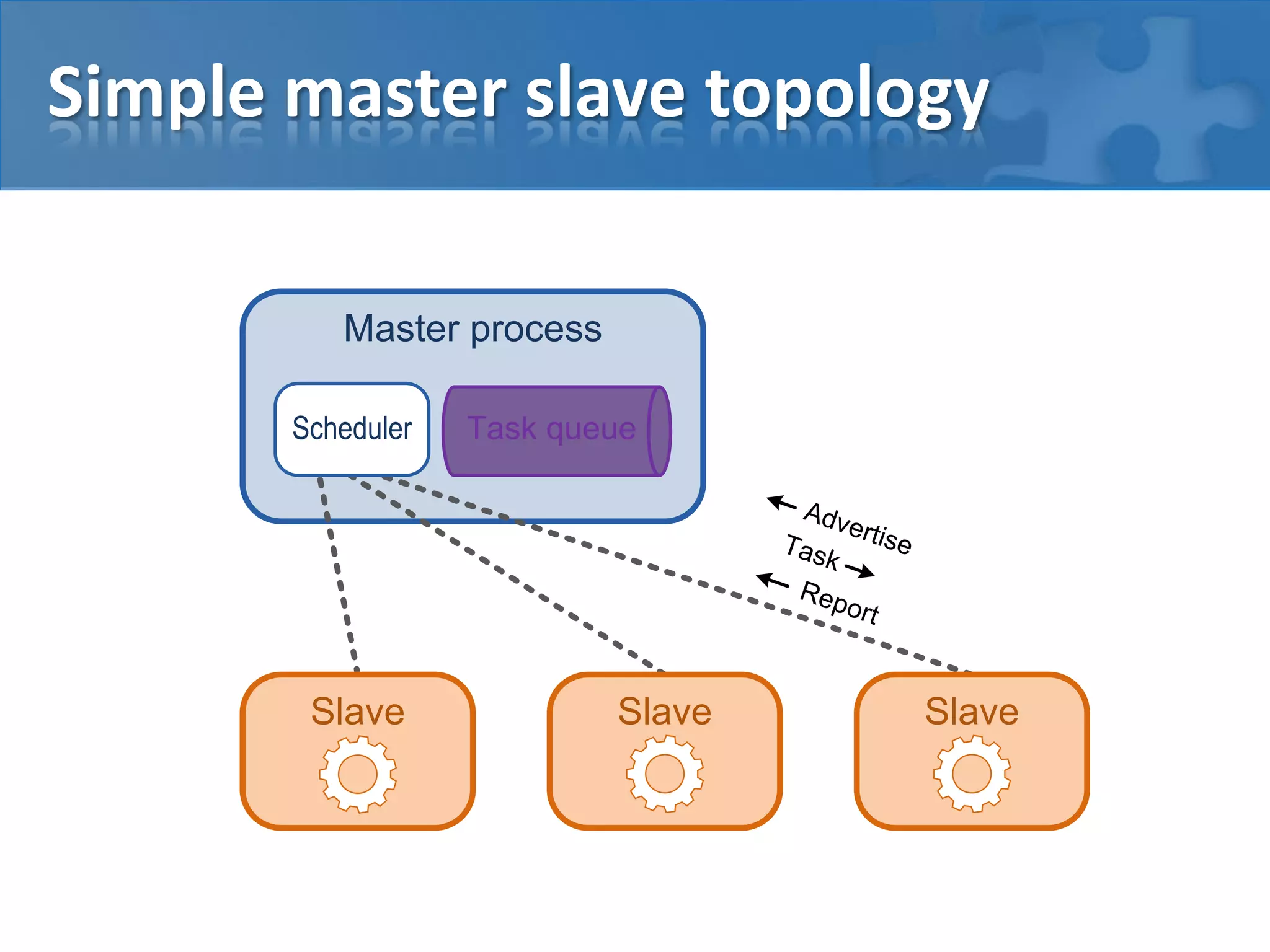
Simple master slave topology
Master process
Task queue
Slave Slave Slave
Scheduler
AdvertiseTask
Report
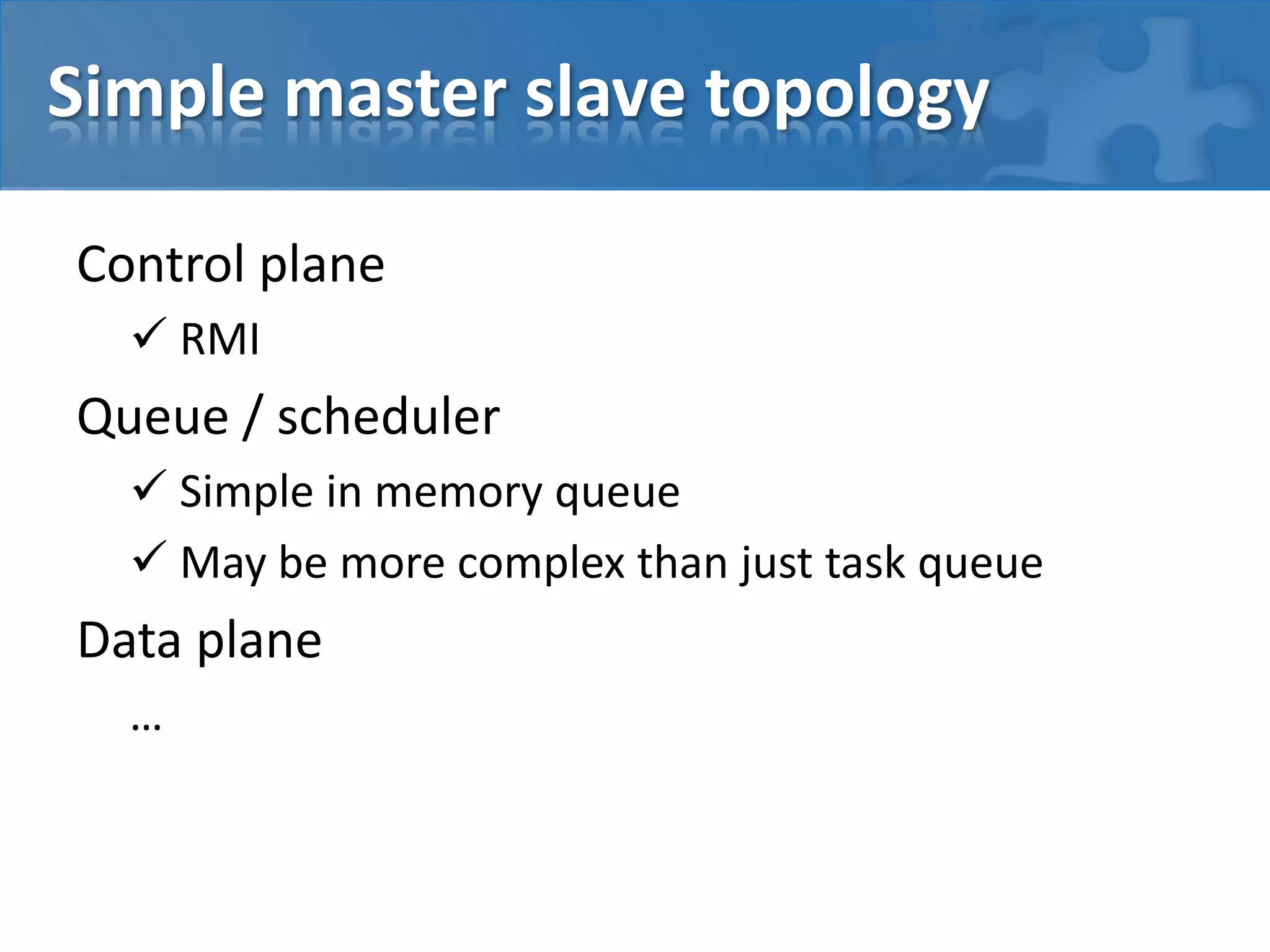
Simple master slave topology
Control plane
 RMI
Queue / scheduler
 Simple in memory queue
 May be more complex than just task queue
Data plane
…
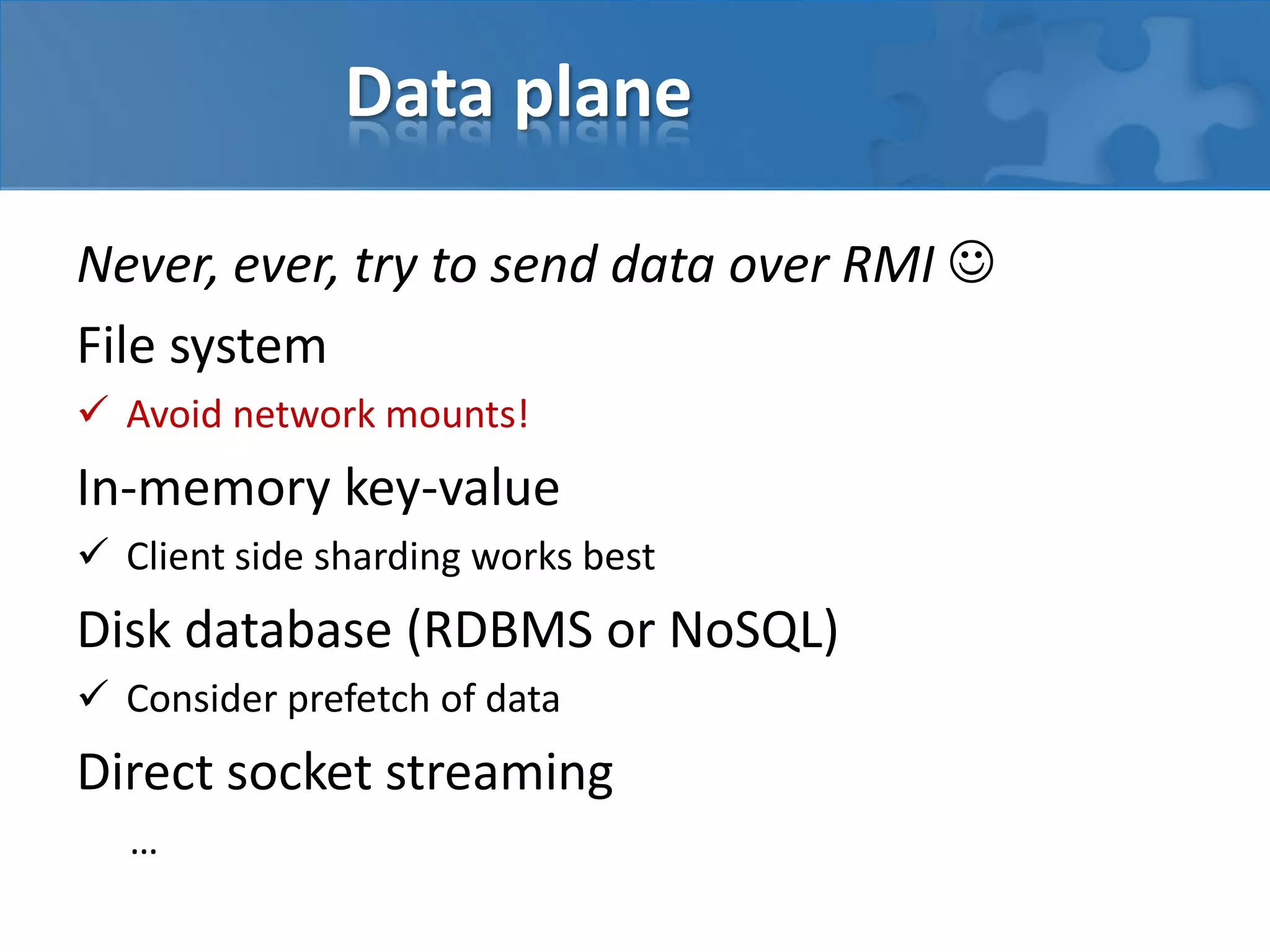
Data plane
Never, ever, try to send data over RMI 
File system
 Avoid network mounts!
In-memory key-value
 Client side sharding works best
Disk database (RDBMS or NoSQL)
 Consider prefetch of data
Direct socket streaming
…
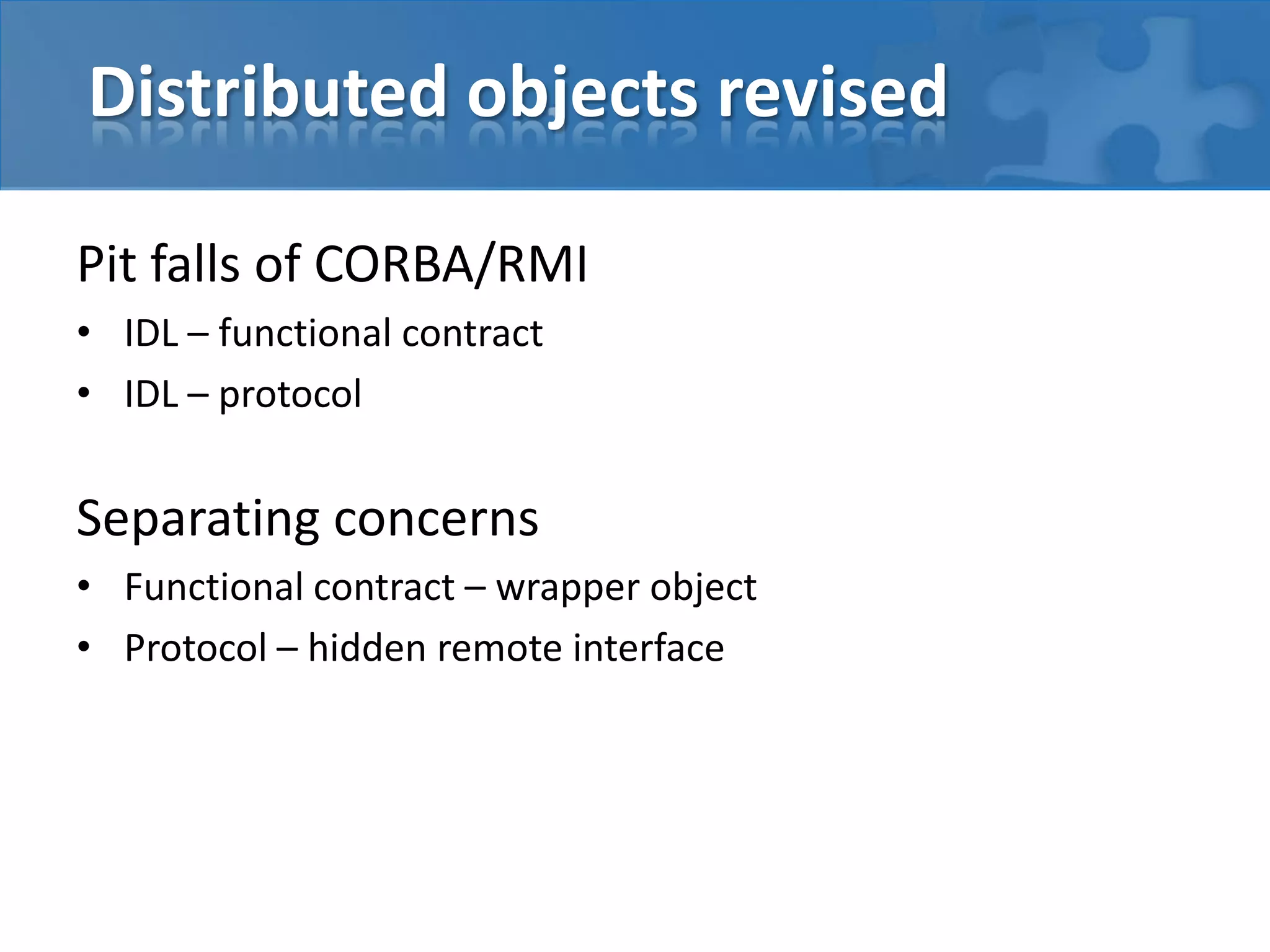
Distributed objects revised
Pit falls of CORBA/RMI
• IDL – functional contract
• IDL – protocol
Separating concerns
• Functional contract – wrapper object
• Protocol – hidden remote interface
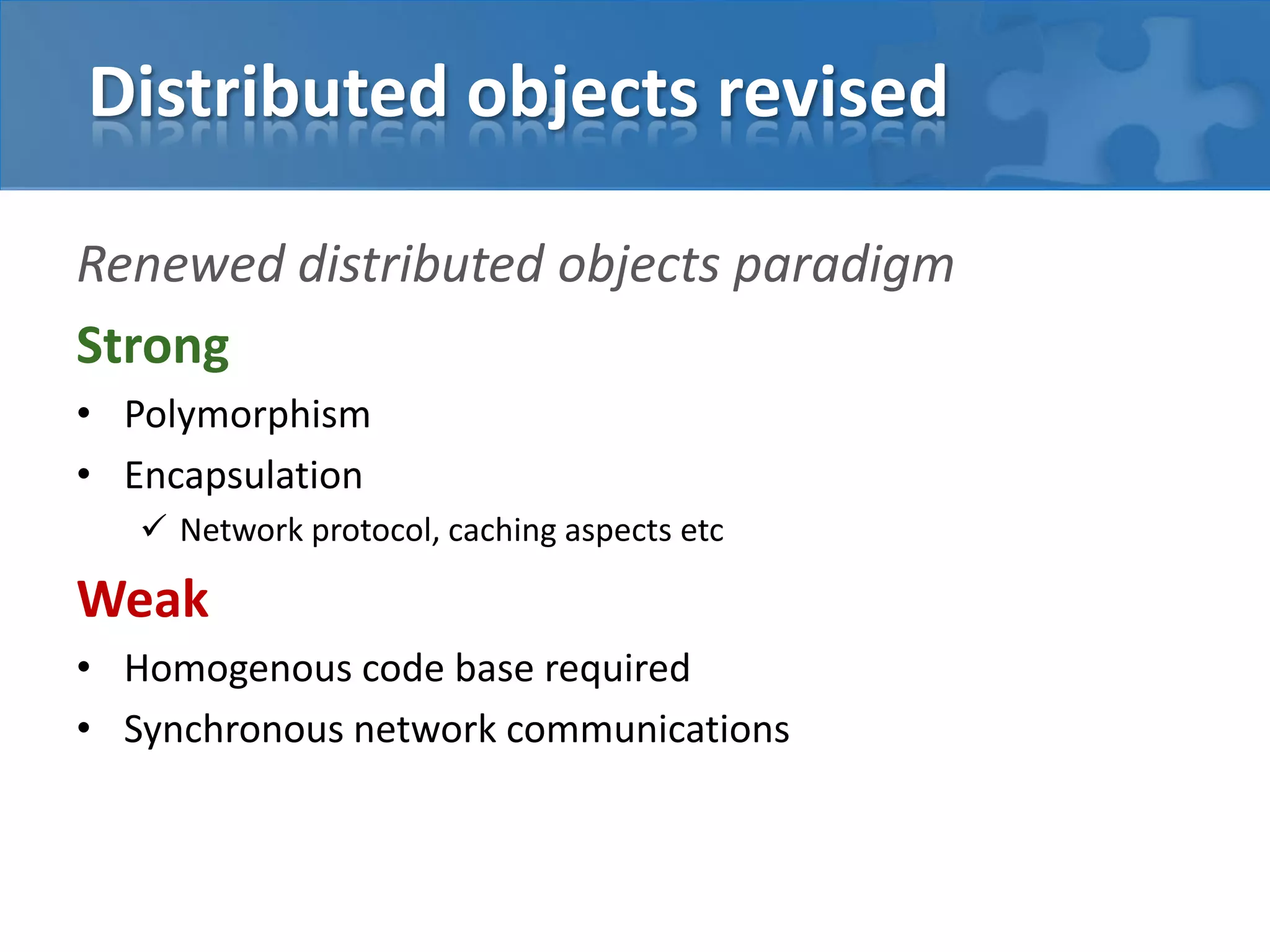
Distributed objects revised
Renewed distributed objects paradigm
Strong
• Polymorphism
• Encapsulation
 Network protocol, caching aspects etc
Weak
• Homogenous code base required
• Synchronous network communications
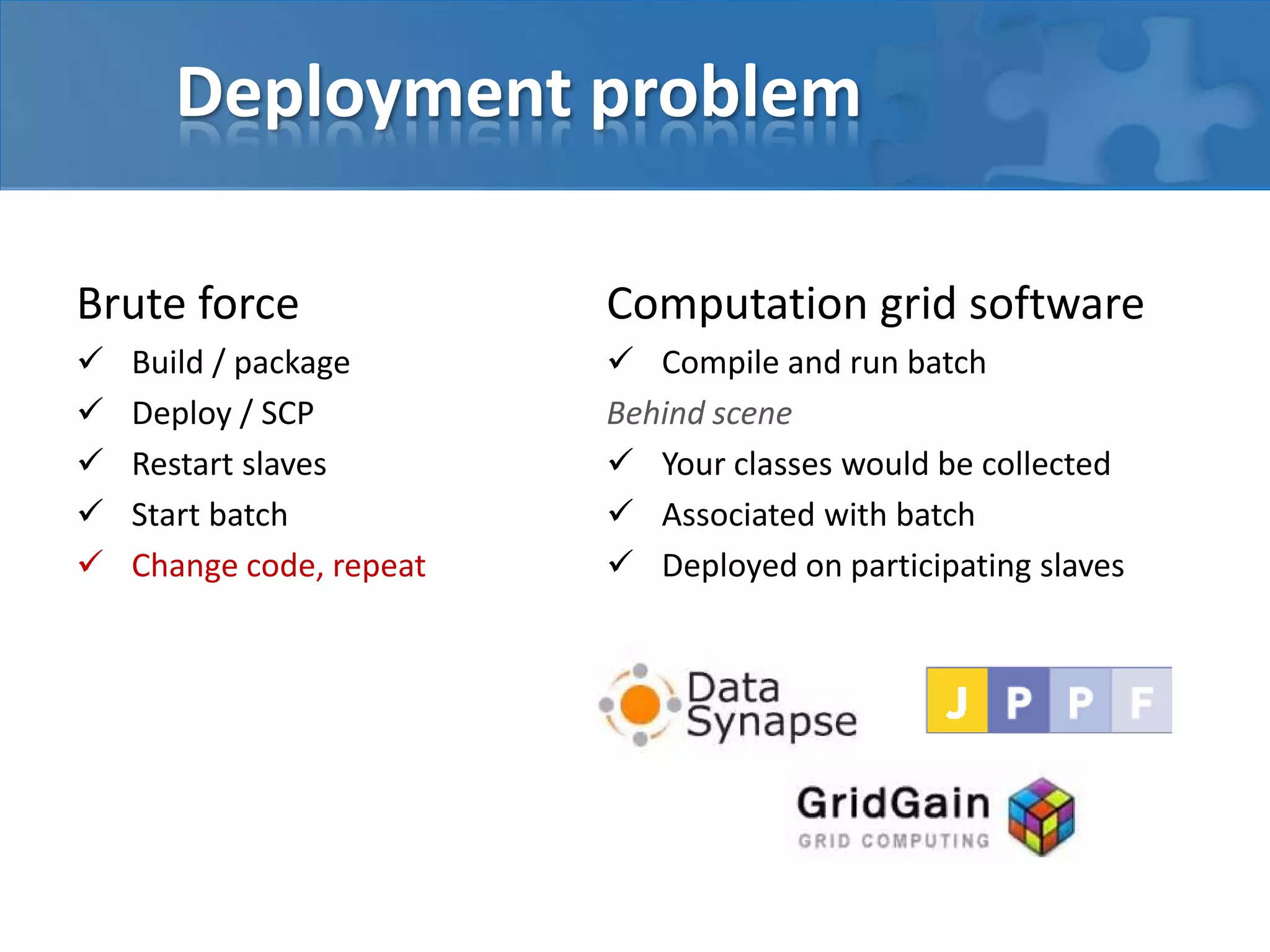
Brute force
 Build / package
 Deploy / SCP
 Restart slaves
 Start batch
 Change code, repeat
Deployment problem
Computation grid software
 Compile and run batch
Behind scene
 Your classes would be collected
 Associated with batch
 Deployed on participating slaves
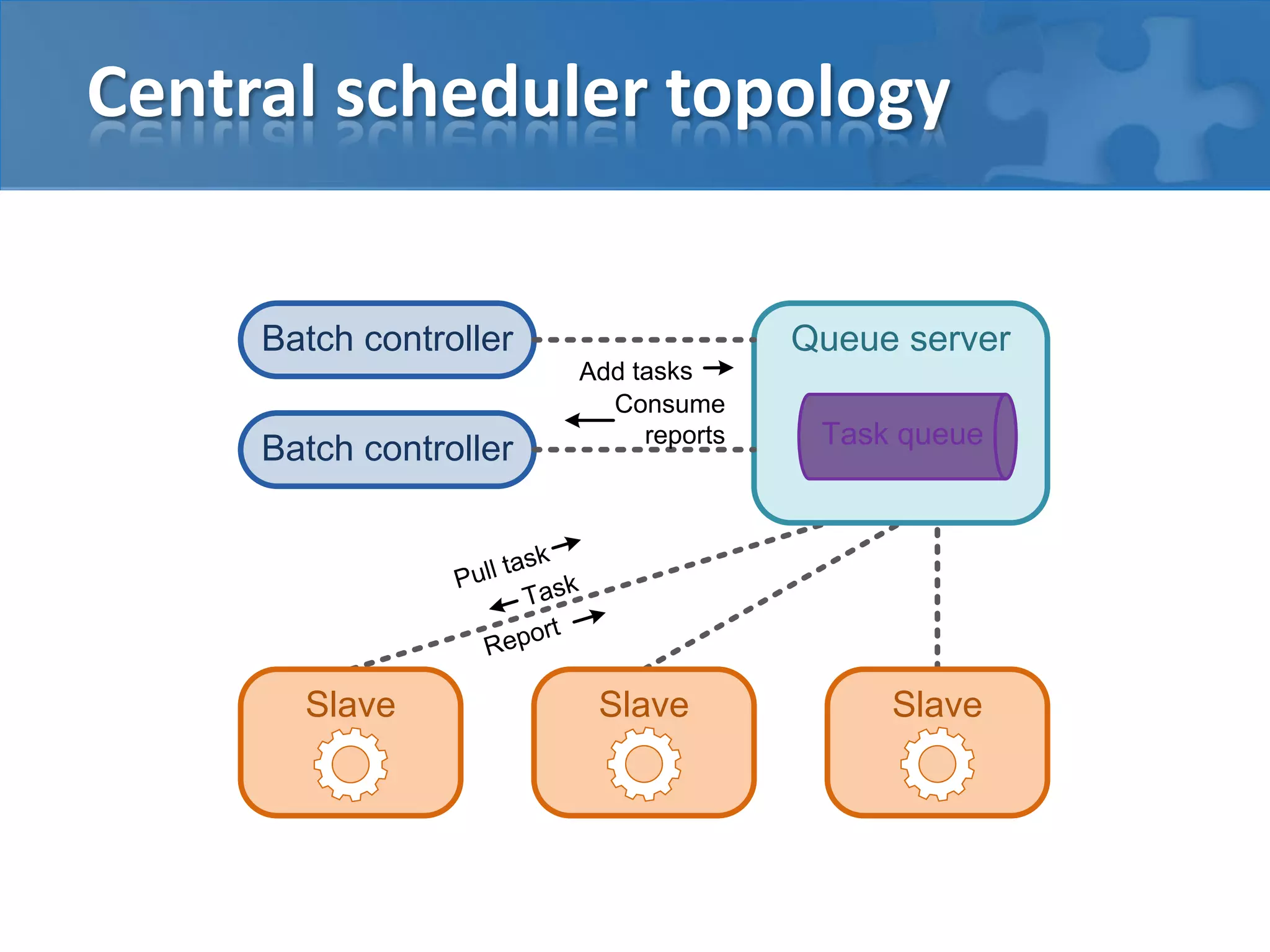
Central scheduler topology
Batch controller
Slave Slave Slave
Pull task
Task
Report
Queue server
Task queue
Batch controller
Add tasks
Consume
reports
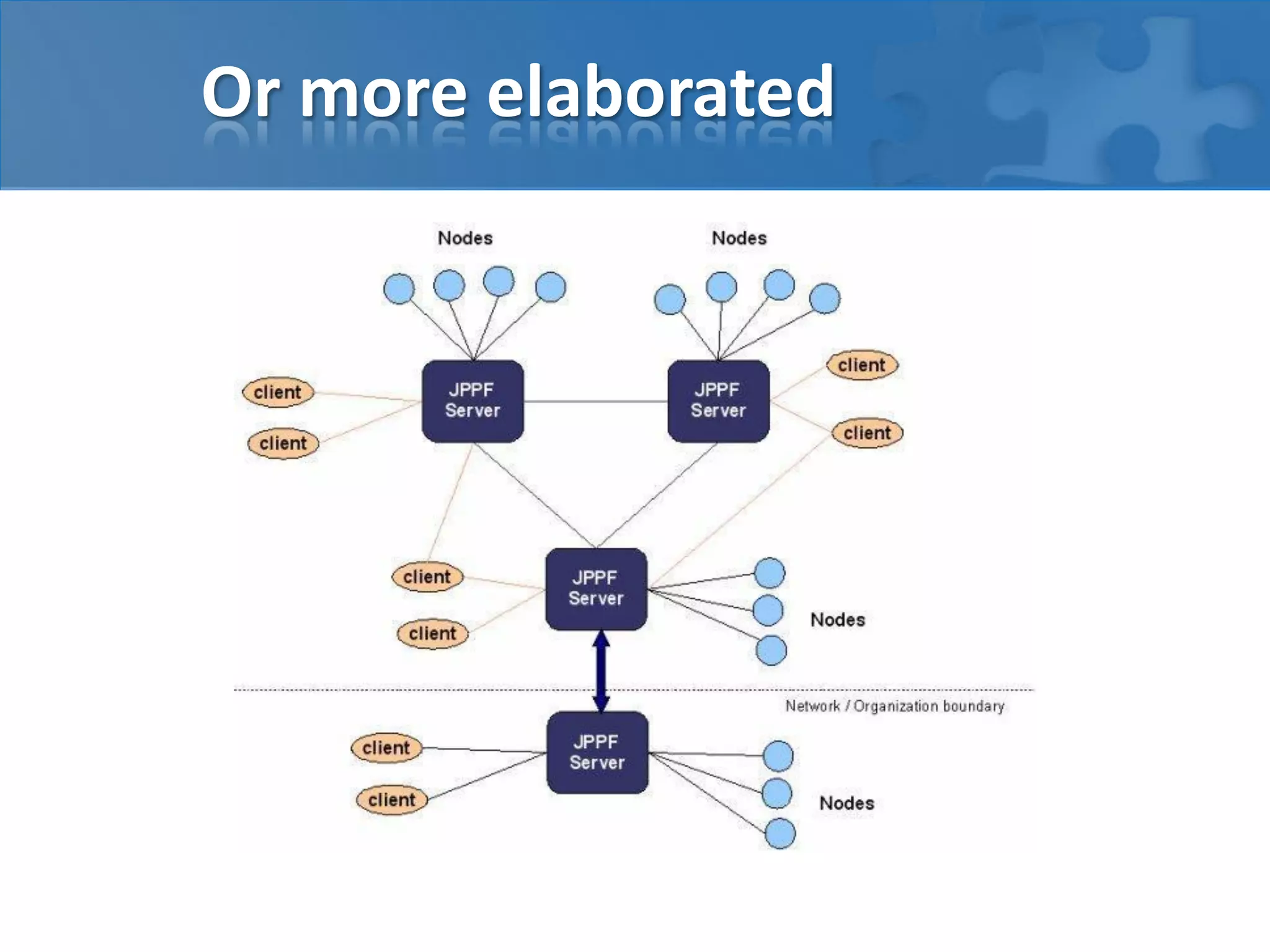
Or more elaborated
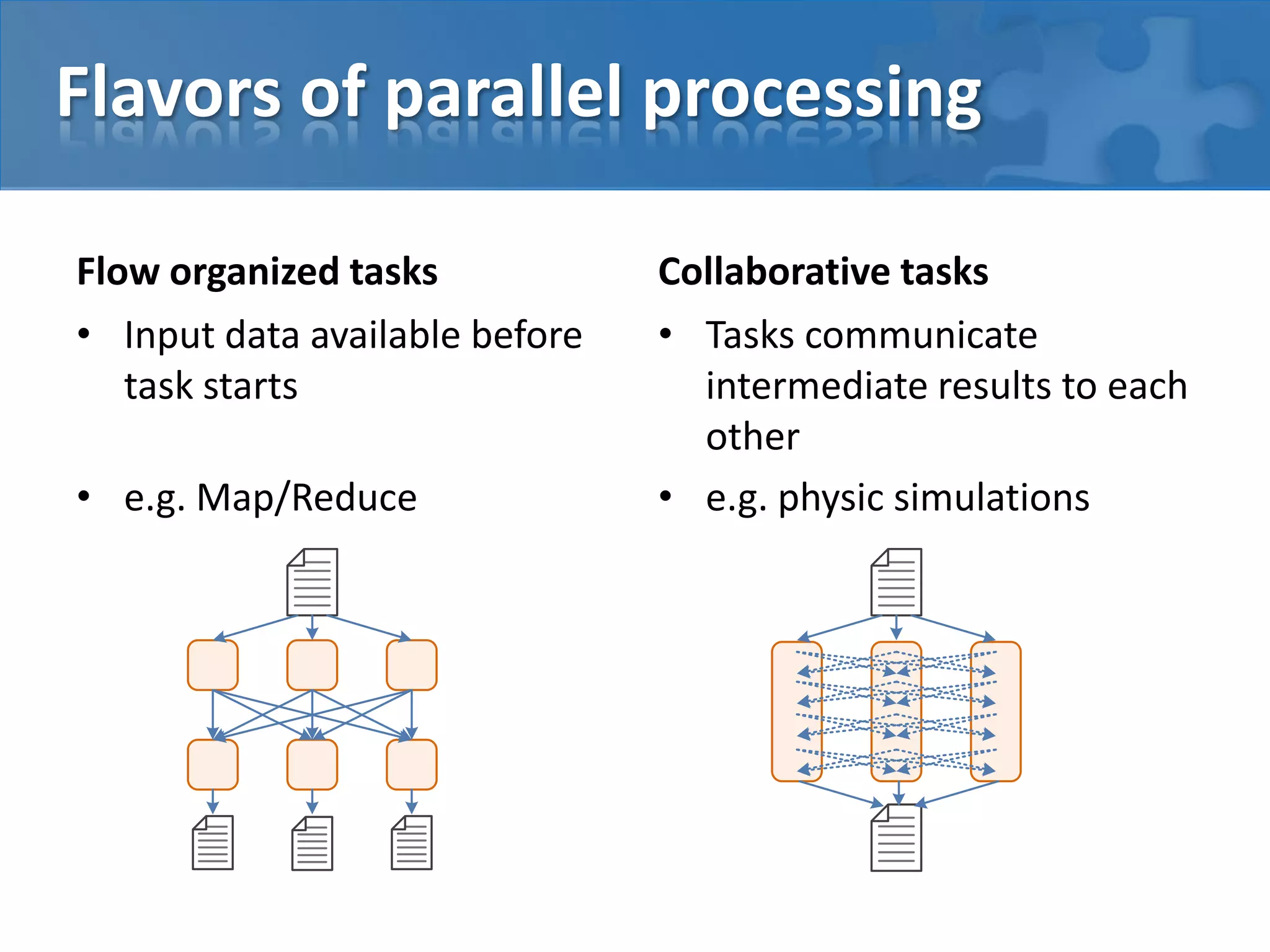
Flow organized tasks
• Input data available before
task starts
• e.g. Map/Reduce
Collaborative tasks
• Tasks communicate
intermediate results to each
other
• e.g. physic simulations
Flavors of parallel processing
Get back to data plane
Rules of thumb
• Insert / delete – never update
• Write locally (reducing risks)
• Read remotely (retry on error)
• Store input as is
 File system
 Document / column oriented NoSQL
• Input and temporary data is different
 Choose right store for each
Exploiting file system
Avoid network file systems
• File system concept is not designed to be distributed
• Good network file system cannot not exists
• Use simple remote file access protocols
• SCP (unencrypteddatatransferoptionsaddedbyCERNguys)
• HTTP (ifyoureallydonotwantSCP)
Cheap SAN could be build from open source
Algorithmic optimization
Parallel computing
• N times speed up will increase
your OPEX and CAPEX cost by N*lg(N)
Algorithmic optimization
• Up front costs only
• Orders of magnitude optimization opportunities
• Exciting coding
• Ecological way of computing 
Streaming algorithms
Finding N most frequent elements
• Min-Count
Estimating number of unique values
• HyperLogLog
Distribution histograms
https://github.com/addthis/stream-lib
https://github.com/rwl/ParallelColt
NanoCloud – drastically simplified
coding for computing clusters
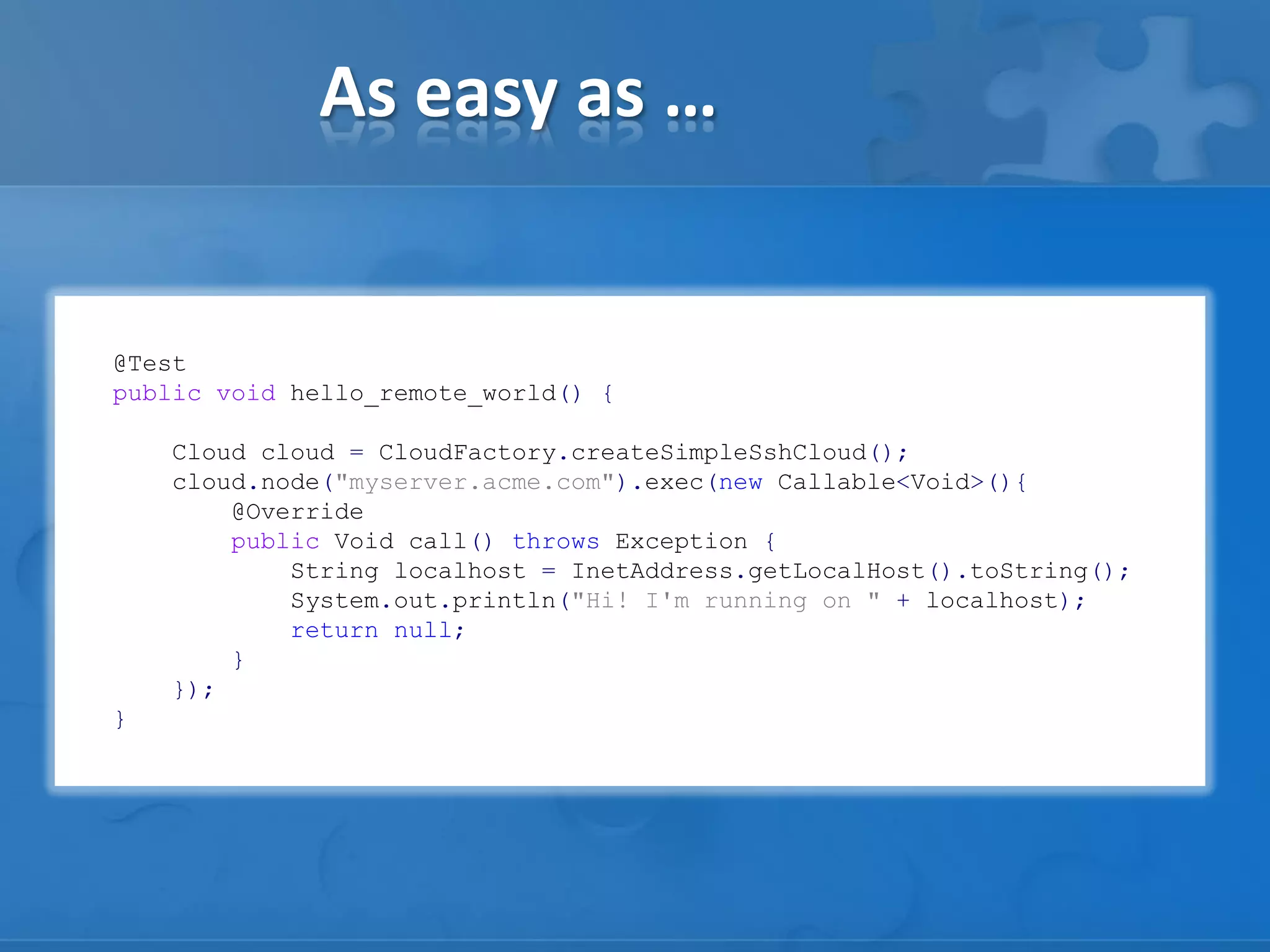
@Test
public void hello_remote_world() {
Cloud cloud = CloudFactory.createSimpleSshCloud();
cloud.node("myserver.acme.com").exec(new Callable<Void>(){
@Override
public Void call() throws Exception {
String localhost = InetAddress.getLocalHost().toString();
System.out.println("Hi! I'm running on " + localhost);
return null;
}
});
}
As easy as …
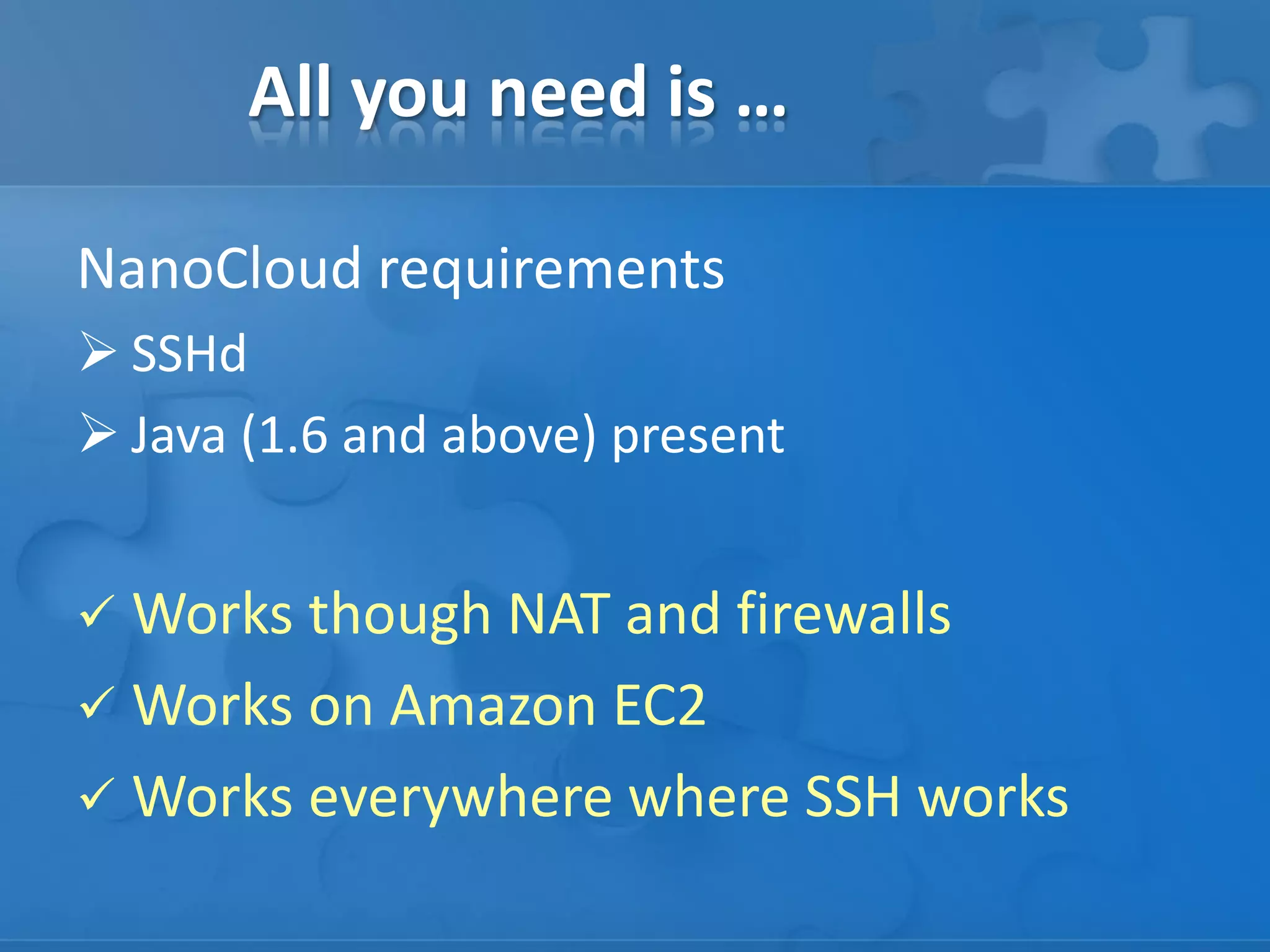
All you need is …
NanoCloud requirements
 SSHd
 Java (1.6 and above) present
 Works though NAT and firewalls
 Works on Amazon EC2
 Works everywhere where SSH works
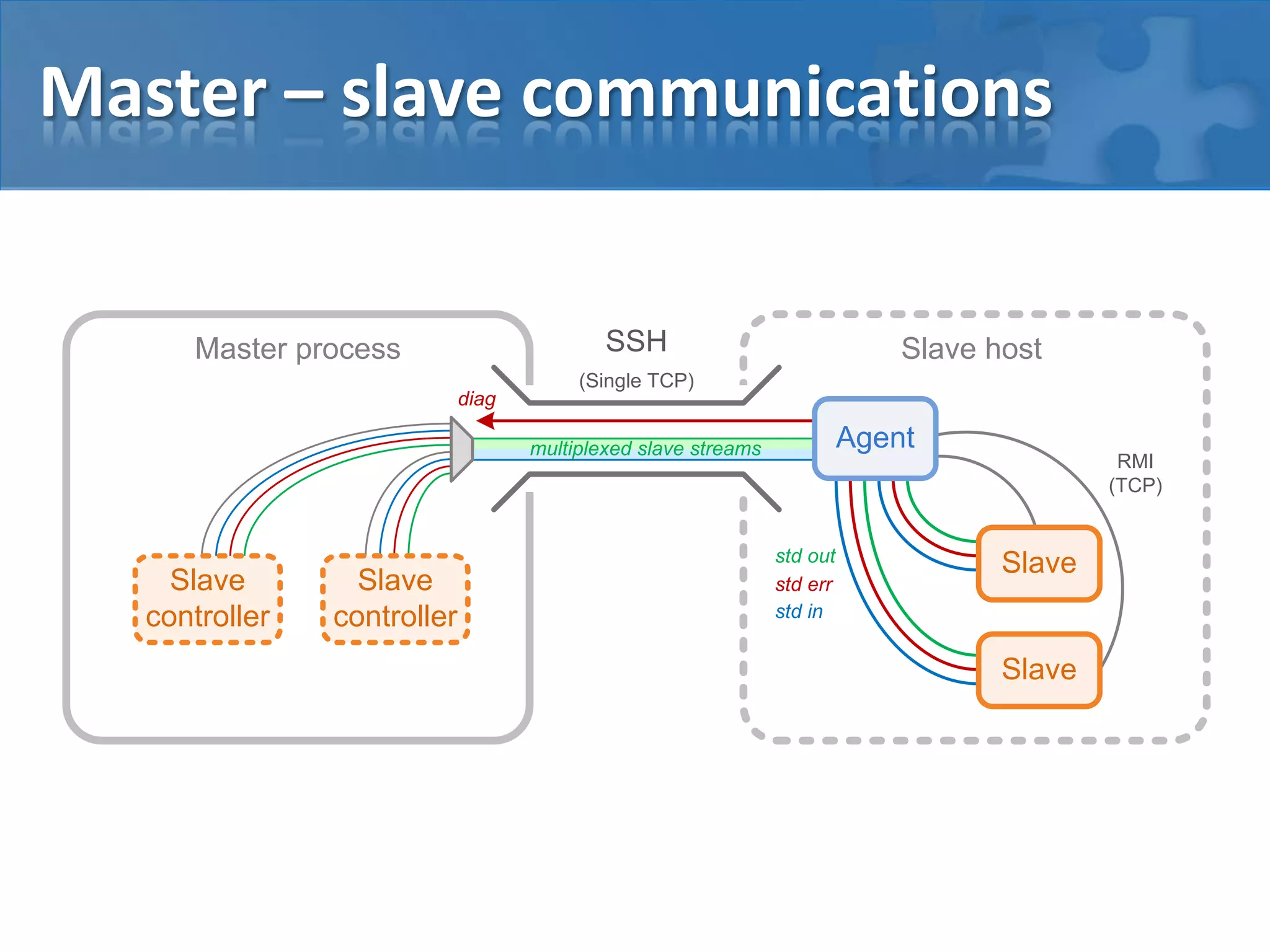
Master – slave communications
Master process Slave hostSSH
(Single TCP)
Slave
Slave
RMI
(TCP)
std err
std out
std in
diag
Slave
controller
Slave
controller
multiplexed slave streams Agent
Links
NanoCloud
• https://code.google.com/p/gridkit/wiki/NanoCloudTutorial
• Maven Central: org.gridkit.lab:telecontrol-ssh:0.7.23
• http://blog.ragozin.info/2013/01/remote-code-execution-in-java-made.html
ANT task
• https://github.com/gridkit/gridant
Thank you
Alexey Ragozin
alexey.ragozin@gmail.com
http://blog.ragozin.info
- my articles
http://code.google.com/p/gridkit
http://github.com/gridkit
- my open source code
http://aragozin.timepad.ru
- community events in Moscow

Casual mass parallel computing

  • 1.
    Casual mass paralleldata processing in Java Alexey Ragozin Mar 2014
  • 2.
  • 3.
    Build Vs. Buy Build •No dedicated team to support infrastructure • Very specific tasks • Exclusive use of infrastructure • Reasonable scale Buy • Product can bought as service (internal or external) • Large scale • Multi tenancy • You are going to use advanced features (e.g. map/reduce)
  • 4.
    “Casual” computing • Smallcomputation farms (< 100 servers) • Team owns both application and grid • Java platform • Reasonably short batches (< 24 hours) • Reasonably small data sets (< 10 TiB)
  • 5.
    Simple master slavetopology Master process Task queue Slave Slave Slave Scheduler AdvertiseTask Report
  • 6.
    Simple master slavetopology Control plane  RMI Queue / scheduler  Simple in memory queue  May be more complex than just task queue Data plane …
  • 7.
    Data plane Never, ever,try to send data over RMI  File system  Avoid network mounts! In-memory key-value  Client side sharding works best Disk database (RDBMS or NoSQL)  Consider prefetch of data Direct socket streaming …
  • 8.
    Distributed objects revised Pitfalls of CORBA/RMI • IDL – functional contract • IDL – protocol Separating concerns • Functional contract – wrapper object • Protocol – hidden remote interface
  • 9.
    Distributed objects revised Reneweddistributed objects paradigm Strong • Polymorphism • Encapsulation  Network protocol, caching aspects etc Weak • Homogenous code base required • Synchronous network communications
  • 10.
    Brute force  Build/ package  Deploy / SCP  Restart slaves  Start batch  Change code, repeat Deployment problem Computation grid software  Compile and run batch Behind scene  Your classes would be collected  Associated with batch  Deployed on participating slaves
  • 11.
    Central scheduler topology Batchcontroller Slave Slave Slave Pull task Task Report Queue server Task queue Batch controller Add tasks Consume reports
  • 12.
  • 13.
    Flow organized tasks •Input data available before task starts • e.g. Map/Reduce Collaborative tasks • Tasks communicate intermediate results to each other • e.g. physic simulations Flavors of parallel processing
  • 14.
    Get back todata plane Rules of thumb • Insert / delete – never update • Write locally (reducing risks) • Read remotely (retry on error) • Store input as is  File system  Document / column oriented NoSQL • Input and temporary data is different  Choose right store for each
  • 15.
    Exploiting file system Avoidnetwork file systems • File system concept is not designed to be distributed • Good network file system cannot not exists • Use simple remote file access protocols • SCP (unencrypteddatatransferoptionsaddedbyCERNguys) • HTTP (ifyoureallydonotwantSCP) Cheap SAN could be build from open source
  • 16.
    Algorithmic optimization Parallel computing •N times speed up will increase your OPEX and CAPEX cost by N*lg(N) Algorithmic optimization • Up front costs only • Orders of magnitude optimization opportunities • Exciting coding • Ecological way of computing 
  • 17.
    Streaming algorithms Finding Nmost frequent elements • Min-Count Estimating number of unique values • HyperLogLog Distribution histograms https://github.com/addthis/stream-lib https://github.com/rwl/ParallelColt
  • 18.
    NanoCloud – drasticallysimplified coding for computing clusters
  • 19.
    @Test public void hello_remote_world(){ Cloud cloud = CloudFactory.createSimpleSshCloud(); cloud.node("myserver.acme.com").exec(new Callable<Void>(){ @Override public Void call() throws Exception { String localhost = InetAddress.getLocalHost().toString(); System.out.println("Hi! I'm running on " + localhost); return null; } }); } As easy as …
  • 20.
    All you needis … NanoCloud requirements  SSHd  Java (1.6 and above) present  Works though NAT and firewalls  Works on Amazon EC2  Works everywhere where SSH works
  • 21.
    Master – slavecommunications Master process Slave hostSSH (Single TCP) Slave Slave RMI (TCP) std err std out std in diag Slave controller Slave controller multiplexed slave streams Agent
  • 22.
    Links NanoCloud • https://code.google.com/p/gridkit/wiki/NanoCloudTutorial • MavenCentral: org.gridkit.lab:telecontrol-ssh:0.7.23 • http://blog.ragozin.info/2013/01/remote-code-execution-in-java-made.html ANT task • https://github.com/gridkit/gridant
  • 23.
    Thank you Alexey Ragozin alexey.ragozin@gmail.com http://blog.ragozin.info -my articles http://code.google.com/p/gridkit http://github.com/gridkit - my open source code http://aragozin.timepad.ru - community events in Moscow