How to Perform Quality Cardiopulmonary 
Resuscitation (CPR) on the Adult Victim 
For Untrained Personnel
What is Cardiopulmonary Resuscitation 
(CPR)? 
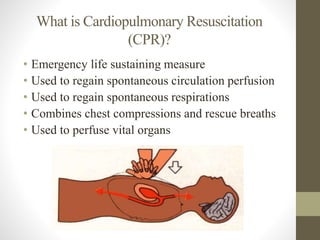
• Emergency life sustaining measure 
• Used to regain spontaneous circulation perfusion 
• Used to regain spontaneous respirations 
• Combines chest compressions and rescue breaths 
• Used to perfuse vital organs
How to Begin 
• Assess victim for level of consciousness 
• Assess your victim for a pulse 
• Assess your victim for spontaneous breathing 
• Call for help/ 911 
• Request an automated external defibrillator 
(AED) 
• Begin compressions
CPR Steps 
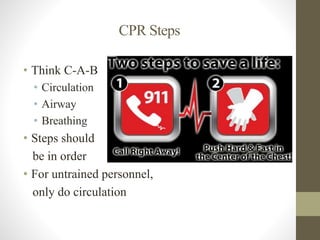
• Think C-A-B 
• Circulation 
• Airway 
• Breathing 
• Steps should 
be in order 
• For untrained personnel, 
only do circulation
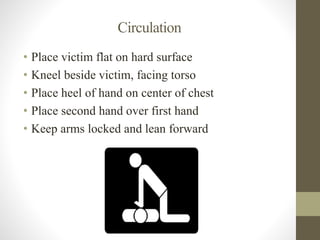
Circulation 
• Place victim flat on hard surface 
• Kneel beside victim, facing torso 
• Place heel of hand on center of chest 
• Place second hand over first hand 
• Keep arms locked and lean forward
Circulation (cont.) 
• Begin pushing down on victims chest 
• Compress chest 2/3’s of chest depth 
• Goal of 100 compressions per minute 
• Continue compressions until medical personnel 
arrive
Facts About CPR 
• Ribs are commonly fractured during CPR 
• Just doing compressions can save lives 
• Beginning quickly increases rate of survival
Importance of Knowing CPR 
• 88% of cardiac arrest occur at home 
• CPR can double chance of survival 
• Cardiac arrest is leading cause of death 
• Not doing CPR could result in death 
• You could save a persons life
How to get Certified 
• American Heart 
Association 
n 
• American 
Red Cross

Cassandra Holcomb CIA#4

  • 1.
    How to PerformQuality Cardiopulmonary Resuscitation (CPR) on the Adult Victim For Untrained Personnel
  • 2.
    What is CardiopulmonaryResuscitation (CPR)? • Emergency life sustaining measure • Used to regain spontaneous circulation perfusion • Used to regain spontaneous respirations • Combines chest compressions and rescue breaths • Used to perfuse vital organs
  • 3.
    How to Begin • Assess victim for level of consciousness • Assess your victim for a pulse • Assess your victim for spontaneous breathing • Call for help/ 911 • Request an automated external defibrillator (AED) • Begin compressions
  • 4.
    CPR Steps •Think C-A-B • Circulation • Airway • Breathing • Steps should be in order • For untrained personnel, only do circulation
  • 5.
    Circulation • Placevictim flat on hard surface • Kneel beside victim, facing torso • Place heel of hand on center of chest • Place second hand over first hand • Keep arms locked and lean forward
  • 6.
    Circulation (cont.) •Begin pushing down on victims chest • Compress chest 2/3’s of chest depth • Goal of 100 compressions per minute • Continue compressions until medical personnel arrive
  • 7.
    Facts About CPR • Ribs are commonly fractured during CPR • Just doing compressions can save lives • Beginning quickly increases rate of survival
  • 8.
    Importance of KnowingCPR • 88% of cardiac arrest occur at home • CPR can double chance of survival • Cardiac arrest is leading cause of death • Not doing CPR could result in death • You could save a persons life
  • 9.
    How to getCertified • American Heart Association n • American Red Cross