BASIC LIFE
SUPPORT(BLS)
PRESENTED BY
SIRAJU RAHMAN K
BASIC LIFE SUPPORT(BLS)
• DEFINITION
BLS refers to the care healthcare providers and public
professionals provide to patients who are experiencing respiratory
arrest , cardiac arrest or airway obstruction
* BLS includes psychomotor skills for performing high quality
Cardiopulmonary resuscitation(CPR), Using an automated external
defibrillator(AED) And relieving an obstructed airway for patients for
all ages.
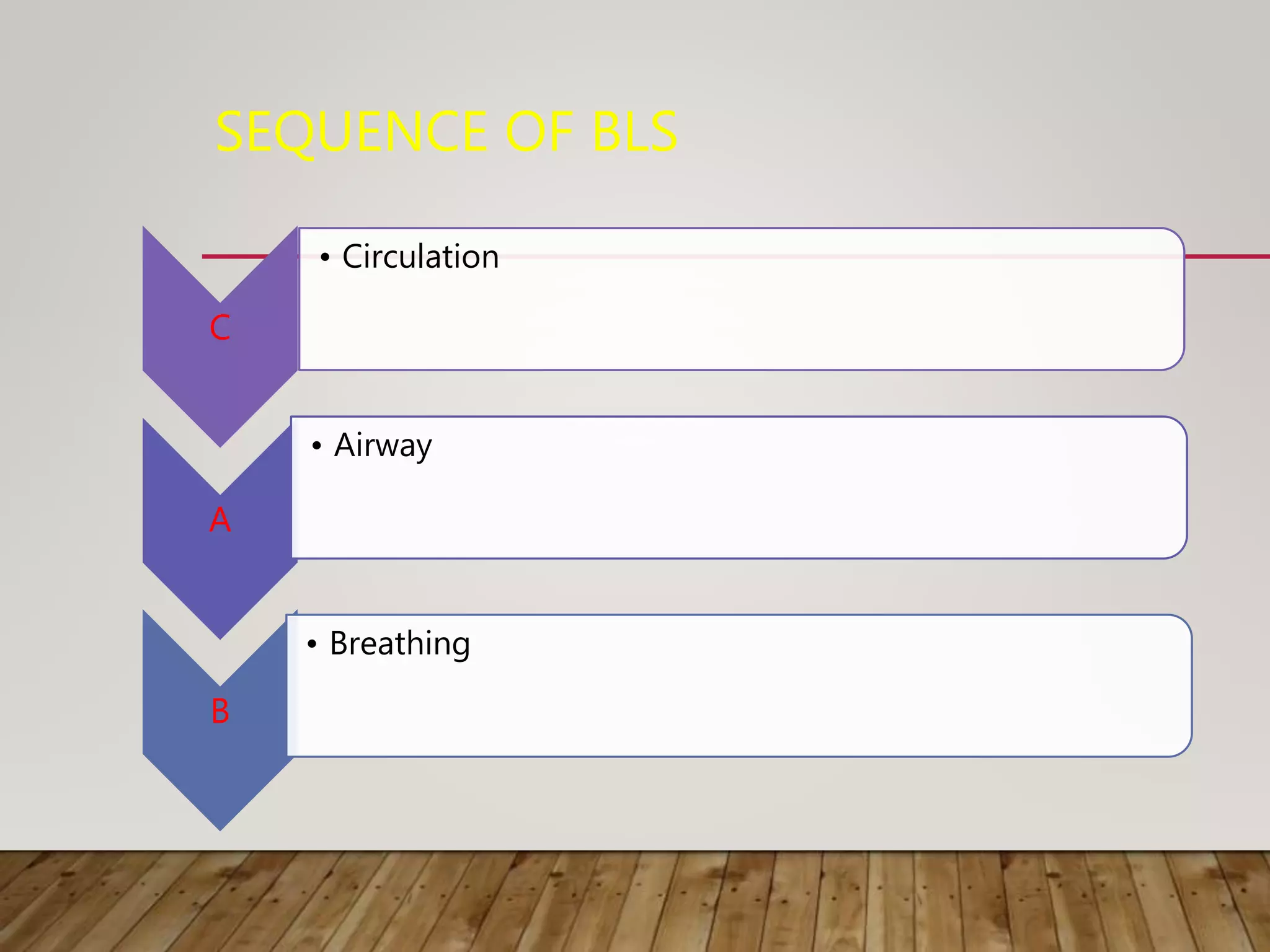
SEQUENCE OF BLS
C
• Circulation
A
• Airway
B
• Breathing
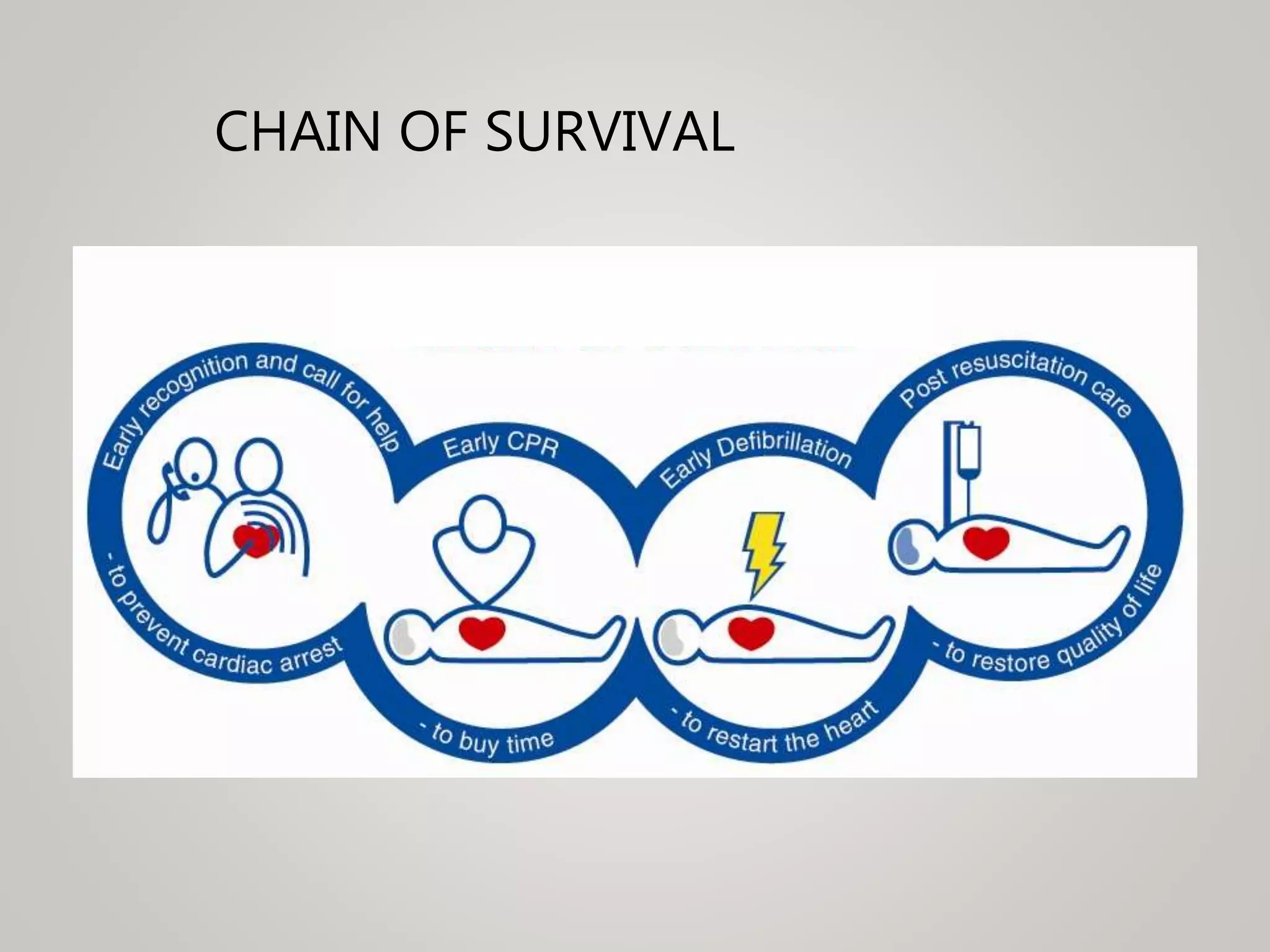
CHAIN OF SURVIVAL
CARDIOPULMONARY
RESUSCITATION
THREE BASIC VITAL FUNCTIONS:
 BREATHING
 CIRCULATION
 CONSCIOUSNESS
INDICATION OF CPR
 TO VICTIMS WITH UNEXPECTED CARDIAC ARREST IN OTHERWISE
HEALTHY INDIVIDUALS …
 = TO THOSE, WHO CAN BE DESCRIBED AS HAVING ”HEART TOO
GOOD TO DIE”
• malignant arrhythmia
• acute myocardial infarction (AMI)
• pulmonary embolism
• intoxication
• electrocution
• drowning
• acute suffocation
• severe trauma
• stroke and alike
Indication of CPR
SIGNS OF CARDIAC
ARREST (GUIDELINES 2000)
1. UNCONSCIOUSNESS IN SEVERAL SECONDS
2. RESPIRATORY ARREST ( APNEA) OR THE LAST GASPS (1-3 MINUTES AFTER
CARDIAC ARREST)
3. PULSE-LESS ON LARGE ( MAJOR) ARTERIES (CAROTID OR
FEMORAL ARTERY)
4. CHANGED GENERAL APPEARANCE (COLOUR
CHANGES, FACE CHANGES…)
5. PUPILS DILATION (MYDRIASIS) – NOT RELIABLE
SIGNS OF CARDIAC
ARREST (GUIDELINES 2005)
1. UNCONSCIOUSNESS
2. NO REACTIVITY
3. ABSENCE OF NORMAL BREATHING
VICTIM IS UN RESPONSIVE ,BREATHING AND PULSE ABSENT
FOR CPR
1. RESCUER’S SAFETY = THE FIRST PRIORITY
2. TO ASSESS THE RISK OF TRAUMA, INTOXICATION, INFECTION …
3. A VICTIM POSITION: SUPINE ON TO HIS/HER BACK
4. ON THE FIRM FLAT SURFACE TO MAKE EFFECTIVE CHEST COMPRESSIONS
5. VICTIM´S POSITION IN RELATION TO RESCUER´S POSITION
6. CPR DURING TRANSFER ???
The rescuer should never place him/herself or
others at more risk than the victim
• before starting resuscitation – assess the risks of
ongoing traffic, falling masonry, electrocution, toxic
fumes and poisons
• risk of infections transmission
• bloodborne infections (hepatitis B and C, HIV)
- can be transmitted by blood and other body
solutions, excretes
• airborne infections (TBC and several infectious
diseases - herpetic, meningococcal etc.
- can be transmitted by mouth-to-mouth breathing
Rescuer’s safety
• Always: protect yourself !!!
• personal protective equipment (gloves)
• barrier protective devices
• Moth – to - barrier protective devices
breathing
Rescuer’s safety
CARDIOPULMONARY RESUSCITATION
BARRIER DEVICES
 S – TUBE
 FACE SHIELDS (RESUSCITATION VEIL )
 POCKET FACE MASK + ONE-WAY VALVE
 HANDKERCHIEF
 TOWEL
STOP CPR IF
• Victim starts to breathe normally
• Medical assistance arrives and instructs you to stop CPR
• You are physically exhausted
No pulse
Kneel by the side of
the victim
BLS sequence
Shake shoulders
Ask “Are you all right?”
BLS sequence
In childrens, Check response by
grasping in the foot.
If he responds
• Leave as you find him
• Find out what is wrong
• Reassess regularly
BLS sequence
Unresponsive
Shout for help
BLS sequence
Unresponsive
Shout for help
and activate
EMS
Open airway
BLS sequence
OPEN AIRWAY
* Head tilt and chin lift method
* Jaw thrust maneuver
Unresponsive
Shout for help
and activate
EMS
Open airway
Check
breathing
BLS sequence
• Look, listen and feel for NORMAL
breathing
• No breathing – apnea
• Gasps (agonal breathing)
BLS sequence
BLS SEQUENCE
• Position your cheek close to victim’s
nose&mouth,look toward victim’s
chest
• By placing fingers on nostrils
• By placing fingers on chest
Unresponsive
Shout for help
Open airway
Check
breathing
Check pulse
BLS sequence
BLS sequence
CHECK PULSE
* Check by using three finger method
* Carotid pulse in adults
* Brachial pulse in children
* Check pulse about 6-10 sec
IF PULSE IS ABSENT , START CPR
Unresponsive
Shout for help
and activate
EMS
Open airway
Check breathing
Check pulse
30 chest
compressions
BLS sequence
Chest compression
 Place the heel of dominant hand
in the centre of the
chest(Between two nipples)
 Place other hand on top
 Interlock fingers
 Compress the chest
 Rate 100-120 min-1
 Depth 4-5 cm(2-2.4 inches) in
adults
 1-1.5 inches in children
 Equal compression : relaxation
Only hip joint of rescuer is allow to
move during chest compression
 When possible (2 or more
rescuers) change CPR operator
every 5 cycle to prevent fatigue
Chest compression
TWO RESCUERS AVIALABLE
• 30: 2 IN ADULT
• 15:2 IN CHILDREN
Unresponsive
Shout for help
and activate
EMS
Open airway
Check
breathing
Check pulse
30 chest
compressions
2 rescue
breaths
Chest compression
OPEN AIRWAY
Head tilt and chin lift method Jaw thrust method
• Pinch nose
• Place and seal your lips over the
victim´s mouth
• Blow until the chest rises
• Takes about 1 second
• Allow chest to fall
• Repeat (10 – 12 times per minute)
2 rescue breaths
30 : 2
Continue CPR
Ratio 30 : 2
One uniform ratio
• always in adults if two rescuer is
present
• in children when the rescuer is alone
Ratio 15 : 2
Always in childrens if two rescuer is
present
IF VICTIM STARTS TO BREATHE NORMALLY
PLACE HIM IN RECOVERY POSITION
LEFT LATERAL POSITION
COMPLICATIONS DURING CPR
 GASTRIC DISTENSION –OFTEN IN CHILDREN
Prevention:
avoid overinflating the lungs
appropriate volume making the chest rise
 RIB FRACTURES
Prevention:
correct hand´s position
do not remove hands from the chest wall
prevent “dancing on the chest“)
 GASTRIC CONTENT (OR OTHER FLUIDS) ASPIRATION
Prevention:
prevent gastric distension
recovery position in unconscious victims
Basic life support (BLS)

Basic life support (BLS)

  • 1.
  • 2.
    BASIC LIFE SUPPORT(BLS) •DEFINITION BLS refers to the care healthcare providers and public professionals provide to patients who are experiencing respiratory arrest , cardiac arrest or airway obstruction * BLS includes psychomotor skills for performing high quality Cardiopulmonary resuscitation(CPR), Using an automated external defibrillator(AED) And relieving an obstructed airway for patients for all ages.
  • 3.
    SEQUENCE OF BLS C •Circulation A • Airway B • Breathing
  • 4.
  • 5.
    CARDIOPULMONARY RESUSCITATION THREE BASIC VITALFUNCTIONS:  BREATHING  CIRCULATION  CONSCIOUSNESS
  • 6.
    INDICATION OF CPR TO VICTIMS WITH UNEXPECTED CARDIAC ARREST IN OTHERWISE HEALTHY INDIVIDUALS …  = TO THOSE, WHO CAN BE DESCRIBED AS HAVING ”HEART TOO GOOD TO DIE”
  • 7.
    • malignant arrhythmia •acute myocardial infarction (AMI) • pulmonary embolism • intoxication • electrocution • drowning • acute suffocation • severe trauma • stroke and alike Indication of CPR
  • 8.
    SIGNS OF CARDIAC ARREST(GUIDELINES 2000) 1. UNCONSCIOUSNESS IN SEVERAL SECONDS 2. RESPIRATORY ARREST ( APNEA) OR THE LAST GASPS (1-3 MINUTES AFTER CARDIAC ARREST) 3. PULSE-LESS ON LARGE ( MAJOR) ARTERIES (CAROTID OR FEMORAL ARTERY) 4. CHANGED GENERAL APPEARANCE (COLOUR CHANGES, FACE CHANGES…) 5. PUPILS DILATION (MYDRIASIS) – NOT RELIABLE
  • 9.
    SIGNS OF CARDIAC ARREST(GUIDELINES 2005) 1. UNCONSCIOUSNESS 2. NO REACTIVITY 3. ABSENCE OF NORMAL BREATHING VICTIM IS UN RESPONSIVE ,BREATHING AND PULSE ABSENT
  • 10.
    FOR CPR 1. RESCUER’SSAFETY = THE FIRST PRIORITY 2. TO ASSESS THE RISK OF TRAUMA, INTOXICATION, INFECTION … 3. A VICTIM POSITION: SUPINE ON TO HIS/HER BACK 4. ON THE FIRM FLAT SURFACE TO MAKE EFFECTIVE CHEST COMPRESSIONS 5. VICTIM´S POSITION IN RELATION TO RESCUER´S POSITION 6. CPR DURING TRANSFER ???
  • 11.
    The rescuer shouldnever place him/herself or others at more risk than the victim • before starting resuscitation – assess the risks of ongoing traffic, falling masonry, electrocution, toxic fumes and poisons • risk of infections transmission • bloodborne infections (hepatitis B and C, HIV) - can be transmitted by blood and other body solutions, excretes • airborne infections (TBC and several infectious diseases - herpetic, meningococcal etc. - can be transmitted by mouth-to-mouth breathing Rescuer’s safety
  • 12.
    • Always: protectyourself !!! • personal protective equipment (gloves) • barrier protective devices • Moth – to - barrier protective devices breathing Rescuer’s safety
  • 13.
    CARDIOPULMONARY RESUSCITATION BARRIER DEVICES S – TUBE  FACE SHIELDS (RESUSCITATION VEIL )  POCKET FACE MASK + ONE-WAY VALVE  HANDKERCHIEF  TOWEL
  • 14.
    STOP CPR IF •Victim starts to breathe normally • Medical assistance arrives and instructs you to stop CPR • You are physically exhausted
  • 15.
  • 16.
    Kneel by theside of the victim BLS sequence
  • 17.
    Shake shoulders Ask “Areyou all right?” BLS sequence In childrens, Check response by grasping in the foot.
  • 18.
    If he responds •Leave as you find him • Find out what is wrong • Reassess regularly BLS sequence
  • 19.
  • 20.
    Unresponsive Shout for help andactivate EMS Open airway BLS sequence OPEN AIRWAY * Head tilt and chin lift method * Jaw thrust maneuver
  • 21.
    Unresponsive Shout for help andactivate EMS Open airway Check breathing BLS sequence
  • 22.
    • Look, listenand feel for NORMAL breathing • No breathing – apnea • Gasps (agonal breathing) BLS sequence
  • 23.
    BLS SEQUENCE • Positionyour cheek close to victim’s nose&mouth,look toward victim’s chest • By placing fingers on nostrils • By placing fingers on chest
  • 24.
    Unresponsive Shout for help Openairway Check breathing Check pulse BLS sequence
  • 25.
    BLS sequence CHECK PULSE *Check by using three finger method * Carotid pulse in adults * Brachial pulse in children * Check pulse about 6-10 sec
  • 26.
    IF PULSE ISABSENT , START CPR
  • 27.
    Unresponsive Shout for help andactivate EMS Open airway Check breathing Check pulse 30 chest compressions BLS sequence
  • 28.
    Chest compression  Placethe heel of dominant hand in the centre of the chest(Between two nipples)  Place other hand on top  Interlock fingers  Compress the chest  Rate 100-120 min-1  Depth 4-5 cm(2-2.4 inches) in adults  1-1.5 inches in children  Equal compression : relaxation Only hip joint of rescuer is allow to move during chest compression  When possible (2 or more rescuers) change CPR operator every 5 cycle to prevent fatigue
  • 29.
    Chest compression TWO RESCUERSAVIALABLE • 30: 2 IN ADULT • 15:2 IN CHILDREN
  • 30.
    Unresponsive Shout for help andactivate EMS Open airway Check breathing Check pulse 30 chest compressions 2 rescue breaths Chest compression
  • 31.
    OPEN AIRWAY Head tiltand chin lift method Jaw thrust method
  • 32.
    • Pinch nose •Place and seal your lips over the victim´s mouth • Blow until the chest rises • Takes about 1 second • Allow chest to fall • Repeat (10 – 12 times per minute) 2 rescue breaths
  • 33.
  • 34.
    Ratio 30 :2 One uniform ratio • always in adults if two rescuer is present • in children when the rescuer is alone
  • 35.
    Ratio 15 :2 Always in childrens if two rescuer is present
  • 36.
    IF VICTIM STARTSTO BREATHE NORMALLY PLACE HIM IN RECOVERY POSITION LEFT LATERAL POSITION
  • 37.
    COMPLICATIONS DURING CPR GASTRIC DISTENSION –OFTEN IN CHILDREN Prevention: avoid overinflating the lungs appropriate volume making the chest rise  RIB FRACTURES Prevention: correct hand´s position do not remove hands from the chest wall prevent “dancing on the chest“)  GASTRIC CONTENT (OR OTHER FLUIDS) ASPIRATION Prevention: prevent gastric distension recovery position in unconscious victims