Cassandra 2012:
What's New & Upcoming

    Sam Tunnicliffe
●   sam@datastax.com
●   DSE : integrated Big Data platform
    –   Built on Cassandra
    –   Analytics using Hadoop (Hive/Pig/Mahout)
    –   Enterprise Search with Solr
Cassandra in 2012
●   Cassandra 1.1 – April 2012
●   Cassandra 1.2 – November 2012
●   What's on the roadmap
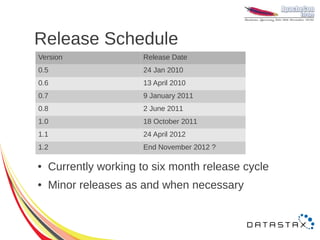
Release Schedule
Version                Release Date
0.5                    24 Jan 2010
0.6                    13 April 2010
0.7                    9 January 2011
0.8                    2 June 2011
1.0                    18 October 2011
1.1                    24 April 2012
1.2                    End November 2012 ?

●   Currently working to six month release cycle
●   Minor releases as and when necessary
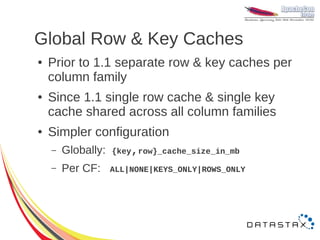
Global Row & Key Caches
●   Prior to 1.1 separate row & key caches per
    column family
●   Since 1.1 single row cache & single key
    cache shared across all column families
●   Simpler configuration
    –   Globally:   {key,row}_cache_size_in_mb

    –   Per CF:     ALL|NONE|KEYS_ONLY|ROWS_ONLY
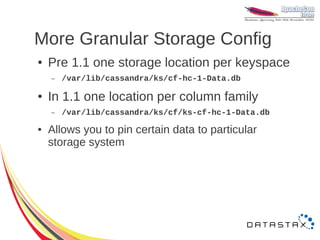
More Granular Storage Config
●   Pre 1.1 one storage location per keyspace
    –   /var/lib/cassandra/ks/cf-hc-1-Data.db

●   In 1.1 one location per column family
    –   /var/lib/cassandra/ks/cf/ks-cf-hc-1-Data.db
●   Allows you to pin certain data to particular
    storage system
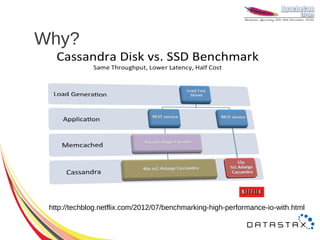
Why?


 http://techblog.netflix.com/2012/07/benchmarking-high-performance-io-with.html
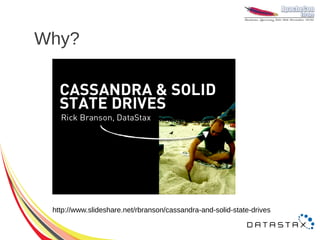
Why?


 http://www.slideshare.net/rbranson/cassandra-and-solid-state-drives
Row Level Isolation
●   Batched writes within row have always
    been atomic
●   Batched writes within row are now also
    isolated
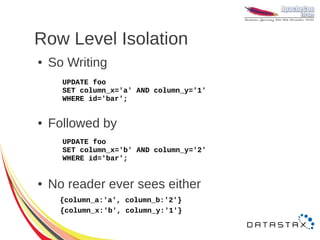
Row Level Isolation
●   So Writing
      UPDATE foo
      SET column_x='a' AND column_y='1'
      WHERE id='bar';


●   Followed by
      UPDATE foo
      SET column_x='b' AND column_y='2'
      WHERE id='bar';


●   No reader ever sees either
      {column_a:'a', column_b:'2'}
      {column_x:'b', column_y:'1'}
Misc Other Stuff
●   Windows off heap cache
●   write survey mode
●   commitlog segment pre-allocation/recycling
●   abortable compactions
●   multi threaded streaming
●   Hadoop improvements
    –   utilise secondary indexes from Hadoop
    –   better wide row support
CQL 3.0
●   Beta in 1.1, finalized in 1.2
●   Motivations
    –   Better support for wide rows
    –   Native syntax for composites
CQL 3.0
●   Wide Rows
●   Composites
●   Transposition
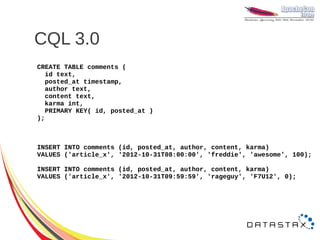
CQL 3.0
CREATE TABLE comments (
   id text,
   posted_at timestamp,
   author text,
   content text,
   karma int,
   PRIMARY KEY( id, posted_at )
);


INSERT INTO comments (id, posted_at, author, content, karma)
VALUES ('article_x', '2012-10-31T08:00:00', 'freddie', 'awesome', 100);

INSERT INTO comments (id, posted_at, author, content, karma)
VALUES ('article_x', '2012-10-31T09:59:59', 'rageguy', 'F7U12', 0);
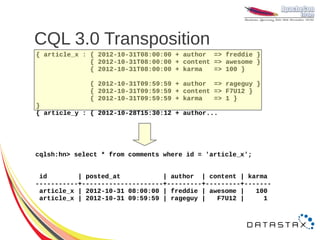
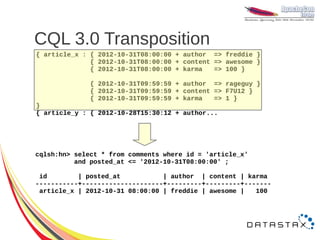
CQL 3.0 Transposition
{ article_x : { 2012-10-31T08:00:00 + author => freddie }
              { 2012-10-31T08:00:00 + content => awesome }
              { 2012-10-31T08:00:00 + karma   => 100 }

              { 2012-10-31T09:59:59 + author => rageguy }
              { 2012-10-31T09:59:59 + content => F7U12 }
              { 2012-10-31T09:59:59 + karma   => 1 }
}
{ article_y : { 2012-10-28T15:30:12 + author...


cqlsh:hn> select * from comments where id = 'article_x';


 id        | posted_at           | author | content | karma
-----------+---------------------+---------+---------+-------
 article_x | 2012-10-31 08:00:00 | freddie | awesome |   100
 article_x | 2012-10-31 09:59:59 | rageguy |   F7U12 |     1
CQL 3.0 Transposition
{ article_x : { 2012-10-31T08:00:00 + author => freddie }
              { 2012-10-31T08:00:00 + content => awesome }
              { 2012-10-31T08:00:00 + karma   => 100 }

              { 2012-10-31T09:59:59 + author => rageguy }
              { 2012-10-31T09:59:59 + content => F7U12 }
              { 2012-10-31T09:59:59 + karma   => 1 }
}
{ article_y : { 2012-10-28T15:30:12 + author...


cqlsh:hn> select * from comments where id = 'article_x'
          and posted_at <= '2012-10-31T08:00:00' ;

 id        | posted_at           | author | content | karma
-----------+---------------------+---------+---------+-------
 article_x | 2012-10-31 08:00:00 | freddie | awesome |   100
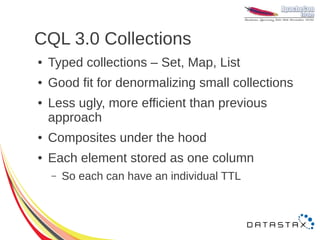
CQL 3.0 Collections
●   Typed collections – Set, Map, List
●   Good fit for denormalizing small collections
●   Less ugly, more efficient than previous
    approach
●   Composites under the hood
●   Each element stored as one column
    –   So each can have an individual TTL
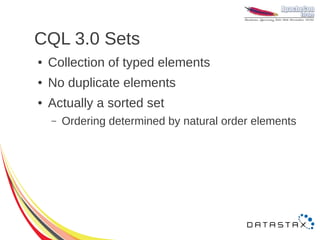
CQL 3.0 Sets
●   Collection of typed elements
●   No duplicate elements
●   Actually a sorted set
    –   Ordering determined by natural order elements
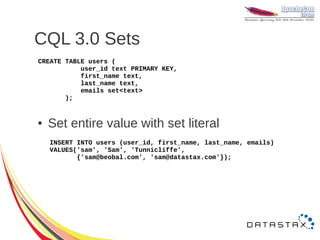
CQL 3.0 Sets
CREATE TABLE users (
           user_id text PRIMARY KEY,
           first_name text,
           last_name text,
           emails set<text>
       );


●   Set entire value with set literal
    INSERT INTO users (user_id, first_name, last_name, emails)
    VALUES('sam', 'Sam', 'Tunnicliffe',
           {'sam@beobal.com', 'sam@datastax.com'});
CQL 3.0 Sets
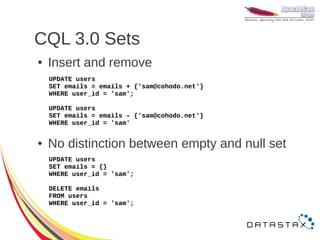
●   Insert and remove
    UPDATE users
    SET emails = emails + {'sam@cohodo.net'}
    WHERE user_id = 'sam';

    UPDATE users
    SET emails = emails – {'sam@cohodo.net'}
    WHERE user_id = 'sam'


●   No distinction between empty and null set
    UPDATE users
    SET emails = {}
    WHERE user_id = 'sam';

    DELETE emails
    FROM users
    WHERE user_id = 'sam';
CQL 3.0 Lists
●   Ordering determined by user, not by
    natural ordering of elements
●   Allows multiple occurrences of same value
CQL 3.0 Lists
ALTER TABLE users ADD todo list<text>;

●   Set, Prepend & Append
    UPDATE users
    SET todo = [ 'get to Sinsheim', 'give presentation' ]
    WHERE user_id = 'sam';

    UPDATE users
    SET todo = [ 'finish slides' ] + todo
    WHERE user_id = 'sam';

    UPDATE users
    SET todo = todo + [ 'drink beer' ]
    WHERE user_id = 'sam';
CQL 3.0 Lists
●   Access elements by index
    –   Less performant, requires read of entire list
    UPDATE users
    SET todo[2] = 'slow down'
    WHERE user_id = 'sam';

    DELETE todo[3]
    FROM users
    WHERE user_id = 'sam';


●   Remove by value
    UPDATE users
    SET todo = todo – ['finish slides']
    WHERE user_id = 'sam';
CQL 3.0 Maps
●   Collection of typed key/value pairs
●   Like sets, maps are actually ordered
    –   Ordering determined by the type of the keys
●   Operate on entire collection or individual
    element by key
CQL 3.0 Maps
ALTER TABLE users ADD accounts map<text, text>;
●   Set entire value with map literal
    UPDATE users
    SET accounts = { 'twitter' : 'beobal',
                     'irc'     : 'sam___' }
    WHERE user_id = 'sam';


●   Access elements by key
    UPDATE users
    SET accounts['irc'] = 'beobal@freenode.net'
    WHERE user_id = 'sam';

    DELETE accounts['twitter']
    FROM users
    WHERE user_id = 'sam';
CQL 3.0 Collections
●   Can only retrieve a collection in its entirety
    –   Collections are not intended to be very large
    –   Not a replacement for a good data model
●   Typed but cannot currently be nested
    –   Can't define a list<list<int>>
●   No support for secondary indexes
    –   On the roadmap but not yet implemented
CQL 3.0 Binary Protocol
●   Motivations
    –   Ability to optimize for specific use-cases
    –   Reduce client dependencies
    –   Lay groundwork for future enhancements such
        as streaming/paging
CQL 3.0 Binary Protocol
●   Framed protocol, designed natively for
    CQL 3.0
●   Built on Netty
●   Java, Python & C drivers in development
●   Switched off by default in 1.2
●   Thrift API will remain, no breaking API
    changes
Virtual Nodes
●   Evolution of Cassandra's distribution model
●   Nodes own multiple token ranges
●   Big implications for operations
    –   Replacing failed nodes
    –   Growing / shrinking cluster
●   Stay put for Eric
Concurrent Schema Changes
●   Online schema changes introduced in 0.7
●   Initially schema changes needed serializing
    –   Update schema
    –   Wait for propagation before making next
        change
●   Mostly fixed in 1.1
●   Completed in 1.2
    –   Concurrent ColumnFamily creation
Better JBOD Support
●   Growing data volumes and compaction
    requirements means moar disk
●   Pre 1.2 best practice is to run RAID10
●   Improvements to handling disk failures
    –   disk_failure_policy : stop | best_effort | ignore

    –   best_effort implications   for writes / reads
●   Better write balancing for less contention
Misc Other Stuff
●   Query Tracing
●   Speedup slicing wide rows from disk
●   Atomic Batches
Future Plans
●   Improved caching for wide rows
●   Remove 2-phase compaction
●   Remove SuperColumns internally
Thank you

Cassandra 2012

  • 1.
    Cassandra 2012: What's New& Upcoming Sam Tunnicliffe
  • 2.
    sam@datastax.com ● DSE : integrated Big Data platform – Built on Cassandra – Analytics using Hadoop (Hive/Pig/Mahout) – Enterprise Search with Solr
  • 3.
    Cassandra in 2012 ● Cassandra 1.1 – April 2012 ● Cassandra 1.2 – November 2012 ● What's on the roadmap
  • 4.
    Release Schedule Version Release Date 0.5 24 Jan 2010 0.6 13 April 2010 0.7 9 January 2011 0.8 2 June 2011 1.0 18 October 2011 1.1 24 April 2012 1.2 End November 2012 ? ● Currently working to six month release cycle ● Minor releases as and when necessary
  • 5.
    Global Row &Key Caches ● Prior to 1.1 separate row & key caches per column family ● Since 1.1 single row cache & single key cache shared across all column families ● Simpler configuration – Globally: {key,row}_cache_size_in_mb – Per CF: ALL|NONE|KEYS_ONLY|ROWS_ONLY
  • 6.
    More Granular StorageConfig ● Pre 1.1 one storage location per keyspace – /var/lib/cassandra/ks/cf-hc-1-Data.db ● In 1.1 one location per column family – /var/lib/cassandra/ks/cf/ks-cf-hc-1-Data.db ● Allows you to pin certain data to particular storage system
  • 7.
  • 8.
  • 9.
    Row Level Isolation ● Batched writes within row have always been atomic ● Batched writes within row are now also isolated
  • 10.
    Row Level Isolation ● So Writing UPDATE foo SET column_x='a' AND column_y='1' WHERE id='bar'; ● Followed by UPDATE foo SET column_x='b' AND column_y='2' WHERE id='bar'; ● No reader ever sees either {column_a:'a', column_b:'2'} {column_x:'b', column_y:'1'}
  • 11.
    Misc Other Stuff ● Windows off heap cache ● write survey mode ● commitlog segment pre-allocation/recycling ● abortable compactions ● multi threaded streaming ● Hadoop improvements – utilise secondary indexes from Hadoop – better wide row support
  • 12.
    CQL 3.0 ● Beta in 1.1, finalized in 1.2 ● Motivations – Better support for wide rows – Native syntax for composites
  • 13.
    CQL 3.0 ● Wide Rows ● Composites ● Transposition
  • 14.
    CQL 3.0 CREATE TABLEcomments ( id text, posted_at timestamp, author text, content text, karma int, PRIMARY KEY( id, posted_at ) ); INSERT INTO comments (id, posted_at, author, content, karma) VALUES ('article_x', '2012-10-31T08:00:00', 'freddie', 'awesome', 100); INSERT INTO comments (id, posted_at, author, content, karma) VALUES ('article_x', '2012-10-31T09:59:59', 'rageguy', 'F7U12', 0);
  • 15.
    CQL 3.0 Transposition {article_x : { 2012-10-31T08:00:00 + author => freddie } { 2012-10-31T08:00:00 + content => awesome } { 2012-10-31T08:00:00 + karma => 100 } { 2012-10-31T09:59:59 + author => rageguy } { 2012-10-31T09:59:59 + content => F7U12 } { 2012-10-31T09:59:59 + karma => 1 } } { article_y : { 2012-10-28T15:30:12 + author... cqlsh:hn> select * from comments where id = 'article_x'; id | posted_at | author | content | karma -----------+---------------------+---------+---------+------- article_x | 2012-10-31 08:00:00 | freddie | awesome | 100 article_x | 2012-10-31 09:59:59 | rageguy | F7U12 | 1
  • 16.
    CQL 3.0 Transposition {article_x : { 2012-10-31T08:00:00 + author => freddie } { 2012-10-31T08:00:00 + content => awesome } { 2012-10-31T08:00:00 + karma => 100 } { 2012-10-31T09:59:59 + author => rageguy } { 2012-10-31T09:59:59 + content => F7U12 } { 2012-10-31T09:59:59 + karma => 1 } } { article_y : { 2012-10-28T15:30:12 + author... cqlsh:hn> select * from comments where id = 'article_x' and posted_at <= '2012-10-31T08:00:00' ; id | posted_at | author | content | karma -----------+---------------------+---------+---------+------- article_x | 2012-10-31 08:00:00 | freddie | awesome | 100
  • 17.
    CQL 3.0 Collections ● Typed collections – Set, Map, List ● Good fit for denormalizing small collections ● Less ugly, more efficient than previous approach ● Composites under the hood ● Each element stored as one column – So each can have an individual TTL
  • 18.
    CQL 3.0 Sets ● Collection of typed elements ● No duplicate elements ● Actually a sorted set – Ordering determined by natural order elements
  • 19.
    CQL 3.0 Sets CREATETABLE users ( user_id text PRIMARY KEY, first_name text, last_name text, emails set<text> ); ● Set entire value with set literal INSERT INTO users (user_id, first_name, last_name, emails) VALUES('sam', 'Sam', 'Tunnicliffe', {'sam@beobal.com', 'sam@datastax.com'});
  • 20.
    CQL 3.0 Sets ● Insert and remove UPDATE users SET emails = emails + {'sam@cohodo.net'} WHERE user_id = 'sam'; UPDATE users SET emails = emails – {'sam@cohodo.net'} WHERE user_id = 'sam' ● No distinction between empty and null set UPDATE users SET emails = {} WHERE user_id = 'sam'; DELETE emails FROM users WHERE user_id = 'sam';
  • 21.
    CQL 3.0 Lists ● Ordering determined by user, not by natural ordering of elements ● Allows multiple occurrences of same value
  • 22.
    CQL 3.0 Lists ALTERTABLE users ADD todo list<text>; ● Set, Prepend & Append UPDATE users SET todo = [ 'get to Sinsheim', 'give presentation' ] WHERE user_id = 'sam'; UPDATE users SET todo = [ 'finish slides' ] + todo WHERE user_id = 'sam'; UPDATE users SET todo = todo + [ 'drink beer' ] WHERE user_id = 'sam';
  • 23.
    CQL 3.0 Lists ● Access elements by index – Less performant, requires read of entire list UPDATE users SET todo[2] = 'slow down' WHERE user_id = 'sam'; DELETE todo[3] FROM users WHERE user_id = 'sam'; ● Remove by value UPDATE users SET todo = todo – ['finish slides'] WHERE user_id = 'sam';
  • 24.
    CQL 3.0 Maps ● Collection of typed key/value pairs ● Like sets, maps are actually ordered – Ordering determined by the type of the keys ● Operate on entire collection or individual element by key
  • 25.
    CQL 3.0 Maps ALTERTABLE users ADD accounts map<text, text>; ● Set entire value with map literal UPDATE users SET accounts = { 'twitter' : 'beobal', 'irc' : 'sam___' } WHERE user_id = 'sam'; ● Access elements by key UPDATE users SET accounts['irc'] = 'beobal@freenode.net' WHERE user_id = 'sam'; DELETE accounts['twitter'] FROM users WHERE user_id = 'sam';
  • 26.
    CQL 3.0 Collections ● Can only retrieve a collection in its entirety – Collections are not intended to be very large – Not a replacement for a good data model ● Typed but cannot currently be nested – Can't define a list<list<int>> ● No support for secondary indexes – On the roadmap but not yet implemented
  • 27.
    CQL 3.0 BinaryProtocol ● Motivations – Ability to optimize for specific use-cases – Reduce client dependencies – Lay groundwork for future enhancements such as streaming/paging
  • 28.
    CQL 3.0 BinaryProtocol ● Framed protocol, designed natively for CQL 3.0 ● Built on Netty ● Java, Python & C drivers in development ● Switched off by default in 1.2 ● Thrift API will remain, no breaking API changes
  • 29.
    Virtual Nodes ● Evolution of Cassandra's distribution model ● Nodes own multiple token ranges ● Big implications for operations – Replacing failed nodes – Growing / shrinking cluster ● Stay put for Eric
  • 30.
    Concurrent Schema Changes ● Online schema changes introduced in 0.7 ● Initially schema changes needed serializing – Update schema – Wait for propagation before making next change ● Mostly fixed in 1.1 ● Completed in 1.2 – Concurrent ColumnFamily creation
  • 31.
    Better JBOD Support ● Growing data volumes and compaction requirements means moar disk ● Pre 1.2 best practice is to run RAID10 ● Improvements to handling disk failures – disk_failure_policy : stop | best_effort | ignore – best_effort implications for writes / reads ● Better write balancing for less contention
  • 32.
    Misc Other Stuff ● Query Tracing ● Speedup slicing wide rows from disk ● Atomic Batches
  • 33.
    Future Plans ● Improved caching for wide rows ● Remove 2-phase compaction ● Remove SuperColumns internally
  • 34.