Cassandra - A Decentralized
Structured Storage System
Avinash Lakshman and Prashant Malik
Facebook
Presented by Ravi Theja M
Agenda
• Outline
• Data Model
• System Architecture
• Implementation
• Experiments
Outline
• Extension of Bigtable with aspects of Dynamo
• Motivations:
– High Availability
– High Write Throughput
– Fail Tolerance
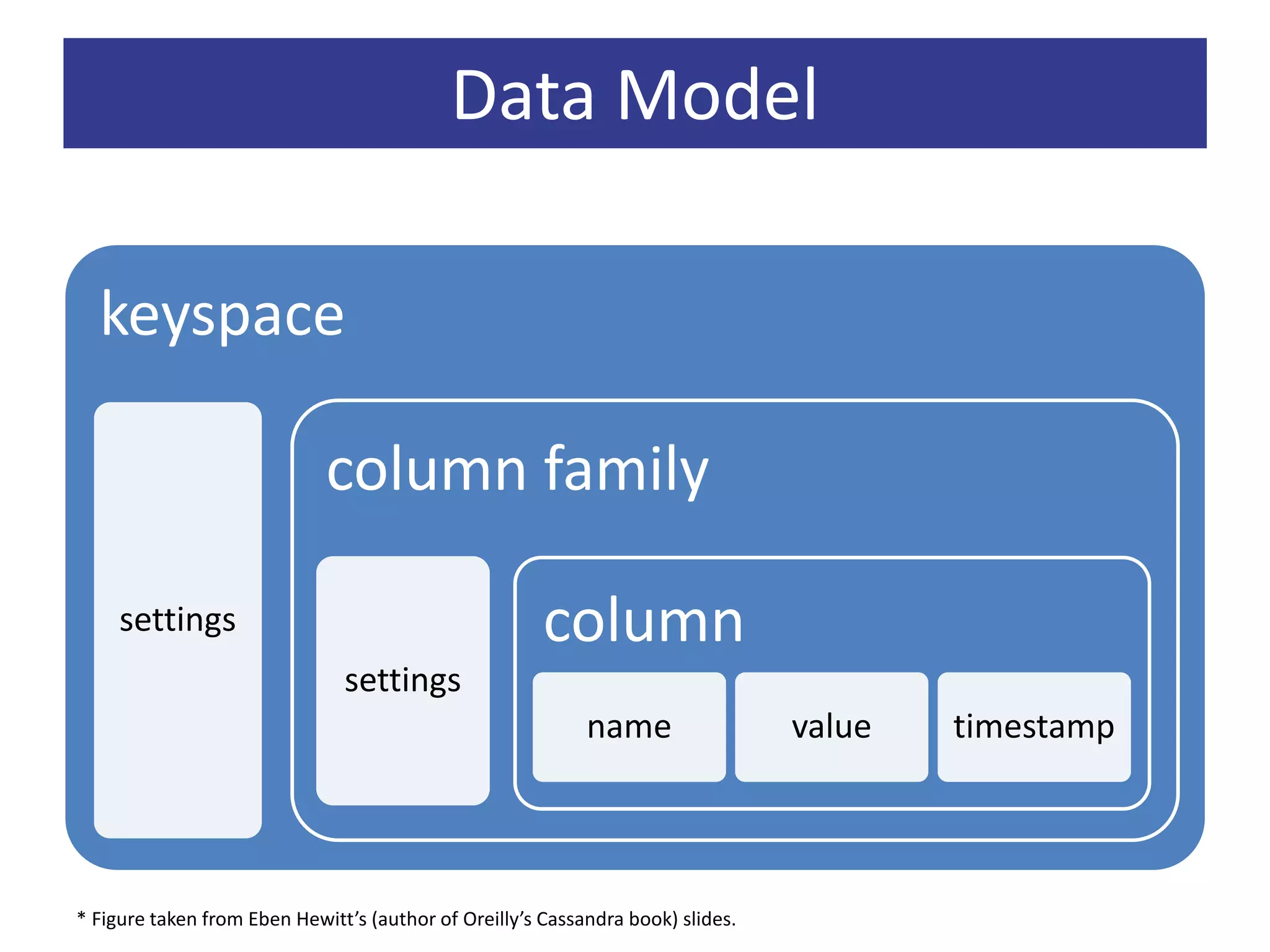
Data Model
• Table is a multi dimensional map indexed by key (row key).
• Columns are grouped into Column Families.
• 2 Types of Column Families
– Simple
– Super (nested Column Families)
• Each Column has
– Name
– Value
– Timestamp
Data Model
keyspace
settings
column family
settings
column
name value timestamp
* Figure taken from Eben Hewitt’s (author of Oreilly’s Cassandra book) slides.
• Partitioning
How data is partitioned across nodes
• Replication
How data is duplicated across nodes
• Cluster Membership
How nodes are added, deleted to the cluster
System Architecture
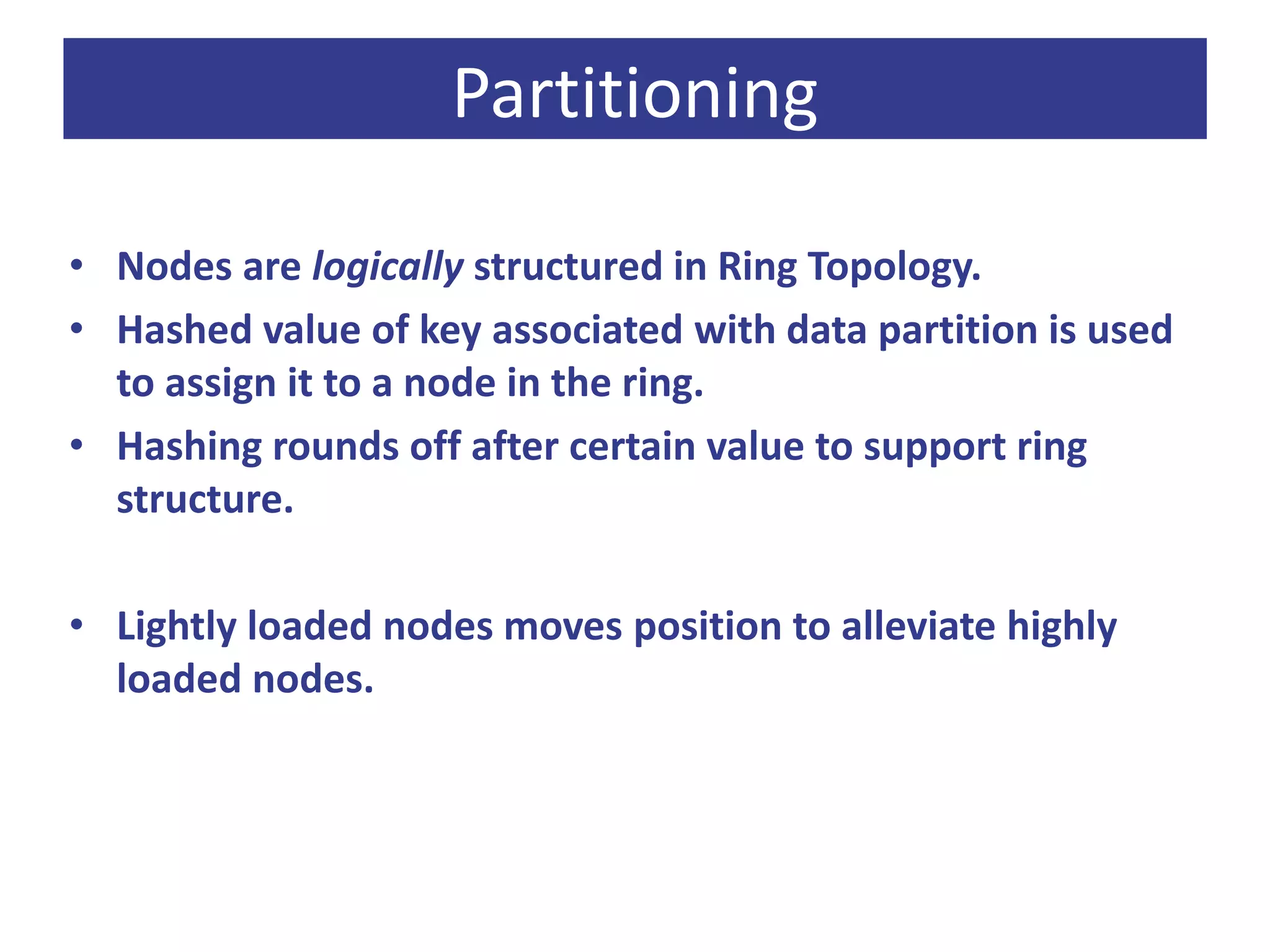
• Nodes are logically structured in Ring Topology.
• Hashed value of key associated with data partition is used
to assign it to a node in the ring.
• Hashing rounds off after certain value to support ring
structure.
• Lightly loaded nodes moves position to alleviate highly
loaded nodes.
Partitioning
Replication
• Each data item is replicated at N (replication factor) nodes.
• Different Replication Policies
– Rack Unaware – replicate data at N-1 successive nodes after its
coordinator
– Rack Aware – uses ‘Zookeeper’ to choose a leader which tells nodes
the range they are replicas for
– Datacenter Aware – similar to Rack Aware but leader is chosen at
Datacenter level instead of Rack level.
0
1
1/2
F
E
D
C
B
A N=3
h(key2)
h(key1)
9
Partitioning and Replication
* Figure taken from Avinash Lakshman and Prashant Malik (authors of the paper) slides.
Gossip Protocols
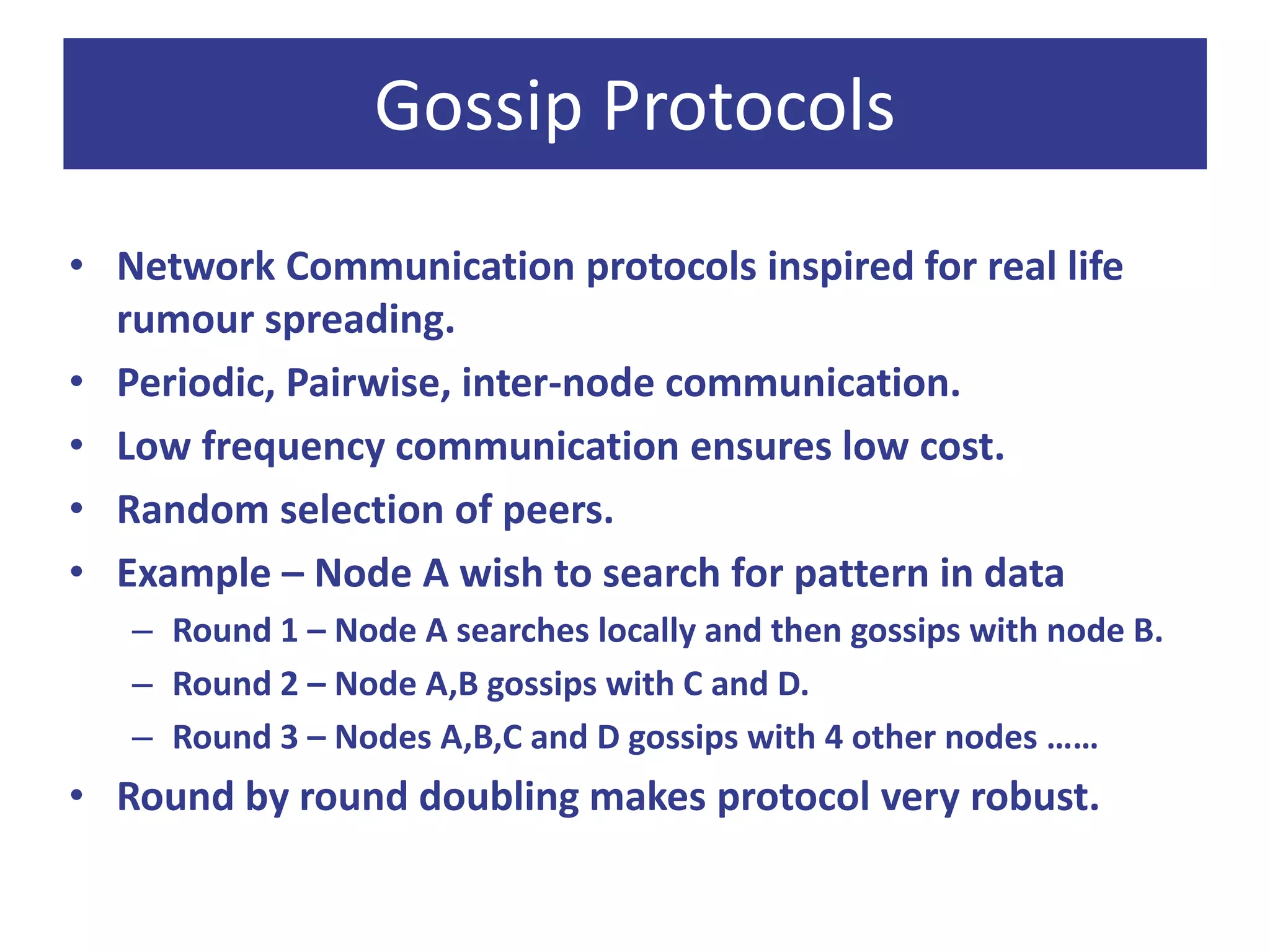
• Network Communication protocols inspired for real life
rumour spreading.
• Periodic, Pairwise, inter-node communication.
• Low frequency communication ensures low cost.
• Random selection of peers.
• Example – Node A wish to search for pattern in data
– Round 1 – Node A searches locally and then gossips with node B.
– Round 2 – Node A,B gossips with C and D.
– Round 3 – Nodes A,B,C and D gossips with 4 other nodes ……
• Round by round doubling makes protocol very robust.
Gossip Protocols
• Variety of Gossip Protocols exists
– Dissemination protocol
• Event Dissemination: multicasts events via gossip. high latency might cause
network strain.
• Background data dissemination: continuous gossip about information
regarding participating nodes
– Anti Entropy protocol
• Used to repair replicated data by comparing and reconciling differences. This
type of protocol is used in Cassandra to repair data in replications.
Cluster Management
• Uses Scuttleback (a Gossip protocol) to manage nodes.
• Uses gossip for node membership and to transmit system
control state.
• Node Fail state is given by variable ‘phi’ which tells how
likely a node might fail (suspicion level) instead of simple
binary value (up/down).
• This type of system is known as Accrual Failure Detector.
Accrual Failure Detector
• If a node is faulty, the suspicion level monotonically
increases with time.
Φ(t)  k as t  k
Where k is a threshold variable (depends on system load)
which tells a node is dead.
• If node is correct, phi will be constant set by application.
Generally
Φ(t) = 0
Bootstrapping and Scaling
• Two ways to add new node
– New node gets assigned a random token which gives its position in
the ring. It gossips its location to rest of the ring
– New node reads its config file to contact it initial contact points.
• New nodes are added manually by administrator via CLI or
Web interface provided by Cassandra.
• Scaling in Cassandra is designed to be easy.
• Lightly loaded nodes can move in the ring to alleviate
heavily loaded nodes.
Local Persistence
• Relies on local file system for data persistency.
• Write operations happens in 2 steps
– Write to commit log in local disk of the node
– Update in-memory data structure.
– Why 2 steps or any preference to order or execution?
• Read operation
– Looks up in-memory ds first before looking up files on disk.
– Uses Bloom Filter (summarization of keys in file store in memory)
to avoid looking up files that do not contain the key.
Query
Closest replica
Cassandra Cluster
Replica A
Result
Replica B Replica C
Digest Query
Digest Response Digest Response
Result
Client
Read repair if
digests differ
Read Operation
* Figure taken from Avinash Lakshman and Prashant Malik (authors of the paper) slides.
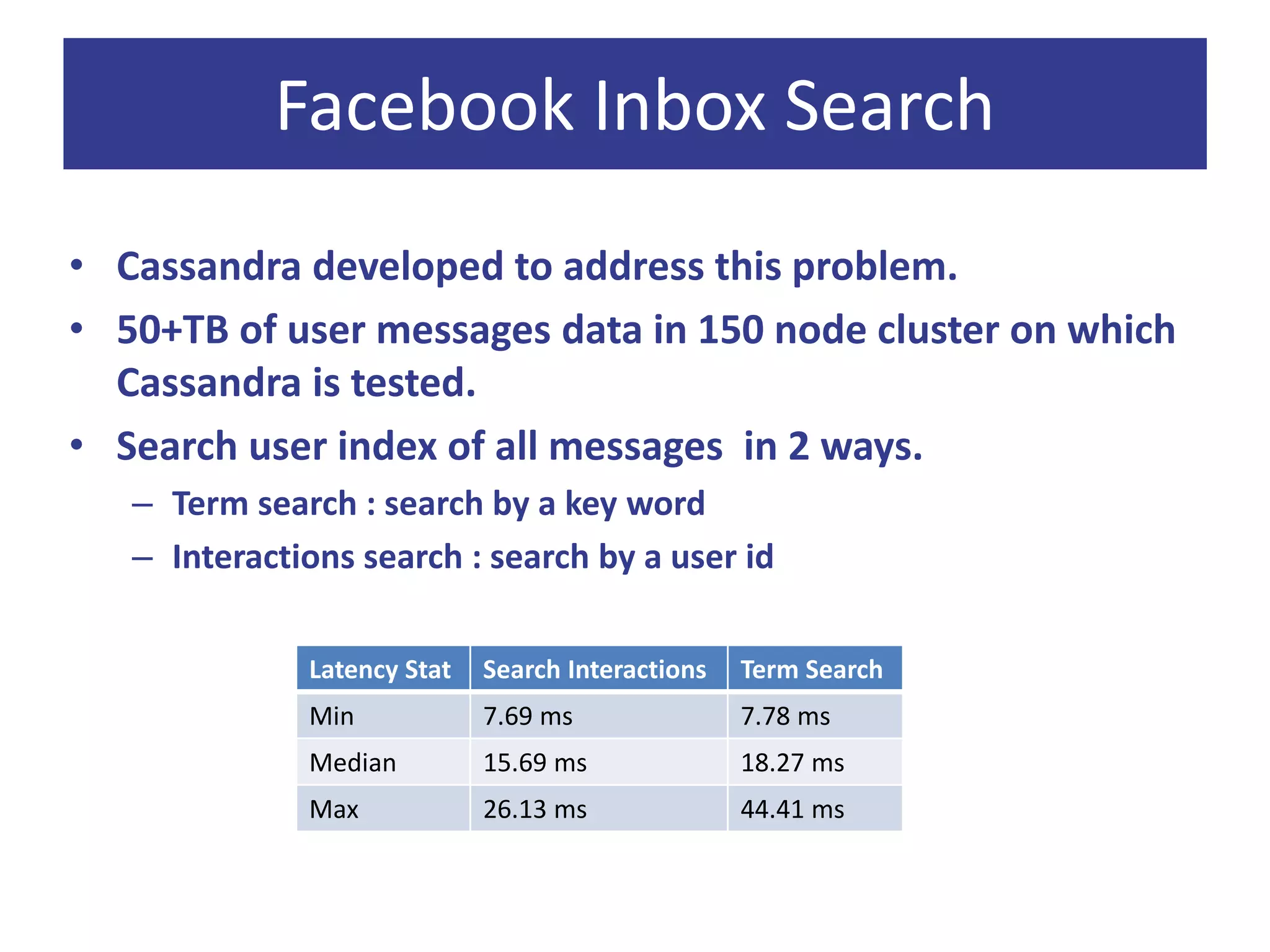
Facebook Inbox Search
• Cassandra developed to address this problem.
• 50+TB of user messages data in 150 node cluster on which
Cassandra is tested.
• Search user index of all messages in 2 ways.
– Term search : search by a key word
– Interactions search : search by a user id
Latency Stat Search Interactions Term Search
Min 7.69 ms 7.78 ms
Median 15.69 ms 18.27 ms
Max 26.13 ms 44.41 ms
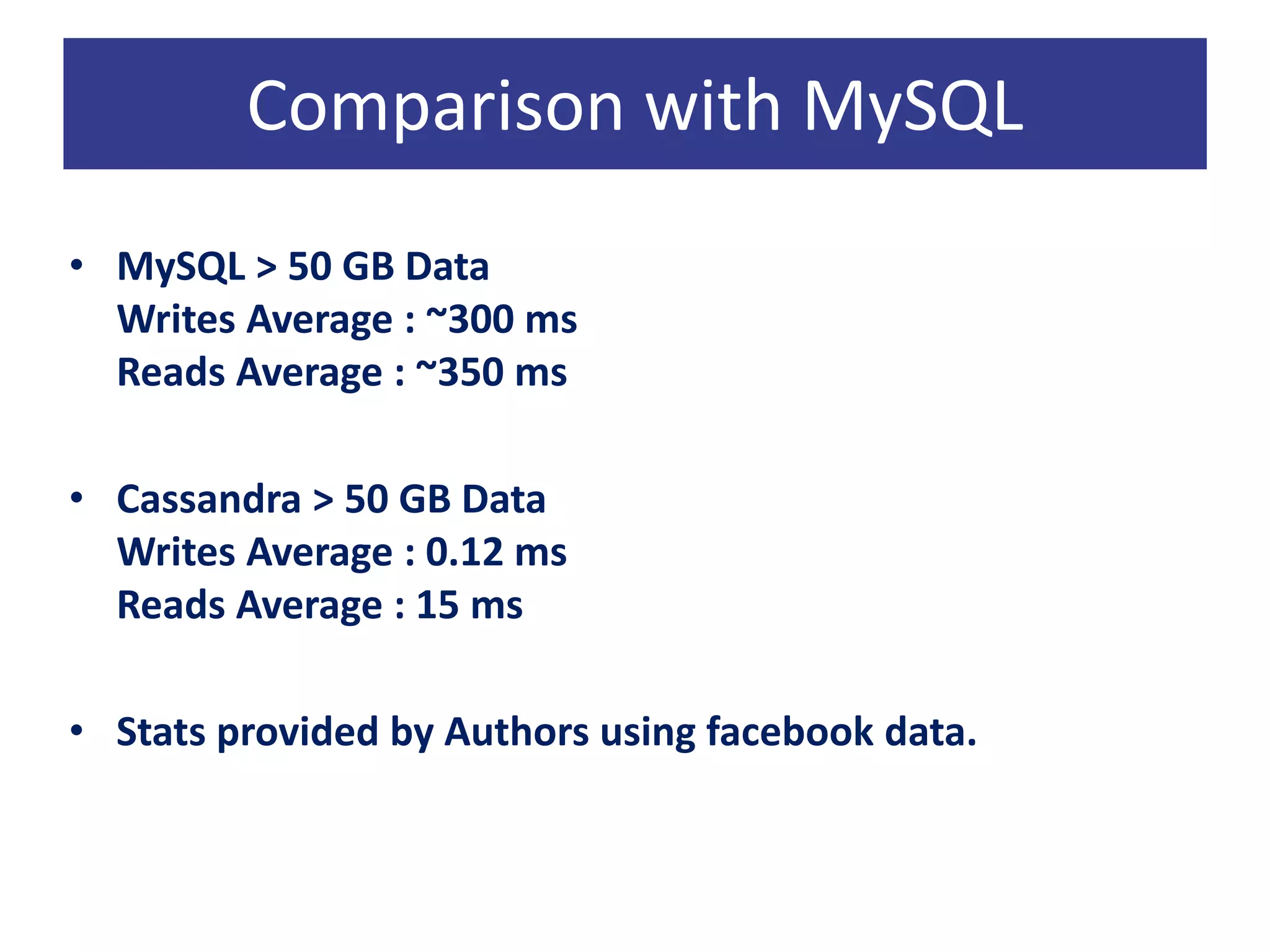
Comparison with MySQL
• MySQL > 50 GB Data
Writes Average : ~300 ms
Reads Average : ~350 ms
• Cassandra > 50 GB Data
Writes Average : 0.12 ms
Reads Average : 15 ms
• Stats provided by Authors using facebook data.
Comparison using YCSB
• Following results taken from ‘Benchmarking Cloud Serving
Systems with YCSB’ by Brain F Cooper et all.
• YCSB is Yahoo Cloud Server Benchmarking framework.
• Comparison between Cassandra, HBase, PNUTS, and
MySQL.
• Cassandra and Hbase have higher read latencies on a read
heavy workload than PNUTS and MySQL, and lower update
latencies on a write heavy workload.
• PNUTS and Cassandra scaled well as the number of servers
and workload increased proportionally.
Comparison using YCSB
• Cassandra, HBase and PNUTS were able to grow elastically
while the workload was executing.
• PNUTS and Cassandra scaled well as the number of
• servers and workload increased proportionally. HBase’s
• performance was more erratic as the system scaled.
Thank You

Cassandra

  • 1.
    Cassandra - ADecentralized Structured Storage System Avinash Lakshman and Prashant Malik Facebook Presented by Ravi Theja M
  • 2.
    Agenda • Outline • DataModel • System Architecture • Implementation • Experiments
  • 3.
    Outline • Extension ofBigtable with aspects of Dynamo • Motivations: – High Availability – High Write Throughput – Fail Tolerance
  • 4.
    Data Model • Tableis a multi dimensional map indexed by key (row key). • Columns are grouped into Column Families. • 2 Types of Column Families – Simple – Super (nested Column Families) • Each Column has – Name – Value – Timestamp
  • 5.
    Data Model keyspace settings column family settings column namevalue timestamp * Figure taken from Eben Hewitt’s (author of Oreilly’s Cassandra book) slides.
  • 6.
    • Partitioning How datais partitioned across nodes • Replication How data is duplicated across nodes • Cluster Membership How nodes are added, deleted to the cluster System Architecture
  • 7.
    • Nodes arelogically structured in Ring Topology. • Hashed value of key associated with data partition is used to assign it to a node in the ring. • Hashing rounds off after certain value to support ring structure. • Lightly loaded nodes moves position to alleviate highly loaded nodes. Partitioning
  • 8.
    Replication • Each dataitem is replicated at N (replication factor) nodes. • Different Replication Policies – Rack Unaware – replicate data at N-1 successive nodes after its coordinator – Rack Aware – uses ‘Zookeeper’ to choose a leader which tells nodes the range they are replicas for – Datacenter Aware – similar to Rack Aware but leader is chosen at Datacenter level instead of Rack level.
  • 9.
    0 1 1/2 F E D C B A N=3 h(key2) h(key1) 9 Partitioning andReplication * Figure taken from Avinash Lakshman and Prashant Malik (authors of the paper) slides.
  • 10.
    Gossip Protocols • NetworkCommunication protocols inspired for real life rumour spreading. • Periodic, Pairwise, inter-node communication. • Low frequency communication ensures low cost. • Random selection of peers. • Example – Node A wish to search for pattern in data – Round 1 – Node A searches locally and then gossips with node B. – Round 2 – Node A,B gossips with C and D. – Round 3 – Nodes A,B,C and D gossips with 4 other nodes …… • Round by round doubling makes protocol very robust.
  • 11.
    Gossip Protocols • Varietyof Gossip Protocols exists – Dissemination protocol • Event Dissemination: multicasts events via gossip. high latency might cause network strain. • Background data dissemination: continuous gossip about information regarding participating nodes – Anti Entropy protocol • Used to repair replicated data by comparing and reconciling differences. This type of protocol is used in Cassandra to repair data in replications.
  • 12.
    Cluster Management • UsesScuttleback (a Gossip protocol) to manage nodes. • Uses gossip for node membership and to transmit system control state. • Node Fail state is given by variable ‘phi’ which tells how likely a node might fail (suspicion level) instead of simple binary value (up/down). • This type of system is known as Accrual Failure Detector.
  • 13.
    Accrual Failure Detector •If a node is faulty, the suspicion level monotonically increases with time. Φ(t)  k as t  k Where k is a threshold variable (depends on system load) which tells a node is dead. • If node is correct, phi will be constant set by application. Generally Φ(t) = 0
  • 14.
    Bootstrapping and Scaling •Two ways to add new node – New node gets assigned a random token which gives its position in the ring. It gossips its location to rest of the ring – New node reads its config file to contact it initial contact points. • New nodes are added manually by administrator via CLI or Web interface provided by Cassandra. • Scaling in Cassandra is designed to be easy. • Lightly loaded nodes can move in the ring to alleviate heavily loaded nodes.
  • 15.
    Local Persistence • Relieson local file system for data persistency. • Write operations happens in 2 steps – Write to commit log in local disk of the node – Update in-memory data structure. – Why 2 steps or any preference to order or execution? • Read operation – Looks up in-memory ds first before looking up files on disk. – Uses Bloom Filter (summarization of keys in file store in memory) to avoid looking up files that do not contain the key.
  • 16.
    Query Closest replica Cassandra Cluster ReplicaA Result Replica B Replica C Digest Query Digest Response Digest Response Result Client Read repair if digests differ Read Operation * Figure taken from Avinash Lakshman and Prashant Malik (authors of the paper) slides.
  • 17.
    Facebook Inbox Search •Cassandra developed to address this problem. • 50+TB of user messages data in 150 node cluster on which Cassandra is tested. • Search user index of all messages in 2 ways. – Term search : search by a key word – Interactions search : search by a user id Latency Stat Search Interactions Term Search Min 7.69 ms 7.78 ms Median 15.69 ms 18.27 ms Max 26.13 ms 44.41 ms
  • 18.
    Comparison with MySQL •MySQL > 50 GB Data Writes Average : ~300 ms Reads Average : ~350 ms • Cassandra > 50 GB Data Writes Average : 0.12 ms Reads Average : 15 ms • Stats provided by Authors using facebook data.
  • 19.
    Comparison using YCSB •Following results taken from ‘Benchmarking Cloud Serving Systems with YCSB’ by Brain F Cooper et all. • YCSB is Yahoo Cloud Server Benchmarking framework. • Comparison between Cassandra, HBase, PNUTS, and MySQL. • Cassandra and Hbase have higher read latencies on a read heavy workload than PNUTS and MySQL, and lower update latencies on a write heavy workload. • PNUTS and Cassandra scaled well as the number of servers and workload increased proportionally.
  • 20.
    Comparison using YCSB •Cassandra, HBase and PNUTS were able to grow elastically while the workload was executing. • PNUTS and Cassandra scaled well as the number of • servers and workload increased proportionally. HBase’s • performance was more erratic as the system scaled.
  • 21.