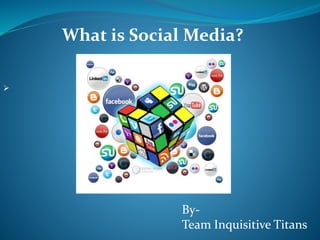
What is Social Media? 
 
By- 
Team Inquisitive Titans
What is Social Media? 
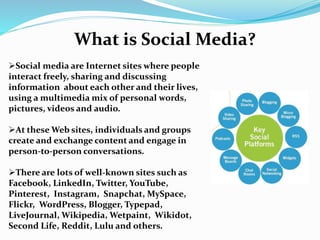
Social media are Internet sites where people 
interact freely, sharing and discussing 
information about each other and their lives, 
using a multimedia mix of personal words, 
pictures, videos and audio. 
At these Web sites, individuals and groups 
create and exchange content and engage in 
person-to-person conversations. 
There are lots of well-known sites such as 
Facebook, LinkedIn, Twitter, YouTube, 
Pinterest, Instagram, Snapchat, MySpace, 
Flickr, WordPress, Blogger, Typepad, 
LiveJournal, Wikipedia, Wetpaint, Wikidot, 
Second Life, Reddit, Lulu and others.
Characteristics of different types of Social Media 
• Online Social Networking- Services that allow you to connect with 
other people of similar interests and background. Usually they consist 
of a profile, various ways to interact with other users, ability to setup 
groups, etc. (Facebook , LinkedIn) 
• Bookmarking Sites - Services that allow you to save, organize and 
manage links to various websites and resources around the 
internet. Most allow you to “tag” your links to make them easy to search 
and share. (Delicious , StumbleUpon) 
• Social News - Services that allow people to post various news items or 
links to outside articles and then allows it’s users to ”vote” on the items. 
(Digg , Reddit) 
• Media Sharing - Services that allow you to upload and share various 
media such as pictures and video. (Youtube, Flickr) 
• Microblogging - Services that focus on short updates that are pushed 
out to anyone subscribed to receive the updates. (Twitter)
Technologies and Techniques involved in Social Media 
• FOAF (Friend Of A Friend) - machine readable ontology 
describing persons, their activities and their relations to other 
people and objects. 
• XHTML Friends Network (XFN)- provides a simple way to 
represent human relationships using links. 
• lOGin- is a form of single sign-on using 
existing login information from a social networking service. 
• Data Mining - Data mining is part of a group of concepts or 
techniques related to business intelligence, or e-business 
intelligence. It involves obtaining information from a variety of 
sources that is stored in a data warehouse.
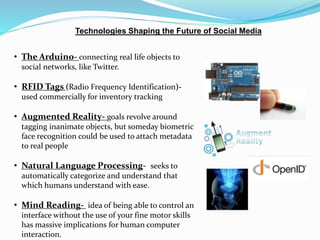
Technologies Shaping the Future of Social Media 
• The Arduino- connecting real life objects to 
social networks, like Twitter. 
• RFID Tags (Radio Frequency Identification)- 
used commercially for inventory tracking 
• Augmented Reality- goals revolve around 
tagging inanimate objects, but someday biometric 
face recognition could be used to attach metadata 
to real people 
• Natural Language Processing- seeks to 
automatically categorize and understand that 
which humans understand with ease. 
• Mind Reading- idea of being able to control an 
interface without the use of your fine motor skills 
has massive implications for human computer 
interaction.
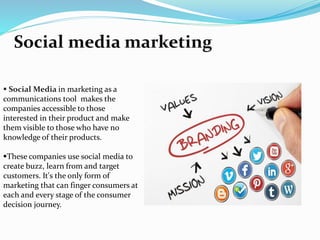
Social media marketing 
 Social Media in marketing as a 
communications tool makes the 
companies accessible to those 
interested in their product and make 
them visible to those who have no 
knowledge of their products. 
These companies use social media to 
create buzz, learn from and target 
customers. It's the only form of 
marketing that can finger consumers at 
each and every stage of the consumer 
decision journey.
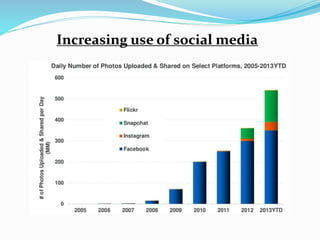
Increasing use of social media
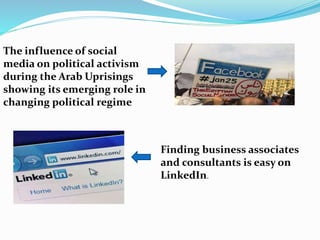
The influence of social 
media on political activism 
during the Arab Uprisings 
showing its emerging role in 
changing political regime 
Finding business associates 
and consultants is easy on 
LinkedIn.
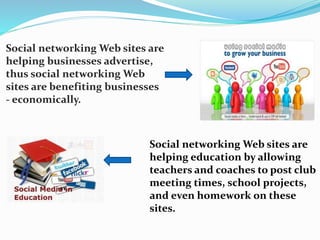
Social networking Web sites are 
helping businesses advertise, 
thus social networking Web 
sites are benefiting businesses 
- economically. 
Social networking Web sites are 
helping education by allowing 
teachers and coaches to post club 
meeting times, school projects, 
and even homework on these 
sites.
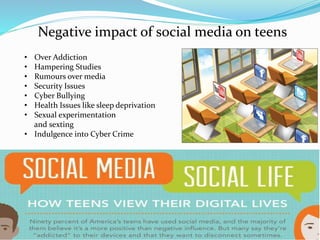
Negative impact of social media on teens 
• Over Addiction 
• Hampering Studies 
• Rumours over media 
• Security Issues 
• Cyber Bullying 
• Health Issues like sleep deprivation 
• Sexual experimentation 
and sexting 
• Indulgence into Cyber Crime

Casiappt

  • 1.
    What is SocialMedia?  By- Team Inquisitive Titans
  • 2.
    What is SocialMedia? Social media are Internet sites where people interact freely, sharing and discussing information about each other and their lives, using a multimedia mix of personal words, pictures, videos and audio. At these Web sites, individuals and groups create and exchange content and engage in person-to-person conversations. There are lots of well-known sites such as Facebook, LinkedIn, Twitter, YouTube, Pinterest, Instagram, Snapchat, MySpace, Flickr, WordPress, Blogger, Typepad, LiveJournal, Wikipedia, Wetpaint, Wikidot, Second Life, Reddit, Lulu and others.
  • 3.
    Characteristics of differenttypes of Social Media • Online Social Networking- Services that allow you to connect with other people of similar interests and background. Usually they consist of a profile, various ways to interact with other users, ability to setup groups, etc. (Facebook , LinkedIn) • Bookmarking Sites - Services that allow you to save, organize and manage links to various websites and resources around the internet. Most allow you to “tag” your links to make them easy to search and share. (Delicious , StumbleUpon) • Social News - Services that allow people to post various news items or links to outside articles and then allows it’s users to ”vote” on the items. (Digg , Reddit) • Media Sharing - Services that allow you to upload and share various media such as pictures and video. (Youtube, Flickr) • Microblogging - Services that focus on short updates that are pushed out to anyone subscribed to receive the updates. (Twitter)
  • 4.
    Technologies and Techniquesinvolved in Social Media • FOAF (Friend Of A Friend) - machine readable ontology describing persons, their activities and their relations to other people and objects. • XHTML Friends Network (XFN)- provides a simple way to represent human relationships using links. • lOGin- is a form of single sign-on using existing login information from a social networking service. • Data Mining - Data mining is part of a group of concepts or techniques related to business intelligence, or e-business intelligence. It involves obtaining information from a variety of sources that is stored in a data warehouse.
  • 5.
    Technologies Shaping theFuture of Social Media • The Arduino- connecting real life objects to social networks, like Twitter. • RFID Tags (Radio Frequency Identification)- used commercially for inventory tracking • Augmented Reality- goals revolve around tagging inanimate objects, but someday biometric face recognition could be used to attach metadata to real people • Natural Language Processing- seeks to automatically categorize and understand that which humans understand with ease. • Mind Reading- idea of being able to control an interface without the use of your fine motor skills has massive implications for human computer interaction.
  • 6.
    Social media marketing  Social Media in marketing as a communications tool makes the companies accessible to those interested in their product and make them visible to those who have no knowledge of their products. These companies use social media to create buzz, learn from and target customers. It's the only form of marketing that can finger consumers at each and every stage of the consumer decision journey.
  • 8.
    Increasing use ofsocial media
  • 9.
    The influence ofsocial media on political activism during the Arab Uprisings showing its emerging role in changing political regime Finding business associates and consultants is easy on LinkedIn.
  • 10.
    Social networking Websites are helping businesses advertise, thus social networking Web sites are benefiting businesses - economically. Social networking Web sites are helping education by allowing teachers and coaches to post club meeting times, school projects, and even homework on these sites.
  • 11.
    Negative impact ofsocial media on teens • Over Addiction • Hampering Studies • Rumours over media • Security Issues • Cyber Bullying • Health Issues like sleep deprivation • Sexual experimentation and sexting • Indulgence into Cyber Crime