Social Networking
By Group 4
Chapter 8:
Social networks are websites
and apps that allow users
and organizations to
connect, communicate,
share information and form
relationships.
WHAT IS SOCIAL NETWORKING SITES?
FACEBOOK
• Social networking site for
keeping up with friends,
uploading photos, sharing
links and videos, and
meeting new people
online
• 750 million estimated
unique visitors monthly
TUMBLR
• Microblogging platform
and social network Web
site that enables users to
post multimedia and
other content in
shortform blog
• 300 million estimated
unique visitors monthly
TWITTER/X
• Real-time information service
for friends, family members,
and coworkers looking to stay
connected through the
exchange of messages that are
a maximum of 140 characters
• 250 million estimated unique
visitors monthly
LINKEDIN
• Business-oriented social
networking site used for
professional networking;
users create a network
made up of people they
know and trust in business
• 110 million estimated
unique visitors monthly
PINTEREST
• Social networking site that
allows members to pin
photos, videos, and other
items to their pin board to
share with others know and
trust in business
• 86 million estimated unique
visitors monthly
MYSPACE
• It allows members to
communicate with friends
via personal profiles, blogs,
and groups, as well as to
post photos, music, and
videos to their personal
pages
• 70 million estimated unique
GOOGLE+
• Social network operated by
Google that integrates social
services such as Google Profiles
and Google Buzz, and
introduces new services such as
Circles, Hangouts, Sparks and
Huddles
• 65 million estimated unique
visitors monthly
INSTAGRAM
• Online photo-and video-
sharing social
networking service
• 59 million estimated
unique visitors monthly
LIVEJOURNAL
• Social network where
users can keep a blog,
journal, or diary; also
widely used to post
political commentary
• 21 million estimated
unique visitors monthly
TAGGED
• Social network with a
focus on helping
members meet new
people; suggests new
friends based on shared
interests
• 25 million estimated
unique visitors monthly
ORKUT
• Social network for users to
meet new and old friends
and maintain existing
friendships
• 18 million estimated
unique visitors monthly
Uses of Social
Networking
Rimberi
o
Presented By Veanne Megh C. Canta
1.Social Network Advertising
Social network advertising, also known as
social media advertising, is a type of digital
marketing, transforming how businesses
reach audiences through social media
platforms like Facebook, Instagram, and
TikTok.
It is estimated that 89 percent of advertisers use
free tools such as Facebook, Twitter, or Pinterest
to promote their products. Additionally, 75
percent of advertisers use paid media such as ads
on Facebook or sponsored blog content.
Two significant advantages of social
network advertising over more
traditional advertising media are:
(1) advertisers can create an opportunity
to generate a conversation with viewers
of the ad, and
(2) ads can be targeted to reach people
with the desired demographic
characteristics.
The two primary objectives of social
media advertisers are:
(1) raising brand awareness, and
(2)driving traffic to a Website to increase
product sales.
Different Social Network
Advertising Strategies
that Organizations
may employ:
1.Direct Advertising
Rimberi
o
Direct advertising refers to marketing efforts where
businesses communicate directly with their target
audience to promote products or services, without
intermediaries. This approach aims to prompt
immediate action, such as making a purchase or free
trial. Direct advertising can take various forms,
including direct mail, telemarketing, email
marketing, and online ads.
2. Advertising Using an
Individual’s Network of
Friends
Rimberi
o
company can use social networking
web sites to advertise to an
individual’s network of contacts.
Rimberi
o
3. Indirect
Advertising
through Groups
This is where an individual or a
group of people are being a fan of a
product. This is where they create a
social networking web site that
interested users can join by
becoming “fans” of that page.
A Company-owned Social
Networking Website
A variation on the above approach is for a
company to form its own social networking
Website.
For example, Dell created its own social
networking Web site, IdeaStorm, in February
2007as a means for its millions of customers in
more than 100 countries to talk about what new
products, services, or improvements they would
like to see Dell develop.
Viral Marketing
Viral marketing is a strategy that
aims to spread information about a
product or service quickly and
widely, much like a virus. The goal
is to encourage individuals to share
the marketing message with
others, creating exponential growth
in the message's visibility and
impact.
2.The Use of Social
Networks in the
Hiring Process
One key advantage of using social networks
in hiring is the ability to access a vast array
of professional profiles. Recruiters can easily
review a candidate’s professional history and
endorsements, facilitating a more informed
decision-making process.
In addition to LinkedIn, companies also use platforms like Twitter
and Facebook to engage with potential candidates. Furthermore,
companies have begun utilizing social networks to conduct initial
screenings.
3.The Use of Social Media to Improve
Customer Service
One of the primary benefits of using social
media for customer service is the immediacy
it offers. Platforms like Twitter and Facebook
allow businesses to address customer
inquiries and complaints in real time.
Moreover, social media allows businesses to
reach a broader audience simultaneously.
4.Social Shopping Web Sites
Social shopping refers to the merging of
social media and ecommerce, allowing users
to browse, share, and purchase products
directly within their social media platforms.
Examples of platforms that facilitate social
shopping include Instagram, Pinterest,
TikTok, and Facebook.
Social Networking
Ethical Issues
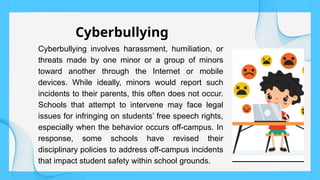
Cyberbullying involves harassment, humiliation, or
threats made by one minor or a group of minors
toward another through the Internet or mobile
devices. While ideally, minors would report such
incidents to their parents, this often does not occur.
Schools that attempt to intervene may face legal
issues for infringing on students’ free speech rights,
especially when the behavior occurs off-campus. In
response, some schools have revised their
disciplinary policies to address off-campus incidents
that impact student safety within school grounds.
Cyberbullying
Cyberstalking is the adult counterpart of
cyberbullying, involving threatening behavior
or unwelcome advances via digital
communication platforms. Victims often suffer
from severe emotional distress, and incidents
may escalate to phone harassment,
threatening messages, physical stalking, or
even assault. This behavior can cause lasting
psychological harm and poses a serious
threat to personal safety.
Cyberstalking
Some social networking sites have been
criticized for insufficient measures in
protecting minors from online predators. One
notable example is MySpace, which undertook
a two-year campaign to remove potentially
dangerous users. In early 2009, the platform
banned 90,000 registered sex offenders in a
significant move to safeguard its younger
users.
Encounters with Sexual
Predators
Most social networking platforms maintain strict policies
against uploading violent or obscene content. These are
typically outlined in terms of use agreements, privacy
policies, and content conduct codes. While such rules
prohibit sexually explicit, defamatory, hateful, or illegal
content, enforcement remains a challenge due to the
vast amount of content submitted daily. For instance,
YouTube receives over 100 hours of video uploads
every minute—equivalent to 670,000 full-length movies
per week—making it nearly impossible to monitor all
content manual.
Uploading of
Inappropriate Material
ONLINE VIRTUAL WORLDS
AND ITS RELATIONSHIP TO
THE INDIVIDUAL'S SOCIETAL
BEHAVIOR
Online virtual worlds are computer-simulated
environments where users (often through avatars) can
interact, play, work, or socialize in real time. These
spaces replicate real-world settings or offer entirely
fictional environments.
What are online virtual
worlds?
Second Life, Roblox, Minecraft, The
Sims Online, VRChat, and Player
Unknowns Battle Ground.
Examples:
Characteristics of Virtual Worlds
• Immersive: Users experience a strong sense
of presence in the digital environment.
• Interactive: Real-time communication and
collaboration with others are possible.
• Persistent: The virtual world continues to
evolve even when users are offline.
• Socially Constructed: Users build virtual
identities, communities, and even digital
How Online Virtua
Worlds Influence
Societal Behavior?
1. IDENTITY FORMATION AND
EXPRESSION
• Users often create avatars
that reflect their ideal
selves or explore different
identities.
• Offers freedom of
expression, especially for
those who feel limited in
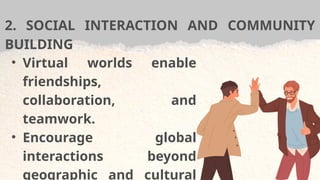
2. SOCIAL INTERACTION AND COMMUNITY
BUILDING
• Virtual worlds enable
friendships,
collaboration, and
teamwork.
• Encourage global
interactions beyond
geographic and cultural
3. IMPACT ON COMMUNICATION
NORMS
• Encourages new ways of
communicating (e.g.,
emoticons, memes, virtual
gestures).
• Changes how individuals
perceive social norms,
ETHICAL
AND
SOCIETAL
IMPLICATIO
NS
PRIVACY
CONCERNS
Online virtual worlds often
collect personal
information such as user
behavior, communication,
and transactions, which can
lead to privacy issues if
data is misused or shared
without clear consent.
Spending excessive time in
immersive virtual
environments can lead to
addiction, where individuals
may neglect real-life
responsibilities,
relationships, and
experience negative effects
ADDICTION RISKS
BEHAVIORAL
INFLUENCE
The anonymity and freedom in
virtual worlds can sometimes
encourage toxic behaviors like
cyberbullying, harassment, and
discrimination, which can harm
users emotionally and shape
negative social interactions.
MORAL
DECISIONS
Virtual worlds often
present users with
realistic scenarios that
involve ethical choices,
which can influence how
individuals form their
values and respond to
Massively Online
Role-Playing Games
(MORPGs) and
Multiplayer Online
Battle Arenas
(MOBAs)
Massively
Online Role-
Playing
Games
(MORPGs)
• Persistent online worlds
with character progression,
quests, and interaction.
• Customizable characters and
classes
• Story-driven quests and
cooperative play
• Real-time multiplayer
interaction
core features
Multiplayer
Online
Battle
Arenas
(MOBAs)
• Team-based strategy games where
players control unique heroes with
the goal of destroying the opposing
team’s base.
• 5v5 competitive gameplay
• Unique heroes with specific
roles
• Strategic map objectives
(towers, jungles, etc.)
core features
• MORPGs: Customizable avatars and character
classes.
• MOBAs: Control distinct heroes with specific
abilities and roles.
KEY FEATURES
• MORPGs: Focus on long-term character progression,
questing, and team-based activities like dungeons and
guilds.
• MOBAs: Competitive, fast-paced matches that require
coordination and strategy to destroy the enemy’s base.
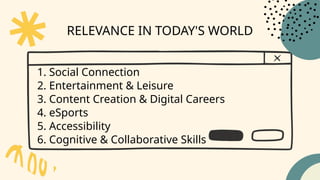
1. Social Connection
2. Entertainment & Leisure
3. Content Creation & Digital Careers
4. eSports
5. Accessibility
6. Cognitive & Collaborative Skills
RELEVANCE IN TODAY'S WORLD
MORPGs and MOBAs
continue to shape digital
entertainment, socialization,
and competitive gaming.
Games are accessible, foster
teamwork, and provide
career opportunities in
content creation and
eSports.
Thank You
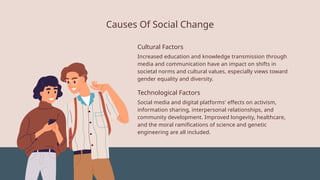
Causes Of Social Change
Increased education and knowledge transmission through
media and communication have an impact on shifts in
societal norms and cultural values, especially views toward
gender equality and diversity.
Cultural Factors
Social media and digital platforms' effects on activism,
information sharing, interpersonal relationships, and
community development. Improved longevity, healthcare,
and the moral ramifications of science and genetic
engineering are all included.
Technological Factors
Benefits of Social Change
• Social movements like women's suffrage and racial equality fights
promote social justice by dismantling discrimination and creating a
more equitable society.
• Advancements in technology, healthcare, and education from social
change lead to improved standards of living and better access to
resources and opportunities.
• Expanded rights such as freedom of speech and choice of life path are
examples of how social change can lead to a society that values
individual freedom more.
• Social change drives innovation and problem-solving.
Evolving societal needs lead to solutions for environmental
challenges, like advancements in renewable energy.
• Social change can drive environmental protection through
movements promoting sustainable practices for a
healthier planet.
• Rapid social change can trigger social unrest, protests,
and conflict as groups either resist or advocate for
change.
Negative Aspects of Social Change
• Introducing new ideas and customs can clash with
existing cultural values, leading to feelings of alienation
and identity loss.
• Economic changes can lead to job losses in certain
sectors, impacting individuals and emphasizing social
inequalities.
• Major social changes can disrupt established orders,
causing uncertainty, anxiety, and reduced social
cohesion.
• Unsustainable economic growth can cause pollution,
deforestation, and resource depletion.
challenges of social change
• Overcoming societal inertia requires clear
communication and sustained effort to advocate for
beneficial changes.
• Those benefiting from the status quo may resist change
to maintain power, requiring coalitions representing the
majority's interests to overcome this resistance.
• Social change movements face challenges due
to limited resources such as funding, media
access, and skilled personnel, impacting
organizational effectiveness and outreach for
implementing change strategies.
• Many social problems are multifaceted and
deeply rooted in historical and systemic factors.
Barriers to Social Change
• Advocating for positive change while respecting cultural
values requires a sensitive approach due to the influence
of social norms and traditions linked to cultural or
religious beliefs.
• Social transformation initiatives advocacy against
prejudice may face opposition from individuals who
maintain discriminatory behaviors.
• Laws and policies can hinder change in areas like labor
rights, environmental protection, and healthcare access.
• Technology can drive social change but also pose
challenges like misinformation, social media
manipulation, and job displacement due to automation,
necessitating mitigation strategies.
Overcoming challenges and barriers
• It is crucial to bring disparate groups
together around a common goal.
• It is imperative that the necessity of
change and its possible advantages are
communicated clearly.
• It is essential to set clear objectives, think
outside the box, and adjust as conditions
change.
• Social change is rarely a quick fix;
perseverance and sustained effort are
essential for success.

Group 4 IT (Chapter 8) yes just (2).pptx

  • 1.
  • 2.
    Social networks arewebsites and apps that allow users and organizations to connect, communicate, share information and form relationships. WHAT IS SOCIAL NETWORKING SITES?
  • 3.
    FACEBOOK • Social networkingsite for keeping up with friends, uploading photos, sharing links and videos, and meeting new people online • 750 million estimated unique visitors monthly
  • 4.
    TUMBLR • Microblogging platform andsocial network Web site that enables users to post multimedia and other content in shortform blog • 300 million estimated unique visitors monthly
  • 5.
    TWITTER/X • Real-time informationservice for friends, family members, and coworkers looking to stay connected through the exchange of messages that are a maximum of 140 characters • 250 million estimated unique visitors monthly
  • 6.
    LINKEDIN • Business-oriented social networkingsite used for professional networking; users create a network made up of people they know and trust in business • 110 million estimated unique visitors monthly
  • 7.
    PINTEREST • Social networkingsite that allows members to pin photos, videos, and other items to their pin board to share with others know and trust in business • 86 million estimated unique visitors monthly
  • 8.
    MYSPACE • It allowsmembers to communicate with friends via personal profiles, blogs, and groups, as well as to post photos, music, and videos to their personal pages • 70 million estimated unique
  • 9.
    GOOGLE+ • Social networkoperated by Google that integrates social services such as Google Profiles and Google Buzz, and introduces new services such as Circles, Hangouts, Sparks and Huddles • 65 million estimated unique visitors monthly
  • 10.
    INSTAGRAM • Online photo-andvideo- sharing social networking service • 59 million estimated unique visitors monthly
  • 11.
    LIVEJOURNAL • Social networkwhere users can keep a blog, journal, or diary; also widely used to post political commentary • 21 million estimated unique visitors monthly
  • 12.
    TAGGED • Social networkwith a focus on helping members meet new people; suggests new friends based on shared interests • 25 million estimated unique visitors monthly
  • 13.
    ORKUT • Social networkfor users to meet new and old friends and maintain existing friendships • 18 million estimated unique visitors monthly
  • 14.
  • 15.
    1.Social Network Advertising Socialnetwork advertising, also known as social media advertising, is a type of digital marketing, transforming how businesses reach audiences through social media platforms like Facebook, Instagram, and TikTok. It is estimated that 89 percent of advertisers use free tools such as Facebook, Twitter, or Pinterest to promote their products. Additionally, 75 percent of advertisers use paid media such as ads on Facebook or sponsored blog content.
  • 16.
    Two significant advantagesof social network advertising over more traditional advertising media are: (1) advertisers can create an opportunity to generate a conversation with viewers of the ad, and (2) ads can be targeted to reach people with the desired demographic characteristics. The two primary objectives of social media advertisers are: (1) raising brand awareness, and (2)driving traffic to a Website to increase product sales.
  • 17.
    Different Social Network AdvertisingStrategies that Organizations may employ:
  • 18.
    1.Direct Advertising Rimberi o Direct advertisingrefers to marketing efforts where businesses communicate directly with their target audience to promote products or services, without intermediaries. This approach aims to prompt immediate action, such as making a purchase or free trial. Direct advertising can take various forms, including direct mail, telemarketing, email marketing, and online ads.
  • 19.
    2. Advertising Usingan Individual’s Network of Friends Rimberi o company can use social networking web sites to advertise to an individual’s network of contacts.
  • 20.
    Rimberi o 3. Indirect Advertising through Groups Thisis where an individual or a group of people are being a fan of a product. This is where they create a social networking web site that interested users can join by becoming “fans” of that page.
  • 21.
    A Company-owned Social NetworkingWebsite A variation on the above approach is for a company to form its own social networking Website. For example, Dell created its own social networking Web site, IdeaStorm, in February 2007as a means for its millions of customers in more than 100 countries to talk about what new products, services, or improvements they would like to see Dell develop.
  • 22.
    Viral Marketing Viral marketingis a strategy that aims to spread information about a product or service quickly and widely, much like a virus. The goal is to encourage individuals to share the marketing message with others, creating exponential growth in the message's visibility and impact.
  • 23.
    2.The Use ofSocial Networks in the Hiring Process One key advantage of using social networks in hiring is the ability to access a vast array of professional profiles. Recruiters can easily review a candidate’s professional history and endorsements, facilitating a more informed decision-making process. In addition to LinkedIn, companies also use platforms like Twitter and Facebook to engage with potential candidates. Furthermore, companies have begun utilizing social networks to conduct initial screenings.
  • 24.
    3.The Use ofSocial Media to Improve Customer Service One of the primary benefits of using social media for customer service is the immediacy it offers. Platforms like Twitter and Facebook allow businesses to address customer inquiries and complaints in real time. Moreover, social media allows businesses to reach a broader audience simultaneously.
  • 25.
    4.Social Shopping WebSites Social shopping refers to the merging of social media and ecommerce, allowing users to browse, share, and purchase products directly within their social media platforms. Examples of platforms that facilitate social shopping include Instagram, Pinterest, TikTok, and Facebook.
  • 26.
  • 27.
    Cyberbullying involves harassment,humiliation, or threats made by one minor or a group of minors toward another through the Internet or mobile devices. While ideally, minors would report such incidents to their parents, this often does not occur. Schools that attempt to intervene may face legal issues for infringing on students’ free speech rights, especially when the behavior occurs off-campus. In response, some schools have revised their disciplinary policies to address off-campus incidents that impact student safety within school grounds. Cyberbullying
  • 28.
    Cyberstalking is theadult counterpart of cyberbullying, involving threatening behavior or unwelcome advances via digital communication platforms. Victims often suffer from severe emotional distress, and incidents may escalate to phone harassment, threatening messages, physical stalking, or even assault. This behavior can cause lasting psychological harm and poses a serious threat to personal safety. Cyberstalking
  • 29.
    Some social networkingsites have been criticized for insufficient measures in protecting minors from online predators. One notable example is MySpace, which undertook a two-year campaign to remove potentially dangerous users. In early 2009, the platform banned 90,000 registered sex offenders in a significant move to safeguard its younger users. Encounters with Sexual Predators
  • 30.
    Most social networkingplatforms maintain strict policies against uploading violent or obscene content. These are typically outlined in terms of use agreements, privacy policies, and content conduct codes. While such rules prohibit sexually explicit, defamatory, hateful, or illegal content, enforcement remains a challenge due to the vast amount of content submitted daily. For instance, YouTube receives over 100 hours of video uploads every minute—equivalent to 670,000 full-length movies per week—making it nearly impossible to monitor all content manual. Uploading of Inappropriate Material
  • 31.
    ONLINE VIRTUAL WORLDS ANDITS RELATIONSHIP TO THE INDIVIDUAL'S SOCIETAL BEHAVIOR
  • 32.
    Online virtual worldsare computer-simulated environments where users (often through avatars) can interact, play, work, or socialize in real time. These spaces replicate real-world settings or offer entirely fictional environments. What are online virtual worlds? Second Life, Roblox, Minecraft, The Sims Online, VRChat, and Player Unknowns Battle Ground. Examples:
  • 33.
    Characteristics of VirtualWorlds • Immersive: Users experience a strong sense of presence in the digital environment. • Interactive: Real-time communication and collaboration with others are possible. • Persistent: The virtual world continues to evolve even when users are offline. • Socially Constructed: Users build virtual identities, communities, and even digital
  • 34.
    How Online Virtua WorldsInfluence Societal Behavior?
  • 35.
    1. IDENTITY FORMATIONAND EXPRESSION • Users often create avatars that reflect their ideal selves or explore different identities. • Offers freedom of expression, especially for those who feel limited in
  • 36.
    2. SOCIAL INTERACTIONAND COMMUNITY BUILDING • Virtual worlds enable friendships, collaboration, and teamwork. • Encourage global interactions beyond geographic and cultural
  • 37.
    3. IMPACT ONCOMMUNICATION NORMS • Encourages new ways of communicating (e.g., emoticons, memes, virtual gestures). • Changes how individuals perceive social norms,
  • 38.
  • 39.
    PRIVACY CONCERNS Online virtual worldsoften collect personal information such as user behavior, communication, and transactions, which can lead to privacy issues if data is misused or shared without clear consent.
  • 40.
    Spending excessive timein immersive virtual environments can lead to addiction, where individuals may neglect real-life responsibilities, relationships, and experience negative effects ADDICTION RISKS
  • 41.
    BEHAVIORAL INFLUENCE The anonymity andfreedom in virtual worlds can sometimes encourage toxic behaviors like cyberbullying, harassment, and discrimination, which can harm users emotionally and shape negative social interactions.
  • 42.
    MORAL DECISIONS Virtual worlds often presentusers with realistic scenarios that involve ethical choices, which can influence how individuals form their values and respond to
  • 43.
    Massively Online Role-Playing Games (MORPGs)and Multiplayer Online Battle Arenas (MOBAs)
  • 44.
    Massively Online Role- Playing Games (MORPGs) • Persistentonline worlds with character progression, quests, and interaction. • Customizable characters and classes • Story-driven quests and cooperative play • Real-time multiplayer interaction core features
  • 47.
    Multiplayer Online Battle Arenas (MOBAs) • Team-based strategygames where players control unique heroes with the goal of destroying the opposing team’s base. • 5v5 competitive gameplay • Unique heroes with specific roles • Strategic map objectives (towers, jungles, etc.) core features
  • 50.
    • MORPGs: Customizableavatars and character classes. • MOBAs: Control distinct heroes with specific abilities and roles. KEY FEATURES • MORPGs: Focus on long-term character progression, questing, and team-based activities like dungeons and guilds. • MOBAs: Competitive, fast-paced matches that require coordination and strategy to destroy the enemy’s base.
  • 51.
    1. Social Connection 2.Entertainment & Leisure 3. Content Creation & Digital Careers 4. eSports 5. Accessibility 6. Cognitive & Collaborative Skills RELEVANCE IN TODAY'S WORLD
  • 52.
    MORPGs and MOBAs continueto shape digital entertainment, socialization, and competitive gaming. Games are accessible, foster teamwork, and provide career opportunities in content creation and eSports.
  • 53.
  • 54.
    Causes Of SocialChange Increased education and knowledge transmission through media and communication have an impact on shifts in societal norms and cultural values, especially views toward gender equality and diversity. Cultural Factors Social media and digital platforms' effects on activism, information sharing, interpersonal relationships, and community development. Improved longevity, healthcare, and the moral ramifications of science and genetic engineering are all included. Technological Factors
  • 55.
    Benefits of SocialChange • Social movements like women's suffrage and racial equality fights promote social justice by dismantling discrimination and creating a more equitable society. • Advancements in technology, healthcare, and education from social change lead to improved standards of living and better access to resources and opportunities. • Expanded rights such as freedom of speech and choice of life path are examples of how social change can lead to a society that values individual freedom more. • Social change drives innovation and problem-solving. Evolving societal needs lead to solutions for environmental challenges, like advancements in renewable energy. • Social change can drive environmental protection through movements promoting sustainable practices for a healthier planet.
  • 56.
    • Rapid socialchange can trigger social unrest, protests, and conflict as groups either resist or advocate for change. Negative Aspects of Social Change • Introducing new ideas and customs can clash with existing cultural values, leading to feelings of alienation and identity loss. • Economic changes can lead to job losses in certain sectors, impacting individuals and emphasizing social inequalities. • Major social changes can disrupt established orders, causing uncertainty, anxiety, and reduced social cohesion. • Unsustainable economic growth can cause pollution, deforestation, and resource depletion.
  • 57.
    challenges of socialchange • Overcoming societal inertia requires clear communication and sustained effort to advocate for beneficial changes. • Those benefiting from the status quo may resist change to maintain power, requiring coalitions representing the majority's interests to overcome this resistance. • Social change movements face challenges due to limited resources such as funding, media access, and skilled personnel, impacting organizational effectiveness and outreach for implementing change strategies. • Many social problems are multifaceted and deeply rooted in historical and systemic factors.
  • 58.
    Barriers to SocialChange • Advocating for positive change while respecting cultural values requires a sensitive approach due to the influence of social norms and traditions linked to cultural or religious beliefs. • Social transformation initiatives advocacy against prejudice may face opposition from individuals who maintain discriminatory behaviors. • Laws and policies can hinder change in areas like labor rights, environmental protection, and healthcare access. • Technology can drive social change but also pose challenges like misinformation, social media manipulation, and job displacement due to automation, necessitating mitigation strategies.
  • 59.

    Overcoming challenges andbarriers • It is crucial to bring disparate groups together around a common goal. • It is imperative that the necessity of change and its possible advantages are communicated clearly. • It is essential to set clear objectives, think outside the box, and adjust as conditions change. • Social change is rarely a quick fix; perseverance and sustained effort are essential for success.