EXAMPLE / CASE STUDY OF MS1525
APPLICATIONS INTO THE ENERGY EFFICIENCT
BUILDING DESIGN & OPERATION
Steve Anthony Lojuntin
Director of Technical Development & Facilitation Division
Sustainable Energy Development Authority @ SEDA Malaysia
Tel / SMS :+6019-2829102 Email: steve@seda.gov.my / asetip@damansara.net
12 September 2019
Awareness Seminar :
Achieving Sustainable Development Goals Through The Application
of MS1525 : Code of Practice – Energy Efficiency & Use of
Renewable Energy for Non-residential Buildings
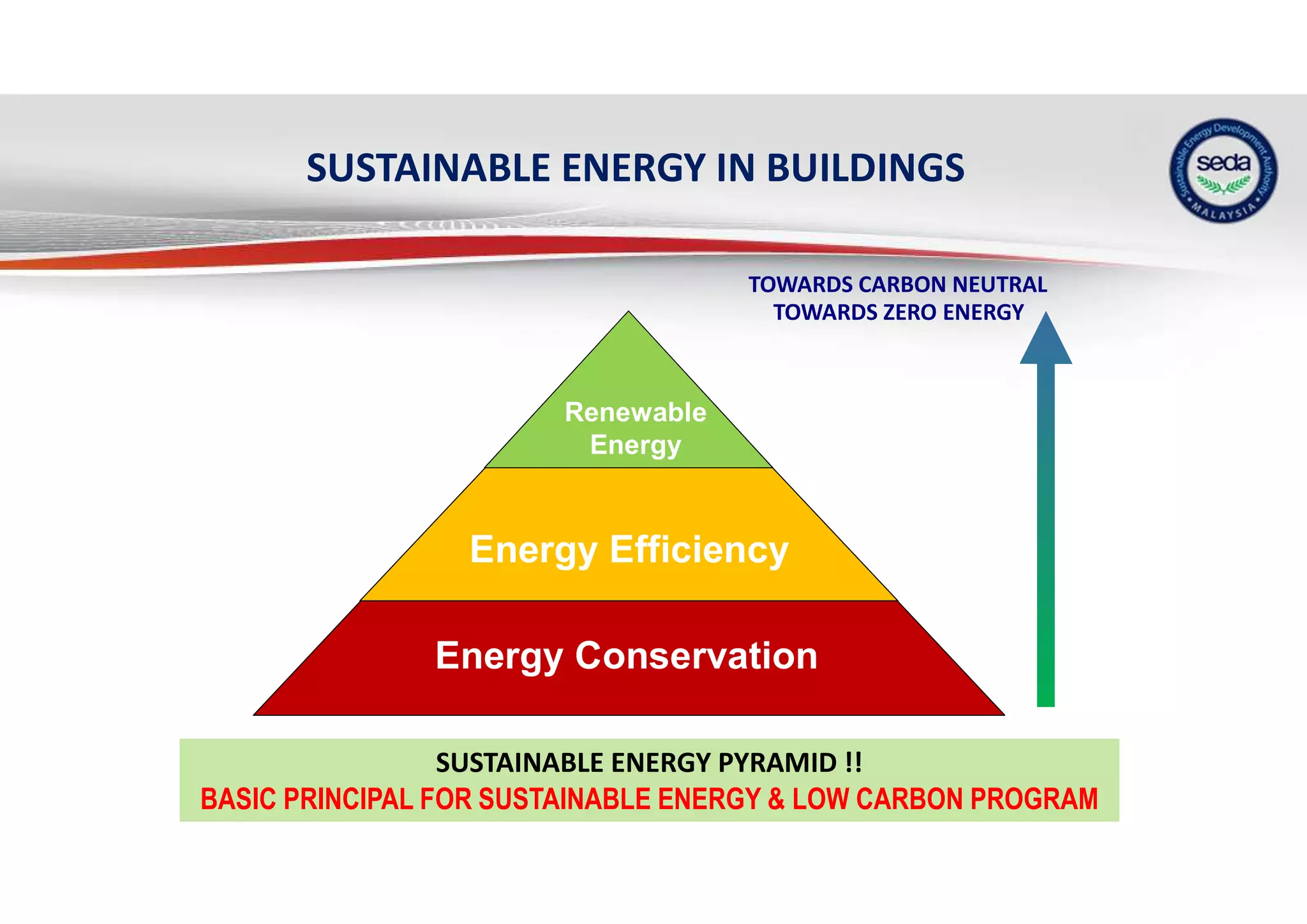
SUSTAINABLE ENERGY IN BUILDINGS
SUSTAINABLE ENERGY PYRAMID !!
BASIC PRINCIPAL FOR SUSTAINABLE ENERGY & LOW CARBON PROGRAM
Energy Conservation
Renewable
Energy
Energy Efficiency
TOWARDS CARBON NEUTRAL
TOWARDS ZERO ENERGY
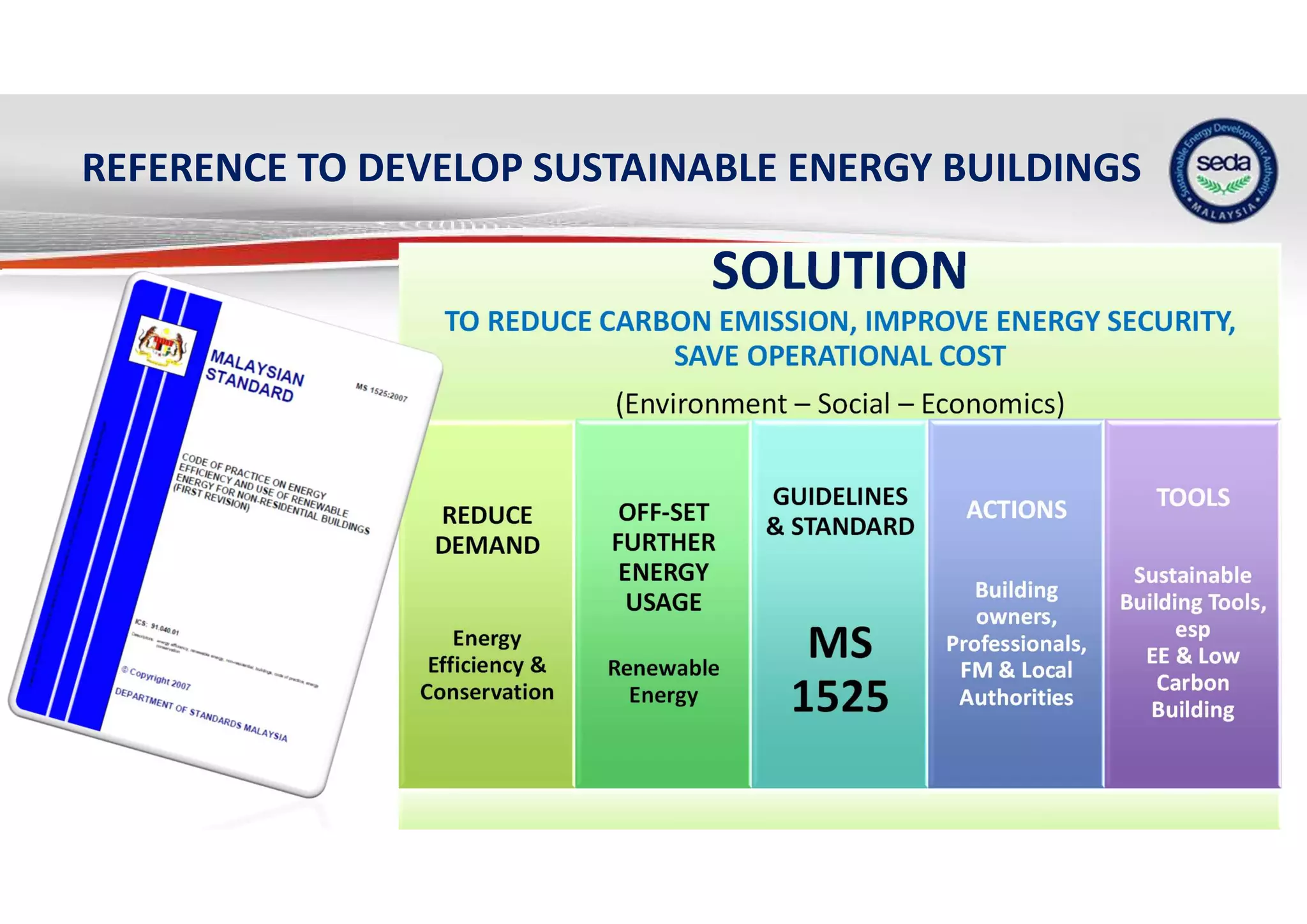
REFERENCE TO DEVELOP SUSTAINABLE ENERGY BUILDINGS
SOLUTION
TO REDUCE CARBON EMISSION, IMPROVE ENERGY SECURITY,
SAVE OPERATIONAL COST
(Environment – Social – Economics)
REDUCE
DEMAND
Energy
Efficiency &
Conservation
OFF-SET
FURTHER
ENERGY
USAGE
Renewable
Energy
GUIDELINES
& STANDARD
MS
1525
ACTIONS
Building
owners,
Professionals,
FM & Local
Authorities
TOOLS
Sustainable
Building Tools,
esp
EE & Low
Carbon
Building
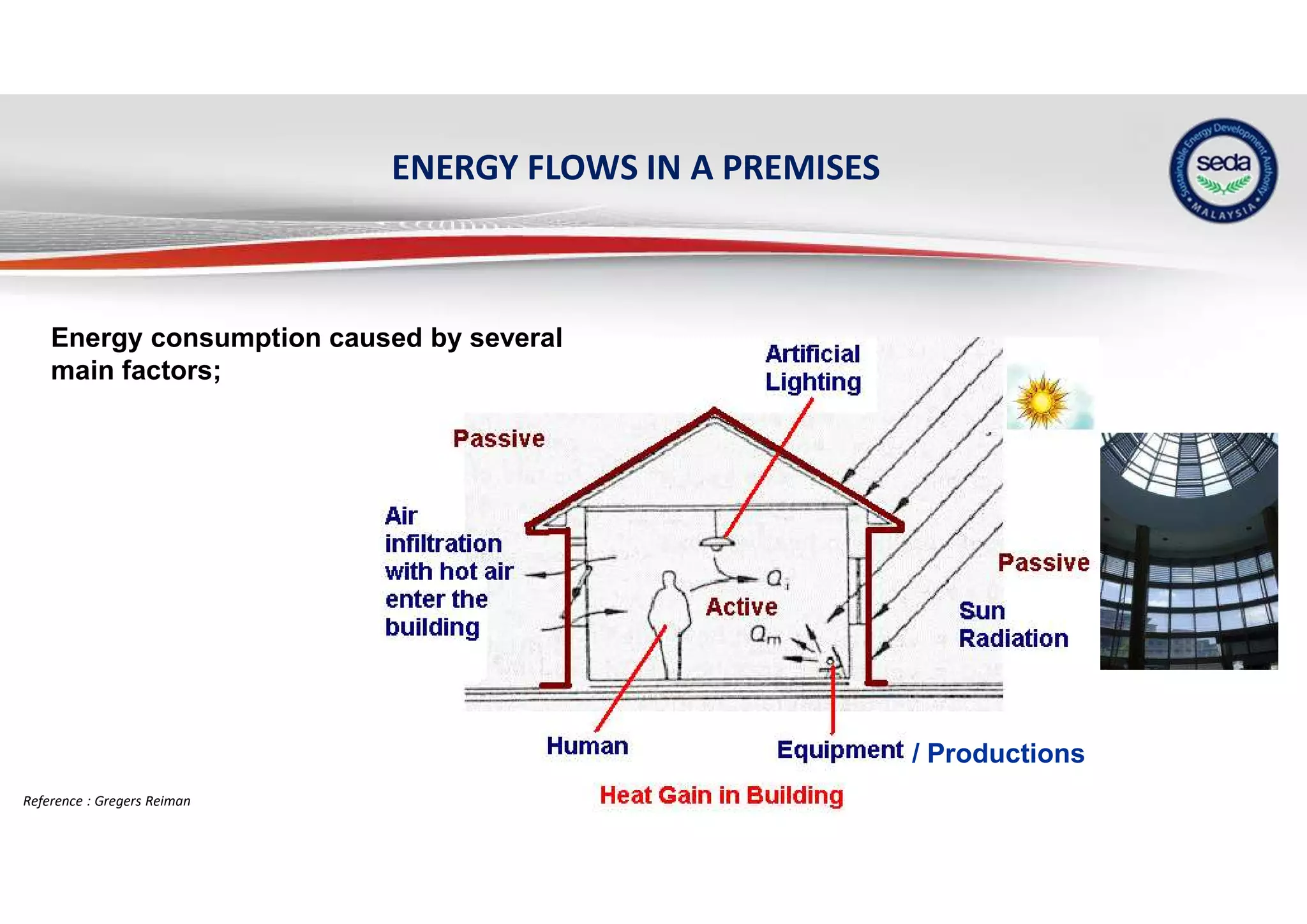
ENERGY FLOWS IN A PREMISES
/ Productions
Energy consumption caused by several
main factors;
Reference : Gregers Reiman
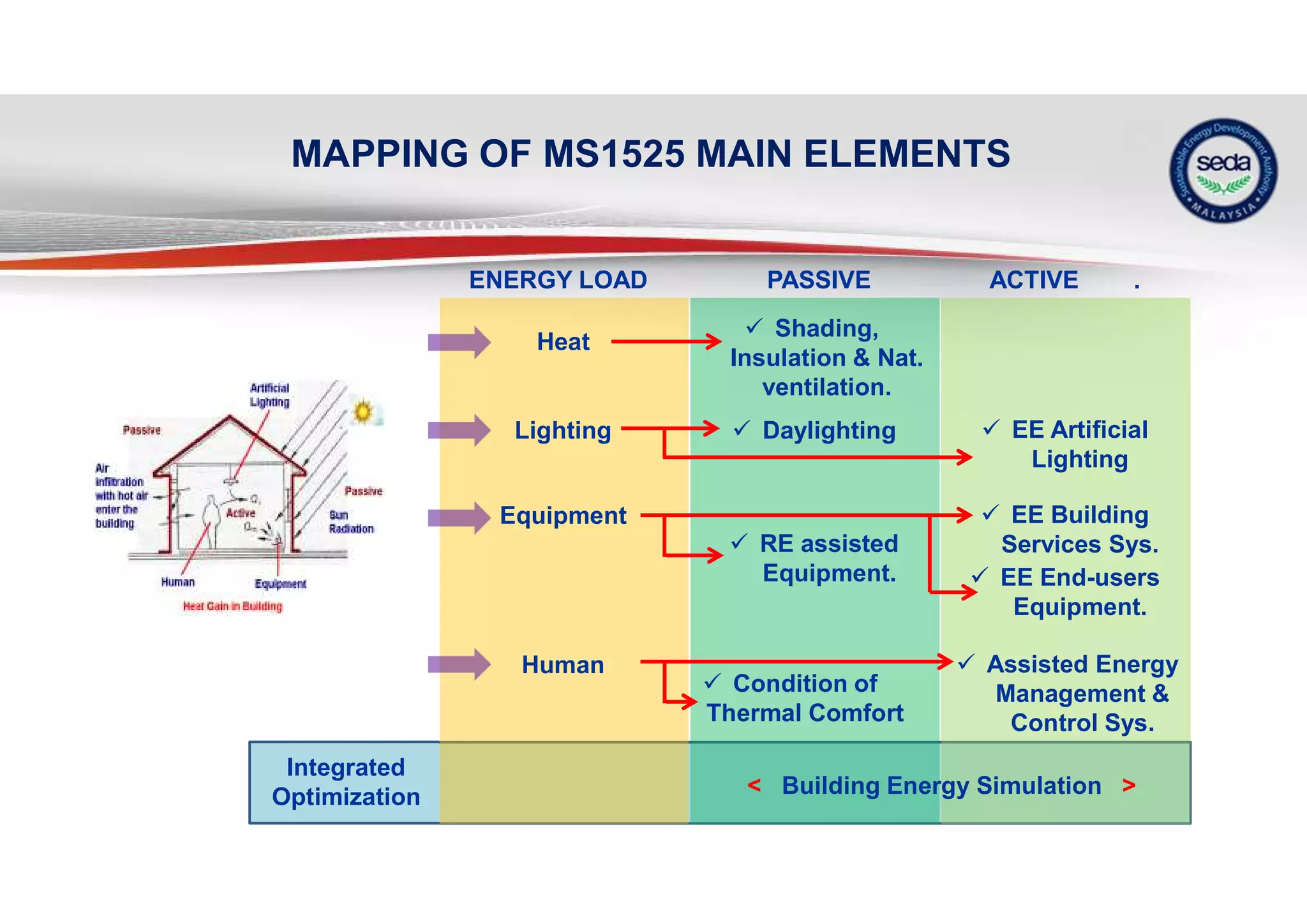
ENERGY LOAD
MAPPING OF MS1525 MAIN ELEMENTS
PASSIVE ACTIVE .
Heat
 Shading,
Insulation & Nat.
ventilation.
 Condition of
Thermal Comfort
Lighting  Daylighting  EE Artificial
Lighting
Equipment  EE Building
Services Sys.
 EE End-users
Equipment.
Human  Assisted Energy
Management &
Control Sys.
< Building Energy Simulation >
 RE assisted
Equipment.
Integrated
Optimization
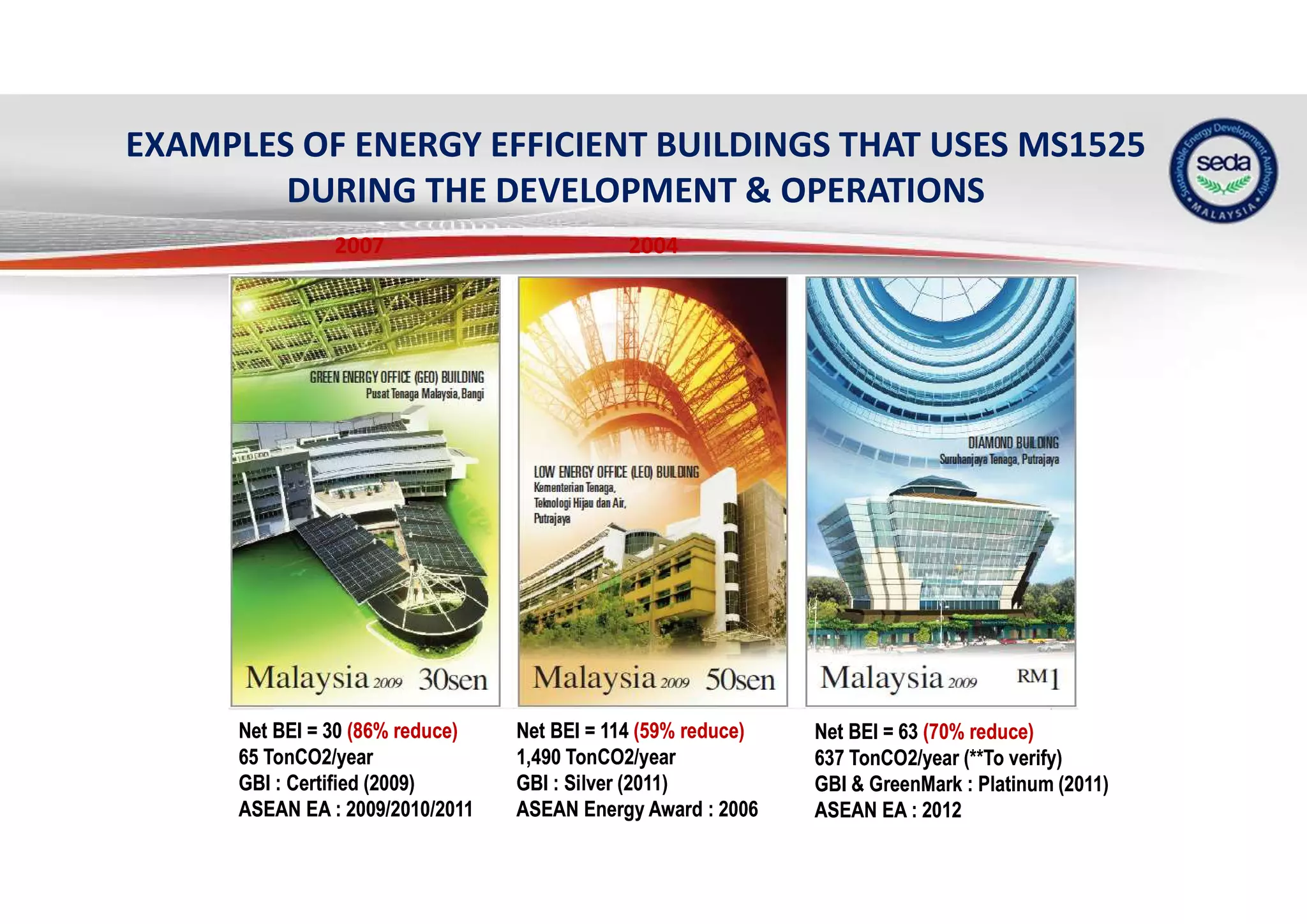
Net BEI = 114 (59% reduce)
1,490 TonCO2/year
GBI : Silver (2011)
ASEAN Energy Award : 2006
Net BEI = 114 (59% reduce)
1,490 TonCO2/year
GBI : Silver (2011)
ASEAN Energy Award : 2006
Net BEI = 63 (70% reduce)
637 TonCO2/year (**To verify)
GBI & GreenMark : Platinum (2011)
ASEAN EA : 2012
Net BEI = 63 (70% reduce)
637 TonCO2/year (**To verify)
GBI & GreenMark : Platinum (2011)
ASEAN EA : 2012
Net BEI = 30 (86% reduce)
65 TonCO2/year
GBI : Certified (2009)
ASEAN EA : 2009/2010/2011
Net BEI = 30 (86% reduce)
65 TonCO2/year
GBI : Certified (2009)
ASEAN EA : 2009/2010/2011
EXAMPLES OF ENERGY EFFICIENT BUILDINGS THAT USES MS1525
DURING THE DEVELOPMENT & OPERATIONS
2007 2004
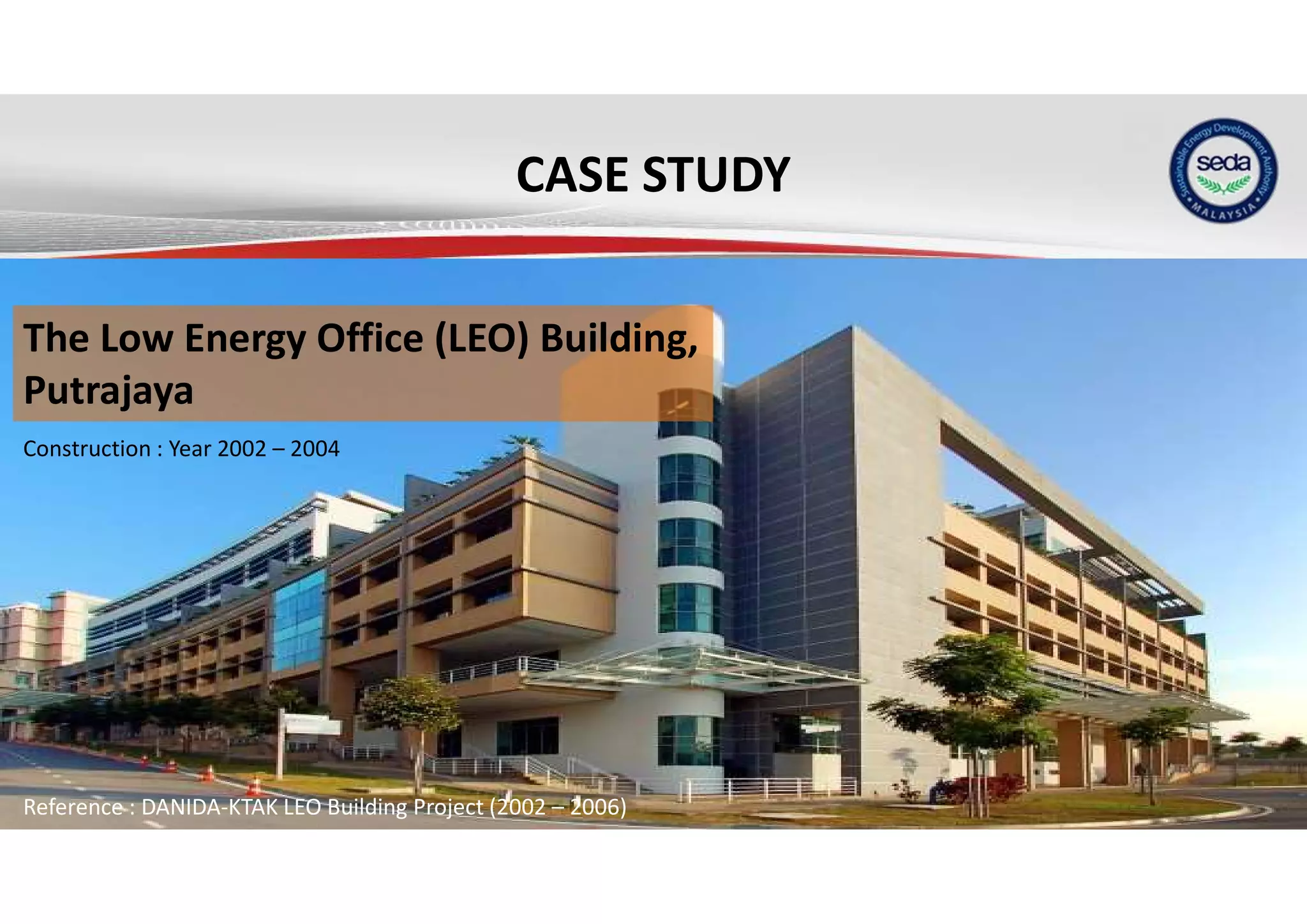
CASE STUDY
The Low Energy Office (LEO) Building,
Putrajaya
Construction : Year 2002 – 2004
Reference : DANIDA-KTAK LEO Building Project (2002 – 2006)
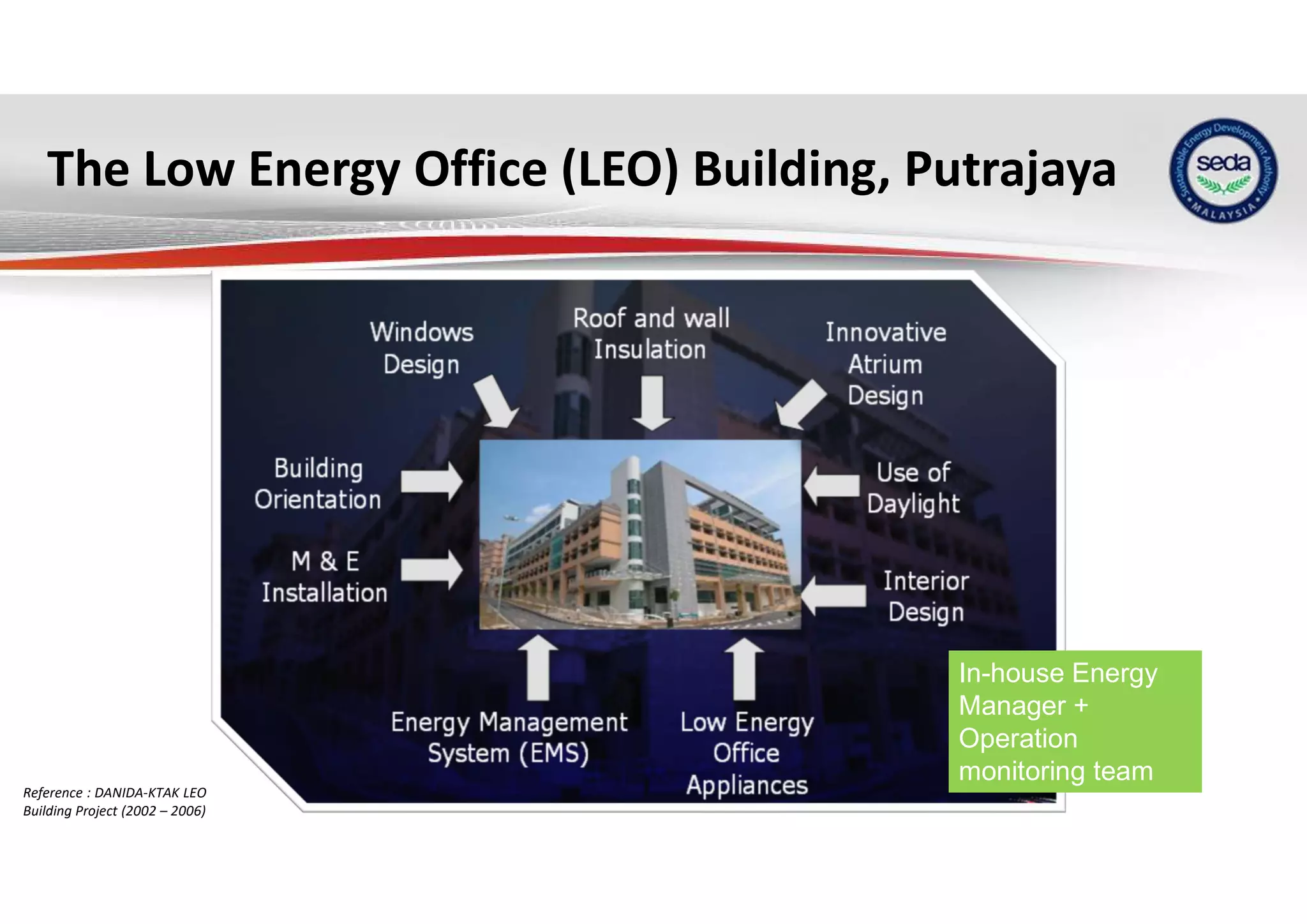
The Low Energy Office (LEO) Building, Putrajaya
In-house Energy
Manager +
Operation
monitoring team
Reference : DANIDA-KTAK LEO
Building Project (2002 – 2006)
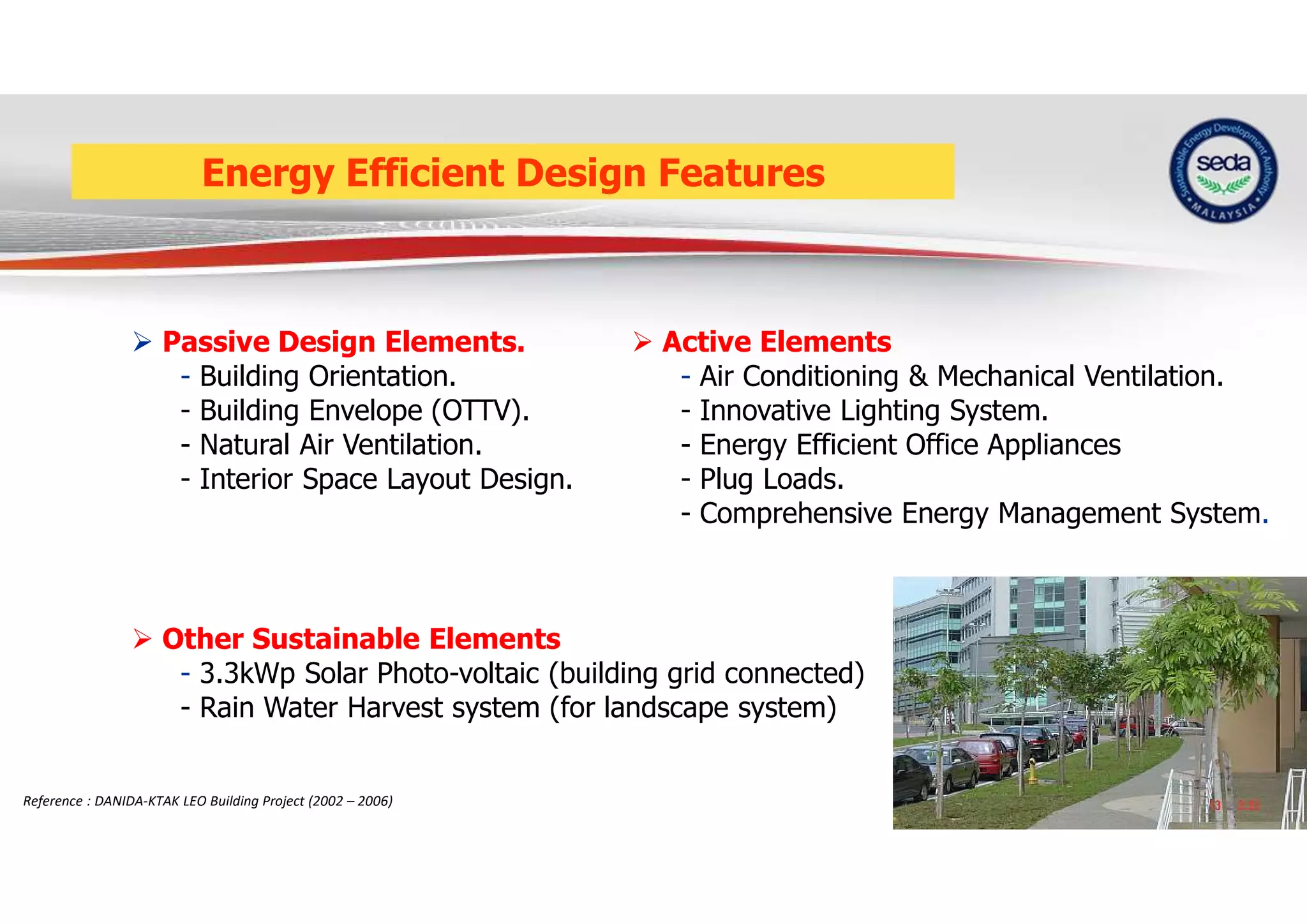
Energy Efficient Design Features
 Passive Design Elements.
- Building Orientation.
- Building Envelope (OTTV).
- Natural Air Ventilation.
- Interior Space Layout Design.
 Active Elements
- Air Conditioning & Mechanical Ventilation.
- Innovative Lighting System.
- Energy Efficient Office Appliances
- Plug Loads.
- Comprehensive Energy Management System.
 Other Sustainable Elements
- 3.3kWp Solar Photo-voltaic (building grid connected)
- Rain Water Harvest system (for landscape system)
Reference : DANIDA-KTAK LEO Building Project (2002 – 2006)
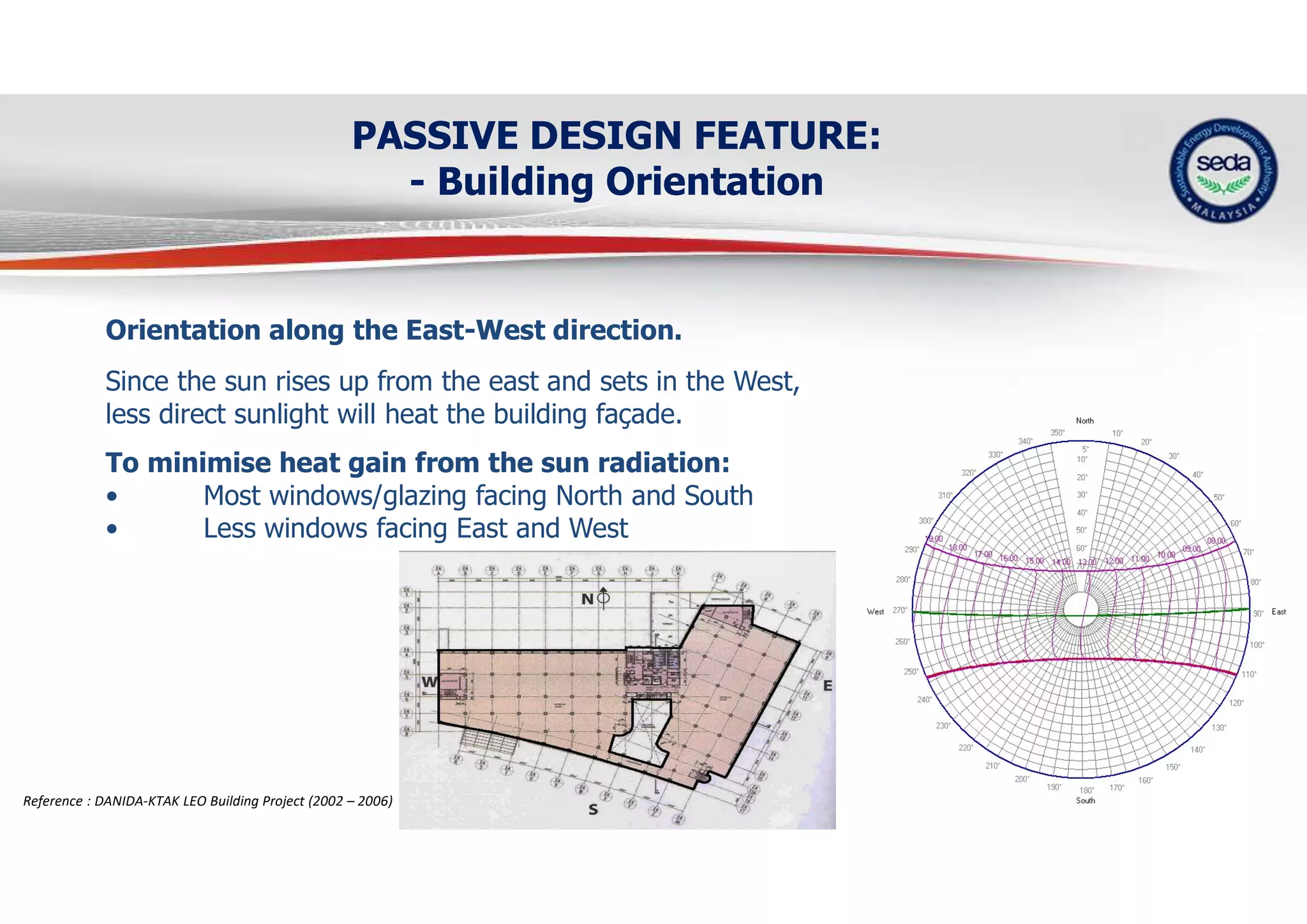
PASSIVE DESIGN FEATURE:
- Building Orientation
N
Orientation along the East-West direction.
Since the sun rises up from the east and sets in the West,
less direct sunlight will heat the building façade.
To minimise heat gain from the sun radiation:
• Most windows/glazing facing North and South
• Less windows facing East and West
Reference : DANIDA-KTAK LEO Building Project (2002 – 2006)
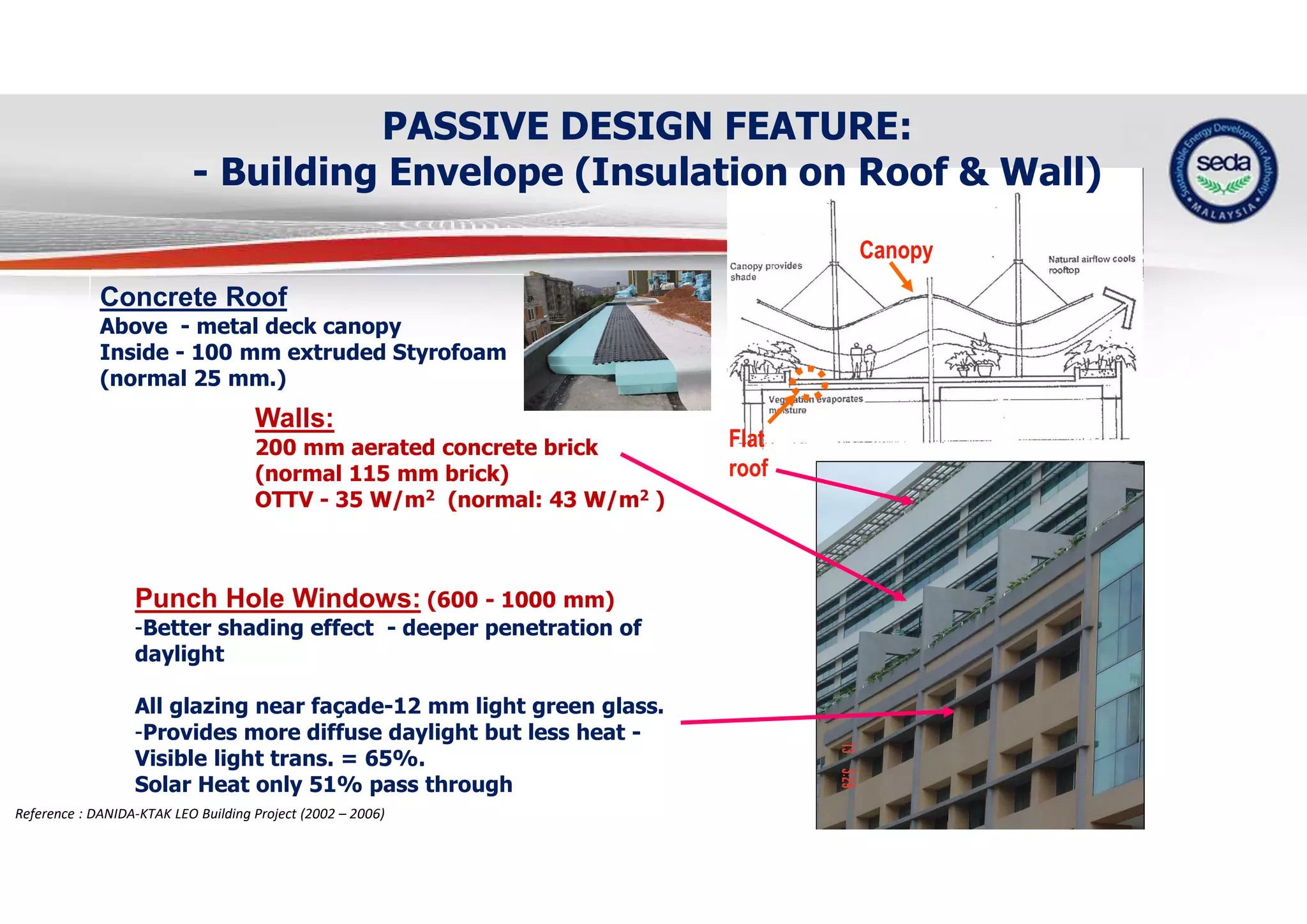
Walls:
200 mm aerated concrete brick
(normal 115 mm brick)
OTTV - 35 W/m2 (normal: 43 W/m2 )
Punch Hole Windows: (600 - 1000 mm)
-Better shading effect - deeper penetration of
daylight
All glazing near façade-12 mm light green glass.
-Provides more diffuse daylight but less heat -
Visible light trans. = 65%.
Solar Heat only 51% pass through
Concrete Roof
Above - metal deck canopy
Inside - 100 mm extruded Styrofoam
(normal 25 mm.)
Flat
roof
Canopy
PASSIVE DESIGN FEATURE:
- Building Envelope (Insulation on Roof & Wall)
Reference : DANIDA-KTAK LEO Building Project (2002 – 2006)
PASSIVE DESIGN FEATURE:
- Building Envelope (Insulation on Roof & Wall)
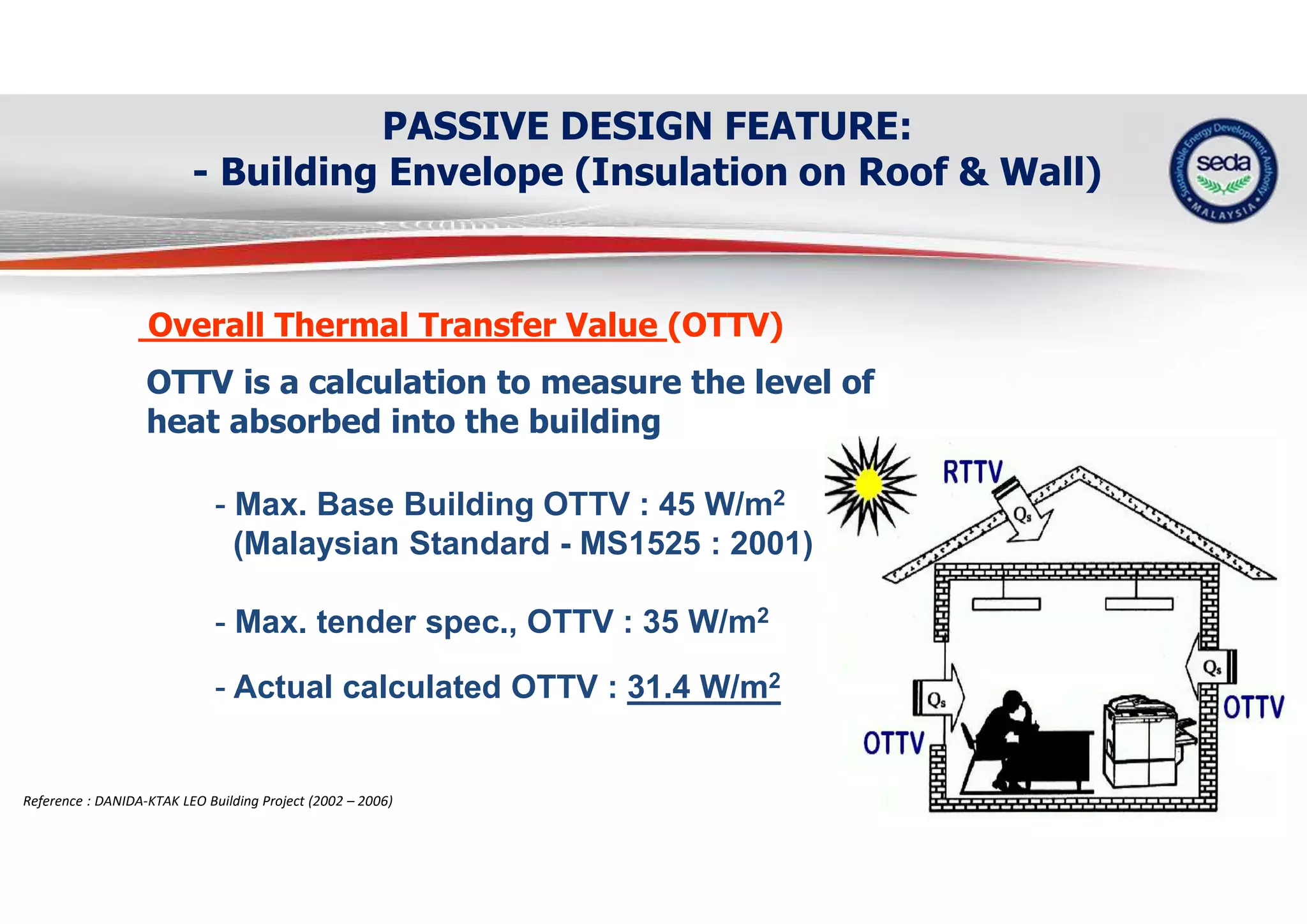
- Max. Base Building OTTV : 45 W/m2
(Malaysian Standard - MS1525 : 2001)
- Max. tender spec., OTTV : 35 W/m2
- Actual calculated OTTV : 31.4 W/m2
Overall Thermal Transfer Value (OTTV)
OTTV is a calculation to measure the level of
heat absorbed into the building
Reference : DANIDA-KTAK LEO Building Project (2002 – 2006)
PASSIVE DESIGN FEATURE:
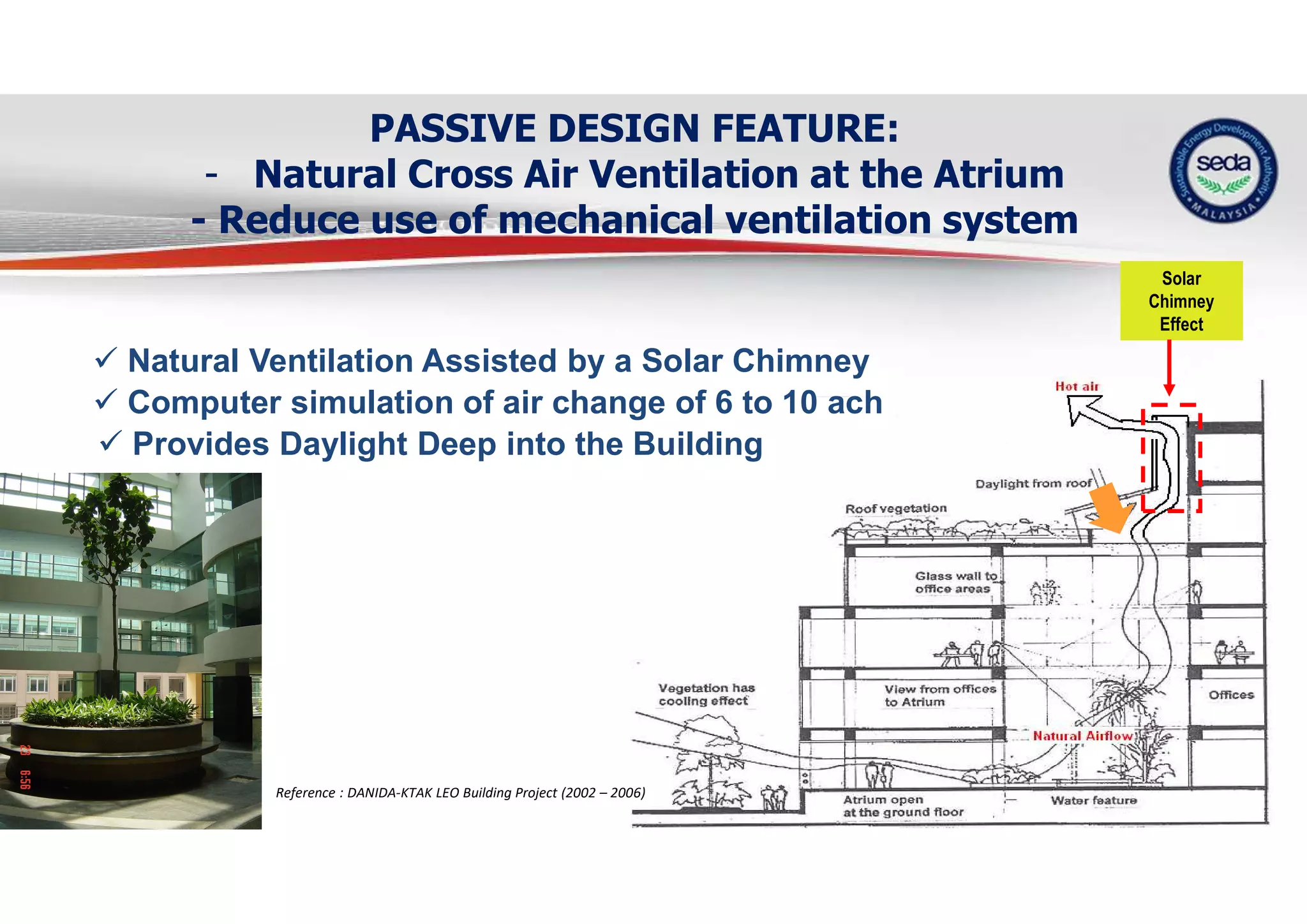
- Natural Cross Air Ventilation at the Atrium
- Reduce use of mechanical ventilation system
 Computer simulation of air change of 6 to 10 ach
 Natural Ventilation Assisted by a Solar Chimney
Solar
Chimney
Effect
 Provides Daylight Deep into the Building
Reference : DANIDA-KTAK LEO Building Project (2002 – 2006)
PASSIVE DESIGN FEATURE:
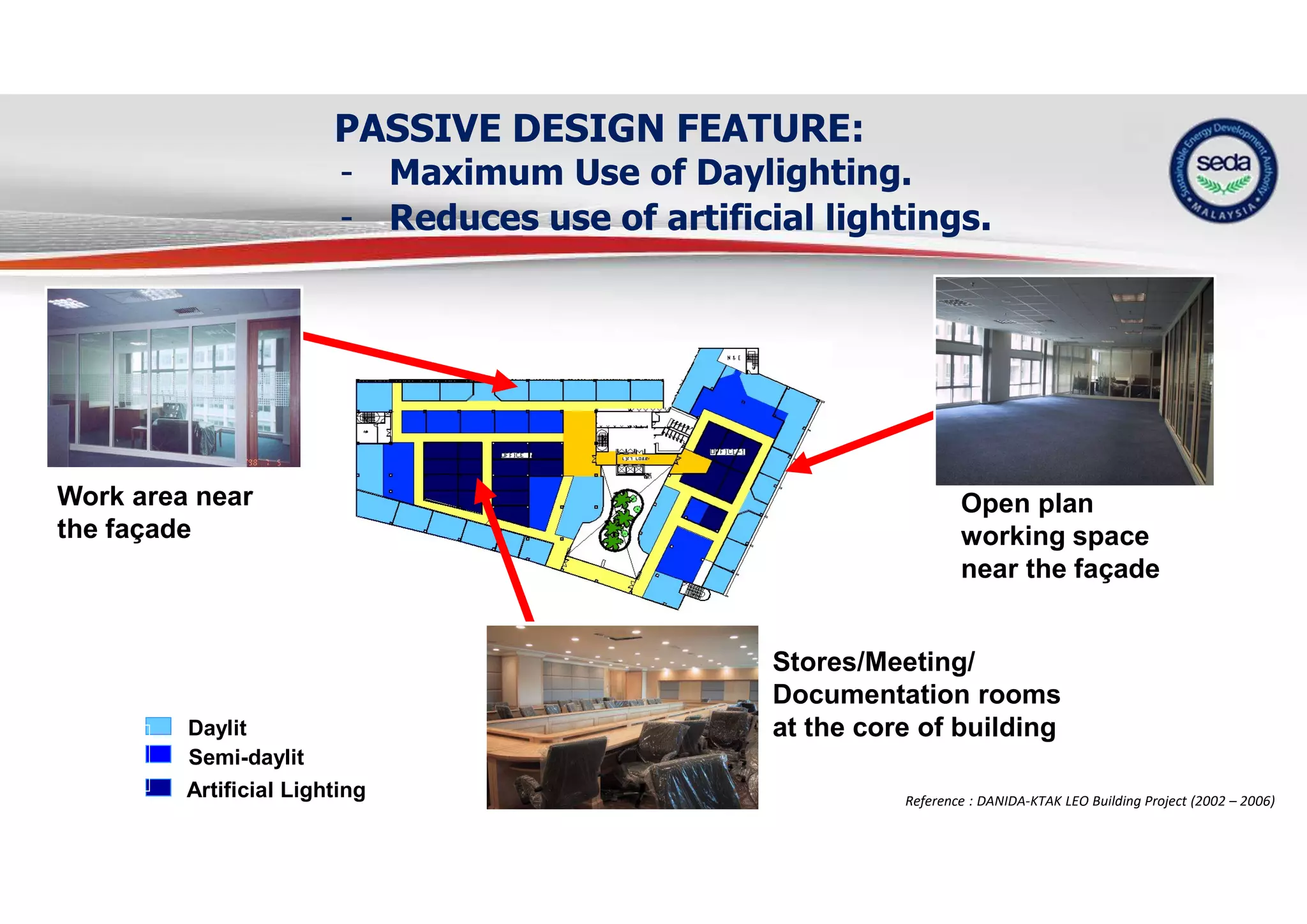
- Maximum Use of Daylighting.
- Reduces use of artificial lightings.
Daylit
Semi-daylit
Artificial Lighting
Stores/Meeting/
Documentation rooms
at the core of building
Open plan
working space
near the façade
Work area near
the façade
Reference : DANIDA-KTAK LEO Building Project (2002 – 2006)
ACTIVE DESIGN FEATURE:
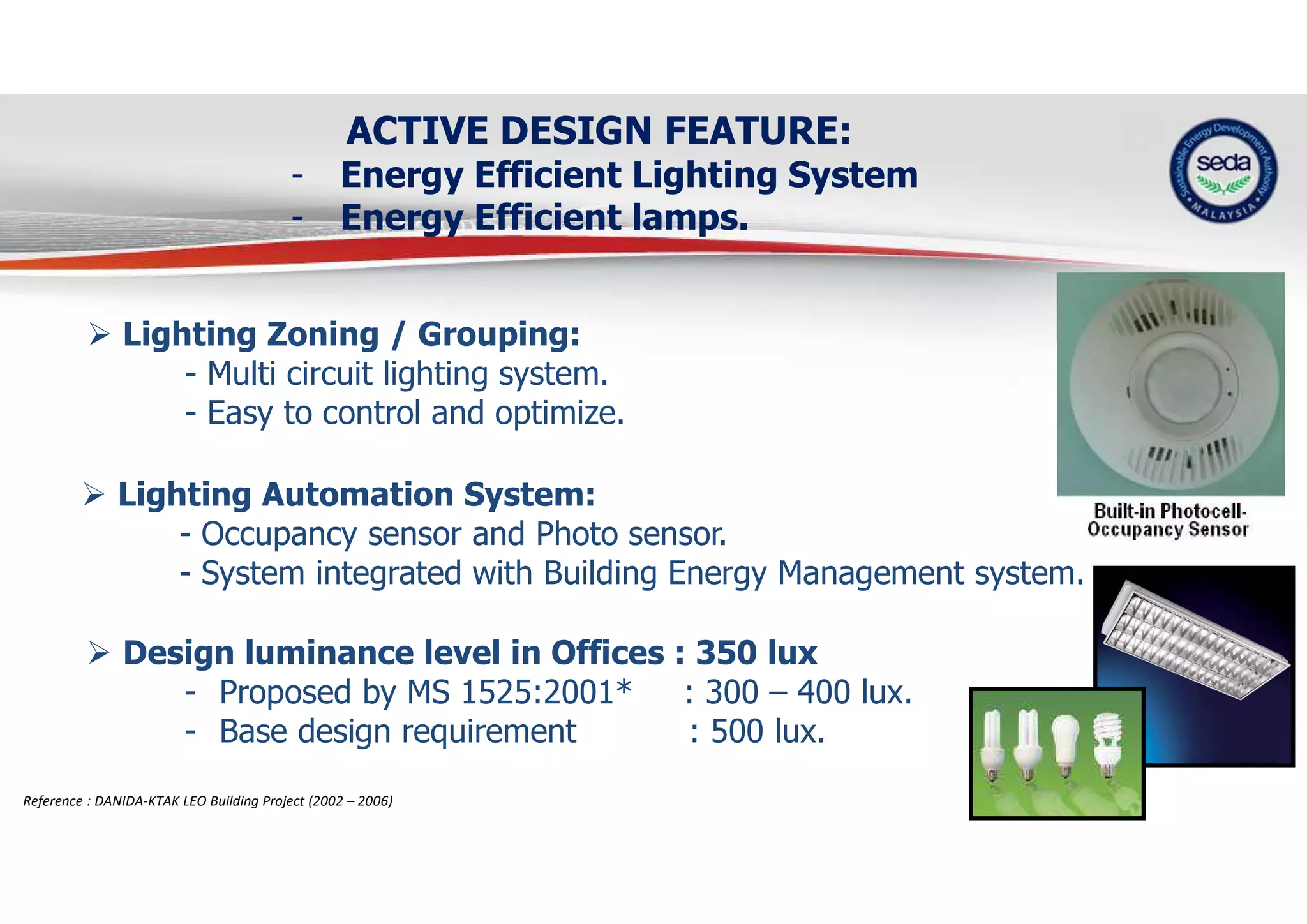
- Energy Efficient Lighting System
- Energy Efficient lamps.
 Lighting Zoning / Grouping:
- Multi circuit lighting system.
- Easy to control and optimize.
 Lighting Automation System:
- Occupancy sensor and Photo sensor.
- System integrated with Building Energy Management system.
 Design luminance level in Offices : 350 lux
- Proposed by MS 1525:2001* : 300 – 400 lux.
- Base design requirement : 500 lux.
Reference : DANIDA-KTAK LEO Building Project (2002 – 2006)
ACTIVE DESIGN FEATURE:
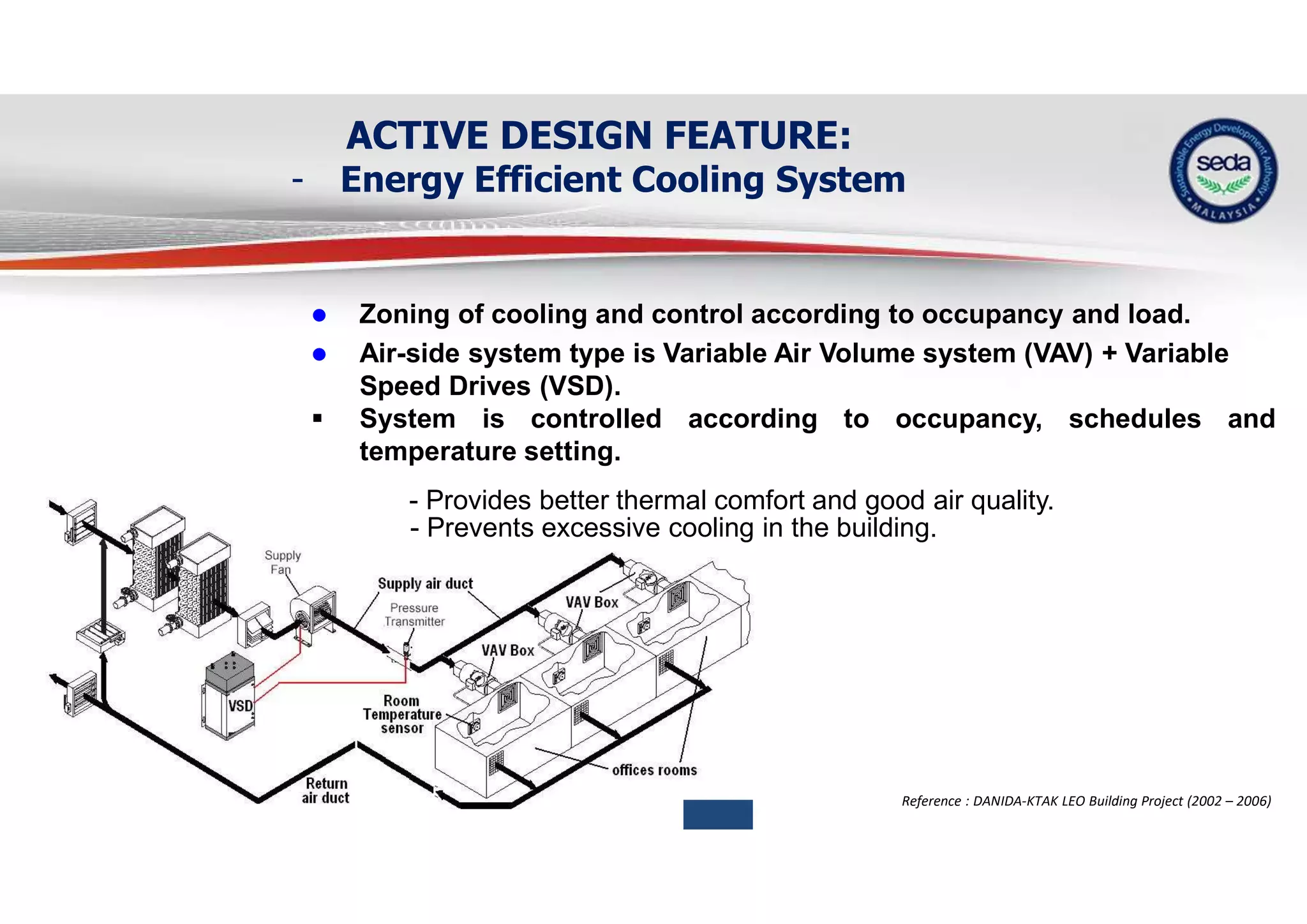
- Energy Efficient Cooling System
 Zoning of cooling and control according to occupancy and load.
 Air-side system type is Variable Air Volume system (VAV) + Variable
Speed Drives (VSD).
 System is controlled according to occupancy, schedules and
temperature setting.
- Provides better thermal comfort and good air quality.
- Prevents excessive cooling in the building.
Reference : DANIDA-KTAK LEO Building Project (2002 – 2006)
ACTIVE DESIGN FEATURE:
- Energy Efficient Cooling System
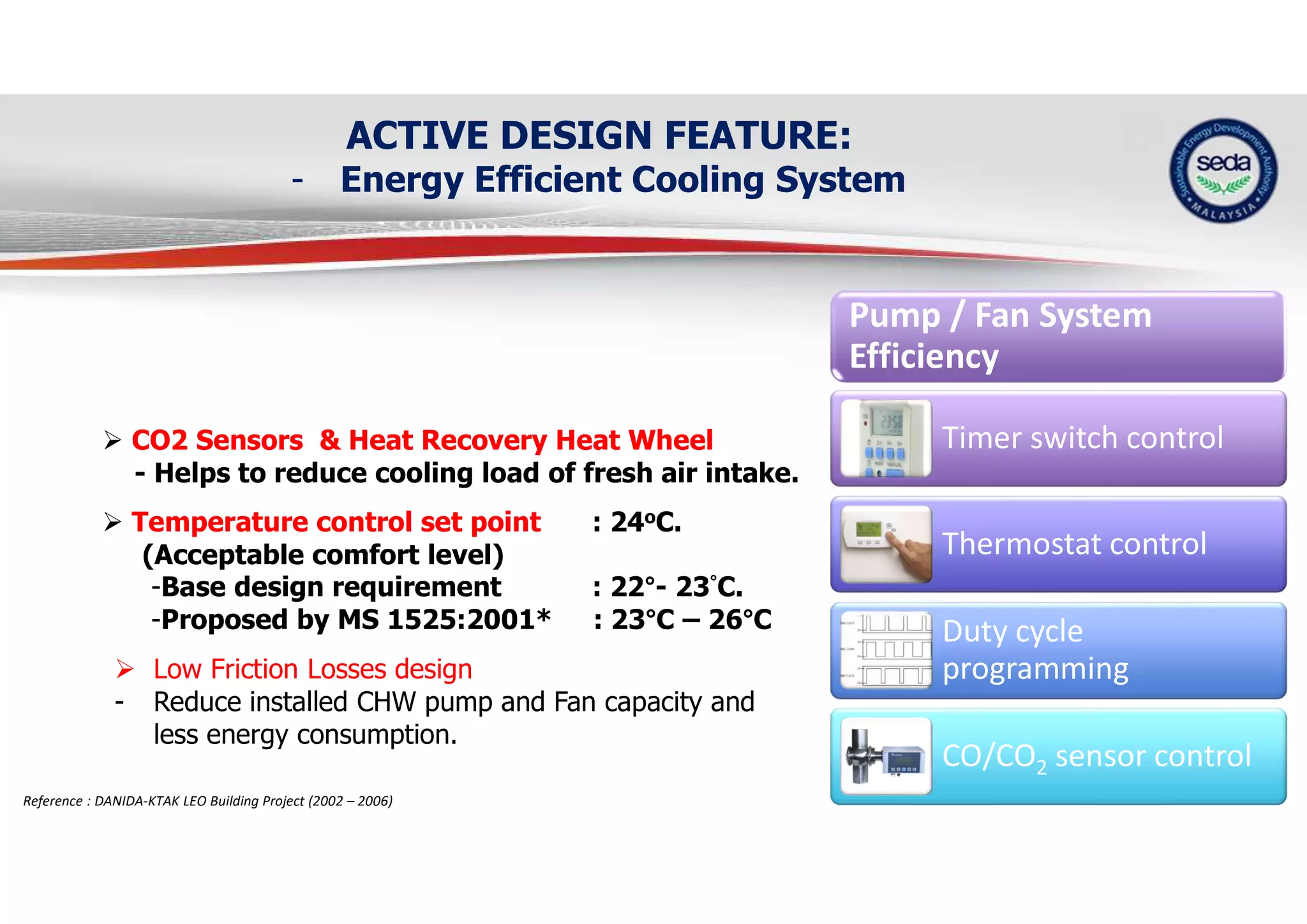
 CO2 Sensors & Heat Recovery Heat Wheel
- Helps to reduce cooling load of fresh air intake.
 Temperature control set point : 24oC.
(Acceptable comfort level)
-Base design requirement : 22°- 23°C.
-Proposed by MS 1525:2001* : 23°C – 26°C
 Low Friction Losses design
- Reduce installed CHW pump and Fan capacity and
less energy consumption.
Timer switch control
Thermostat control
Duty cycle
programming
CO/CO2 sensor control
Pump / Fan System
Efficiency
Reference : DANIDA-KTAK LEO Building Project (2002 – 2006)
ACTIVE DESIGN FEATURE:
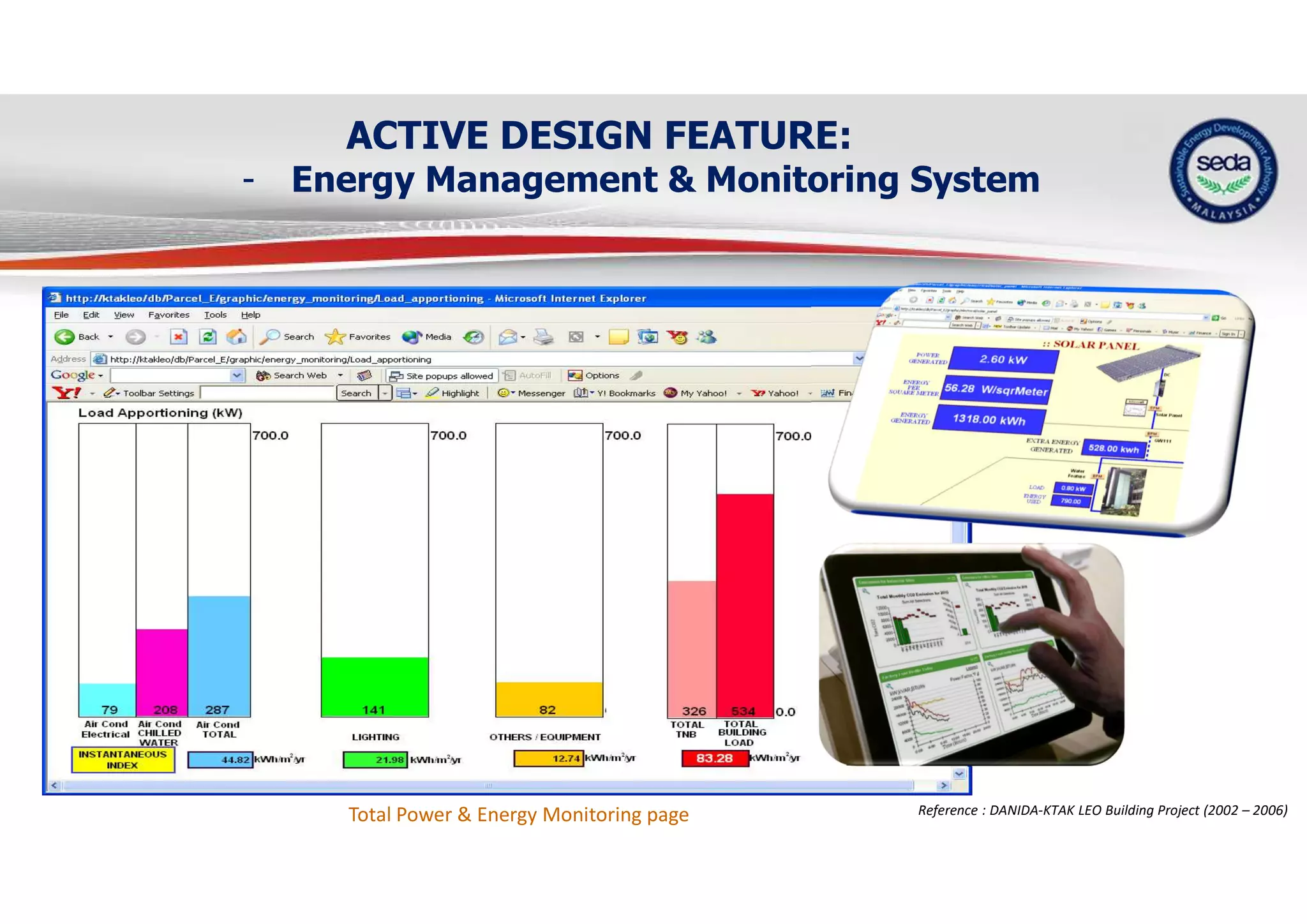
- Energy Management & Monitoring System
Total Power & Energy Monitoring page Reference : DANIDA-KTAK LEO Building Project (2002 – 2006)
ACTIVE DESIGN FEATURE:
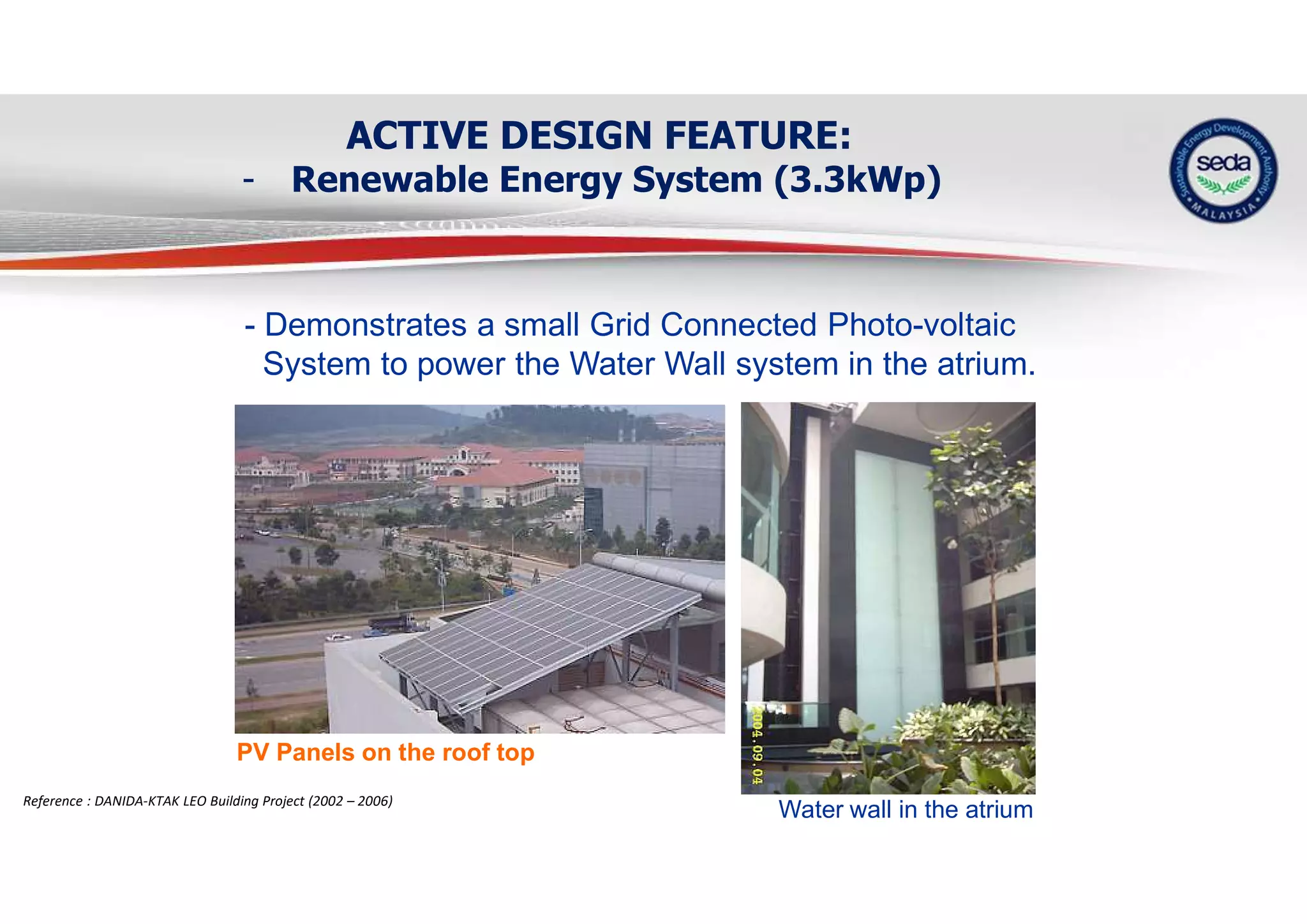
- Renewable Energy System (3.3kWp)
Water wall in the atrium
PV Panels on the roof top
- Demonstrates a small Grid Connected Photo-voltaic
System to power the Water Wall system in the atrium.
Reference : DANIDA-KTAK LEO Building Project (2002 – 2006)
BUILDING ENERGY SIMULATION:
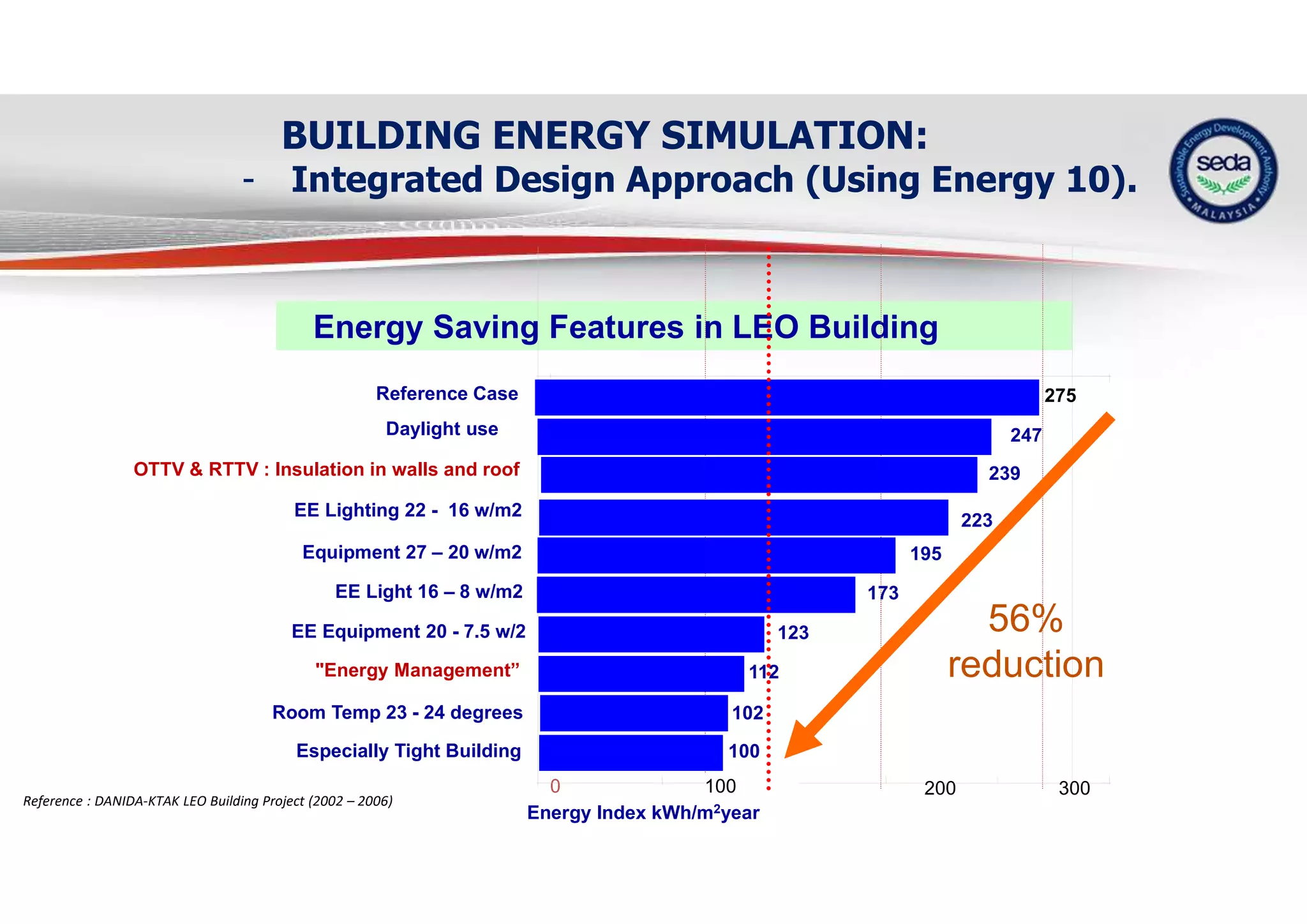
- Integrated Design Approach (Using Energy 10).
Energy Saving Features in LEO Building
Energy Index kWh/m2year
0 1000 200 300
275Reference Case
247Daylight use
223
EE Lighting 22 - 16 w/m2
195Equipment 27 – 20 w/m2
173EE Light 16 – 8 w/m2
123EE Equipment 20 - 7.5 w/2
112"Energy Management”
102Room Temp 23 - 24 degrees
100Especially Tight Building
100
239OTTV & RTTV : Insulation in walls and roof
56%
reduction
Reference : DANIDA-KTAK LEO Building Project (2002 – 2006)
BUILDING ENERGY SIMULATION:
- Integrated Design Approach (Using Energy 10).
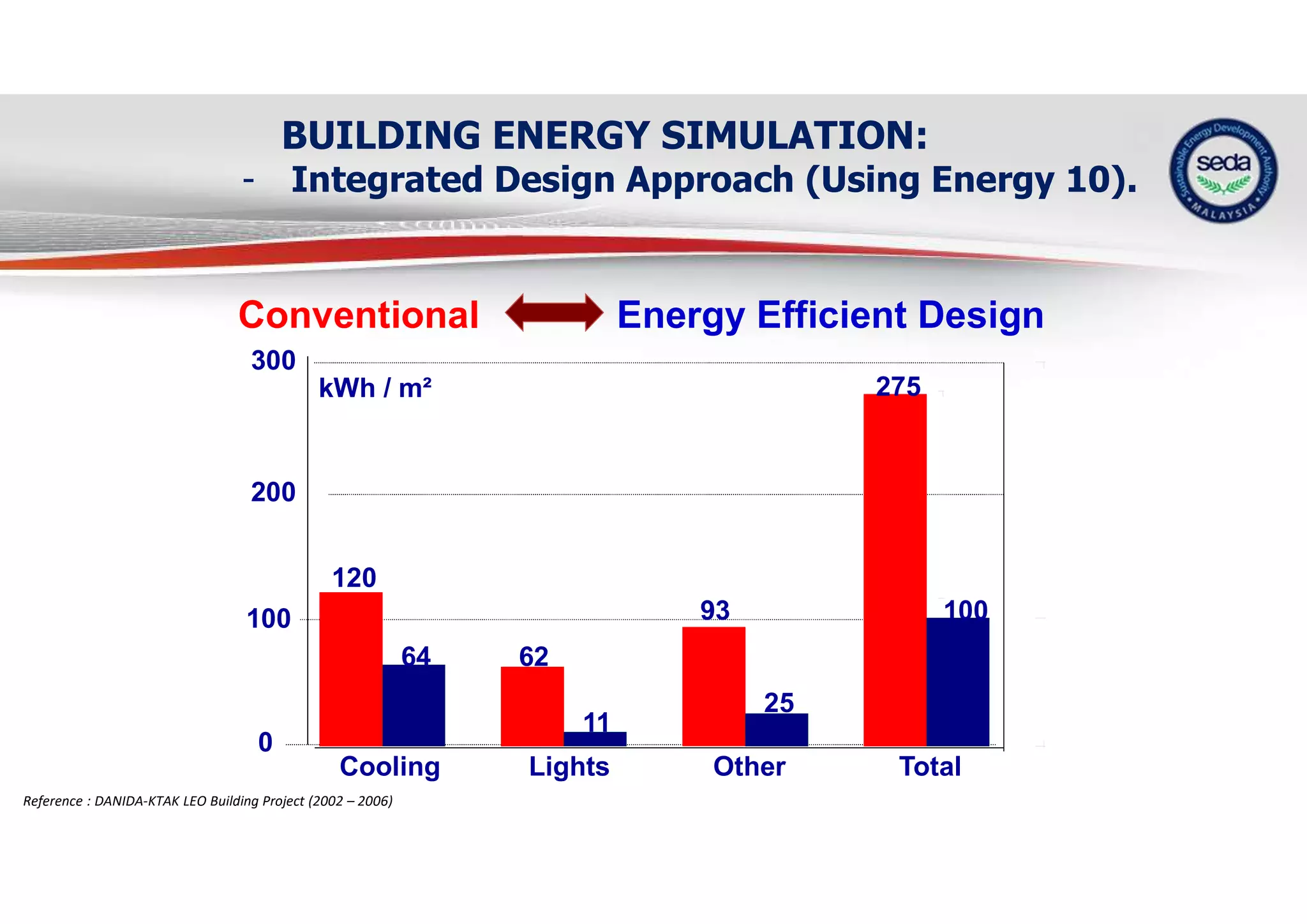
Conventional Energy Efficient Design
0
100
200
300
Cooling Lights Other Total
120
64 62
11
93
25
275
100
kWh / m²
Reference : DANIDA-KTAK LEO Building Project (2002 – 2006)
ENERGY MANAGEMENT IN OPERATIONAL:
- Fine tuning, Optimisation & Maintain Performance.
Building Energy Index
(Based on Energy Bills)
64
38
29
16
38
29
28
27
33
30
31
32
29
24
26
25
23
29
20
32
29
27
31
27
30
26
25
18
35
26
31
30
32
35
33
30
24
26
26
24
24
25
25
30
30
30
34
31
28
32
30
-
28
64
36
111
94
90
78
83
88
90
87
92
87
88
87
79
80
77
78
80
77
73
80
81
79
80
78
74
81
79
76
82
92
90
89
90
95
94
89
85
88
89
93
90
87
93
91
89
94
91
90
92
87
-
86
36
100
149
122
106
116
112
115
117
120
122
118
120
116
103
106
102
100
109
97
105
109
108
110
107
108
99
106
97
111
108
123
121
122
124
128
124
113
110
114
113
116
116
113
122
120
119
128
122
118
124
118
100
115
0
20
40
60
80
100
120
140
160
Month
[kWh/m2/yr]
Chilled Water-Cooling Index [kWh/m2/yr] Electrical Energy Index [kWh/m2/yr] Building Energy Index [kWh/m2/yr]
LEO Monitoring & PerformanceReference : DANIDA-KTAK LEO
Building Project (2002 – 2006)
ENERGY MANAGEMENT IN OPERATIONAL:
- Fine tune, Optimisation & Maintain Performance.
= 3,366,475 kWh/yr
or more than RM 800,000
per year
= 3,366,475 kWh/yr x
0.614 kg CO2/kwh
= 2,067,016 kg/year CO2
= 2,067 tones CO2/year
LEO Building
LEO BEI = 100
(Conventional) BEI = 275
175 kWh/m2year
Tariff C1
28.8 sen/kWh
Savings = 56%
Average Building Energy Index (BEI) in Parcel B
[kWh/m2/yr]
378
315
278
196
233
253
322
349
123
321
268
236
167
198
215
273
296
114
-
50
100
150
200
250
300
350
400
B1 B2 B3 B4 B5 B6 B7 B8 E4/5
Blocks
[kWh/m2/yr]
AVERAGE (3276 hrs/yr) AVERAGE (Normalised to 2646hrs/yr)
Comparison LEO Building with several
buildings in Putrajaya
Reference : DANIDA-KTAK LEO Building Project (2002 – 2006)
WAY FORWARD
- Maximize Use of The Energy Efficient Reference Guide & Standard
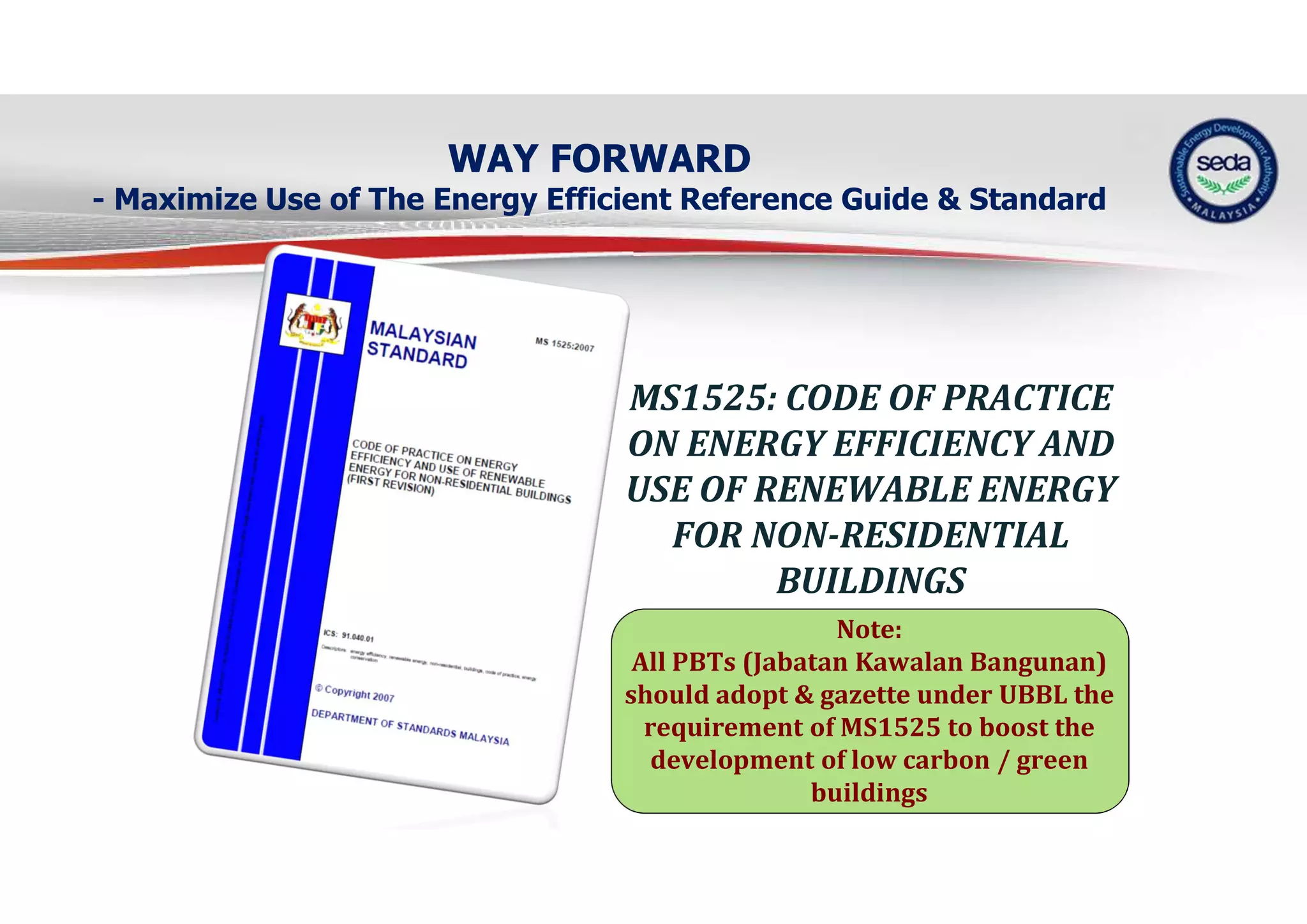
MS1525: CODE OF PRACTICE
ON ENERGY EFFICIENCY AND
USE OF RENEWABLE ENERGY
FOR NON-RESIDENTIAL
BUILDINGS
Note:
All PBTs (Jabatan Kawalan Bangunan)
should adopt & gazette under UBBL the
requirement of MS1525 to boost the
development of low carbon / green
buildings
WAY FORWARD
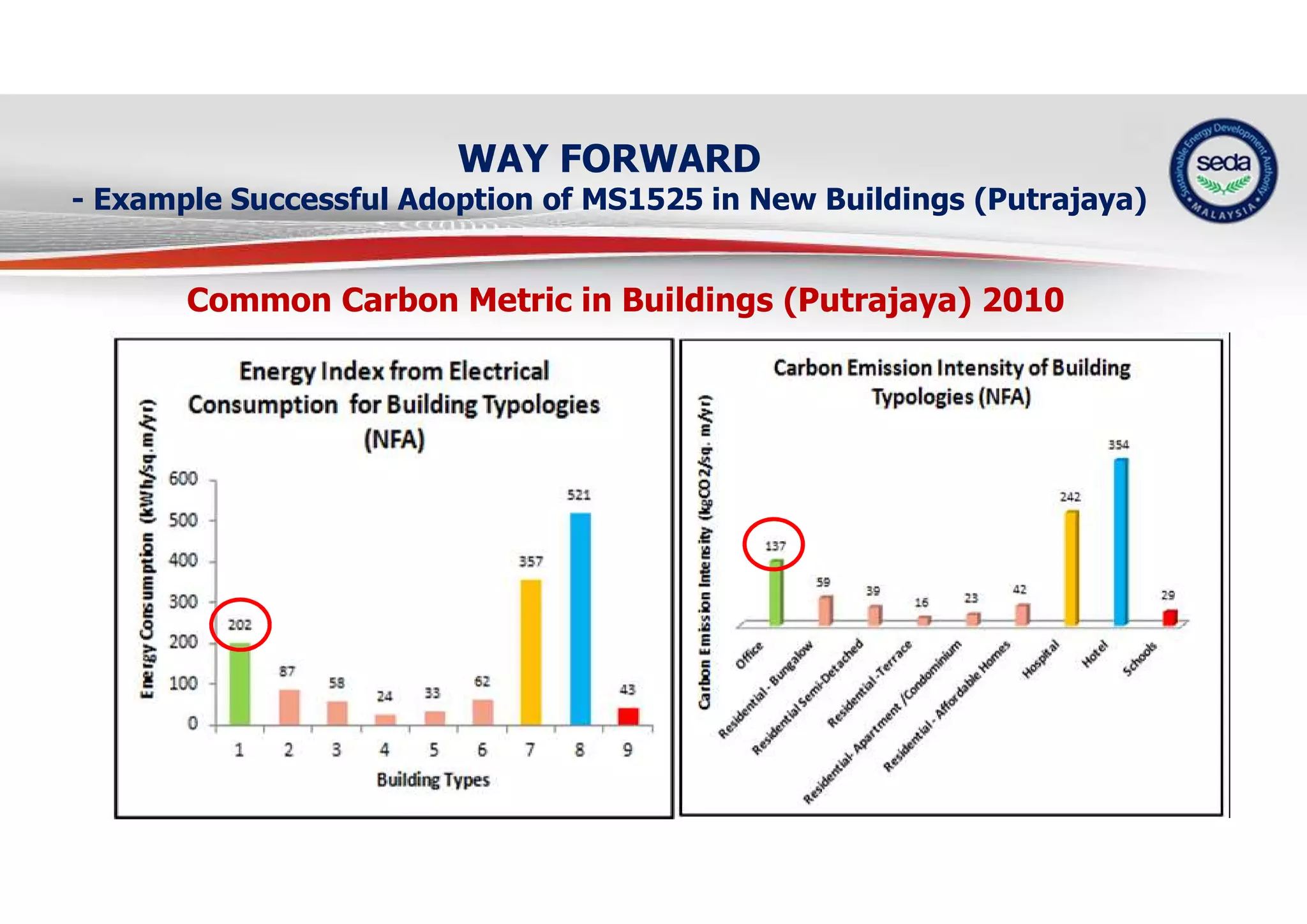
- Example Successful Adoption of MS1525 in New Buildings (Putrajaya)
Common Carbon Metric in Buildings (Putrajaya) 2010
WAY FORWARD
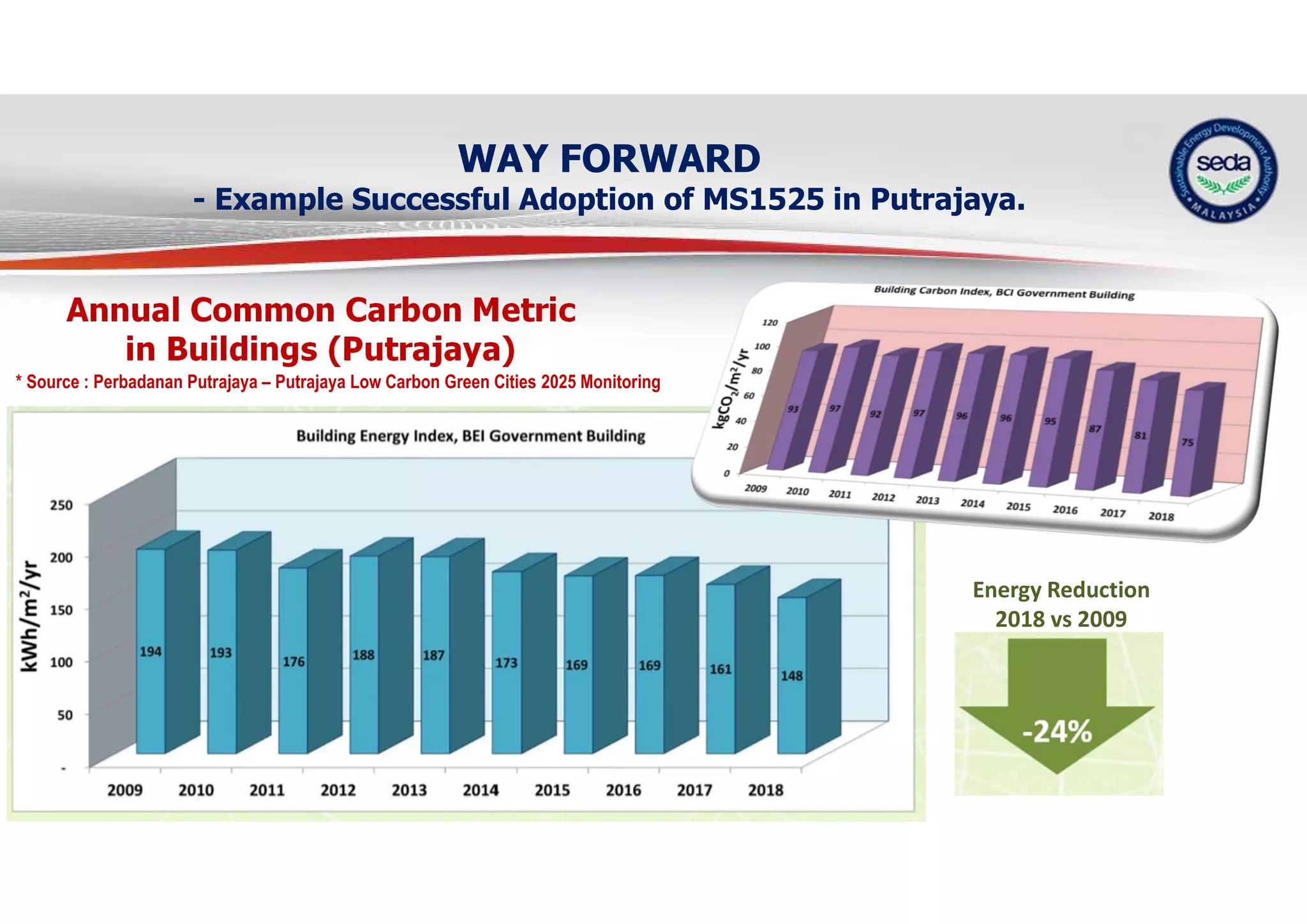
- Example Successful Adoption of MS1525 in Putrajaya.
Annual Common Carbon Metric
in Buildings (Putrajaya)
* Source : Perbadanan Putrajaya – Putrajaya Low Carbon Green Cities 2025 Monitoring
Energy Reduction
2018 vs 2009
31
Thank you for your attention
SEDA Malaysia,
Galeria PjH, Level 9
Jalan P4W, Persiaran Perdana,
Presint 4, 62100 Putrajaya, Malaysia.
Phone : +603-8870 5800 / 5841
Email: steve@seda.gov.my
Web: www.seda.gov.my
- Tel / SMS / WhatApps: +6019-2829102
steve@seda.gov.my / asetip@damansara.net
+
Steve Anthony Lojuntin

Case study of ms1525 energy efficiency and renewable energy code of practice.

  • 1.
    EXAMPLE / CASESTUDY OF MS1525 APPLICATIONS INTO THE ENERGY EFFICIENCT BUILDING DESIGN & OPERATION Steve Anthony Lojuntin Director of Technical Development & Facilitation Division Sustainable Energy Development Authority @ SEDA Malaysia Tel / SMS :+6019-2829102 Email: steve@seda.gov.my / asetip@damansara.net 12 September 2019 Awareness Seminar : Achieving Sustainable Development Goals Through The Application of MS1525 : Code of Practice – Energy Efficiency & Use of Renewable Energy for Non-residential Buildings
  • 2.
    SUSTAINABLE ENERGY INBUILDINGS SUSTAINABLE ENERGY PYRAMID !! BASIC PRINCIPAL FOR SUSTAINABLE ENERGY & LOW CARBON PROGRAM Energy Conservation Renewable Energy Energy Efficiency TOWARDS CARBON NEUTRAL TOWARDS ZERO ENERGY
  • 3.
    REFERENCE TO DEVELOPSUSTAINABLE ENERGY BUILDINGS SOLUTION TO REDUCE CARBON EMISSION, IMPROVE ENERGY SECURITY, SAVE OPERATIONAL COST (Environment – Social – Economics) REDUCE DEMAND Energy Efficiency & Conservation OFF-SET FURTHER ENERGY USAGE Renewable Energy GUIDELINES & STANDARD MS 1525 ACTIONS Building owners, Professionals, FM & Local Authorities TOOLS Sustainable Building Tools, esp EE & Low Carbon Building
  • 4.
    ENERGY FLOWS INA PREMISES / Productions Energy consumption caused by several main factors; Reference : Gregers Reiman
  • 5.
    ENERGY LOAD MAPPING OFMS1525 MAIN ELEMENTS PASSIVE ACTIVE . Heat  Shading, Insulation & Nat. ventilation.  Condition of Thermal Comfort Lighting  Daylighting  EE Artificial Lighting Equipment  EE Building Services Sys.  EE End-users Equipment. Human  Assisted Energy Management & Control Sys. < Building Energy Simulation >  RE assisted Equipment. Integrated Optimization
  • 6.
    Net BEI =114 (59% reduce) 1,490 TonCO2/year GBI : Silver (2011) ASEAN Energy Award : 2006 Net BEI = 114 (59% reduce) 1,490 TonCO2/year GBI : Silver (2011) ASEAN Energy Award : 2006 Net BEI = 63 (70% reduce) 637 TonCO2/year (**To verify) GBI & GreenMark : Platinum (2011) ASEAN EA : 2012 Net BEI = 63 (70% reduce) 637 TonCO2/year (**To verify) GBI & GreenMark : Platinum (2011) ASEAN EA : 2012 Net BEI = 30 (86% reduce) 65 TonCO2/year GBI : Certified (2009) ASEAN EA : 2009/2010/2011 Net BEI = 30 (86% reduce) 65 TonCO2/year GBI : Certified (2009) ASEAN EA : 2009/2010/2011 EXAMPLES OF ENERGY EFFICIENT BUILDINGS THAT USES MS1525 DURING THE DEVELOPMENT & OPERATIONS 2007 2004
  • 7.
    CASE STUDY The LowEnergy Office (LEO) Building, Putrajaya Construction : Year 2002 – 2004 Reference : DANIDA-KTAK LEO Building Project (2002 – 2006)
  • 8.
    The Low EnergyOffice (LEO) Building, Putrajaya In-house Energy Manager + Operation monitoring team Reference : DANIDA-KTAK LEO Building Project (2002 – 2006)
  • 9.
    Energy Efficient DesignFeatures  Passive Design Elements. - Building Orientation. - Building Envelope (OTTV). - Natural Air Ventilation. - Interior Space Layout Design.  Active Elements - Air Conditioning & Mechanical Ventilation. - Innovative Lighting System. - Energy Efficient Office Appliances - Plug Loads. - Comprehensive Energy Management System.  Other Sustainable Elements - 3.3kWp Solar Photo-voltaic (building grid connected) - Rain Water Harvest system (for landscape system) Reference : DANIDA-KTAK LEO Building Project (2002 – 2006)
  • 10.
    PASSIVE DESIGN FEATURE: -Building Orientation N Orientation along the East-West direction. Since the sun rises up from the east and sets in the West, less direct sunlight will heat the building façade. To minimise heat gain from the sun radiation: • Most windows/glazing facing North and South • Less windows facing East and West Reference : DANIDA-KTAK LEO Building Project (2002 – 2006)
  • 11.
    Walls: 200 mm aeratedconcrete brick (normal 115 mm brick) OTTV - 35 W/m2 (normal: 43 W/m2 ) Punch Hole Windows: (600 - 1000 mm) -Better shading effect - deeper penetration of daylight All glazing near façade-12 mm light green glass. -Provides more diffuse daylight but less heat - Visible light trans. = 65%. Solar Heat only 51% pass through Concrete Roof Above - metal deck canopy Inside - 100 mm extruded Styrofoam (normal 25 mm.) Flat roof Canopy PASSIVE DESIGN FEATURE: - Building Envelope (Insulation on Roof & Wall) Reference : DANIDA-KTAK LEO Building Project (2002 – 2006)
  • 12.
    PASSIVE DESIGN FEATURE: -Building Envelope (Insulation on Roof & Wall) - Max. Base Building OTTV : 45 W/m2 (Malaysian Standard - MS1525 : 2001) - Max. tender spec., OTTV : 35 W/m2 - Actual calculated OTTV : 31.4 W/m2 Overall Thermal Transfer Value (OTTV) OTTV is a calculation to measure the level of heat absorbed into the building Reference : DANIDA-KTAK LEO Building Project (2002 – 2006)
  • 13.
    PASSIVE DESIGN FEATURE: -Natural Cross Air Ventilation at the Atrium - Reduce use of mechanical ventilation system  Computer simulation of air change of 6 to 10 ach  Natural Ventilation Assisted by a Solar Chimney Solar Chimney Effect  Provides Daylight Deep into the Building Reference : DANIDA-KTAK LEO Building Project (2002 – 2006)
  • 14.
    PASSIVE DESIGN FEATURE: -Maximum Use of Daylighting. - Reduces use of artificial lightings. Daylit Semi-daylit Artificial Lighting Stores/Meeting/ Documentation rooms at the core of building Open plan working space near the façade Work area near the façade Reference : DANIDA-KTAK LEO Building Project (2002 – 2006)
  • 15.
    ACTIVE DESIGN FEATURE: -Energy Efficient Lighting System - Energy Efficient lamps.  Lighting Zoning / Grouping: - Multi circuit lighting system. - Easy to control and optimize.  Lighting Automation System: - Occupancy sensor and Photo sensor. - System integrated with Building Energy Management system.  Design luminance level in Offices : 350 lux - Proposed by MS 1525:2001* : 300 – 400 lux. - Base design requirement : 500 lux. Reference : DANIDA-KTAK LEO Building Project (2002 – 2006)
  • 16.
    ACTIVE DESIGN FEATURE: -Energy Efficient Cooling System  Zoning of cooling and control according to occupancy and load.  Air-side system type is Variable Air Volume system (VAV) + Variable Speed Drives (VSD).  System is controlled according to occupancy, schedules and temperature setting. - Provides better thermal comfort and good air quality. - Prevents excessive cooling in the building. Reference : DANIDA-KTAK LEO Building Project (2002 – 2006)
  • 17.
    ACTIVE DESIGN FEATURE: -Energy Efficient Cooling System  CO2 Sensors & Heat Recovery Heat Wheel - Helps to reduce cooling load of fresh air intake.  Temperature control set point : 24oC. (Acceptable comfort level) -Base design requirement : 22°- 23°C. -Proposed by MS 1525:2001* : 23°C – 26°C  Low Friction Losses design - Reduce installed CHW pump and Fan capacity and less energy consumption. Timer switch control Thermostat control Duty cycle programming CO/CO2 sensor control Pump / Fan System Efficiency Reference : DANIDA-KTAK LEO Building Project (2002 – 2006)
  • 18.
    ACTIVE DESIGN FEATURE: -Energy Management & Monitoring System Total Power & Energy Monitoring page Reference : DANIDA-KTAK LEO Building Project (2002 – 2006)
  • 19.
    ACTIVE DESIGN FEATURE: -Renewable Energy System (3.3kWp) Water wall in the atrium PV Panels on the roof top - Demonstrates a small Grid Connected Photo-voltaic System to power the Water Wall system in the atrium. Reference : DANIDA-KTAK LEO Building Project (2002 – 2006)
  • 20.
    BUILDING ENERGY SIMULATION: -Integrated Design Approach (Using Energy 10). Energy Saving Features in LEO Building Energy Index kWh/m2year 0 1000 200 300 275Reference Case 247Daylight use 223 EE Lighting 22 - 16 w/m2 195Equipment 27 – 20 w/m2 173EE Light 16 – 8 w/m2 123EE Equipment 20 - 7.5 w/2 112"Energy Management” 102Room Temp 23 - 24 degrees 100Especially Tight Building 100 239OTTV & RTTV : Insulation in walls and roof 56% reduction Reference : DANIDA-KTAK LEO Building Project (2002 – 2006)
  • 21.
    BUILDING ENERGY SIMULATION: -Integrated Design Approach (Using Energy 10). Conventional Energy Efficient Design 0 100 200 300 Cooling Lights Other Total 120 64 62 11 93 25 275 100 kWh / m² Reference : DANIDA-KTAK LEO Building Project (2002 – 2006)
  • 22.
    ENERGY MANAGEMENT INOPERATIONAL: - Fine tuning, Optimisation & Maintain Performance. Building Energy Index (Based on Energy Bills) 64 38 29 16 38 29 28 27 33 30 31 32 29 24 26 25 23 29 20 32 29 27 31 27 30 26 25 18 35 26 31 30 32 35 33 30 24 26 26 24 24 25 25 30 30 30 34 31 28 32 30 - 28 64 36 111 94 90 78 83 88 90 87 92 87 88 87 79 80 77 78 80 77 73 80 81 79 80 78 74 81 79 76 82 92 90 89 90 95 94 89 85 88 89 93 90 87 93 91 89 94 91 90 92 87 - 86 36 100 149 122 106 116 112 115 117 120 122 118 120 116 103 106 102 100 109 97 105 109 108 110 107 108 99 106 97 111 108 123 121 122 124 128 124 113 110 114 113 116 116 113 122 120 119 128 122 118 124 118 100 115 0 20 40 60 80 100 120 140 160 Month [kWh/m2/yr] Chilled Water-Cooling Index [kWh/m2/yr] Electrical Energy Index [kWh/m2/yr] Building Energy Index [kWh/m2/yr] LEO Monitoring & PerformanceReference : DANIDA-KTAK LEO Building Project (2002 – 2006)
  • 23.
    ENERGY MANAGEMENT INOPERATIONAL: - Fine tune, Optimisation & Maintain Performance. = 3,366,475 kWh/yr or more than RM 800,000 per year = 3,366,475 kWh/yr x 0.614 kg CO2/kwh = 2,067,016 kg/year CO2 = 2,067 tones CO2/year LEO Building LEO BEI = 100 (Conventional) BEI = 275 175 kWh/m2year Tariff C1 28.8 sen/kWh Savings = 56% Average Building Energy Index (BEI) in Parcel B [kWh/m2/yr] 378 315 278 196 233 253 322 349 123 321 268 236 167 198 215 273 296 114 - 50 100 150 200 250 300 350 400 B1 B2 B3 B4 B5 B6 B7 B8 E4/5 Blocks [kWh/m2/yr] AVERAGE (3276 hrs/yr) AVERAGE (Normalised to 2646hrs/yr) Comparison LEO Building with several buildings in Putrajaya Reference : DANIDA-KTAK LEO Building Project (2002 – 2006)
  • 24.
    WAY FORWARD - MaximizeUse of The Energy Efficient Reference Guide & Standard MS1525: CODE OF PRACTICE ON ENERGY EFFICIENCY AND USE OF RENEWABLE ENERGY FOR NON-RESIDENTIAL BUILDINGS Note: All PBTs (Jabatan Kawalan Bangunan) should adopt & gazette under UBBL the requirement of MS1525 to boost the development of low carbon / green buildings
  • 25.
    WAY FORWARD - ExampleSuccessful Adoption of MS1525 in New Buildings (Putrajaya) Common Carbon Metric in Buildings (Putrajaya) 2010
  • 26.
    WAY FORWARD - ExampleSuccessful Adoption of MS1525 in Putrajaya. Annual Common Carbon Metric in Buildings (Putrajaya) * Source : Perbadanan Putrajaya – Putrajaya Low Carbon Green Cities 2025 Monitoring Energy Reduction 2018 vs 2009
  • 27.
    31 Thank you foryour attention SEDA Malaysia, Galeria PjH, Level 9 Jalan P4W, Persiaran Perdana, Presint 4, 62100 Putrajaya, Malaysia. Phone : +603-8870 5800 / 5841 Email: steve@seda.gov.my Web: www.seda.gov.my - Tel / SMS / WhatApps: +6019-2829102 steve@seda.gov.my / asetip@damansara.net + Steve Anthony Lojuntin