Somchai Ruangpermpool Tresor Ngassa
Outlines R& T Department Structure and Activity  Company overview Management of a large R&T Management of International R&T Activity Features of global R&T activity International R&T sites Lessons learned Conclusion Tresor Ngassa
Tresor Ngassa
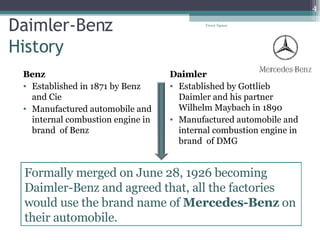
Daimler-Benz History Benz Established in 1871 by Benz and Cie Manufactured automobile and internal combustion engine in brand  of Benz Daimler Established by Gottlieb Daimler and his partner Wilhelm Maybach in 1890 Manufactured automobile and internal combustion engine in brand  of DMG Tresor Ngassa Formally merged on June 28, 1926 becoming Daimler-Benz and agreed that, all the factories would use the brand name of  Mercedes-Benz  on their automobile.
In  1998  Daimler-Benz merged with the American automobile manufacturer, Chrysler corporation and formed  DaimlerChrysler The company produces car and truck under the brands Chrysler, Dodge, Jeep, Mercedes-Benz, Smart and Maybach Daimler-Benz  History (cont.) Tresor Ngassa
T otal revenues of  € 151.6  billion s   in the year 2006 33 % was generated by the Mercedes Car Group  31  %   by   T he Chrysler Group  19  %   by the Truck Group  9 %  by the Financial Services division an d 8  % by the Van, Bus, Other segment. DaimlerChrysler employed more than   360,000  people  worldwide. Through most of its history, Chrysler has been the third largest of the “BIG 3”  US auto makers,  In Jan 2007, DaimlerChrysler excluding its luxury Mercedes and Maybach lines outsold traditionally  2 nd   placed  Ford, though   behind Toyota DaimlerChrysler 2006 Figures Tresor Ngassa
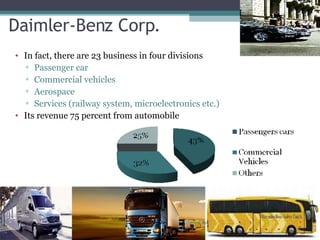
Daimler-Benz Corp. In fact, there are 23 business in four divisions Passenger car Commercial vehicles Aerospace Services (railway system, microelectronics etc.) Its revenue 75 percent from automobile Tresor Ngassa
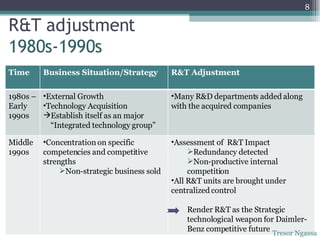
R&T adjustment  1980s-1990s Tresor Ngassa Time Business Situation/Strategy R&T Adjustment 1980s –  Early 1990s External Growth Technology Acquisition Establish itself as an major “ Integrated technology group” Many R&D departments added along with the acquired companies Middle 1990s Concentration on specific competencies and competitive strengths  Non-strategic business sold Assessment of  R&T Impact Redundancy detected Non-productive internal competition All R&T units are brought under centralized control Render R&T as the Strategic technological weapon for Daimler-Benz competitive future
Tresor Ngassa
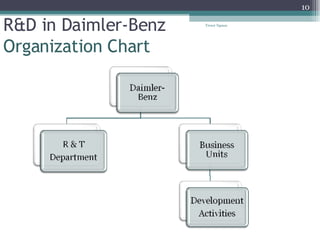
R&D in Daimler-Benz Organization Chart Tresor Ngassa
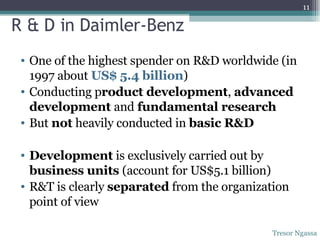
R & D in Daimler-Benz One of the highest spender on R&D worldwide (in 1997 about  US$ 5.4 billion ) Conducting p roduct development ,  advanced development  and  fundamental research But  not  heavily conducted in  basic R&D Development  is exclusively carried out by  business units  (account for US$5.1 billion) R&T is clearly  separated  from the organization point of view Tresor Ngassa
R&T department  Overview Centralized for all business units and cover research activities for a wide range of potential products. Their responsibilities Support all business units and Daimler –Benz in term of technological strategies through networked and knowledge based cooperation within business units Had budget of US$280 billion coming from two sources. Tresor Ngassa
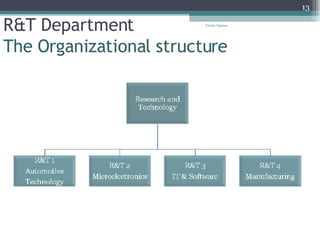
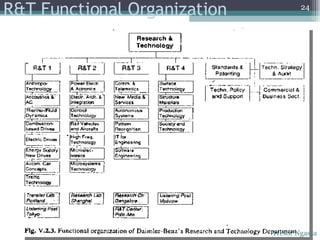
R&T Department The Organizational structure Tresor Ngassa
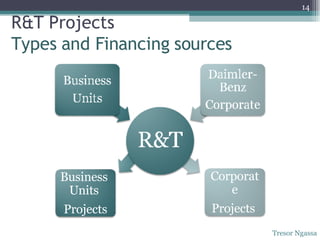
R&T Projects  Types and Financing sources  Tresor Ngassa Corporate Projects  Business  Units  Projects
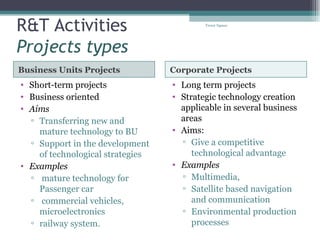
R&T Activities Projects types Business Units Projects Corporate Projects Short-term projects Business oriented  Aims Transferring new and mature technology to BU Support in the development of technological strategies Examples mature technology for Passenger car commercial vehicles, microelectronics railway system. Long term projects Strategic technology creation applicable in several business areas Aims: Give a competitive technological advantage Examples Multimedia, Satellite based navigation and communication  Environmental production processes Tresor Ngassa
R&T management : How to make it works ? What is the yardstick of  R&T? Successful transfer of research results to the business Since R&T aim to be integral part of business units therefore Scientific know how   of employee is crucial and This know how can be sustained via the  networks Tresor Ngassa
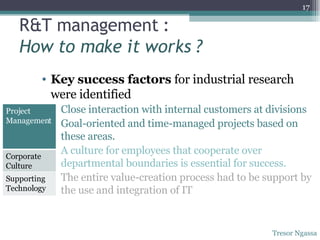
R&T management : How to make it works ? Key success factors  for industrial research were identified Close interaction with internal customers at divisions Goal-oriented and time-managed projects based on these areas. A culture for employees that cooperate over departmental boundaries is essential for success. The entire value-creation process had to be support by the use and integration of IT Tresor Ngassa Project Management Corporate Culture Supporting Technology
Two core process were identified Technology strategy, innovation planning, project work, transfer of results. Measure agree upon are : Technology management and research  know-how are now united Cooperation with business units will be determined in individual organization agreement The process transfers will dealt with separately. Staff selection, staff development, staff transfer : Critical success factor for  R&T and technology transfer are Skilled Motivated employees. R&T management : How to make it works ? Tresor Ngassa
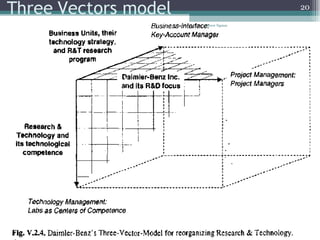
First core process  The main goal Reinforced integration of R&T  in defining the overall technology strategy of Daimler-Benz and the innovation strategy of the business units. Transition   of all research programs into research projects Concentration of distinct capabilities  in research laboratories designated as competency center that serve to consolidate internal and external knowledge Tresor Ngassa
Three Vectors model Tresor Ngassa
Problems and Solutions  in  R & T Set of Problems I It is more difficult to  cooperate  between  different business area  than between  different sites Project members are engaged in several projects or function .  And  different locations  do  increase coordination problems. Spatially dispersed project  management has to deal with the following problems . Coordination cost Information cost Project management cost are higher and must be accounted for accordingly Tresor Ngassa
Problems and Solutions  in R & T (cont.) Solution for set I Project must be  identified   properly at the  beginning phase At  individual level,  project managers should be educated in  Human Resources Management  and  cultural management +++ People with technical knowledge, managerial talent and good networking skill are generally hard to find Tresor Ngassa
Problems and Solutions  in R& T (cont.) Set of problems Problem II External partners within Daimler-Benz are considered as competition. The NIH syndrome occur between different  location. Solution II The new structure with labs as competence centers. Each lab has research focus. The labs form a resource pool for project team, so that matrix problem can be solved. Lab are clustered with R&T directors managing the cluster. Tresor Ngassa
R&T Functional Organization Tresor Ngassa
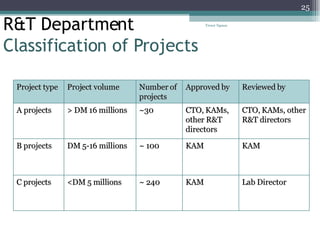
R&T Department Classification of Projects Tresor Ngassa Project type Project volume Number of projects Approved by Reviewed by A projects > DM 16 millions ~30 CTO, KAMs, other R&T directors CTO, KAMs, other R&T directors B projects DM 5-16 millions ~ 100 KAM KAM C projects <DM 5 millions ~ 240 KAM Lab Director
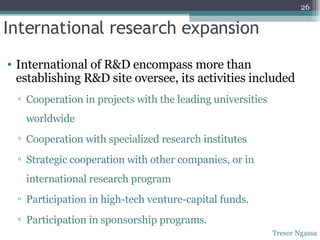
International research expansion International of R&D encompass more than establishing R&D site oversee, its activities included Cooperation in projects with the leading universities worldwide Cooperation with specialized research institutes Strategic cooperation with other companies, or in international research program Participation in high-tech venture-capital funds. Participation in sponsorship programs. Tresor Ngassa
 
Tresor Ngassa
Global R&T Management  Major Issues  Organization of soft and informal means  Building of a global mind-set for R&T employees Intrinsic difficulties of international R&D operations Different languages and cultures High costs  Long project execution times Geographical distances Interfunctional differences Tresor Ngassa
R & T Organization Special features Five features support global R&T operations at Daimler-Benz Technology Monitoring  Research Project Coaching Circle Member Group Exchange Group R&T Research Auditing Tresor Ngassa
Technology Monitoring In 1990 Daimler-Benz establish a technology observation unit to  systematize  its  global technology monitoring Mission: Maintain and strengthen the technological competitiveness of the business areas Tasks: Conduct a business oriented analysis of relevant technological developments Support corporate or business specific technology strategy development Tresor Ngassa
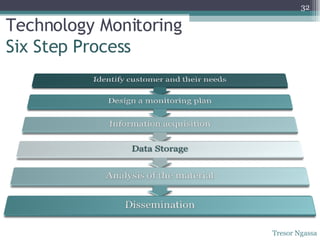
Technology Monitoring Six Step Process Tresor Ngassa
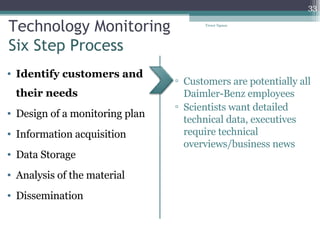
Technology Monitoring Six Step Process Identify customers and their needs Design of a monitoring plan Information acquisition Data Storage Analysis of the material Dissemination  Customers are potentially all Daimler-Benz employees Scientists want detailed technical data, executives require technical overviews/business news Tresor Ngassa
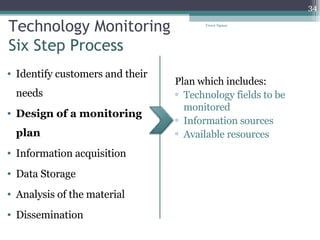
Technology Monitoring Six Step Process Identify customers and their needs Design of a monitoring plan Information acquisition Data Storage Analysis of the material Dissemination  Plan which includes: Technology fields to be monitored Information sources Available resources Tresor Ngassa
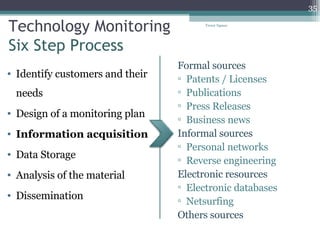
Technology Monitoring Six Step Process Identify customers and their needs Design of a monitoring plan Information acquisition Data Storage Analysis of the material Dissemination  Formal sources Patents / Licenses Publications Press Releases Business news Informal sources Personal networks Reverse engineering Electronic resources Electronic databases Netsurfing Others sources Tresor Ngassa
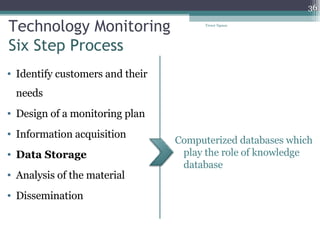
Technology Monitoring Six Step Process Identify customers and their needs Design of a monitoring plan Information acquisition Data Storage Analysis of the material Dissemination  Computerized databases which play the role of knowledge database Tresor Ngassa
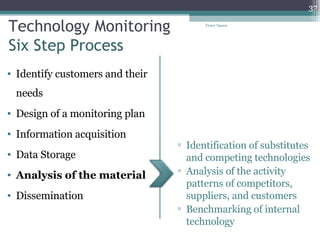
Technology Monitoring Six Step Process Identify customers and their needs Design of a monitoring plan Information acquisition Data Storage Analysis of the material Dissemination  Identification of substitutes and competing technologies Analysis of the activity patterns of competitors, suppliers, and customers Benchmarking of internal technology Tresor Ngassa
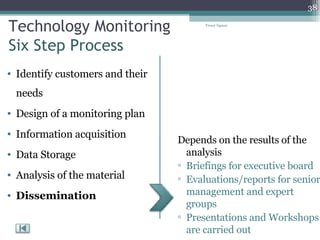
Technology Monitoring Six Step Process Identify customers and their needs Design of a monitoring plan Information acquisition Data Storage Analysis of the material Dissemination   Depends on the results of the analysis Briefings for executive board Evaluations/reports for senior management and expert groups Presentations and Workshops are carried out Tresor Ngassa
Research Project Coaching Daimler-Benz established  commercial project controlling  in R&T in 1991.  Consist of  project coaches  who act as service providers.  Have grown from 11 to 40 coaches (as in 1997) Tasks: Introduce  project management  (knowledge, instruments) Establish  project controlling processes Focus: Strategic or special R&T projects Projects susceptible to (or having) particular problems Tresor Ngassa
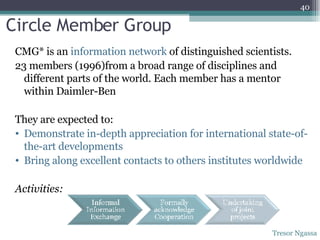
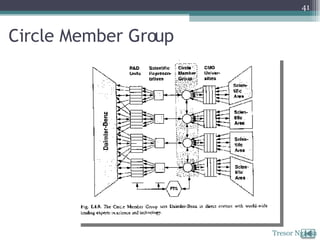
Circle Member Group CMG* is an  information network  of distinguished scientists.  23 members (1996)from a broad range of disciplines and different parts of the world. Each member has a mentor within Daimler-Ben They are expected to: Demonstrate in-depth appreciation for international state-of-the-art developments Bring along excellent contacts to others institutes worldwide Activities: Tresor Ngassa
Circle Member Group Tresor Ngassa
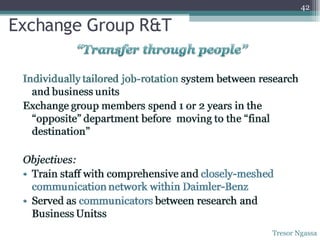
Exchange Group R&T Tresor Ngassa
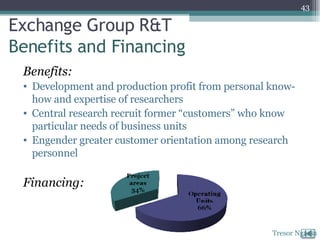
Exchange Group R&T Benefits and Financing Benefits: Development and production profit from personal know-how and expertise of researchers Central research recruit former “customers” who know particular needs of business units Engender greater customer orientation among research personnel Financing: Tresor Ngassa
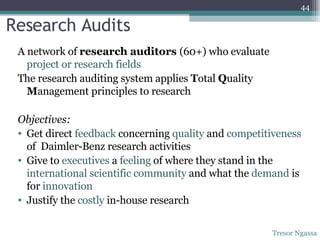
Research Audits A network of  research auditors  (60+) who evaluate  project or research fields The research auditing system applies  T otal  Q uality  M anagement principles to research Objectives: Get direct  feedback  concerning  quality  and  competitiveness  of  Daimler-Benz research activities Give to  executives  a  feeling  of where they stand in the  international scientific community  and what the  demand  is for  innovation Justify the  costly  in-house research Tresor Ngassa
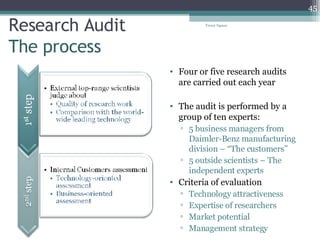
Research Audit The process Four or five research audits are carried out each year The audit is performed by a group of ten experts: 5 business managers from Daimler-Benz manufacturing division – “The customers” 5 outside scientists – The independent experts Criteria of evaluation Technology attractiveness Expertise of researchers Market potential Management strategy Tresor Ngassa
Tresor Ngassa
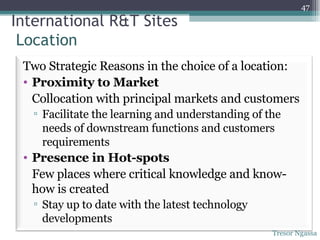
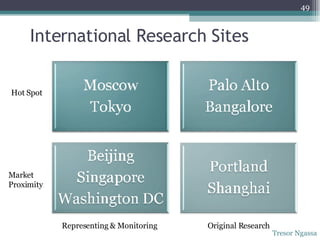
Tresor Ngassa International R&T Sites  Location  Two Strategic Reasons in the choice of a location: Proximity to Market Collocation with principal markets and customers Facilitate the learning and understanding of the needs of downstream functions and customers requirements Presence in Hot-spots Few places where critical knowledge and know-how is created Stay up to date with the latest technology developments
Activity of International Research Site Depending on the purpose, international sites carry on 3 different activities: Representing Monitoring / Listening Research  Tresor Ngassa
International Research Sites Representing & Monitoring Original Research Hot Spot Market Proximity Tresor Ngassa
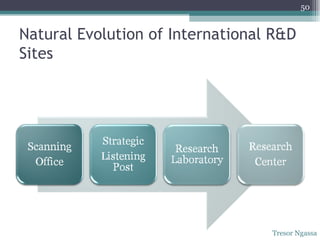
Natural Evolution of International R&D Sites Tresor Ngassa
Listening Posts  Small teams :  3 to 10 people Missions Technology Monitoring:  Observation of key technology areas and identification of new trends Establishing Research Cooperation Establishing  and maintaining expert networks Technology and market intelligence service Location Tokyo Boston Moscow Tresor Ngassa
Tokyo Listening Post (1990) Reasons of the Location: Monitoring of the Japanese automobile market Japan is a strategic market for Daimler-Benz Get pre-market, first-hand data Improve Daimler-Benz competitiveness Tresor Ngassa
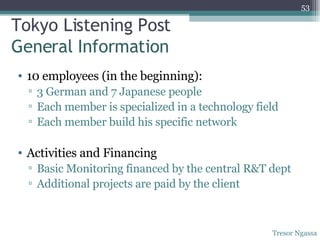
Tokyo Listening Post General Information 10 employees (in the beginning): 3 German and 7 Japanese people Each member is specialized in a technology field Each member build his specific network Activities and Financing Basic Monitoring financed by the central R&T dept Additional projects are paid by the client  Tresor Ngassa
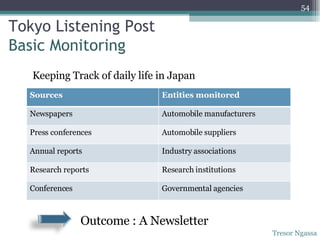
Tokyo Listening Post Basic Monitoring Keeping Track of daily life in Japan Outcome : A Newsletter Tresor Ngassa Sources Entities monitored Newspapers Automobile manufacturers Press conferences  Automobile suppliers Annual reports Industry associations Research reports Research institutions Conferences Governmental agencies
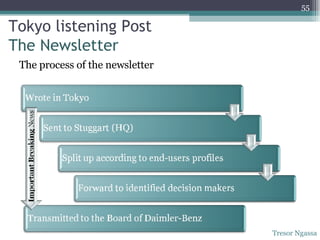
Tokyo listening Post The Newsletter The process of the newsletter Tresor Ngassa
Tokyo Listening Post Additional Projects Identify a research institution/researcher to work on the problem of the client Making contact and/or facilitating a visit of the client Tresor Ngassa
Very long and complex process  to establish contact with Japanese institution A full week of preparation for each day spent in a Japanese institution by a Daimler researcher Lifetime lasting contact A  deep understanding  of the  Japanese culture  is  indispensable , especially for reading “between lines” Tokyo Listening Post Cultural/Country specificities Tresor Ngassa
Boston Listening Post Set up in 1992 Reason: Presence of excellent research institutions/universities (especially MIT) After the opening of Palo Alto in 1995, the Boston group was spun off into a consulting company Tresor Ngassa
Moscow Listening Post Founded in 1992 with six employees One German and five Russians Try to establish contacts with research institutions and companies Fields of interests:  Material sciences, Information science and Mathematics Tresor Ngassa
Moscow Listening Post The results Having an  influential figure  of the Russian  science community  appeared to be decisive A  lot of activities didn’t result in a direct benefit However the discovery of a titanium alloy with good welding characteristics was a major achievement Tresor Ngassa
Moscow Listening Post Cultural/Country specificities Erratic reception  of western  visitors  by research institutions Short relationship duration  once the contact is established Difficult integration  of a research center with the local scientific community Tresor Ngassa
Establishing Listening Posts Lessons Learned The pre-requisite characteristic for working in a technology liaison office are: Colorful   and  hyperactive  personalities Not shy and not afraid of high-ranking counterparts Generalist  in terms of scientific/technical background Broad engineering background Rather in his  fifties  than thirties Tresor Ngassa
Listening Posts Reviewing the efforts Task description is often vague Can be partly based on the outcomes  Number of reports Timeliness Accuracy Expenses/impact is very hard to estimate One big hit can finance the program for 10+ years Cost of the offices should be put into  perspective  to the  overall R&D investments . Tresor Ngassa
Research Centers There are two types of research centers: Research center for local development support Follow a market-driven internationalization The Shanghai Institute of Metallurgy (China) The Portland Vehicle Systems center (USA) Research center for technology sourcing Pure research in hot-spots The Daimler-Benz R&T center in Palo Alto (USA) The Daimler-Benz Research Center India  Tresor Ngassa
Research for local development support The Shanghai Institute of Metallurgy It’s a Joint venture founded 1995 to support Temic Fields : “electronic packaging” (microelectronics) Frequent exchange between Chinese and German scientists. Portland Vehicle Systems  Established in 1996 to support Freightliner Fields:  Vehicle System Technology  Tresor Ngassa
Research for technology sourcing Daimler-Benz R&T center in Palo Alto Set up 1995, originally technology listening post in the Silicon Valley, a crucial hot spot Fields : Transportation, communications and related technologies Objectives: Help Daimler-Benz  in  accelerating acquisition  of  cutting-edge technology Help  intellectual exchange  flourish between  US research universities/institutions  and  Daimler-Benz Tresor Ngassa
Research for technology sourcing Daimler-Benz R&T center in Palo Alto Activities Original research  conducted jointly by scientists, US researchers, host scientists and engineers from Daimler-Benz Foster  relevant research at universities and independent research institutions Encouraging  promising  proposals  and ideas Publishing a newsletter Not the retrieval of the information that is vital but the selection Tresor Ngassa
Research for technology sourcing Daimler-Benz R&T center India  Founded in 1997 in Bangalore, a new hot spot Fields:  Information technology and communication research (software sector) Objectives Be a bridgehead for the Indian scientific community, research institutions and software industry Benefit from the cost advantages of India to serve the needs of Daimler-Benz in Asian Tresor Ngassa
Daimler-Benz R&T center India How It Works? 50 scientists headed by an Indian scientist Integration of Indian scientists in Daimler-Benz research projects Including sponsoring of PhD dissertations and Master theses Contract out entire projects to Indian Institutes and others research companies Reverse engineering  Aims at shortening development cycles Tresor Ngassa
Theory and Practice Tresor Ngassa
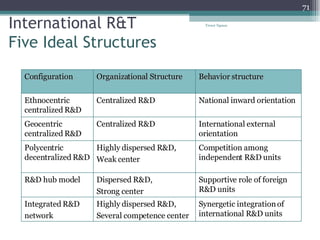
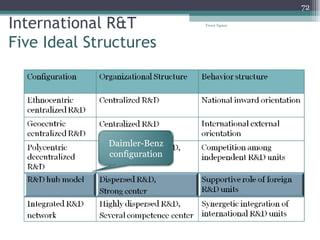
International R&T  Five Ideal Structures Tresor Ngassa Configuration Organizational Structure Behavior structure Ethnocentric centralized R&D Centralized R&D National inward orientation Geocentric centralized R&D Centralized R&D International external orientation Polycentric decentralized R&D Highly dispersed R&D, Weak center Competition among independent R&D units R&D hub model Dispersed R&D, Strong center Supportive role of foreign R&D units Integrated R&D network Highly dispersed R&D, Several competence center Synergetic integration of international R&D units
International R&T  Five Ideal Structures Tresor Ngassa Daimler-Benz configuration
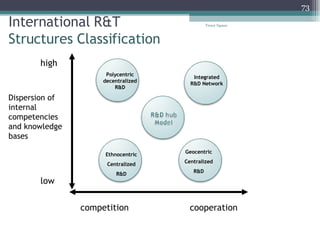
competition cooperation high low Dispersion of internal competencies and knowledge bases Polycentric decentralized R&D Integrated R&D Network Ethnocentric Centralized R&D Geocentric Centralized R&D International R&T  Structures Classification Tresor Ngassa
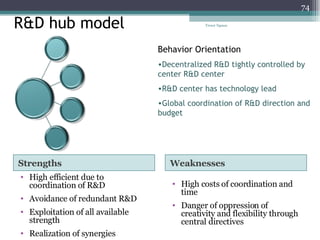
Strengths High efficient due to coordination of R&D Avoidance of redundant R&D Exploitation of all available strength Realization of synergies Weaknesses High costs of coordination and time Danger of oppression of creativity and flexibility through central directives Behavior Orientation Decentralized R&D tightly controlled by center R&D center  R&D center has technology lead Global coordination of R&D direction and budget R&D hub model Tresor Ngassa
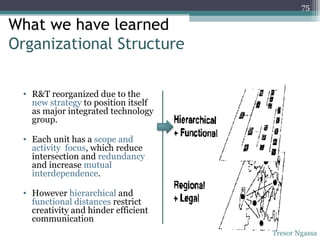
What we have learned Organizational Structure R&T reorganized due to the  new strategy  to position itself as major integrated technology group.  Each unit has a  scope and activity  focus , which reduce intersection and  redundancy  and increase  mutual interdependence . However  hierarchical  and  functional distances  restrict creativity and hinder efficient communication  Tresor Ngassa
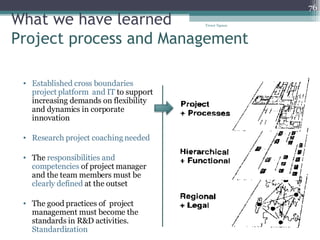
What we have learned Project process and Management Established cross boundaries project platform  and IT  to support increasing demands on flexibility and dynamics in corporate innovation  Research project coaching needed The  responsibilities and competencies  of project manager and the team members must be  clearly defined  at the outset The good practices of  project management must become the standards in R&D activities.  Standardization Tresor Ngassa
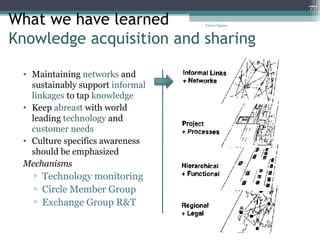
What we have learned Knowledge acquisition and sharing Maintaining  networks  and sustainably support  informal linkages  to tap  knowledge  Keep  abreast  with world leading  technology  and  customer needs Culture specifics awareness should be emphasized Mechanisms Technology monitoring   Circle Member Group Exchange Group R&T Tresor Ngassa
What we have learned  Reviewing and Auditing  Reviewing is a must-have. The main benefit is: Projects and researches are on par with the worldwide state of the art Research Audit address several issues Make sure that quality is embedded in project and technology management. Evaluate the research activity and the relevance of the research programs Justify the heavy R&T investments Tresor Ngassa
Tresor Ngassa
Conclusion The reorganization and reorientation of R&D towards business units   and downstream customer is not completed and remains a  continuous challenge . Some   work of R&T should always be  removed  from  direct market contact  in order to guarantee  radical innovation  and completely new  business opportunities . Tresor Ngassa
Conclusion   Merge with Chrysler Nowadays, after merging with Chrysler, Chrysler corporate research department merged with the Mercedes Care Group’s product development department to Form the new Board of Management Department  “Group Research and Development Mercedes Car  Group” More closely integrated their  research , predevelopment and development activities and effectively focused on  development of final product . New department continue to function as a research competence center for the entire group. But is assuming more responsibility for  predevelopment activities  of all automotive divisions. Still expand  international R&D sites . Tresor Ngassa
Lessons Learned Applicable for other countries? France Overall organization Special Features People mindsets Country specifics Cameroon Overall organization Special Features People mindsets Country specifics Thailand Overall organization Special Features People mindsets Country specifics Tresor Ngassa
Thank you Tresor Ngassa

Case Study: Knowledge Sourcing in Daimler-Benz

  • 1.
  • 2.
    Outlines R& TDepartment Structure and Activity Company overview Management of a large R&T Management of International R&T Activity Features of global R&T activity International R&T sites Lessons learned Conclusion Tresor Ngassa
  • 3.
  • 4.
    Daimler-Benz History BenzEstablished in 1871 by Benz and Cie Manufactured automobile and internal combustion engine in brand of Benz Daimler Established by Gottlieb Daimler and his partner Wilhelm Maybach in 1890 Manufactured automobile and internal combustion engine in brand of DMG Tresor Ngassa Formally merged on June 28, 1926 becoming Daimler-Benz and agreed that, all the factories would use the brand name of Mercedes-Benz on their automobile.
  • 5.
    In 1998 Daimler-Benz merged with the American automobile manufacturer, Chrysler corporation and formed DaimlerChrysler The company produces car and truck under the brands Chrysler, Dodge, Jeep, Mercedes-Benz, Smart and Maybach Daimler-Benz History (cont.) Tresor Ngassa
  • 6.
    T otal revenuesof € 151.6 billion s in the year 2006 33 % was generated by the Mercedes Car Group 31 % by T he Chrysler Group 19 % by the Truck Group 9 % by the Financial Services division an d 8 % by the Van, Bus, Other segment. DaimlerChrysler employed more than 360,000 people worldwide. Through most of its history, Chrysler has been the third largest of the “BIG 3” US auto makers, In Jan 2007, DaimlerChrysler excluding its luxury Mercedes and Maybach lines outsold traditionally 2 nd placed Ford, though behind Toyota DaimlerChrysler 2006 Figures Tresor Ngassa
  • 7.
    Daimler-Benz Corp. Infact, there are 23 business in four divisions Passenger car Commercial vehicles Aerospace Services (railway system, microelectronics etc.) Its revenue 75 percent from automobile Tresor Ngassa
  • 8.
    R&T adjustment 1980s-1990s Tresor Ngassa Time Business Situation/Strategy R&T Adjustment 1980s – Early 1990s External Growth Technology Acquisition Establish itself as an major “ Integrated technology group” Many R&D departments added along with the acquired companies Middle 1990s Concentration on specific competencies and competitive strengths Non-strategic business sold Assessment of R&T Impact Redundancy detected Non-productive internal competition All R&T units are brought under centralized control Render R&T as the Strategic technological weapon for Daimler-Benz competitive future
  • 9.
  • 10.
    R&D in Daimler-BenzOrganization Chart Tresor Ngassa
  • 11.
    R & Din Daimler-Benz One of the highest spender on R&D worldwide (in 1997 about US$ 5.4 billion ) Conducting p roduct development , advanced development and fundamental research But not heavily conducted in basic R&D Development is exclusively carried out by business units (account for US$5.1 billion) R&T is clearly separated from the organization point of view Tresor Ngassa
  • 12.
    R&T department Overview Centralized for all business units and cover research activities for a wide range of potential products. Their responsibilities Support all business units and Daimler –Benz in term of technological strategies through networked and knowledge based cooperation within business units Had budget of US$280 billion coming from two sources. Tresor Ngassa
  • 13.
    R&T Department TheOrganizational structure Tresor Ngassa
  • 14.
    R&T Projects Types and Financing sources Tresor Ngassa Corporate Projects Business Units Projects
  • 15.
    R&T Activities Projectstypes Business Units Projects Corporate Projects Short-term projects Business oriented Aims Transferring new and mature technology to BU Support in the development of technological strategies Examples mature technology for Passenger car commercial vehicles, microelectronics railway system. Long term projects Strategic technology creation applicable in several business areas Aims: Give a competitive technological advantage Examples Multimedia, Satellite based navigation and communication Environmental production processes Tresor Ngassa
  • 16.
    R&T management :How to make it works ? What is the yardstick of R&T? Successful transfer of research results to the business Since R&T aim to be integral part of business units therefore Scientific know how of employee is crucial and This know how can be sustained via the networks Tresor Ngassa
  • 17.
    R&T management :How to make it works ? Key success factors for industrial research were identified Close interaction with internal customers at divisions Goal-oriented and time-managed projects based on these areas. A culture for employees that cooperate over departmental boundaries is essential for success. The entire value-creation process had to be support by the use and integration of IT Tresor Ngassa Project Management Corporate Culture Supporting Technology
  • 18.
    Two core processwere identified Technology strategy, innovation planning, project work, transfer of results. Measure agree upon are : Technology management and research know-how are now united Cooperation with business units will be determined in individual organization agreement The process transfers will dealt with separately. Staff selection, staff development, staff transfer : Critical success factor for R&T and technology transfer are Skilled Motivated employees. R&T management : How to make it works ? Tresor Ngassa
  • 19.
    First core process The main goal Reinforced integration of R&T in defining the overall technology strategy of Daimler-Benz and the innovation strategy of the business units. Transition of all research programs into research projects Concentration of distinct capabilities in research laboratories designated as competency center that serve to consolidate internal and external knowledge Tresor Ngassa
  • 20.
    Three Vectors modelTresor Ngassa
  • 21.
    Problems and Solutions in R & T Set of Problems I It is more difficult to cooperate between different business area than between different sites Project members are engaged in several projects or function . And different locations do increase coordination problems. Spatially dispersed project management has to deal with the following problems . Coordination cost Information cost Project management cost are higher and must be accounted for accordingly Tresor Ngassa
  • 22.
    Problems and Solutions in R & T (cont.) Solution for set I Project must be identified properly at the beginning phase At individual level, project managers should be educated in Human Resources Management and cultural management +++ People with technical knowledge, managerial talent and good networking skill are generally hard to find Tresor Ngassa
  • 23.
    Problems and Solutions in R& T (cont.) Set of problems Problem II External partners within Daimler-Benz are considered as competition. The NIH syndrome occur between different location. Solution II The new structure with labs as competence centers. Each lab has research focus. The labs form a resource pool for project team, so that matrix problem can be solved. Lab are clustered with R&T directors managing the cluster. Tresor Ngassa
  • 24.
  • 25.
    R&T Department Classificationof Projects Tresor Ngassa Project type Project volume Number of projects Approved by Reviewed by A projects > DM 16 millions ~30 CTO, KAMs, other R&T directors CTO, KAMs, other R&T directors B projects DM 5-16 millions ~ 100 KAM KAM C projects <DM 5 millions ~ 240 KAM Lab Director
  • 26.
    International research expansionInternational of R&D encompass more than establishing R&D site oversee, its activities included Cooperation in projects with the leading universities worldwide Cooperation with specialized research institutes Strategic cooperation with other companies, or in international research program Participation in high-tech venture-capital funds. Participation in sponsorship programs. Tresor Ngassa
  • 27.
  • 28.
  • 29.
    Global R&T Management Major Issues Organization of soft and informal means Building of a global mind-set for R&T employees Intrinsic difficulties of international R&D operations Different languages and cultures High costs Long project execution times Geographical distances Interfunctional differences Tresor Ngassa
  • 30.
    R & TOrganization Special features Five features support global R&T operations at Daimler-Benz Technology Monitoring Research Project Coaching Circle Member Group Exchange Group R&T Research Auditing Tresor Ngassa
  • 31.
    Technology Monitoring In1990 Daimler-Benz establish a technology observation unit to systematize its global technology monitoring Mission: Maintain and strengthen the technological competitiveness of the business areas Tasks: Conduct a business oriented analysis of relevant technological developments Support corporate or business specific technology strategy development Tresor Ngassa
  • 32.
    Technology Monitoring SixStep Process Tresor Ngassa
  • 33.
    Technology Monitoring SixStep Process Identify customers and their needs Design of a monitoring plan Information acquisition Data Storage Analysis of the material Dissemination Customers are potentially all Daimler-Benz employees Scientists want detailed technical data, executives require technical overviews/business news Tresor Ngassa
  • 34.
    Technology Monitoring SixStep Process Identify customers and their needs Design of a monitoring plan Information acquisition Data Storage Analysis of the material Dissemination Plan which includes: Technology fields to be monitored Information sources Available resources Tresor Ngassa
  • 35.
    Technology Monitoring SixStep Process Identify customers and their needs Design of a monitoring plan Information acquisition Data Storage Analysis of the material Dissemination Formal sources Patents / Licenses Publications Press Releases Business news Informal sources Personal networks Reverse engineering Electronic resources Electronic databases Netsurfing Others sources Tresor Ngassa
  • 36.
    Technology Monitoring SixStep Process Identify customers and their needs Design of a monitoring plan Information acquisition Data Storage Analysis of the material Dissemination Computerized databases which play the role of knowledge database Tresor Ngassa
  • 37.
    Technology Monitoring SixStep Process Identify customers and their needs Design of a monitoring plan Information acquisition Data Storage Analysis of the material Dissemination Identification of substitutes and competing technologies Analysis of the activity patterns of competitors, suppliers, and customers Benchmarking of internal technology Tresor Ngassa
  • 38.
    Technology Monitoring SixStep Process Identify customers and their needs Design of a monitoring plan Information acquisition Data Storage Analysis of the material Dissemination Depends on the results of the analysis Briefings for executive board Evaluations/reports for senior management and expert groups Presentations and Workshops are carried out Tresor Ngassa
  • 39.
    Research Project CoachingDaimler-Benz established commercial project controlling in R&T in 1991. Consist of project coaches who act as service providers. Have grown from 11 to 40 coaches (as in 1997) Tasks: Introduce project management (knowledge, instruments) Establish project controlling processes Focus: Strategic or special R&T projects Projects susceptible to (or having) particular problems Tresor Ngassa
  • 40.
    Circle Member GroupCMG* is an information network of distinguished scientists. 23 members (1996)from a broad range of disciplines and different parts of the world. Each member has a mentor within Daimler-Ben They are expected to: Demonstrate in-depth appreciation for international state-of-the-art developments Bring along excellent contacts to others institutes worldwide Activities: Tresor Ngassa
  • 41.
    Circle Member GroupTresor Ngassa
  • 42.
    Exchange Group R&TTresor Ngassa
  • 43.
    Exchange Group R&TBenefits and Financing Benefits: Development and production profit from personal know-how and expertise of researchers Central research recruit former “customers” who know particular needs of business units Engender greater customer orientation among research personnel Financing: Tresor Ngassa
  • 44.
    Research Audits Anetwork of research auditors (60+) who evaluate project or research fields The research auditing system applies T otal Q uality M anagement principles to research Objectives: Get direct feedback concerning quality and competitiveness of Daimler-Benz research activities Give to executives a feeling of where they stand in the international scientific community and what the demand is for innovation Justify the costly in-house research Tresor Ngassa
  • 45.
    Research Audit Theprocess Four or five research audits are carried out each year The audit is performed by a group of ten experts: 5 business managers from Daimler-Benz manufacturing division – “The customers” 5 outside scientists – The independent experts Criteria of evaluation Technology attractiveness Expertise of researchers Market potential Management strategy Tresor Ngassa
  • 46.
  • 47.
    Tresor Ngassa InternationalR&T Sites Location Two Strategic Reasons in the choice of a location: Proximity to Market Collocation with principal markets and customers Facilitate the learning and understanding of the needs of downstream functions and customers requirements Presence in Hot-spots Few places where critical knowledge and know-how is created Stay up to date with the latest technology developments
  • 48.
    Activity of InternationalResearch Site Depending on the purpose, international sites carry on 3 different activities: Representing Monitoring / Listening Research Tresor Ngassa
  • 49.
    International Research SitesRepresenting & Monitoring Original Research Hot Spot Market Proximity Tresor Ngassa
  • 50.
    Natural Evolution ofInternational R&D Sites Tresor Ngassa
  • 51.
    Listening Posts Small teams : 3 to 10 people Missions Technology Monitoring: Observation of key technology areas and identification of new trends Establishing Research Cooperation Establishing and maintaining expert networks Technology and market intelligence service Location Tokyo Boston Moscow Tresor Ngassa
  • 52.
    Tokyo Listening Post(1990) Reasons of the Location: Monitoring of the Japanese automobile market Japan is a strategic market for Daimler-Benz Get pre-market, first-hand data Improve Daimler-Benz competitiveness Tresor Ngassa
  • 53.
    Tokyo Listening PostGeneral Information 10 employees (in the beginning): 3 German and 7 Japanese people Each member is specialized in a technology field Each member build his specific network Activities and Financing Basic Monitoring financed by the central R&T dept Additional projects are paid by the client Tresor Ngassa
  • 54.
    Tokyo Listening PostBasic Monitoring Keeping Track of daily life in Japan Outcome : A Newsletter Tresor Ngassa Sources Entities monitored Newspapers Automobile manufacturers Press conferences Automobile suppliers Annual reports Industry associations Research reports Research institutions Conferences Governmental agencies
  • 55.
    Tokyo listening PostThe Newsletter The process of the newsletter Tresor Ngassa
  • 56.
    Tokyo Listening PostAdditional Projects Identify a research institution/researcher to work on the problem of the client Making contact and/or facilitating a visit of the client Tresor Ngassa
  • 57.
    Very long andcomplex process to establish contact with Japanese institution A full week of preparation for each day spent in a Japanese institution by a Daimler researcher Lifetime lasting contact A deep understanding of the Japanese culture is indispensable , especially for reading “between lines” Tokyo Listening Post Cultural/Country specificities Tresor Ngassa
  • 58.
    Boston Listening PostSet up in 1992 Reason: Presence of excellent research institutions/universities (especially MIT) After the opening of Palo Alto in 1995, the Boston group was spun off into a consulting company Tresor Ngassa
  • 59.
    Moscow Listening PostFounded in 1992 with six employees One German and five Russians Try to establish contacts with research institutions and companies Fields of interests: Material sciences, Information science and Mathematics Tresor Ngassa
  • 60.
    Moscow Listening PostThe results Having an influential figure of the Russian science community appeared to be decisive A lot of activities didn’t result in a direct benefit However the discovery of a titanium alloy with good welding characteristics was a major achievement Tresor Ngassa
  • 61.
    Moscow Listening PostCultural/Country specificities Erratic reception of western visitors by research institutions Short relationship duration once the contact is established Difficult integration of a research center with the local scientific community Tresor Ngassa
  • 62.
    Establishing Listening PostsLessons Learned The pre-requisite characteristic for working in a technology liaison office are: Colorful and hyperactive personalities Not shy and not afraid of high-ranking counterparts Generalist in terms of scientific/technical background Broad engineering background Rather in his fifties than thirties Tresor Ngassa
  • 63.
    Listening Posts Reviewingthe efforts Task description is often vague Can be partly based on the outcomes Number of reports Timeliness Accuracy Expenses/impact is very hard to estimate One big hit can finance the program for 10+ years Cost of the offices should be put into perspective to the overall R&D investments . Tresor Ngassa
  • 64.
    Research Centers Thereare two types of research centers: Research center for local development support Follow a market-driven internationalization The Shanghai Institute of Metallurgy (China) The Portland Vehicle Systems center (USA) Research center for technology sourcing Pure research in hot-spots The Daimler-Benz R&T center in Palo Alto (USA) The Daimler-Benz Research Center India Tresor Ngassa
  • 65.
    Research for localdevelopment support The Shanghai Institute of Metallurgy It’s a Joint venture founded 1995 to support Temic Fields : “electronic packaging” (microelectronics) Frequent exchange between Chinese and German scientists. Portland Vehicle Systems Established in 1996 to support Freightliner Fields: Vehicle System Technology Tresor Ngassa
  • 66.
    Research for technologysourcing Daimler-Benz R&T center in Palo Alto Set up 1995, originally technology listening post in the Silicon Valley, a crucial hot spot Fields : Transportation, communications and related technologies Objectives: Help Daimler-Benz in accelerating acquisition of cutting-edge technology Help intellectual exchange flourish between US research universities/institutions and Daimler-Benz Tresor Ngassa
  • 67.
    Research for technologysourcing Daimler-Benz R&T center in Palo Alto Activities Original research conducted jointly by scientists, US researchers, host scientists and engineers from Daimler-Benz Foster relevant research at universities and independent research institutions Encouraging promising proposals and ideas Publishing a newsletter Not the retrieval of the information that is vital but the selection Tresor Ngassa
  • 68.
    Research for technologysourcing Daimler-Benz R&T center India Founded in 1997 in Bangalore, a new hot spot Fields: Information technology and communication research (software sector) Objectives Be a bridgehead for the Indian scientific community, research institutions and software industry Benefit from the cost advantages of India to serve the needs of Daimler-Benz in Asian Tresor Ngassa
  • 69.
    Daimler-Benz R&T centerIndia How It Works? 50 scientists headed by an Indian scientist Integration of Indian scientists in Daimler-Benz research projects Including sponsoring of PhD dissertations and Master theses Contract out entire projects to Indian Institutes and others research companies Reverse engineering Aims at shortening development cycles Tresor Ngassa
  • 70.
    Theory and PracticeTresor Ngassa
  • 71.
    International R&T Five Ideal Structures Tresor Ngassa Configuration Organizational Structure Behavior structure Ethnocentric centralized R&D Centralized R&D National inward orientation Geocentric centralized R&D Centralized R&D International external orientation Polycentric decentralized R&D Highly dispersed R&D, Weak center Competition among independent R&D units R&D hub model Dispersed R&D, Strong center Supportive role of foreign R&D units Integrated R&D network Highly dispersed R&D, Several competence center Synergetic integration of international R&D units
  • 72.
    International R&T Five Ideal Structures Tresor Ngassa Daimler-Benz configuration
  • 73.
    competition cooperation highlow Dispersion of internal competencies and knowledge bases Polycentric decentralized R&D Integrated R&D Network Ethnocentric Centralized R&D Geocentric Centralized R&D International R&T Structures Classification Tresor Ngassa
  • 74.
    Strengths High efficientdue to coordination of R&D Avoidance of redundant R&D Exploitation of all available strength Realization of synergies Weaknesses High costs of coordination and time Danger of oppression of creativity and flexibility through central directives Behavior Orientation Decentralized R&D tightly controlled by center R&D center R&D center has technology lead Global coordination of R&D direction and budget R&D hub model Tresor Ngassa
  • 75.
    What we havelearned Organizational Structure R&T reorganized due to the new strategy to position itself as major integrated technology group. Each unit has a scope and activity focus , which reduce intersection and redundancy and increase mutual interdependence . However hierarchical and functional distances restrict creativity and hinder efficient communication Tresor Ngassa
  • 76.
    What we havelearned Project process and Management Established cross boundaries project platform and IT to support increasing demands on flexibility and dynamics in corporate innovation Research project coaching needed The responsibilities and competencies of project manager and the team members must be clearly defined at the outset The good practices of project management must become the standards in R&D activities. Standardization Tresor Ngassa
  • 77.
    What we havelearned Knowledge acquisition and sharing Maintaining networks and sustainably support informal linkages to tap knowledge Keep abreast with world leading technology and customer needs Culture specifics awareness should be emphasized Mechanisms Technology monitoring Circle Member Group Exchange Group R&T Tresor Ngassa
  • 78.
    What we havelearned Reviewing and Auditing Reviewing is a must-have. The main benefit is: Projects and researches are on par with the worldwide state of the art Research Audit address several issues Make sure that quality is embedded in project and technology management. Evaluate the research activity and the relevance of the research programs Justify the heavy R&T investments Tresor Ngassa
  • 79.
  • 80.
    Conclusion The reorganizationand reorientation of R&D towards business units and downstream customer is not completed and remains a continuous challenge . Some work of R&T should always be removed from direct market contact in order to guarantee radical innovation and completely new business opportunities . Tresor Ngassa
  • 81.
    Conclusion Merge with Chrysler Nowadays, after merging with Chrysler, Chrysler corporate research department merged with the Mercedes Care Group’s product development department to Form the new Board of Management Department “Group Research and Development Mercedes Car Group” More closely integrated their research , predevelopment and development activities and effectively focused on development of final product . New department continue to function as a research competence center for the entire group. But is assuming more responsibility for predevelopment activities of all automotive divisions. Still expand international R&D sites . Tresor Ngassa
  • 82.
    Lessons Learned Applicablefor other countries? France Overall organization Special Features People mindsets Country specifics Cameroon Overall organization Special Features People mindsets Country specifics Thailand Overall organization Special Features People mindsets Country specifics Tresor Ngassa
  • 83.