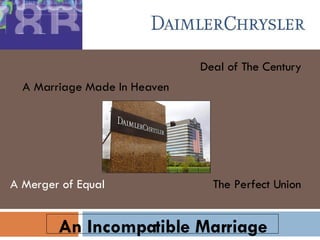
A Merger of Equal A Marriage Made In Heaven An Incompatible Marriage The Perfect Union Deal of The Century
BACKGROUND England’s oldest marque
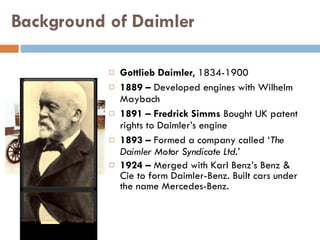
Background of Daimler Gottlieb Daimler , 1834-1900 1889 –  Developed engines with Wilhelm Maybach 1891 – Fredrick Simms  Bought UK patent rights to Daimler’s engine 1893 –  Formed a company called  ‘The Daimler Motor Syndicate Ltd.’ 1924 –  Merged with Karl Benz’s Benz & Cie to form Daimler-Benz. Built cars under the name Mercedes-Benz. Gottlieb Daimler
Core Competencies  high-valued, technically advanced cars, and focuses on development of car engines Target Market  Daimler is an up-market brand The company targets a market niche with high-end users, that focus on the luxurious trait of Daimler Strategic Intent  The company aims to achieve sustainable profitable growth through the development superior products, and customer-relevant technologies. Source :  http://www.just-auto.com/store/product.aspx?ID =60037
Daimler’s Company Profile Current Chairman:  Dr .  Dieter Zetsche Business Divisions:  Mercedes-Benz Cars, Daimler Trucks, Daimler Financial Services, Daimler Buses, Mercedes-Benz Vans Total Revenues in 2007:  EUR 99.4 billion Total Sales in 2007:  2.1 million units Today is the  2 nd  of the Big Three European Automakers  (Volkswagen, Daimler AG, Renault) Brands:   Mercedes - Benz, Smart, Maybach, AMG, Freightliner, Sterling, Western Star, Mitsubishi Fuso, Setra, Detroit Diesel, Thomas Built Buses, Orion   Source:   http://www.daimler.com/dccom/0-5-7155-1-12898-1-0-0-0-0-0-36-0-0-0-0-0-0-0-0.html
BACKGROUND All American
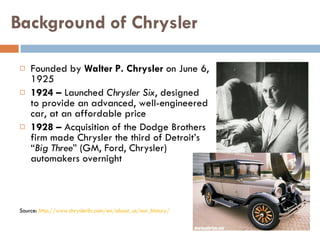
Background of Chrysler Founded by  Walter P. Chrysler  on June 6, 1925 1924 –  Launched  Chrysler Six , designed to provide an advanced, well-engineered car, at an affordable price 1928 –  Acquisition of the Dodge Brothers firm made Chrysler the third of Detroit’s “ Big Three ” (GM, Ford, Chrysler) automakers overnight Source:  http://www.chryslerllc.com/en/about_us/our_history/
Background of Chrysler Core Competencies Well known for its product designs, process design, marketing Target Market Mass market
Chrysler’s Company Profile Current Chairman and CEO:  Robert Nardeli Business Divisions:  Chrysler, Dodge, ENVI, Jeep, Global Electric Motorcars (GEMCAR), Mopar, Chrysler Financial Main Market:  North America  90% of sales, 2.1 million units produced annually Dealerships in US:  3,669 (as of 2007) Chrysler i s considered today as the most successful Detroit automaker
The Merger How it all happened…
Motives for the Merger Daimler’s Motives Their goal to become a global player with interests outside its traditional West European base, led to its merger with the Chrysler Corporation. Chrysler’s Motives To gain competence in product technology and quality To expand beyond the North American market In combining the two companies, you had the potential of gaining high volumes, participation in all segments, innovation, adaptability, and technology and quality excellence Source: School of Economics and Management, Lund University
SWOT ANALYSIS
SWOT   Analysis Strengths Merger combined two strong companies . Savings resulting from economies of scale . Company does more than just autos . Daimler has outstanding reputation . Chrysler was a very cost - effective company . A leader in innovation . Record revenues and increasing market share . Lack of capital constraints . Strong existing product brands . $47 billion allocated for research and development . A wide array of corporate holdings . Leader in Fortune Global 500 .
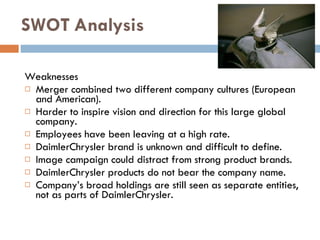
Weaknesses Merger combined two different company cultures  ( European and American ). Harder to inspire vision and direction for this large global company . Employees have been leaving at a high rate . DaimlerChrysler brand is unknown and difficult to define . Image campaign could distract from strong product brands . DaimlerChrysler products do not bear the company name . Company’s broad holdings are still seen as separate entities, not as parts of DaimlerChrysler . SWOT   Analysis
Opportunities Merged company should be able to expand markets, particularly into Asia . Safety failures at Ford should open door for DaimlerChrysler . Innovation will lead to new products on the market . A hybrid car, which is very environmentally friendly, will be launched soon . Creating a DaimlerChrysler corporate brand identity . Over 68 percent of the company's profits come from automotive brands . Can reach opinion leaders and existing customers with similar communication plans . Innovative car ideas . SWOT   Analysis
Threats Has been an extended period of time without corporate communications . Globally, the general population knows little about this corporate merger . DaimlerChrysler does not yet have a corporate brand identity . Over 68 percent of the company's profits come from automotive brands; this is a threat if the market takes a downturn . Behind in the research and marketing of hybrid autos . Size of company will demand a varied marketing program; a cookie - cutter approach will not work . SWOT   Analysis
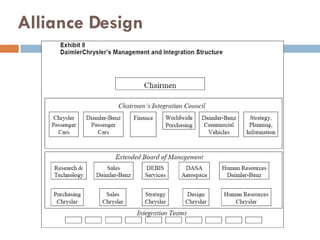
Alliance Design
Alliance with Other Companies CEO, Schrempp attempted to enter Asia by forming an alliance with Nissan but was turned down by board members. Hyundai of South Korea in June 2000 DCX  purchased  10  percent of Hyundai  share in June of  2000  for  $428  million , later increase its holding to   10.5%   S old share of Hyundai in  2004  for  $912  Million
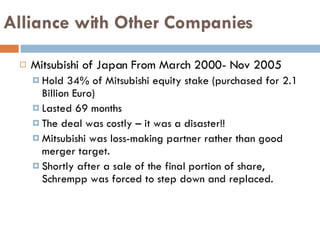
Mitsubishi of Japan From March 2000- Nov 2005 Hold 34% of Mitsubishi equity stake (purchased for 2.1 Billion Euro) Lasted 69 months The deal was costly – it was a disaster!! Mitsubishi was loss-making partner rather than good merger target. Shortly after a sale of the final portion of share, Schrempp was forced to step down and replaced. Alliance with Other Companies
Mitsubishi Performance
Following the alliance…
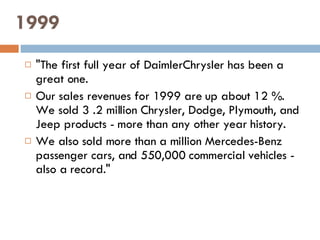
1999 "The first full year of DaimlerChrysler has been a great one.  Our sales revenues for 1999 are up about 12 %. We sold 3 .2 million Chrysler, Dodge, Plymouth, and Jeep products - more than any other year history.  We also sold more than a million Mercedes-Benz passenger cars, and 550,000 commercial vehicles - also a record."
2000 2-years after merger, DaimlerChrysler's US arm stumble. Chrysler US loss for 3rd Q at $530M-$550M Problems: US exec flight due to German “intervention“, abandon of Jeep/Dodge Ram up styling, failure to deliver on cost savings  (unwelcome by US execs) Investments in Mitsubishi and Hyundai for "global" market projects
2001-2002 Late 2000: Dr. Z, then head of Chrysler, proposed a massive reorganization of the US subsidiary: the closure of six plants and the loss of 26,000 jobs .  A poor performance in 2001   DaimlerChrysler's revenues for 2002 ($148.15 billion) decreased 6% from 2000 Chrysler cars generated a decreasing revenue, down 7% from 2000 and Chrysler accounts for 41.5% of company revenue On the opposite, Mercedes Benz generated an increasing revenue of 9%, only accounted for 31% of the total revenue.
2003-2005
After that… Late 2005: shareholders forced Jurgen Schrempp to step down as the chairman. After the Chrysler unit of DaimlerChrysler made a big loss in 3Q of 2005,. Dr. Z, Dieter Zetsche, took over. $1.5 billion loss for 2006 DaimlerChrysler's operating profit in 2006 rose .3 billion euros  from  the previous year .  However, Chrysler division suffered a large financial loss of 1.5 billion euros   and   has plans to lay off over 13,000 jobs in the future.
1. Stock Price shrank… Overall results Stock Price 1998-2002
Comparison Stock Price 2000-2005
2. Chrysler Total Market Share Drop … Overall results
3. Total Market Share Overall results 4. Net Operating Profit
Reasons for Failure “ How do you pronounce the name of a German-American automaker?” Daimler.  Chrysler is silent. --DC headquarters joke Auburn Hills, MI
1. Cultural Clash DaimlerChrysler  did  provide cultural workshops for employees and had post-merger integration team. During the deal making process, meeting of the minds was met at senior management level. However, there are several components causing this clash.
Daimler  --a conglomerate with 21 different business Hierarchical: tradition top-down management Bureaucratic Detailed decision making Disciplined 1.1 Corporate Structure Chrysler --highly centralized car and truck manufacturer Fast and lean decision making: allow mid-level employees to make decision Relatively informal  Team-orientated  Success Driven
1.2 Corporate Culture Daimler Management processes of planning, organizing and controlling More conservative, efficient, and safe  Formality, hierarchy Well-structured decision making process Beer brakes - smoke and alcohol in the workplace Chrysler Setting goals, directing and monitoring implementation The risk-taking underdog Innovative Free -form discussion Less formal but strict about issue like alcohol and smoking in the workplace
Daimler Codetermination: equal representation of workers and supervisors Union have much more power Lesser salary but high expense budget Chrysler  No codetermination Toothless Union: struggle between union and management Higher salary and bonus 1.2 cont.     -- Corporate Governance and lifestyle
1.3 Customer Proposition    & Product  development philosophies “ Mercedes was universally perceived as the fancy, special brand, while Chrysler, Dodge, Plymouth and Jeep were the poorer, blue collar relations” James Holden, President of Chrysler  --From September 1999 to November 2000
Daimler – Quality At Any Cost The brand image and experience associated with the highest quality available in the market and uncompromising 1.3 Customer Proposition    & Product  development philosophies Chrysler – Price Targeted Vehicle Attractive, eye-catching design at a very competitive price, assertiveness, and risk-taking
Daimler   Use handful of close suppliers Brand bias: Dodge Neon and Jeep Grand Cherokee were sidelined in favour of less cost-effective and troublesome Mercedes A-Class and M-Class SUV. Chrysler  Several sources of suppliers Chrysler’s European market penetration was affected from this brand bias 1.4 Purchasing, distribution and sales
Daimler Emphasis on engineering, design, quality, and after-sales service Chrysler High volume, low cost manufacturing, and distribution 1.5 Value s
2. Mismanagement Failure to inform all stakeholders accurately about the terms of the mergers. Oct 2000, Schrempp, Daimler CEO, confessed that it was never meant to be merger of equal – Chrysler was to be a subsidiary of Daimler-Benz. This caused “Deep Mutual Distrust”.
“ Deep Mutual Distrust” Were the Germans at point of dominating?   Schrempp’s public announcement in Germany --This rather be an acquisition, not a merger. Employees’ and US buyers’ felt they were betrayed.  Unequal representation at the executive board Closing out of Plymouth brand Later on, almost all of Chrysler key executives and upper management personals were either left, resigned, or replaced by the German ones.
Late 2000, an American president of the Chrysler Group, Jim Holden, was replaced by a German appointee, Dieter Zetsche during the time when Chrysler experienced difficulty   in the marketplace  Other American executives were either replace or left as well -- Now the German was solely in charge of Chrysler. “ Deep Mutual Distrust” cont.
Communication challenges No clear message and communication about answer to current problems and who is going to run the entity. The German? Will facilities of Chrysler have to close down?  DaimlerChrysler’s communication strategy was not effective enough to meet this challenge. Less than 2 years, it had lost the confidence of the media   and credibility it had with US management staff and shareholders. Soon DaimlerChrysler was referred to as acquisition rather than merger.
3. Changes in US Auto Industry Rapidly changing world market…large amounts of cash would be needed to keep product lines up to date as well as to take products to emerging and profitable new markets. In US, the challenges from Japanese brands during 1998-2000 which Chrysler responded with little innovation and competitive price reduction.
Current Situation
The Divorce May 2007, a private equity firm Cerberus Capital Management LP is buying  80.1  percent of Chrysler, for  $7.4  billion. Far  from the $38 billion Daimler spent to acquire Chrysler back in 1998.  Not all money goes to DaimlerChrysler, t he money actually goes to paying off Chrysler's outstanding loans, ensuring the new Chrysler Holding company begins life debt-free.
Just A Plain Daimler  -- Back to Daimler AG
Chrysler LLC
Thank You For Your Attention

SWOT daimlerchrysler

  • 1.
    A Merger ofEqual A Marriage Made In Heaven An Incompatible Marriage The Perfect Union Deal of The Century
  • 2.
  • 3.
    Background of DaimlerGottlieb Daimler , 1834-1900 1889 – Developed engines with Wilhelm Maybach 1891 – Fredrick Simms Bought UK patent rights to Daimler’s engine 1893 – Formed a company called ‘The Daimler Motor Syndicate Ltd.’ 1924 – Merged with Karl Benz’s Benz & Cie to form Daimler-Benz. Built cars under the name Mercedes-Benz. Gottlieb Daimler
  • 4.
    Core Competencies high-valued, technically advanced cars, and focuses on development of car engines Target Market Daimler is an up-market brand The company targets a market niche with high-end users, that focus on the luxurious trait of Daimler Strategic Intent The company aims to achieve sustainable profitable growth through the development superior products, and customer-relevant technologies. Source : http://www.just-auto.com/store/product.aspx?ID =60037
  • 5.
    Daimler’s Company ProfileCurrent Chairman: Dr . Dieter Zetsche Business Divisions: Mercedes-Benz Cars, Daimler Trucks, Daimler Financial Services, Daimler Buses, Mercedes-Benz Vans Total Revenues in 2007: EUR 99.4 billion Total Sales in 2007: 2.1 million units Today is the 2 nd of the Big Three European Automakers (Volkswagen, Daimler AG, Renault) Brands: Mercedes - Benz, Smart, Maybach, AMG, Freightliner, Sterling, Western Star, Mitsubishi Fuso, Setra, Detroit Diesel, Thomas Built Buses, Orion Source: http://www.daimler.com/dccom/0-5-7155-1-12898-1-0-0-0-0-0-36-0-0-0-0-0-0-0-0.html
  • 6.
  • 7.
    Background of ChryslerFounded by Walter P. Chrysler on June 6, 1925 1924 – Launched Chrysler Six , designed to provide an advanced, well-engineered car, at an affordable price 1928 – Acquisition of the Dodge Brothers firm made Chrysler the third of Detroit’s “ Big Three ” (GM, Ford, Chrysler) automakers overnight Source: http://www.chryslerllc.com/en/about_us/our_history/
  • 8.
    Background of ChryslerCore Competencies Well known for its product designs, process design, marketing Target Market Mass market
  • 9.
    Chrysler’s Company ProfileCurrent Chairman and CEO: Robert Nardeli Business Divisions: Chrysler, Dodge, ENVI, Jeep, Global Electric Motorcars (GEMCAR), Mopar, Chrysler Financial Main Market: North America 90% of sales, 2.1 million units produced annually Dealerships in US: 3,669 (as of 2007) Chrysler i s considered today as the most successful Detroit automaker
  • 10.
    The Merger Howit all happened…
  • 11.
    Motives for theMerger Daimler’s Motives Their goal to become a global player with interests outside its traditional West European base, led to its merger with the Chrysler Corporation. Chrysler’s Motives To gain competence in product technology and quality To expand beyond the North American market In combining the two companies, you had the potential of gaining high volumes, participation in all segments, innovation, adaptability, and technology and quality excellence Source: School of Economics and Management, Lund University
  • 12.
  • 13.
    SWOT Analysis Strengths Merger combined two strong companies . Savings resulting from economies of scale . Company does more than just autos . Daimler has outstanding reputation . Chrysler was a very cost - effective company . A leader in innovation . Record revenues and increasing market share . Lack of capital constraints . Strong existing product brands . $47 billion allocated for research and development . A wide array of corporate holdings . Leader in Fortune Global 500 .
  • 14.
    Weaknesses Merger combinedtwo different company cultures ( European and American ). Harder to inspire vision and direction for this large global company . Employees have been leaving at a high rate . DaimlerChrysler brand is unknown and difficult to define . Image campaign could distract from strong product brands . DaimlerChrysler products do not bear the company name . Company’s broad holdings are still seen as separate entities, not as parts of DaimlerChrysler . SWOT Analysis
  • 15.
    Opportunities Merged companyshould be able to expand markets, particularly into Asia . Safety failures at Ford should open door for DaimlerChrysler . Innovation will lead to new products on the market . A hybrid car, which is very environmentally friendly, will be launched soon . Creating a DaimlerChrysler corporate brand identity . Over 68 percent of the company's profits come from automotive brands . Can reach opinion leaders and existing customers with similar communication plans . Innovative car ideas . SWOT Analysis
  • 16.
    Threats Has beenan extended period of time without corporate communications . Globally, the general population knows little about this corporate merger . DaimlerChrysler does not yet have a corporate brand identity . Over 68 percent of the company's profits come from automotive brands; this is a threat if the market takes a downturn . Behind in the research and marketing of hybrid autos . Size of company will demand a varied marketing program; a cookie - cutter approach will not work . SWOT Analysis
  • 17.
  • 18.
    Alliance with OtherCompanies CEO, Schrempp attempted to enter Asia by forming an alliance with Nissan but was turned down by board members. Hyundai of South Korea in June 2000 DCX purchased 10 percent of Hyundai share in June of 2000 for $428 million , later increase its holding to 10.5% S old share of Hyundai in 2004 for $912 Million
  • 19.
    Mitsubishi of JapanFrom March 2000- Nov 2005 Hold 34% of Mitsubishi equity stake (purchased for 2.1 Billion Euro) Lasted 69 months The deal was costly – it was a disaster!! Mitsubishi was loss-making partner rather than good merger target. Shortly after a sale of the final portion of share, Schrempp was forced to step down and replaced. Alliance with Other Companies
  • 20.
  • 21.
  • 22.
    1999 "The firstfull year of DaimlerChrysler has been a great one. Our sales revenues for 1999 are up about 12 %. We sold 3 .2 million Chrysler, Dodge, Plymouth, and Jeep products - more than any other year history. We also sold more than a million Mercedes-Benz passenger cars, and 550,000 commercial vehicles - also a record."
  • 23.
    2000 2-years aftermerger, DaimlerChrysler's US arm stumble. Chrysler US loss for 3rd Q at $530M-$550M Problems: US exec flight due to German “intervention“, abandon of Jeep/Dodge Ram up styling, failure to deliver on cost savings (unwelcome by US execs) Investments in Mitsubishi and Hyundai for "global" market projects
  • 24.
    2001-2002 Late 2000:Dr. Z, then head of Chrysler, proposed a massive reorganization of the US subsidiary: the closure of six plants and the loss of 26,000 jobs . A poor performance in 2001 DaimlerChrysler's revenues for 2002 ($148.15 billion) decreased 6% from 2000 Chrysler cars generated a decreasing revenue, down 7% from 2000 and Chrysler accounts for 41.5% of company revenue On the opposite, Mercedes Benz generated an increasing revenue of 9%, only accounted for 31% of the total revenue.
  • 25.
  • 26.
    After that… Late2005: shareholders forced Jurgen Schrempp to step down as the chairman. After the Chrysler unit of DaimlerChrysler made a big loss in 3Q of 2005,. Dr. Z, Dieter Zetsche, took over. $1.5 billion loss for 2006 DaimlerChrysler's operating profit in 2006 rose .3 billion euros from the previous year . However, Chrysler division suffered a large financial loss of 1.5 billion euros and has plans to lay off over 13,000 jobs in the future.
  • 27.
    1. Stock Priceshrank… Overall results Stock Price 1998-2002
  • 28.
  • 29.
    2. Chrysler TotalMarket Share Drop … Overall results
  • 30.
    3. Total MarketShare Overall results 4. Net Operating Profit
  • 31.
    Reasons for Failure“ How do you pronounce the name of a German-American automaker?” Daimler. Chrysler is silent. --DC headquarters joke Auburn Hills, MI
  • 32.
    1. Cultural ClashDaimlerChrysler did provide cultural workshops for employees and had post-merger integration team. During the deal making process, meeting of the minds was met at senior management level. However, there are several components causing this clash.
  • 33.
    Daimler --aconglomerate with 21 different business Hierarchical: tradition top-down management Bureaucratic Detailed decision making Disciplined 1.1 Corporate Structure Chrysler --highly centralized car and truck manufacturer Fast and lean decision making: allow mid-level employees to make decision Relatively informal Team-orientated Success Driven
  • 34.
    1.2 Corporate CultureDaimler Management processes of planning, organizing and controlling More conservative, efficient, and safe Formality, hierarchy Well-structured decision making process Beer brakes - smoke and alcohol in the workplace Chrysler Setting goals, directing and monitoring implementation The risk-taking underdog Innovative Free -form discussion Less formal but strict about issue like alcohol and smoking in the workplace
  • 35.
    Daimler Codetermination: equalrepresentation of workers and supervisors Union have much more power Lesser salary but high expense budget Chrysler No codetermination Toothless Union: struggle between union and management Higher salary and bonus 1.2 cont. -- Corporate Governance and lifestyle
  • 36.
    1.3 Customer Proposition & Product development philosophies “ Mercedes was universally perceived as the fancy, special brand, while Chrysler, Dodge, Plymouth and Jeep were the poorer, blue collar relations” James Holden, President of Chrysler --From September 1999 to November 2000
  • 37.
    Daimler – QualityAt Any Cost The brand image and experience associated with the highest quality available in the market and uncompromising 1.3 Customer Proposition & Product development philosophies Chrysler – Price Targeted Vehicle Attractive, eye-catching design at a very competitive price, assertiveness, and risk-taking
  • 38.
    Daimler Use handful of close suppliers Brand bias: Dodge Neon and Jeep Grand Cherokee were sidelined in favour of less cost-effective and troublesome Mercedes A-Class and M-Class SUV. Chrysler Several sources of suppliers Chrysler’s European market penetration was affected from this brand bias 1.4 Purchasing, distribution and sales
  • 39.
    Daimler Emphasis onengineering, design, quality, and after-sales service Chrysler High volume, low cost manufacturing, and distribution 1.5 Value s
  • 40.
    2. Mismanagement Failureto inform all stakeholders accurately about the terms of the mergers. Oct 2000, Schrempp, Daimler CEO, confessed that it was never meant to be merger of equal – Chrysler was to be a subsidiary of Daimler-Benz. This caused “Deep Mutual Distrust”.
  • 41.
    “ Deep MutualDistrust” Were the Germans at point of dominating? Schrempp’s public announcement in Germany --This rather be an acquisition, not a merger. Employees’ and US buyers’ felt they were betrayed. Unequal representation at the executive board Closing out of Plymouth brand Later on, almost all of Chrysler key executives and upper management personals were either left, resigned, or replaced by the German ones.
  • 42.
    Late 2000, anAmerican president of the Chrysler Group, Jim Holden, was replaced by a German appointee, Dieter Zetsche during the time when Chrysler experienced difficulty in the marketplace Other American executives were either replace or left as well -- Now the German was solely in charge of Chrysler. “ Deep Mutual Distrust” cont.
  • 43.
    Communication challenges Noclear message and communication about answer to current problems and who is going to run the entity. The German? Will facilities of Chrysler have to close down? DaimlerChrysler’s communication strategy was not effective enough to meet this challenge. Less than 2 years, it had lost the confidence of the media and credibility it had with US management staff and shareholders. Soon DaimlerChrysler was referred to as acquisition rather than merger.
  • 44.
    3. Changes inUS Auto Industry Rapidly changing world market…large amounts of cash would be needed to keep product lines up to date as well as to take products to emerging and profitable new markets. In US, the challenges from Japanese brands during 1998-2000 which Chrysler responded with little innovation and competitive price reduction.
  • 45.
  • 46.
    The Divorce May2007, a private equity firm Cerberus Capital Management LP is buying 80.1 percent of Chrysler, for $7.4 billion. Far from the $38 billion Daimler spent to acquire Chrysler back in 1998. Not all money goes to DaimlerChrysler, t he money actually goes to paying off Chrysler's outstanding loans, ensuring the new Chrysler Holding company begins life debt-free.
  • 47.
    Just A PlainDaimler -- Back to Daimler AG
  • 48.
  • 49.
    Thank You ForYour Attention