Introduction

Kmart was a pioneer of the discount retailer industry. At the turn of the century, innovative tactics and
strong customer loyalty contributed to unprecedented corporate growth. The playing field changed
however, and Kmart had newer rivals to compete with. This report will focus on the attempts to
revitalize Kmart, what factors contributed to its bankruptcy, as well as the future for an acquired
Kmart.

Some Problems Just Don’t Go Away

Throughout Kmart’s recent history, it has been plagued by a series of problems. All management teams
attempted a variety of strategies to combat these. Listed below is the list of ongoing problems.i

Poor inventory management  Too often would popular products be out of stock, while others
collected dust on the shelves, and in some cases stored in trailors outside of the stores.
Price Competition  Wal-Mart had successfully found a way to offer the lowest price possible on
many goods.
Poor Customer Service  Too often did consumer reports, secret shops, and industry analysts report of
the apathy of Kmart sales staff. Poor Customer Service problems plagued Kmart on a consistent store
to store level.
“Niche”less  While Walmart reigned supreme as the low cost leader, Target was perceived as being a
“higher quality” retailer. Where did this leave Kmart? What was Kmart’s competitive advantage over
the two large rivals?

The Antonini Era

Kmart’s conception began in 1899 with a single five-and-dime store. Over the years, Kmart continued
to grow and evolve with the market. Under CEO Joseph Antonini, Kmart changed its basic strategy.ii

Strategy prior to 1987                           Antonini Strategy (1987-1995)

Continue to grow company through                 Diversify assets into a variety of industries
additional store locations, renovating current   that were deemed high growth, ripe for
stores, and analyze consumer demand to add       market entrance, and profitable.
additional products and services.
Kmart acquired several established businesses in a variety of industries.iii

Builder’s Square (1984)
Walden Book Company (1984)
Payless Drug Stores, Inc (1985)
Harold’s Discount Outlets {Canadian} (1985)
The Sports Authority (1990)
90% interest in OfficeMax (1991)
Borders, Inc (1992)
Czech Republic/Slovakian Discount Stores (1992)
Bizmart (1992)
Joint Venture into Singapore (1994)
Antonini was on a buying frenzy, continuously expanding Kmart’s portfolio. 3 start-up companies were
also initiated, as well as 100 Kmart stores in Mexico. Although international expansion was the
backbone for Kmart’s strategy, changes were also made to Kmart in the United States. Listed below are
the strategies Antonini put into effect during his tenure, and the outcome of such.iv

                  Strategy                                      Outcome

Diversification                                 Failure

Purchased a variety of businesses in several    Acquisitions all performed poorly posting
retail industries including internationally.    minimal net income or losses.
                                                Distracted management from core business.

Renewal Program                                 Mixed Results

$3.5 billion program intended to modernize,     Super Kmarts sales were 23% higher than
expand, or relocate Kmart’s 2,435 stores.       traditional stores.
Increase sq ft (800K to 100K), and open 500     Fashion strategy was a disappointment.
Super Kmarts. Improve quality of private        Antonini blamed the failure on market
label brands. Logic: Cash Cow Fashion to        conditions.
subsidize specific hardline products to be      Wal-Mart continued to emphasis on being
low price leader.                               the local cost leader, at any cost.
                                                Customer’s View of Kmart: dirty, poorly
                                                stocked, and rude staff.
                                                Many stores did not receive substantial
                                                renovations.

Modernize Inventory Methods                     Failure

State of the art GTE Spacenet satellite based   Although an improvement from the previous
network. Implemented Central                    system, CMAR still did not meet
Merchandising Automated Replenishment           expectations. Many contribute the vast
system (CMAR). Costs of revolutionary           amount of inventory, and the high
technology = $160 million/annually              complexity of the system for it’s failure.
New King is Crowned

In 1990, Kmart was dethroned as the leader of the discount retailer, by rival Wal-Mart. Sales growth
for Kmart from 1980 to 1990 was a mere 7.7%, compared to the skyrocketing Wal-Mart. Shown on the
following page is a time line of sales dollars (revenue) per each of the 3 large discount chains.v

   The Wal-Mart
    Advantage

Near perfection
distribution system.
Lowest operating
costs allowed for
being the low cost
leader.
Newcomer advantage


Source: Target, Wal-Mart, and Kmart’s Annual Reports (SEC Filings)


Hall Steps Up To Bat

After a failed corporate strategy by Joseph Antonini, the reins of Kmart were handed over to Floyd
Hall. Hall had industry clout due to his success at Target and Grand Union Supermarkets. Hall quickly
assembled a new board of top level managers with the intentions of, “…trying to build a team…get a
good succession plan and new policies in place.”vi The competitive environment in 1995 did not reflect
positively for Kmart, as shown below.

                                                   Competitive Match-Up in 1995vii

                                       Kmart                                        Wal-Mart

            Customers averaged 15 visits a year                      Customers averaged 32 visits per year
            Sales/sq ft = $185                                       Sales/sq ft = $379
            19% loyal customers                                      46% loyal customers
With rival Wal-Mart defeating Kmart clearly in every key performance indicator, Hall declared that
complete surgery was needed, no band-aid could revive this company.

Hall’s strategy can be defined as: Divest noncore activities, drastically improve all core principles,
and drive down cost wherever possible. A “use it or loss it” style was put into effect.viii

                Use It                           Lose It                   Overall Asessment

Consolidated U.S. and                Close 400 stores                      Positives
Canadian Operations                  Cleared out $700 million of
Capitalize on volume buying          inventory                          1,600 renovated stores
power to drive down employee         Sold of previous acquisitions      Martha Stewart sales = $1
health benefits                      (ex. OfficeMax & Sports            Billion
Improve stores, “department          Authority, etc)                    Sales per sq ft rivaled
by department”                       Eliminated some 2nd tier           Target
Increase private labels              brands, and all 3rd tier brands.   Dropped Operational
Expand Martha Stewart                                                   Costs by $500 million
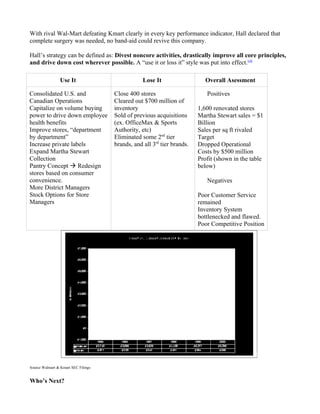
Collection                                                              Profit (shown in the table
Pantry Concept  Redesign                                               below)
stores based on consumer
convenience.                                                               Negatives
More District Managers
Stock Options for Store                                                 Poor Customer Service
Managers                                                                remained
                                                                        Inventory System
                                                                        bottlenecked and flawed.
                                                                        Poor Competitive Position


Source Walmart & Kmart SEC Filings


Who’s Next?
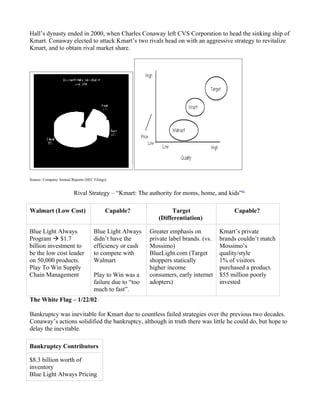
Hall’s dynasty ended in 2000, when Charles Conaway left CVS Corporation to head the sinking ship of
Kmart. Conaway elected to attack Kmart’s two rivals head on with an aggressive strategy to revitalize
Kmart, and to obtain rival market share.


Source: Company Annual Reports (SEC Filings)


                         Rival Strategy – “Kmart: The authority for moms, home, and kids”ix

Walmart (Low Cost)                         Capable?               Target                    Capable?
                                                             (Differentiation)

Blue Light Always                   Blue Light Always     Greater emphasis on          Kmart’s private
Program  $1.7                      didn’t have the       private label brands. (vs.   brands couldn’t match
billion investment to               efficiency or cash    Mossimo)                     Mossimo’s
be the low cost leader              to compete with       BlueLight.com (Target        quality/style
on 50,000 products.                 Walmart               shoppers statically          1% of visitors
Play To Win Supply                                        higher income                purchased a product.
Chain Management                    Play to Win was a     consumers, early internet    $55 million poorly
                                    failure due to “too   adopters)                    invested
                                    much to fast”.
The White Flag – 1/22/02

Bankruptcy was inevitable for Kmart due to countless failed strategies over the previous two decades.
Conaway’s actions solidified the bankruptcy, although in truth there was little he could do, but hope to
delay the inevitable.

Bankruptcy Contributors

$8.3 billion worth of
inventory
Blue Light Always Pricing
Strategy
Sales Decline
Unpaid vendors
Massive debt


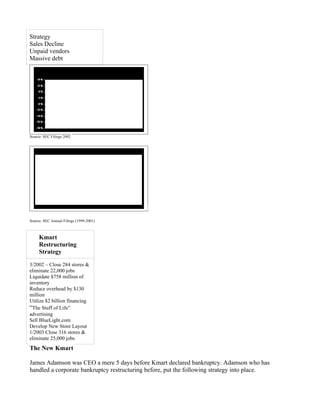
Source: SEC Filings 2002


Source: SEC Annual Filings (1999-2001)


     Kmart
     Restructuring
     Strategy

3/2002 – Close 284 stores &
eliminate 22,000 jobs
Liquidate $758 million of
inventory
Reduce overhead by $130
million
Utilize $2 billion financing
“The Stuff of Life”
advertising
Sell BlueLight.com
Develop New Store Layout
1/2003 Close 316 stores &
eliminate 25,000 jobs
The New Kmart

James Adamson was CEO a mere 5 days before Kmart declared bankruptcy. Adamson who has
handled a corporate bankruptcy restructuring before, put the following strategy into place.
Restructuring Recommendations

Address housekeeping/poor customer service concerns by frequent District
Manager visits & Mystery Shoppers

Hire Fashion experts to compete with Target on Fashion, including
releasing an entirely new private brand line
Open additional distribution centers across the nation, and work on a “just
in time” inventory approach.
DO NOT attempt to be the low cost provider.
Compete head to head with Target.
“Open Door/Open Books” Policy regarding accounting letters.

     Consumer
Recommendation: Don’t
     Buy Kmart

Wal-Mart continues to
grow momentum
Very small loyal customer
base
Accounting violations
taint brand image
Lack of Positioning
Closing stores limits
accessibility.
Underlying problems of
inventory management
have yet to find a solution
Source: SEC Filings 1992 through 2002


An Empire is Born

On November 17th 2004, the announcement was made that Kmart and Sears Roebuck Company would
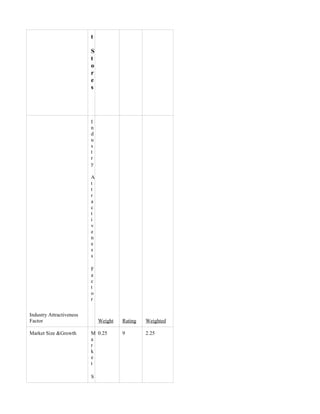
merge to form the third largest retailer in the nation. Was this a strategically sound decision by Sears?x

Industry:                           I
Department Stores                   n
                                    d
                                    u
                                    s
                                    t
                                    r
                                    y
                                    :

                                    D
                                    e
                                    p
                                    a
                                    r
                                    t
                                    m
                                    e
                                    n
t

                          S
                          t
                          o
                          r
                          e
                          s


                          I
                          n
                          d
                          u
                          s
                          t
                          r
                          y

                          A
                          t
                          t
                          r
                          a
                          c
                          t
                          i
                          v
                          e
                          n
                          e
                          s
                          s

                          F
                          a
                          c
                          t
                          o
                          r

Industry Attractiveness
Factor                        Weight   Rating   Weighted

Market Size &Growth       M 0.25       9        2.25
                          a
                          r
                          k
                          e
                          t

                          S
i
                           z
                           e

                           &
                           G
                           r
                           o
                           w
                           t
                           h


                           I
                           n
                           t
                           e
                           n
                           s
                           i
                           t
                           y

                           o
                           f

                           C
                           o
                           m
                           p
                           e
                           t
                           i
                           t
                           i
                           o
                           n


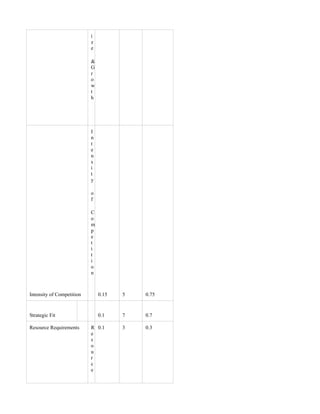
Intensity of Competition       0.15   5   0.75


Strategic Fit                  0.1    7   0.7

Resource Requirements      R 0.1      3   0.3
                           e
                           s
                           o
                           u
                           r
                           c
                           e
R
                          e
                          q
                          u
                          i
                          r
                          e
                          m
                          e
                          n
                          t
                          s


                          E
                          m
                          e
                          r
                          g
                          i
                          n
                          g

                          O
                          p
                          p
                          o
                          r
                          t
                          u
                          n
                          i
                          t
                          i
                          e
                          s
                          /
                          T
                          h
                          r
                          e
                          a
                          t
                          s

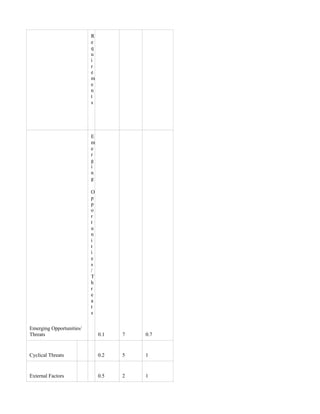
Emerging Opportunities/
Threats                       0.1   7   0.7


Cyclical Threats              0.2   5   1


External Factors              0.5   2   1
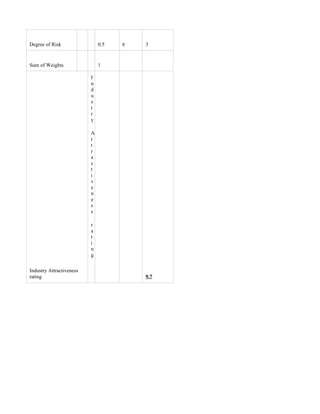
Degree of Risk                0.5   6   3


Sum of Weights                1

                          I
                          n
                          d
                          u
                          s
                          t
                          r
                          y

                          A
                          t
                          t
                          r
                          a
                          c
                          t
                          i
                          v
                          e
                          n
                          e
                          s
                          s

                          r
                          a
                          t
                          i
                          n
                          g

Industry Attractiveness
rating                                  9.7
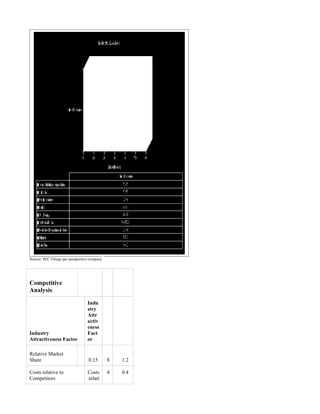
Source: SEC Filings per perspective company


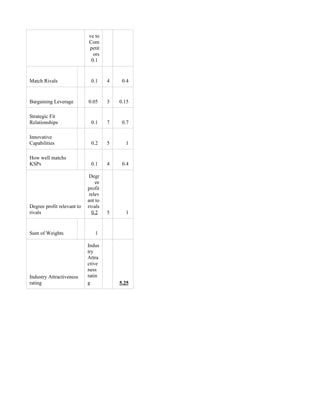
Competitive
Analysis

                                  Indu
                                  stry
                                  Attr
                                  activ
                                  eness
Industry                          Fact
Attractiveness Factor             or

Relative Market
Share                              0.15       8   1.2

Costs relative to                 Costs       4   0.4
Competitors                       relati
ve to
                            Com
                            petit
                              ors
                             0.1


Match Rivals                 0.1     4    0.4


Bargaining Leverage         0.05     3   0.15

Strategic Fit
Relationships                0.1     7    0.7

Innovative
Capabilities                 0.2     5     1

How well matchs
KSPs                         0.1     4    0.4

                             Degr
                                ee
                            profit
                             relev
                            ant to
Degree profit relevant to   rivals
rivals                        0.2    5     1


Sum of Weights                 1

                            Indus
                            try
                            Attra
                            ctive
                            ness
Industry Attractiveness     ratin
rating                      g            5.25
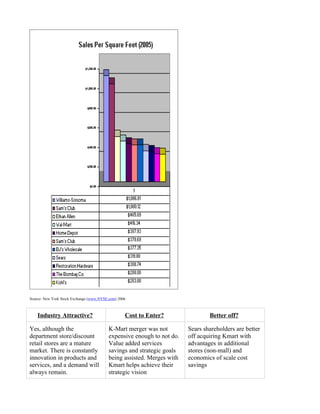
Source: New York Stock Exchange (www.NYSE.com) 2006


    Industry Attractive?                          Cost to Enter?                Better off?

Yes, although the                         K-Mart merger was not         Sears shareholders are better
department store/discount                 expensive enough to not do.   off acquiring Kmart with
retail stores are a mature                Value added services          advantages in additional
market. There is constantly               savings and strategic goals   stores (non-mall) and
innovation in products and                being assisted. Merges with   economics of scale cost
services, and a demand will               Kmart helps achieve their     savings
always remain.                            strategic vision
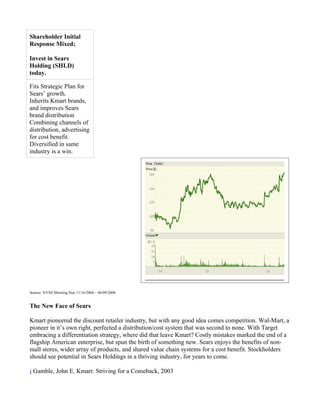
Shareholder Initial
Response Mixed;

Invest in Sears
Holding (SHLD)
today.

Fits Strategic Plan for
Sears’ growth.
Inherits Kmart brands,
and improves Sears
brand distribution
Combining channels of
distribution, advertising
for cost benefit.
Diversified in same
industry is a win.


Source: NYSE/Morning Star 11/16/2004 – 06/09/2006


The New Face of Sears

Kmart pioneered the discount retailer industry, but with any good idea comes competition. Wal-Mart, a
pioneer in it’s own right, perfected a distribution/cost system that was second to none. With Target
embracing a differentiation strategy, where did that leave Kmart? Costly mistakes marked the end of a
flagship American enterprise, but spun the birth of something new. Sears enjoys the benefits of non-
mall stores, wider array of products, and shared value chain systems for a cost benefit. Stockholders
should see potential in Sears Holdings in a thriving industry, for years to come.

i Gamble, John E. Kmart: Striving for a Comeback, 2003
ii Gamble, John E. Kmart: Striving for a Comeback, 2003

iii Gamble, John E. Kmart: Striving for a Comeback, 2003

iv Gamble, John E. Kmart: Striving for a Comeback, 2003

v Gamble, John E. Kmart: Striving for a Comeback, 2003

vi Gamble, John E. Kmart: Striving for a Comeback, 2003

vii Gamble, John E. Kmart: Striving for a Comeback, 2003

viii Gamble, John E. Kmart: Striving for a Comeback, 2003

ix Gamble, John E. Kmart: Striving for a Comeback, 2003

x Press Release: “Kmart Holding Corporation and Sears, Roebuck and Co. Agree to Merge”
11/17/2004

                                                                                         1

Case Study_ K-Mart.doc

  • 1.
    Introduction Kmart was apioneer of the discount retailer industry. At the turn of the century, innovative tactics and strong customer loyalty contributed to unprecedented corporate growth. The playing field changed however, and Kmart had newer rivals to compete with. This report will focus on the attempts to revitalize Kmart, what factors contributed to its bankruptcy, as well as the future for an acquired Kmart. Some Problems Just Don’t Go Away Throughout Kmart’s recent history, it has been plagued by a series of problems. All management teams attempted a variety of strategies to combat these. Listed below is the list of ongoing problems.i Poor inventory management  Too often would popular products be out of stock, while others collected dust on the shelves, and in some cases stored in trailors outside of the stores. Price Competition  Wal-Mart had successfully found a way to offer the lowest price possible on many goods. Poor Customer Service  Too often did consumer reports, secret shops, and industry analysts report of the apathy of Kmart sales staff. Poor Customer Service problems plagued Kmart on a consistent store to store level. “Niche”less  While Walmart reigned supreme as the low cost leader, Target was perceived as being a “higher quality” retailer. Where did this leave Kmart? What was Kmart’s competitive advantage over the two large rivals? The Antonini Era Kmart’s conception began in 1899 with a single five-and-dime store. Over the years, Kmart continued to grow and evolve with the market. Under CEO Joseph Antonini, Kmart changed its basic strategy.ii Strategy prior to 1987 Antonini Strategy (1987-1995) Continue to grow company through Diversify assets into a variety of industries additional store locations, renovating current that were deemed high growth, ripe for stores, and analyze consumer demand to add market entrance, and profitable. additional products and services. Kmart acquired several established businesses in a variety of industries.iii Builder’s Square (1984) Walden Book Company (1984) Payless Drug Stores, Inc (1985) Harold’s Discount Outlets {Canadian} (1985) The Sports Authority (1990) 90% interest in OfficeMax (1991) Borders, Inc (1992) Czech Republic/Slovakian Discount Stores (1992) Bizmart (1992) Joint Venture into Singapore (1994)
  • 2.
    Antonini was ona buying frenzy, continuously expanding Kmart’s portfolio. 3 start-up companies were also initiated, as well as 100 Kmart stores in Mexico. Although international expansion was the backbone for Kmart’s strategy, changes were also made to Kmart in the United States. Listed below are the strategies Antonini put into effect during his tenure, and the outcome of such.iv Strategy Outcome Diversification Failure Purchased a variety of businesses in several Acquisitions all performed poorly posting retail industries including internationally. minimal net income or losses. Distracted management from core business. Renewal Program Mixed Results $3.5 billion program intended to modernize, Super Kmarts sales were 23% higher than expand, or relocate Kmart’s 2,435 stores. traditional stores. Increase sq ft (800K to 100K), and open 500 Fashion strategy was a disappointment. Super Kmarts. Improve quality of private Antonini blamed the failure on market label brands. Logic: Cash Cow Fashion to conditions. subsidize specific hardline products to be Wal-Mart continued to emphasis on being low price leader. the local cost leader, at any cost. Customer’s View of Kmart: dirty, poorly stocked, and rude staff. Many stores did not receive substantial renovations. Modernize Inventory Methods Failure State of the art GTE Spacenet satellite based Although an improvement from the previous network. Implemented Central system, CMAR still did not meet Merchandising Automated Replenishment expectations. Many contribute the vast system (CMAR). Costs of revolutionary amount of inventory, and the high technology = $160 million/annually complexity of the system for it’s failure. New King is Crowned In 1990, Kmart was dethroned as the leader of the discount retailer, by rival Wal-Mart. Sales growth for Kmart from 1980 to 1990 was a mere 7.7%, compared to the skyrocketing Wal-Mart. Shown on the following page is a time line of sales dollars (revenue) per each of the 3 large discount chains.v The Wal-Mart Advantage Near perfection distribution system. Lowest operating costs allowed for being the low cost
  • 3.
    leader. Newcomer advantage Source: Target,Wal-Mart, and Kmart’s Annual Reports (SEC Filings) Hall Steps Up To Bat After a failed corporate strategy by Joseph Antonini, the reins of Kmart were handed over to Floyd Hall. Hall had industry clout due to his success at Target and Grand Union Supermarkets. Hall quickly assembled a new board of top level managers with the intentions of, “…trying to build a team…get a good succession plan and new policies in place.”vi The competitive environment in 1995 did not reflect positively for Kmart, as shown below. Competitive Match-Up in 1995vii Kmart Wal-Mart Customers averaged 15 visits a year Customers averaged 32 visits per year Sales/sq ft = $185 Sales/sq ft = $379 19% loyal customers 46% loyal customers
  • 4.
    With rival Wal-Martdefeating Kmart clearly in every key performance indicator, Hall declared that complete surgery was needed, no band-aid could revive this company. Hall’s strategy can be defined as: Divest noncore activities, drastically improve all core principles, and drive down cost wherever possible. A “use it or loss it” style was put into effect.viii Use It Lose It Overall Asessment Consolidated U.S. and Close 400 stores Positives Canadian Operations Cleared out $700 million of Capitalize on volume buying inventory 1,600 renovated stores power to drive down employee Sold of previous acquisitions Martha Stewart sales = $1 health benefits (ex. OfficeMax & Sports Billion Improve stores, “department Authority, etc) Sales per sq ft rivaled by department” Eliminated some 2nd tier Target Increase private labels brands, and all 3rd tier brands. Dropped Operational Expand Martha Stewart Costs by $500 million Collection Profit (shown in the table Pantry Concept  Redesign below) stores based on consumer convenience. Negatives More District Managers Stock Options for Store Poor Customer Service Managers remained Inventory System bottlenecked and flawed. Poor Competitive Position Source Walmart & Kmart SEC Filings Who’s Next?
  • 5.
    Hall’s dynasty endedin 2000, when Charles Conaway left CVS Corporation to head the sinking ship of Kmart. Conaway elected to attack Kmart’s two rivals head on with an aggressive strategy to revitalize Kmart, and to obtain rival market share. Source: Company Annual Reports (SEC Filings) Rival Strategy – “Kmart: The authority for moms, home, and kids”ix Walmart (Low Cost) Capable? Target Capable? (Differentiation) Blue Light Always Blue Light Always Greater emphasis on Kmart’s private Program  $1.7 didn’t have the private label brands. (vs. brands couldn’t match billion investment to efficiency or cash Mossimo) Mossimo’s be the low cost leader to compete with BlueLight.com (Target quality/style on 50,000 products. Walmart shoppers statically 1% of visitors Play To Win Supply higher income purchased a product. Chain Management Play to Win was a consumers, early internet $55 million poorly failure due to “too adopters) invested much to fast”. The White Flag – 1/22/02 Bankruptcy was inevitable for Kmart due to countless failed strategies over the previous two decades. Conaway’s actions solidified the bankruptcy, although in truth there was little he could do, but hope to delay the inevitable. Bankruptcy Contributors $8.3 billion worth of inventory Blue Light Always Pricing
  • 6.
    Strategy Sales Decline Unpaid vendors Massivedebt Source: SEC Filings 2002 Source: SEC Annual Filings (1999-2001) Kmart Restructuring Strategy 3/2002 – Close 284 stores & eliminate 22,000 jobs Liquidate $758 million of inventory Reduce overhead by $130 million Utilize $2 billion financing “The Stuff of Life” advertising Sell BlueLight.com Develop New Store Layout 1/2003 Close 316 stores & eliminate 25,000 jobs The New Kmart James Adamson was CEO a mere 5 days before Kmart declared bankruptcy. Adamson who has handled a corporate bankruptcy restructuring before, put the following strategy into place.
  • 7.
    Restructuring Recommendations Address housekeeping/poorcustomer service concerns by frequent District Manager visits & Mystery Shoppers Hire Fashion experts to compete with Target on Fashion, including releasing an entirely new private brand line Open additional distribution centers across the nation, and work on a “just in time” inventory approach. DO NOT attempt to be the low cost provider. Compete head to head with Target. “Open Door/Open Books” Policy regarding accounting letters. Consumer Recommendation: Don’t Buy Kmart Wal-Mart continues to grow momentum Very small loyal customer base Accounting violations taint brand image Lack of Positioning Closing stores limits accessibility. Underlying problems of inventory management have yet to find a solution
  • 8.
    Source: SEC Filings1992 through 2002 An Empire is Born On November 17th 2004, the announcement was made that Kmart and Sears Roebuck Company would merge to form the third largest retailer in the nation. Was this a strategically sound decision by Sears?x Industry: I Department Stores n d u s t r y : D e p a r t m e n
  • 9.
    t S t o r e s I n d u s t r y A t t r a c t i v e n e s s F a c t o r Industry Attractiveness Factor Weight Rating Weighted Market Size &Growth M 0.25 9 2.25 a r k e t S
  • 10.
    i z e & G r o w t h I n t e n s i t y o f C o m p e t i t i o n Intensity of Competition 0.15 5 0.75 Strategic Fit 0.1 7 0.7 Resource Requirements R 0.1 3 0.3 e s o u r c e
  • 11.
    R e q u i r e m e n t s E m e r g i n g O p p o r t u n i t i e s / T h r e a t s Emerging Opportunities/ Threats 0.1 7 0.7 Cyclical Threats 0.2 5 1 External Factors 0.5 2 1
  • 12.
    Degree of Risk 0.5 6 3 Sum of Weights 1 I n d u s t r y A t t r a c t i v e n e s s r a t i n g Industry Attractiveness rating 9.7
  • 13.
    Source: SEC Filingsper perspective company Competitive Analysis Indu stry Attr activ eness Industry Fact Attractiveness Factor or Relative Market Share 0.15 8 1.2 Costs relative to Costs 4 0.4 Competitors relati
  • 14.
    ve to Com petit ors 0.1 Match Rivals 0.1 4 0.4 Bargaining Leverage 0.05 3 0.15 Strategic Fit Relationships 0.1 7 0.7 Innovative Capabilities 0.2 5 1 How well matchs KSPs 0.1 4 0.4 Degr ee profit relev ant to Degree profit relevant to rivals rivals 0.2 5 1 Sum of Weights 1 Indus try Attra ctive ness Industry Attractiveness ratin rating g 5.25
  • 15.
    Source: New YorkStock Exchange (www.NYSE.com) 2006 Industry Attractive? Cost to Enter? Better off? Yes, although the K-Mart merger was not Sears shareholders are better department store/discount expensive enough to not do. off acquiring Kmart with retail stores are a mature Value added services advantages in additional market. There is constantly savings and strategic goals stores (non-mall) and innovation in products and being assisted. Merges with economics of scale cost services, and a demand will Kmart helps achieve their savings always remain. strategic vision
  • 16.
    Shareholder Initial Response Mixed; Investin Sears Holding (SHLD) today. Fits Strategic Plan for Sears’ growth. Inherits Kmart brands, and improves Sears brand distribution Combining channels of distribution, advertising for cost benefit. Diversified in same industry is a win. Source: NYSE/Morning Star 11/16/2004 – 06/09/2006 The New Face of Sears Kmart pioneered the discount retailer industry, but with any good idea comes competition. Wal-Mart, a pioneer in it’s own right, perfected a distribution/cost system that was second to none. With Target embracing a differentiation strategy, where did that leave Kmart? Costly mistakes marked the end of a flagship American enterprise, but spun the birth of something new. Sears enjoys the benefits of non- mall stores, wider array of products, and shared value chain systems for a cost benefit. Stockholders should see potential in Sears Holdings in a thriving industry, for years to come. i Gamble, John E. Kmart: Striving for a Comeback, 2003
  • 17.
    ii Gamble, JohnE. Kmart: Striving for a Comeback, 2003 iii Gamble, John E. Kmart: Striving for a Comeback, 2003 iv Gamble, John E. Kmart: Striving for a Comeback, 2003 v Gamble, John E. Kmart: Striving for a Comeback, 2003 vi Gamble, John E. Kmart: Striving for a Comeback, 2003 vii Gamble, John E. Kmart: Striving for a Comeback, 2003 viii Gamble, John E. Kmart: Striving for a Comeback, 2003 ix Gamble, John E. Kmart: Striving for a Comeback, 2003 x Press Release: “Kmart Holding Corporation and Sears, Roebuck and Co. Agree to Merge” 11/17/2004 1